A Presentation by Amanda Shelley, Brandy Hiett & Michael Hiett, and Troy White,  Amanda Shelley Brandy Hiett Michael Hiett Digital Literacy Troy White
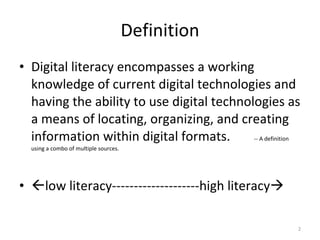
Definition Digital literacy encompasses a working knowledge of current digital technologies and having the ability to use digital technologies as a means of locating, organizing, and creating information within digital formats.  -- A definition using a combo of multiple sources.  low literacy--------------------high literacy 
Description Component of information literacy One can have “user” literacy, but a lack of “research” literacy (another component of information literacy) which lowers overall information literacy.  Therefore, digital literacy does not necessarily = information literacy.
Digital Technology Examples Digital technologies include the Internet, cell phones, PDA’s, computer hardware and software, electronic mail, and other digital devices.  Some level of literacy in most of these technologies have enabled us to participate in this Wimba presentation.
History of Digital Literacy Inseparable from the history of information literacy. Information literacy led to development of digital technologies and subsequent digital literacy.  Hammer Time! (Philosophy 101).  “ By all means, marry. If you get a good wife, you'll become happy; if you get a bad one, you'll become a philosopher.” --Socrates
Historic Quote "We are living through an extraordinary moment in human history. Historians will look back on our times, the 40-year span between 1980 and 2020, and classify it among the handful of historical moments when humans reorganized their entire civilization around a new tool, a new idea. These decades mark the transition from the Industrial Age, an era organized around the motor, to the Digital Age, an era defined by the microprocessor -- the brains within today's personal computer. The mid-1990s, perhaps even 1995, may come to be viewed as the defining moment when society recognized the enormity of the changes taking place and began to reorient itself. " Source : Peter Leyden, " The Historic Moment ," in " On the Edge of the Digital Age ," Minneapolis-St. Paul Star Tribune, 1995
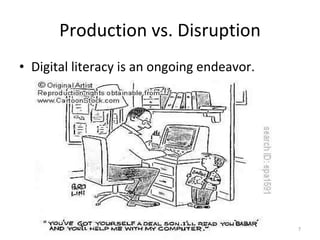
Production vs. Disruption Digital literacy is an ongoing endeavor.
History in the Making As people become more digitally literate we are increasingly becoming digital citizens in a digital society.  More and more, digital literacy is being equated with economic security as workplaces are becoming dependent on digital technologies.  As this trend continues and digital literacy among individuals increases, I believe we will hear the term “digital identity” more and more.
“ According to a recent report from the Workforce Commission’s National Alliance of Business, “The current and future health of America’s 21st century economy depends directly on how broadly and deeply Americans reach a new level of literacy—‘21st Century Literacy.’” http://www.educause.edu/EDUCAUSE+Quarterly/EDUCAUSEQuarterlyMagazineVolum/ConnectingtheDigitalDotsLitera/157395 Why is Digital Literacy Important?
Students today are growing up with technology! They are being led by adults who have not. Therefore, it is very important for teachers to not only know about technology but to understand how to instruct with technology to the E-Generation! Why is Digital Literacy Important for Teachers?
It is important for students to now only learn how to utilize media, but also how to process and understand the sources they are using. Teachers must be understand digital literacy so that they can educate students on what defines reliable sources and to not absorb and believe all that is on the internet is fact.  Why is Digital Literacy Important for Teachers II
Funding is not the biggest challenge! Technical learning objectives may not have been defined. Integration of digital literacy into lesson plans may not have happened. Why… Challenges
Professional development plans may be limited. Teachers are having to become educated on their own time! Why… More Challenges
Develop a vision and goals to make Digital Literacy a priority. Create incentives for teachers to pursue knowledge on how to incorporate digital literacy. Develop more Professional Development opportunities for Digital Literacy. Why.. What schools can do
Teacher initiative towards digital literacy
Federal and State Mandates The U.S. Department of Education ELEMENTARY & SECONDARY EDUCATION Part D — Enhancing Education Through Technology SEC. 2401, SEC. 2402, SEC. 2403, SEC. 2404 http://www2.ed.gov/policy/elsec/leg/esea02/pg34.html Georgia Technology Standards for Educators http://www.gapsc.com/EducatorPreparation/Documents/TechStandards.pdf
The U.S. Department of Education The primary goal of this legislation is to improve student academic achievement through the use of technology in elementary schools and secondary schools. The other goals are: (A) To assist every student in crossing the digital divide by ensuring that every student is technologically literate by the time the student finishes the eighth grade, regardless of the student's race, ethnicity, gender, family income, geographic location, or disability. (B) To encourage the effective integration of technology resources and systems with teacher training and curriculum development to establish research-based instructional methods that can be widely implemented as best practices by State educational agencies and local educational agencies.
Georgia Technology Standards for Educators The Georgia Professional Standards Commission adopted their technology standards from the ISTE National Educational Technology Standards (NETS•T) and Performance Indicators for Teachers: 1. Facilitate and Inspire Student Learning and Creativity 2. Design and Develop Digital-Age Learning Experiences and Assessments 3. Model Digital-Age Work and Learning 4. Promote and Model Digital Citizenship and Responsibility 5. Engage in Professional Growth and Leadership
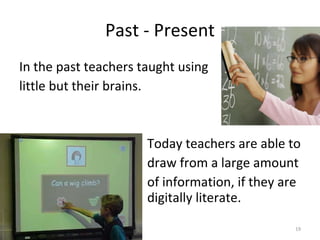
Past - Present In the past teachers taught using little but their brains. Today teachers are able to draw from a large amount  of information, if they are  digitally literate.
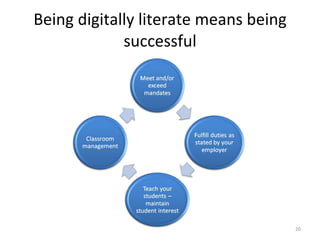
Being digitally literate means being successful
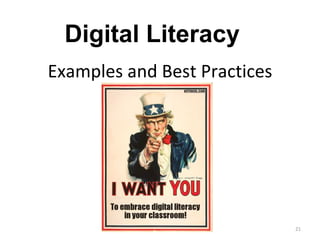
Examples and Best Practices Digital Literacy
Einstein
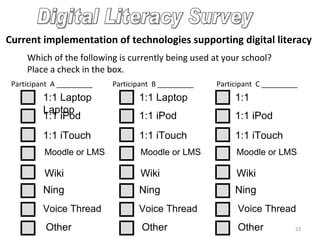
Survey Digital Literacy Survey Participant  A _________   Current implementation of technologies supporting digital literacy 1:1 Laptop 1:1 Laptop 1:1 Laptop 1:1 iPod 1:1 iPod  1:1 iPod 1:1 iTouch 1:1 iTouch 1:1 iTouch Moodle or LMS  Moodle or LMS  Moodle or LMS Participant  B _________   Participant  C _________   Wiki    Wiki  Wiki Ning Ning  Ning Voice Thread  Voice Thread  Voice Thread Other Other Other Which of the following is currently being used at your school? Place a check in the box.
Accessibility I The National Broadband Plan  – FCC plans to have 90% of American households equipped with internet access by 2010. FCC compares not having access as a form of handicap.  NGO’s and Corporate Sponsorship –  many non-governmental organizations and corporations support digital literacy via grants and   services. - Microsoft  -  “Since the Community Technology Skills Program began in 2003, Microsoft has provided more than US$350 million in cash and software grants to more than 1,000 community partners”.  - Dell/Harvard  – DigiLit- an OLPC program workign in Boston, Nicaragua, and Mali.  ACCESSIBILITY-
Accessibility II 1:1 – One to one technology programs-  Help promote digital literacy by ensuring that each learner has his/her own personal technology.  Laptop Programs - OLPC  One Laptop Per Child –  provides impoverished children with a special rugged laptop, the XO iPods, iTouch (iPad)-   ACCESSIBILITY-  http://1to1inpractice.blogspot.com/  Jane Ross is an Apple Distinguished Educator. Her site is dedicated to her implementing  1:1 practices with iTouch and Mac laptops.
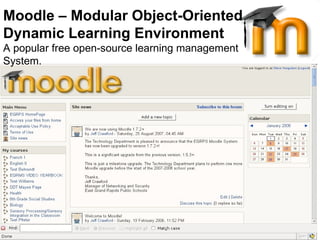
Moodle I Moodle – Modular Object-Oriented  Dynamic Learning Environment   A popular free open-source learning management System.
Moodle II Moodle – Modular Object-Oriented  Dynamic Learning Environment   Moodle is used  by over 32 million people.  It has replaced similar software such a WebCT at a number of universities.  Moodle allows for: enrollment-attendance Discussion forums Assessments  Rss
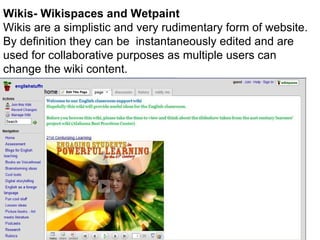
Wiki Wikis- Wikispaces and Wetpaint Wikis are a simplistic and very rudimentary form of website. By definition they can be  instantaneously edited and are used for collaborative purposes as multiple users can change the wiki content.
Wiki II Wikis- Wikispaces and Wetpaint  Wikis allow for: Presentation of content via the web.  Embedding of video, audio (audio players), images, and countless widgets Presentation of student work via the web Discussion forums
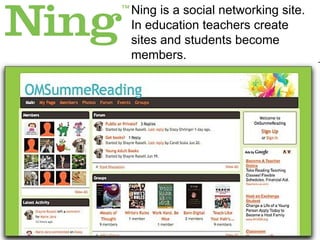
Ning I Ning is a social networking site. In education teachers create sites and students become members.
Ning 2 Ning Allows for:  Presentation of content via the web.  Discussion forums Live chat Private messages between students and teacher Embedding of video, audio (audio players), images, and countless widgets
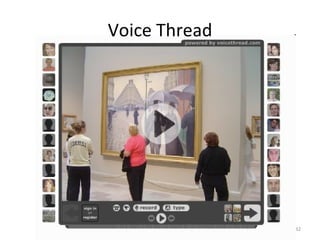
Voice Thread
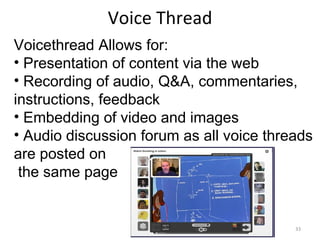
Voice Thread Voicethread Allows for:  Presentation of content via the web Recording of audio, Q&A, commentaries, instructions, feedback Embedding of video and images Audio discussion forum as all voice threads are posted on  the same page
Digital Literacy   Examples and Best Practices Videos Moodle -  http:// www.youtube.com/watch?v =_o1fMQsfzoQ   Wiki -  http:// www.youtube.com/watch?v =av2yofWSdU0&NR=1   Voice Thread-  http:// www.youtube.com/watch?v =3oNwOkctpOs&NR=1   Links Moodle -  http://moodle.com/   Wikispaces-   http://www.wikispaces.com   Wetpaint-   http://www.wetpaint.com/   Ning-   http://ning.com/   Voice Thread-   http://voicethread.com/#home

VSU OLA Project

  • 1.
    A Presentation byAmanda Shelley, Brandy Hiett & Michael Hiett, and Troy White, Amanda Shelley Brandy Hiett Michael Hiett Digital Literacy Troy White
  • 2.
    Definition Digital literacyencompasses a working knowledge of current digital technologies and having the ability to use digital technologies as a means of locating, organizing, and creating information within digital formats. -- A definition using a combo of multiple sources.  low literacy--------------------high literacy 
  • 3.
    Description Component ofinformation literacy One can have “user” literacy, but a lack of “research” literacy (another component of information literacy) which lowers overall information literacy. Therefore, digital literacy does not necessarily = information literacy.
  • 4.
    Digital Technology ExamplesDigital technologies include the Internet, cell phones, PDA’s, computer hardware and software, electronic mail, and other digital devices. Some level of literacy in most of these technologies have enabled us to participate in this Wimba presentation.
  • 5.
    History of DigitalLiteracy Inseparable from the history of information literacy. Information literacy led to development of digital technologies and subsequent digital literacy. Hammer Time! (Philosophy 101). “ By all means, marry. If you get a good wife, you'll become happy; if you get a bad one, you'll become a philosopher.” --Socrates
  • 6.
    Historic Quote "Weare living through an extraordinary moment in human history. Historians will look back on our times, the 40-year span between 1980 and 2020, and classify it among the handful of historical moments when humans reorganized their entire civilization around a new tool, a new idea. These decades mark the transition from the Industrial Age, an era organized around the motor, to the Digital Age, an era defined by the microprocessor -- the brains within today's personal computer. The mid-1990s, perhaps even 1995, may come to be viewed as the defining moment when society recognized the enormity of the changes taking place and began to reorient itself. " Source : Peter Leyden, " The Historic Moment ," in " On the Edge of the Digital Age ," Minneapolis-St. Paul Star Tribune, 1995
  • 7.
    Production vs. DisruptionDigital literacy is an ongoing endeavor.
  • 8.
    History in theMaking As people become more digitally literate we are increasingly becoming digital citizens in a digital society. More and more, digital literacy is being equated with economic security as workplaces are becoming dependent on digital technologies. As this trend continues and digital literacy among individuals increases, I believe we will hear the term “digital identity” more and more.
  • 9.
    “ According toa recent report from the Workforce Commission’s National Alliance of Business, “The current and future health of America’s 21st century economy depends directly on how broadly and deeply Americans reach a new level of literacy—‘21st Century Literacy.’” http://www.educause.edu/EDUCAUSE+Quarterly/EDUCAUSEQuarterlyMagazineVolum/ConnectingtheDigitalDotsLitera/157395 Why is Digital Literacy Important?
  • 10.
    Students today aregrowing up with technology! They are being led by adults who have not. Therefore, it is very important for teachers to not only know about technology but to understand how to instruct with technology to the E-Generation! Why is Digital Literacy Important for Teachers?
  • 11.
    It is importantfor students to now only learn how to utilize media, but also how to process and understand the sources they are using. Teachers must be understand digital literacy so that they can educate students on what defines reliable sources and to not absorb and believe all that is on the internet is fact. Why is Digital Literacy Important for Teachers II
  • 12.
    Funding is notthe biggest challenge! Technical learning objectives may not have been defined. Integration of digital literacy into lesson plans may not have happened. Why… Challenges
  • 13.
    Professional development plansmay be limited. Teachers are having to become educated on their own time! Why… More Challenges
  • 14.
    Develop a visionand goals to make Digital Literacy a priority. Create incentives for teachers to pursue knowledge on how to incorporate digital literacy. Develop more Professional Development opportunities for Digital Literacy. Why.. What schools can do
  • 15.
  • 16.
    Federal and StateMandates The U.S. Department of Education ELEMENTARY & SECONDARY EDUCATION Part D — Enhancing Education Through Technology SEC. 2401, SEC. 2402, SEC. 2403, SEC. 2404 http://www2.ed.gov/policy/elsec/leg/esea02/pg34.html Georgia Technology Standards for Educators http://www.gapsc.com/EducatorPreparation/Documents/TechStandards.pdf
  • 17.
    The U.S. Departmentof Education The primary goal of this legislation is to improve student academic achievement through the use of technology in elementary schools and secondary schools. The other goals are: (A) To assist every student in crossing the digital divide by ensuring that every student is technologically literate by the time the student finishes the eighth grade, regardless of the student's race, ethnicity, gender, family income, geographic location, or disability. (B) To encourage the effective integration of technology resources and systems with teacher training and curriculum development to establish research-based instructional methods that can be widely implemented as best practices by State educational agencies and local educational agencies.
  • 18.
    Georgia Technology Standardsfor Educators The Georgia Professional Standards Commission adopted their technology standards from the ISTE National Educational Technology Standards (NETS•T) and Performance Indicators for Teachers: 1. Facilitate and Inspire Student Learning and Creativity 2. Design and Develop Digital-Age Learning Experiences and Assessments 3. Model Digital-Age Work and Learning 4. Promote and Model Digital Citizenship and Responsibility 5. Engage in Professional Growth and Leadership
  • 19.
    Past - PresentIn the past teachers taught using little but their brains. Today teachers are able to draw from a large amount of information, if they are digitally literate.
  • 20.
    Being digitally literatemeans being successful
  • 21.
    Examples and BestPractices Digital Literacy
  • 22.
  • 23.
    Survey Digital LiteracySurvey Participant A _________ Current implementation of technologies supporting digital literacy 1:1 Laptop 1:1 Laptop 1:1 Laptop 1:1 iPod 1:1 iPod 1:1 iPod 1:1 iTouch 1:1 iTouch 1:1 iTouch Moodle or LMS Moodle or LMS Moodle or LMS Participant B _________ Participant C _________ Wiki Wiki Wiki Ning Ning Ning Voice Thread Voice Thread Voice Thread Other Other Other Which of the following is currently being used at your school? Place a check in the box.
  • 24.
    Accessibility I TheNational Broadband Plan – FCC plans to have 90% of American households equipped with internet access by 2010. FCC compares not having access as a form of handicap. NGO’s and Corporate Sponsorship – many non-governmental organizations and corporations support digital literacy via grants and services. - Microsoft - “Since the Community Technology Skills Program began in 2003, Microsoft has provided more than US$350 million in cash and software grants to more than 1,000 community partners”. - Dell/Harvard – DigiLit- an OLPC program workign in Boston, Nicaragua, and Mali. ACCESSIBILITY-
  • 25.
    Accessibility II 1:1– One to one technology programs- Help promote digital literacy by ensuring that each learner has his/her own personal technology. Laptop Programs - OLPC One Laptop Per Child – provides impoverished children with a special rugged laptop, the XO iPods, iTouch (iPad)- ACCESSIBILITY- http://1to1inpractice.blogspot.com/ Jane Ross is an Apple Distinguished Educator. Her site is dedicated to her implementing 1:1 practices with iTouch and Mac laptops.
  • 26.
    Moodle I Moodle– Modular Object-Oriented Dynamic Learning Environment A popular free open-source learning management System.
  • 27.
    Moodle II Moodle– Modular Object-Oriented Dynamic Learning Environment Moodle is used by over 32 million people. It has replaced similar software such a WebCT at a number of universities. Moodle allows for: enrollment-attendance Discussion forums Assessments Rss
  • 28.
    Wiki Wikis- Wikispacesand Wetpaint Wikis are a simplistic and very rudimentary form of website. By definition they can be instantaneously edited and are used for collaborative purposes as multiple users can change the wiki content.
  • 29.
    Wiki II Wikis-Wikispaces and Wetpaint Wikis allow for: Presentation of content via the web. Embedding of video, audio (audio players), images, and countless widgets Presentation of student work via the web Discussion forums
  • 30.
    Ning I Ningis a social networking site. In education teachers create sites and students become members.
  • 31.
    Ning 2 NingAllows for: Presentation of content via the web. Discussion forums Live chat Private messages between students and teacher Embedding of video, audio (audio players), images, and countless widgets
  • 32.
  • 33.
    Voice Thread VoicethreadAllows for: Presentation of content via the web Recording of audio, Q&A, commentaries, instructions, feedback Embedding of video and images Audio discussion forum as all voice threads are posted on the same page
  • 34.
    Digital Literacy Examples and Best Practices Videos Moodle - http:// www.youtube.com/watch?v =_o1fMQsfzoQ Wiki - http:// www.youtube.com/watch?v =av2yofWSdU0&NR=1 Voice Thread- http:// www.youtube.com/watch?v =3oNwOkctpOs&NR=1 Links Moodle - http://moodle.com/ Wikispaces- http://www.wikispaces.com Wetpaint- http://www.wetpaint.com/ Ning- http://ning.com/ Voice Thread- http://voicethread.com/#home