
ST
21

CENTURY LEARNING

Personalization, Mastery, and Blended Learning
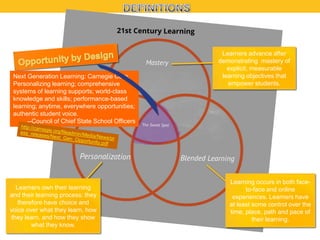
Next Generation Learning: Carnegie Corp.
Personalizing learning; comprehensive
systems of learning supports; world-class
knowledge and skills; performance-based
learning; anytime, everywhere opportunities;
authentic student voice.
--Council of Chief State School Officers

Learners own their learning
and their learning process: they
therefore have choice and
voice over what they learn, how
they learn, and how they show
what they know.

Learners advance after
demonstrating mastery of
explicit, measurable
learning objectives that
empower students.

Learning occurs in both faceto-face and online
experiences. Learners have
at least some control over the
time, place, path and pace of
their learning.
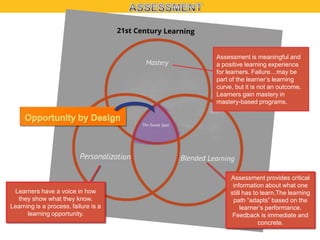
Assessment is meaningful and
a positive learning experience
for learners. Failure…may be
part of the learner’s learning
curve, but it is not an outcome.
Learners gain mastery in
mastery-based programs.

Learners have a voice in how
they show what they know.
Learning is a process, failure is a
learning opportunity.

Assessment provides critical
information about what one
still has to learn.The learning
path ―adapts‖ based on the
learner’s performance.
Feedback is immediate and
concrete.
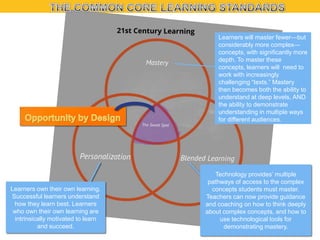
Learners will master fewer—but
considerably more complex—
concepts, with significantly more
depth. To master these
concepts, learners will need to
work with increasingly
challenging ―texts.‖ Mastery
then becomes both the ability to
understand at deep levels, AND
the ability to demonstrate
understanding in multiple ways
for different audiences.

Learners own their own learning.
Successful learners understand
how they learn best. Learners
who own their own learning are
intrinsically motivated to learn
and succeed.

Technology provides’ multiple
pathways of access to the complex
concepts students must master.
Teachers can now provide guidance
and coaching on how to think deeply
about complex concepts, and how to
use technological tools for
demonstrating mastery.
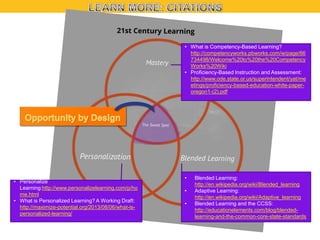
• What is Competency-Based Learning?
http://competencyworks.pbworks.com/w/page/66
734498/Welcome%20to%20the%20Competency
Works%20Wiki
• Proficiency-Based Instruction and Assessment:
http://www.ode.state.or.us/superintendent/yat/me
etings/proficiency-based-education-white-paperoregon1-(2).pdf

• Personalize
Learning:http://www.personalizelearning.com/p/ho
me.html
• What is Personalized Learning? A Working Draft:
http://maximize-potential.org/2013/08/06/what-ispersonalized-learning/

•
•
•

Blended Learning:
http://en.wikipedia.org/wiki/Blended_learning
Adaptive Learning:
http://en.wikipedia.org/wiki/Adaptive_learning
Blended Learning and the CCSS:
http://educationelements.com/blog/blendedlearning-and-the-common-core-state-standards
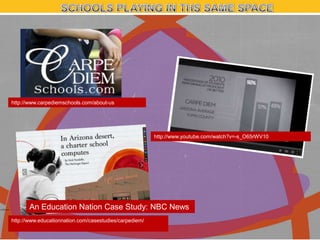
http://www.carpediemschools.com/about-us

http://www.youtube.com/watch?v=-s_O65rWV10

An Education Nation Case Study: NBC News
http://www.educationnation.com/casestudies/carpediem/
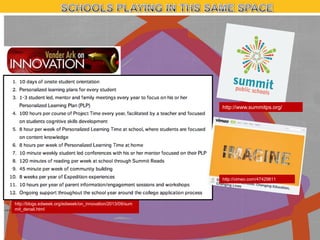
http://www.summitps.org/

http://vimeo.com/47429811

http://blogs.edweek.org/edweek/on_innovation/2013/09/sum
mit_denali.html
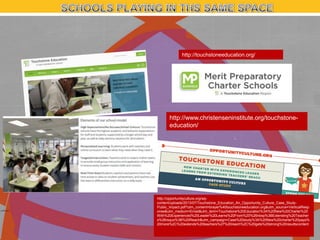
http://touchstoneeducation.org/

http://www.christenseninstitute.org/touchstoneeducation/

http://opportunityculture.org/wpcontent/uploads/2013/07/Touchstone_Education_An_Opportunity_Culture_Case_StudyPublic_Impact.pdf?utm_content=brayer%40touchstoneeducation.org&utm_source=VerticalResp
onse&utm_medium=Email&utm_term=Touchstone%20Education%3A%20New%20Charter%20
With%20Experienced%20Leader%20Learns%20From%20%26nbsp%3BExtending%20Teacher
s%26rsquo%3B%20Reach&utm_campaign=Case%20study%3A%20New%20charter%20pays%
20more%2C%20extends%20teachers%27%20reach%2C%20gets%20strong%20resultscontent
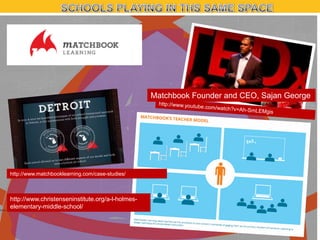
Matchbook Founder and CEO, Sajan George

http://www.matchbooklearning.com/case-studies/

http://www.christenseninstitute.org/a-l-holmeselementary-middle-school/
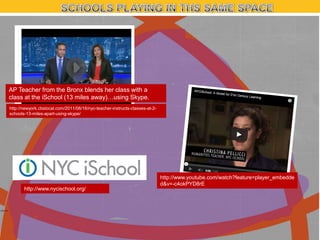
AP Teacher from the Bronx blends her class with a
class at the iSchool (13 miles away)…using Skype.
http://newyork.cbslocal.com/2011/06/16/nyc-teacher-instructs-classes-at-2schools-13-miles-apart-using-skype/

http://www.nycischool.org/

http://www.youtube.com/watch?feature=player_embedde
d&v=-c4okPYD8rE
http://www.bacademy.org/

https://sites.google.com/site/competencybasedpathways/home/innovati
ve-examples/school-models/boston-day-and-evening-academy
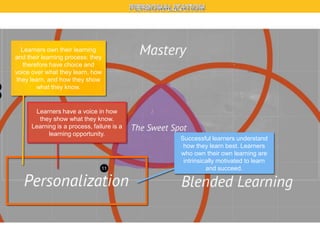
Learners own their learning
and their learning process: they
therefore have choice and
voice over what they learn, how
they learn, and how they show
what they know.

Learners have a voice in how
they show what they know.
Learning is a process, failure is a
learning opportunity.

Successful learners understand
how they learn best. Learners
who own their own learning are
intrinsically motivated to learn
and succeed.
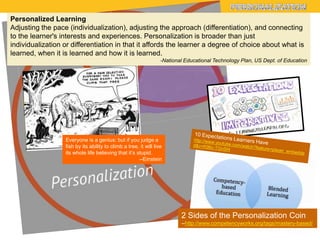
Personalized Learning
Adjusting the pace (individualization), adjusting the approach (differentiation), and connecting
to the learner's interests and experiences. Personalization is broader than just
individualization or differentiation in that it affords the learner a degree of choice about what is
learned, when it is learned and how it is learned.
-National Educational Technology Plan, US Dept. of Education

Everyone is a genius: but if you judge a
fish by its ability to climb a tree, it will live
its whole life believing that it’s stupid.
--Einstein

2 Sides of the Personalization Coin
--http://www.competencyworks.org/tags/mastery-based/
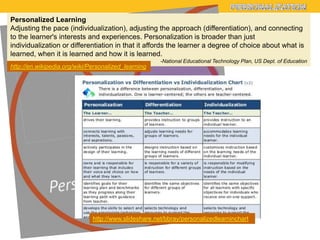
Personalized Learning
Adjusting the pace (individualization), adjusting the approach (differentiation), and connecting
to the learner's interests and experiences. Personalization is broader than just
individualization or differentiation in that it affords the learner a degree of choice about what is
learned, when it is learned and how it is learned.
http://en.wikipedia.org/wiki/Personalized_learning

-National Educational Technology Plan, US Dept. of Education

http://www.slideshare.net/bbray/personalizedlearninchart
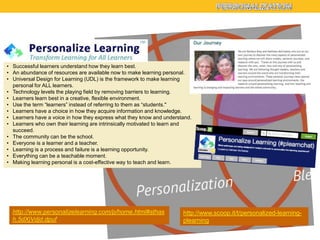
• Successful learners understand how they learn best.
• An abundance of resources are available now to make learning personal.
• Universal Design for Learning (UDL) is the framework to make learning
personal for ALL learners.
• Technology levels the playing field by removing barriers to learning.
• Learners learn best in a creative, flexible environment.
• Use the term ―learners‖ instead of referring to them as ―students."
• Learners have a choice in how they acquire information and knowledge.
• Learners have a voice in how they express what they know and understand.
• Learners who own their learning are intrinsically motivated to learn and
succeed.
• The community can be the school.
• Everyone is a learner and a teacher.
• Learning is a process and failure is a learning opportunity.
• Everything can be a teachable moment.
• Making learning personal is a cost-effective way to teach and learn.

http://www.personalizelearning.com/p/home.html#sthas
h.5dXjVdjd.dpuf

http://www.scoop.it/t/personalized-learningplearning
What is Personalized Learning? A working draft.
In a Personalized Learning environment, students’ learning experiences
– what they learn, and how, when, and where they learn it – are tailored
to their individual developmental needs, skills, and interests. Although
where, how, and when they learn might vary according to their needs,
students also develop deep connections to each other and their teachers
and other adults.
Furthermore, each of the following are essential attributes of a
personalized learning model:
• Learner Profiles: Captures individual skills, gaps, strengths,
weaknesses, interests & aspirations of each student.
• Personal Learning Paths: Each student has learning goals &
objectives. Learning experiences are diverse and matched to the
individual needs of students.
• Individual Mastery: Continually assesses student progress against
clearly defined standards & goals. Students advance based on
demonstrated mastery.
• Flexible Learning Environment: Multiple instructional delivery
approaches that continuously optimize available resources in support
of student learning.
--Scott Benson
Next Generation Learning Models, Gates Foundation

http://maximize-potential.org/2013/08/06/what-ispersonalized-learning/
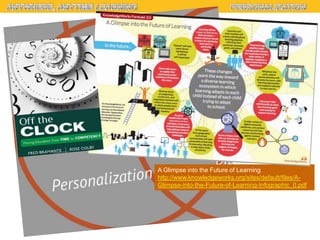
A Glimpse into the Future of Learning
http://www.knowledgeworks.org/sites/default/files/AGlimpse-into-the-Future-of-Learning-Infographic_0.pdf
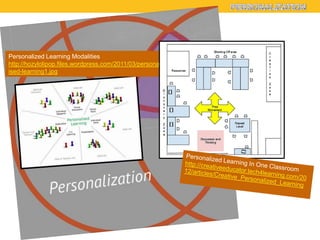
Personalized Learning Modalities
http://hozylolipop.files.wordpress.com/2011/03/personal
ised-learning1.jpg
xxx
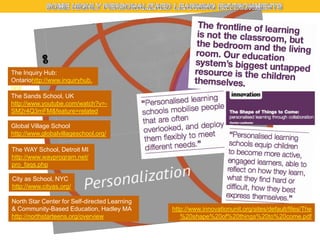
The Inquiry Hub:
Ontariohttp://www.inquiryhub.
org/
The Sands School, UK
http://www.youtube.com/watch?v=SM2r4Q3mFM&feature=related
Global Village School
http://www.globalvillageschool.org/
The WAY School, Detroit MI
http://www.wayprogram.net/
pro_faqs.php

City as School, NYC
http://www.cityas.org/
North Star Center for Self-directed Learning
& Community-Based Education, Hadley MA
http://northstarteens.org/overview

http://www.innovationunit.org/sites/default/files/The
%20shape%20of%20things%20to%20come.pdf
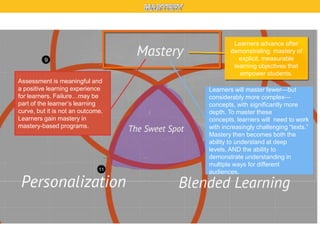
Learners advance after
demonstrating mastery of
explicit, measurable
learning objectives that
empower students.
Assessment is meaningful and
a positive learning experience
for learners. Failure…may be
part of the learner’s learning
curve, but it is not an outcome.
Learners gain mastery in
mastery-based programs.

Learners will master fewer—but
considerably more complex—
concepts, with significantly more
depth. To master these
concepts, learners will need to work
with increasingly challenging ―texts.‖
Mastery then becomes both the
ability to understand at deep
levels, AND the ability to
demonstrate understanding in
multiple ways for different
audiences.
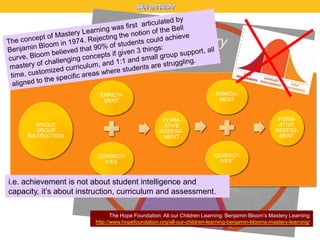
ENRICHMENT

ENRICHMENT

FORMATIVE
ASSESSMENT

FORMATIVE
ASSESSMENT

WHOLE
GROUP
INSTRUCTION

―

CORRECTIVES‖

―CORRECTIVES‖

i.e. achievement is not about student intelligence and
capacity, it’s about instruction, curriculum and assessment.
The Hope Foundation: All our Children Learning: Benjamin Bloom’s Mastery Learning
http://www.hopefoundation.org/all-our-children-learning-benjamin-blooms-mastery-learning/
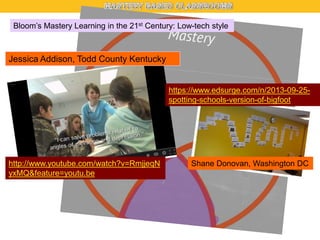
Bloom’s Mastery Learning in the 21st Century: Low-tech style

Jessica Addison, Todd County Kentucky

https://www.edsurge.com/n/2013-09-25spotting-schools-version-of-bigfoot

http://www.youtube.com/watch?v=RmjjeqN
yxMQ&feature=youtu.be

Shane Donovan, Washington DC
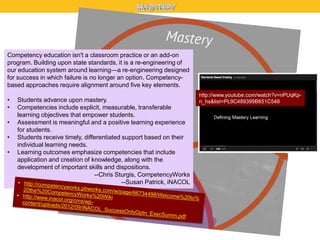
Competency education isn't a classroom practice or an add-on
program. Building upon state standards, it is a re-engineering of
our education system around learning—a re-engineering designed
for success in which failure is no longer an option. Competencybased approaches require alignment around five key elements.
•
•
•
•
•

Students advance upon mastery.
Competencies include explicit, measurable, transferable
learning objectives that empower students.
Assessment is meaningful and a positive learning experience
for students.
Students receive timely, differentiated support based on their
individual learning needs.
Learning outcomes emphasize competencies that include
application and creation of knowledge, along with the
development of important skills and dispositions.
--Chris Sturgis, CompetencyWorks
--Susan Patrick, iNACOL

http://www.youtube.com/watch?v=nPUqKpn_hs&list=PL9C489399B851C548
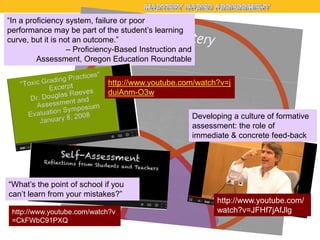
―In a proficiency system, failure or poor
performance may be part of the student’s learning
curve, but it is not an outcome.‖
– Proficiency-Based Instruction and
Assessment, Oregon Education Roundtable
http://www.youtube.com/watch?v=j
duiAnm-O3w
Developing a culture of formative
assessment: the role of
immediate & concrete feed-back

―What’s the point of school if you
can’t learn from your mistakes?‖
http://www.youtube.com/watch?v
=CkFWbC91PXQ

http://www.youtube.com/
watch?v=JFHf7jAfJlg
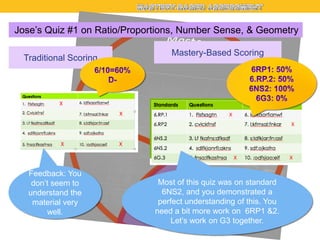
Jose’s Quiz #1 on Ratio/Proportions, Number Sense, & Geometry
Traditional Scoring

Feedback: You
don’t seem to
understand the
material very
well.

Mastery-Based Scoring

Most of this quiz was on standard
6NS2, and you demonstrated a
perfect understanding of this. You
need a bit more work on 6RP1 &2.
Let’s work on G3 together.
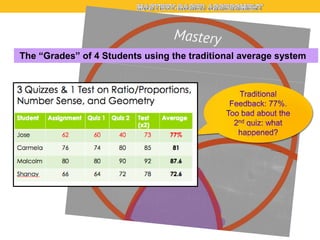
The “Grades” of 4 Students using the traditional average system
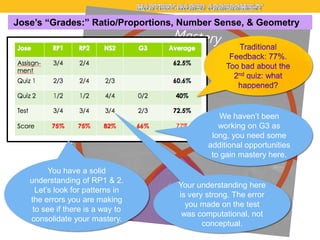
Jose’s “Grades:” Ratio/Proportions, Number Sense, & Geometry

We haven’t been
working on G3 as
long, you need some
additional opportunities
to gain mastery here.
You have a solid
understanding of RP1 & 2.
Let’s look for patterns in
the errors you are making
to see if there is a way to
consolidate your mastery.

Your understanding here
is very strong. The error
you made on the test
was computational, not
conceptual.
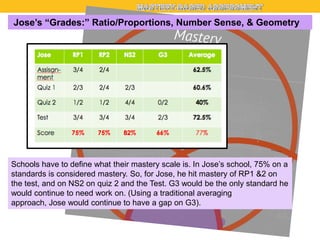
Jose’s “Grades:” Ratio/Proportions, Number Sense, & Geometry

Schools have to define what their mastery scale is. In Jose’s school, 75% on a
standards is considered mastery. So, for Jose, he hit mastery of RP1 &2 on
the test, and on NS2 on quiz 2 and the Test. G3 would be the only standard he
would continue to need work on. (Using a traditional averaging
approach, Jose would continue to have a gap on G3).
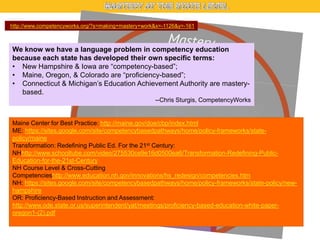
http://www.competencyworks.org/?s=making+mastery+work&x=-1126&y=-161

We know we have a language problem in competency education
because each state has developed their own specific terms:
• New Hampshire & Iowa are ―competency-based‖;
• Maine, Oregon, & Colorado are ―proficiency-based‖;
• Connecticut & Michigan’s Education Achievement Authority are masterybased.
--Chris Sturgis, CompetencyWorks

Maine Center for Best Practice: http://maine.gov/doe/cbp/index.html
ME: https://sites.google.com/site/competencybasedpathways/home/policy-frameworks/statepolicy/maine
Transformation: Redefining Public Ed. For the 21st Century:
NHhttp://www.schooltube.com/video/275530ce9e16d0500ea6/Transformation-Redefining-PublicEducation-for-the-21st-Century
NH Course Level & Cross-Cutting
Competencieshttp://www.education.nh.gov/innovations/hs_redesign/competencies.htm
NH: https://sites.google.com/site/competencybasedpathways/home/policy-frameworks/state-policy/newhampshire
OR: Proficiency-Based Instruction and Assessment:
http://www.ode.state.or.us/superintendent/yat/meetings/proficiency-based-education-white-paperoregon1-(2).pdf
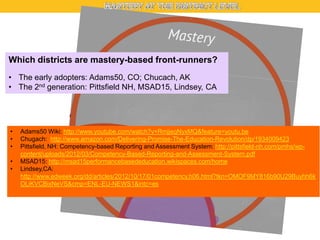
Which districts are mastery-based front-runners?
• The early adopters: Adams50, CO; Chucach, AK
• The 2nd generation: Pittsfield NH, MSAD15, Lindsey, CA

•
•
•
•
•

Adams50 Wiki: http://www.youtube.com/watch?v=RmjjeqNyxMQ&feature=youtu.be
Chugach: http://www.amazon.com/Delivering-Promise-The-Education-Revolution/dp/1934009423
Pittsfield, NH: Competency-based Reporting and Assessment System: http://pittsfield-nh.com/pmhs/wpcontent/uploads/2012/03/Competency-Based-Reporting-and-Assessment-System.pdf
MSAD15: http://msad15performancebasededucation.wikispaces.com/home
Lindsey,CA:
http://www.edweek.org/dd/articles/2012/10/17/01competency.h06.html?tkn=OMOF9MY816b90U29Buyhh6k
OLiKVCBixNeVS&cmp=ENL-EU-NEWS1&intc=es
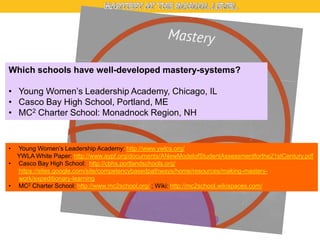
Which schools have well-developed mastery-systems?
• Young Women’s Leadership Academy, Chicago, IL
• Casco Bay High School, Portland, ME
• MC2 Charter School: Monadnock Region, NH

•
•
•

Young Women’s Leadership Academy: http://www.ywlcs.org/
YWLA White Paper: http://www.aypf.org/documents/ANewModelofStudentAssessmentforthe21stCentury.pdf
Casco Bay High School: http://cbhs.portlandschools.org/
https://sites.google.com/site/competencybasedpathways/home/resources/making-masterywork/expeditionary-learning
MC2 Charter School: http://www.mc2school.org/ ; Wiki: http://mc2school.wikispaces.com/
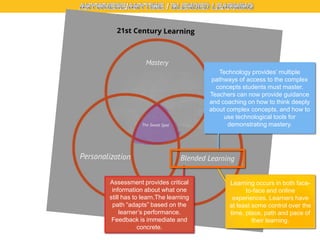
Technology provides’ multiple
pathways of access to the complex
concepts students must master.
Teachers can now provide guidance
and coaching on how to think deeply
about complex concepts, and how to
use technological tools for
demonstrating mastery.

Assessment provides critical
information about what one
still has to learn.The learning
path ―adapts‖ based on the
learner’s performance.
Feedback is immediate and
concrete.

Learning occurs in both faceto-face and online
experiences. Learners have
at least some control over the
time, place, path and pace of
their learning.
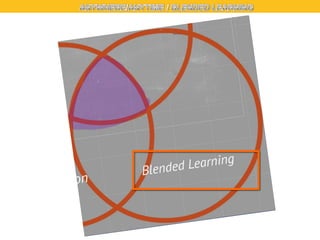
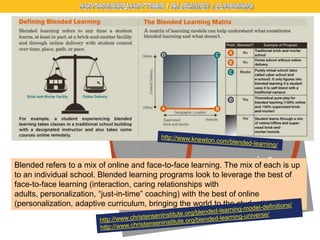
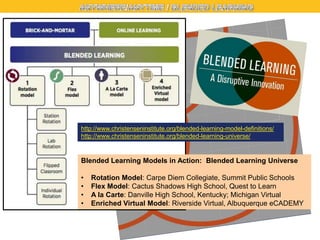
Blended refers to a mix of online and face-to-face learning. The mix of each is up
to an individual school. Blended learning programs look to leverage the best of
face-to-face learning (interaction, caring relationships with
adults, personalization, ―just-in-time‖ coaching) with the best of online
(personalization, adaptive curriculum, bringing the world to the student).
http://www.christenseninstitute.org/blended-learning-model-definitions/
http://www.christenseninstitute.org/blended-learning-universe/

Blended Learning Models in Action: Blended Learning Universe
•
•
•
•

Rotation Model: Carpe Diem Collegiate, Summit Public Schools
Flex Model: Cactus Shadows High School, Quest to Learn
A la Carte: Danville High School, Kentucky; Michigan Virtual
Enriched Virtual Model: Riverside Virtual, Albuquerque eCADEMY
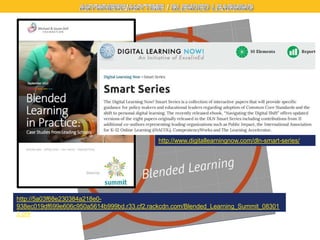
http://www.digitallearningnow.com/dln-smart-series/

http://5a03f68e230384a218e0938ec019df699e606c950a5614b999bd.r33.cf2.rackcdn.com/Blended_Learning_Summit_08301
2.pdf
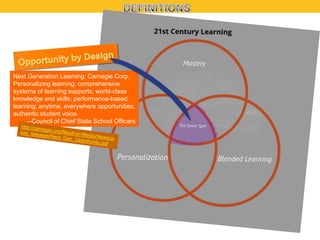
Next Generation Learning: Carnegie Corp.
Personalizing learning; comprehensive
systems of learning supports; world-class
knowledge and skills; performance-based
learning; anytime, everywhere opportunities;
authentic student voice.
--Council of Chief State School Officers
Antonia Rudenstine
antonia@redesignu.org
781.367.6457
http://www.redesignu.org

21st century learning

  • 1.
  • 2.
    Next Generation Learning:Carnegie Corp. Personalizing learning; comprehensive systems of learning supports; world-class knowledge and skills; performance-based learning; anytime, everywhere opportunities; authentic student voice. --Council of Chief State School Officers Learners own their learning and their learning process: they therefore have choice and voice over what they learn, how they learn, and how they show what they know. Learners advance after demonstrating mastery of explicit, measurable learning objectives that empower students. Learning occurs in both faceto-face and online experiences. Learners have at least some control over the time, place, path and pace of their learning.
  • 3.
    Assessment is meaningfuland a positive learning experience for learners. Failure…may be part of the learner’s learning curve, but it is not an outcome. Learners gain mastery in mastery-based programs. Learners have a voice in how they show what they know. Learning is a process, failure is a learning opportunity. Assessment provides critical information about what one still has to learn.The learning path ―adapts‖ based on the learner’s performance. Feedback is immediate and concrete.
  • 4.
    Learners will masterfewer—but considerably more complex— concepts, with significantly more depth. To master these concepts, learners will need to work with increasingly challenging ―texts.‖ Mastery then becomes both the ability to understand at deep levels, AND the ability to demonstrate understanding in multiple ways for different audiences. Learners own their own learning. Successful learners understand how they learn best. Learners who own their own learning are intrinsically motivated to learn and succeed. Technology provides’ multiple pathways of access to the complex concepts students must master. Teachers can now provide guidance and coaching on how to think deeply about complex concepts, and how to use technological tools for demonstrating mastery.
  • 5.
    • What isCompetency-Based Learning? http://competencyworks.pbworks.com/w/page/66 734498/Welcome%20to%20the%20Competency Works%20Wiki • Proficiency-Based Instruction and Assessment: http://www.ode.state.or.us/superintendent/yat/me etings/proficiency-based-education-white-paperoregon1-(2).pdf • Personalize Learning:http://www.personalizelearning.com/p/ho me.html • What is Personalized Learning? A Working Draft: http://maximize-potential.org/2013/08/06/what-ispersonalized-learning/ • • • Blended Learning: http://en.wikipedia.org/wiki/Blended_learning Adaptive Learning: http://en.wikipedia.org/wiki/Adaptive_learning Blended Learning and the CCSS: http://educationelements.com/blog/blendedlearning-and-the-common-core-state-standards
  • 8.
    http://www.carpediemschools.com/about-us http://www.youtube.com/watch?v=-s_O65rWV10 An Education NationCase Study: NBC News http://www.educationnation.com/casestudies/carpediem/
  • 9.
  • 10.
  • 11.
    Matchbook Founder andCEO, Sajan George http://www.matchbooklearning.com/case-studies/ http://www.christenseninstitute.org/a-l-holmeselementary-middle-school/
  • 12.
    AP Teacher fromthe Bronx blends her class with a class at the iSchool (13 miles away)…using Skype. http://newyork.cbslocal.com/2011/06/16/nyc-teacher-instructs-classes-at-2schools-13-miles-apart-using-skype/ http://www.nycischool.org/ http://www.youtube.com/watch?feature=player_embedde d&v=-c4okPYD8rE
  • 13.
  • 14.
    Learners own theirlearning and their learning process: they therefore have choice and voice over what they learn, how they learn, and how they show what they know. Learners have a voice in how they show what they know. Learning is a process, failure is a learning opportunity. Successful learners understand how they learn best. Learners who own their own learning are intrinsically motivated to learn and succeed.
  • 15.
    Personalized Learning Adjusting thepace (individualization), adjusting the approach (differentiation), and connecting to the learner's interests and experiences. Personalization is broader than just individualization or differentiation in that it affords the learner a degree of choice about what is learned, when it is learned and how it is learned. -National Educational Technology Plan, US Dept. of Education Everyone is a genius: but if you judge a fish by its ability to climb a tree, it will live its whole life believing that it’s stupid. --Einstein 2 Sides of the Personalization Coin --http://www.competencyworks.org/tags/mastery-based/
  • 16.
    Personalized Learning Adjusting thepace (individualization), adjusting the approach (differentiation), and connecting to the learner's interests and experiences. Personalization is broader than just individualization or differentiation in that it affords the learner a degree of choice about what is learned, when it is learned and how it is learned. http://en.wikipedia.org/wiki/Personalized_learning -National Educational Technology Plan, US Dept. of Education http://www.slideshare.net/bbray/personalizedlearninchart
  • 17.
    • Successful learnersunderstand how they learn best. • An abundance of resources are available now to make learning personal. • Universal Design for Learning (UDL) is the framework to make learning personal for ALL learners. • Technology levels the playing field by removing barriers to learning. • Learners learn best in a creative, flexible environment. • Use the term ―learners‖ instead of referring to them as ―students." • Learners have a choice in how they acquire information and knowledge. • Learners have a voice in how they express what they know and understand. • Learners who own their learning are intrinsically motivated to learn and succeed. • The community can be the school. • Everyone is a learner and a teacher. • Learning is a process and failure is a learning opportunity. • Everything can be a teachable moment. • Making learning personal is a cost-effective way to teach and learn. http://www.personalizelearning.com/p/home.html#sthas h.5dXjVdjd.dpuf http://www.scoop.it/t/personalized-learningplearning
  • 18.
    What is PersonalizedLearning? A working draft. In a Personalized Learning environment, students’ learning experiences – what they learn, and how, when, and where they learn it – are tailored to their individual developmental needs, skills, and interests. Although where, how, and when they learn might vary according to their needs, students also develop deep connections to each other and their teachers and other adults. Furthermore, each of the following are essential attributes of a personalized learning model: • Learner Profiles: Captures individual skills, gaps, strengths, weaknesses, interests & aspirations of each student. • Personal Learning Paths: Each student has learning goals & objectives. Learning experiences are diverse and matched to the individual needs of students. • Individual Mastery: Continually assesses student progress against clearly defined standards & goals. Students advance based on demonstrated mastery. • Flexible Learning Environment: Multiple instructional delivery approaches that continuously optimize available resources in support of student learning. --Scott Benson Next Generation Learning Models, Gates Foundation http://maximize-potential.org/2013/08/06/what-ispersonalized-learning/
  • 19.
    A Glimpse intothe Future of Learning http://www.knowledgeworks.org/sites/default/files/AGlimpse-into-the-Future-of-Learning-Infographic_0.pdf
  • 20.
  • 21.
    xxx The Inquiry Hub: Ontariohttp://www.inquiryhub. org/ TheSands School, UK http://www.youtube.com/watch?v=SM2r4Q3mFM&feature=related Global Village School http://www.globalvillageschool.org/ The WAY School, Detroit MI http://www.wayprogram.net/ pro_faqs.php City as School, NYC http://www.cityas.org/ North Star Center for Self-directed Learning & Community-Based Education, Hadley MA http://northstarteens.org/overview http://www.innovationunit.org/sites/default/files/The %20shape%20of%20things%20to%20come.pdf
  • 22.
    Learners advance after demonstratingmastery of explicit, measurable learning objectives that empower students. Assessment is meaningful and a positive learning experience for learners. Failure…may be part of the learner’s learning curve, but it is not an outcome. Learners gain mastery in mastery-based programs. Learners will master fewer—but considerably more complex— concepts, with significantly more depth. To master these concepts, learners will need to work with increasingly challenging ―texts.‖ Mastery then becomes both the ability to understand at deep levels, AND the ability to demonstrate understanding in multiple ways for different audiences.
  • 23.
    ENRICHMENT ENRICHMENT FORMATIVE ASSESSMENT FORMATIVE ASSESSMENT WHOLE GROUP INSTRUCTION ― CORRECTIVES‖ ―CORRECTIVES‖ i.e. achievement isnot about student intelligence and capacity, it’s about instruction, curriculum and assessment. The Hope Foundation: All our Children Learning: Benjamin Bloom’s Mastery Learning http://www.hopefoundation.org/all-our-children-learning-benjamin-blooms-mastery-learning/
  • 24.
    Bloom’s Mastery Learningin the 21st Century: Low-tech style Jessica Addison, Todd County Kentucky https://www.edsurge.com/n/2013-09-25spotting-schools-version-of-bigfoot http://www.youtube.com/watch?v=RmjjeqN yxMQ&feature=youtu.be Shane Donovan, Washington DC
  • 25.
    Competency education isn'ta classroom practice or an add-on program. Building upon state standards, it is a re-engineering of our education system around learning—a re-engineering designed for success in which failure is no longer an option. Competencybased approaches require alignment around five key elements. • • • • • Students advance upon mastery. Competencies include explicit, measurable, transferable learning objectives that empower students. Assessment is meaningful and a positive learning experience for students. Students receive timely, differentiated support based on their individual learning needs. Learning outcomes emphasize competencies that include application and creation of knowledge, along with the development of important skills and dispositions. --Chris Sturgis, CompetencyWorks --Susan Patrick, iNACOL http://www.youtube.com/watch?v=nPUqKpn_hs&list=PL9C489399B851C548
  • 26.
    ―In a proficiencysystem, failure or poor performance may be part of the student’s learning curve, but it is not an outcome.‖ – Proficiency-Based Instruction and Assessment, Oregon Education Roundtable http://www.youtube.com/watch?v=j duiAnm-O3w Developing a culture of formative assessment: the role of immediate & concrete feed-back ―What’s the point of school if you can’t learn from your mistakes?‖ http://www.youtube.com/watch?v =CkFWbC91PXQ http://www.youtube.com/ watch?v=JFHf7jAfJlg
  • 27.
    Jose’s Quiz #1on Ratio/Proportions, Number Sense, & Geometry Traditional Scoring Feedback: You don’t seem to understand the material very well. Mastery-Based Scoring Most of this quiz was on standard 6NS2, and you demonstrated a perfect understanding of this. You need a bit more work on 6RP1 &2. Let’s work on G3 together.
  • 28.
    The “Grades” of4 Students using the traditional average system
  • 29.
    Jose’s “Grades:” Ratio/Proportions,Number Sense, & Geometry We haven’t been working on G3 as long, you need some additional opportunities to gain mastery here. You have a solid understanding of RP1 & 2. Let’s look for patterns in the errors you are making to see if there is a way to consolidate your mastery. Your understanding here is very strong. The error you made on the test was computational, not conceptual.
  • 30.
    Jose’s “Grades:” Ratio/Proportions,Number Sense, & Geometry Schools have to define what their mastery scale is. In Jose’s school, 75% on a standards is considered mastery. So, for Jose, he hit mastery of RP1 &2 on the test, and on NS2 on quiz 2 and the Test. G3 would be the only standard he would continue to need work on. (Using a traditional averaging approach, Jose would continue to have a gap on G3).
  • 31.
    http://www.competencyworks.org/?s=making+mastery+work&x=-1126&y=-161 We know wehave a language problem in competency education because each state has developed their own specific terms: • New Hampshire & Iowa are ―competency-based‖; • Maine, Oregon, & Colorado are ―proficiency-based‖; • Connecticut & Michigan’s Education Achievement Authority are masterybased. --Chris Sturgis, CompetencyWorks Maine Center for Best Practice: http://maine.gov/doe/cbp/index.html ME: https://sites.google.com/site/competencybasedpathways/home/policy-frameworks/statepolicy/maine Transformation: Redefining Public Ed. For the 21st Century: NHhttp://www.schooltube.com/video/275530ce9e16d0500ea6/Transformation-Redefining-PublicEducation-for-the-21st-Century NH Course Level & Cross-Cutting Competencieshttp://www.education.nh.gov/innovations/hs_redesign/competencies.htm NH: https://sites.google.com/site/competencybasedpathways/home/policy-frameworks/state-policy/newhampshire OR: Proficiency-Based Instruction and Assessment: http://www.ode.state.or.us/superintendent/yat/meetings/proficiency-based-education-white-paperoregon1-(2).pdf
  • 32.
    Which districts aremastery-based front-runners? • The early adopters: Adams50, CO; Chucach, AK • The 2nd generation: Pittsfield NH, MSAD15, Lindsey, CA • • • • • Adams50 Wiki: http://www.youtube.com/watch?v=RmjjeqNyxMQ&feature=youtu.be Chugach: http://www.amazon.com/Delivering-Promise-The-Education-Revolution/dp/1934009423 Pittsfield, NH: Competency-based Reporting and Assessment System: http://pittsfield-nh.com/pmhs/wpcontent/uploads/2012/03/Competency-Based-Reporting-and-Assessment-System.pdf MSAD15: http://msad15performancebasededucation.wikispaces.com/home Lindsey,CA: http://www.edweek.org/dd/articles/2012/10/17/01competency.h06.html?tkn=OMOF9MY816b90U29Buyhh6k OLiKVCBixNeVS&cmp=ENL-EU-NEWS1&intc=es
  • 33.
    Which schools havewell-developed mastery-systems? • Young Women’s Leadership Academy, Chicago, IL • Casco Bay High School, Portland, ME • MC2 Charter School: Monadnock Region, NH • • • Young Women’s Leadership Academy: http://www.ywlcs.org/ YWLA White Paper: http://www.aypf.org/documents/ANewModelofStudentAssessmentforthe21stCentury.pdf Casco Bay High School: http://cbhs.portlandschools.org/ https://sites.google.com/site/competencybasedpathways/home/resources/making-masterywork/expeditionary-learning MC2 Charter School: http://www.mc2school.org/ ; Wiki: http://mc2school.wikispaces.com/
  • 35.
    Technology provides’ multiple pathwaysof access to the complex concepts students must master. Teachers can now provide guidance and coaching on how to think deeply about complex concepts, and how to use technological tools for demonstrating mastery. Assessment provides critical information about what one still has to learn.The learning path ―adapts‖ based on the learner’s performance. Feedback is immediate and concrete. Learning occurs in both faceto-face and online experiences. Learners have at least some control over the time, place, path and pace of their learning.
  • 36.
    Blended refers toa mix of online and face-to-face learning. The mix of each is up to an individual school. Blended learning programs look to leverage the best of face-to-face learning (interaction, caring relationships with adults, personalization, ―just-in-time‖ coaching) with the best of online (personalization, adaptive curriculum, bringing the world to the student).
  • 37.
    http://www.christenseninstitute.org/blended-learning-model-definitions/ http://www.christenseninstitute.org/blended-learning-universe/ Blended Learning Modelsin Action: Blended Learning Universe • • • • Rotation Model: Carpe Diem Collegiate, Summit Public Schools Flex Model: Cactus Shadows High School, Quest to Learn A la Carte: Danville High School, Kentucky; Michigan Virtual Enriched Virtual Model: Riverside Virtual, Albuquerque eCADEMY
  • 38.
  • 39.
    Next Generation Learning:Carnegie Corp. Personalizing learning; comprehensive systems of learning supports; world-class knowledge and skills; performance-based learning; anytime, everywhere opportunities; authentic student voice. --Council of Chief State School Officers
  • 40.