PERSONAL LEARNING GRAPHS
(PLeG)
George Siemens
Dragan Gasevic
Ryan Baker
Presented to:
International Educational Data Mining Conference
Madrid
June 27, 2015
The so-called “holy grail” of education:
personalized and adaptive learning
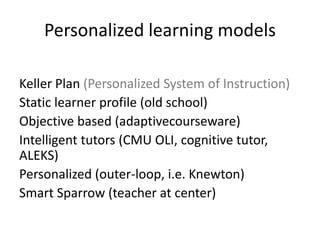
Personalized learning models
Keller Plan (Personalized System of Instruction)
Static learner profile (old school)
Objective based (adaptivecourseware)
Intelligent tutors (CMU OLI, cognitive tutor,
ALEKS)
Personalized (outer-loop, i.e. Knewton)
Smart Sparrow (teacher at center)
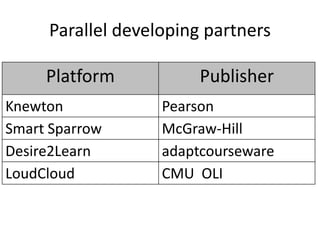
Parallel developing partners
Platform Publisher
Knewton Pearson
Smart Sparrow McGraw-Hill
Desire2Learn adaptcourseware
LoudCloud CMU OLI
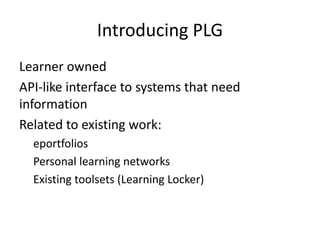
Introducing PLG
Learner owned
API-like interface to systems that need
information
Related to existing work:
eportfolios
Personal learning networks
Existing toolsets (Learning Locker)
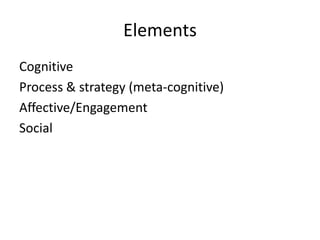
Elements
Cognitive
Process & strategy (meta-cognitive)
Affective/Engagement
Social
Why PLeG?
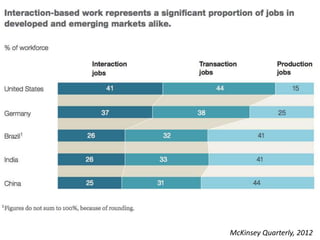
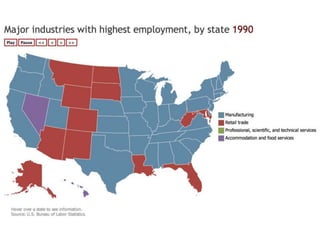
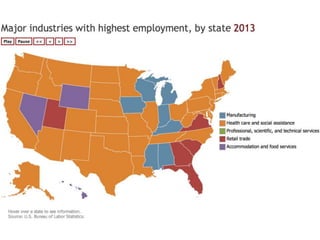
Jobs: disappearing & new
Automation
(Frey & Osborne, 2013)
Knowledge work
(US Bureau of Economic Analysis,
McKinsey & Co, 2012)
http://www.oxfordmartin.ox.ac.uk/downloads/academic/The_Future_of_Em
ployment.pdf
http://www.bea.gov/industry/gdpbyind_data.htm
http://www.mckinsey.com/insights/organization/preparing_for_a_new_era_
of_work
McKinsey Quarterly, 2012
Student profiles
Diversifying
(OECD)
Less than 50% now full time
(US Census Bureau)
http://www.oecd.org/edu/skills-beyond-school/EDIF%202013--
N%C2%B015.pdf
http://www.census.gov/prod/2013pubs/acsbr11-14.pdf
Complexification of higher education
Learning needs are complex, ongoing
Simple singular narrative won’t suffice going
forward
The idea of the university (and learning) is
expanding and diversifying
Granularization of learning
Competency-based degrees
(Chronicle, 2014)
Prior learning assessment
(Insider Higher Ed, 2012)
http://chronicle.com/article/Competency-Based-Degrees-/144769/
http://www.insidehighered.com/news/2012/05/07/prior-learning-
assessment-catches-quietly
Granularization of assessment
Cracking the credit hour
(New America Foundation)
Badges
(Mozilla & others)
http://newamerica.net/publications/policy/cracking_the_credit_hour
http://openbadges.org/
Something is needed that expands the
idea of a “course” and moves control
of learning experience/data from the
institution to the learner
Exploration
Learning is the exploration of the unknown…
… not just mastery of what is already known.
Compelling Questions
Habitable Worlds:
Are We Alone?
Contagion:
Can We Survive?
Astronomy
Chemistry
Geology
Physics
Biology
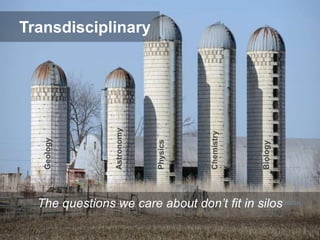
The questions we care about don’t fit in silos
Transdisciplinary
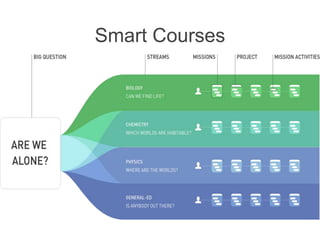
Smart Courses
What will PLeG enable?
Career transitions
Full spectrum of learning (hobby, work, formal,
personal)
Integrated & immersive learning
Foundation for personalized/adaptive learning
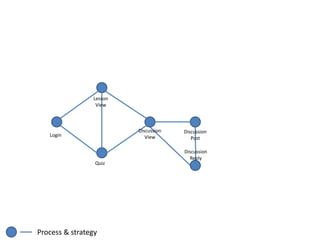
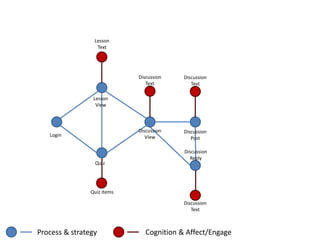
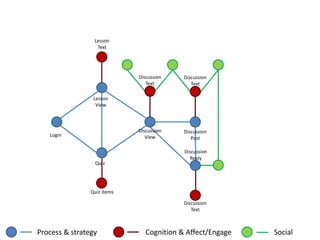
Multipartite graphs
Process & strategy
Login
Lesson
View
Discussion
View
Discussion
Post
Quiz
Discussion
Reply
Discussion
Reply
Login
Lesson
View
Quiz
Discussion
View
Discussion
Post
Lesson
Text
Discussion
Text
Discussion
Text
Quiz items
Discussion
Text
Cognition & Affect/EngageProcess & strategy
Login
Lesson
View
Quiz
Discussion
View
Discussion
Post
Lesson
Text
Discussion
Text
Discussion
Text
Quiz items
Discussion
Reply
Discussion
Text
SocialProcess & strategy Cognition & Affect/Engage
High computational complexity,
but suitable representation
Coding of nodes
(necessary) to describe PLeG
Information, learning processes, affective
states, social functions, etc.
Use of process/strategy graphs
Understanding of self-regulated learning
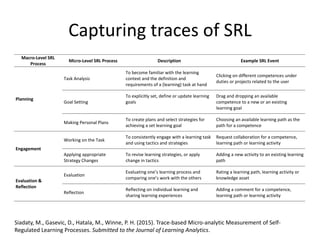
Capturing traces of SRL
Macro-Level SRL
Process
Micro-Level SRL Process Description Example SRL Event
Planning
Task Analysis
To become familiar with the learning
context and the definition and
requirements of a (learning) task at hand
Clicking on different competences under
duties or projects related to the user
Goal Setting
To explicitly set, define or update learning
goals
Drag and dropping an available
competence to a new or an existing
learning goal
Making Personal Plans
To create plans and select strategies for
achieving a set learning goal
Choosing an available learning path as the
path for a competence
Engagement
Working on the Task
To consistently engage with a learning task
and using tactics and strategies
Request collaboration for a competence,
learning path or learning activity
Applying appropriate
Strategy Changes
To revise learning strategies, or apply
change in tactics
Adding a new activity to an existing learning
path
Evaluation &
Reflection
Evaluation
Evaluating one’s learning process and
comparing one’s work with the others
Rating a learning path, learning activity or
knowledge asset
Reflection
Reflecting on individual learning and
sharing learning experiences
Adding a comment for a competence,
learning path or learning activity
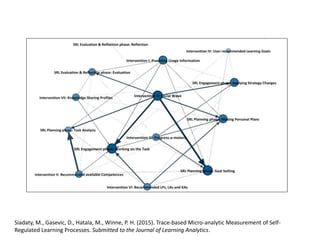
Siadaty, M., Gasevic, D., Hatala, M., Winne, P. H. (2015). Trace-based Micro-analytic Measurement of Self-
Regulated Learning Processes. Submitted to the Journal of Learning Analytics.
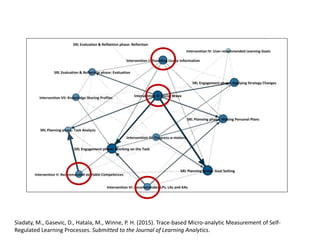
Siadaty, M., Gasevic, D., Hatala, M., Winne, P. H. (2015). Trace-based Micro-analytic Measurement of Self-
Regulated Learning Processes. Submitted to the Journal of Learning Analytics.
Siadaty, M., Gasevic, D., Hatala, M., Winne, P. H. (2015). Trace-based Micro-analytic Measurement of Self-
Regulated Learning Processes. Submitted to the Journal of Learning Analytics.
Use of process/strategy graphs
Measurement of metacognitive monitoring
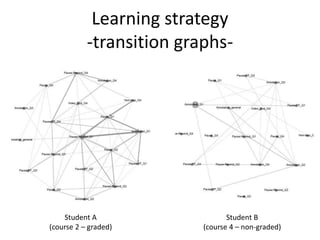
Learning strategy
-transition graphs-
Student A
(course 2 – graded)
Student B
(course 4 – non-graded)
Orchestration graphs
Process modeling and process mining (discovery,
compliance checking, and improvement)
Dillenbourg, P. (2015). Orchestration graphs. Lausanne, Switzerland: EPFL Press / Routledge
Information structure of content
Information extraction techniques such as topic
modeling (LDA) or name entity extraction
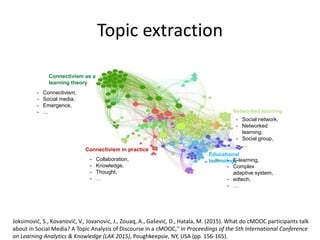
Connectivism as a
learning theory
Networked learning
Educational
technology
- Connectivism,
- Social media,
- Emergence,
- …
- E-learning,
- Complex
adaptive system,
- edtech,
- …
- Social network,
- Networked
learning,
- Social group,
- …
Connectivism in practice
- Collaboration,
- Knowledge,
- Thought,
- …
Joksimović, S., Kovanović, V., Jovanović, J., Zouaq, A., Gašević, D., Hatala, M. (2015). What do cMOOC participants talk
about in Social Media? A Topic Analysis of Discourse in a cMOOC," In Proceedings of the 5th International Conference
on Learning Analytics & Knowledge (LAK 2015), Poughkeepsie, NY, USA (pp. 156-165).
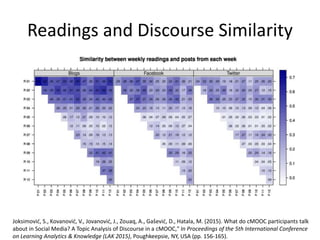
Topic extraction
Readings and Discourse Similarity
Joksimović, S., Kovanović, V., Jovanović, J., Zouaq, A., Gašević, D., Hatala, M. (2015). What do cMOOC participants talk
about in Social Media? A Topic Analysis of Discourse in a cMOOC," In Proceedings of the 5th International Conference
on Learning Analytics & Knowledge (LAK 2015), Poughkeepsie, NY, USA (pp. 156-165).
Coding learning processes from
unstructured sources
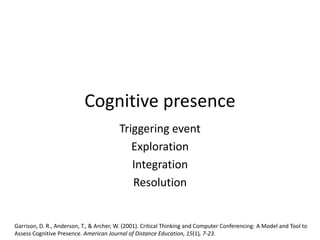
Cognitive presence
Triggering event
Exploration
Integration
Resolution
Garrison, D. R., Anderson, T., & Archer, W. (2001). Critical Thinking and Computer Conferencing: A Model and Tool to
Assess Cognitive Presence. American Journal of Distance Education, 15(1), 7-23.
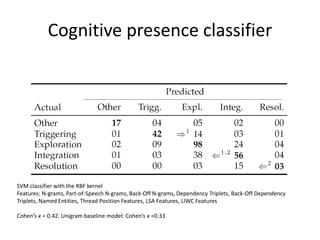
Cognitive presence classifier
SVM classifier with the RBF kernel
Features: N-grams, Part-of-Speech N-grams, Back-Off N-grams, Dependency Triplets, Back-Off Dependency
Triplets, Named Entities, Thread Position Features, LSA Features, LIWC Features
Cohen’s κ = 0.42. Unigram baseline model: Cohen’s κ =0.33
Currently missing!
Integration of
LA/EDM & assessment
to guide learning progression
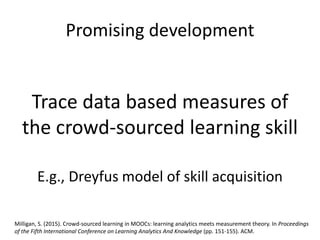
Promising development
Trace data based measures of
the crowd-sourced learning skill
E.g., Dreyfus model of skill acquisition
Milligan, S. (2015). Crowd-sourced learning in MOOCs: learning analytics meets measurement theory. In Proceedings
of the Fifth International Conference on Learning Analytics And Knowledge (pp. 151-155). ACM.
Progressions can build upon
• Models that represent prerequisite structure
and connections in knowledge
• Such as Partial Order Knowledge Spaces
(Desmarais & Pu, 2005)
Engagement in the PLeG
• Behavioral Engagement
• Affective Engagement
Engagement predicts learning
Engagement predicts long-term
participation
Engagement predicts long-term
participation
Engagement during middle school math predicts
– College attendance (San Pedro et al., 2013)
– College selectivity (San Pedro et al., in
preparation)
– College major (San Pedro et al., 2014, 2015)
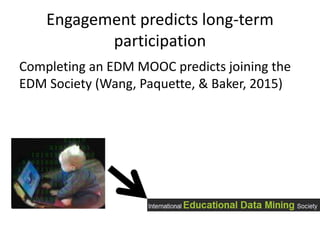
Engagement predicts long-term
participation
Completing an EDM MOOC predicts joining the
EDM Society (Wang, Paquette, & Baker, 2015)
Community Factors Matter
Communities form during MOOCs like this one
(Brown et al., 2015)
Future work – study how these communities
persist into the future
(early evidence from CCK08 MOOC)
Use PLeG to
• Track what aspects of student engagement are
enduring
• As opposed to just pertaining to a specific
system or learning domain
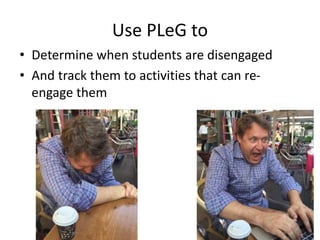
Use PLeG to
• Determine when students are disengaged
• And track them to activities that can re-
engage them
Use PLeG to
• Find what does motivate a student
• And personalize less motivating content to
connect it to what motivates the student (cf.
Walkington & Bernacki, 2014; Walkington et
al., 2014)
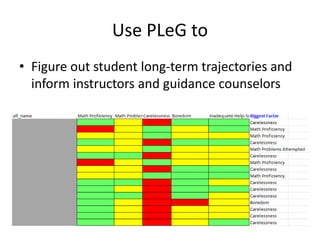
Use PLeG to
• Figure out student long-term trajectories and
inform instructors and guidance counselors
Challenges
• Linking engagement models from different
learning systems to each other
– Models of different constructs
– Models with different reliabilities
– More and less aggressive models
• Figuring out how to decay engagement data
over time, and where it does and doesn’t
apply
Self-Regulated Learning
Similar challenges
We know…
• Scientific inquiry skills transfer across domains
(Sao Pedro et al., 2012)
– Essential if we are dealing with complex and multi-
disciplinary problems
• SRL skill that a student develops can be enduring
across a semester (Roll et al., 2011)
• These processes and strategies support the
development of cognition
– Can also support social skills, and affect and
engagement regulation skills
But…
• To what degree does SRL process skills in one learning
environment transfer to other environments?
• Are the same strategies and processes positive across
different learning environments?
– What behaviors are beneficial across learning
environments?
• Are the same strategies and processes effective for
different cultures and populations?
– Soriano et al. (2013) has found evidence that this is not the
case
Conclusion
Expansion of learning (for so-called knowledge age)
requires expansion techniques and methods for
learning
Learning controlled, owned
Personalized learning – by starting with learners
driving their learning
Resonance & activating latency
Labour market & related impact (rethinking “the
course”)
Need YOUR/EDM algorithmic and related expertise

Personal Learning Graph (PLeG)

  • 1.
    PERSONAL LEARNING GRAPHS (PLeG) GeorgeSiemens Dragan Gasevic Ryan Baker Presented to: International Educational Data Mining Conference Madrid June 27, 2015
  • 2.
    The so-called “holygrail” of education: personalized and adaptive learning
  • 3.
    Personalized learning models KellerPlan (Personalized System of Instruction) Static learner profile (old school) Objective based (adaptivecourseware) Intelligent tutors (CMU OLI, cognitive tutor, ALEKS) Personalized (outer-loop, i.e. Knewton) Smart Sparrow (teacher at center)
  • 4.
    Parallel developing partners PlatformPublisher Knewton Pearson Smart Sparrow McGraw-Hill Desire2Learn adaptcourseware LoudCloud CMU OLI
  • 5.
    Introducing PLG Learner owned API-likeinterface to systems that need information Related to existing work: eportfolios Personal learning networks Existing toolsets (Learning Locker)
  • 6.
    Elements Cognitive Process & strategy(meta-cognitive) Affective/Engagement Social
  • 7.
  • 8.
    Jobs: disappearing &new Automation (Frey & Osborne, 2013) Knowledge work (US Bureau of Economic Analysis, McKinsey & Co, 2012) http://www.oxfordmartin.ox.ac.uk/downloads/academic/The_Future_of_Em ployment.pdf http://www.bea.gov/industry/gdpbyind_data.htm http://www.mckinsey.com/insights/organization/preparing_for_a_new_era_ of_work
  • 9.
  • 12.
    Student profiles Diversifying (OECD) Less than50% now full time (US Census Bureau) http://www.oecd.org/edu/skills-beyond-school/EDIF%202013-- N%C2%B015.pdf http://www.census.gov/prod/2013pubs/acsbr11-14.pdf
  • 13.
    Complexification of highereducation Learning needs are complex, ongoing Simple singular narrative won’t suffice going forward The idea of the university (and learning) is expanding and diversifying
  • 14.
    Granularization of learning Competency-baseddegrees (Chronicle, 2014) Prior learning assessment (Insider Higher Ed, 2012) http://chronicle.com/article/Competency-Based-Degrees-/144769/ http://www.insidehighered.com/news/2012/05/07/prior-learning- assessment-catches-quietly
  • 15.
    Granularization of assessment Crackingthe credit hour (New America Foundation) Badges (Mozilla & others) http://newamerica.net/publications/policy/cracking_the_credit_hour http://openbadges.org/
  • 16.
    Something is neededthat expands the idea of a “course” and moves control of learning experience/data from the institution to the learner
  • 17.
    Exploration Learning is theexploration of the unknown… … not just mastery of what is already known.
  • 18.
    Compelling Questions Habitable Worlds: AreWe Alone? Contagion: Can We Survive?
  • 19.
    Astronomy Chemistry Geology Physics Biology The questions wecare about don’t fit in silos Transdisciplinary
  • 20.
  • 21.
    What will PLeGenable? Career transitions Full spectrum of learning (hobby, work, formal, personal) Integrated & immersive learning Foundation for personalized/adaptive learning
  • 22.
  • 23.
  • 24.
  • 25.
  • 26.
    High computational complexity, butsuitable representation
  • 27.
    Coding of nodes (necessary)to describe PLeG Information, learning processes, affective states, social functions, etc.
  • 28.
    Use of process/strategygraphs Understanding of self-regulated learning
  • 29.
    Capturing traces ofSRL Macro-Level SRL Process Micro-Level SRL Process Description Example SRL Event Planning Task Analysis To become familiar with the learning context and the definition and requirements of a (learning) task at hand Clicking on different competences under duties or projects related to the user Goal Setting To explicitly set, define or update learning goals Drag and dropping an available competence to a new or an existing learning goal Making Personal Plans To create plans and select strategies for achieving a set learning goal Choosing an available learning path as the path for a competence Engagement Working on the Task To consistently engage with a learning task and using tactics and strategies Request collaboration for a competence, learning path or learning activity Applying appropriate Strategy Changes To revise learning strategies, or apply change in tactics Adding a new activity to an existing learning path Evaluation & Reflection Evaluation Evaluating one’s learning process and comparing one’s work with the others Rating a learning path, learning activity or knowledge asset Reflection Reflecting on individual learning and sharing learning experiences Adding a comment for a competence, learning path or learning activity Siadaty, M., Gasevic, D., Hatala, M., Winne, P. H. (2015). Trace-based Micro-analytic Measurement of Self- Regulated Learning Processes. Submitted to the Journal of Learning Analytics.
  • 30.
    Siadaty, M., Gasevic,D., Hatala, M., Winne, P. H. (2015). Trace-based Micro-analytic Measurement of Self- Regulated Learning Processes. Submitted to the Journal of Learning Analytics.
  • 31.
    Siadaty, M., Gasevic,D., Hatala, M., Winne, P. H. (2015). Trace-based Micro-analytic Measurement of Self- Regulated Learning Processes. Submitted to the Journal of Learning Analytics.
  • 32.
    Use of process/strategygraphs Measurement of metacognitive monitoring
  • 33.
    Learning strategy -transition graphs- StudentA (course 2 – graded) Student B (course 4 – non-graded)
  • 34.
    Orchestration graphs Process modelingand process mining (discovery, compliance checking, and improvement) Dillenbourg, P. (2015). Orchestration graphs. Lausanne, Switzerland: EPFL Press / Routledge
  • 35.
    Information structure ofcontent Information extraction techniques such as topic modeling (LDA) or name entity extraction
  • 36.
    Connectivism as a learningtheory Networked learning Educational technology - Connectivism, - Social media, - Emergence, - … - E-learning, - Complex adaptive system, - edtech, - … - Social network, - Networked learning, - Social group, - … Connectivism in practice - Collaboration, - Knowledge, - Thought, - … Joksimović, S., Kovanović, V., Jovanović, J., Zouaq, A., Gašević, D., Hatala, M. (2015). What do cMOOC participants talk about in Social Media? A Topic Analysis of Discourse in a cMOOC," In Proceedings of the 5th International Conference on Learning Analytics & Knowledge (LAK 2015), Poughkeepsie, NY, USA (pp. 156-165). Topic extraction
  • 37.
    Readings and DiscourseSimilarity Joksimović, S., Kovanović, V., Jovanović, J., Zouaq, A., Gašević, D., Hatala, M. (2015). What do cMOOC participants talk about in Social Media? A Topic Analysis of Discourse in a cMOOC," In Proceedings of the 5th International Conference on Learning Analytics & Knowledge (LAK 2015), Poughkeepsie, NY, USA (pp. 156-165).
  • 38.
    Coding learning processesfrom unstructured sources
  • 40.
    Cognitive presence Triggering event Exploration Integration Resolution Garrison,D. R., Anderson, T., & Archer, W. (2001). Critical Thinking and Computer Conferencing: A Model and Tool to Assess Cognitive Presence. American Journal of Distance Education, 15(1), 7-23.
  • 41.
    Cognitive presence classifier SVMclassifier with the RBF kernel Features: N-grams, Part-of-Speech N-grams, Back-Off N-grams, Dependency Triplets, Back-Off Dependency Triplets, Named Entities, Thread Position Features, LSA Features, LIWC Features Cohen’s κ = 0.42. Unigram baseline model: Cohen’s κ =0.33
  • 42.
    Currently missing! Integration of LA/EDM& assessment to guide learning progression
  • 43.
    Promising development Trace databased measures of the crowd-sourced learning skill E.g., Dreyfus model of skill acquisition Milligan, S. (2015). Crowd-sourced learning in MOOCs: learning analytics meets measurement theory. In Proceedings of the Fifth International Conference on Learning Analytics And Knowledge (pp. 151-155). ACM.
  • 44.
    Progressions can buildupon • Models that represent prerequisite structure and connections in knowledge • Such as Partial Order Knowledge Spaces (Desmarais & Pu, 2005)
  • 45.
    Engagement in thePLeG • Behavioral Engagement • Affective Engagement
  • 46.
  • 47.
  • 48.
    Engagement predicts long-term participation Engagementduring middle school math predicts – College attendance (San Pedro et al., 2013) – College selectivity (San Pedro et al., in preparation) – College major (San Pedro et al., 2014, 2015)
  • 49.
    Engagement predicts long-term participation Completingan EDM MOOC predicts joining the EDM Society (Wang, Paquette, & Baker, 2015)
  • 50.
    Community Factors Matter Communitiesform during MOOCs like this one (Brown et al., 2015) Future work – study how these communities persist into the future (early evidence from CCK08 MOOC)
  • 51.
    Use PLeG to •Track what aspects of student engagement are enduring • As opposed to just pertaining to a specific system or learning domain
  • 52.
    Use PLeG to •Determine when students are disengaged • And track them to activities that can re- engage them
  • 53.
    Use PLeG to •Find what does motivate a student • And personalize less motivating content to connect it to what motivates the student (cf. Walkington & Bernacki, 2014; Walkington et al., 2014)
  • 54.
    Use PLeG to •Figure out student long-term trajectories and inform instructors and guidance counselors
  • 55.
    Challenges • Linking engagementmodels from different learning systems to each other – Models of different constructs – Models with different reliabilities – More and less aggressive models • Figuring out how to decay engagement data over time, and where it does and doesn’t apply
  • 56.
  • 57.
    We know… • Scientificinquiry skills transfer across domains (Sao Pedro et al., 2012) – Essential if we are dealing with complex and multi- disciplinary problems • SRL skill that a student develops can be enduring across a semester (Roll et al., 2011) • These processes and strategies support the development of cognition – Can also support social skills, and affect and engagement regulation skills
  • 58.
    But… • To whatdegree does SRL process skills in one learning environment transfer to other environments? • Are the same strategies and processes positive across different learning environments? – What behaviors are beneficial across learning environments? • Are the same strategies and processes effective for different cultures and populations? – Soriano et al. (2013) has found evidence that this is not the case
  • 59.
    Conclusion Expansion of learning(for so-called knowledge age) requires expansion techniques and methods for learning Learning controlled, owned Personalized learning – by starting with learners driving their learning Resonance & activating latency Labour market & related impact (rethinking “the course”) Need YOUR/EDM algorithmic and related expertise

Editor's Notes

  • #10 https://www.mckinseyquarterly.com/Economic_Studies/Productivity_Performance/Preparing_for_a_new_era_of_knowledge_work_3034
  • #11 http://www.bls.gov/opub/ted/2014/ted_20140728.htm
  • #12 http://www.bls.gov/opub/ted/2014/ted_20140728.htm
  • #18 So what makes the type of courseware special? Well, we think that it teaches students that science is not just mastery of what is already known, but an exploration of the unknown. We actually believe that this is what learning itself is all about.
  • #19 The courseware is also centred around compelling questions that motivate students, such as, are we alone in the universe? There are challenging problems that contextualise the learning. They are authentic problems that real scientists are working on right now at the frontier of human knowledge.
  • #20 The courseware also gets students to appreciate the solutions to real problems in science do not fit into tidy disciplinary bins. The courseware has a transdisciplinary approach whilst mapping closely to introductory science courses, and the learning objectives faculty are used to teaching.
  • #21 And as a community, we are building what we call Smart Courses: streams of enquiry, centred around a Big Question (for example, Are We Alone?), which map to introductory science courses in physics, chemistry, and biology. We currently have the existing gen-ed science course Habitable Worlds that I mentioned, and will have the biology course (or Stream) completed this year. The first set of courses will be framed around this astrobiology theme and next year we will do it all again with a biomedical theme and the Big Question: can we survive the next epidemic?
  • #44 Novice, advanced beginner, competent, proficient, and expert