Modeling Flexible Business Processes with Business Rule Patterns Milan Milanović 1 ,  Dragan Gašević 2 , Luis Rocha 2 1 University of Belgrade, Serbia 2 Athabasca University, AB, Canada https://semtech.athabascau.ca
Motivation Modeling flexible business process Integration of rules in processes
Motivation Modeling flexible business process Integration of rules in processes Patterns for Rules in BPs [Graml et al., 2007] Control flow  decisions Control flow  decisions Rule types DR IR PrR Control flow  decisions Decision logic abstraction +     Decision node to business rule binding +     Decision with flexible input data +     Decision flexible output  +   + Data  constraints Constraints at predefined checkpoint   +   Constraints at multiple checkpoints +   Constraints enforced by external data context   +   Dynamic BP composition Business rule-based subprocess selection     + Business rule-based process composition +   +
Rule and Processes Observations Implementation focus primarily  Development complexity  Weak integration with information modeling  Questionable declarative definition of rules
To what extent can  a rule-enhanced  business process modeling language   address the observed problems  Research Objective MODELS 2009
Rule-enhanced BP modeling language Integrates BPMN2 and R2ML (EDOC 2009) Improved expressivity (BuRO 2010) A rule can be associated with a flow element Advice-like types – before, after around  Models rule-enhanced Orchestrations (CASCON 2009) Choreographies (EDOC 2010) rBPMN
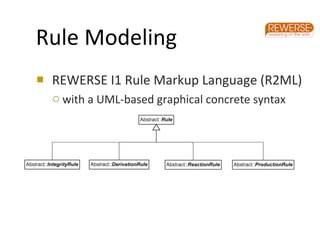
Rule Modeling REWERSE I1 Rule Markup Language (R2ML) with a UML-based graphical concrete syntax MODELS 2009
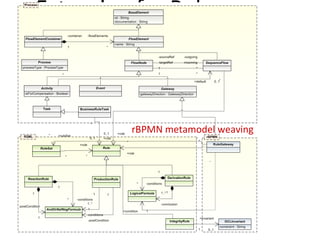
REWERSE I1 Rule Markup Language Extension for Rule Models MODELS 2009 rBPMN metamodel weaving
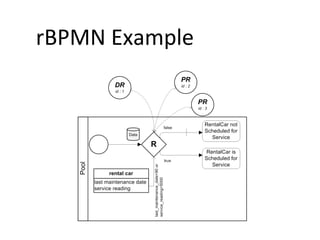
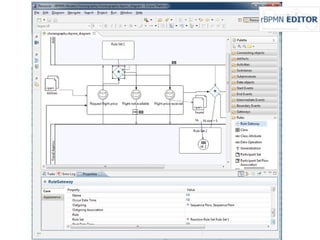
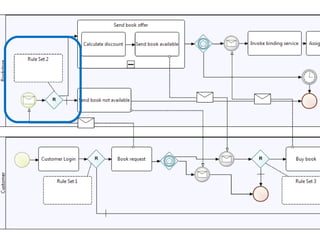
rBPMN Example
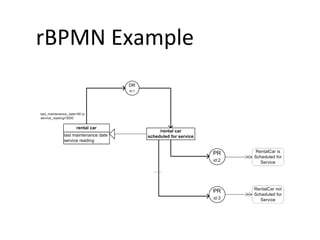
rBPMN Example
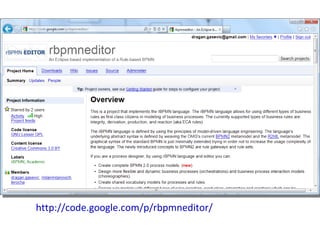
http://code.google.com/p/rbpmneditor/
rBPMN Editor
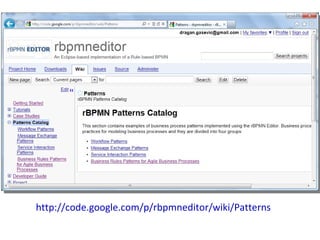
http://code.google.com/p/rbpmneditor/wiki/Patterns
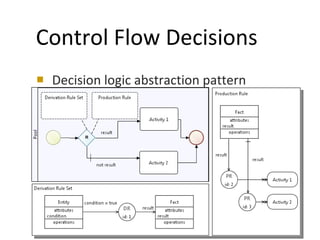
Control Flow Decisions Decision logic abstraction pattern
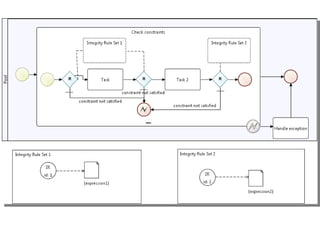
Data Constraints Constraints at multiple checkpoints
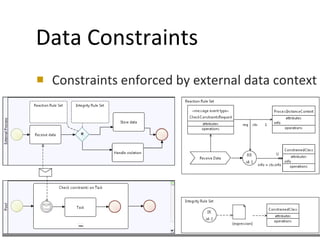
Data Constraints Constraints enforced by external data context
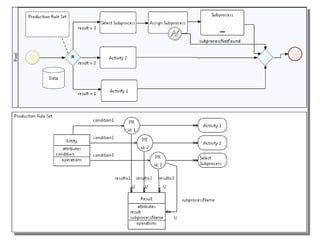
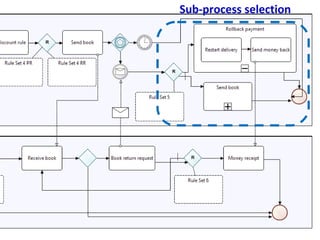
Dynamic BP Composition  Business rule-based subprocess selection
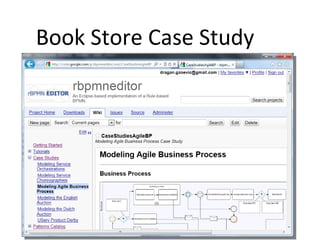
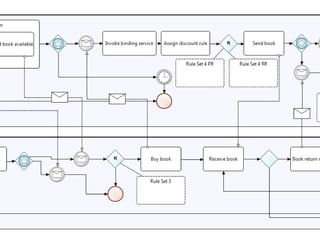
Book Store Case Study
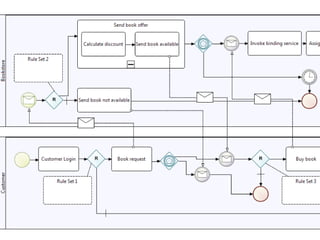
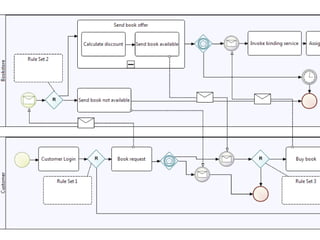
Case Study – Book Store
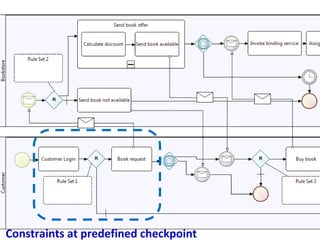
Case Study – Book Store Constraints at predefined checkpoint
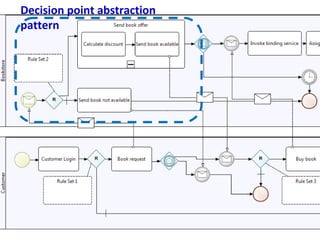
Case Study – Book Store Decision point abstraction pattern
Case Study – Book Store
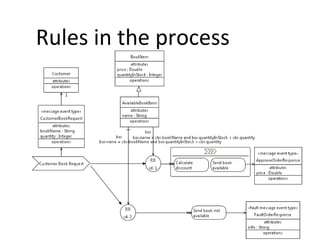
Rules in the process Reaction rules attached to R 2
Case Study – Book Store
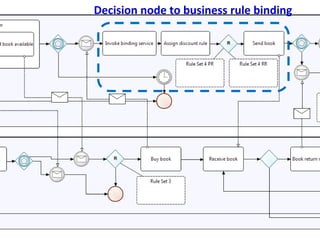
Case Study – Book Store Decision node to business rule binding
Case Study – Book Store
Case Study – Book Store Sub-process selection
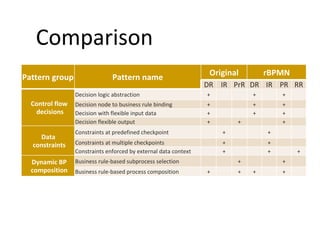
Comparison Pattern group Pattern name Original rBPMN DR IR PrR DR IR PR RR Control flow  decisions Decision logic abstraction +     +   +   Decision node to business rule binding +     +   +   Decision with flexible input data +     +   +   Decision flexible output  +   +     +   Data  constraints Constraints at predefined checkpoint   +     +     Constraints at multiple checkpoints +     +     Constraints enforced by external data context   +     +   + Dynamic BP composition Business rule-based subprocess selection     +     +   Business rule-based process composition +   + +   +  
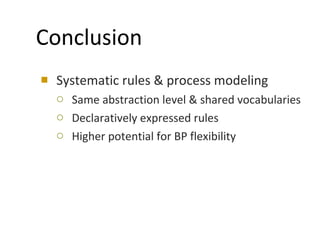
Systematic rules & process modeling  Same abstraction level & shared vocabularies  Declaratively expressed rules Higher potential for BP flexibility  Conclusion MODELS 2009
Formal verification of rBPMN processes Petri Nets and well-formedness Executable rBPMN  Concrete syntax  Reduction of the graphical concrete syntax Semi-structure English for rules  Controlled experiments Maintainability and usability  Future Work MODELS 2009
Thank you! Questions?  https://semtech.athabascau.ca

Modeling Flexible Business Processes with Business Rule Patterns

  • 1.
    Modeling Flexible BusinessProcesses with Business Rule Patterns Milan Milanović 1 , Dragan Gašević 2 , Luis Rocha 2 1 University of Belgrade, Serbia 2 Athabasca University, AB, Canada https://semtech.athabascau.ca
  • 2.
    Motivation Modeling flexiblebusiness process Integration of rules in processes
  • 3.
    Motivation Modeling flexiblebusiness process Integration of rules in processes Patterns for Rules in BPs [Graml et al., 2007] Control flow decisions Control flow decisions Rule types DR IR PrR Control flow decisions Decision logic abstraction +     Decision node to business rule binding +     Decision with flexible input data +     Decision flexible output +   + Data constraints Constraints at predefined checkpoint   +   Constraints at multiple checkpoints +   Constraints enforced by external data context   +   Dynamic BP composition Business rule-based subprocess selection     + Business rule-based process composition +   +
  • 4.
    Rule and ProcessesObservations Implementation focus primarily Development complexity Weak integration with information modeling Questionable declarative definition of rules
  • 5.
    To what extentcan a rule-enhanced business process modeling language address the observed problems Research Objective MODELS 2009
  • 6.
    Rule-enhanced BP modelinglanguage Integrates BPMN2 and R2ML (EDOC 2009) Improved expressivity (BuRO 2010) A rule can be associated with a flow element Advice-like types – before, after around Models rule-enhanced Orchestrations (CASCON 2009) Choreographies (EDOC 2010) rBPMN
  • 7.
    Rule Modeling REWERSEI1 Rule Markup Language (R2ML) with a UML-based graphical concrete syntax MODELS 2009
  • 8.
    REWERSE I1 RuleMarkup Language Extension for Rule Models MODELS 2009 rBPMN metamodel weaving
  • 9.
  • 10.
  • 11.
  • 12.
  • 13.
  • 14.
    Control Flow DecisionsDecision logic abstraction pattern
  • 15.
    Data Constraints Constraintsat multiple checkpoints
  • 16.
    Data Constraints Constraintsat multiple checkpoints
  • 17.
    Data Constraints Constraintsenforced by external data context
  • 18.
    Dynamic BP Composition Business rule-based subprocess selection
  • 19.
    Dynamic BP Composition Business rule-based subprocess selection
  • 20.
  • 21.
    Case Study –Book Store
  • 22.
    Case Study –Book Store Constraints at predefined checkpoint
  • 23.
    Case Study –Book Store Decision point abstraction pattern
  • 24.
    Case Study –Book Store
  • 25.
    Rules in theprocess Reaction rules attached to R 2
  • 26.
    Case Study –Book Store
  • 27.
    Case Study –Book Store Decision node to business rule binding
  • 28.
    Case Study –Book Store
  • 29.
    Case Study –Book Store Sub-process selection
  • 30.
    Comparison Pattern groupPattern name Original rBPMN DR IR PrR DR IR PR RR Control flow decisions Decision logic abstraction +     +   +   Decision node to business rule binding +     +   +   Decision with flexible input data +     +   +   Decision flexible output +   +     +   Data constraints Constraints at predefined checkpoint   +     +     Constraints at multiple checkpoints +     +     Constraints enforced by external data context   +     +   + Dynamic BP composition Business rule-based subprocess selection     +     +   Business rule-based process composition +   + +   +  
  • 31.
    Systematic rules &process modeling Same abstraction level & shared vocabularies Declaratively expressed rules Higher potential for BP flexibility Conclusion MODELS 2009
  • 32.
    Formal verification ofrBPMN processes Petri Nets and well-formedness Executable rBPMN Concrete syntax Reduction of the graphical concrete syntax Semi-structure English for rules Controlled experiments Maintainability and usability Future Work MODELS 2009
  • 33.
    Thank you! Questions? https://semtech.athabascau.ca

Editor's Notes

  • #7 BPMN -> OMG specification.