By : Anurag Juyal
19BC512
Techniques of Decision Making
By : Anurag Juyal
19BC512
Decision Making
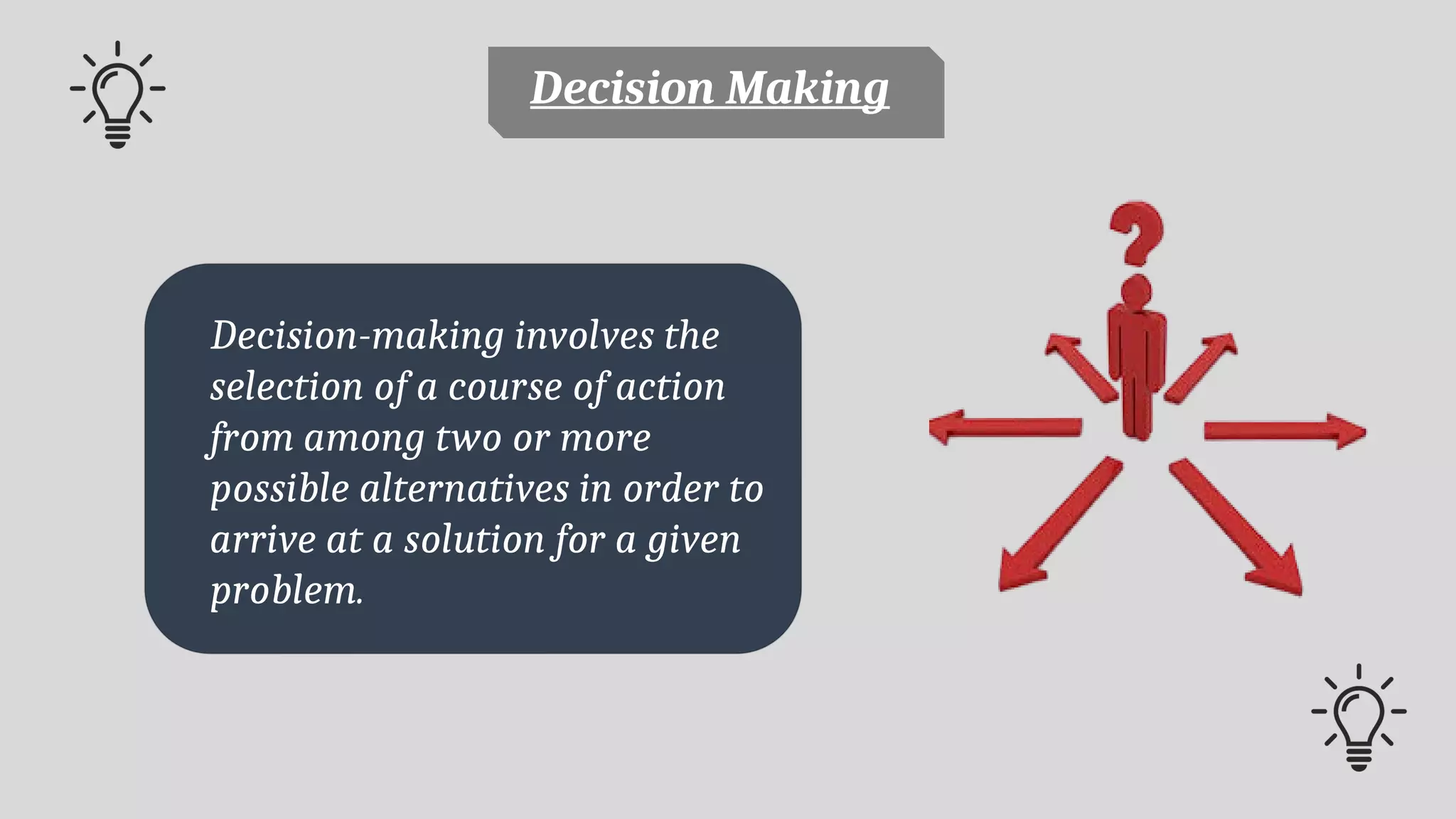
Decision-making involves the
selection of a course of action
from among two or more
possible alternatives in order to
arrive at a solution for a given
problem.
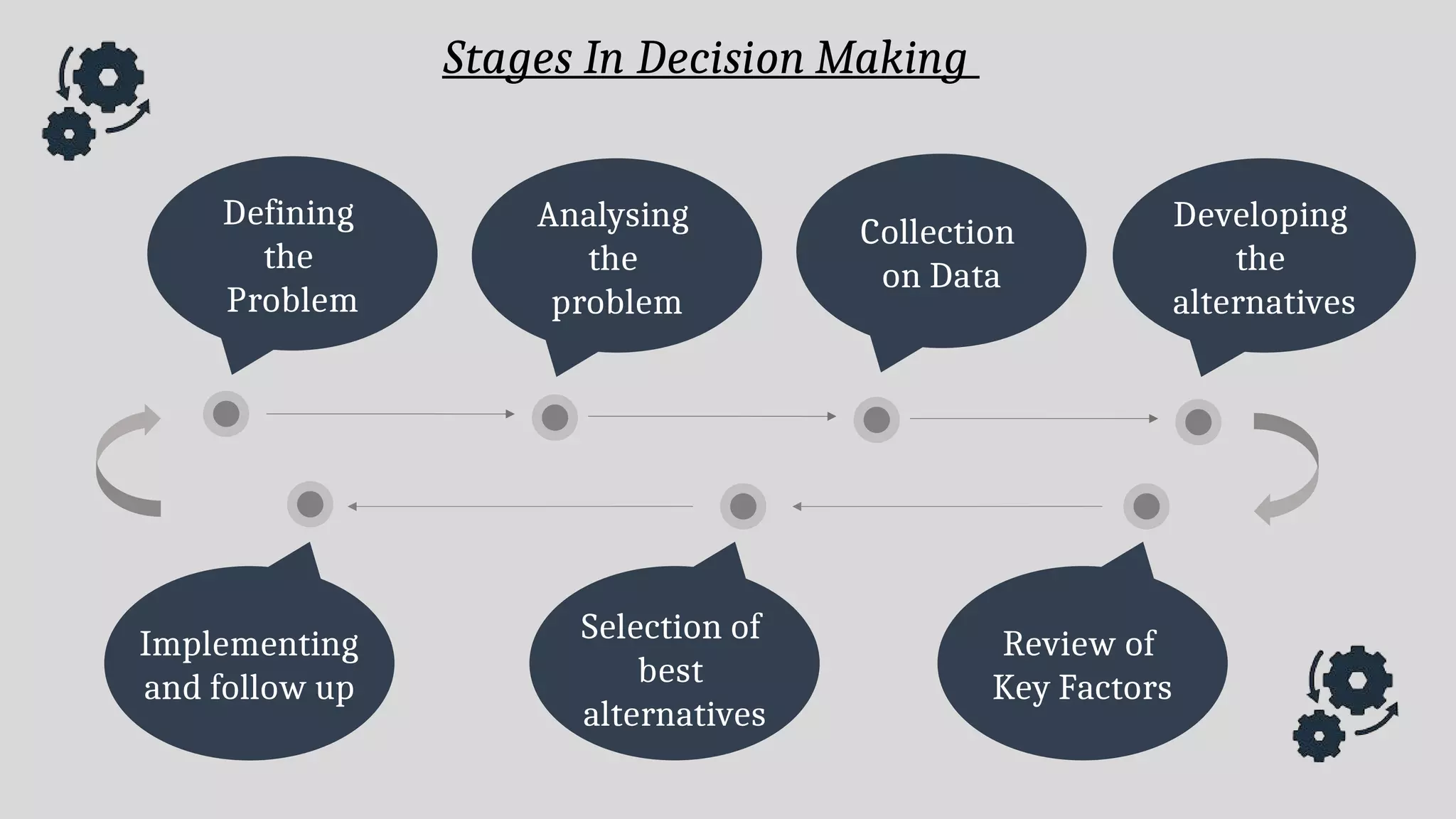
Stages In Decision Making
Defining
the
Problem
Analysing
the
problem
Collection
on Data
Developing
the
alternatives
Review of
Key Factors
Selection of
best
alternatives
Implementing
and follow up
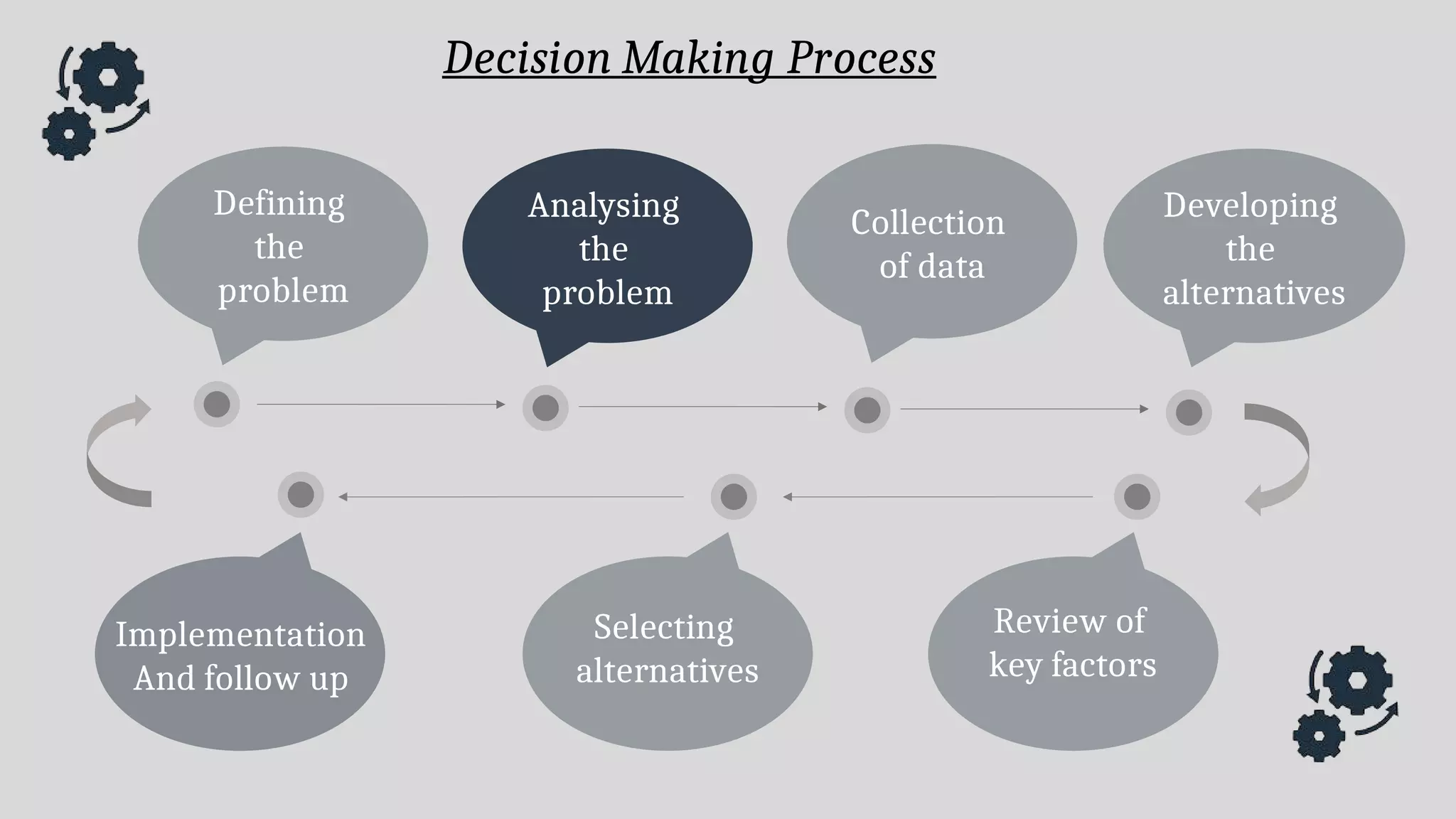
Decision Making Process
Defining
the
problem
Analysing
the
problem
Collection
of data
Developing
the
alternatives
Review of
key factors
Selecting
alternatives
Implementation
And follow up
Decision Making Process
Defining
the
problem
Analysing
the
problem
Collection
of data
Developing
the
alternatives
Review of
key factors
Selecting
alternatives
Implementation
And follow up
Decision Making Process
Defining
the
problem
Analysing
the
problem
Collection
of data
Developing
the
alternatives
Review of
key factors
Selecting
alternatives
Implementation
And follow up
Decision Making Process
Defining
the
problem
Analysing
the
problem
Collection
of data
Developing
the
alternatives
Review of
key factors
Selecting
alternatives
Implementation
And follow up
Decision Making Process
Defining
the
problem
Analysing
the
problem
Collection
of data
Developing
the
alternatives
Review of
key factors
Selecting
alternatives
Implementation
And follow up
Decision Making Process
Defining
the
problem
Analysing
the
problem
Collection
of data
Developing
the
alternatives
Review of
key factors
Selecting
alternatives
Implementation
And follow up
Decision Making Process
Defining
the
problem
Analysing
the
problem
Collection
of data
Developing
the
alternatives
Review of
key factors
Selecting
alternatives
Implementation
And follow up
TechniquesTechniques
Quantitative Techniques
• Cost Benefit Analysis
• Decision Tree
• Risk Analysis
Qualitative Techniques
• Brainstorming
• Delphi technique
• Nominal Group
Cost Benefit Analysis
• This method aims at comparing total benefits derived from a
project with the total costs incurred for the same.
• A CBA involves measurable financial metrics such as revenue
earned or costs saved as a result of the decision to pursue a
project.
• A CBA can also include intangible benefits and costs or effects
from a decision such as employee morale and customer
satisfaction.
• CBA will also factor the opportunity cost into the decision-
making process.
A New
Company - ABC
Product X
Product Y
Which one to
produce?
For Instance,
Merits
• Figure out whether the benefits outweigh the cost.
• Easy to compare projects of every type in spite of being dissimilar.
• Helps to make a rational decision based on facts and figures.
• Manager relies on data and information from past projects.
• Analysis adds into the project budget.
• Analysis estimates the value over some time. This could
lead to miscalculations and inaccurate analysis.
Demerits
Decision Tree
• A Decision Tree Analysis is a graphic representation of various
alternative solutions that are available to solve a problem.
• It is created by answering a number of questions that are continued
after each affirmative or negative answer until a final choice can be
made.
• It is presented in graphic representation on a tree-like structure in
which the problems in decision making can be seen in the form of a
flowchart, each with branches for alternative choices.
• The Decision Tree Analysis makes good use of the ‘what if’ thought.
For Instance
You want to have a Party at your house but can’t decide if you should do it inside or in the Backyard due to
weather forecasts regarding rain.
Party
Indoor Outdoor
Rain
No
Rain
Rain
No
Rain
Discomfort
but happy
Discomfort
and regret
Disaster Perfect
Merits
• Compared to other algorithms decision trees requires less effort for data
preparation during pre-processing.
• A Decision trees model is very intuitive and easy to explain to technical
teams as well as stakeholders.
Demerits
• The reproducibility of decision tree model is highly sensitive as small
change in the data can result in large change in the tree structure.
• Difficult to Handle Numerous Outcomes.
• Sensitive towards Biasness
Risk Analysis
• Risk Analysis is a process that helps you identify and
manage potential problems that could undermine key
business initiatives or projects.
• First identify the possible threats that you face, and then
estimate the likelihood that these threats will materialize.
• It is used to evaluate whether the potential risks of a project
are balanced by its benefits to aid in the decision process
when evaluating whether to move forward with the project.
• Complex process as you will have to take a lot of factors into
consideration such as financial data, security protocols, etc.
How to use Risk Analysis
Identify the
risk
Estimate the
risk Avoid the risk
Share the
risk
Accept the
risk
Control
the risk
Merits
Demerits
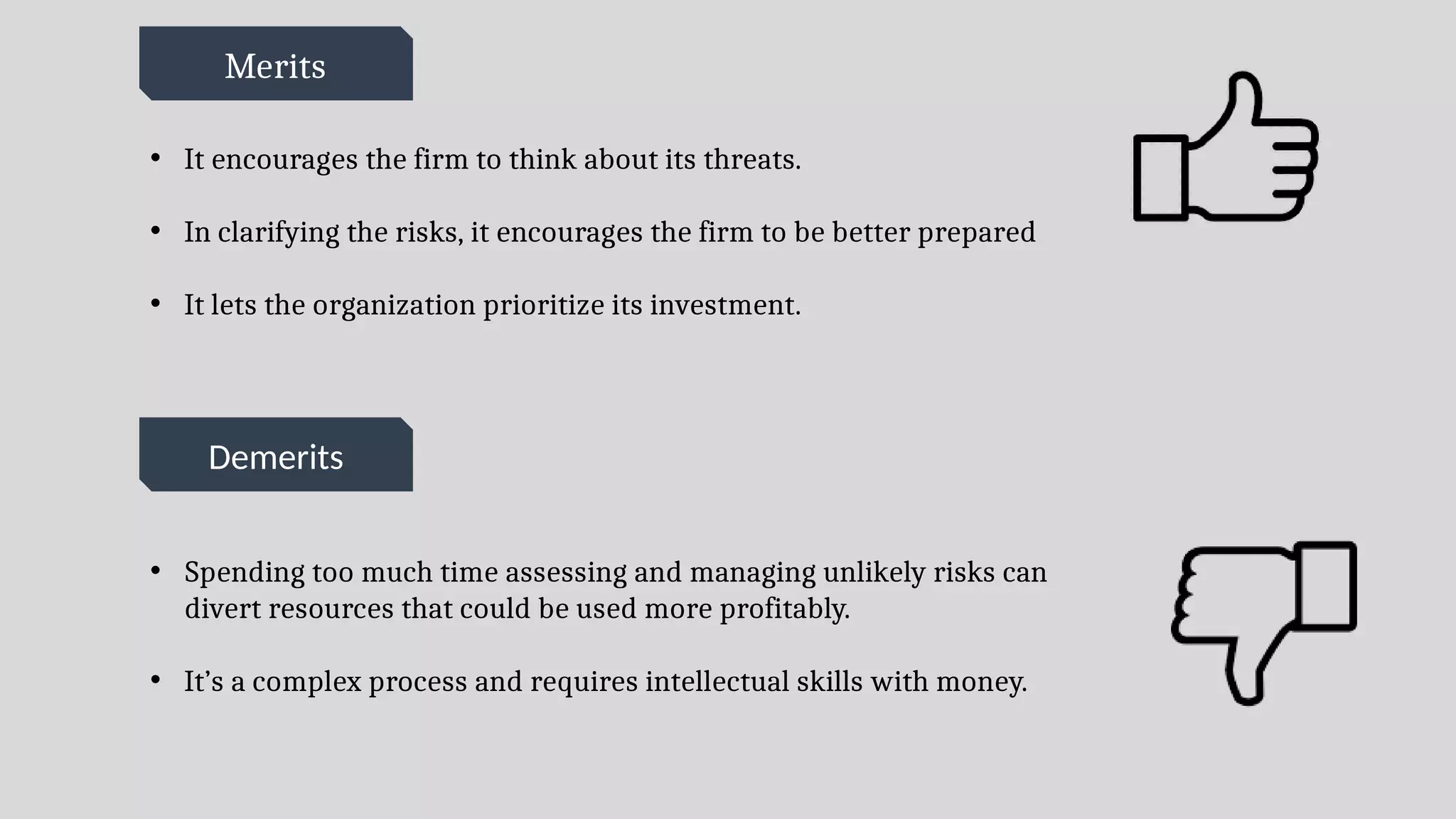
• It encourages the firm to think about its threats.
• In clarifying the risks, it encourages the firm to be better prepared
• It lets the organization prioritize its investment.
• Spending too much time assessing and managing unlikely risks can
divert resources that could be used more profitably.
• It’s a complex process and requires intellectual skills with money.
Brainstorming
• A creative process for generating ideas
that encourages quantity over quality
and discourages criticism and
evaluation.
• It generates a large quantity of ideas.
• It generates a large variety of ideas
addressing different aspects of the
problem.
Process of Brainstorming
Identify the
Problem
Generation
of idea
No criticism
and
judgement
Analyse pros
and cons
Buy-in from
all
members
Establish
the
members
Implement Record all
ideas
Merits
Demerits
• It helps you come up with great ideas.
•  It fosters mutual trust and friendship.
• It promotes creativity.
• It promotes fights and arguments.
• It’s not always effective.
• It’s not always the right choice for
everybody.
Delphi Technique
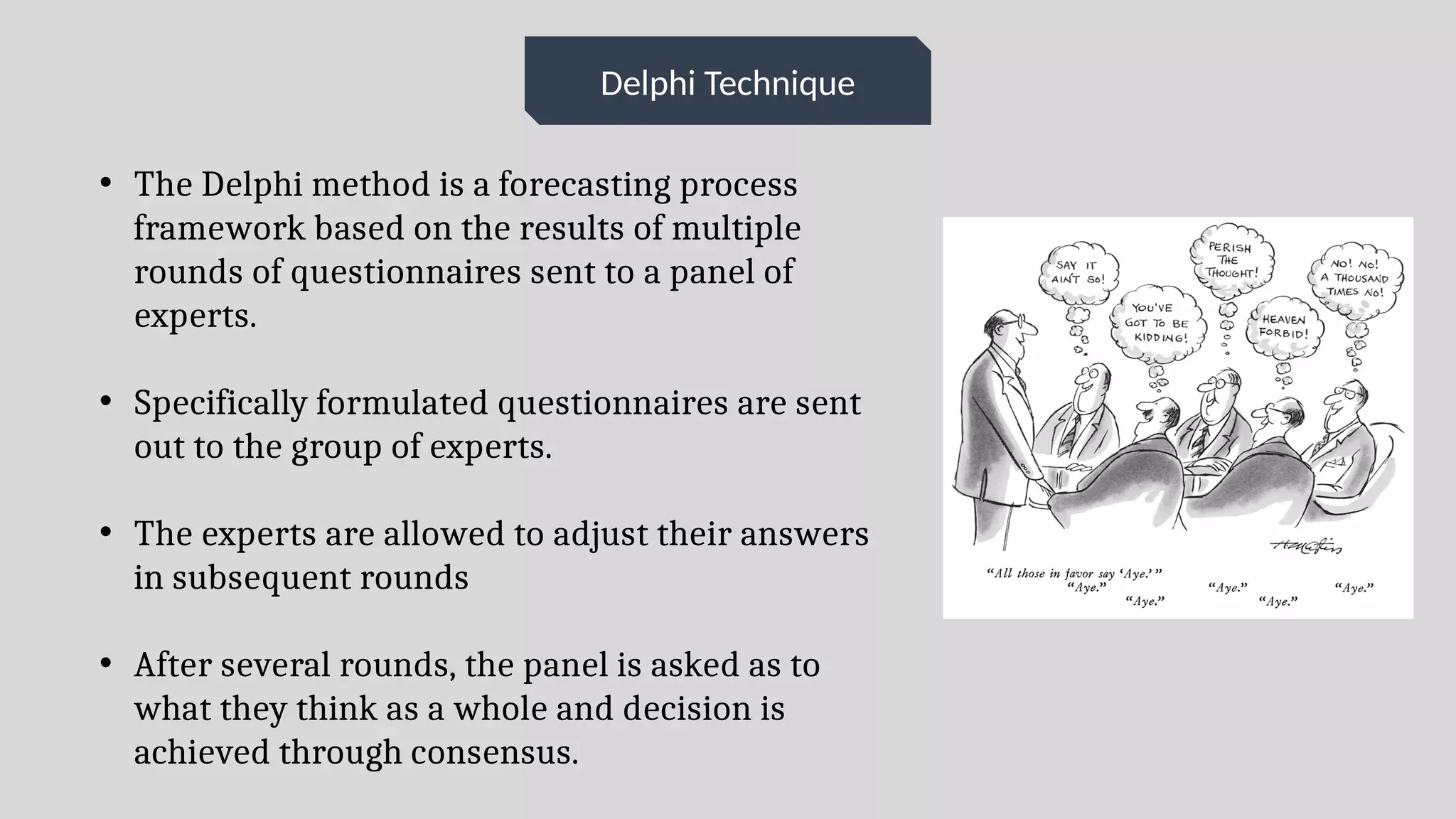
• The Delphi method is a forecasting process
framework based on the results of multiple
rounds of questionnaires sent to a panel of
experts. 
• Specifically formulated questionnaires are sent
out to the group of experts.
• The experts are allowed to adjust their answers
in subsequent rounds
• After several rounds, the panel is asked as to
what they think as a whole and decision is
achieved through consensus.
How to Use Delphi
Identify the
Problem
Call the
experts
Ask for
solutions
Note down
all the
solutions
Opinions on
every
solution
No consensus,
Repeat
Merits
Demerits
• Focus is on ideas rather than individuals
• Anonymity of participants which makes contributions of
ideas a safe activity.
• Opportunities for participants to consider their opinions.
• Large amount of time to conduct several rounds.
• Analysis of opinion of experts is a complex activity.
• The difficulty in maintaining enthusiasm and engagement in
long hours.
Nominal Group
• Nominal group technique is defined as a
structured method for group brainstorming.
• Team members begin by writing down their ideas,
then selecting which idea they feel is best. 
• Everyone presents their favorite idea, and the
suggestions are then discussed and prioritized by
the entire group using a point system. 
• Combines the importance ratings of individual
group members into the final weighted priorities
of the group.
For Instance
On a summer evening you decide to go on a road trip with your friends. The following
table shows the essential items you should take with yourself.
Particulars
Spare tyre and Tool
kit
First Aid kit
Large water bottles
and food
A B C Total
9
5
3
7
7
9
5
3
7
5
9
3
23
19
17
13Phone Chargers
Merits
Demerits
• Involving personnel for decision-making process helps in wider
acceptability of the final decision.
•  Silent generation of ideas initially reduce the possibility of biases
and undue influences.
• Subsequent discussions and interactions allow the group to take
the advantage of diversity of minds.
• Reduces the scope of discussion, and thus does not allow for
the full development of ideas.
• It lends itself only to a single purpose, single-topic meeting.
Whenever you see a successful business, someone
once made a courageous decision.
- Peter Dru

Techniques of Decision Making

  • 1.
    By : AnuragJuyal 19BC512 Techniques of Decision Making By : Anurag Juyal 19BC512
  • 2.
    Decision Making Decision-making involvesthe selection of a course of action from among two or more possible alternatives in order to arrive at a solution for a given problem.
  • 3.
    Stages In DecisionMaking Defining the Problem Analysing the problem Collection on Data Developing the alternatives Review of Key Factors Selection of best alternatives Implementing and follow up
  • 4.
    Decision Making Process Defining the problem Analysing the problem Collection ofdata Developing the alternatives Review of key factors Selecting alternatives Implementation And follow up
  • 5.
    Decision Making Process Defining the problem Analysing the problem Collection ofdata Developing the alternatives Review of key factors Selecting alternatives Implementation And follow up
  • 6.
    Decision Making Process Defining the problem Analysing the problem Collection ofdata Developing the alternatives Review of key factors Selecting alternatives Implementation And follow up
  • 7.
    Decision Making Process Defining the problem Analysing the problem Collection ofdata Developing the alternatives Review of key factors Selecting alternatives Implementation And follow up
  • 8.
    Decision Making Process Defining the problem Analysing the problem Collection ofdata Developing the alternatives Review of key factors Selecting alternatives Implementation And follow up
  • 9.
    Decision Making Process Defining the problem Analysing the problem Collection ofdata Developing the alternatives Review of key factors Selecting alternatives Implementation And follow up
  • 10.
    Decision Making Process Defining the problem Analysing the problem Collection ofdata Developing the alternatives Review of key factors Selecting alternatives Implementation And follow up
  • 11.
    TechniquesTechniques Quantitative Techniques • CostBenefit Analysis • Decision Tree • Risk Analysis Qualitative Techniques • Brainstorming • Delphi technique • Nominal Group
  • 12.
    Cost Benefit Analysis •This method aims at comparing total benefits derived from a project with the total costs incurred for the same. • A CBA involves measurable financial metrics such as revenue earned or costs saved as a result of the decision to pursue a project. • A CBA can also include intangible benefits and costs or effects from a decision such as employee morale and customer satisfaction. • CBA will also factor the opportunity cost into the decision- making process.
  • 13.
    A New Company -ABC Product X Product Y Which one to produce? For Instance,
  • 14.
    Merits • Figure outwhether the benefits outweigh the cost. • Easy to compare projects of every type in spite of being dissimilar. • Helps to make a rational decision based on facts and figures. • Manager relies on data and information from past projects. • Analysis adds into the project budget. • Analysis estimates the value over some time. This could lead to miscalculations and inaccurate analysis. Demerits
  • 15.
    Decision Tree • ADecision Tree Analysis is a graphic representation of various alternative solutions that are available to solve a problem. • It is created by answering a number of questions that are continued after each affirmative or negative answer until a final choice can be made. • It is presented in graphic representation on a tree-like structure in which the problems in decision making can be seen in the form of a flowchart, each with branches for alternative choices. • The Decision Tree Analysis makes good use of the ‘what if’ thought.
  • 16.
    For Instance You wantto have a Party at your house but can’t decide if you should do it inside or in the Backyard due to weather forecasts regarding rain. Party Indoor Outdoor Rain No Rain Rain No Rain Discomfort but happy Discomfort and regret Disaster Perfect
  • 17.
    Merits • Compared toother algorithms decision trees requires less effort for data preparation during pre-processing. • A Decision trees model is very intuitive and easy to explain to technical teams as well as stakeholders. Demerits • The reproducibility of decision tree model is highly sensitive as small change in the data can result in large change in the tree structure. • Difficult to Handle Numerous Outcomes. • Sensitive towards Biasness
  • 18.
    Risk Analysis • RiskAnalysis is a process that helps you identify and manage potential problems that could undermine key business initiatives or projects. • First identify the possible threats that you face, and then estimate the likelihood that these threats will materialize. • It is used to evaluate whether the potential risks of a project are balanced by its benefits to aid in the decision process when evaluating whether to move forward with the project. • Complex process as you will have to take a lot of factors into consideration such as financial data, security protocols, etc.
  • 19.
    How to useRisk Analysis Identify the risk Estimate the risk Avoid the risk Share the risk Accept the risk Control the risk
  • 20.
    Merits Demerits • It encouragesthe firm to think about its threats. • In clarifying the risks, it encourages the firm to be better prepared • It lets the organization prioritize its investment. • Spending too much time assessing and managing unlikely risks can divert resources that could be used more profitably. • It’s a complex process and requires intellectual skills with money.
  • 21.
    Brainstorming • A creativeprocess for generating ideas that encourages quantity over quality and discourages criticism and evaluation. • It generates a large quantity of ideas. • It generates a large variety of ideas addressing different aspects of the problem.
  • 22.
    Process of Brainstorming Identifythe Problem Generation of idea No criticism and judgement Analyse pros and cons Buy-in from all members Establish the members Implement Record all ideas
  • 23.
    Merits Demerits • It helpsyou come up with great ideas. •  It fosters mutual trust and friendship. • It promotes creativity. • It promotes fights and arguments. • It’s not always effective. • It’s not always the right choice for everybody.
  • 24.
    Delphi Technique • TheDelphi method is a forecasting process framework based on the results of multiple rounds of questionnaires sent to a panel of experts.  • Specifically formulated questionnaires are sent out to the group of experts. • The experts are allowed to adjust their answers in subsequent rounds • After several rounds, the panel is asked as to what they think as a whole and decision is achieved through consensus.
  • 25.
    How to UseDelphi Identify the Problem Call the experts Ask for solutions Note down all the solutions Opinions on every solution No consensus, Repeat
  • 26.
    Merits Demerits • Focus ison ideas rather than individuals • Anonymity of participants which makes contributions of ideas a safe activity. • Opportunities for participants to consider their opinions. • Large amount of time to conduct several rounds. • Analysis of opinion of experts is a complex activity. • The difficulty in maintaining enthusiasm and engagement in long hours.
  • 27.
    Nominal Group • Nominalgroup technique is defined as a structured method for group brainstorming. • Team members begin by writing down their ideas, then selecting which idea they feel is best.  • Everyone presents their favorite idea, and the suggestions are then discussed and prioritized by the entire group using a point system.  • Combines the importance ratings of individual group members into the final weighted priorities of the group.
  • 28.
    For Instance On asummer evening you decide to go on a road trip with your friends. The following table shows the essential items you should take with yourself. Particulars Spare tyre and Tool kit First Aid kit Large water bottles and food A B C Total 9 5 3 7 7 9 5 3 7 5 9 3 23 19 17 13Phone Chargers
  • 29.
    Merits Demerits • Involving personnelfor decision-making process helps in wider acceptability of the final decision. •  Silent generation of ideas initially reduce the possibility of biases and undue influences. • Subsequent discussions and interactions allow the group to take the advantage of diversity of minds. • Reduces the scope of discussion, and thus does not allow for the full development of ideas. • It lends itself only to a single purpose, single-topic meeting.
  • 30.
    Whenever you seea successful business, someone once made a courageous decision. - Peter Dru