Techniques and Challenges in
Autonomous Driving
Yu Huang
Chief Scientist of Autonomous Driving
Outline
1. Introduction
2. Perception
3. Mapping & Localization
4. Prediction
5. Planning & Control
6. V2X
7. Safety
8. Data Closed Loop
9. Annotation
10. Simulation
11. Scenario-based Development
12. Summary
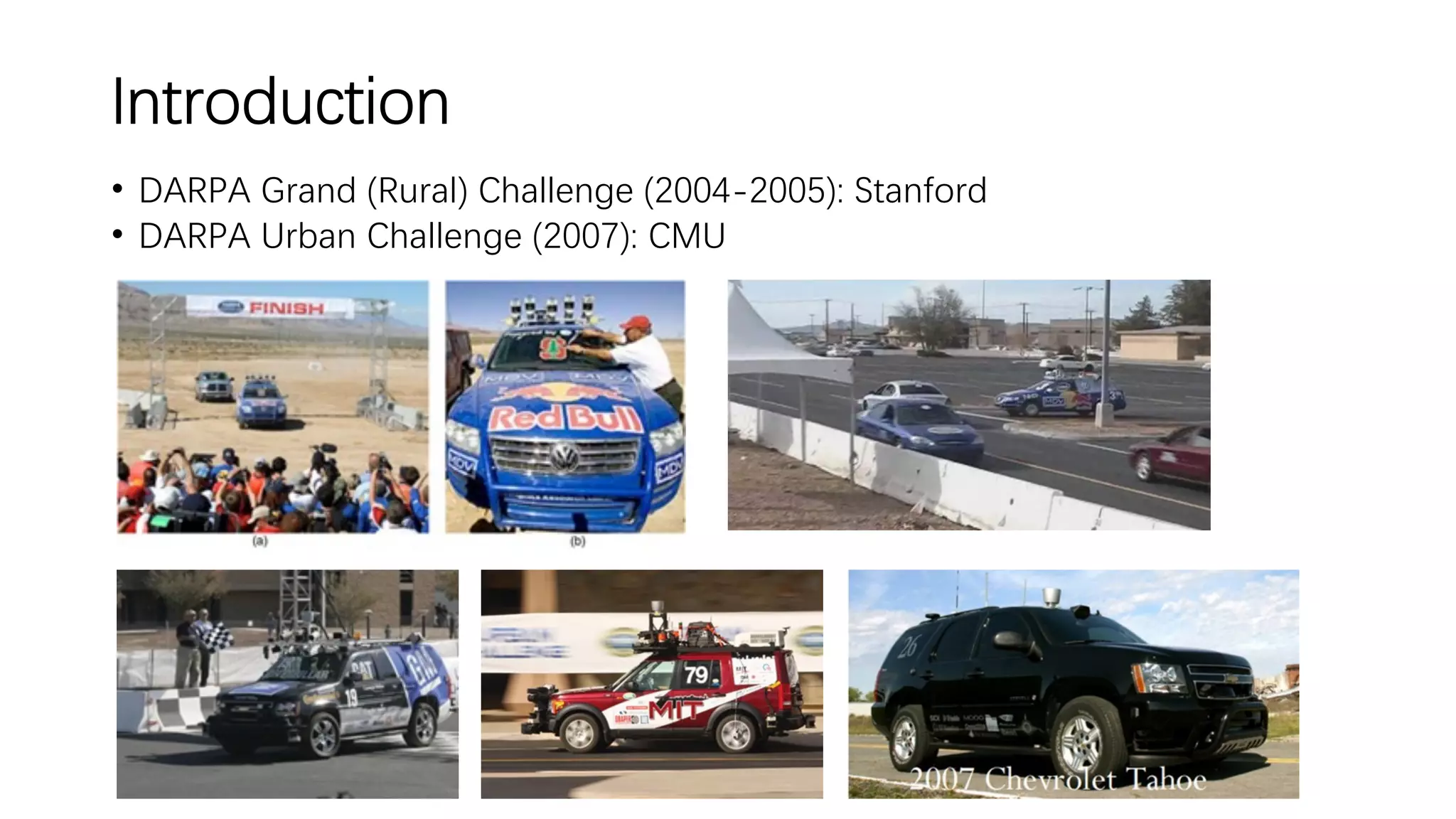
Introduction
• DARPA Grand (Rural) Challenge (2004-2005): Stanford
• DARPA Urban Challenge (2007): CMU
Introduction
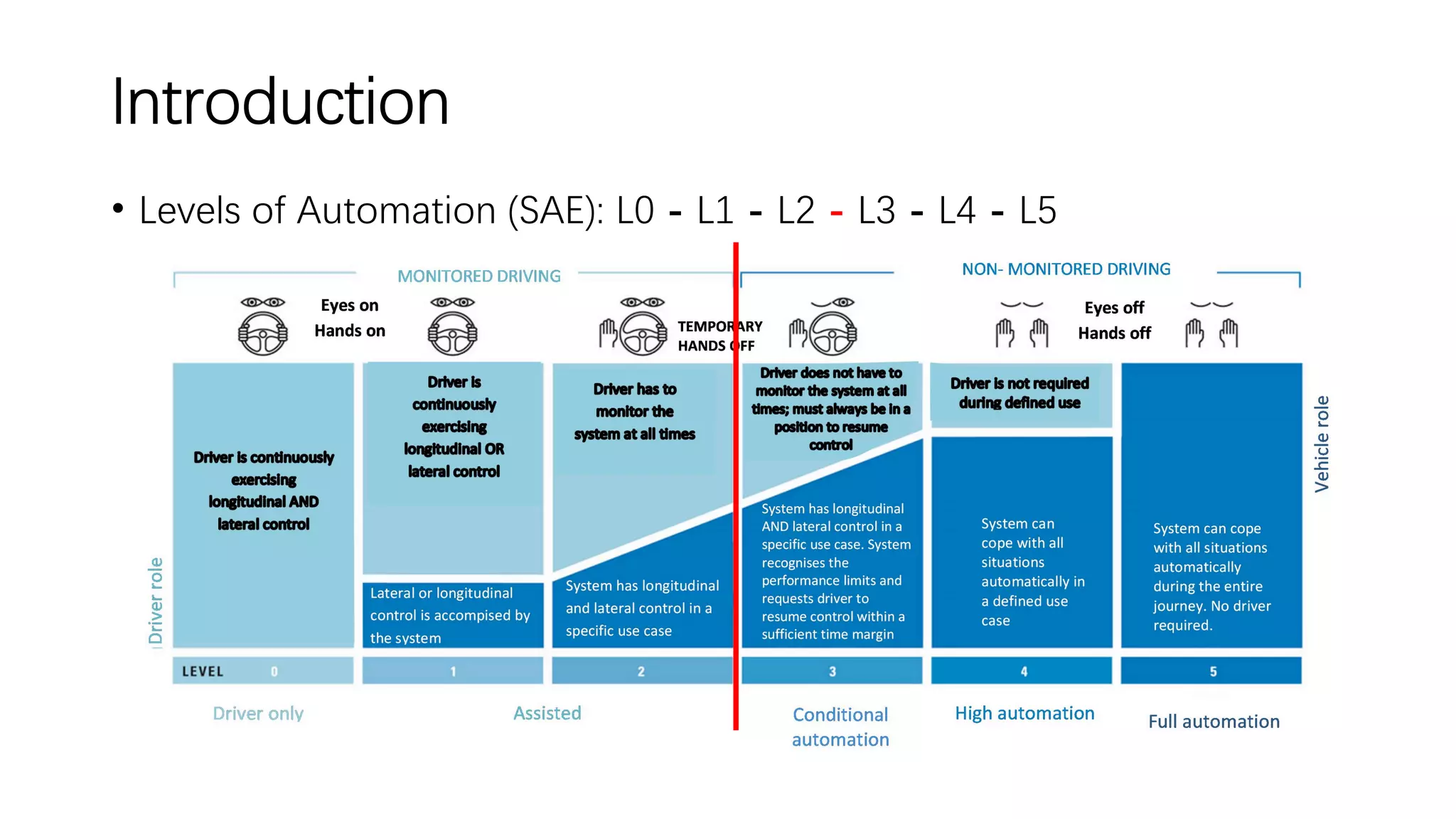
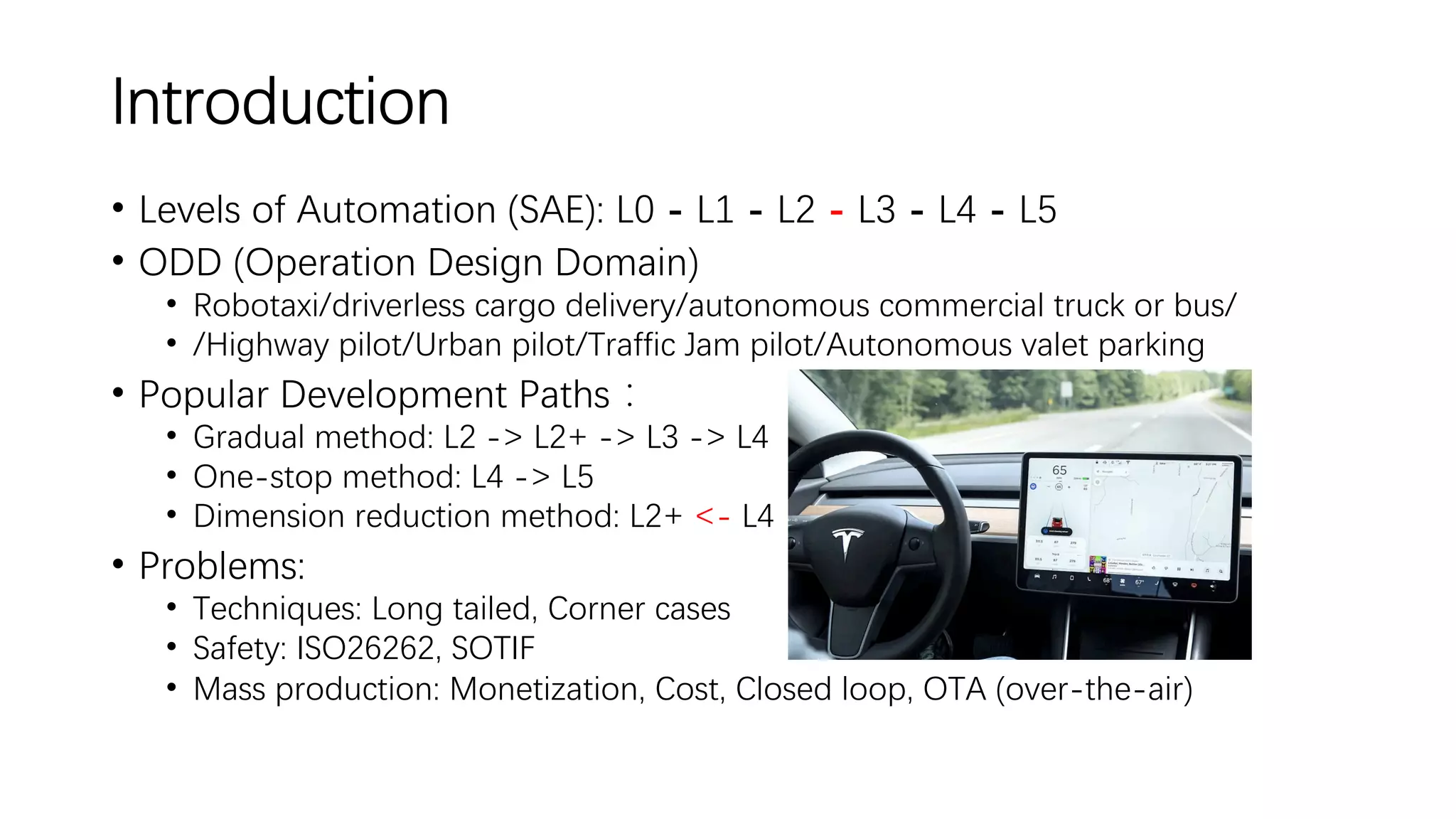
• Levels of Automation (SAE): L0 - L1 - L2 - L3 - L4 - L5
Introduction
• Levels of Automation (SAE): L0 - L1 - L2 - L3 - L4 - L5
• ODD (Operation Design Domain)
• Robotaxi/driverless cargo delivery/autonomous commercial truck or bus/
• /Highway pilot/Urban pilot/Traffic Jam pilot/Autonomous valet parking
• Popular Development Paths:
• Gradual method: L2 -> L2+ -> L3 -> L4
• One-stop method: L4 -> L5
• Dimension reduction method: L2+ <- L4
• Problems:
• Techniques: Long tailed, Corner cases
• Safety: ISO26262, SOTIF
• Mass production: Monetization, Cost, Closed loop, OTA (over-the-air)
Introduction
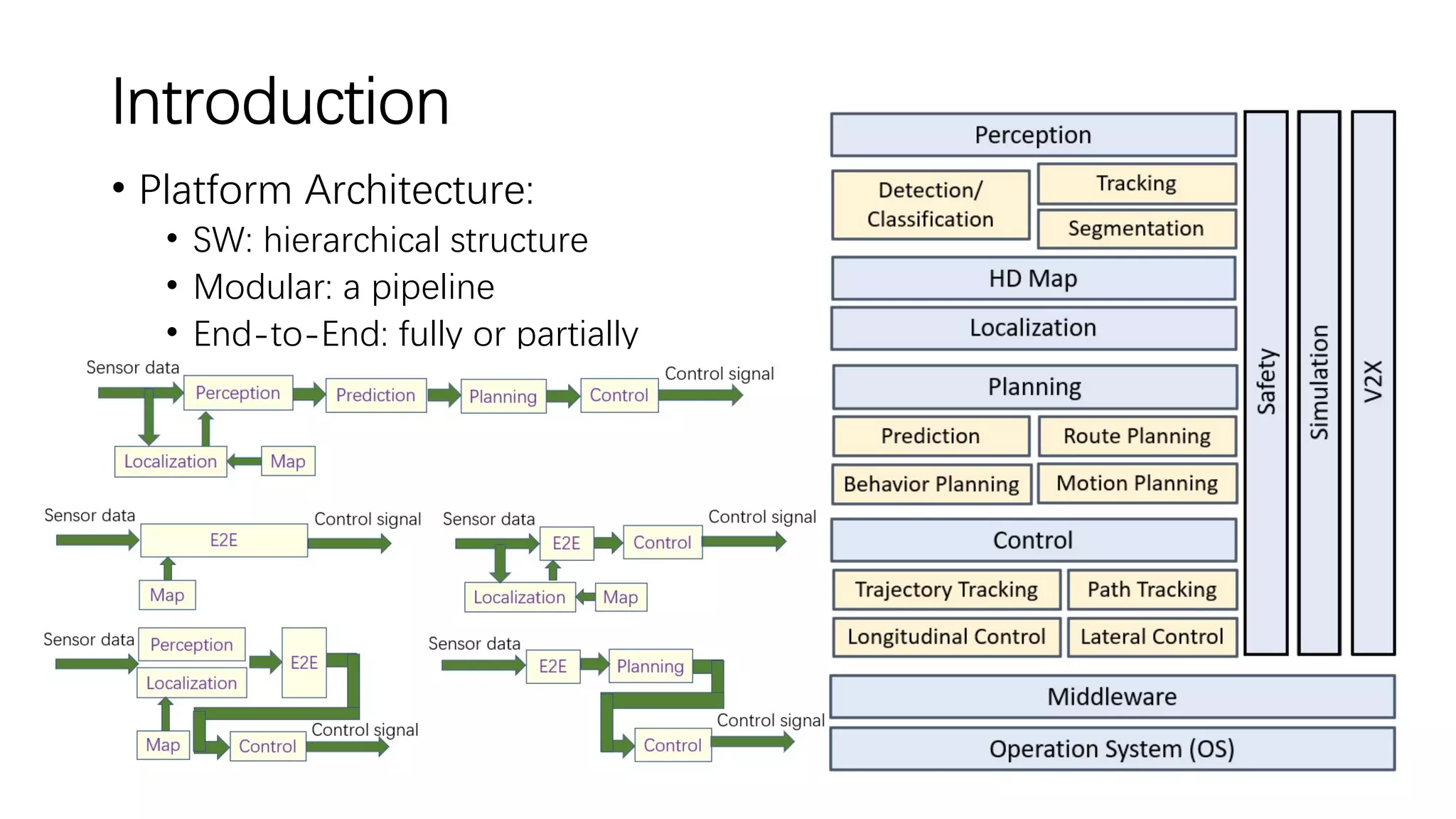
• Platform Architecture:
• SW: hierarchical structure
• Modular: a pipeline
• End-to-End: fully or partially
Perception
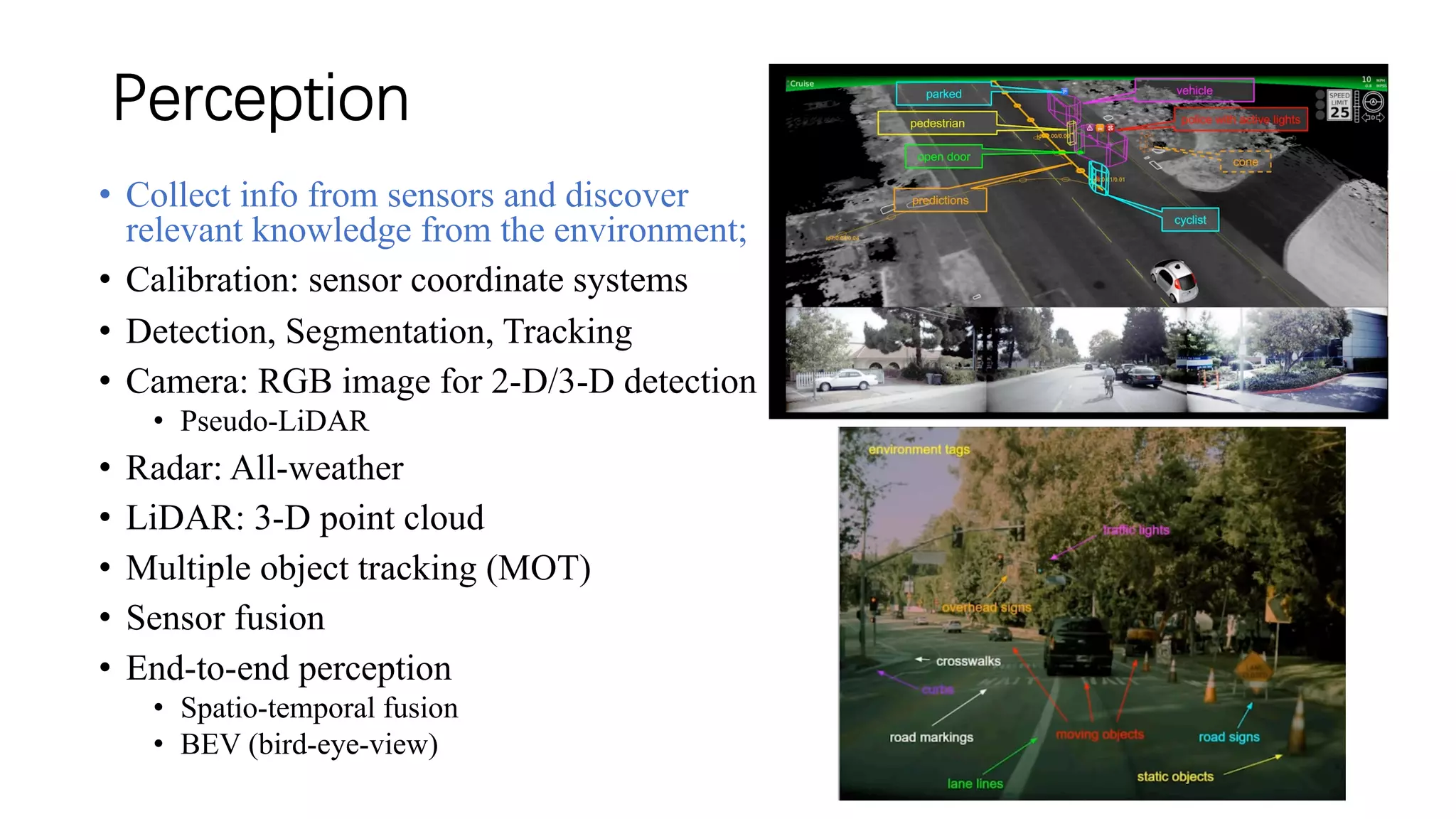
• Collect info from sensors and discover
relevant knowledge from the environment;
• Calibration: sensor coordinate systems
• Detection, Segmentation, Tracking
• Camera: RGB image for 2-D/3-D detection
• Pseudo-LiDAR
• Radar: All-weather
• LiDAR: 3-D point cloud
• Multiple object tracking (MOT)
• Sensor fusion
• End-to-end perception
• Spatio-temporal fusion
• BEV (bird-eye-view)
Perception
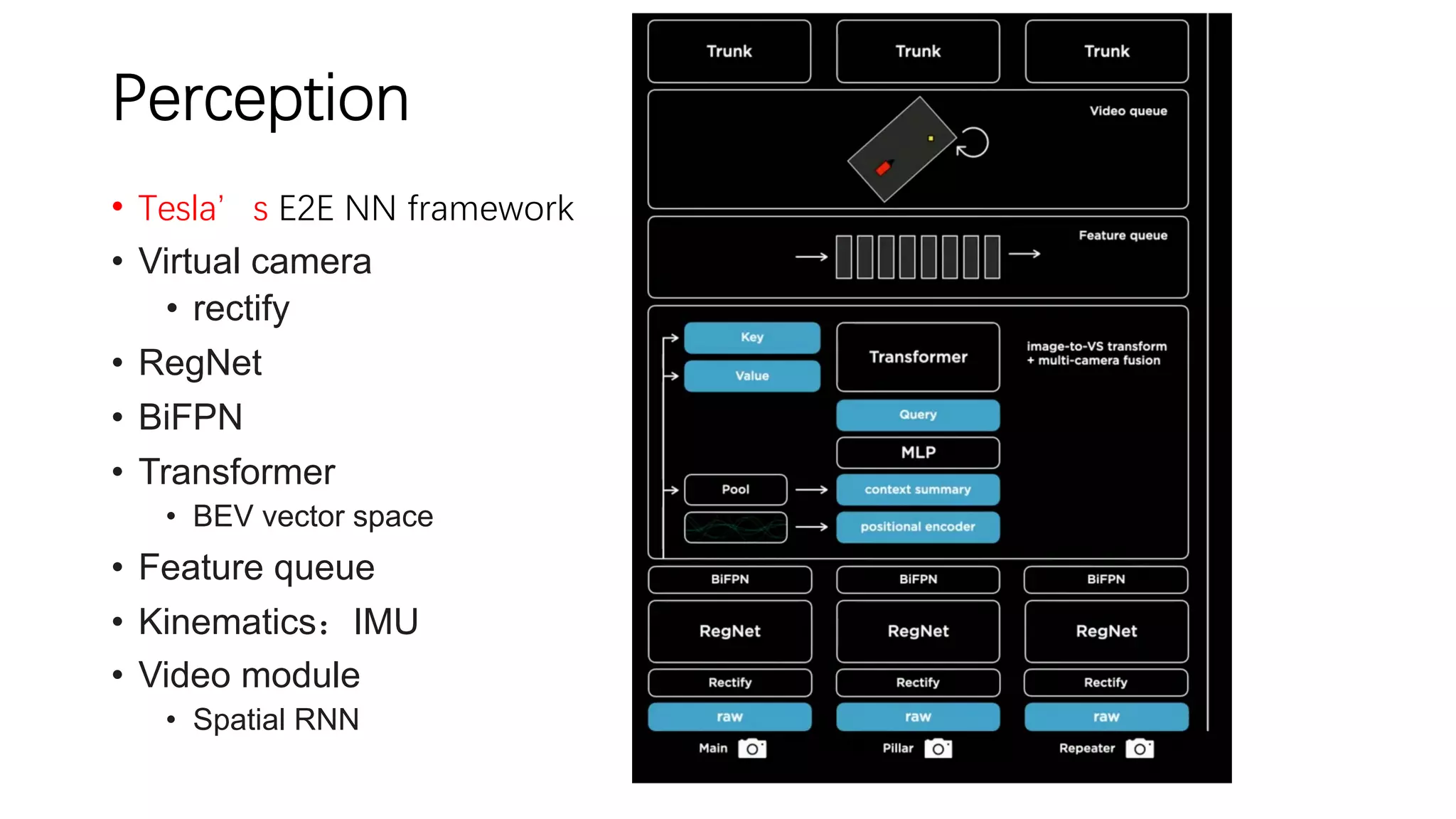
• Tesla’s E2E NN framework
• Virtual camera
• rectify
• RegNet
• BiFPN
• Transformer
• BEV vector space
• Feature queue
• Kinematics:IMU
• Video module
• Spatial RNN
Mapping
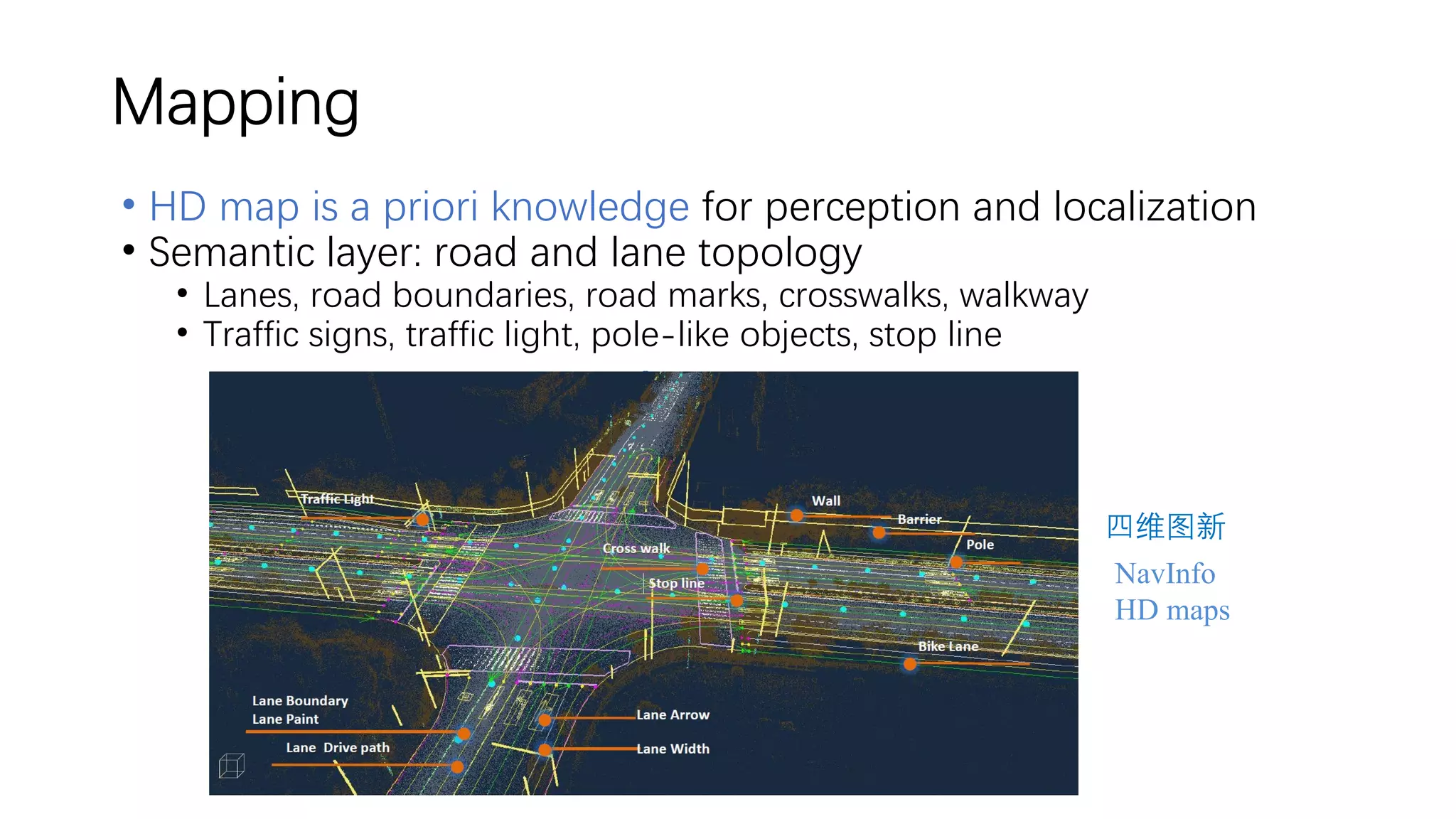
• HD map is a priori knowledge for perception and localization
• Semantic layer: road and lane topology
• Lanes, road boundaries, road marks, crosswalks, walkway
• Traffic signs, traffic light, pole-like objects, stop line
NavInfo
HD maps
四维图新
Mapping
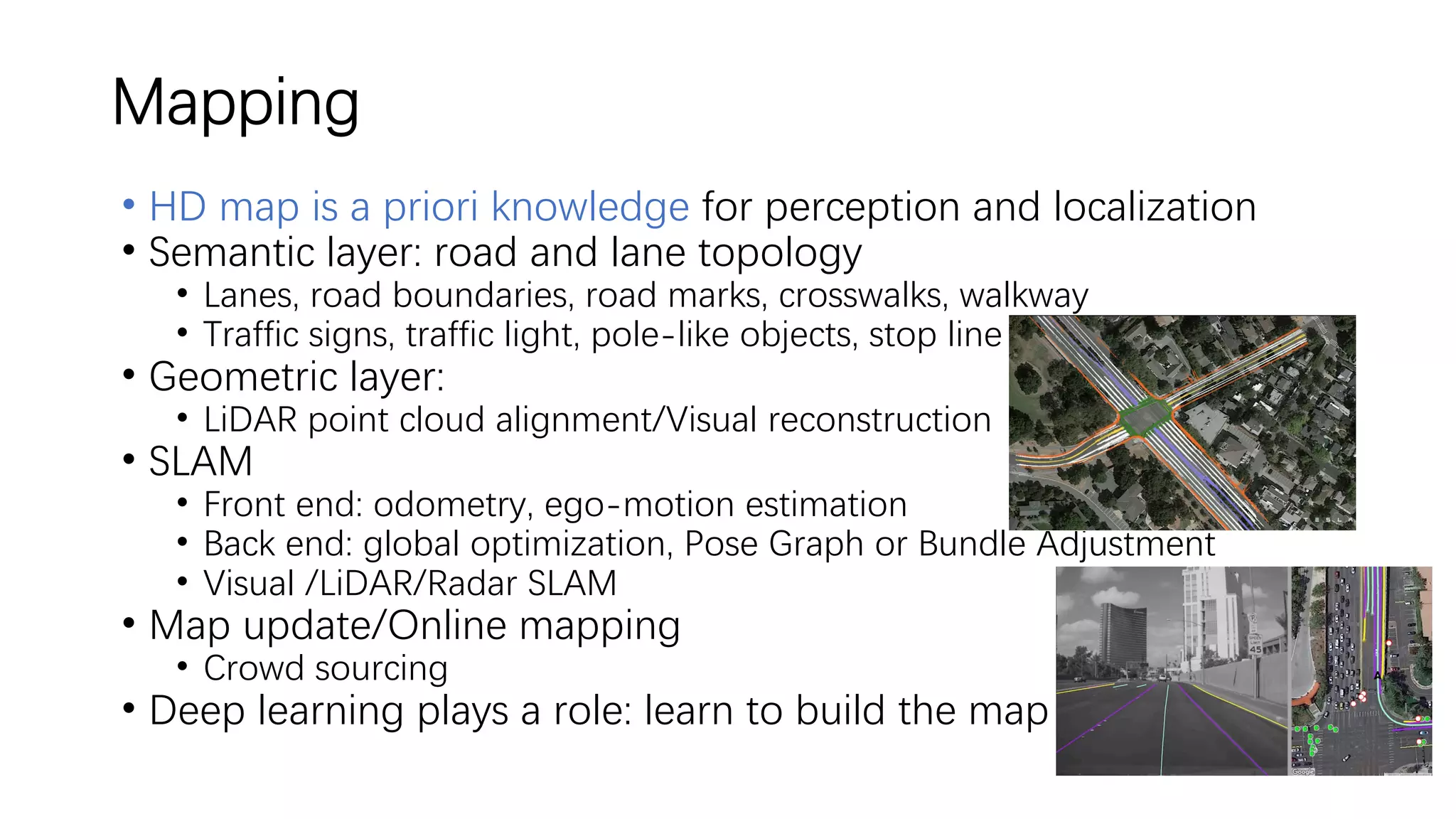
• HD map is a priori knowledge for perception and localization
• Semantic layer: road and lane topology
• Lanes, road boundaries, road marks, crosswalks, walkway
• Traffic signs, traffic light, pole-like objects, stop line
• Geometric layer:
• LiDAR point cloud alignment/Visual reconstruction
• SLAM
• Front end: odometry, ego-motion estimation
• Back end: global optimization, Pose Graph or Bundle Adjustment
• Visual /LiDAR/Radar SLAM
• Map update/Online mapping
• Crowd sourcing
• Deep learning plays a role: learn to build the map
Mapping
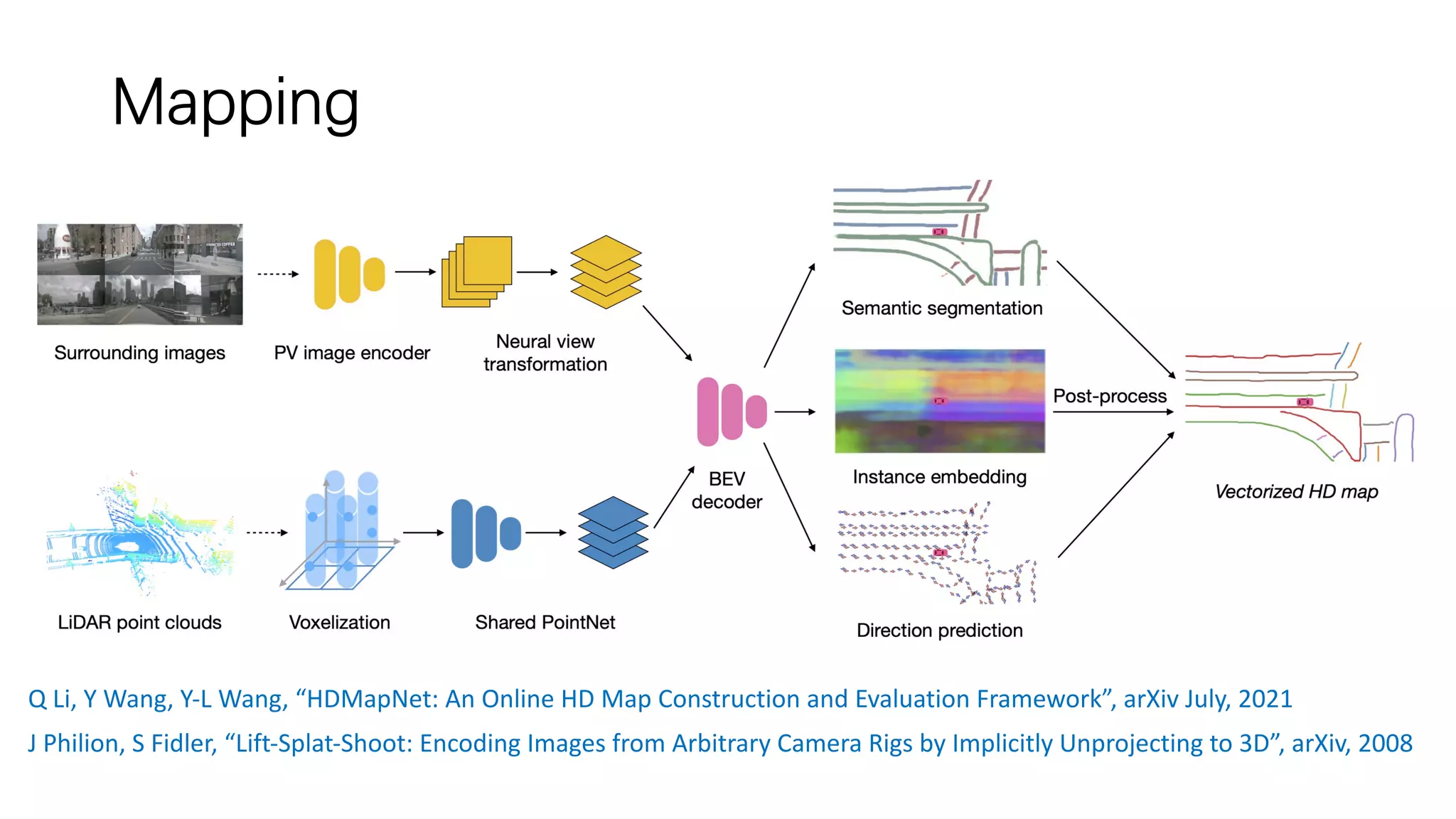
Q Li, Y Wang, Y-L Wang, “HDMapNet: An Online HD Map Construction and Evaluation Framework”, arXiv July, 2021
J Philion, S Fidler, “Lift-Splat-Shoot: Encoding Images from Arbitrary Camera Rigs by Implicitly Unprojecting to 3D”, arXiv, 2008
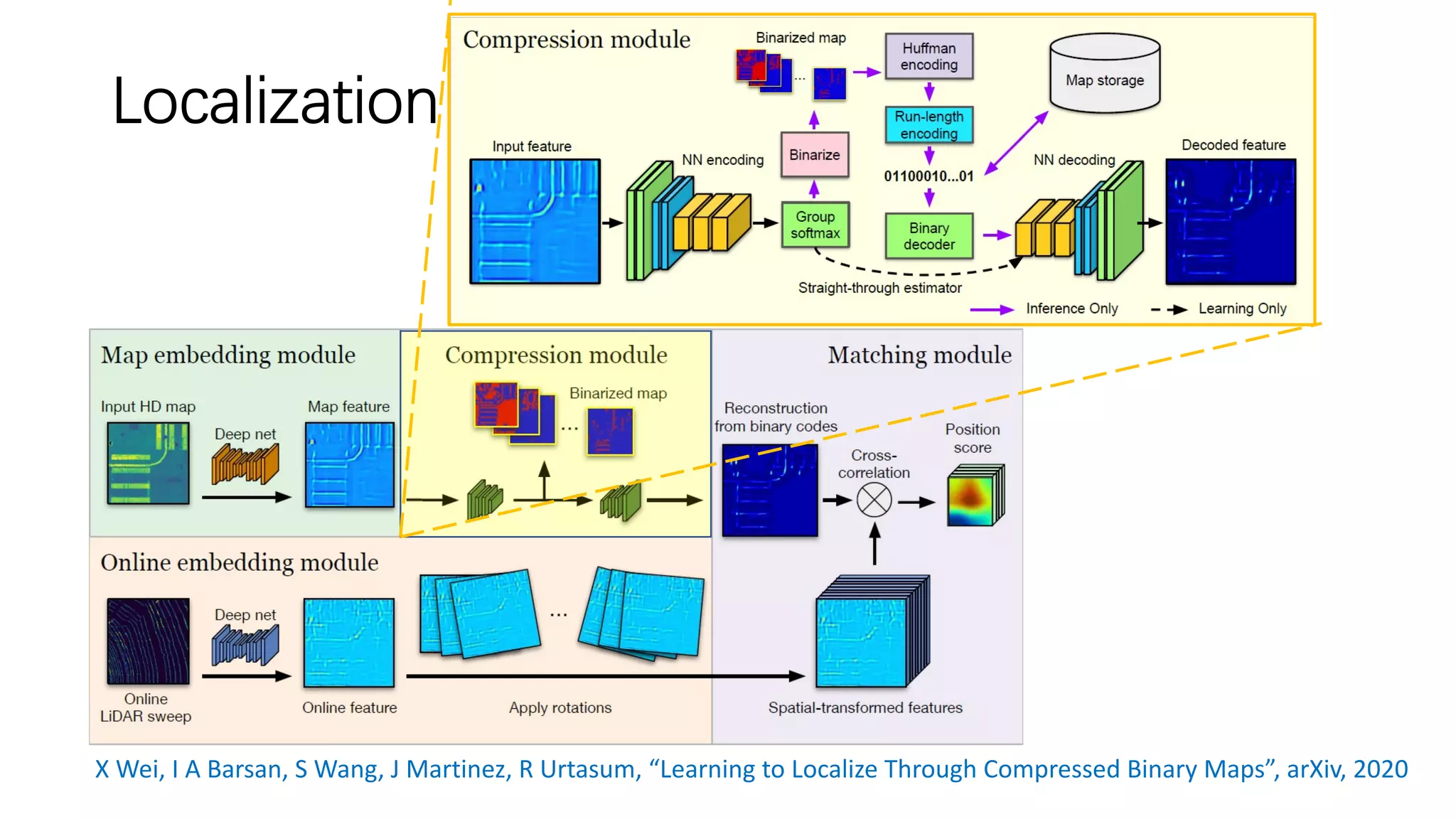
Localization
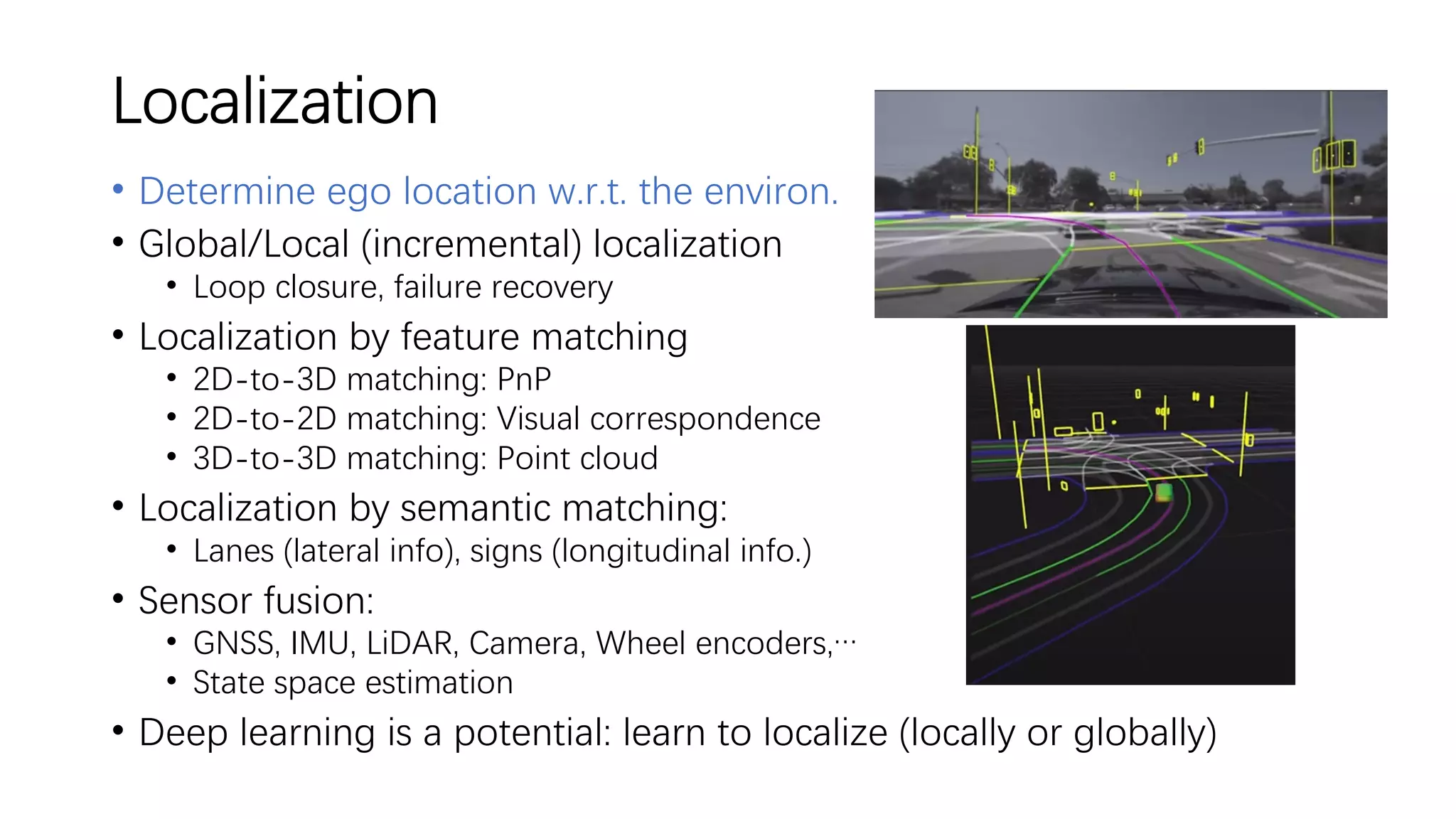
• Determine ego location w.r.t. the environ.
• Global/Local (incremental) localization
• Loop closure, failure recovery
• Localization by feature matching
• 2D-to-3D matching: PnP
• 2D-to-2D matching: Visual correspondence
• 3D-to-3D matching: Point cloud
• Localization by semantic matching:
• Lanes (lateral info), signs (longitudinal info.)
• Sensor fusion:
• GNSS, IMU, LiDAR, Camera, Wheel encoders,…
• State space estimation
• Deep learning is a potential: learn to localize (locally or globally)
Localization
X Wei, I A Barsan, S Wang, J Martinez, R Urtasum, “Learning to Localize Through Compressed Binary Maps”, arXiv, 2020
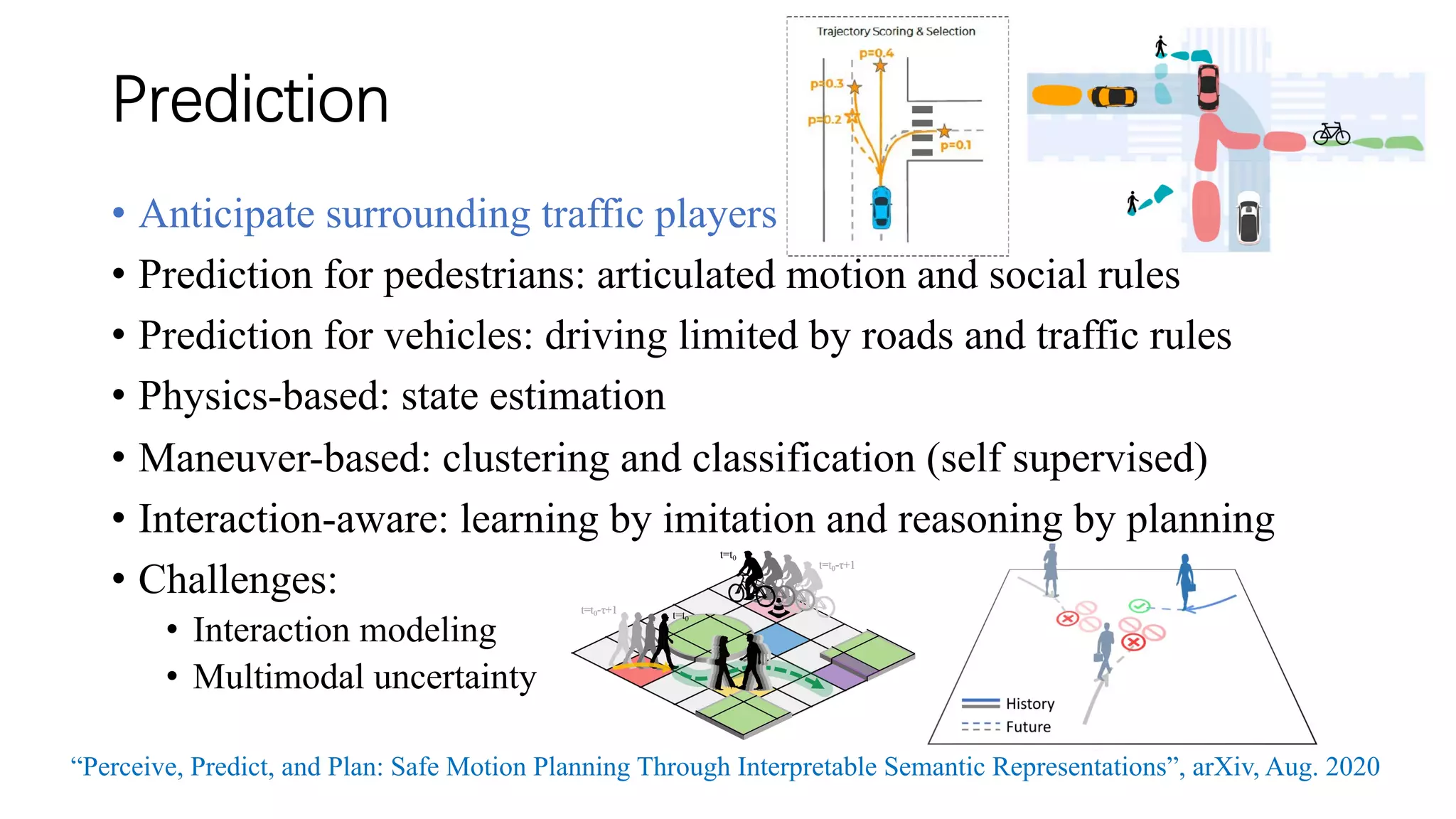
Prediction
• Anticipate surrounding traffic players
• Prediction for pedestrians: articulated motion and social rules
• Prediction for vehicles: driving limited by roads and traffic rules
• Physics-based: state estimation
• Maneuver-based: clustering and classification (self supervised)
• Interaction-aware: learning by imitation and reasoning by planning
• Challenges:
• Interaction modeling
• Multimodal uncertainty
“Perceive, Predict, and Plan: Safe Motion Planning Through Interpretable Semantic Representations”, arXiv, Aug. 2020
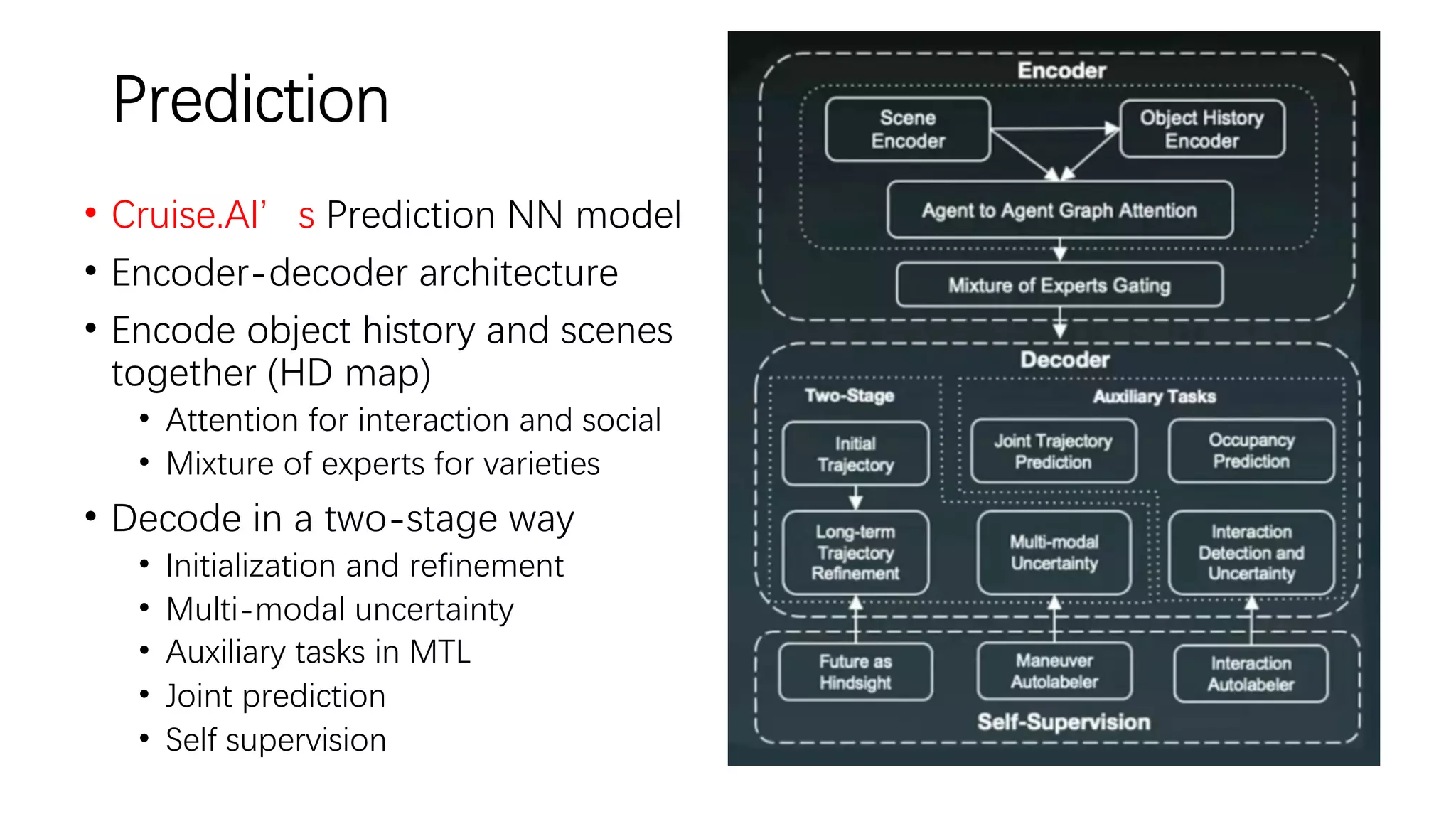
Prediction
• Cruise.AI’s Prediction NN model
• Encoder-decoder architecture
• Encode object history and scenes
together (HD map)
• Attention for interaction and social
• Mixture of experts for varieties
• Decode in a two-stage way
• Initialization and refinement
• Multi-modal uncertainty
• Auxiliary tasks in MTL
• Joint prediction
• Self supervision
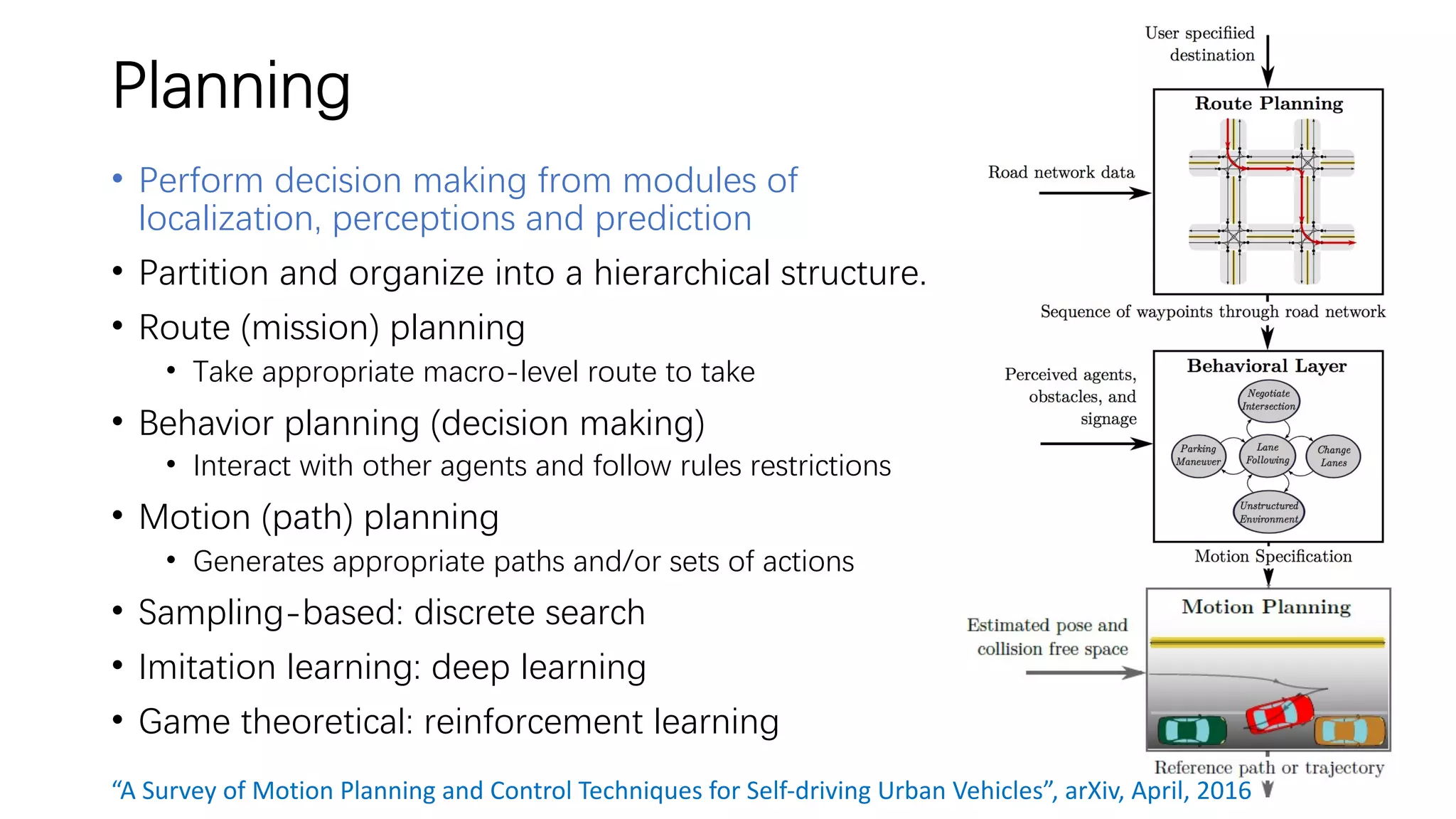
Planning
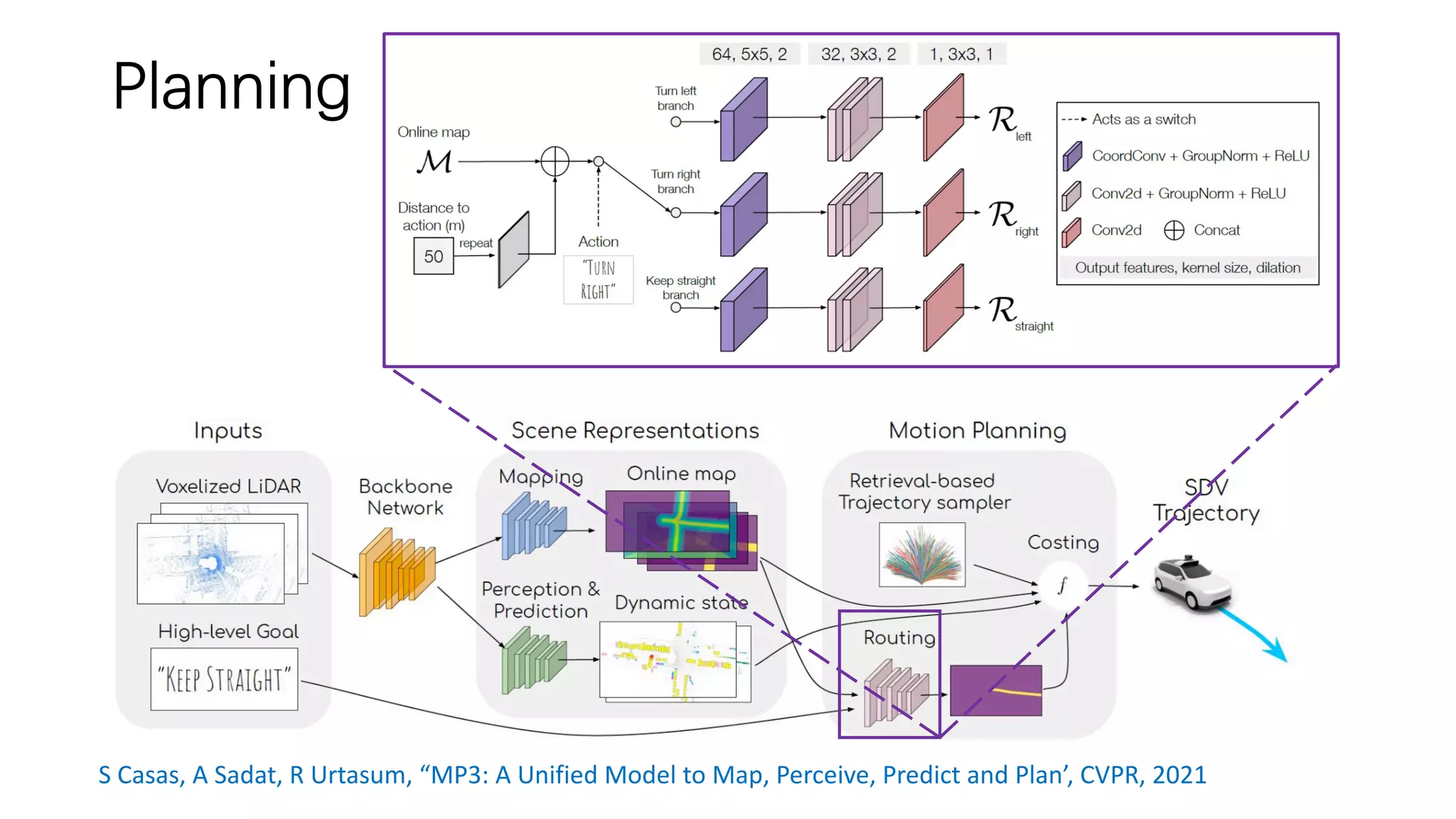
• Perform decision making from modules of
localization, perceptions and prediction
• Partition and organize into a hierarchical structure.
• Route (mission) planning
• Take appropriate macro-level route to take
• Behavior planning (decision making)
• Interact with other agents and follow rules restrictions
• Motion (path) planning
• Generates appropriate paths and/or sets of actions
• Sampling-based: discrete search
• Imitation learning: deep learning
• Game theoretical: reinforcement learning
“A Survey of Motion Planning and Control Techniques for Self-driving Urban Vehicles”, arXiv, April, 2016
Planning
S Casas, A Sadat, R Urtasum, “MP3: A Unified Model to Map, Perceive, Predict and Plan’, CVPR, 2021
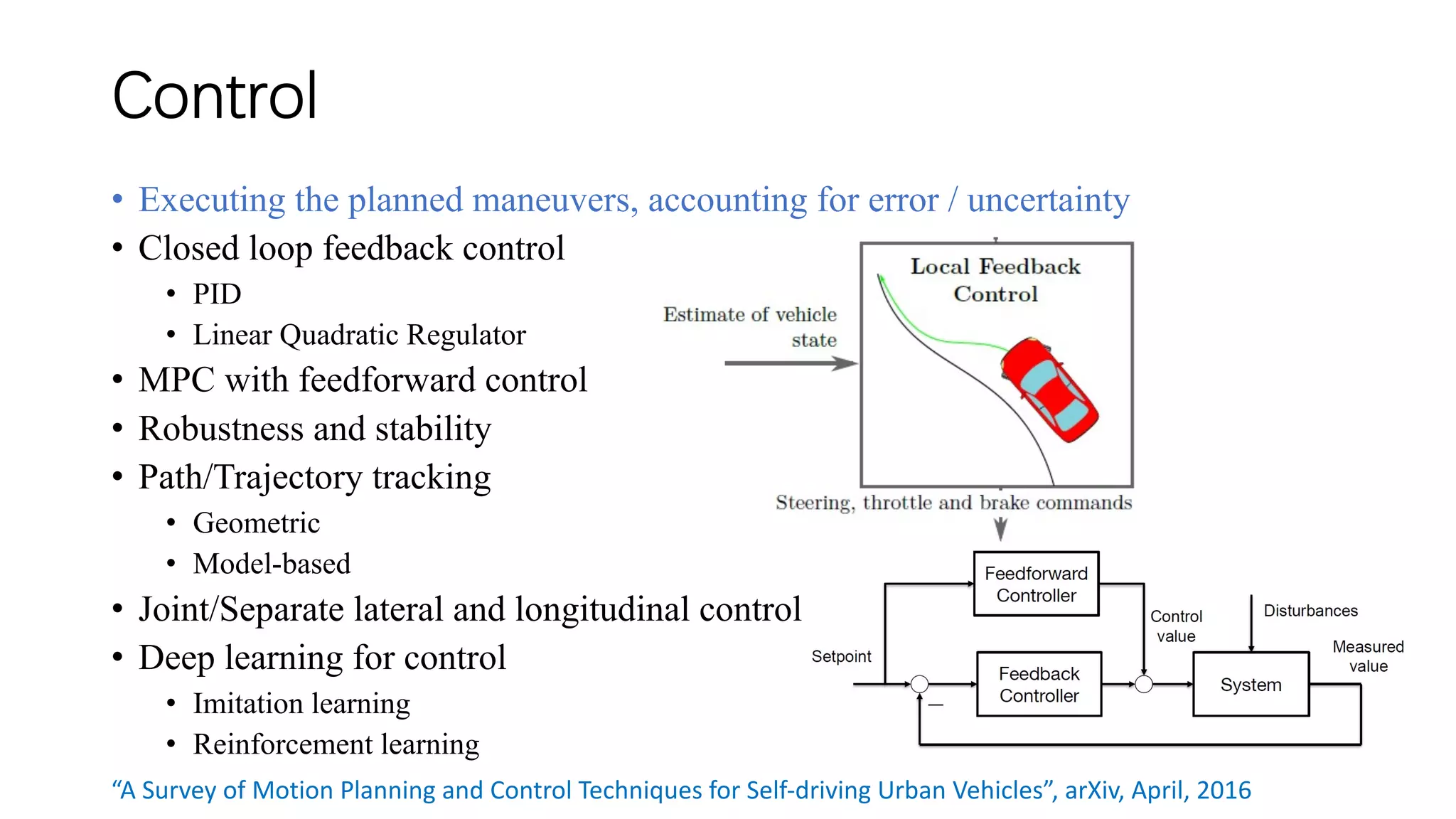
Control
• Executing the planned maneuvers, accounting for error / uncertainty
• Closed loop feedback control
• PID
• Linear Quadratic Regulator
• MPC with feedforward control
• Robustness and stability
• Path/Trajectory tracking
• Geometric
• Model-based
• Joint/Separate lateral and longitudinal control
• Deep learning for control
• Imitation learning
• Reinforcement learning
“A Survey of Motion Planning and Control Techniques for Self-driving Urban Vehicles”, arXiv, April, 2016
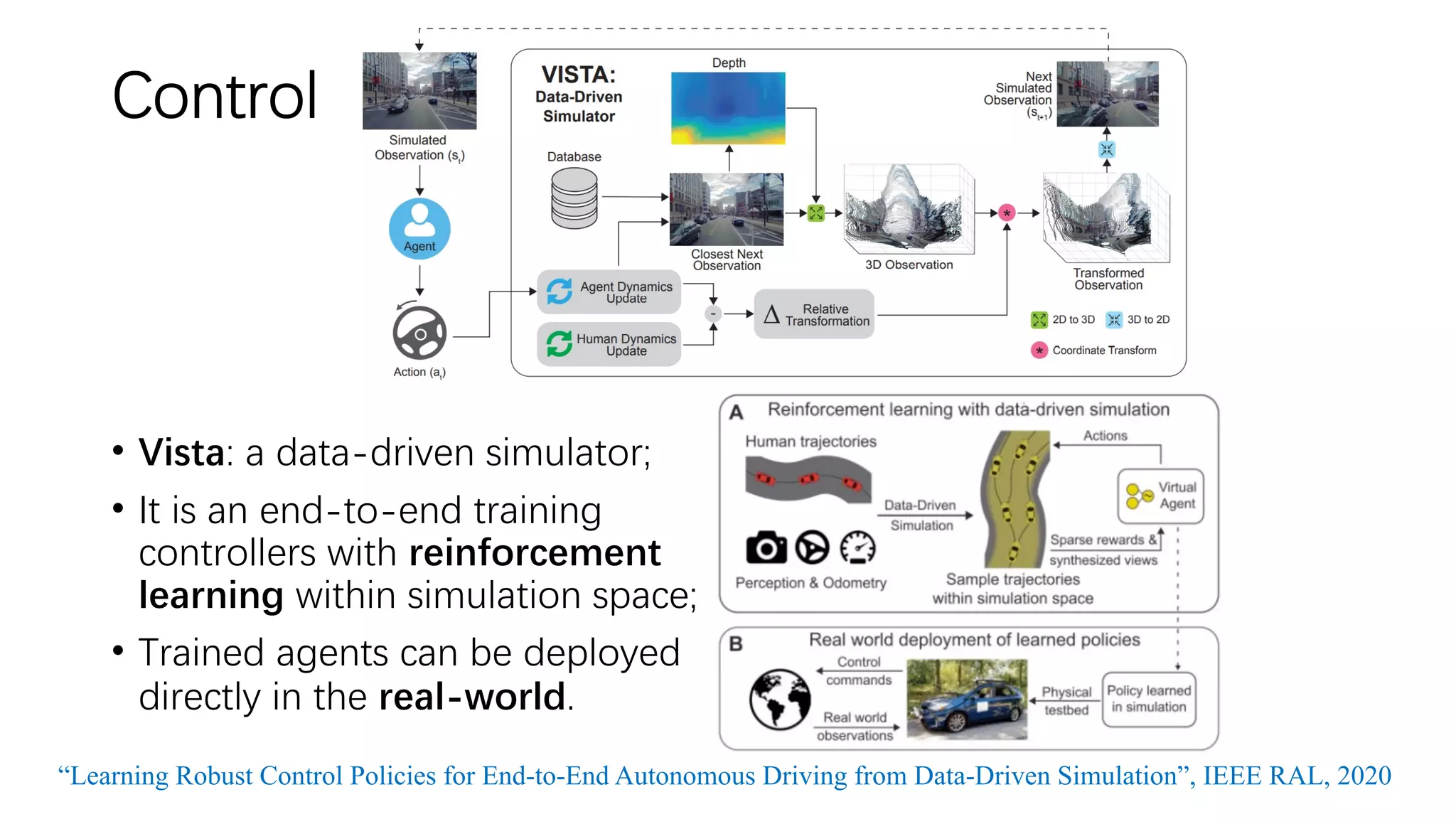
Control
“Learning Robust Control Policies for End-to-End Autonomous Driving from Data-Driven Simulation”, IEEE RAL, 2020
• Vista: a data-driven simulator;
• It is an end-to-end training
controllers with reinforcement
learning within simulation space;
• Trained agents can be deployed
directly in the real-world.
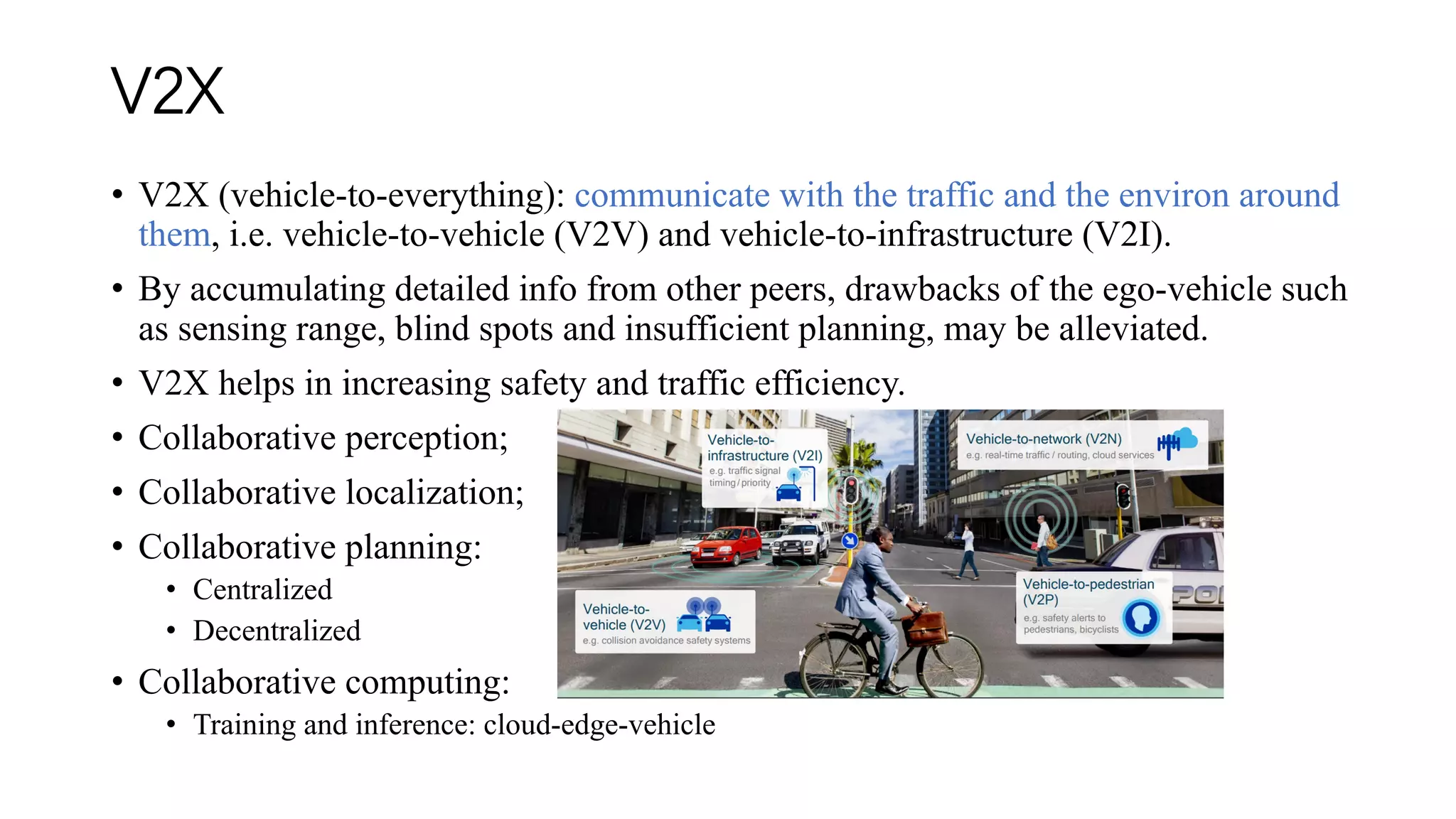
V2X
• V2X (vehicle-to-everything): communicate with the traffic and the environ around
them, i.e. vehicle-to-vehicle (V2V) and vehicle-to-infrastructure (V2I).
• By accumulating detailed info from other peers, drawbacks of the ego-vehicle such
as sensing range, blind spots and insufficient planning, may be alleviated.
• V2X helps in increasing safety and traffic efficiency.
• Collaborative perception;
• Collaborative localization;
• Collaborative planning:
• Centralized
• Decentralized
• Collaborative computing:
• Training and inference: cloud-edge-vehicle
V2X
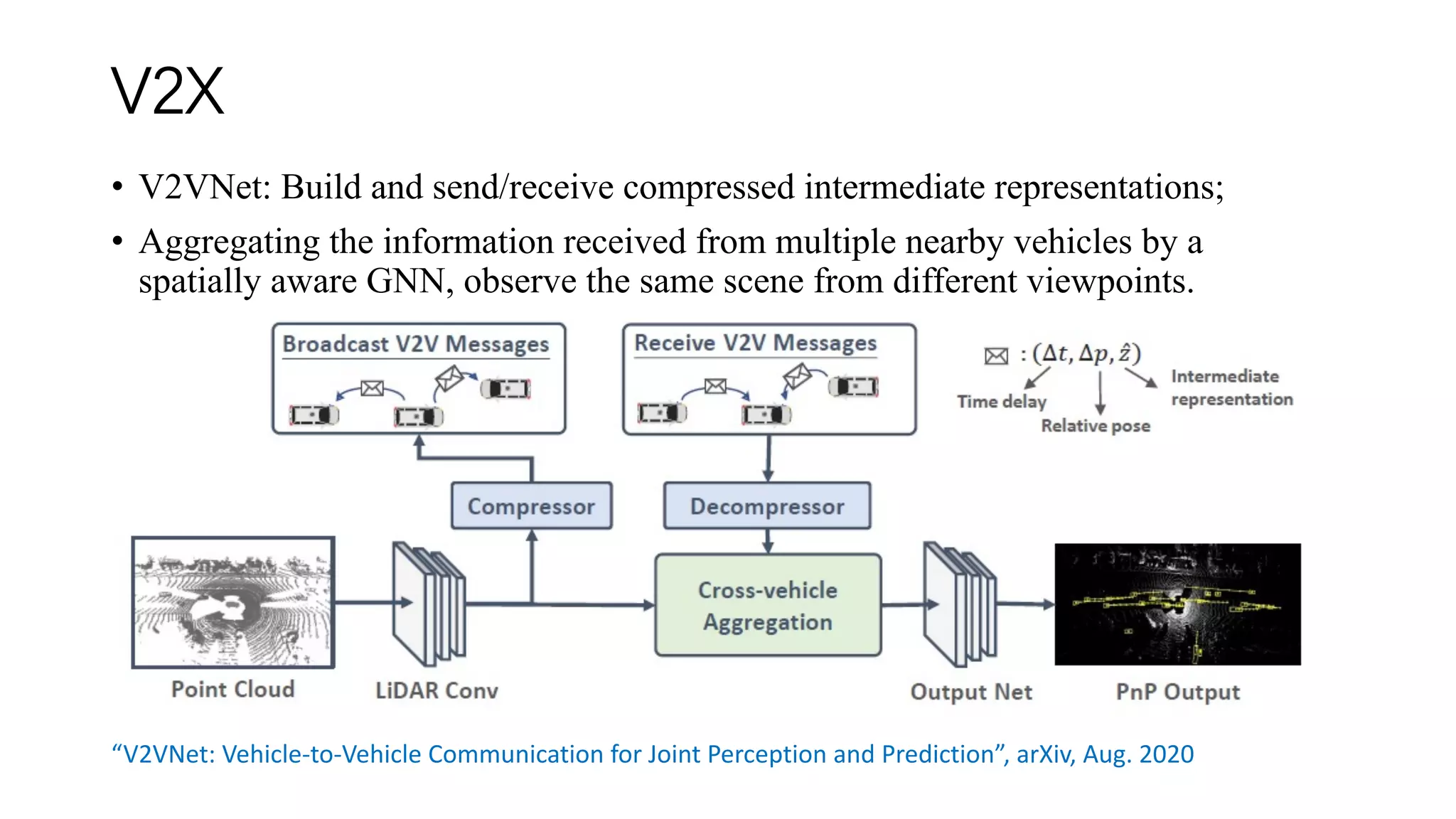
• V2VNet: Build and send/receive compressed intermediate representations;
• Aggregating the information received from multiple nearby vehicles by a
spatially aware GNN, observe the same scene from different viewpoints.
“V2VNet: Vehicle-to-Vehicle Communication for Joint Perception and Prediction”, arXiv, Aug. 2020
Safety
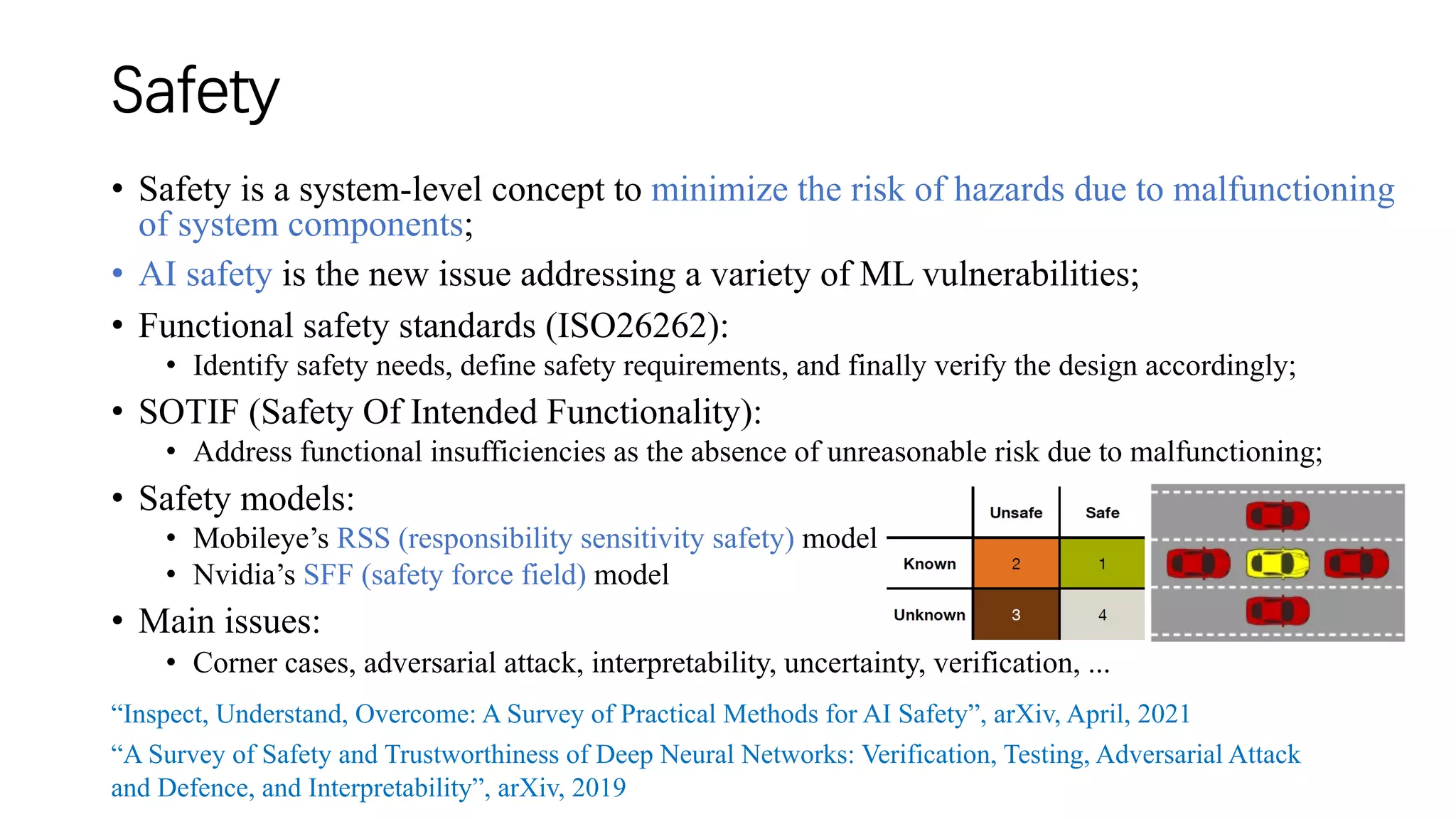
• Safety is a system-level concept to minimize the risk of hazards due to malfunctioning
of system components;
• AI safety is the new issue addressing a variety of ML vulnerabilities;
• Functional safety standards (ISO26262):
• Identify safety needs, define safety requirements, and finally verify the design accordingly;
• SOTIF (Safety Of Intended Functionality):
• Address functional insufficiencies as the absence of unreasonable risk due to malfunctioning;
• Safety models:
• Mobileye’s RSS (responsibility sensitivity safety) model
• Nvidia’s SFF (safety force field) model
• Main issues:
• Corner cases, adversarial attack, interpretability, uncertainty, verification, ...
“Inspect, Understand, Overcome: A Survey of Practical Methods for AI Safety”, arXiv, April, 2021
“A Survey of Safety and Trustworthiness of Deep Neural Networks: Verification, Testing, Adversarial Attack
and Defence, and Interpretability”, arXiv, 2019
Safety
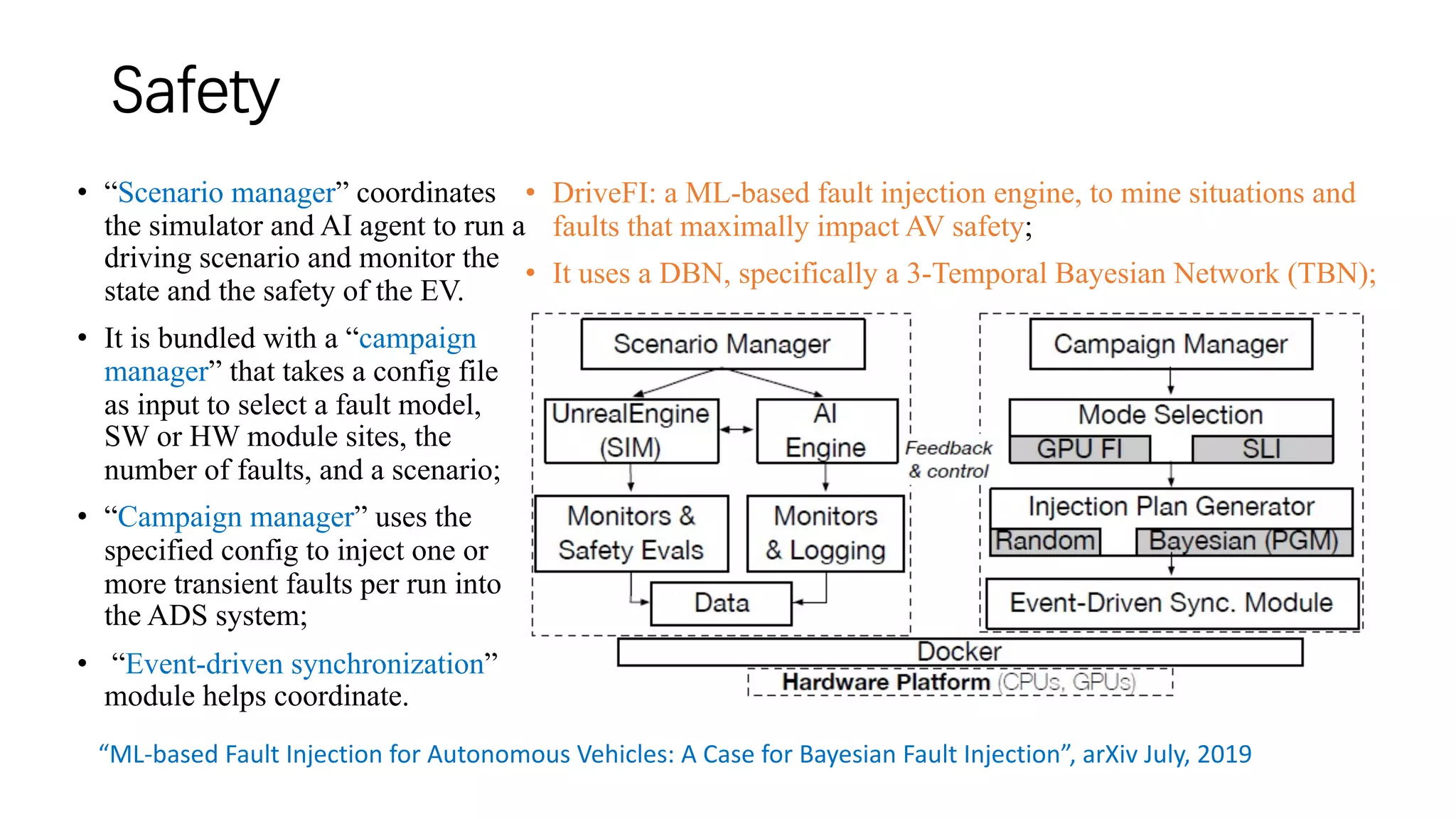
• “Scenario manager” coordinates
the simulator and AI agent to run a
driving scenario and monitor the
state and the safety of the EV.
• It is bundled with a “campaign
manager” that takes a config file
as input to select a fault model,
SW or HW module sites, the
number of faults, and a scenario;
• “Campaign manager” uses the
specified config to inject one or
more transient faults per run into
the ADS system;
• “Event-driven synchronization”
module helps coordinate.
“ML-based Fault Injection for Autonomous Vehicles: A Case for Bayesian Fault Injection”, arXiv July, 2019
• DriveFI: a ML-based fault injection engine, to mine situations and
faults that maximally impact AV safety;
• It uses a DBN, specifically a 3-Temporal Bayesian Network (TBN);
Data Closed Loop
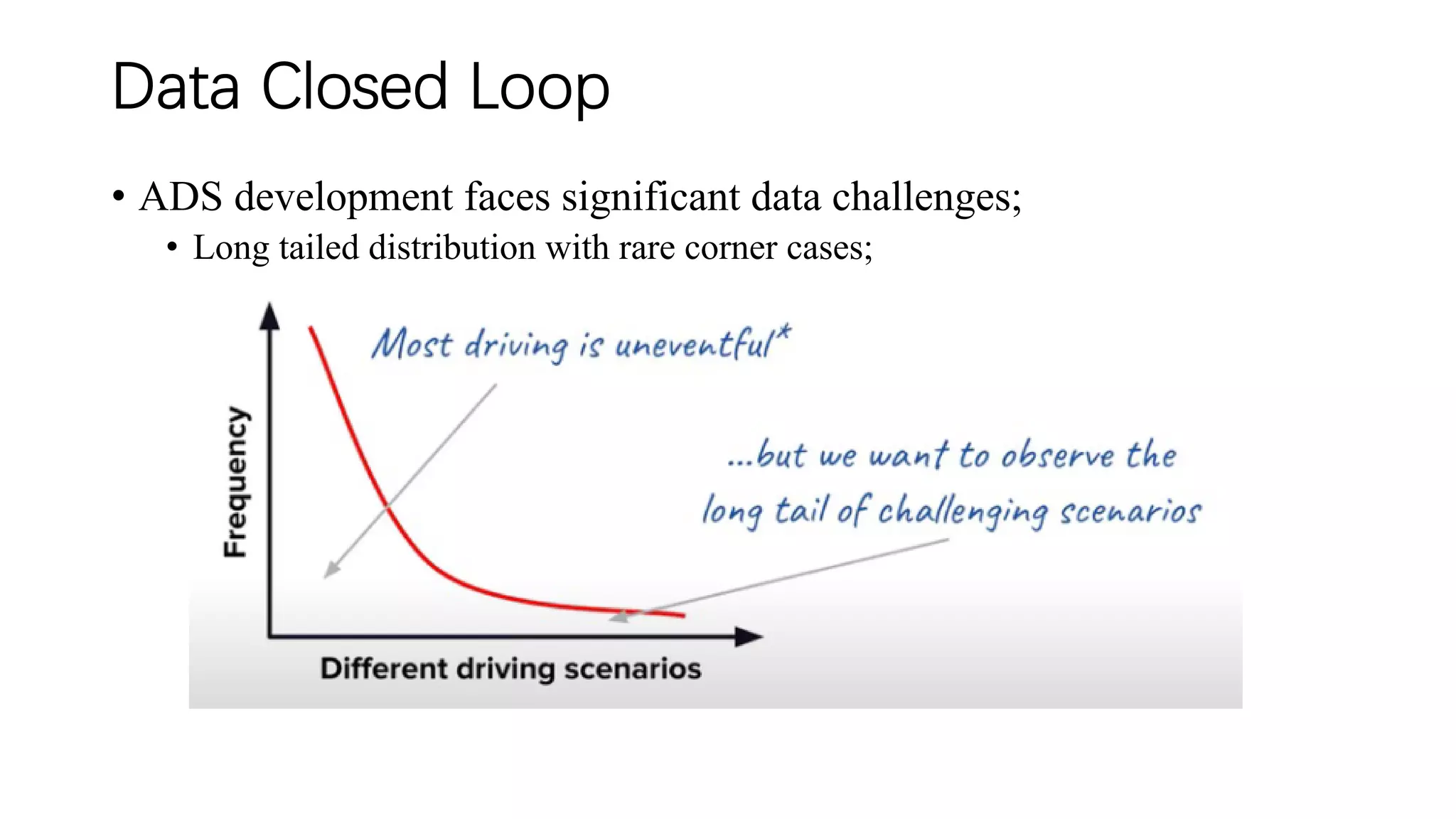
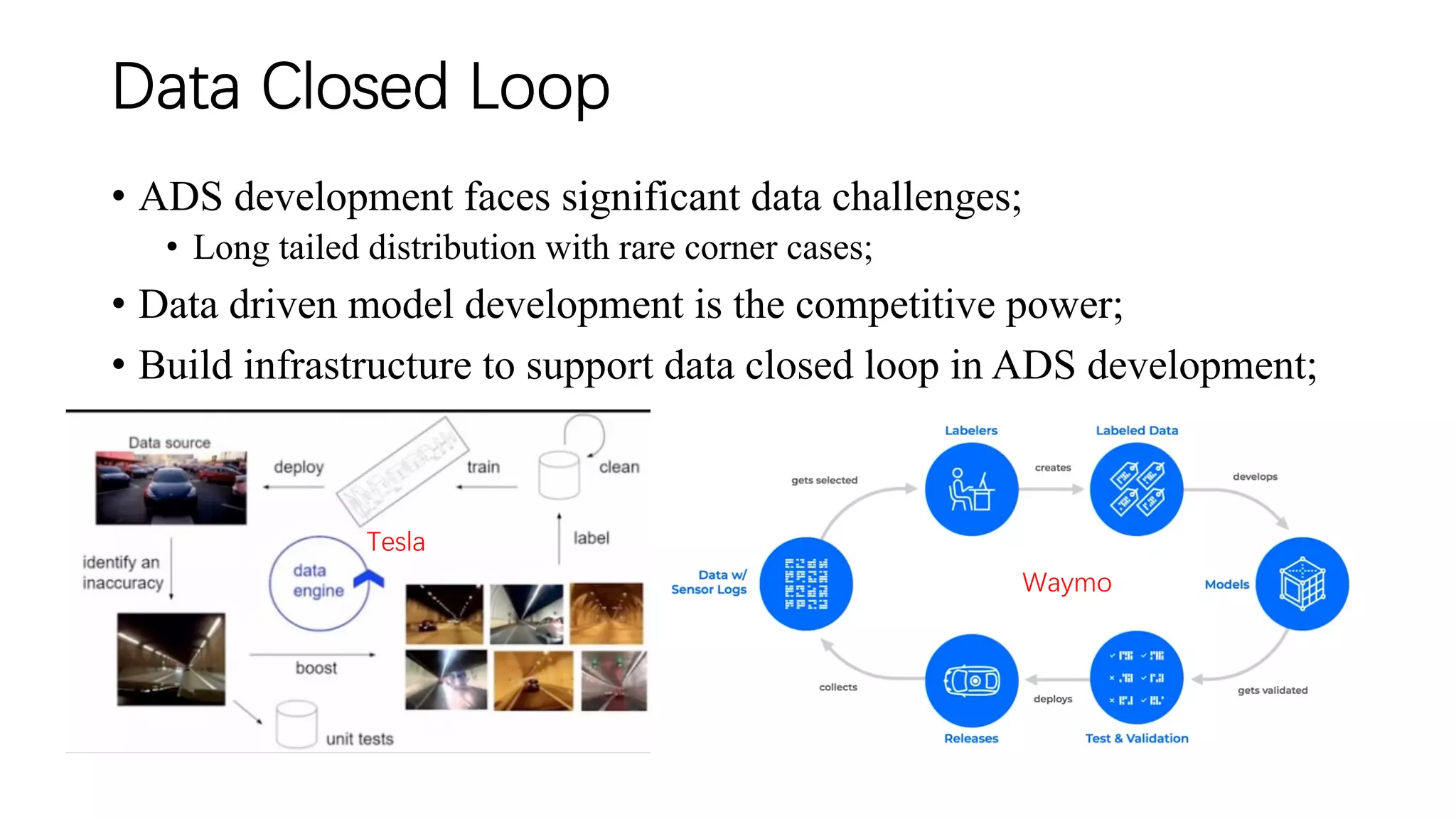
• ADS development faces significant data challenges;
• Long tailed distribution with rare corner cases;
Data Closed Loop
• ADS development faces significant data challenges;
• Long tailed distribution with rare corner cases;
• Data driven model development is the competitive power;
• Build infrastructure to support data closed loop in ADS development;
Tesla
Waymo
Data Closed Loop
• ADS development faces significant data challenges;
• Long tailed distribution with rare corner cases;
• Data driven model development is the competitive power;
• Build infrastructure to support data closed loop in ADS development;
• Data capture with “smart” selection;
• Active learning with uncertainty estimation, corner case/out-of-distribution detection;
• Efficient data annotation;
• Fully automated labeling tools: offline, large NN models on servers.
• Incremental model training;
• Adversarial augmentation, domain adaptation, open world learning.
• Simulation platform with scenario-based testing & validation;
• MIL (model-in-loop), SIL (SW-in-loop), HIL(HW-in-loop) and VIL (vehicle-in-loop);
• Deployment with OTA: shadow mode (Tesla)
Data Closed Loop
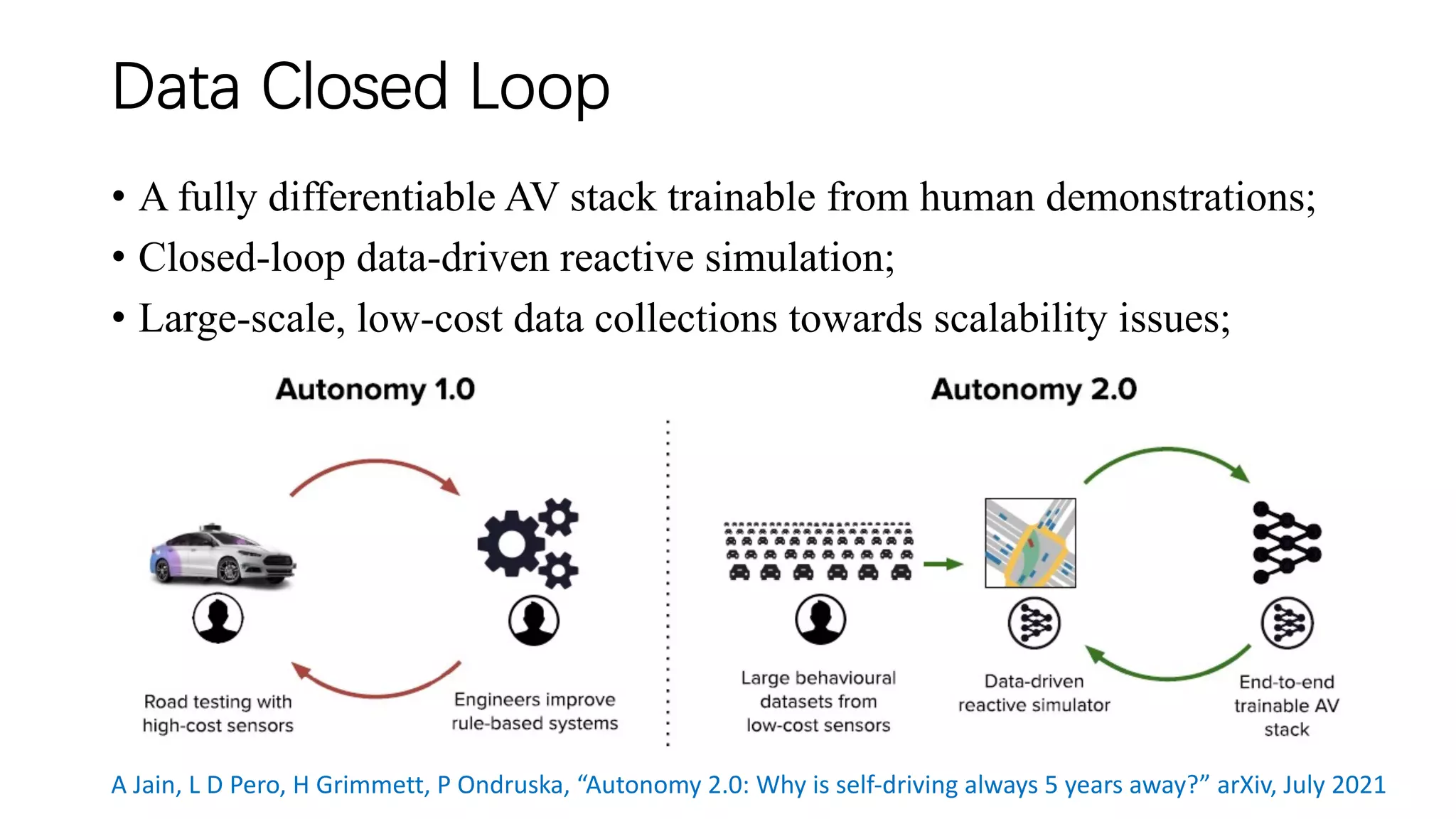
• A fully differentiable AV stack trainable from human demonstrations;
• Closed-loop data-driven reactive simulation;
• Large-scale, low-cost data collections towards scalability issues;
A Jain, L D Pero, H Grimmett, P Ondruska, “Autonomy 2.0: Why is self-driving always 5 years away?” arXiv, July 2021
Annotation
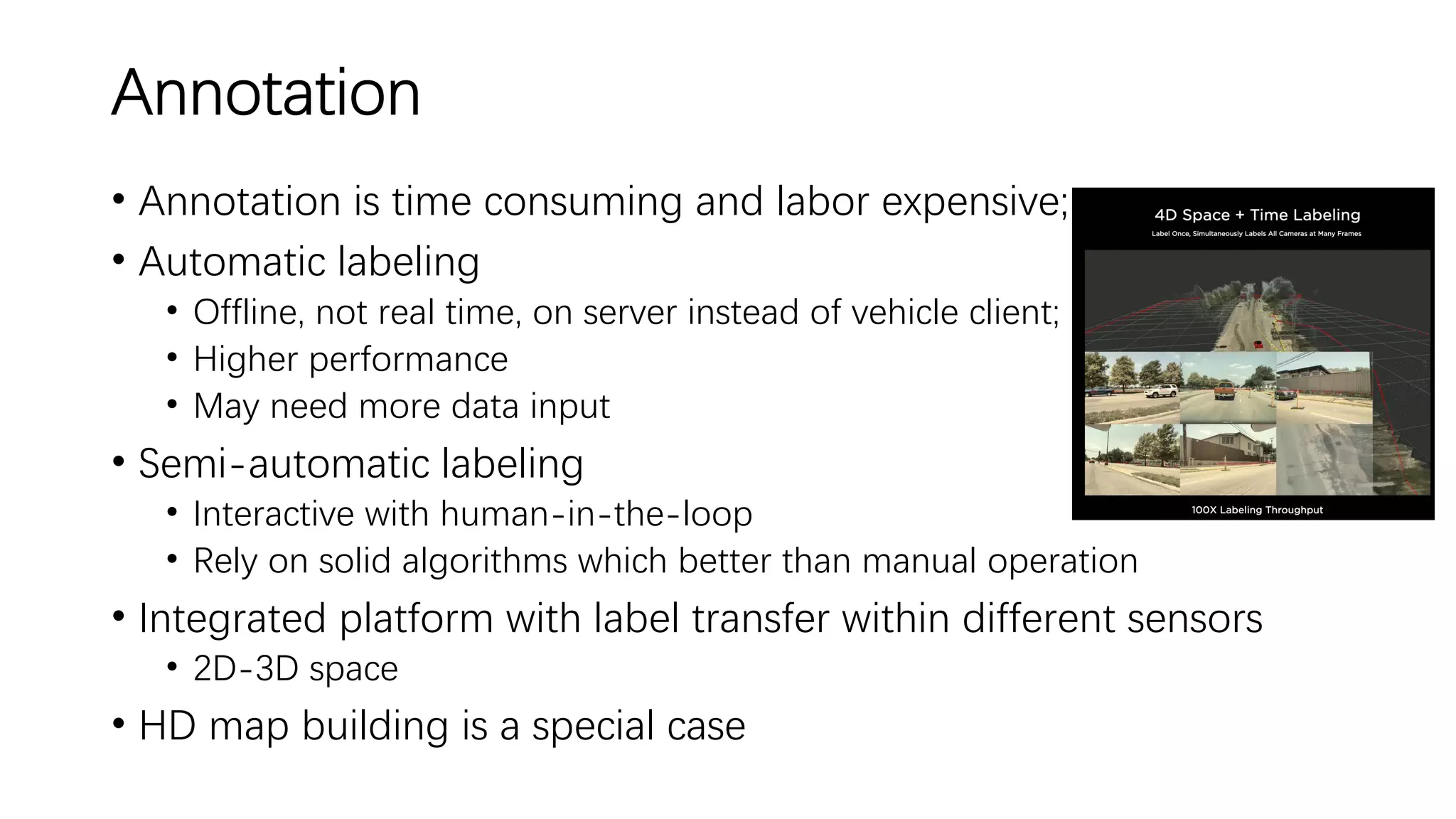
• Annotation is time consuming and labor expensive;
• Automatic labeling
• Offline, not real time, on server instead of vehicle client;
• Higher performance
• May need more data input
• Semi-automatic labeling
• Interactive with human-in-the-loop
• Rely on solid algorithms which better than manual operation
• Integrated platform with label transfer within different sensors
• 2D-3D space
• HD map building is a special case
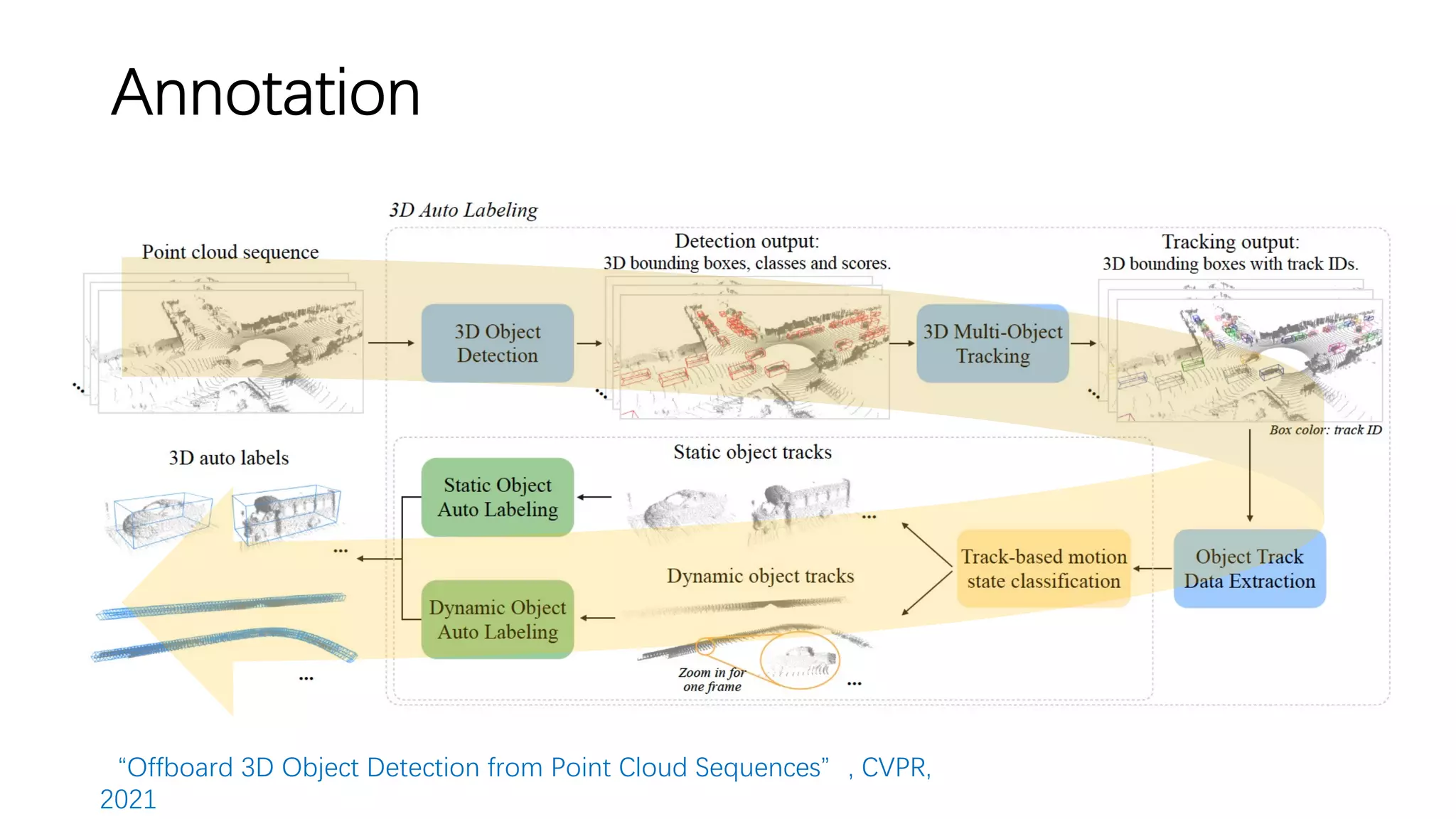
Annotation
“Offboard 3D Object Detection from Point Cloud Sequences”, CVPR,
2021
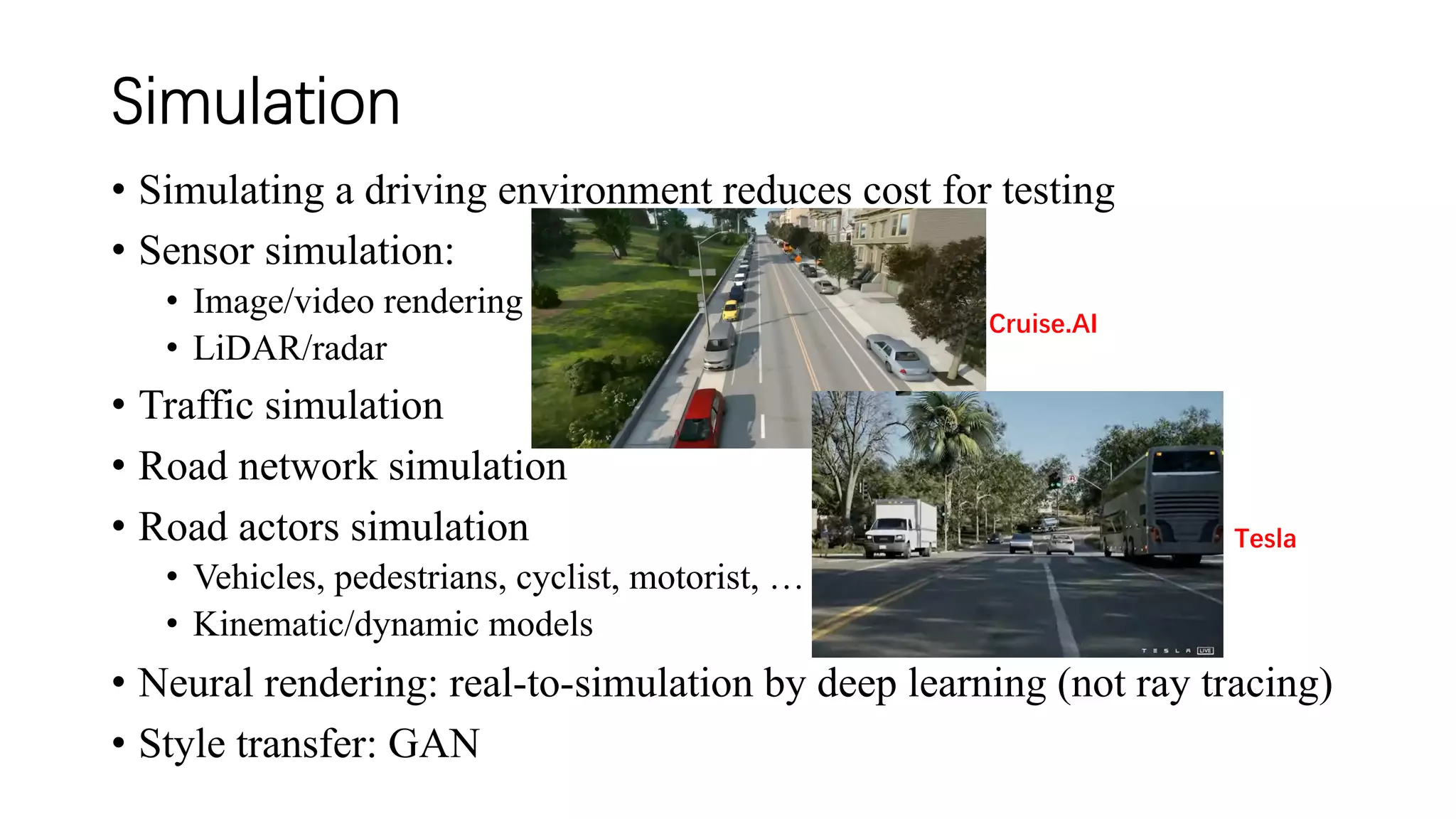
Simulation
• Simulating a driving environment reduces cost for testing
• Sensor simulation:
• Image/video rendering
• LiDAR/radar
• Traffic simulation
• Road network simulation
• Road actors simulation
• Vehicles, pedestrians, cyclist, motorist, …
• Kinematic/dynamic models
• Neural rendering: real-to-simulation by deep learning (not ray tracing)
• Style transfer: GAN
Cruise.AI
Tesla
Simulation
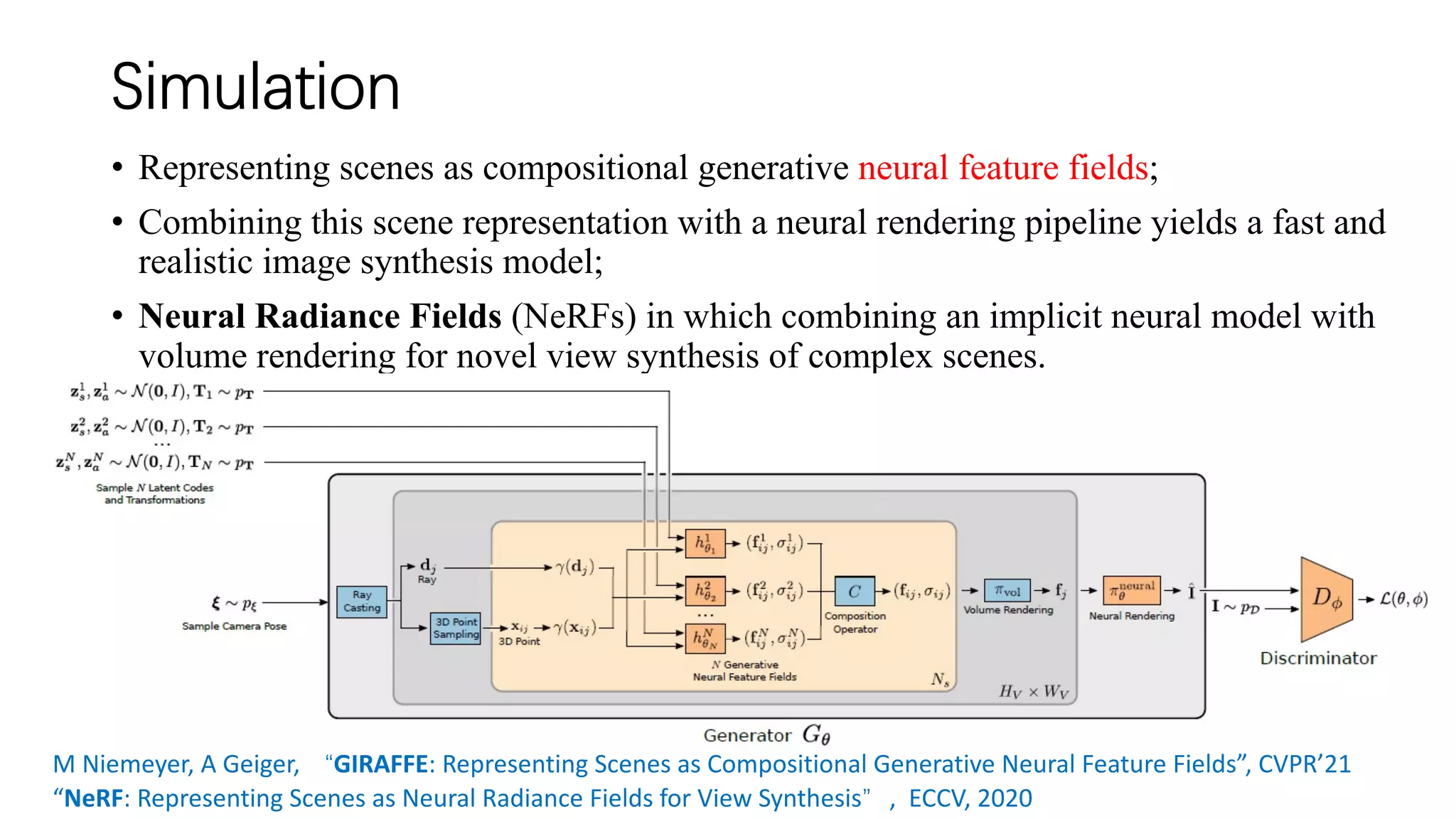
• Representing scenes as compositional generative neural feature fields;
• Combining this scene representation with a neural rendering pipeline yields a fast and
realistic image synthesis model;
• Neural Radiance Fields (NeRFs) in which combining an implicit neural model with
volume rendering for novel view synthesis of complex scenes.
M Niemeyer, A Geiger, “GIRAFFE: Representing Scenes as Compositional Generative Neural Feature Fields”, CVPR’21
“NeRF: Representing Scenes as Neural Radiance Fields for View Synthesis”, ECCV, 2020
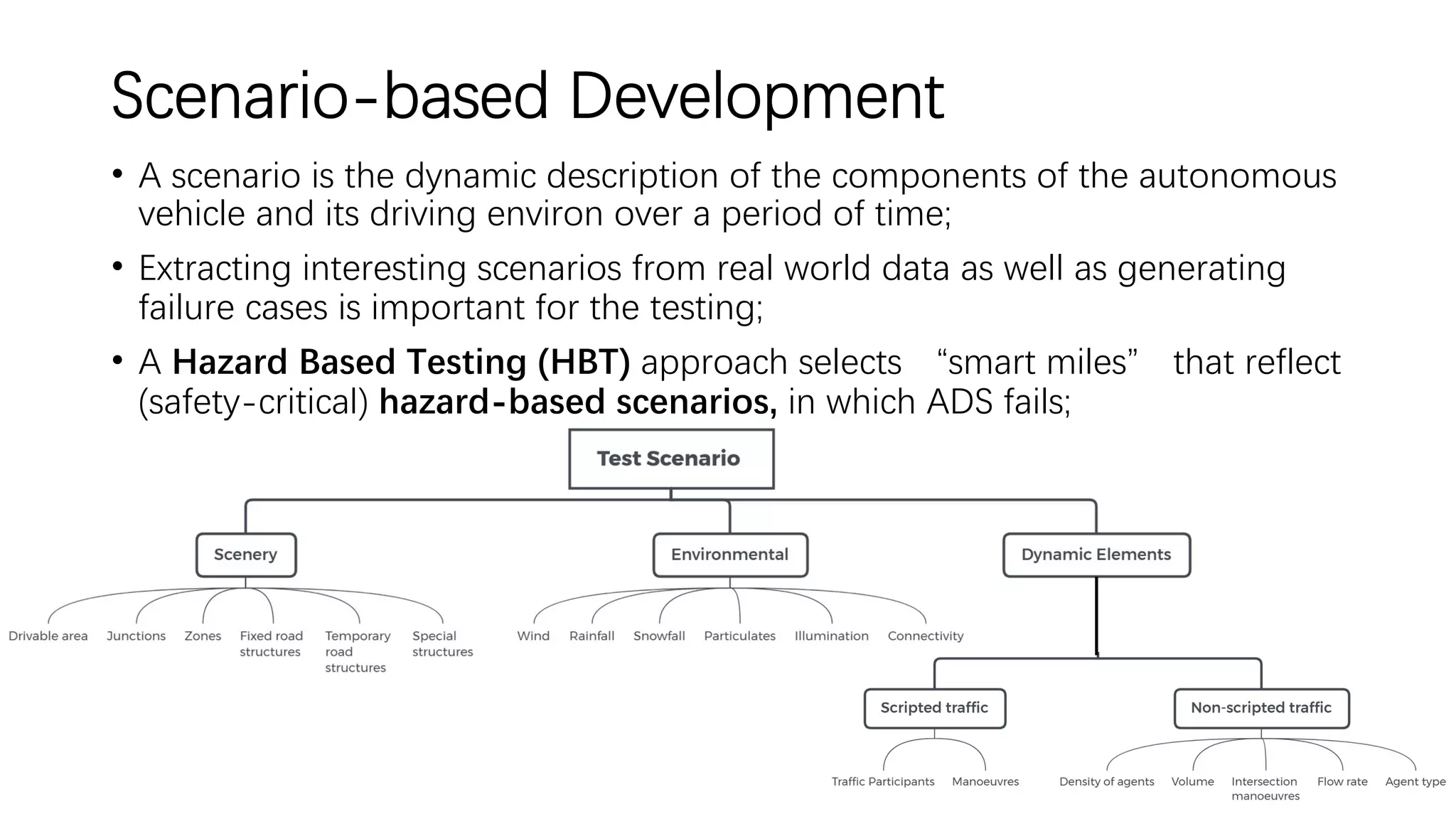
Scenario-based Development
• A scenario is the dynamic description of the components of the autonomous
vehicle and its driving environ over a period of time;
• Extracting interesting scenarios from real world data as well as generating
failure cases is important for the testing;
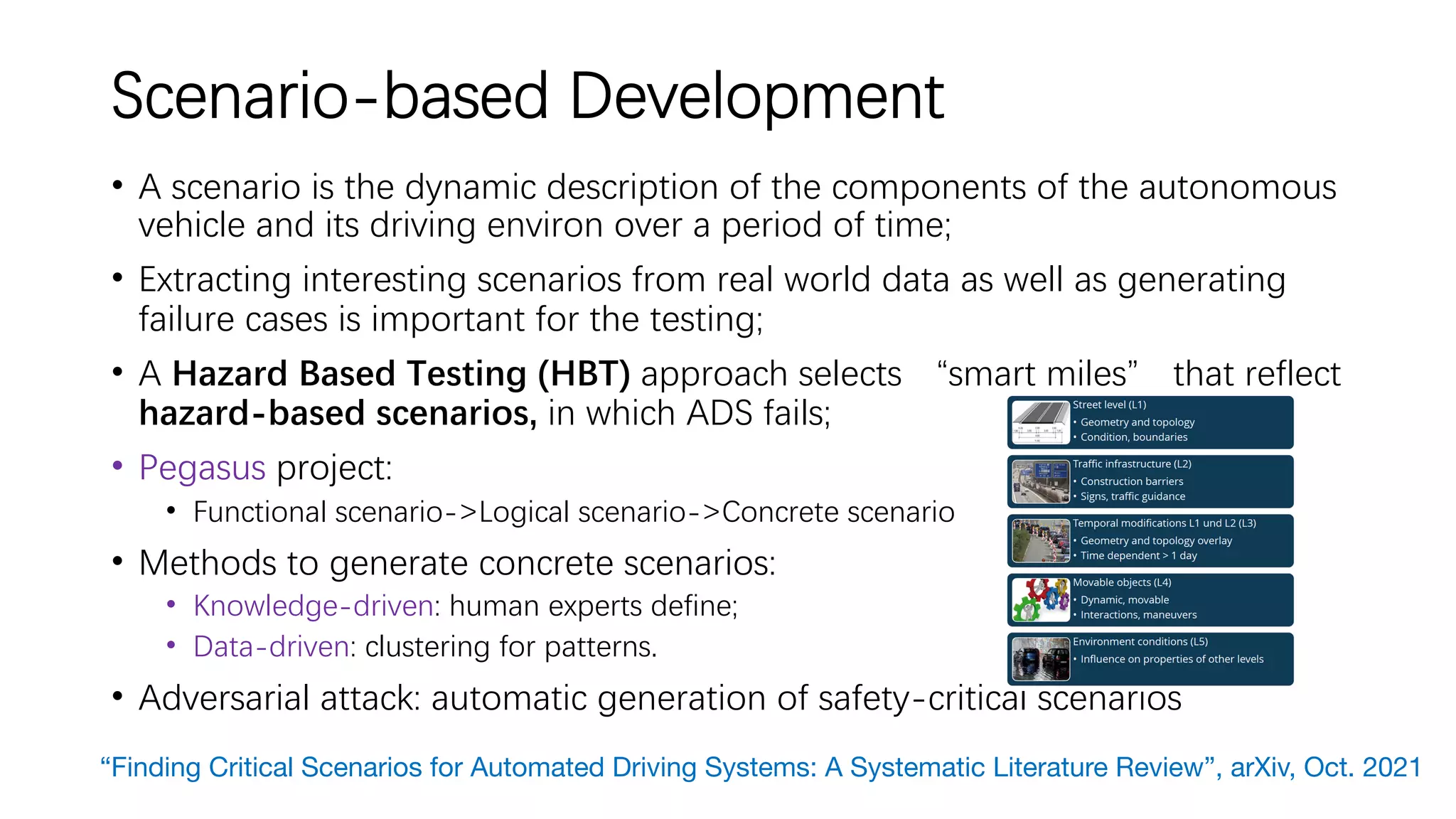
• A Hazard Based Testing (HBT) approach selects “smart miles” that reflect
(safety-critical) hazard-based scenarios, in which ADS fails;
Scenario-based Development
• A scenario is the dynamic description of the components of the autonomous
vehicle and its driving environ over a period of time;
• Extracting interesting scenarios from real world data as well as generating
failure cases is important for the testing;
• A Hazard Based Testing (HBT) approach selects “smart miles” that reflect
hazard-based scenarios, in which ADS fails;
• Pegasus project:
• Functional scenario->Logical scenario->Concrete scenario
• Methods to generate concrete scenarios:
• Knowledge-driven: human experts define;
• Data-driven: clustering for patterns.
• Adversarial attack: automatic generation of safety-critical scenarios
“Finding Critical Scenarios for Automated Driving Systems: A Systematic Literature Review”, arXiv, Oct. 2021
Scenario-based Development
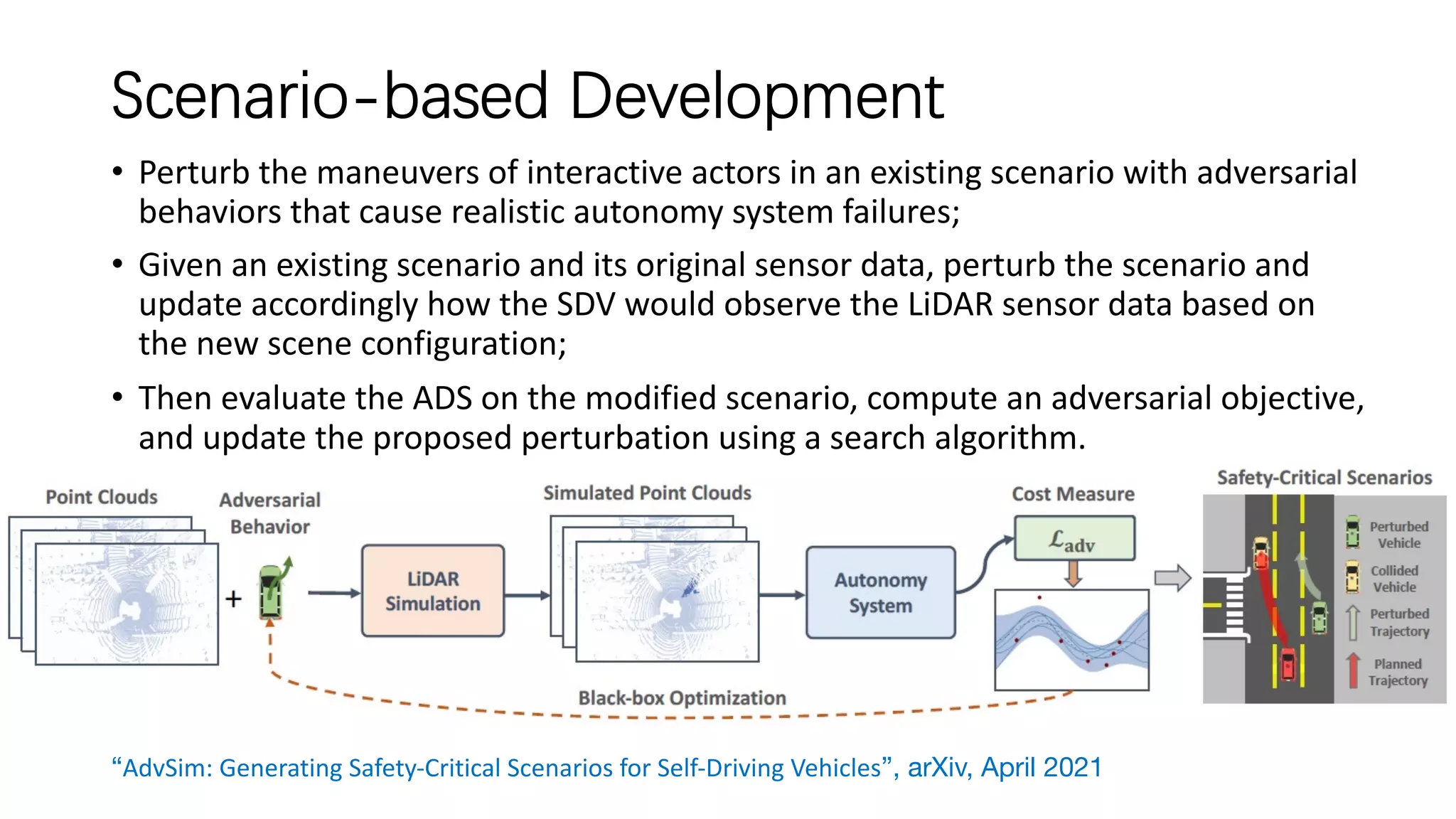
“AdvSim: Generating Safety-Critical Scenarios for Self-Driving Vehicles”, arXiv, April 2021
• Perturb the maneuvers of interactive actors in an existing scenario with adversarial
behaviors that cause realistic autonomy system failures;
• Given an existing scenario and its original sensor data, perturb the scenario and
update accordingly how the SDV would observe the LiDAR sensor data based on
the new scene configuration;
• Then evaluate the ADS on the modified scenario, compute an adversarial objective,
and update the proposed perturbation using a search algorithm.
Summary
• Autonomous Driving development is a challenging work;
• Deep learning is the core in algorithm development;
• Data closed loop is the competitive power in ADS;
• Safety-critical scenarios are “gold” sources for ADS upgrade;
• New sensor development is also the propulsion;
• ODD (Operation Domain Design ) and mass production are important.
Techniques and Challenges in Autonomous Driving

Techniques and Challenges in Autonomous Driving

  • 1.
    Techniques and Challengesin Autonomous Driving Yu Huang Chief Scientist of Autonomous Driving
  • 2.
    Outline 1. Introduction 2. Perception 3.Mapping & Localization 4. Prediction 5. Planning & Control 6. V2X 7. Safety 8. Data Closed Loop 9. Annotation 10. Simulation 11. Scenario-based Development 12. Summary
  • 3.
    Introduction • DARPA Grand(Rural) Challenge (2004-2005): Stanford • DARPA Urban Challenge (2007): CMU
  • 4.
    Introduction • Levels ofAutomation (SAE): L0 - L1 - L2 - L3 - L4 - L5
  • 5.
    Introduction • Levels ofAutomation (SAE): L0 - L1 - L2 - L3 - L4 - L5 • ODD (Operation Design Domain) • Robotaxi/driverless cargo delivery/autonomous commercial truck or bus/ • /Highway pilot/Urban pilot/Traffic Jam pilot/Autonomous valet parking • Popular Development Paths: • Gradual method: L2 -> L2+ -> L3 -> L4 • One-stop method: L4 -> L5 • Dimension reduction method: L2+ <- L4 • Problems: • Techniques: Long tailed, Corner cases • Safety: ISO26262, SOTIF • Mass production: Monetization, Cost, Closed loop, OTA (over-the-air)
  • 6.
    Introduction • Platform Architecture: •SW: hierarchical structure • Modular: a pipeline • End-to-End: fully or partially
  • 7.
    Perception • Collect infofrom sensors and discover relevant knowledge from the environment; • Calibration: sensor coordinate systems • Detection, Segmentation, Tracking • Camera: RGB image for 2-D/3-D detection • Pseudo-LiDAR • Radar: All-weather • LiDAR: 3-D point cloud • Multiple object tracking (MOT) • Sensor fusion • End-to-end perception • Spatio-temporal fusion • BEV (bird-eye-view)
  • 8.
    Perception • Tesla’s E2ENN framework • Virtual camera • rectify • RegNet • BiFPN • Transformer • BEV vector space • Feature queue • Kinematics:IMU • Video module • Spatial RNN
  • 9.
    Mapping • HD mapis a priori knowledge for perception and localization • Semantic layer: road and lane topology • Lanes, road boundaries, road marks, crosswalks, walkway • Traffic signs, traffic light, pole-like objects, stop line NavInfo HD maps 四维图新
  • 10.
    Mapping • HD mapis a priori knowledge for perception and localization • Semantic layer: road and lane topology • Lanes, road boundaries, road marks, crosswalks, walkway • Traffic signs, traffic light, pole-like objects, stop line • Geometric layer: • LiDAR point cloud alignment/Visual reconstruction • SLAM • Front end: odometry, ego-motion estimation • Back end: global optimization, Pose Graph or Bundle Adjustment • Visual /LiDAR/Radar SLAM • Map update/Online mapping • Crowd sourcing • Deep learning plays a role: learn to build the map
  • 11.
    Mapping Q Li, YWang, Y-L Wang, “HDMapNet: An Online HD Map Construction and Evaluation Framework”, arXiv July, 2021 J Philion, S Fidler, “Lift-Splat-Shoot: Encoding Images from Arbitrary Camera Rigs by Implicitly Unprojecting to 3D”, arXiv, 2008
  • 12.
    Localization • Determine egolocation w.r.t. the environ. • Global/Local (incremental) localization • Loop closure, failure recovery • Localization by feature matching • 2D-to-3D matching: PnP • 2D-to-2D matching: Visual correspondence • 3D-to-3D matching: Point cloud • Localization by semantic matching: • Lanes (lateral info), signs (longitudinal info.) • Sensor fusion: • GNSS, IMU, LiDAR, Camera, Wheel encoders,… • State space estimation • Deep learning is a potential: learn to localize (locally or globally)
  • 13.
    Localization X Wei, IA Barsan, S Wang, J Martinez, R Urtasum, “Learning to Localize Through Compressed Binary Maps”, arXiv, 2020
  • 14.
    Prediction • Anticipate surroundingtraffic players • Prediction for pedestrians: articulated motion and social rules • Prediction for vehicles: driving limited by roads and traffic rules • Physics-based: state estimation • Maneuver-based: clustering and classification (self supervised) • Interaction-aware: learning by imitation and reasoning by planning • Challenges: • Interaction modeling • Multimodal uncertainty “Perceive, Predict, and Plan: Safe Motion Planning Through Interpretable Semantic Representations”, arXiv, Aug. 2020
  • 15.
    Prediction • Cruise.AI’s PredictionNN model • Encoder-decoder architecture • Encode object history and scenes together (HD map) • Attention for interaction and social • Mixture of experts for varieties • Decode in a two-stage way • Initialization and refinement • Multi-modal uncertainty • Auxiliary tasks in MTL • Joint prediction • Self supervision
  • 16.
    Planning • Perform decisionmaking from modules of localization, perceptions and prediction • Partition and organize into a hierarchical structure. • Route (mission) planning • Take appropriate macro-level route to take • Behavior planning (decision making) • Interact with other agents and follow rules restrictions • Motion (path) planning • Generates appropriate paths and/or sets of actions • Sampling-based: discrete search • Imitation learning: deep learning • Game theoretical: reinforcement learning “A Survey of Motion Planning and Control Techniques for Self-driving Urban Vehicles”, arXiv, April, 2016
  • 17.
    Planning S Casas, ASadat, R Urtasum, “MP3: A Unified Model to Map, Perceive, Predict and Plan’, CVPR, 2021
  • 18.
    Control • Executing theplanned maneuvers, accounting for error / uncertainty • Closed loop feedback control • PID • Linear Quadratic Regulator • MPC with feedforward control • Robustness and stability • Path/Trajectory tracking • Geometric • Model-based • Joint/Separate lateral and longitudinal control • Deep learning for control • Imitation learning • Reinforcement learning “A Survey of Motion Planning and Control Techniques for Self-driving Urban Vehicles”, arXiv, April, 2016
  • 19.
    Control “Learning Robust ControlPolicies for End-to-End Autonomous Driving from Data-Driven Simulation”, IEEE RAL, 2020 • Vista: a data-driven simulator; • It is an end-to-end training controllers with reinforcement learning within simulation space; • Trained agents can be deployed directly in the real-world.
  • 20.
    V2X • V2X (vehicle-to-everything):communicate with the traffic and the environ around them, i.e. vehicle-to-vehicle (V2V) and vehicle-to-infrastructure (V2I). • By accumulating detailed info from other peers, drawbacks of the ego-vehicle such as sensing range, blind spots and insufficient planning, may be alleviated. • V2X helps in increasing safety and traffic efficiency. • Collaborative perception; • Collaborative localization; • Collaborative planning: • Centralized • Decentralized • Collaborative computing: • Training and inference: cloud-edge-vehicle
  • 21.
    V2X • V2VNet: Buildand send/receive compressed intermediate representations; • Aggregating the information received from multiple nearby vehicles by a spatially aware GNN, observe the same scene from different viewpoints. “V2VNet: Vehicle-to-Vehicle Communication for Joint Perception and Prediction”, arXiv, Aug. 2020
  • 22.
    Safety • Safety isa system-level concept to minimize the risk of hazards due to malfunctioning of system components; • AI safety is the new issue addressing a variety of ML vulnerabilities; • Functional safety standards (ISO26262): • Identify safety needs, define safety requirements, and finally verify the design accordingly; • SOTIF (Safety Of Intended Functionality): • Address functional insufficiencies as the absence of unreasonable risk due to malfunctioning; • Safety models: • Mobileye’s RSS (responsibility sensitivity safety) model • Nvidia’s SFF (safety force field) model • Main issues: • Corner cases, adversarial attack, interpretability, uncertainty, verification, ... “Inspect, Understand, Overcome: A Survey of Practical Methods for AI Safety”, arXiv, April, 2021 “A Survey of Safety and Trustworthiness of Deep Neural Networks: Verification, Testing, Adversarial Attack and Defence, and Interpretability”, arXiv, 2019
  • 23.
    Safety • “Scenario manager”coordinates the simulator and AI agent to run a driving scenario and monitor the state and the safety of the EV. • It is bundled with a “campaign manager” that takes a config file as input to select a fault model, SW or HW module sites, the number of faults, and a scenario; • “Campaign manager” uses the specified config to inject one or more transient faults per run into the ADS system; • “Event-driven synchronization” module helps coordinate. “ML-based Fault Injection for Autonomous Vehicles: A Case for Bayesian Fault Injection”, arXiv July, 2019 • DriveFI: a ML-based fault injection engine, to mine situations and faults that maximally impact AV safety; • It uses a DBN, specifically a 3-Temporal Bayesian Network (TBN);
  • 24.
    Data Closed Loop •ADS development faces significant data challenges; • Long tailed distribution with rare corner cases;
  • 25.
    Data Closed Loop •ADS development faces significant data challenges; • Long tailed distribution with rare corner cases; • Data driven model development is the competitive power; • Build infrastructure to support data closed loop in ADS development; Tesla Waymo
  • 26.
    Data Closed Loop •ADS development faces significant data challenges; • Long tailed distribution with rare corner cases; • Data driven model development is the competitive power; • Build infrastructure to support data closed loop in ADS development; • Data capture with “smart” selection; • Active learning with uncertainty estimation, corner case/out-of-distribution detection; • Efficient data annotation; • Fully automated labeling tools: offline, large NN models on servers. • Incremental model training; • Adversarial augmentation, domain adaptation, open world learning. • Simulation platform with scenario-based testing & validation; • MIL (model-in-loop), SIL (SW-in-loop), HIL(HW-in-loop) and VIL (vehicle-in-loop); • Deployment with OTA: shadow mode (Tesla)
  • 27.
    Data Closed Loop •A fully differentiable AV stack trainable from human demonstrations; • Closed-loop data-driven reactive simulation; • Large-scale, low-cost data collections towards scalability issues; A Jain, L D Pero, H Grimmett, P Ondruska, “Autonomy 2.0: Why is self-driving always 5 years away?” arXiv, July 2021
  • 28.
    Annotation • Annotation istime consuming and labor expensive; • Automatic labeling • Offline, not real time, on server instead of vehicle client; • Higher performance • May need more data input • Semi-automatic labeling • Interactive with human-in-the-loop • Rely on solid algorithms which better than manual operation • Integrated platform with label transfer within different sensors • 2D-3D space • HD map building is a special case
  • 29.
    Annotation “Offboard 3D ObjectDetection from Point Cloud Sequences”, CVPR, 2021
  • 30.
    Simulation • Simulating adriving environment reduces cost for testing • Sensor simulation: • Image/video rendering • LiDAR/radar • Traffic simulation • Road network simulation • Road actors simulation • Vehicles, pedestrians, cyclist, motorist, … • Kinematic/dynamic models • Neural rendering: real-to-simulation by deep learning (not ray tracing) • Style transfer: GAN Cruise.AI Tesla
  • 31.
    Simulation • Representing scenesas compositional generative neural feature fields; • Combining this scene representation with a neural rendering pipeline yields a fast and realistic image synthesis model; • Neural Radiance Fields (NeRFs) in which combining an implicit neural model with volume rendering for novel view synthesis of complex scenes. M Niemeyer, A Geiger, “GIRAFFE: Representing Scenes as Compositional Generative Neural Feature Fields”, CVPR’21 “NeRF: Representing Scenes as Neural Radiance Fields for View Synthesis”, ECCV, 2020
  • 32.
    Scenario-based Development • Ascenario is the dynamic description of the components of the autonomous vehicle and its driving environ over a period of time; • Extracting interesting scenarios from real world data as well as generating failure cases is important for the testing; • A Hazard Based Testing (HBT) approach selects “smart miles” that reflect (safety-critical) hazard-based scenarios, in which ADS fails;
  • 33.
    Scenario-based Development • Ascenario is the dynamic description of the components of the autonomous vehicle and its driving environ over a period of time; • Extracting interesting scenarios from real world data as well as generating failure cases is important for the testing; • A Hazard Based Testing (HBT) approach selects “smart miles” that reflect hazard-based scenarios, in which ADS fails; • Pegasus project: • Functional scenario->Logical scenario->Concrete scenario • Methods to generate concrete scenarios: • Knowledge-driven: human experts define; • Data-driven: clustering for patterns. • Adversarial attack: automatic generation of safety-critical scenarios “Finding Critical Scenarios for Automated Driving Systems: A Systematic Literature Review”, arXiv, Oct. 2021
  • 34.
    Scenario-based Development “AdvSim: GeneratingSafety-Critical Scenarios for Self-Driving Vehicles”, arXiv, April 2021 • Perturb the maneuvers of interactive actors in an existing scenario with adversarial behaviors that cause realistic autonomy system failures; • Given an existing scenario and its original sensor data, perturb the scenario and update accordingly how the SDV would observe the LiDAR sensor data based on the new scene configuration; • Then evaluate the ADS on the modified scenario, compute an adversarial objective, and update the proposed perturbation using a search algorithm.
  • 35.
    Summary • Autonomous Drivingdevelopment is a challenging work; • Deep learning is the core in algorithm development; • Data closed loop is the competitive power in ADS; • Safety-critical scenarios are “gold” sources for ADS upgrade; • New sensor development is also the propulsion; • ODD (Operation Domain Design ) and mass production are important.