Introduction to Scientific Paper Writing Handasa Arabia Organization www.handasarabia.org
Introduction In science, no matter how spectacular the results are, the work is not completed until the results are published. The purpose of this presentation is to help students to prepare the manuscript and to show all steps from the rough manuscript to published paper.
Contents scientific writing in general IMRAD format paper organization paper writing paper submission ethics of scientific writing the editing process bibliography From an idea by help of rules to the published paper
Scientific writing in general Subject Purpose to exchange the scientific knowledge to ask and answer specific questions Audience scientists and those interested in the subject a publisher or an editor
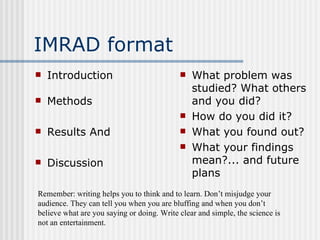
IMRAD format Introduction Methods Results And Discussion What problem was studied? What others and you did? How do you did it? What you found out? What your findings mean?... and future plans Remember: writing helps you to think and to learn. Don’t misjudge your audience. They can tell you when you are bluffing and when you don’t believe what are you saying or doing. Write clear and simple, the science is not an entertainment.
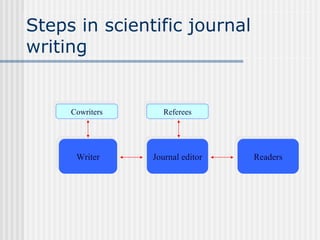
Steps in scientific journal writing Writer Journal editor Readers Cowriters Referees
Paper organization Introduction call attention to the specific subject, define the problem provide background and present the results of other studies (literature review) list the structure of your research project and what you plan to present in your paper Reading a scientific article isn’t the same as reading a detective story. We want to know from the start that the butler did it (Ratnoff, 1981)
Paper organization Methods complete information of materials and methods used, conditions present, actions, experimental design, etc. this section usually has subheadings; when possible match those to be used in Results enough information must be given so that the experiments could be reproduced ask a colleague if he/she can follow the methodology
Paper organization Results display of data with logical development showing how your findings satisfy your objectives where possible give illustrative examples and compare those with known results from literature use tables and figures ” the fool collects facts; the wise man selects them” (J. W. Powell, 1888)
Paper organization Discussion the hardest section to write, you discuss, you do not recapitulate the Results show the relationship among observed facts state your conclusion as clearly as possible summarize your evidence for each conclusion end with a short summary/conclusion regarding the significance of your work
Paper writing Write a rough abstract first or start text in the middle A rough draft is ready Select the journal and read Instructions to Authors (manuscript requirements: style in headings, figures and tables, etc.) Write the final manuscript
Paper writing cont. Example: IEEE journal two-column format http://www.ieee.org/portal/cms_docs/pubs/transactions/TRANS-JOUR.DOC
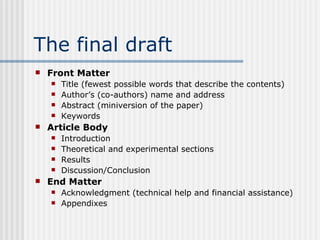
The final draft Front Matter Title (fewest possible words that describe the contents) Author’s (co-authors) name and address Abstract (miniversion of the paper) Keywords Article Body Introduction Theoretical and experimental sections Results Discussion/Conclusion End Matter Acknowledgment (technical help and financial assistance) Appendixes
Ethics of scientific writing Avoid the dual publication Don’t use the work of others without appropriate attribution List only those co-authors who contributed substantially to the work
Final submission In-house reviews are required? Submit the paper to the journal’s editor (only to one journal) Hard-copy of manuscript (usually three or more copies) Disk of the same version Text: Word, PDF, TeX/LaTeX, etc. Figures: tif, gif, postscript, etc.
Editing process Editor log a manuscript and send an acknowledgement that the paper has been received Editor sends the manuscript to reviewers  On the basis of the reviews and the editor’s opinion, your paper will be accepted, conditional accepted or rejected.
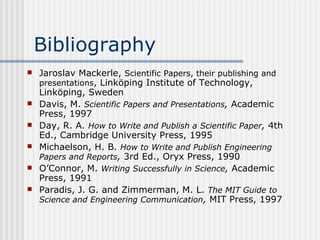
Bibliography Jaroslav Mackerle,  Scientific Papers, their publishing and presentations , Linköping Institute of Technology, Linköping, Sweden Davis, M.  Scientific Papers and Presentations ,  Academic Press, 1997 Day, R. A.  How to Write and Publish a Scientific Paper ,  4th Ed., Cambridge University Press, 1995 Michaelson, H. B.  How to Write and Publish Engineering Papers and Reports ,  3rd Ed., Oryx Press, 1990 O’Connor, M.  Writing Successfully in Science ,  Academic Press, 1991 Paradis, J. G. and Zimmerman, M. L.  The MIT Guide to Science and Engineering Communication ,  MIT Press, 1997
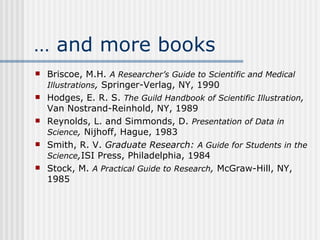
…  and more books Briscoe, M.H.  A Researcher’s Guide to Scientific and Medical Illustrations ,  Springer-Verlag, NY, 1990 Hodges, E. R. S.  The Guild Handbook of Scientific Illustration ,  Van Nostrand-Reinhold, NY, 1989 Reynolds, L. and Simmonds, D.  Presentation of Data in Science ,  Nijhoff, Hague, 1983 Smith, R. V.  Graduate Research:  A Guide for Students in the Science , ISI Press, Philadelphia, 1984 Stock, M.  A Practical Guide to Research ,  McGraw-Hill, NY, 1985

Technical & Research Writing (English)

  • 1.
    Introduction to ScientificPaper Writing Handasa Arabia Organization www.handasarabia.org
  • 2.
    Introduction In science,no matter how spectacular the results are, the work is not completed until the results are published. The purpose of this presentation is to help students to prepare the manuscript and to show all steps from the rough manuscript to published paper.
  • 3.
    Contents scientific writingin general IMRAD format paper organization paper writing paper submission ethics of scientific writing the editing process bibliography From an idea by help of rules to the published paper
  • 4.
    Scientific writing ingeneral Subject Purpose to exchange the scientific knowledge to ask and answer specific questions Audience scientists and those interested in the subject a publisher or an editor
  • 5.
    IMRAD format IntroductionMethods Results And Discussion What problem was studied? What others and you did? How do you did it? What you found out? What your findings mean?... and future plans Remember: writing helps you to think and to learn. Don’t misjudge your audience. They can tell you when you are bluffing and when you don’t believe what are you saying or doing. Write clear and simple, the science is not an entertainment.
  • 6.
    Steps in scientificjournal writing Writer Journal editor Readers Cowriters Referees
  • 7.
    Paper organization Introductioncall attention to the specific subject, define the problem provide background and present the results of other studies (literature review) list the structure of your research project and what you plan to present in your paper Reading a scientific article isn’t the same as reading a detective story. We want to know from the start that the butler did it (Ratnoff, 1981)
  • 8.
    Paper organization Methodscomplete information of materials and methods used, conditions present, actions, experimental design, etc. this section usually has subheadings; when possible match those to be used in Results enough information must be given so that the experiments could be reproduced ask a colleague if he/she can follow the methodology
  • 9.
    Paper organization Resultsdisplay of data with logical development showing how your findings satisfy your objectives where possible give illustrative examples and compare those with known results from literature use tables and figures ” the fool collects facts; the wise man selects them” (J. W. Powell, 1888)
  • 10.
    Paper organization Discussionthe hardest section to write, you discuss, you do not recapitulate the Results show the relationship among observed facts state your conclusion as clearly as possible summarize your evidence for each conclusion end with a short summary/conclusion regarding the significance of your work
  • 11.
    Paper writing Writea rough abstract first or start text in the middle A rough draft is ready Select the journal and read Instructions to Authors (manuscript requirements: style in headings, figures and tables, etc.) Write the final manuscript
  • 12.
    Paper writing cont.Example: IEEE journal two-column format http://www.ieee.org/portal/cms_docs/pubs/transactions/TRANS-JOUR.DOC
  • 13.
    The final draftFront Matter Title (fewest possible words that describe the contents) Author’s (co-authors) name and address Abstract (miniversion of the paper) Keywords Article Body Introduction Theoretical and experimental sections Results Discussion/Conclusion End Matter Acknowledgment (technical help and financial assistance) Appendixes
  • 14.
    Ethics of scientificwriting Avoid the dual publication Don’t use the work of others without appropriate attribution List only those co-authors who contributed substantially to the work
  • 15.
    Final submission In-housereviews are required? Submit the paper to the journal’s editor (only to one journal) Hard-copy of manuscript (usually three or more copies) Disk of the same version Text: Word, PDF, TeX/LaTeX, etc. Figures: tif, gif, postscript, etc.
  • 16.
    Editing process Editorlog a manuscript and send an acknowledgement that the paper has been received Editor sends the manuscript to reviewers On the basis of the reviews and the editor’s opinion, your paper will be accepted, conditional accepted or rejected.
  • 17.
    Bibliography Jaroslav Mackerle, Scientific Papers, their publishing and presentations , Linköping Institute of Technology, Linköping, Sweden Davis, M. Scientific Papers and Presentations , Academic Press, 1997 Day, R. A. How to Write and Publish a Scientific Paper , 4th Ed., Cambridge University Press, 1995 Michaelson, H. B. How to Write and Publish Engineering Papers and Reports , 3rd Ed., Oryx Press, 1990 O’Connor, M. Writing Successfully in Science , Academic Press, 1991 Paradis, J. G. and Zimmerman, M. L. The MIT Guide to Science and Engineering Communication , MIT Press, 1997
  • 18.
    … andmore books Briscoe, M.H. A Researcher’s Guide to Scientific and Medical Illustrations , Springer-Verlag, NY, 1990 Hodges, E. R. S. The Guild Handbook of Scientific Illustration , Van Nostrand-Reinhold, NY, 1989 Reynolds, L. and Simmonds, D. Presentation of Data in Science , Nijhoff, Hague, 1983 Smith, R. V. Graduate Research: A Guide for Students in the Science , ISI Press, Philadelphia, 1984 Stock, M. A Practical Guide to Research , McGraw-Hill, NY, 1985