UNIT 3 Checkpoint English
Year 9:
Recommended Prior Knowledge: Checkpoint English, Year 7. The Senses; Checkpoint English, Year 8, Myself and Others.
Context: The material for Year 9 Checkpoint English engages with the structure of the Checkpoint English test papers. The work also prepares students for
what they may expect during their IGCSE courses in First language English and Literature in English, so that passage between this stage and the next may
be a smooth one. Speaking and listening activities are included. Although speaking and listening is not assessed in Checkpoint, its importance as an
essential part of the curriculum continues to be stressed. Where the word Discuss is used, it is intended that students will work in pairs or small groups and
will report their conclusions to the class. Writing activities are also included as part of reading activities where appropriate.
Outline: The sections are as follows:
1. Comprehension and vocabulary work (Paper 1)
2. Summary (Paper 1)
3. Writing to inform, explain and persuade (Paper 1)
4. Character (Paper 2)
5. Setting (Paper 2)
6. Writers’ use of language ( Paper 2)
7. Implicit and explicit comprehension (Paper 2 )
8. Narrative plot development and usage of sentence structures and punctuation (Paper 2)
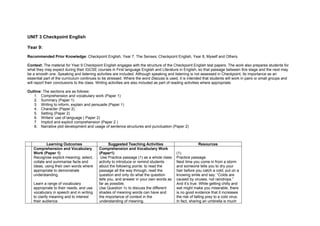
Learning Outcomes Suggested Teaching Activities Resources
Comprehension and Vocabulary
Work (Paper 1)
Recognise explicit meaning; select,
collate and summarise facts and
ideas, using their own words where
appropriate to demonstrate
understanding.
Learn a range of vocabulary
appropriate to their needs, and use
vocabulary in speech and in writing
to clarify meaning and to interest
their audience.
Comprehension and Vocabulary Work
(Paper1)
Use Practice passage (1) as a whole class
activity to introduce or remind students
about the following points: to read the
passage all the way through, read the
question and only do what the question
tells you, and answer in your own words as
far as possible.
Use Question 1c to discuss the different
shades of meaning words can have and
the importance of context in the
understanding of meaning.
(1)
Practice passage.
Next time you come in from a storm
and someone tells you to dry your
hair before you catch a cold, put on a
knowing smile and say: “Colds are
caused by viruses, not raindrops.”
And it’s true. While getting chilly and
wet might make you miserable, there
is no good evidence that it increases
the risk of falling prey to a cold virus.
In fact, sharing an umbrella is much
Recognise and comment on
opinions expressed by a writer
Summary (Paper1)
Speak to discuss.
Recognise explicit meaning; select,
collate and summarise facts and
ideas, using their own words where
appropriate to demonstrate
understanding
Begin to make significant
contributions to group discussions
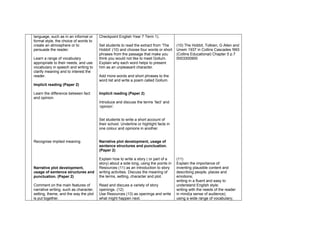
Discuss the terms fact and opinion. Read a
selection of newspaper articles and pick
out the facts from the opinions expressed
in the articles.
Summary (Paper1)
Introduce or revise the meaning of the term
summary with a class discussion on when
it is useful to give the main points about
something, briefly written down or spoken.
Use the following activities as spoken or
written practice as follow up to the class
discussion.
Summarise the main points of a recent
lesson (eg the main points of a scientific
experiment).
Summarise the main events of a film or TV
programme.
Read a short story. Discuss how much of
the story is narrative. Which parts describe
a place? Which parts describe character?
Which parts build up atmosphere?
Summarise the main events.
Work in groups and prepare and present a
newscast of five or six items. You may use
more risky – as the person with
whom you’re huddling may be
harbouring a cold, or there could be
cold viruses lurking on the handle.
The best way to avoid colds is to
avoid contact with people – or with
anything that they have touched.
So why are colds called “colds”? The
short answer is that no-one knows.
According to the Oxford English
Dictionary, the term first appears in
1537, in the State Papers of
England’s King Henry VIII. However,
suggestions that the King removed
heads of two of his wives to avoid
catching colds from them is not taken
seriously by historians.
Make sure you answer these
questions as far as possible in your
own words.
1(a) People often tell you things that
later turn out not to be true. What two
examples of this are in the passage?
1(b) Explain two ways in which you
can catch a cold.
1(c) Explain the meaning of the
following words as they are used in
the passage:
(i) prey
(ii) huddling
(iii) harbouring
(iv) lurking
(2)
Unit 2 Checkpoint English 3 Sue
and help to plan and to give group
presentations.
real news items from newspapers, or TV
news; local or school news items; made-up
items that are typical of the news usually
read or heard. The newscast may end with
something light hearted (a commonly used
technique). Use on-the-spot reporters,
interviews and expert opinions. When your
newscast is ready, write a summary of the
two or three main points of each story and
then the headlines. See Resources. (2)
Introduce a summary exercise (similar to
something used on Checkpoint Paper 1) to
the class with the tips for answering the
question. Resources. (3)
Guide students through Practice Summary
Hackman Alan Howe, Sue Bonnett,
Hodder Murray ISBN 0340887397
(3) Tips for writing a summary
Read the passage and check that
you understand it. Then:
1. Read the question and re-
read the passage, underling
or highlighting the bits that
answer the question. Look
for eight or nine of these.
You may like to give them
numbers to identify them.
2. The passage has information
that does not answer the
question. Make sure you
don’t try to use it.
3. Sometimes there are points
at the beginning and at the
end but not in the middle.
Make sure you check the
end.
4. Leave out detail. Just give
the main points enough to
make them clear.
5. Never repeat yourself.
6. Don’t go off the task. Focus
carefully.
Use your own words to prove that
Writing to Inform, Explain and
Persuade (Paper 1)
Structure their writing, using
paragraphs and sequencing events,
details and ideas within paragraphs.
Use a range of increasingly complex
sentence structures to communicate
Writing to Inform, Explain and Persuade
(Paper 1)
Explain how to write two well made
paragraphs on two aspects of a topic (like
describing a creature that is dangerous –
para 1 – and explaining how you can keep
yourself from it – para 2).
See resources (4) for checklist of points to
cover as an introduction to the following
activities.
Use the paragraph in Resources (5) to
discuss the use of topic sentences and
sequence and order within paragraphs.
Write paragraphs using the topic sentences
in Resources (6).
Use the paragraphs in Resources (7) to
revise and discuss sentence structure and
style.
you have understood
(4) Checklist
Explain that marks are given for:
writing structured paragraphs in
which ideas are developed and
where one paragraph leads smoothly
to the next;
Writing in a fluent and easy to read
style;
Writing with a sense of audience;
Writing with varied sentence
structure;
Using full stops and commas
correctly (with additional credit for
using other types of punctuation);
spelling correctly.
(5) Rewrite this paragraph to get the
sentences in a better order.
I really cannot work properly when I
am suffering with a cold, and today is
no exception. When I woke up this
morning I felt a bit thick in the head,
but I had this essay to do for
tomorrow. All yesterday I was feeling
awful and had a terrible sore throat.
Now it is Monday and my head is
going round in circles, so I had better
stop. I must have picked it up in the
cinema on Saturday because it was
very hot and everyone was coughing
and sneezing. It’s no good trying to
work when you cannot think straight.
Even on Friday I didn’t feel quite
right.
(6) Topic Sentences
Copy out topic sentence and add the
rest of the paragraph.
meaning and to give fluency to their
speech and writing.
Use full stops, capital letters,
commas and question marks to
make meaning clear, and show
awareness of other forms of
punctuation.
Discuss concepts of audience and
purpose in writing.
Read advertisements and study
aspects of their language.
Begin to make significant
contributions to group discussions
and help to plan and to give group
presentations.
Begin to develop a sense of
audience and engage the readers
attention
Write to persuade as a formal letter
and as the script of a commercial.
Characters (Paper 2)
Recognise implicit meaning and
Explain that paragraphs should usually
develop two or three linked ideas; the
sequence should be logical. The
paragraphs should not be lists. The first
paragraph should start with a clear topic
sentence and the second paragraph should
start with a sentence that suggests a link
with preceding material.
Remind and discuss the meaning of the
terms audience and purpose.
Write paragraphs using appropriate
persuasive language, e.g. You have just
had a holiday in the place of your dreams.
Write a paragraph as in a letter to a friend,
persuading her/him to go to the same
place.
Read and discuss the use of language and
format in ads from an assortment of
magazines.
In small groups decide on a product to sell.
Design an ad for a magazine. Write a
formal letter to a large supermarket
manager trying to persuade her/him to
stock your product. Prepare and make a
tape recording of a radio ad for your
product. Prepare a short TV ad to perform
to the class or to video.
Feedback all material to class for
discussion on how successful their
attempts were at ‘selling’ their product.
Characters (Paper 2)
I am going to describe my favourite
meal to you in such a way that your
mouth will begin to water.
If I were able to make some changes
to the buildings and grounds of the
school, my priority would be to…
When the time comes for me to leave
home, I think that I shall feel…
(7) Discuss the differences between
paragraph A and B in sentence
structure, style and use of
punctuation.
A:
I am very fond of my cat. She comes
bounding into the room whenever I
call her. She is very friendly. She sits
next to me in the evening. She is
very gentle. She never attacks me.
She greets me with a quiet miaow
when she comes in in the morning.
She seems very intelligent. She has
her own ways of telling me what she
wants.
B:
I am very fond of my cat, she is a
real character and highly intelligent.
The best thing of all is her
friendliness. She seems to want to
be near to me and sits by me in the
evening after following me round my
garden during the day. In the garden
she is always ready for a game,
entertaining me by leaping out at
sticks and lengths of garden twine.
Whenever I meet her there and call
her name, she always responds with
two or three “miaows” and then rolls
over on her back, waiting to be
study character.
Speak to explain, describe and
comment.
Use a range of vocabulary and
sentence structure to make speech
interesting and convincing.
Setting (Paper 2)
Comment on the main features of
narrative writing, such as character,
setting, theme, and the way in which
a plot is put together.
Demonstrate understanding of
features of narrative, non-fiction and
media texts by developing them in
their own discussion and writing.
Writers’ use of Language (Paper
2)
Understand vocabulary and
comment on a writer’s use of
Read extracts from novels, short stories
and plays and make notes on the
appearance and behaviour of the main
characters.(8)
In small groups describe a favourite
character from a book or a film and explain,
with reference to incidents in the plot, why
they like the character.
Introduce and discuss the term
impressions to the class
Set students to prepare and give a short
talk describing a character they admire,
giving evidence to justify their admiration.
Setting (Paper 2)
Discuss what impressions an author is
trying to convey through the setting of a
story. Explain how the detail used to
describe the time and place are an
important part of giving a sense of genre to
the narrative. (9)
Explain the terms ‘atmosphere’ and
‘tension’ in narrative.
Set students to think of a place and write a
paragraph to describe it. Use the
paragraph to plan out a story that could
happen in that place (write notes, no more
than five events). Share and discuss the
paragraph and plan in small groups.
Writers’ use of Language (Paper 2)
Revise and discuss the term image.(See
tickled. I could not have a better cat.
(8) Pages 40-62
Reading Between the Lines Fiction
and Poetry – Sue Bonnett, Letts
Educational, 2001
ISBN 1840855770
(9) Unit 1 Checkpoint English 3 (forth
coming)
Pages 84-108
Reading Between the Lines Fiction
and Poetry – Sue Bonnett Letts
Educational 2001 ISBN1840855770.
language, such as in an informal or
formal style, the choice of words to
create an atmosphere or to
persuade the reader.
Learn a range of vocabulary
appropriate to their needs, and use
vocabulary in speech and writing to
clarify meaning and to interest the
reader.
Implicit reading (Paper 2)
Learn the difference between fact
and opinion.
Recognise implied meaning.
Narrative plot development,
usage of sentence structures and
punctuation. (Paper 2)
Comment on the main features of
narrative writing, such as character,
setting, theme, and the way the plot
is put together.
Checkpoint English Year 7 Term 1).
Set students to read the extract from ‘The
Hobbit’ (10) and choose four words or short
phrases from the passage that make you
think you would not like to meet Gollum.
Explain why each word helps to present
him as an unpleasant character.
Add more words and short phrases to the
word list and write a poem called Gollum.
Implicit reading (Paper 2)
Introduce and discuss the terms ‘fact’ and
‘opinion’.
Set students to write a short account of
their school. Underline or highlight facts in
one colour and opinions in another.
Narrative plot development, usage of
sentence structures and punctuation.
(Paper 2)
Explain how to write a story ( or part of a
story) about a side long, using the points in
Resources (11) as an introduction to story
writing activities. Discuss the meaning of
the terms, setting, character and plot.
Read and discuss a variety of story
openings. (12)
Use Resources (13) as openings and write
what might happen next.
(10) The Hobbit, Tolkien, G Allen and
Unwin 1937 in Collins Cascades !993
(Collins Educational) Chapter 5 p.7
0003300900
(11)
Explain the importance of:
inventing plausible content and
describing people, places and
emotions;
writing in a fluent and easy to
understand English style;
writing with the needs of the reader
in mind(a sense of audience);
using a wide range of vocabulary;
Use full stops, capital letters,
commas and question marks to
make meaning clear, and show
awareness of other forms of
punctuation, including the
presentation of dialogue.
Use a range of increasingly complex
sentence structures to communicate
meaning and give fluency to their
speech and writing.
Begin to make significant
contributions to group discussions
and help to plan and give group
presentations.
Write for a variety of purposes, such
as to describe, explore, imagine,
entertain.
Begin to develop a sense of
audience and to engage the
reader’s attention
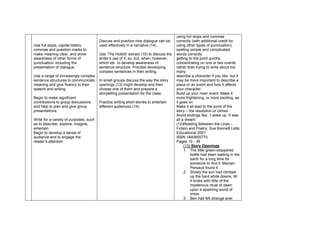
Discuss and practice how dialogue can be
used effectively in a narrative (14)
Use ‘The Hobbit’ extract (10) to discuss the
writer’s use of if, so, but, when, however,
which etc. to develop awareness of
sentence structure. Practise developing
complex sentences in their writing.
In small groups discuss the way the story
openings (13) might develop and then
choose one of them and prepare a
storytelling presentation for the class.
Practice writing short stories to entertain
different audiences.(14)
using full stops and commas
correctly (with additional credit for
using other types of punctuation);
spelling simple and complicated
words correctly.
getting to the point quickly.
concentrating on one or two events
rather than trying to write about too
many.
describe a character if you like, but it
may be more important to describe a
place or an event and how it effects
your character.
Build up your main event. Make it
more frightening, or more exciting, as
it goes on
Make it all lead to the point of the
story – the resolution.or climax
Avoid endings like, ‘I woke up. It was
all a dream’
(12)Reading Between the Lines –
Fiction and Poetry, Sue Bonnett Letts
Educational 2001
ISBN 1840855770.
Pages 10 - 38
(13) Story Openings
1. The little green-stoppered
bottle had been waiting in the
earth for a long time for
someone to find it. Mariam
Persaud found it.
2. Slowly the sun had climbed
up the hard white downs, till
it broke with little of the
mysterious ritual of dawn
upon a sparkling world of
snow.
3. Ben had felt strange ever
since the snow started
falling. He looked out of the
window and saw that it had
come again, sweeping
across like a curtain.
4. “I think I must move out of
where I am living,” he said. “I
have this problem with my
landlady.”
5. The car pulled up at the kerb.
The man who had been
staring into the department
store window turned as the
window of the car slowly
opened. “This won’t take
long,” said a voice.
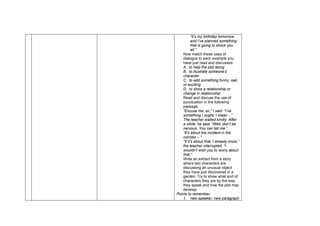
(14) Using Dialogue
Read and discuss what these
examples of dialogue may add to
a story.
1. “Listen!” she whispered into
her mobile, “I haven’t much
time. This information is
vital…are you there?”
2. “No I won’t!” she snapped,
her temper suddenly
breaking out. “I’ve had
enough of you telling me
what to do all the time. From
now on it’s going to be
different.”
3. “Er, I don’t know. I can’t
make up my mind,” he
muttered. That was what
infuriated his friends. He just
couldn’t think for himself.
4. “Just you wait,” he
announced to his little party.
“It’s my birthday tomorrow,
and I’ve planned something
that is going to shock you
all.”
Now match these uses of
dialogue to each example you
have just read and discussed.
A. to help the plot along
B. to illustrate someone’s
character
C. to add something funny, sad
or exciting
D. to show a relationship or
change in relationship
Read and discuss the use of
punctuation in the following
passage.
“Excuse me, sir,” I said. “I’ve
something I ought, I mean…”
The teacher waited kindly. After
a while, he said, “Well, don’t be
nervous. You can tell me.”
“It’s about the incident in the
corridor – “
“If it’s about that, I already know,”
the teacher interrupted. “I
wouldn’t wish you to worry about
that.”
Write an extract from a story
where two characters are
discussing an unusual object
they have just discovered in a
garden. Try to show what sort of
characters they are by the way
they speak and how the plot may
develop.
Points to remember:
1. new speaker, new paragraph
2. speech marks round the
words actually spoken
3. commas, fullstops, question
marks and exclamation
marks as required
4. Row of little dots if someone
fades away and a dash if
someone is interrupted
(14)Unit 4 Checkpoint English 3,
Sue Hackman, Alan Howe, Sue
Bonnett, Hodder Murray, ISBN
0340887397

Cambridge Checkpoint

  • 1.
    UNIT 3 CheckpointEnglish Year 9: Recommended Prior Knowledge: Checkpoint English, Year 7. The Senses; Checkpoint English, Year 8, Myself and Others. Context: The material for Year 9 Checkpoint English engages with the structure of the Checkpoint English test papers. The work also prepares students for what they may expect during their IGCSE courses in First language English and Literature in English, so that passage between this stage and the next may be a smooth one. Speaking and listening activities are included. Although speaking and listening is not assessed in Checkpoint, its importance as an essential part of the curriculum continues to be stressed. Where the word Discuss is used, it is intended that students will work in pairs or small groups and will report their conclusions to the class. Writing activities are also included as part of reading activities where appropriate. Outline: The sections are as follows: 1. Comprehension and vocabulary work (Paper 1) 2. Summary (Paper 1) 3. Writing to inform, explain and persuade (Paper 1) 4. Character (Paper 2) 5. Setting (Paper 2) 6. Writers’ use of language ( Paper 2) 7. Implicit and explicit comprehension (Paper 2 ) 8. Narrative plot development and usage of sentence structures and punctuation (Paper 2) Learning Outcomes Suggested Teaching Activities Resources Comprehension and Vocabulary Work (Paper 1) Recognise explicit meaning; select, collate and summarise facts and ideas, using their own words where appropriate to demonstrate understanding. Learn a range of vocabulary appropriate to their needs, and use vocabulary in speech and in writing to clarify meaning and to interest their audience. Comprehension and Vocabulary Work (Paper1) Use Practice passage (1) as a whole class activity to introduce or remind students about the following points: to read the passage all the way through, read the question and only do what the question tells you, and answer in your own words as far as possible. Use Question 1c to discuss the different shades of meaning words can have and the importance of context in the understanding of meaning. (1) Practice passage. Next time you come in from a storm and someone tells you to dry your hair before you catch a cold, put on a knowing smile and say: “Colds are caused by viruses, not raindrops.” And it’s true. While getting chilly and wet might make you miserable, there is no good evidence that it increases the risk of falling prey to a cold virus. In fact, sharing an umbrella is much
  • 2.
    Recognise and commenton opinions expressed by a writer Summary (Paper1) Speak to discuss. Recognise explicit meaning; select, collate and summarise facts and ideas, using their own words where appropriate to demonstrate understanding Begin to make significant contributions to group discussions Discuss the terms fact and opinion. Read a selection of newspaper articles and pick out the facts from the opinions expressed in the articles. Summary (Paper1) Introduce or revise the meaning of the term summary with a class discussion on when it is useful to give the main points about something, briefly written down or spoken. Use the following activities as spoken or written practice as follow up to the class discussion. Summarise the main points of a recent lesson (eg the main points of a scientific experiment). Summarise the main events of a film or TV programme. Read a short story. Discuss how much of the story is narrative. Which parts describe a place? Which parts describe character? Which parts build up atmosphere? Summarise the main events. Work in groups and prepare and present a newscast of five or six items. You may use more risky – as the person with whom you’re huddling may be harbouring a cold, or there could be cold viruses lurking on the handle. The best way to avoid colds is to avoid contact with people – or with anything that they have touched. So why are colds called “colds”? The short answer is that no-one knows. According to the Oxford English Dictionary, the term first appears in 1537, in the State Papers of England’s King Henry VIII. However, suggestions that the King removed heads of two of his wives to avoid catching colds from them is not taken seriously by historians. Make sure you answer these questions as far as possible in your own words. 1(a) People often tell you things that later turn out not to be true. What two examples of this are in the passage? 1(b) Explain two ways in which you can catch a cold. 1(c) Explain the meaning of the following words as they are used in the passage: (i) prey (ii) huddling (iii) harbouring (iv) lurking (2) Unit 2 Checkpoint English 3 Sue
  • 3.
    and help toplan and to give group presentations. real news items from newspapers, or TV news; local or school news items; made-up items that are typical of the news usually read or heard. The newscast may end with something light hearted (a commonly used technique). Use on-the-spot reporters, interviews and expert opinions. When your newscast is ready, write a summary of the two or three main points of each story and then the headlines. See Resources. (2) Introduce a summary exercise (similar to something used on Checkpoint Paper 1) to the class with the tips for answering the question. Resources. (3) Guide students through Practice Summary Hackman Alan Howe, Sue Bonnett, Hodder Murray ISBN 0340887397 (3) Tips for writing a summary Read the passage and check that you understand it. Then: 1. Read the question and re- read the passage, underling or highlighting the bits that answer the question. Look for eight or nine of these. You may like to give them numbers to identify them. 2. The passage has information that does not answer the question. Make sure you don’t try to use it. 3. Sometimes there are points at the beginning and at the end but not in the middle. Make sure you check the end. 4. Leave out detail. Just give the main points enough to make them clear. 5. Never repeat yourself. 6. Don’t go off the task. Focus carefully. Use your own words to prove that
  • 4.
    Writing to Inform,Explain and Persuade (Paper 1) Structure their writing, using paragraphs and sequencing events, details and ideas within paragraphs. Use a range of increasingly complex sentence structures to communicate Writing to Inform, Explain and Persuade (Paper 1) Explain how to write two well made paragraphs on two aspects of a topic (like describing a creature that is dangerous – para 1 – and explaining how you can keep yourself from it – para 2). See resources (4) for checklist of points to cover as an introduction to the following activities. Use the paragraph in Resources (5) to discuss the use of topic sentences and sequence and order within paragraphs. Write paragraphs using the topic sentences in Resources (6). Use the paragraphs in Resources (7) to revise and discuss sentence structure and style. you have understood (4) Checklist Explain that marks are given for: writing structured paragraphs in which ideas are developed and where one paragraph leads smoothly to the next; Writing in a fluent and easy to read style; Writing with a sense of audience; Writing with varied sentence structure; Using full stops and commas correctly (with additional credit for using other types of punctuation); spelling correctly. (5) Rewrite this paragraph to get the sentences in a better order. I really cannot work properly when I am suffering with a cold, and today is no exception. When I woke up this morning I felt a bit thick in the head, but I had this essay to do for tomorrow. All yesterday I was feeling awful and had a terrible sore throat. Now it is Monday and my head is going round in circles, so I had better stop. I must have picked it up in the cinema on Saturday because it was very hot and everyone was coughing and sneezing. It’s no good trying to work when you cannot think straight. Even on Friday I didn’t feel quite right. (6) Topic Sentences Copy out topic sentence and add the rest of the paragraph.
  • 5.
    meaning and togive fluency to their speech and writing. Use full stops, capital letters, commas and question marks to make meaning clear, and show awareness of other forms of punctuation. Discuss concepts of audience and purpose in writing. Read advertisements and study aspects of their language. Begin to make significant contributions to group discussions and help to plan and to give group presentations. Begin to develop a sense of audience and engage the readers attention Write to persuade as a formal letter and as the script of a commercial. Characters (Paper 2) Recognise implicit meaning and Explain that paragraphs should usually develop two or three linked ideas; the sequence should be logical. The paragraphs should not be lists. The first paragraph should start with a clear topic sentence and the second paragraph should start with a sentence that suggests a link with preceding material. Remind and discuss the meaning of the terms audience and purpose. Write paragraphs using appropriate persuasive language, e.g. You have just had a holiday in the place of your dreams. Write a paragraph as in a letter to a friend, persuading her/him to go to the same place. Read and discuss the use of language and format in ads from an assortment of magazines. In small groups decide on a product to sell. Design an ad for a magazine. Write a formal letter to a large supermarket manager trying to persuade her/him to stock your product. Prepare and make a tape recording of a radio ad for your product. Prepare a short TV ad to perform to the class or to video. Feedback all material to class for discussion on how successful their attempts were at ‘selling’ their product. Characters (Paper 2) I am going to describe my favourite meal to you in such a way that your mouth will begin to water. If I were able to make some changes to the buildings and grounds of the school, my priority would be to… When the time comes for me to leave home, I think that I shall feel… (7) Discuss the differences between paragraph A and B in sentence structure, style and use of punctuation. A: I am very fond of my cat. She comes bounding into the room whenever I call her. She is very friendly. She sits next to me in the evening. She is very gentle. She never attacks me. She greets me with a quiet miaow when she comes in in the morning. She seems very intelligent. She has her own ways of telling me what she wants. B: I am very fond of my cat, she is a real character and highly intelligent. The best thing of all is her friendliness. She seems to want to be near to me and sits by me in the evening after following me round my garden during the day. In the garden she is always ready for a game, entertaining me by leaping out at sticks and lengths of garden twine. Whenever I meet her there and call her name, she always responds with two or three “miaows” and then rolls over on her back, waiting to be
  • 6.
    study character. Speak toexplain, describe and comment. Use a range of vocabulary and sentence structure to make speech interesting and convincing. Setting (Paper 2) Comment on the main features of narrative writing, such as character, setting, theme, and the way in which a plot is put together. Demonstrate understanding of features of narrative, non-fiction and media texts by developing them in their own discussion and writing. Writers’ use of Language (Paper 2) Understand vocabulary and comment on a writer’s use of Read extracts from novels, short stories and plays and make notes on the appearance and behaviour of the main characters.(8) In small groups describe a favourite character from a book or a film and explain, with reference to incidents in the plot, why they like the character. Introduce and discuss the term impressions to the class Set students to prepare and give a short talk describing a character they admire, giving evidence to justify their admiration. Setting (Paper 2) Discuss what impressions an author is trying to convey through the setting of a story. Explain how the detail used to describe the time and place are an important part of giving a sense of genre to the narrative. (9) Explain the terms ‘atmosphere’ and ‘tension’ in narrative. Set students to think of a place and write a paragraph to describe it. Use the paragraph to plan out a story that could happen in that place (write notes, no more than five events). Share and discuss the paragraph and plan in small groups. Writers’ use of Language (Paper 2) Revise and discuss the term image.(See tickled. I could not have a better cat. (8) Pages 40-62 Reading Between the Lines Fiction and Poetry – Sue Bonnett, Letts Educational, 2001 ISBN 1840855770 (9) Unit 1 Checkpoint English 3 (forth coming) Pages 84-108 Reading Between the Lines Fiction and Poetry – Sue Bonnett Letts Educational 2001 ISBN1840855770.
  • 7.
    language, such asin an informal or formal style, the choice of words to create an atmosphere or to persuade the reader. Learn a range of vocabulary appropriate to their needs, and use vocabulary in speech and writing to clarify meaning and to interest the reader. Implicit reading (Paper 2) Learn the difference between fact and opinion. Recognise implied meaning. Narrative plot development, usage of sentence structures and punctuation. (Paper 2) Comment on the main features of narrative writing, such as character, setting, theme, and the way the plot is put together. Checkpoint English Year 7 Term 1). Set students to read the extract from ‘The Hobbit’ (10) and choose four words or short phrases from the passage that make you think you would not like to meet Gollum. Explain why each word helps to present him as an unpleasant character. Add more words and short phrases to the word list and write a poem called Gollum. Implicit reading (Paper 2) Introduce and discuss the terms ‘fact’ and ‘opinion’. Set students to write a short account of their school. Underline or highlight facts in one colour and opinions in another. Narrative plot development, usage of sentence structures and punctuation. (Paper 2) Explain how to write a story ( or part of a story) about a side long, using the points in Resources (11) as an introduction to story writing activities. Discuss the meaning of the terms, setting, character and plot. Read and discuss a variety of story openings. (12) Use Resources (13) as openings and write what might happen next. (10) The Hobbit, Tolkien, G Allen and Unwin 1937 in Collins Cascades !993 (Collins Educational) Chapter 5 p.7 0003300900 (11) Explain the importance of: inventing plausible content and describing people, places and emotions; writing in a fluent and easy to understand English style; writing with the needs of the reader in mind(a sense of audience); using a wide range of vocabulary;
  • 8.
    Use full stops,capital letters, commas and question marks to make meaning clear, and show awareness of other forms of punctuation, including the presentation of dialogue. Use a range of increasingly complex sentence structures to communicate meaning and give fluency to their speech and writing. Begin to make significant contributions to group discussions and help to plan and give group presentations. Write for a variety of purposes, such as to describe, explore, imagine, entertain. Begin to develop a sense of audience and to engage the reader’s attention Discuss and practice how dialogue can be used effectively in a narrative (14) Use ‘The Hobbit’ extract (10) to discuss the writer’s use of if, so, but, when, however, which etc. to develop awareness of sentence structure. Practise developing complex sentences in their writing. In small groups discuss the way the story openings (13) might develop and then choose one of them and prepare a storytelling presentation for the class. Practice writing short stories to entertain different audiences.(14) using full stops and commas correctly (with additional credit for using other types of punctuation); spelling simple and complicated words correctly. getting to the point quickly. concentrating on one or two events rather than trying to write about too many. describe a character if you like, but it may be more important to describe a place or an event and how it effects your character. Build up your main event. Make it more frightening, or more exciting, as it goes on Make it all lead to the point of the story – the resolution.or climax Avoid endings like, ‘I woke up. It was all a dream’ (12)Reading Between the Lines – Fiction and Poetry, Sue Bonnett Letts Educational 2001 ISBN 1840855770. Pages 10 - 38 (13) Story Openings 1. The little green-stoppered bottle had been waiting in the earth for a long time for someone to find it. Mariam Persaud found it. 2. Slowly the sun had climbed up the hard white downs, till it broke with little of the mysterious ritual of dawn upon a sparkling world of snow. 3. Ben had felt strange ever
  • 9.
    since the snowstarted falling. He looked out of the window and saw that it had come again, sweeping across like a curtain. 4. “I think I must move out of where I am living,” he said. “I have this problem with my landlady.” 5. The car pulled up at the kerb. The man who had been staring into the department store window turned as the window of the car slowly opened. “This won’t take long,” said a voice. (14) Using Dialogue Read and discuss what these examples of dialogue may add to a story. 1. “Listen!” she whispered into her mobile, “I haven’t much time. This information is vital…are you there?” 2. “No I won’t!” she snapped, her temper suddenly breaking out. “I’ve had enough of you telling me what to do all the time. From now on it’s going to be different.” 3. “Er, I don’t know. I can’t make up my mind,” he muttered. That was what infuriated his friends. He just couldn’t think for himself. 4. “Just you wait,” he announced to his little party.
  • 10.
    “It’s my birthdaytomorrow, and I’ve planned something that is going to shock you all.” Now match these uses of dialogue to each example you have just read and discussed. A. to help the plot along B. to illustrate someone’s character C. to add something funny, sad or exciting D. to show a relationship or change in relationship Read and discuss the use of punctuation in the following passage. “Excuse me, sir,” I said. “I’ve something I ought, I mean…” The teacher waited kindly. After a while, he said, “Well, don’t be nervous. You can tell me.” “It’s about the incident in the corridor – “ “If it’s about that, I already know,” the teacher interrupted. “I wouldn’t wish you to worry about that.” Write an extract from a story where two characters are discussing an unusual object they have just discovered in a garden. Try to show what sort of characters they are by the way they speak and how the plot may develop. Points to remember: 1. new speaker, new paragraph
  • 11.
    2. speech marksround the words actually spoken 3. commas, fullstops, question marks and exclamation marks as required 4. Row of little dots if someone fades away and a dash if someone is interrupted (14)Unit 4 Checkpoint English 3, Sue Hackman, Alan Howe, Sue Bonnett, Hodder Murray, ISBN 0340887397