This document defines a precis as a summary that cuts down a longer text to its main ideas in a brief yet complete form. It lists the skills needed like clarity, coherence and conciseness. The methods involve reading carefully and identifying key points to write a rough draft keeping the length in mind. Guidelines state to decide the theme, avoid direct quotes, maintain proportion and include conclusions not comments. Summarizing is shortening a text without unnecessary details for presenting key information like in a CV. The steps are to outline major points after understanding the text and write a draft at 25% the original length using paraphrases when possible.
PRECIS
DERIVATION:
‘Precis’ is alatin word derived from the french word
‘Praecissus’ which means cut off, to be brief and is
connected with the English word ‘Precis’.
MEANING:
A precis is a summary or the list of the main ideas of written
matter. Thus, precis writing means summarizing. It is an
exercise in concentration, comprehension and condensation.
METHODS OF PRECISWRITING:
First of all, one should read the passage two or three times carefully to
understand clearly its general theme.
Secondly, it is necessary to write down the main points of the passage by
Next, write down a preliminary or a rough draft, keeping in mind the length of
the precis.
If it is necessary to provide a title to the summary, a short title may be given
which will express the ideas in the passage.
While making the final draft, one should make sure that all the main points are
included in the precis. One should also check whether the precis reads well and is
within the length prescribed.
4.
PROCEDURE :
Start yourprécis with the main idea
One should know beforehand as to what should they expect in the
written précis.
While writing a précis, make a suitable environment where all the
points can be described and discussed equally.
As the main idea or the essence is established , you can follow it up
with some methods, facts, points, etc.
Removing the irrelevant data or sentence is as important as writing
the relevant points.
Identify the superfluous data and facts and keep the core idea of the
work only in the précis.
Also, remember to put the purpose as to why you are writing a précis
in the writing piece.
5.
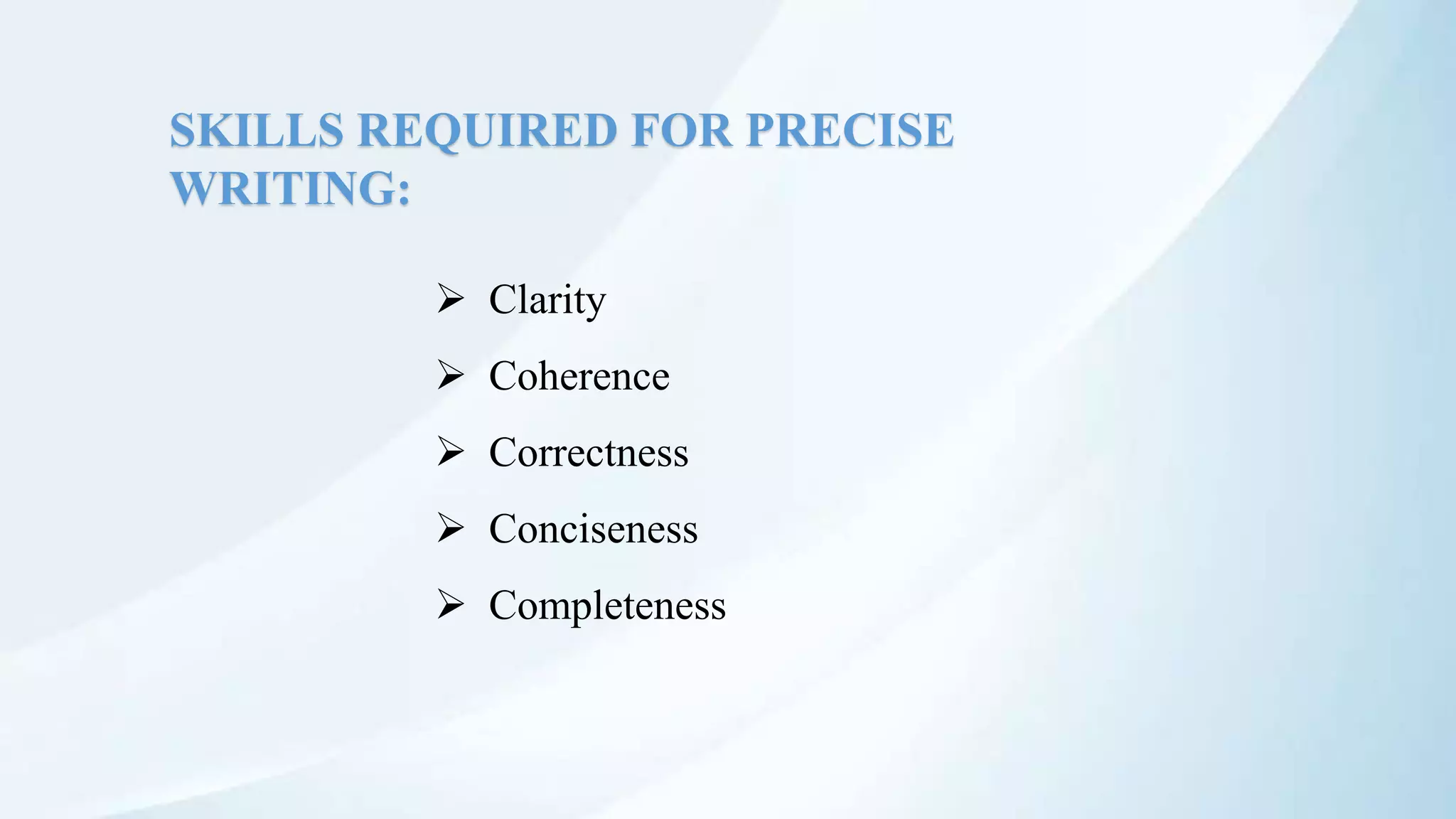
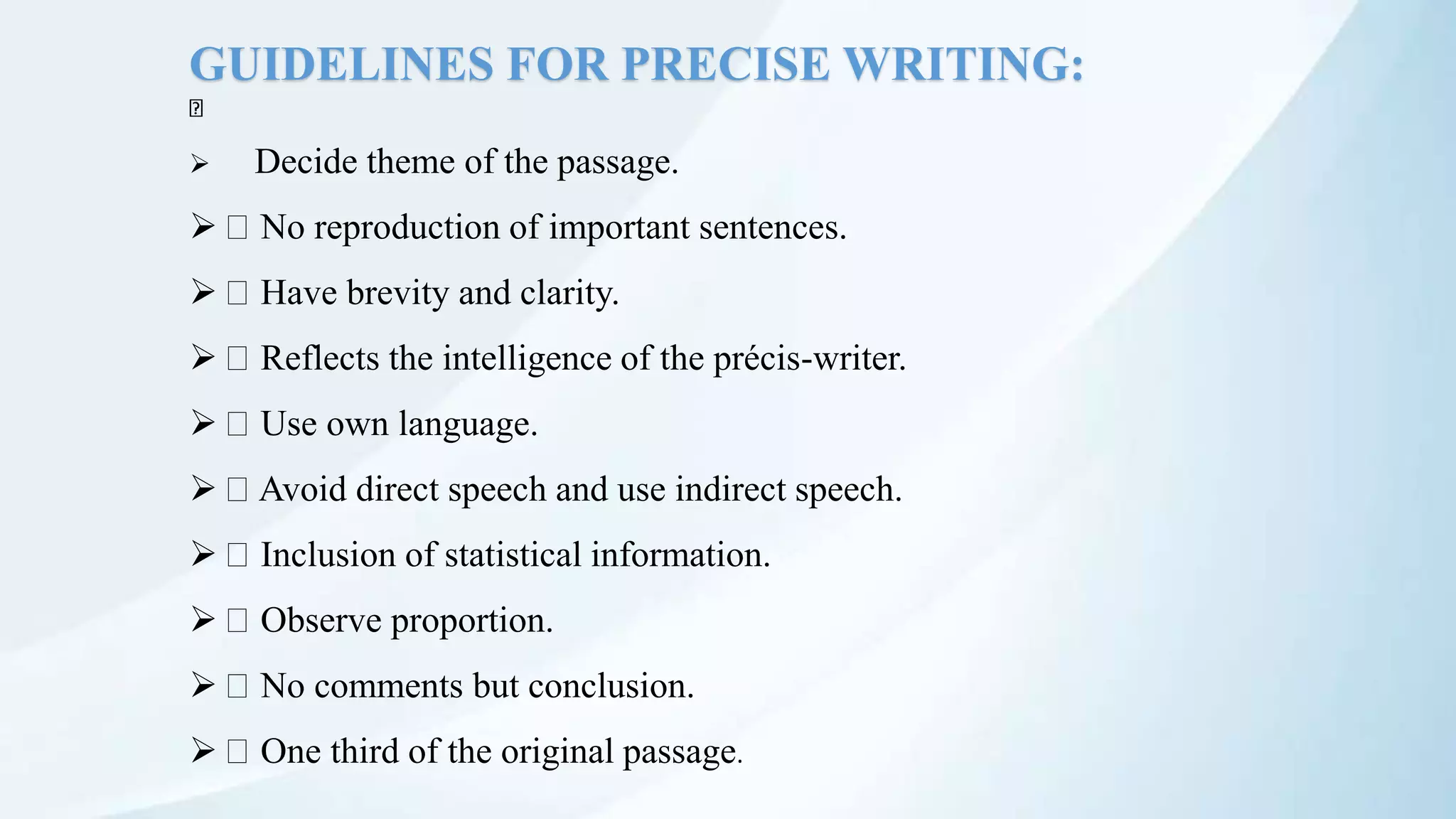
GUIDELINES FOR PRECISEWRITING:
Decide theme of the passage.
No reproduction of important sentences.
Have brevity and clarity.
Reflects the intelligence of the précis-writer.
Use own language.
Avoid direct speech and use indirect speech.
Inclusion of statistical information.
Observe proportion.
No comments but conclusion.
One third of the original passage.
6.
SUMMARISING:
MEANING:
Summarising is animportant skill that is often used when researching,
gathering or presenting information. A summary is a shortened version of a
longer text. It should not contain unnecessary detail or be written like an
essay.
A good example of summarizing is preparing a curriculum vitae
(CV).The person reading your CV should be able to make a decision about
whether or not you have the necessary skills and experience for the job.
7.
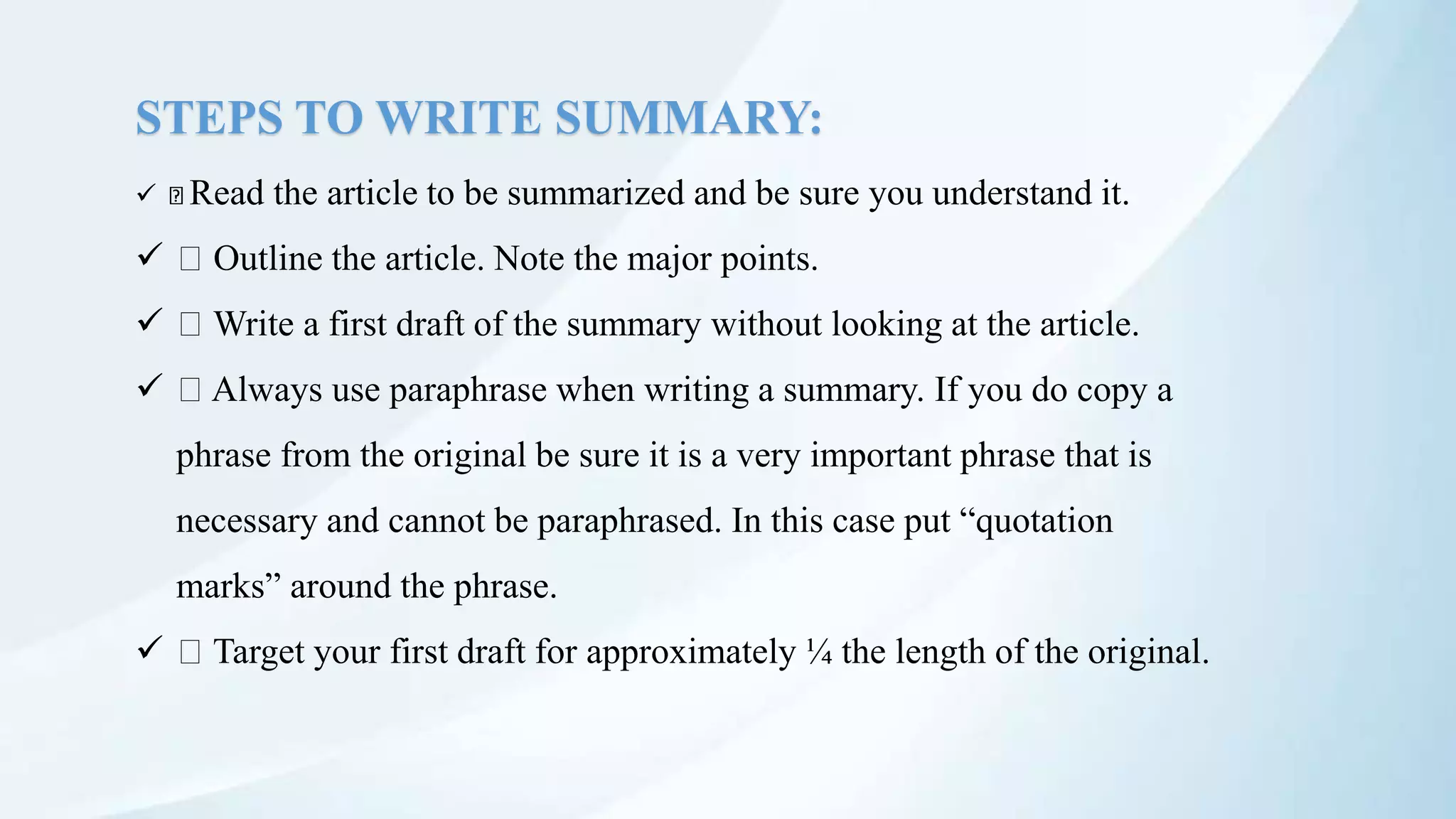
STEPS TO WRITESUMMARY:
Read the article to be summarized and be sure you understand it.
Outline the article. Note the major points.
Write a first draft of the summary without looking at the article.
Always use paraphrase when writing a summary. If you do copy a
phrase from the original be sure it is a very important phrase that is
necessary and cannot be paraphrased. In this case put “quotation
marks” around the phrase.
Target your first draft for approximately ¼ the length of the original.
8.
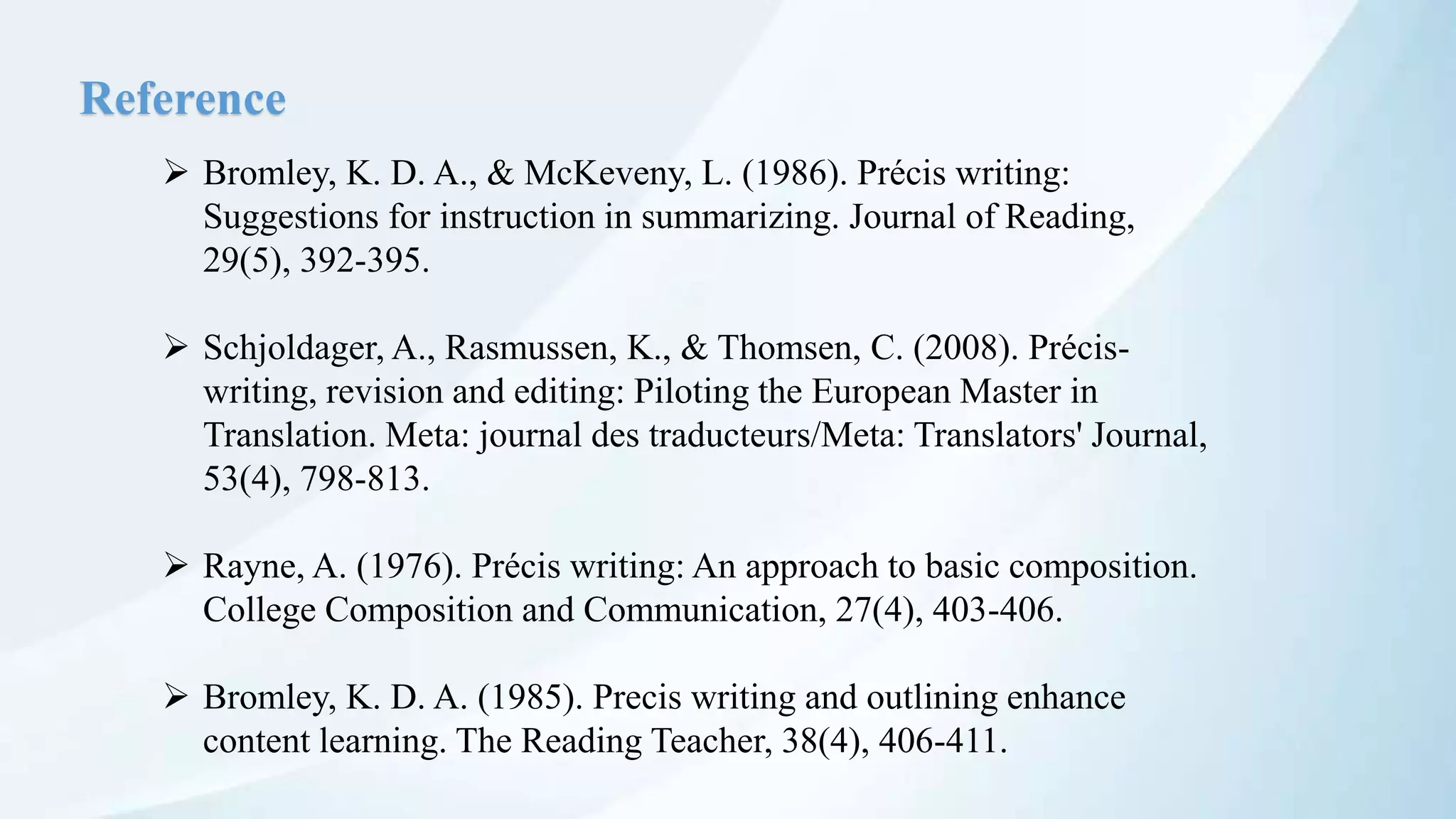
Reference
Bromley, K.D. A., & McKeveny, L. (1986). Précis writing:
Suggestions for instruction in summarizing. Journal of Reading,
29(5), 392-395.
Schjoldager, A., Rasmussen, K., & Thomsen, C. (2008). Précis-
writing, revision and editing: Piloting the European Master in
Translation. Meta: journal des traducteurs/Meta: Translators' Journal,
53(4), 798-813.
Rayne, A. (1976). Précis writing: An approach to basic composition.
College Composition and Communication, 27(4), 403-406.
Bromley, K. D. A. (1985). Precis writing and outlining enhance
content learning. The Reading Teacher, 38(4), 406-411.