
Objectives and the main concept of W-Assistant Target customers & benefits Similar products and technologies System construction Technical specifications SWOT Analysis Similar products and technologies Structure
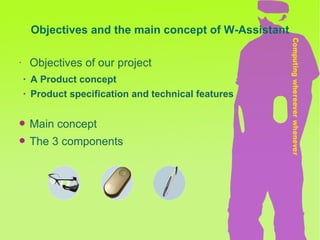
Objectives of our project A Product concept Product specification and technical features Main concept The 3 components  Objectives and the main concept of W-Assistant
Target customers & benefits For bussiness man Permanent information and communication access  messaging everywhere Record all of the ideas and work Stay connected with office and company database Display the text during presentation Personal digital organizer Electronic dictionaries Various software  Programs Wearable data storage and spread them through various connections
Target customers & benefits For student Permanent information and communication access  Record lectures and display the electronic materials Search any topic online Submit questions & homework directly Organize timetable and remind lectures, appointments and parties etc. Mobile entertainment, videos, music and games everywhere Display the text during presentation Electronic dictionaries Various software Programs
Product comparison  (Market research) Comparision of existing products and components on the market Optical mouse pen Headsets
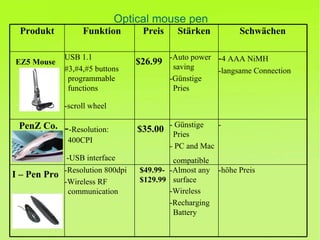
Optical mouse pen -höhe Preis -Almost any surface -Wireless -Recharging Battery  $49.99-$129.99   -Resolution 800dpi  -Wireless RF communication I – Pen Pro   - - Günstige  Pries  - PC and Mac compatible   $35.00   - -Resolution: 400CPI -USB interface   PenZ Co. - 4 AAA NiMH -langsame Connection -Auto power saving  -Günstige Pries $26.99     USB 1.1  #3,#4,#5 buttons programmable functions  -scroll wheel   EZ5 Mouse   Schwächen Stärken Preis Funktion Produkt
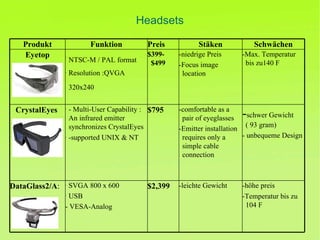
Headsets -höhe preis -Temperatur bis zu 104 F -leichte Gewicht $2,399 SVGA 800 x 600  USB - VESA-Analog DataGlass2/A : - schwer Gewicht ( 93 gram) - unbequeme Design -comfortable as a pair of eyeglasses  -Emitter installation requires only a simple cable connection  $795  - Multi-User Capability :  An infrared emitter synchronizes CrystalEyes  -supported UNIX & NT CrystalEyes   -Max. Temperatur bis zu140 F -niedrige Preis -Focus image location $399- $499 NTSC-M / PAL format   Resolution :QVGA 320x240   Eyetop Schwächen Stäken Preis Funktion Produkt
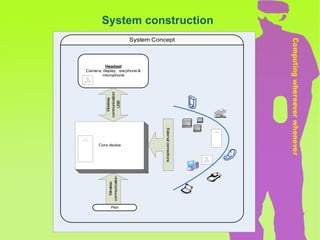
System construction
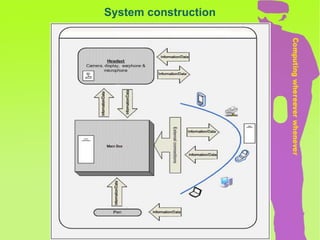
System construction
 
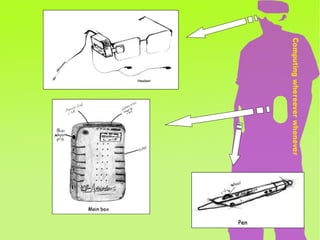
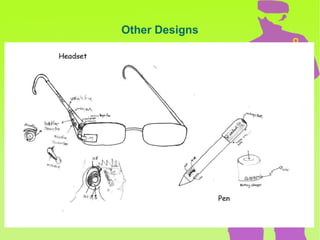
Other Designs
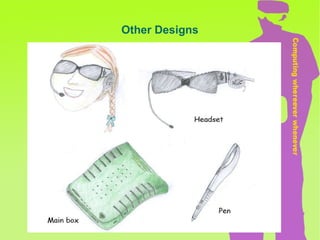
Other Designs
Technical Details Main box specifaction Optical Pen specification Headset specification Standards Software & Drivers Security Chips and components
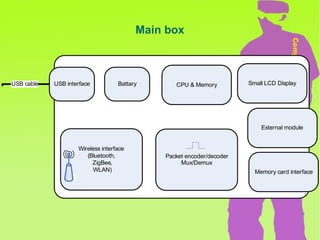
Main box
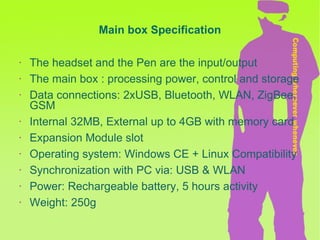
Main box Specification The headset and the Pen are the input/output The main box : processing power, control and storage Data connections: 2xUSB, Bluetooth, WLAN, ZigBee, GSM Internal 32MB, External up to 4GB with memory card Expansion Module slot Operating system: Windows CE + Linux Compatibility Synchronization with PC via: USB & WLAN Power: Rechargeable battery, 5 hours activity Weight: 250g
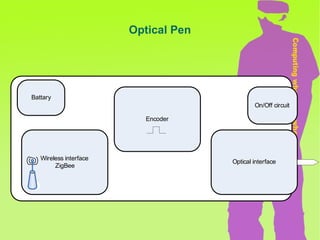
Optical Pen
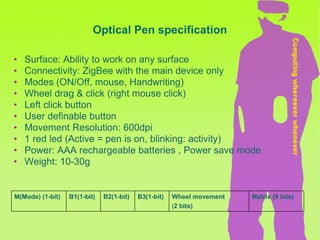
Optical Pen specification Surface: Ability to work on any surface Connectivity: ZigBee with the main device only Modes (ON/Off, mouse, Handwriting) Wheel drag & click (right mouse click) Left click button User definable button Movement Resolution: 600dpi 1 red led (Active = pen is on, blinking: activity) Power: AAA rechargeable batteries , Power save mode Weight: 10-30g Matrix (9 bits) Wheel movement   ( 2 bits) B3(1-bit) B2(1-bit) B1(1-bit) M(Mode) (1-bit)
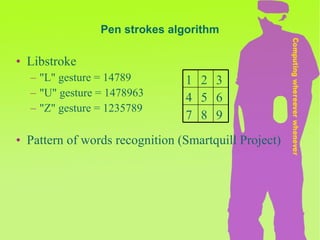
Pen strokes algorithm Libstroke "L" gesture = 14789 "U" gesture = 1478963 "Z" gesture = 1235789  Pattern of words recognition (Smartquill Project) 9 8 7 6 5 4 3 2 1
Headset
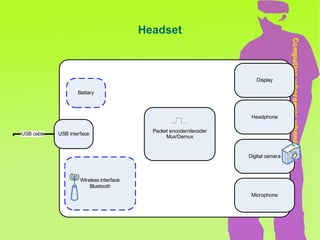
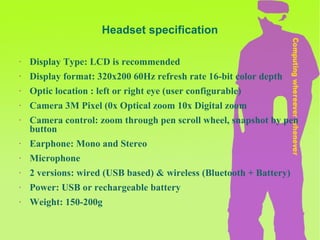
Headset specification Display Type: LCD is recommended Display format: 320x200 60Hz refresh rate 16-bit color depth Optic location : left or right eye (user configurable) Camera 3M Pixel (0x Optical zoom 10x Digital zoom Camera control: zoom through pen scroll wheel, snapshot by pen button Earphone: Mono and Stereo Microphone 2 versions: wired (USB based) & wireless (Bluetooth + Battery) Power: USB or rechargeable battery Weight: 150-200g
USB 1.0 & 2.0 WLAN  (IEEE,802.11g/a/b) Bluetooth: (IEEE,802.15.2) ZigBee:(IEEE,802.15.4) GSM FCC (Class “B” TBD) CE (norm TBD)   Standards to be supported
Handwrite recognition/ Pattern of words recognition (smartquill Project) Microsoft’s (MyLifeBits) to store and index activities during the day Synchronization software Digital assistant software Search engine Protocol to communicate between W-assistant devices Software/Drivers
Security features PIN code to lock/unlock the device User name/password to synchronize Wireless protocols with encryption enabled The Headset and the pen connect only to the user’s main device
Chips and components suggestion Multi-core/Multi-protocol chips (processors) Size Power consumption Cost FPGA Open source hardware designs Chips ZigBee: Chipcon, Freescale CPU: Motorola MPC860, Intel StrongArm,
SWOT analysis Strengths: Wearable computing, emerging technology and new product  System deployed around the body and no obstruction to user movement Multifunction Fit to most of the clothes Simple user interface In comparison with PDA, easy to replace damaged component. Various of standard connections (Bluetooth, WLAN, USB.....) Very open system less power consuming
SWOT analysis Weaknesses: Lack of technical experience  Large project with very new concept Relatively expensive Technical lacks No special new technology
Threats: The market may not accept the concept Side effects and Social problem  New technology Imitation by other competitors Opportunities: Large and increasing potential market No similar product The concept can be adopt to many fields of day-to-day life If successful, could set up the standard of wearable computing system. SWOT analysis
Display  technology selection Mechanical design Power  supply and power calculations Safety  standards for wearable devices User interface  software System   management  and control software Information  exchange  between headset and main device Extensive Market research and analysis for  users value ,  acceptance Price  estimation Chips  and components selection  System  test plan Open issues and next steps
Thanks!

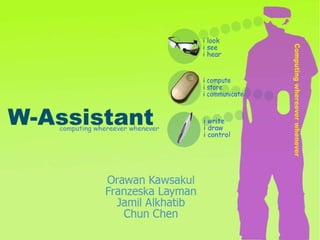
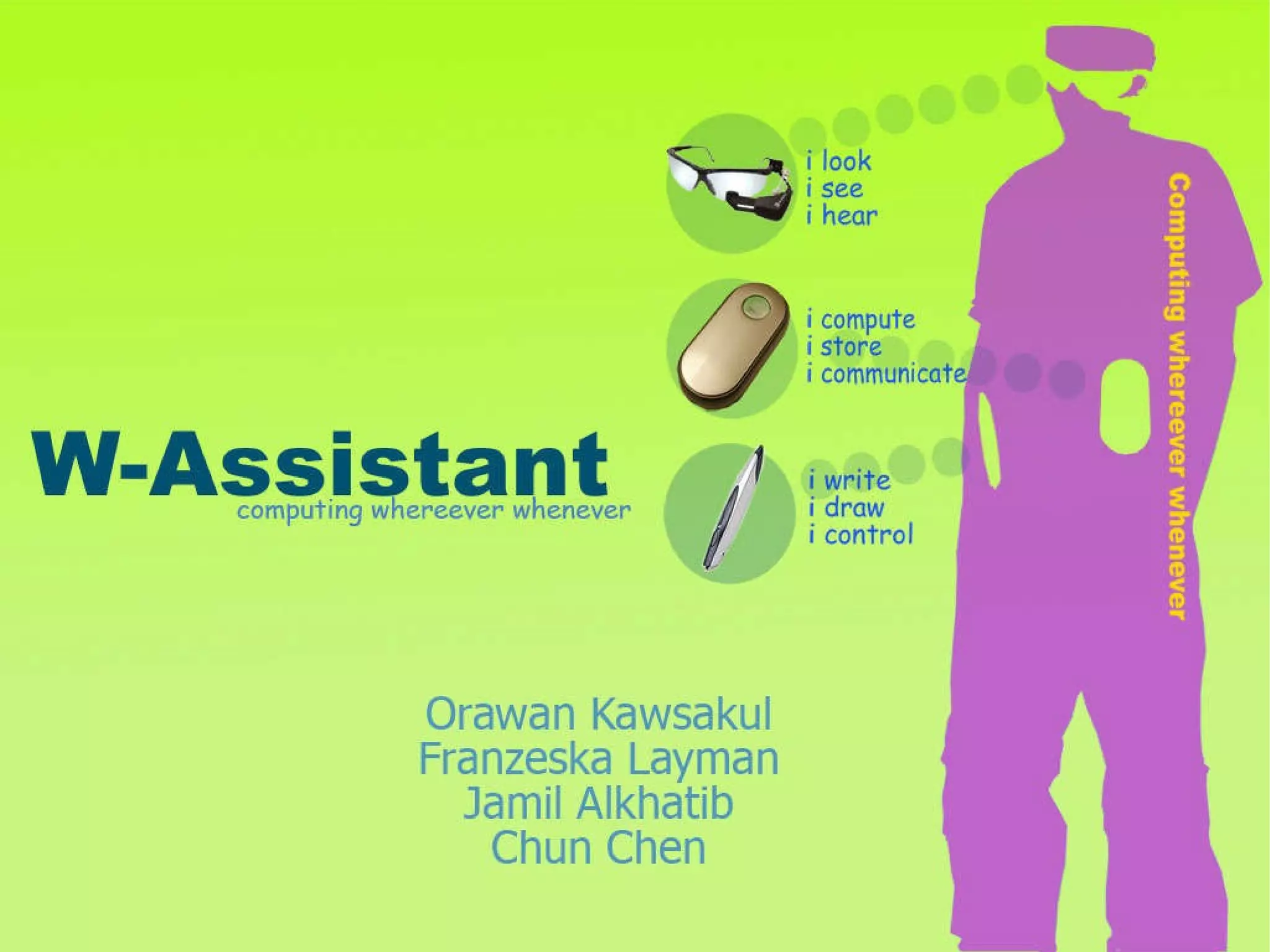
Wearable Assistant (Wassistant)

  • 1.
  • 2.
    Objectives and themain concept of W-Assistant Target customers & benefits Similar products and technologies System construction Technical specifications SWOT Analysis Similar products and technologies Structure
  • 3.
    Objectives of ourproject A Product concept Product specification and technical features Main concept The 3 components Objectives and the main concept of W-Assistant
  • 4.
    Target customers &benefits For bussiness man Permanent information and communication access messaging everywhere Record all of the ideas and work Stay connected with office and company database Display the text during presentation Personal digital organizer Electronic dictionaries Various software Programs Wearable data storage and spread them through various connections
  • 5.
    Target customers &benefits For student Permanent information and communication access Record lectures and display the electronic materials Search any topic online Submit questions & homework directly Organize timetable and remind lectures, appointments and parties etc. Mobile entertainment, videos, music and games everywhere Display the text during presentation Electronic dictionaries Various software Programs
  • 6.
    Product comparison (Market research) Comparision of existing products and components on the market Optical mouse pen Headsets
  • 7.
    Optical mouse pen-höhe Preis -Almost any surface -Wireless -Recharging Battery $49.99-$129.99 -Resolution 800dpi -Wireless RF communication I – Pen Pro - - Günstige Pries - PC and Mac compatible $35.00 - -Resolution: 400CPI -USB interface PenZ Co. - 4 AAA NiMH -langsame Connection -Auto power saving -Günstige Pries $26.99   USB 1.1 #3,#4,#5 buttons programmable functions -scroll wheel EZ5 Mouse   Schwächen Stärken Preis Funktion Produkt
  • 8.
    Headsets -höhe preis-Temperatur bis zu 104 F -leichte Gewicht $2,399 SVGA 800 x 600 USB - VESA-Analog DataGlass2/A : - schwer Gewicht ( 93 gram) - unbequeme Design -comfortable as a pair of eyeglasses -Emitter installation requires only a simple cable connection $795 - Multi-User Capability : An infrared emitter synchronizes CrystalEyes -supported UNIX & NT CrystalEyes -Max. Temperatur bis zu140 F -niedrige Preis -Focus image location $399- $499 NTSC-M / PAL format Resolution :QVGA 320x240 Eyetop Schwächen Stäken Preis Funktion Produkt
  • 9.
  • 10.
  • 11.
  • 12.
  • 13.
  • 14.
    Technical Details Mainbox specifaction Optical Pen specification Headset specification Standards Software & Drivers Security Chips and components
  • 15.
  • 16.
    Main box SpecificationThe headset and the Pen are the input/output The main box : processing power, control and storage Data connections: 2xUSB, Bluetooth, WLAN, ZigBee, GSM Internal 32MB, External up to 4GB with memory card Expansion Module slot Operating system: Windows CE + Linux Compatibility Synchronization with PC via: USB & WLAN Power: Rechargeable battery, 5 hours activity Weight: 250g
  • 17.
  • 18.
    Optical Pen specificationSurface: Ability to work on any surface Connectivity: ZigBee with the main device only Modes (ON/Off, mouse, Handwriting) Wheel drag & click (right mouse click) Left click button User definable button Movement Resolution: 600dpi 1 red led (Active = pen is on, blinking: activity) Power: AAA rechargeable batteries , Power save mode Weight: 10-30g Matrix (9 bits) Wheel movement ( 2 bits) B3(1-bit) B2(1-bit) B1(1-bit) M(Mode) (1-bit)
  • 19.
    Pen strokes algorithmLibstroke "L" gesture = 14789 "U" gesture = 1478963 "Z" gesture = 1235789 Pattern of words recognition (Smartquill Project) 9 8 7 6 5 4 3 2 1
  • 20.
  • 21.
    Headset specification DisplayType: LCD is recommended Display format: 320x200 60Hz refresh rate 16-bit color depth Optic location : left or right eye (user configurable) Camera 3M Pixel (0x Optical zoom 10x Digital zoom Camera control: zoom through pen scroll wheel, snapshot by pen button Earphone: Mono and Stereo Microphone 2 versions: wired (USB based) & wireless (Bluetooth + Battery) Power: USB or rechargeable battery Weight: 150-200g
  • 22.
    USB 1.0 &2.0 WLAN (IEEE,802.11g/a/b) Bluetooth: (IEEE,802.15.2) ZigBee:(IEEE,802.15.4) GSM FCC (Class “B” TBD) CE (norm TBD) Standards to be supported
  • 23.
    Handwrite recognition/ Patternof words recognition (smartquill Project) Microsoft’s (MyLifeBits) to store and index activities during the day Synchronization software Digital assistant software Search engine Protocol to communicate between W-assistant devices Software/Drivers
  • 24.
    Security features PINcode to lock/unlock the device User name/password to synchronize Wireless protocols with encryption enabled The Headset and the pen connect only to the user’s main device
  • 25.
    Chips and componentssuggestion Multi-core/Multi-protocol chips (processors) Size Power consumption Cost FPGA Open source hardware designs Chips ZigBee: Chipcon, Freescale CPU: Motorola MPC860, Intel StrongArm,
  • 26.
    SWOT analysis Strengths:Wearable computing, emerging technology and new product System deployed around the body and no obstruction to user movement Multifunction Fit to most of the clothes Simple user interface In comparison with PDA, easy to replace damaged component. Various of standard connections (Bluetooth, WLAN, USB.....) Very open system less power consuming
  • 27.
    SWOT analysis Weaknesses:Lack of technical experience Large project with very new concept Relatively expensive Technical lacks No special new technology
  • 28.
    Threats: The marketmay not accept the concept Side effects and Social problem New technology Imitation by other competitors Opportunities: Large and increasing potential market No similar product The concept can be adopt to many fields of day-to-day life If successful, could set up the standard of wearable computing system. SWOT analysis
  • 29.
    Display technologyselection Mechanical design Power supply and power calculations Safety standards for wearable devices User interface software System management and control software Information exchange between headset and main device Extensive Market research and analysis for users value , acceptance Price estimation Chips and components selection System test plan Open issues and next steps
  • 30.

Editor's Notes

  • #8 -gleiche Produktsanwendung existiert nicht - .Die Wettbewerber mit ähnlicher inhaltlicher Ausrichtung gibt es im Markt. Die stärksten Wettbewerb kann man in der Richtung Optical pen mouse und Headset finden und dabei wurden die Konkurrenten als Beispiel beleuchtet.
  • #10 The system is composed of 3 devices as shown in the figure (Headset, Pen and main box). The headset is made up of: the camera and microphone, as input device for image and audio to be captured; display and earphone, as the output device for image and audio to be shown. The headset communicates only with the main box, trough USB or Bluetooth connection( there are 2 versions of headset), the headset sends to main box the input data that should to be processed by main box, and receives from the main box the result of processing and outputs it on the display or the earphone. The pen is the main input device of the system, it collects inputs through its optical interface, wheel and buttons, and outputs them to the main box through wireless communication (ZigBee). By using the pen, we can input text and drawing, operate and interact with the system. The main box is the communication center, storage center and process center of the system. It performs the communication with the other components of system (pen and headset) and external world ( PC, mobile phones, printers, etc.) through wireless protocols or USB. The data will be read and wrote through the storage unit in the main box- internal and external memory. All the computing processes will be accomplished with the CPU in the main box. The extension slot on the main box helps the upgrade and extension of system functions.
  • #12 “ HCI” , human and W-Assistant communicate/interact through the headset and pen. .. 解释一下各个附件的组成,按钮的作用, main box 扩展槽扩展功能 - 定位系统、扩大存储、高端无线通信、 GSM 最好举例解释一下系统如何运作。
  • #19 1 more battery status led?
  • #27 New innovative product Wearable computing, display is available all the time and can be used conveniently No obstruction to user movement More and better integrated multifunction compared with existing wearable systems The system is divided and distributed around the body (display, pen, processing) Fit to most of the clothes Simple user interface (based on MS-windows mobile), easy operation, e.g. to use the pen like normal writing action. In comparison with PDA, easy to replace damaged component. The system can connect with other devices through standard wireless/wired connections like (Bluetooth, WLAN, USB.....) Very open system; its functions and applications can be expanded by the expansion module and numerous of software Longer working time with less power consuming display and other components
  • #28 Lack of technical experience for several technical issues that have to be tested like (temperature effect, display size and angle, etc.) Large project with very new concept Market is new and unknown concept to the users Relatively Expensive Cable that connects to the headset can be problematic to some people No special new technology developed from the project
  • #29 Threats: The market may not accept the concept Side effects on the health of the user are unknown New technology can substitute our basic technology Imitation by other competitors can be fast Social problem may be caused by ‘creative’ abuse of w-assistant system Opportunities: No similar products exist in the market Large and increasing potential market The concept can be adopt to many fields of day-to-day life If successful, could set up the standard of wearable computing system.