Note Making Skills
ď‚—Note making is an important
reading skill.
ď‚—It involves the identification of
main idea or Governing
Thought, supported by relevant
data and specific information.
Note Making Skills
Notes are usually made to record a speech or
dictation while listening to it to refer back to
reproduce in the desired way.
While reproducing the details, the text of the
notes, the meaning of the draft or the speech
remains the same. It should not be distorted.
Personal comments or views should not be
included while explaining the notes.
WHY Note are Necessary
ď‚— Knowledge is advancing and expanding so fast
that we have to learn it with the same speed.
Human mind is not a computing machine to
store all the knowledge imparted. We have to
take notes and develop them into our own
details to prepare and make maximum and the
best use of our teacher‟s lesson or lecture
which is outcome of their learned valuable
labour.
ď‚— Notes therefore are very important for almost
all educated
persons, teachers, lawyers, doctors and
ď‚— .
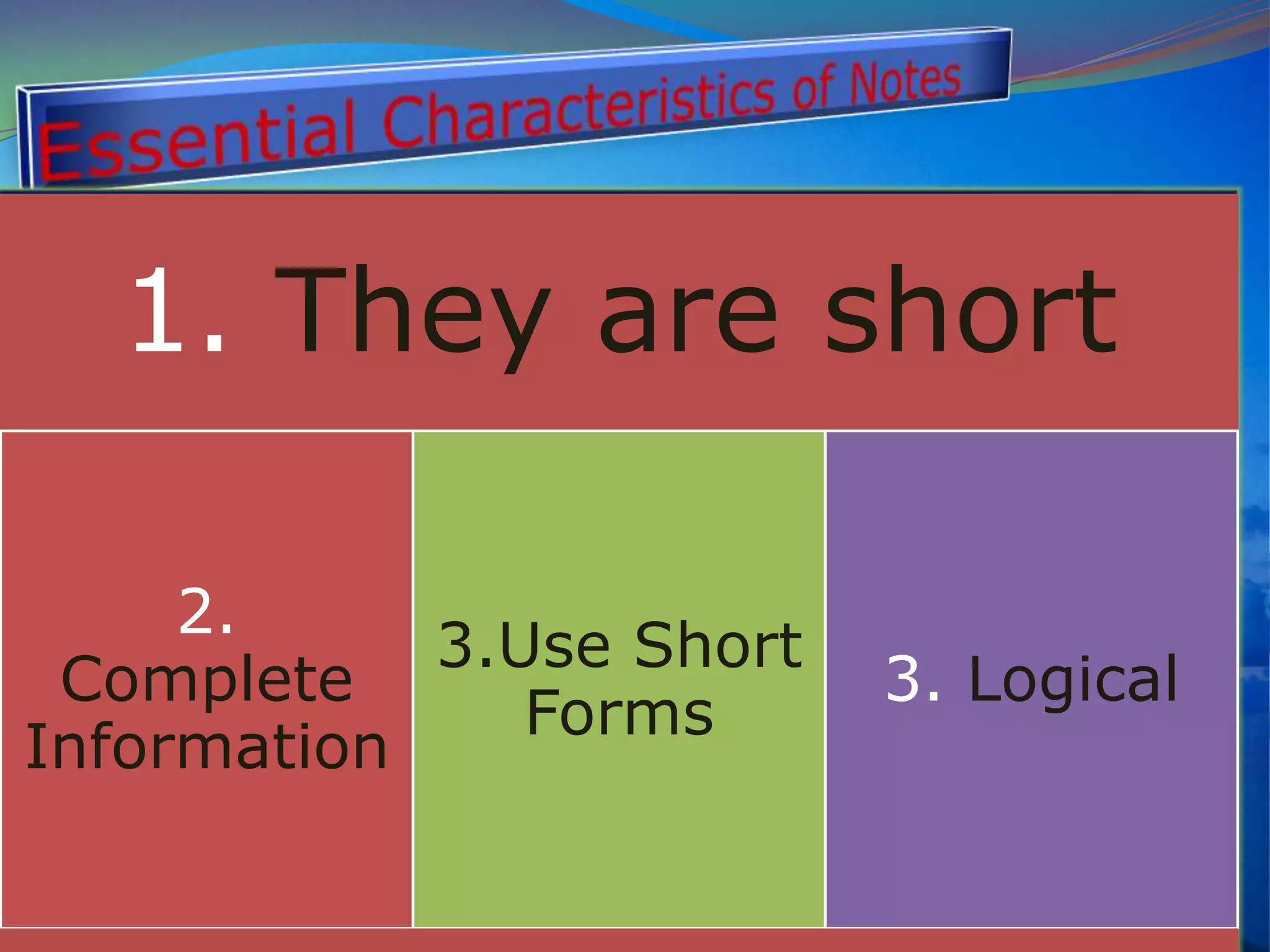
1. They are short
2.
Complete
Information
3.Use Short
Forms
3. Logical
01. They are Short
ď‚—They are written in key words
or phrases and not in
sentences. There is no need
to care for grammatical
accuracy. They are
short, brief and
compact, giving complete
02. Complete Information
The notes should contain all the
important points or information.
Nothing important or crucial to
the draft or the speech is to be
missed. Adjectival or qualifying
phrases or sentences and
explanatory parts of the main
points are left out.
03. Use of Short Forms
To save time and labour
popular abbreviations and
symbols are used. Own
abbreviations are also
coined but they should be
clear and intelligible.
04. Logical
Notes are in logical and
natural order, under
relevant headings and
sub- headings for easy
and quick reference.
Before making notes, read the passage
at least thrice. This helps in identifying
the main points and their sub- points
and arranging them. If necessary. Note-
Making is essentially the skill to put a
great deal of information in a few words
in an intelligible form and including all its
essential points.
.
I) Suggesting a Title
To make notes, first read the passage from
beginning to end. Try to find out „ what the
passage deals with‟ or „ what is the author‟s
view‟. This will guide you to suggest the Title.
The Title should be either a word or a short
phrase; it should not be a sentence
.
II)Finding the Main- Points
Now see how the author has developed the
theme and divide the passage accordingly into
main parts. Take care that each part deals
with one main point related to the theme of
the passage. Also find a suitable heading for
each part. These will be your main points
.
III)Finding the Sub- Points
The next step is to find details of each main
point. Each detail will make a sub- heading
under its main point and there can be further
details of a sub- heading
.
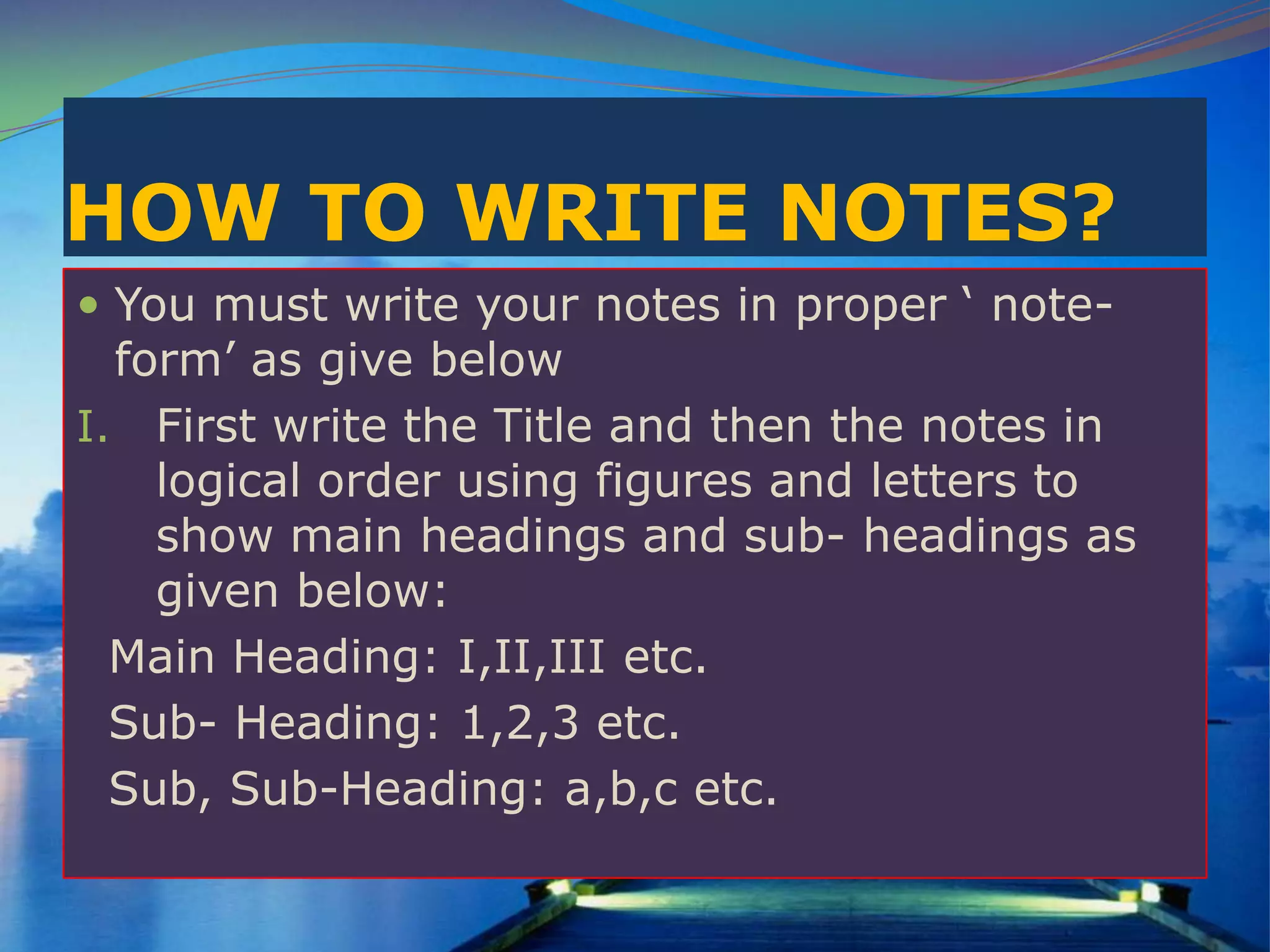
HOW TO WRITE NOTES?
 You must write your notes in proper „ note-
form‟ as give below
I. First write the Title and then the notes in
logical order using figures and letters to
show main headings and sub- headings as
given below:
Main Heading: I,II,III etc.
Sub- Heading: 1,2,3 etc.
Sub, Sub-Heading: a,b,c etc.
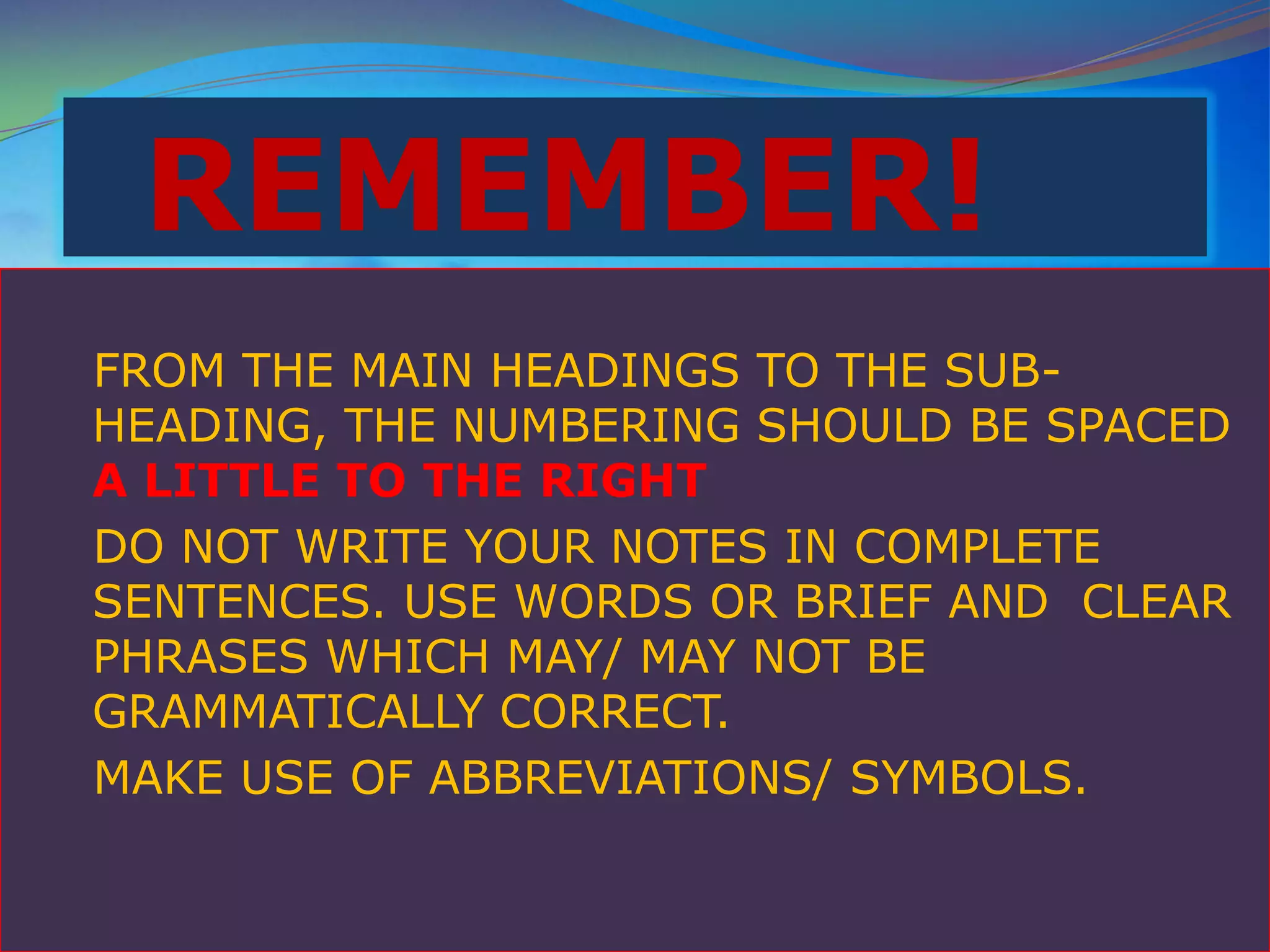
REMEMBER!
FROM THE MAIN HEADINGS TO THE SUB-
HEADING, THE NUMBERING SHOULD BE SPACED
A LITTLE TO THE RIGHT
DO NOT WRITE YOUR NOTES IN COMPLETE
SENTENCES. USE WORDS OR BRIEF AND CLEAR
PHRASES WHICH MAY/ MAY NOT BE
GRAMMATICALLY CORRECT.
MAKE USE OF ABBREVIATIONS/ SYMBOLS.
NOW LET US TRY
ď‚— Anything printed and bound in book size can be called a book, but the quality or mind
distinguishes the value of it.
 What is a book? This is how Anatole France describes it: “ A series of little printed
signs-essentially only that. It is for the reader to supply himself the forms and the
colors and sentiments to which these signs correspond. It will depend on him whether
the book be dull or brilliant, hot with passion and cold as ice. Or if you prefer to put it
otherwise, each word in a book is a magic finger that sets a fibre of our brain
vibrating like a harp string and so evokes a note from the sounding board of our soul.
No matter how skilful, how inspired the artist's hand, the sound it makes depends on
the quality of the strings within ourselves.”
ď‚— Until recently books were the preserve of a small section- the urban upper classes.
Some, even today, make it a point to call themselves intellectuals. It would be a pity if
books were meant only for intellectuals and not for housewives, farmers, factory
workers, artisans etc.
ď‚— In India there are first- generation learners, whose parents might have been illiterate.
This poses special challenges to our authors and to those who are entrusted with the
task of disseminating knowledge. We need much more research in the use of
language and the development of techniques by which knowledge can be transferred
to these people without transmission loss.
ď‚— Publishers should initiate to persuade people that a good book makes a beautiful
present and that reading a good book can be the most relaxing as well as absorbing
of pastimes. We should aim at books of quality no less than at quantitative expansion
in production and sale. Unless one is constantly exposed to the best, one cannot
develop a taste for the good.
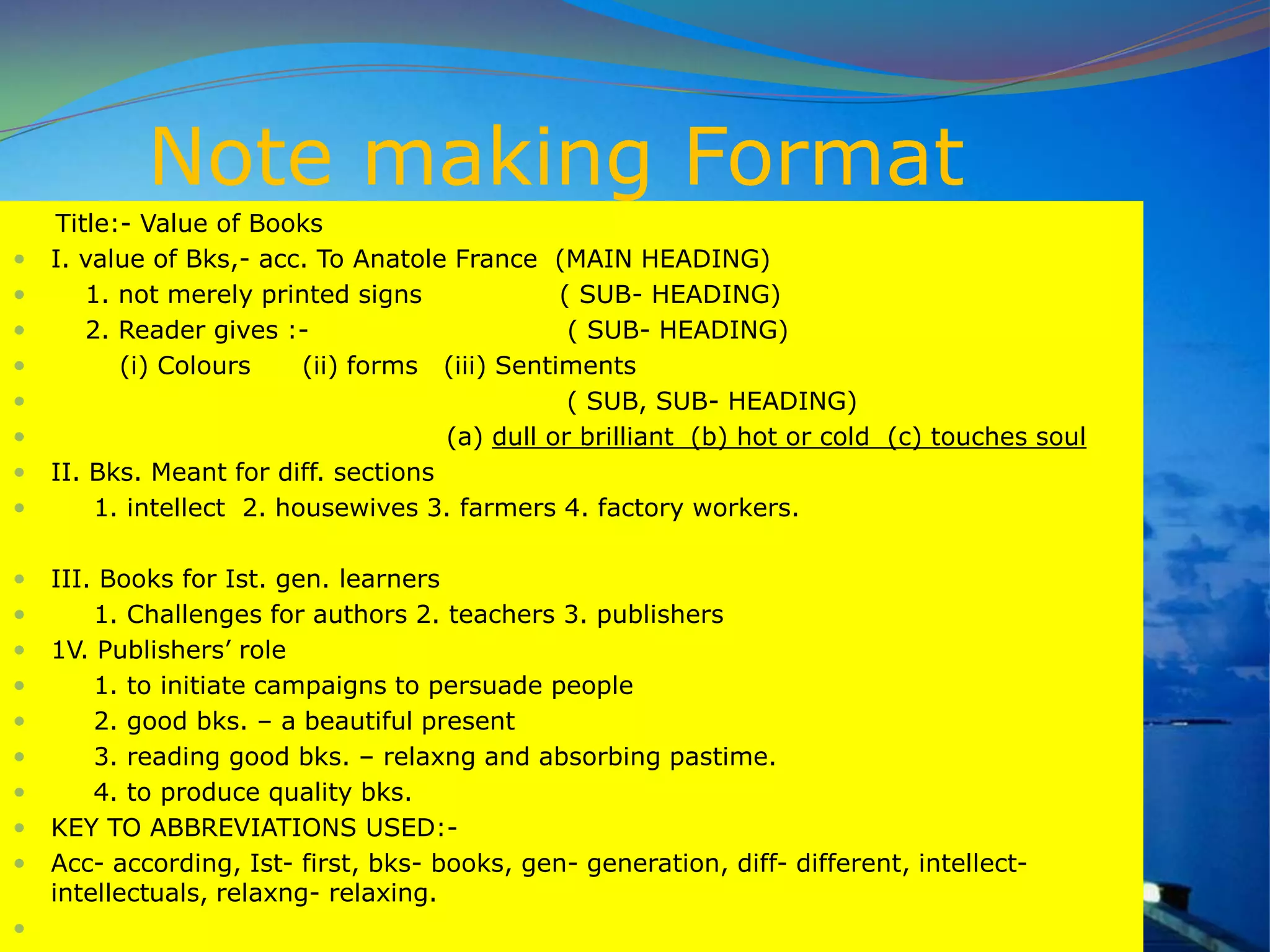
Note making Format
Title:- Value of Books
ď‚— I. value of Bks,- acc. To Anatole France (MAIN HEADING)
ď‚— 1. not merely printed signs ( SUB- HEADING)
ď‚— 2. Reader gives :- ( SUB- HEADING)
ď‚— (i) Colours (ii) forms (iii) Sentiments
ď‚— ( SUB, SUB- HEADING)
ď‚— (a) dull or brilliant (b) hot or cold (c) touches soul
ď‚— II. Bks. Meant for diff. sections
ď‚— 1. intellect 2. housewives 3. farmers 4. factory workers.
ď‚— III. Books for Ist. gen. learners
ď‚— 1. Challenges for authors 2. teachers 3. publishers
 1V. Publishers‟ role
ď‚— 1. to initiate campaigns to persuade people
 2. good bks. – a beautiful present
 3. reading good bks. – relaxng and absorbing pastime.
ď‚— 4. to produce quality bks.
ď‚— KEY TO ABBREVIATIONS USED:-
ď‚— Acc- according, Ist- first, bks- books, gen- generation, diff- different, intellect-
intellectuals, relaxng- relaxing.
ď‚—
Note making skills

Note making skills

  • 2.
    Note Making Skills ď‚—Notemaking is an important reading skill. ď‚—It involves the identification of main idea or Governing Thought, supported by relevant data and specific information.
  • 3.
    Note Making Skills Notesare usually made to record a speech or dictation while listening to it to refer back to reproduce in the desired way. While reproducing the details, the text of the notes, the meaning of the draft or the speech remains the same. It should not be distorted. Personal comments or views should not be included while explaining the notes.
  • 4.
    WHY Note areNecessary  Knowledge is advancing and expanding so fast that we have to learn it with the same speed. Human mind is not a computing machine to store all the knowledge imparted. We have to take notes and develop them into our own details to prepare and make maximum and the best use of our teacher‟s lesson or lecture which is outcome of their learned valuable labour.  Notes therefore are very important for almost all educated persons, teachers, lawyers, doctors and
  • 5.
    ď‚— . 1. Theyare short 2. Complete Information 3.Use Short Forms 3. Logical
  • 6.
    01. They areShort ď‚—They are written in key words or phrases and not in sentences. There is no need to care for grammatical accuracy. They are short, brief and compact, giving complete
  • 7.
    02. Complete Information Thenotes should contain all the important points or information. Nothing important or crucial to the draft or the speech is to be missed. Adjectival or qualifying phrases or sentences and explanatory parts of the main points are left out.
  • 8.
    03. Use ofShort Forms To save time and labour popular abbreviations and symbols are used. Own abbreviations are also coined but they should be clear and intelligible.
  • 9.
    04. Logical Notes arein logical and natural order, under relevant headings and sub- headings for easy and quick reference.
  • 10.
    Before making notes,read the passage at least thrice. This helps in identifying the main points and their sub- points and arranging them. If necessary. Note- Making is essentially the skill to put a great deal of information in a few words in an intelligible form and including all its essential points. .
  • 11.
    I) Suggesting aTitle To make notes, first read the passage from beginning to end. Try to find out „ what the passage deals with‟ or „ what is the author‟s view‟. This will guide you to suggest the Title. The Title should be either a word or a short phrase; it should not be a sentence .
  • 12.
    II)Finding the Main-Points Now see how the author has developed the theme and divide the passage accordingly into main parts. Take care that each part deals with one main point related to the theme of the passage. Also find a suitable heading for each part. These will be your main points .
  • 13.
    III)Finding the Sub-Points The next step is to find details of each main point. Each detail will make a sub- heading under its main point and there can be further details of a sub- heading .
  • 14.
    HOW TO WRITENOTES?  You must write your notes in proper „ note- form‟ as give below I. First write the Title and then the notes in logical order using figures and letters to show main headings and sub- headings as given below: Main Heading: I,II,III etc. Sub- Heading: 1,2,3 etc. Sub, Sub-Heading: a,b,c etc.
  • 15.
    REMEMBER! FROM THE MAINHEADINGS TO THE SUB- HEADING, THE NUMBERING SHOULD BE SPACED A LITTLE TO THE RIGHT DO NOT WRITE YOUR NOTES IN COMPLETE SENTENCES. USE WORDS OR BRIEF AND CLEAR PHRASES WHICH MAY/ MAY NOT BE GRAMMATICALLY CORRECT. MAKE USE OF ABBREVIATIONS/ SYMBOLS.
  • 16.
    NOW LET USTRY  Anything printed and bound in book size can be called a book, but the quality or mind distinguishes the value of it.  What is a book? This is how Anatole France describes it: “ A series of little printed signs-essentially only that. It is for the reader to supply himself the forms and the colors and sentiments to which these signs correspond. It will depend on him whether the book be dull or brilliant, hot with passion and cold as ice. Or if you prefer to put it otherwise, each word in a book is a magic finger that sets a fibre of our brain vibrating like a harp string and so evokes a note from the sounding board of our soul. No matter how skilful, how inspired the artist's hand, the sound it makes depends on the quality of the strings within ourselves.”  Until recently books were the preserve of a small section- the urban upper classes. Some, even today, make it a point to call themselves intellectuals. It would be a pity if books were meant only for intellectuals and not for housewives, farmers, factory workers, artisans etc.  In India there are first- generation learners, whose parents might have been illiterate. This poses special challenges to our authors and to those who are entrusted with the task of disseminating knowledge. We need much more research in the use of language and the development of techniques by which knowledge can be transferred to these people without transmission loss.  Publishers should initiate to persuade people that a good book makes a beautiful present and that reading a good book can be the most relaxing as well as absorbing of pastimes. We should aim at books of quality no less than at quantitative expansion in production and sale. Unless one is constantly exposed to the best, one cannot develop a taste for the good.
  • 17.
    Note making Format Title:-Value of Books  I. value of Bks,- acc. To Anatole France (MAIN HEADING)  1. not merely printed signs ( SUB- HEADING)  2. Reader gives :- ( SUB- HEADING)  (i) Colours (ii) forms (iii) Sentiments  ( SUB, SUB- HEADING)  (a) dull or brilliant (b) hot or cold (c) touches soul  II. Bks. Meant for diff. sections  1. intellect 2. housewives 3. farmers 4. factory workers.  III. Books for Ist. gen. learners  1. Challenges for authors 2. teachers 3. publishers  1V. Publishers‟ role  1. to initiate campaigns to persuade people  2. good bks. – a beautiful present  3. reading good bks. – relaxng and absorbing pastime.  4. to produce quality bks.  KEY TO ABBREVIATIONS USED:-  Acc- according, Ist- first, bks- books, gen- generation, diff- different, intellect- intellectuals, relaxng- relaxing. 