Publishing and Presenting
Scientific Papers
Adapted from the PPT of Jaroslav Mackerle, Linköping Institute of Technology, Linköping, Sweden, by way of Keith Clarke’s Geog 200A course at UCSB
Introduction
 A naturalist’s life would be happy one if he had only to
observe and never to write (Charles Darwin)
 In science, no matter how spectacular the results are, the
work is not completed until the results are published.
 Let’s explore the main steps from rough manuscript to
published paper.
Contents
 kinds of scientific written
communication
 scientific writing in general
 IMRaD format
 paper organization
 paper writing
 paper submission
 the editing process
 proof-reading
 … and pointers to reading
From an idea
by way of rules
to the published paper
Scientific written communication
 Reports
 Theses or dissertations
 Journal articles
 Books and book chapters
 Technical manuals/users guides
 Research or grant proposals
 Slide presentations
 Posters
Scientific writing in general
 Subject
 Purpose
– to exchange the scientific knowledge
– to ask and answer specific questions
 Audience
– scientists and those interested in the subject
– a publisher or an editor
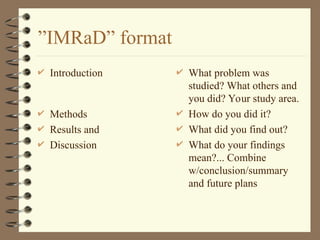
”IMRaD” format
 Introduction
 Methods
 Results and
 Discussion
 What problem was
studied? What others and
you did? Your study area.
 How do you did it?
 What did you find out?
 What do your findings
mean?... Combine
w/conclusion/summary
and future plans
Other types of journal papers
 Review
 Technical note
 Letter to the editor
 State-of-the-Art
Example of other types of articles, including
technical notes or data briefs:
 http://www.agu.org/journals/gc/
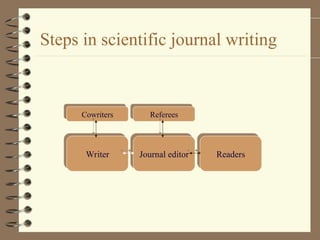
Steps in scientific journal writing
Writer Journal editor Readers
Cowriters Referees
Paper organization
 Introduction
– call attention to the specific subject, define the
problem
– provide background and present the results of
other studies (literature review)
– list the structure of your research project and
what you plan to present in your paper
Reading a scientific article isn’t the same as reading a detective story. We want to
know from the start that the butler did it (Ratnoff, 1981)
Paper organization
 Methods
– complete information of materials and methods
used, conditions present, actions, experimental
design, etc.
– this section usually has subheadings; when
possible match those to be used in Results
– enough information must be given so that the
models/experiments can be reproduced
– ask a colleague if he/she can follow the
methodology
Paper organization
 Results
– display of data with logical development showing how
your findings satisfy your objectives
– where possible give illustrative examples and compare
those with known results from literature
– use tables and figures
– the fool collects facts; the wise man selects them (J. W.
Powell, 1888)
Paper organization
 Discussion
– the hardest section to write
– discuss, without just repeating the Results
– show the relationship among observed facts
 Conclusion or Summary
– state your conclusion(s) as clearly as possible
– summarize evidence for each conclusion
• end with a short statement regarding the significance of
your work
Literature Review Revisited
 Exploring ideas on your subject
– gaps in research on a subject of interest
– existence of any duplication to your work
 Conducting a specific search
– manually in the library
– on-line searching
 Keep up-to-date with the specific subject
A rough draft perhaps but ….
 Will you have co-authors?
 Which journal to submit
your manuscript?
 How soon will it be
published?
 How to deal with editors?
 Professional publishers
– Elsevier
– Pergamon Press
– Springer Verlag
– J Wiley & Sons
– Kluwer Academic
Publishing
– Blackwell
Taylor & Francis
– Academic Press
 Professional
societies
– ACS
– RSC
– JBCS
– AAG
– AGU
– URISA
– ESA
– AFS
Journals - Publishers
Where to submit the manuscript
 The prestige factor
 The circulation factor
 The frequency factor
 The audience factor
 What is the publisher’s practice w/libraries?
– Will they have access to the journal for
reasonable price???
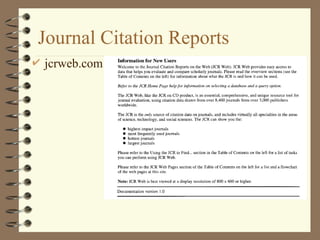
Journal Citation Reports
 jcrweb.com
Paper writing
 Write a rough outline first, fill it in
 A rough draft is ready
 Select the journal and read Instructions to Authors
(manuscript requirements: style in headings, the system for citations,
figures and tables, etc.)
 Write the final manuscript
 Write or refine your abstract
 Carefully choose keywords (increases success
with e-databases and search engines)
The final draft
 Front Matter
– Title (fewest possible words that describe the contents)
– Author’s (co-authors) name and address
– Abstract (miniversion of the paper, no citations)
– Keywords
 Article Body (IMRaD)
– Introduction
– Methods
– Results
– Discussion/Conclusion
 End Matter
– Acknowledgment (technical help and financial assistance)
– References (EndNote has style guides)
– Appendices
Abstracts
 Descriptive abstract
– or topical abstract, describes the contents but contains
too little substance and detail
 Informative abstract
– self-explanatory report on a scientific investigation
(research objectives for conducting the investigation,
the basic method used, and the results and significant
conclusions) - 200 to 250 words
 Extended abstract (conference proceedings)
 Don’t ignore those keywords!
Citations and references
 For a better credibility you have to review the literature
and show that your contribution extends from a solid
foundation of research
 Quality and quantity of the sources you have consulted
will enhance your work
 You have make it possible for readers to retrace your steps
 Your references can be as valuable as your research
methods and findings
 Check Information for Authors section
Citations: Name-year system
 Examples in the text:
– Salwasser (1992)
developed a …
– …realism or humanism
(Schmitt, 1986).
– Many other have
surveyed (Schmitt,
1986; Teal, 1981)
 References
– Salwasser, K.
Landscape Metrics,
…… 1999.
– Schmitt, L. A.
Symposium and
concluding remarks,…
1986.
– Teal, D.W. … 1981
Note: list of references in author alphabetical order
Ethics of scientific writing
 Avoid dual publication
 Don’t use the work of others without
appropriate attribution
 List only those co-authors who contributed
substantially to the work
Final submission
 In-house reviews required?
 Submit the paper to the journal’s editor (only to
one journal)
– Hard-copy of manuscript (usually three or more copies)
– Disk of the same version
• Text: Word, Word Perfect, TeX/LaTeX, etc.
• Figures: tif, gif, postscript, etc.
– E-Journal submission
Editing process
 Editor logs a manuscript and sends an
acknowledgement that the paper has been
received
 Editor sends the manuscript to reviewers
 On the basis of the reviews and the editor’s
opinion, your paper will be accepted,
conditionally accepted, or rejected.
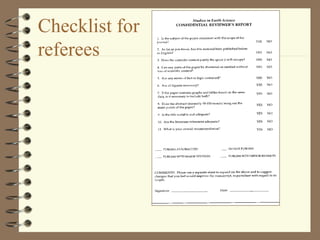
Checklist for
referees
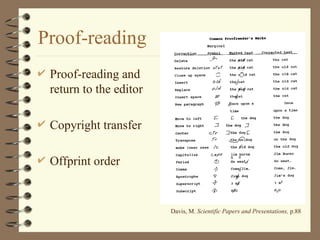
Proof-reading
 Proof-reading and
return to the editor
 Copyright transfer
 Offprint order
Davis, M. Scientific Papers and Presentations, p.88
Copyright Statement from
Journal
 Be sure to read thoroughly
 For theses read UMI Microfilm statement
 Make sure you agree with points
 Will you be free to send or post to web the
final pdf??
Congratulations
Bibliography
 Davis, M. Scientific Papers and Presentations, Academic
Press, 1997
 Day, R. A. How to Write and Publish a Scientific Paper,
4th Ed., Cambridge University Press, 1995
 Michaelson, H. B. How to Write and Publish Engineering
Papers and Reports, 3rd Ed., Oryx Press, 1990
 O’Connor, M. Writing Successfully in Science, Academic
Press, 1991
 Paradis, J. G. and Zimmerman, M. L. The MIT Guide to
Science and Engineering Communication, MIT Press, 1997
… and more books
 Briscoe, M.H. A Researcher’s Guide to Scientific and
Medical Illustrations, Springer-Verlag, NY, 1990
 Hodges, E. R. S. The Guild Handbook of Scientific
Illustration, Van Nostrand-Reinhold, NY, 1989
 Reynolds, L. and Simmonds, D. Presentation of Data in
Science, Nijhoff, Hague, 1983
 Smith, R. V. Graduate Research: A Guide for Students in
the Science,ISI Press, Philadelphia, 1984
 Stock, M. A Practical Guide to Graduate Research,
McGraw-Hill, NY, 1985

publishing.ppt...................................

  • 1.
    Publishing and Presenting ScientificPapers Adapted from the PPT of Jaroslav Mackerle, Linköping Institute of Technology, Linköping, Sweden, by way of Keith Clarke’s Geog 200A course at UCSB
  • 2.
    Introduction  A naturalist’slife would be happy one if he had only to observe and never to write (Charles Darwin)  In science, no matter how spectacular the results are, the work is not completed until the results are published.  Let’s explore the main steps from rough manuscript to published paper.
  • 3.
    Contents  kinds ofscientific written communication  scientific writing in general  IMRaD format  paper organization  paper writing  paper submission  the editing process  proof-reading  … and pointers to reading From an idea by way of rules to the published paper
  • 4.
    Scientific written communication Reports  Theses or dissertations  Journal articles  Books and book chapters  Technical manuals/users guides  Research or grant proposals  Slide presentations  Posters
  • 5.
    Scientific writing ingeneral  Subject  Purpose – to exchange the scientific knowledge – to ask and answer specific questions  Audience – scientists and those interested in the subject – a publisher or an editor
  • 6.
    ”IMRaD” format  Introduction Methods  Results and  Discussion  What problem was studied? What others and you did? Your study area.  How do you did it?  What did you find out?  What do your findings mean?... Combine w/conclusion/summary and future plans
  • 7.
    Other types ofjournal papers  Review  Technical note  Letter to the editor  State-of-the-Art Example of other types of articles, including technical notes or data briefs:  http://www.agu.org/journals/gc/
  • 8.
    Steps in scientificjournal writing Writer Journal editor Readers Cowriters Referees
  • 9.
    Paper organization  Introduction –call attention to the specific subject, define the problem – provide background and present the results of other studies (literature review) – list the structure of your research project and what you plan to present in your paper Reading a scientific article isn’t the same as reading a detective story. We want to know from the start that the butler did it (Ratnoff, 1981)
  • 10.
    Paper organization  Methods –complete information of materials and methods used, conditions present, actions, experimental design, etc. – this section usually has subheadings; when possible match those to be used in Results – enough information must be given so that the models/experiments can be reproduced – ask a colleague if he/she can follow the methodology
  • 11.
    Paper organization  Results –display of data with logical development showing how your findings satisfy your objectives – where possible give illustrative examples and compare those with known results from literature – use tables and figures – the fool collects facts; the wise man selects them (J. W. Powell, 1888)
  • 12.
    Paper organization  Discussion –the hardest section to write – discuss, without just repeating the Results – show the relationship among observed facts  Conclusion or Summary – state your conclusion(s) as clearly as possible – summarize evidence for each conclusion • end with a short statement regarding the significance of your work
  • 13.
    Literature Review Revisited Exploring ideas on your subject – gaps in research on a subject of interest – existence of any duplication to your work  Conducting a specific search – manually in the library – on-line searching  Keep up-to-date with the specific subject
  • 14.
    A rough draftperhaps but ….  Will you have co-authors?  Which journal to submit your manuscript?  How soon will it be published?  How to deal with editors?
  • 15.
     Professional publishers –Elsevier – Pergamon Press – Springer Verlag – J Wiley & Sons – Kluwer Academic Publishing – Blackwell Taylor & Francis – Academic Press  Professional societies – ACS – RSC – JBCS – AAG – AGU – URISA – ESA – AFS Journals - Publishers
  • 16.
    Where to submitthe manuscript  The prestige factor  The circulation factor  The frequency factor  The audience factor  What is the publisher’s practice w/libraries? – Will they have access to the journal for reasonable price???
  • 17.
  • 18.
    Paper writing  Writea rough outline first, fill it in  A rough draft is ready  Select the journal and read Instructions to Authors (manuscript requirements: style in headings, the system for citations, figures and tables, etc.)  Write the final manuscript  Write or refine your abstract  Carefully choose keywords (increases success with e-databases and search engines)
  • 19.
    The final draft Front Matter – Title (fewest possible words that describe the contents) – Author’s (co-authors) name and address – Abstract (miniversion of the paper, no citations) – Keywords  Article Body (IMRaD) – Introduction – Methods – Results – Discussion/Conclusion  End Matter – Acknowledgment (technical help and financial assistance) – References (EndNote has style guides) – Appendices
  • 20.
    Abstracts  Descriptive abstract –or topical abstract, describes the contents but contains too little substance and detail  Informative abstract – self-explanatory report on a scientific investigation (research objectives for conducting the investigation, the basic method used, and the results and significant conclusions) - 200 to 250 words  Extended abstract (conference proceedings)  Don’t ignore those keywords!
  • 21.
    Citations and references For a better credibility you have to review the literature and show that your contribution extends from a solid foundation of research  Quality and quantity of the sources you have consulted will enhance your work  You have make it possible for readers to retrace your steps  Your references can be as valuable as your research methods and findings  Check Information for Authors section
  • 22.
    Citations: Name-year system Examples in the text: – Salwasser (1992) developed a … – …realism or humanism (Schmitt, 1986). – Many other have surveyed (Schmitt, 1986; Teal, 1981)  References – Salwasser, K. Landscape Metrics, …… 1999. – Schmitt, L. A. Symposium and concluding remarks,… 1986. – Teal, D.W. … 1981 Note: list of references in author alphabetical order
  • 23.
    Ethics of scientificwriting  Avoid dual publication  Don’t use the work of others without appropriate attribution  List only those co-authors who contributed substantially to the work
  • 24.
    Final submission  In-housereviews required?  Submit the paper to the journal’s editor (only to one journal) – Hard-copy of manuscript (usually three or more copies) – Disk of the same version • Text: Word, Word Perfect, TeX/LaTeX, etc. • Figures: tif, gif, postscript, etc. – E-Journal submission
  • 25.
    Editing process  Editorlogs a manuscript and sends an acknowledgement that the paper has been received  Editor sends the manuscript to reviewers  On the basis of the reviews and the editor’s opinion, your paper will be accepted, conditionally accepted, or rejected.
  • 26.
  • 27.
    Proof-reading  Proof-reading and returnto the editor  Copyright transfer  Offprint order Davis, M. Scientific Papers and Presentations, p.88
  • 28.
    Copyright Statement from Journal Be sure to read thoroughly  For theses read UMI Microfilm statement  Make sure you agree with points  Will you be free to send or post to web the final pdf??
  • 29.
  • 30.
    Bibliography  Davis, M.Scientific Papers and Presentations, Academic Press, 1997  Day, R. A. How to Write and Publish a Scientific Paper, 4th Ed., Cambridge University Press, 1995  Michaelson, H. B. How to Write and Publish Engineering Papers and Reports, 3rd Ed., Oryx Press, 1990  O’Connor, M. Writing Successfully in Science, Academic Press, 1991  Paradis, J. G. and Zimmerman, M. L. The MIT Guide to Science and Engineering Communication, MIT Press, 1997
  • 31.
    … and morebooks  Briscoe, M.H. A Researcher’s Guide to Scientific and Medical Illustrations, Springer-Verlag, NY, 1990  Hodges, E. R. S. The Guild Handbook of Scientific Illustration, Van Nostrand-Reinhold, NY, 1989  Reynolds, L. and Simmonds, D. Presentation of Data in Science, Nijhoff, Hague, 1983  Smith, R. V. Graduate Research: A Guide for Students in the Science,ISI Press, Philadelphia, 1984  Stock, M. A Practical Guide to Graduate Research, McGraw-Hill, NY, 1985

Editor's Notes

  • #1 Adapted from the PPT of Jaroslav Mackerle, Linköping Institute of Technology, Linköping, Sweden, jarma@ikp.liu.se, by way of Keith Clarke’s Geog 200A course at UCSB
  • #15 AAG - Association of American Geographers, www.aag.org AGU - American Geophysical Union, www.agu.org ESA - Ecological Society of America, www.esa.org AFS - American Fisheries Society, www.fisheries.org Elsevier www.elsevier.nl/ Pergamon Press www.elsevier.nl/ Springer Verlag www.springer.de/ J Wiley & Sons www.wiley.com Kluwer Academic Publ. www.wkap. nl/ MCB University Press www.mcb.co.uk/ IOP Publishing www.iop.org Academic Press www.apnet.com/