
Technical
Assistance
to Schools
Session Objectives
At the end of the session the participants
shall be able to:

1.describe what is technical assistance, its,
guiding principles, steps & guidelines;
2.analyze the processes for providing
technical assistance to schools;
3.demonstrate readiness in applying the
guidelines/standards in providing technical
assistance to schools;
4.express appreciation in adhering to set
guidelines, standards and processes in
providing technical assistance.
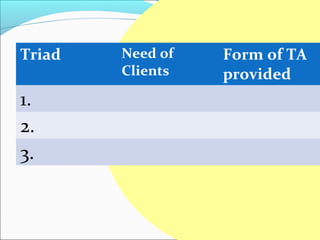
Triad   Need of   Form of TA
        Clients   provided
1.
2.
3.
What has helped in deciding the kind of
 technical assistance to be provided to the
 school?
What forms of TA can you identify from
 the reports?
Are there other form of TA which you are
 using in your division
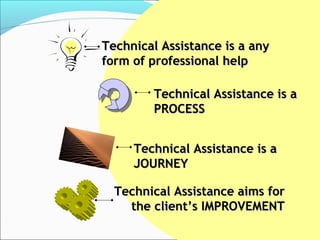
Technical Assistance is a any
form of professional help

        Technical Assistance is a
        PROCESS


     Technical Assistance is a
     JOURNEY

  Technical Assistance aims for
    the client’s IMPROVEMENT
Technical Assistance…..

o Any form of professional help,
  guidance or support
o For “others” to be more
  effective in the performance
  of their functions .
Technical Assistance is conducted
                      to help . . .
     solve problems
     improve performance
     get results
     gather data to inform policy
 formulation (RO).
Technical Assistance….
An Active PROCESS -
o With steps to follow; makes
  use of tools
o Via Process Consultation
o Requires specific skills
o Focuses on achieving set
  goals .
Technical Assistance….

A JOURNEY –
o Reminding the client of their
  prime responsibility and
  accountability
o Respecting their capability
  and pace
Technical Assistance….
 A JOURNEY –
 o Providing alternatives
 o Leaving decision-making
   into the hands of the client
Guiding Principles of Technical
Assistance organization is responsible for its
        Each
                  own growth and development

            Technical assistance is aligned with
                  the organization’s vision and
                   mission and is based on the
                          organization’s needs.

                Learning is a cooperative and
                    a collaborative process.
Technical Assistance Types:

 o Direct sharing of expertise
 o Providing information where
   to secure what the client
   needs
Skills in Providing Technical Assistance

    1. Facilitation Skills
    2. Giving Feedback Skills
    3. Coaching Skills
    4. Monitoring and Analysis of
       TA Progress
    5. Summative Evaluation of
       Providing TA
Guidelines:
1.   Know clients profile
2.   Be clear with your goal
3.   Give clear instructions
4.   Use the common language
5.   Speak in an audible voice
6.   Provide ample time
Guidelines:
 7. Conduct coaching face to face
 esp. at the first time / observation of
 accomplishing their task is needed
 8. Conduct coaching in an
 appropriate learning atmosphere
 9. There must be a 2-way
 communication
Some practical steps in Performance
Coaching
 Establish rapport with the staff.
 Ask her/him how the work has been.
 Allow her/him to tell her/his side of the story
  first.
 Share your own observations, again using
  the STAR technique and validate how it
  happened and why.
 Ask what s/he can do to sustain those with
  positive results and avoid those with
  negative results.
Some practical steps in Performance
Coaching
Together identify which area should
 s/he focus on for the next meeting.
Ask which areas he/she would like to
 seek help from you or others.
Make agreements and summarize.
Set the date for your next meeting with
 her/him
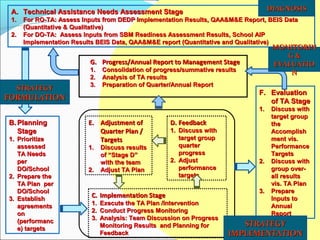
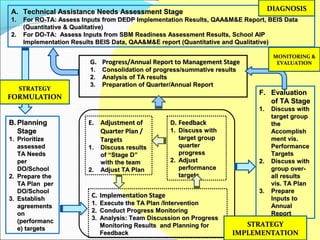
TA Mechanism Flow
A. Technical Assistance Needs Assessment Stage                                    DIAGNOSIS
 1.   For RO-TA: Assess Inputs from DEDP Implementation Results, QAA&M&E Report, BEIS Data
      (Quantitative & Qualitative)
 2.   For DO-TA: Assess Inputs from SBM Readiness Assessment Results, School AIP
      Implementation Results BEIS Data, QAA&M&E report (Quantitative and Qualitative)
                                                                                    MONITORIN
                                                                                       G&
                          G. Progress/Annual Report to Management Stage             EVALUATIO
                          1.   Consolidation of progress/summative results
                                                                                        N
                          2.   Analysis of TA results
                          3.   Preparation of Quarter/Annual Report
  STRATEGY
                                                                              F. Evaluation
FORMULATION                                                                      of TA Stage
                                                                              1.   Discuss with
                                                                                   target group
B. Planning              E. Adjustment of           D. Feedback                    the
   Stage                    Quarter Plan /          1. Discuss with                Accomplish
1. Prioritize               Targets                    target group                ment vis.
   assessed              1.    Discuss results         quarter                     Performance
   TA Needs                    of “Stage D”            progress                    Targets
   per                         with the team        2. Adjust                 2.   Discuss with
   DO/School             2.    Adjust TA Plan          performance                 group over-
2. Prepare the                                         targets                     all results
   TA Plan per                                                                     vis. TA Plan
   DO/School                                                                  3.   Prepare
3. Establish
                          C. Implementation Stage                                  Inputs to
   agreements             1. Execute the TA Plan /Intervention                     Annual
                          2. Conduct Progress Monitoring                           Report
   on
                          3. Analysis: Team Discussion on Progress
   (performanc
                             Monitoring Results and Planning for          STRATEGY
   e) targets
                             Feedback                                  IMPLEMENTATION
A. Technical Assistance Needs Assessment Stage                                     DIAGNOSIS
1.    For RO-TA: Assess Inputs from DEDP Implementation Results, QAA&M&E Report, BEIS Data
      (Quantitative & Qualitative)
2.    For DO-TA: Assess Inputs from SBM Readiness Assessment Results, School AIP
      Implementation Results BEIS Data, QAA&M&E report (Quantitative and Qualitative)

                                                                                    MONITORING &
                          G. Progress/Annual Report to Management Stage              EVALUATION
                          1.   Consolidation of progress/summative results
                          2.   Analysis of TA results
                          3.   Preparation of Quarter/Annual Report
     STRATEGY
                                                                              F. Evaluation
FORMULATION
                                                                                 of TA Stage
                                                                              1.   Discuss with
                                                                                   target group
B. Planning              E. Adjustment of           D. Feedback                    the
   Stage                    Quarter Plan /          1. Discuss with                Accomplish
1. Prioritize               Targets                    target group                ment vis.
   assessed              1.    Discuss results         quarter                     Performance
   TA Needs                    of “Stage D”            progress                    Targets
   per                         with the team        2. Adjust                 2.   Discuss with
   DO/School             2.    Adjust TA Plan          performance                 group over-
2. Prepare the                                         targets                     all results
   TA Plan per                                                                     vis. TA Plan
   DO/School                                                                  3.   Prepare
3. Establish
                          C. Implementation Stage                                  Inputs to
   agreements             1. Execute the TA Plan /Intervention                     Annual
                          2. Conduct Progress Monitoring                           Report
   on
                          3. Analysis: Team Discussion on Progress
   (performanc
                             Monitoring Results and Planning for           STRATEGY
   e) targets
                             Feedback                                   IMPLEMENTATION
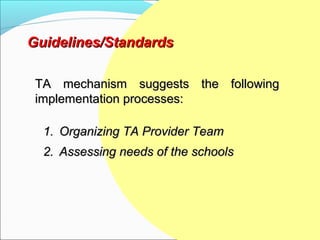
Guidelines/Standards

 TA mechanism suggests the following
 implementation processes:

  1. Organizing TA Provider Team
  2. Assessing needs of the schools
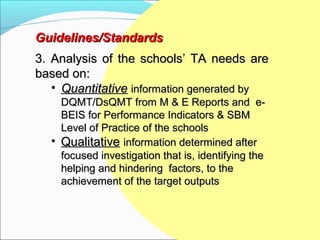
Guidelines/Standards
3. Analysis of the schools’ TA needs are
based on:
   • Quantitative information generated by
    DQMT/DsQMT from M & E Reports and e-
    BEIS for Performance Indicators & SBM
    Level of Practice of the schools
  • Qualitative information determined after
    focused investigation that is, identifying the
    helping and hindering factors, to the
    achievement of the target outputs
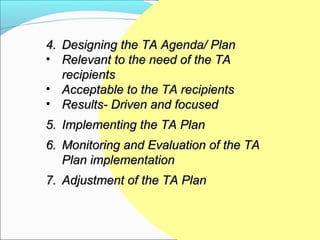
4. Designing the TA Agenda/ Plan
• Relevant to the need of the TA
   recipients
• Acceptable to the TA recipients
• Results- Driven and focused
5. Implementing the TA Plan
6. Monitoring and Evaluation of the TA
   Plan implementation
7. Adjustment of the TA Plan
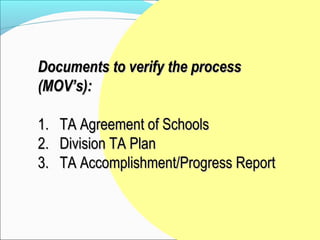
Documents to verify the process
(MOV’s):

1.   TA Agreement of Schools
2.   Division TA Plan
3.   TA Accomplishment/Progress Report
Some crucial Technical Assistance
areas for strengthening SBM
Implementation in schools which
need to be checked for quality
assurance:
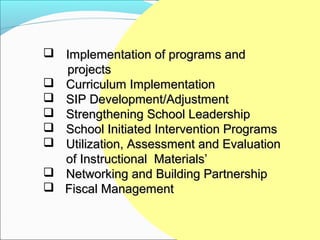
 Implementation of programs and
  projects
 Curriculum Implementation
 SIP Development/Adjustment
 Strengthening School Leadership
 School Initiated Intervention Programs
 Utilization, Assessment and Evaluation
  of Instructional Materials’
 Networking and Building Partnership
 Fiscal Management
“People don’t
care how much
  you know,

until they know
how much you
     care”.


         - John Hanley

Technical Assistance to Schools

  • 1.
  • 2.
  • 3.
    At the endof the session the participants shall be able to: 1.describe what is technical assistance, its, guiding principles, steps & guidelines; 2.analyze the processes for providing technical assistance to schools; 3.demonstrate readiness in applying the guidelines/standards in providing technical assistance to schools; 4.express appreciation in adhering to set guidelines, standards and processes in providing technical assistance.
  • 4.
    Triad Need of Form of TA Clients provided 1. 2. 3.
  • 5.
    What has helpedin deciding the kind of technical assistance to be provided to the school? What forms of TA can you identify from the reports? Are there other form of TA which you are using in your division
  • 6.
    Technical Assistance isa any form of professional help Technical Assistance is a PROCESS Technical Assistance is a JOURNEY Technical Assistance aims for the client’s IMPROVEMENT
  • 7.
    Technical Assistance….. o Anyform of professional help, guidance or support o For “others” to be more effective in the performance of their functions .
  • 8.
    Technical Assistance isconducted to help . . . solve problems improve performance get results gather data to inform policy formulation (RO).
  • 9.
    Technical Assistance…. An ActivePROCESS - o With steps to follow; makes use of tools o Via Process Consultation o Requires specific skills o Focuses on achieving set goals .
  • 10.
    Technical Assistance…. A JOURNEY– o Reminding the client of their prime responsibility and accountability o Respecting their capability and pace
  • 11.
    Technical Assistance…. AJOURNEY – o Providing alternatives o Leaving decision-making into the hands of the client
  • 12.
    Guiding Principles ofTechnical Assistance organization is responsible for its Each own growth and development Technical assistance is aligned with the organization’s vision and mission and is based on the organization’s needs. Learning is a cooperative and a collaborative process.
  • 13.
    Technical Assistance Types: o Direct sharing of expertise o Providing information where to secure what the client needs
  • 14.
    Skills in ProvidingTechnical Assistance 1. Facilitation Skills 2. Giving Feedback Skills 3. Coaching Skills 4. Monitoring and Analysis of TA Progress 5. Summative Evaluation of Providing TA
  • 15.
    Guidelines: 1. Know clients profile 2. Be clear with your goal 3. Give clear instructions 4. Use the common language 5. Speak in an audible voice 6. Provide ample time
  • 16.
    Guidelines: 7. Conductcoaching face to face esp. at the first time / observation of accomplishing their task is needed 8. Conduct coaching in an appropriate learning atmosphere 9. There must be a 2-way communication
  • 17.
    Some practical stepsin Performance Coaching  Establish rapport with the staff.  Ask her/him how the work has been.  Allow her/him to tell her/his side of the story first.  Share your own observations, again using the STAR technique and validate how it happened and why.  Ask what s/he can do to sustain those with positive results and avoid those with negative results.
  • 18.
    Some practical stepsin Performance Coaching Together identify which area should s/he focus on for the next meeting. Ask which areas he/she would like to seek help from you or others. Make agreements and summarize. Set the date for your next meeting with her/him
  • 19.
  • 20.
    A. Technical AssistanceNeeds Assessment Stage DIAGNOSIS 1. For RO-TA: Assess Inputs from DEDP Implementation Results, QAA&M&E Report, BEIS Data (Quantitative & Qualitative) 2. For DO-TA: Assess Inputs from SBM Readiness Assessment Results, School AIP Implementation Results BEIS Data, QAA&M&E report (Quantitative and Qualitative) MONITORIN G& G. Progress/Annual Report to Management Stage EVALUATIO 1. Consolidation of progress/summative results N 2. Analysis of TA results 3. Preparation of Quarter/Annual Report STRATEGY F. Evaluation FORMULATION of TA Stage 1. Discuss with target group B. Planning E. Adjustment of D. Feedback the Stage Quarter Plan / 1. Discuss with Accomplish 1. Prioritize Targets target group ment vis. assessed 1. Discuss results quarter Performance TA Needs of “Stage D” progress Targets per with the team 2. Adjust 2. Discuss with DO/School 2. Adjust TA Plan performance group over- 2. Prepare the targets all results TA Plan per vis. TA Plan DO/School 3. Prepare 3. Establish C. Implementation Stage Inputs to agreements 1. Execute the TA Plan /Intervention Annual 2. Conduct Progress Monitoring Report on 3. Analysis: Team Discussion on Progress (performanc Monitoring Results and Planning for STRATEGY e) targets Feedback IMPLEMENTATION
  • 21.
    A. Technical AssistanceNeeds Assessment Stage DIAGNOSIS 1. For RO-TA: Assess Inputs from DEDP Implementation Results, QAA&M&E Report, BEIS Data (Quantitative & Qualitative) 2. For DO-TA: Assess Inputs from SBM Readiness Assessment Results, School AIP Implementation Results BEIS Data, QAA&M&E report (Quantitative and Qualitative) MONITORING & G. Progress/Annual Report to Management Stage EVALUATION 1. Consolidation of progress/summative results 2. Analysis of TA results 3. Preparation of Quarter/Annual Report STRATEGY F. Evaluation FORMULATION of TA Stage 1. Discuss with target group B. Planning E. Adjustment of D. Feedback the Stage Quarter Plan / 1. Discuss with Accomplish 1. Prioritize Targets target group ment vis. assessed 1. Discuss results quarter Performance TA Needs of “Stage D” progress Targets per with the team 2. Adjust 2. Discuss with DO/School 2. Adjust TA Plan performance group over- 2. Prepare the targets all results TA Plan per vis. TA Plan DO/School 3. Prepare 3. Establish C. Implementation Stage Inputs to agreements 1. Execute the TA Plan /Intervention Annual 2. Conduct Progress Monitoring Report on 3. Analysis: Team Discussion on Progress (performanc Monitoring Results and Planning for STRATEGY e) targets Feedback IMPLEMENTATION
  • 22.
    Guidelines/Standards TA mechanismsuggests the following implementation processes: 1. Organizing TA Provider Team 2. Assessing needs of the schools
  • 23.
    Guidelines/Standards 3. Analysis ofthe schools’ TA needs are based on: • Quantitative information generated by DQMT/DsQMT from M & E Reports and e- BEIS for Performance Indicators & SBM Level of Practice of the schools • Qualitative information determined after focused investigation that is, identifying the helping and hindering factors, to the achievement of the target outputs
  • 24.
    4. Designing theTA Agenda/ Plan • Relevant to the need of the TA recipients • Acceptable to the TA recipients • Results- Driven and focused 5. Implementing the TA Plan 6. Monitoring and Evaluation of the TA Plan implementation 7. Adjustment of the TA Plan
  • 25.
    Documents to verifythe process (MOV’s): 1. TA Agreement of Schools 2. Division TA Plan 3. TA Accomplishment/Progress Report
  • 26.
    Some crucial TechnicalAssistance areas for strengthening SBM Implementation in schools which need to be checked for quality assurance:
  • 27.
     Implementation ofprograms and projects  Curriculum Implementation  SIP Development/Adjustment  Strengthening School Leadership  School Initiated Intervention Programs  Utilization, Assessment and Evaluation of Instructional Materials’  Networking and Building Partnership  Fiscal Management
  • 28.
    “People don’t care howmuch you know, until they know how much you care”. - John Hanley