School Improvement Plan
(SIP) 2016-2019 and
Monitoring & Evaluation
(M&E) Tool
Formulation Seminar Workshop
WELCOME Batch 15
Why craft the School
Improvement Plan?
It is required by LAW.
It is envisioned to create an
environment of collaboration.
Legal Basis
 Republic Act 9155 – Governance of
Basic Education Act of 2001 (Section
6.2.4)
 The School Head shall have authority,
accountability and responsibility in
“Developing the School Education Program
and School Improvement Plan”
Legal Basis
 Republic Act 9184 – Procurement
Law (Article II Section 7)
“… No government procurement shall be
undertaken unless it is in accordance with
the approved Annual Procurement Plan of
the Procuring Entity..”
Legal Basis
 DO No. 44 s. 2015 – School
Improvement Planning Guidebook
School Improvement Plan
A 3-year roadmap of
interventions for the school
To be undertaken with the help
of the community and
stakeholders.
School Improvement Plan
It is formulated based on
evidences, results and intended
for the learners.
A requirement of the School
Based Management (SBM).
Prepared by the School-
Community Planning Team (SPT).
School Improvement Plan
A basis for the Annual
Implementation Plan (AIP).
A basis for the Annual Procurement
Plan (APP).
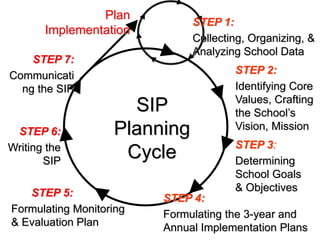
STEP 1:
Collecting, Organizing, &
Analyzing School Data
STEP 2:
Identifying Core
Values, Crafting
the School’s
Vision, Mission
STEP 3:
Determining
School Goals
& Objectives
STEP 4:
Formulating the 3-year and
Annual Implementation Plans
STEP 5:
Formulating Monitoring
& Evaluation Plan
STEP 6:
Writing the
SIP
STEP 7:
Communicati
ng the SIP
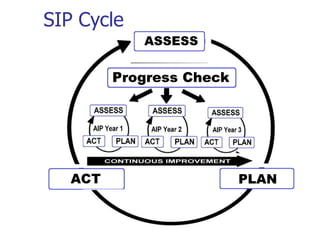
Plan
Implementation
SIP
Planning
Cycle
SIP Cycle
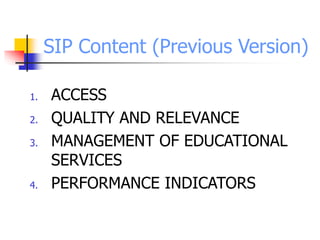
SIP Content (Previous Version)
1. ACCESS
2. QUALITY AND RELEVANCE
3. MANAGEMENT OF EDUCATIONAL
SERVICES
4. PERFORMANCE INDICATORS
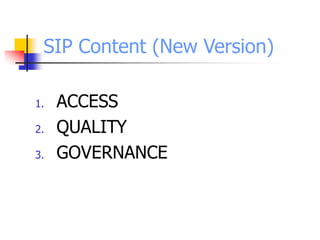
SIP Content (New Version)
1. ACCESS
2. QUALITY
3. GOVERNANCE
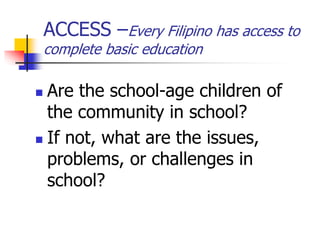
ACCESS –Every Filipino has access to
complete basic education
 Are the school-age children of
the community in school?
 If not, what are the issues,
problems, or challenges in
school?
ACCESS –Every Filipino has access to
complete basic education
 What are the causes of the
children dropping out? Is there
anything that the school can do
about it?
 Transition
 Grade 6 to Grade 7
 Grade 10 to Grade 11 (SHS)
QUALITY – Every graduate is prepared
for further education and the world of work
 Quality vs Number of Graduates
 NAT Mean Percentage Scores
 Reading Proficiency of Students
 Numeracy Levels of Students
 Instructional Supervision
QUALITY - Every graduate is prepared
for further education and the world of work
 How do learners learn? (NAT Results)
 How do teachers teach? (RPMS
Indicators)
 How do school head manages and
supervises the school? (RPMS
Indicators)
GOVERNANCE – Effective, transparent,
and collaborative governance of basic
education
 School Based Management
 Child Friendly School System
 Stakeholders’ Participation in School PPAs
 Learner-Teacher Ratio
 Learner-Classroom Ratio
 Learner-Toilet Ratio
 Learner-Seat Ratio
Preparatory Activities
1. Gather and Organize Necessary Data
 DM 223 s 2015 Requirements from Participants
2. Form the School Planning Team
 DRRMC and Child Protection Committee
3. Convene the School Planning Team
for Orientation, Vision Sharing and
Scheduling
SPT Preparatory Activity
1. Run through of School Data
Gathering Forms
BACK
2. Identify the improvement areas of
the school
(PAST) Unsolved problems of the school
(PRESENT) New problems of the school
3. Vision sharing of the SPT
4. SPT Schedule/Timeline
Expected Outputs:
 Available Data and Its Source(s)
 Vision Sharing of Planning Team
 Planning Team Schedule
Workshop 1 – Activity 1a
Run through of School Data Gathering Forms
Sources of Data
School-Community Data (Annex 1A) 45/17
Child Mapping (Annex 1B) 63
Child Friendly School Survey (Annex 2A) 65
Child Protection Policy Implementation Checklist (Annex 2B) 77
School Hazard Mapping (Annex 2C) 79
SRC Summary (Annex 11)
BACK
What is the use of these data
collected?
 Evidence for improvement
 Areas that do not meet standards
 Lacking requirements of the school
 Gaps may be the aim for
improvements or innovations
Workshop
Vision Sharing of Planning Team
Planning Team’s UNDERSTANDING of DepED’s
 Vision
 Mission
 Core Values
NEXT ACTIVITY
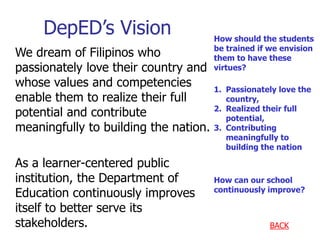
DepED’s Vision
We dream of Filipinos who
passionately love their country and
whose values and competencies
enable them to realize their full
potential and contribute
meaningfully to building the nation.
As a learner-centered public
institution, the Department of
Education continuously improves
itself to better serve its
stakeholders. BACK
How should the students
be trained if we envision
them to have these
virtues?
1. Passionately love the
country,
2. Realized their full
potential,
3. Contributing
meaningfully to
building the nation
How can our school
continuously improve?
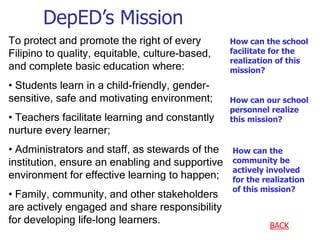
DepED’s Mission
To protect and promote the right of every
Filipino to quality, equitable, culture-based,
and complete basic education where:
• Students learn in a child-friendly, gender-
sensitive, safe and motivating environment;
• Teachers facilitate learning and constantly
nurture every learner;
• Administrators and staff, as stewards of the
institution, ensure an enabling and supportive
environment for effective learning to happen;
• Family, community, and other stakeholders
are actively engaged and share responsibility
for developing life-long learners. BACK
How can the school
facilitate for the
realization of this
mission?
How can our school
personnel realize
this mission?
How can the
community be
actively involved
for the realization
of this mission?
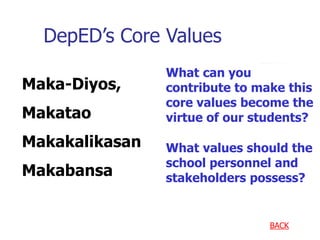
DepED’s Core Values
Maka-Diyos,
Makatao
Makakalikasan
Makabansa
BACK
What can you
contribute to make this
core values become the
virtue of our students?
What values should the
school personnel and
stakeholders possess?
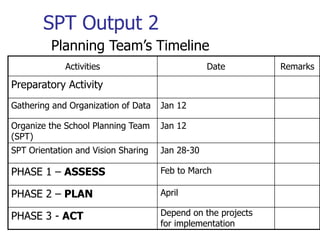
SPT Output 2
Planning Team’s Timeline
Activities Date Remarks
Preparatory Activity
Gathering and Organization of Data Jan 12
Organize the School Planning Team
(SPT)
Jan 12
SPT Orientation and Vision Sharing Jan 28-30
PHASE 1 – ASSESS Feb to March
PHASE 2 – PLAN April
PHASE 3 - ACT Depend on the projects
for implementation
As soon as the School Planning
Team got the needed data, it is
now time to for the first step of the
SIP Planning Cycle.
ASSESS
Phase 1: ASSESS
 Identify/Review Improvement Areas
 Use the results of the Preparatory
Activity
 Check school’s current SIP for IA’s
 What are the IA’s in the current SIP?
 List down some Improvement Areas
Activity 3.
List down three Improvement Areas under
each category.
ACCESS QUALITY GOVERNANCE
ACCESS –Every Filipino has access to
complete basic education
QUALITY - Every graduate is prepared for
further education and the world of work
GOVERNANCE – Effective, transparent,
and collaborative governance of basic education
Phase 1: ASSESS
(Analysis of Previous & Current IAs)
 Analyze the Improvement Areas
 What IAs in the previous SIP were
successfully implemented? Not successfully
implemented? Why?
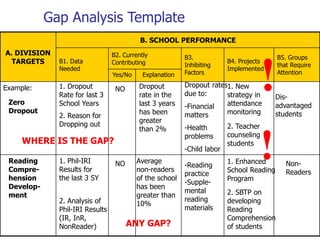
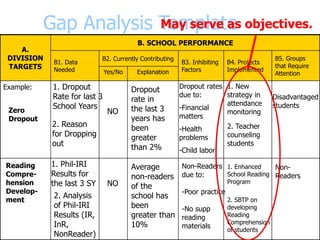
 Use the GAP ANALYSIS TEMPLATE in
Annex 3
Gap Analysis Template
A. DIVISION
TARGETS
B. SCHOOL PERFORMANCE
B1. Data
Needed
B2. Currently
Contributing
B3.
Inhibiting
Factors
B4. Projects
Implemented
B5. Groups
that Require
AttentionYes/No Explanation
Example:
Zero
Dropout
1. Dropout
Rate for last 3
School Years
2. Reason for
Dropping out
NO Dropout
rate in the
last 3 years
has been
greater
than 2%
Dropout rates
due to:
-Financial
matters
-Health
problems
-Child labor
1. New
strategy in
attendance
monitoring
2. Teacher
counseling
students
Dis-
advantaged
students
Reading
Compre-
hension
Develop-
ment
1. Phil-IRI
Results for
the last 3 SY
2. Analysis of
Phil-IRI Results
(IR, InR,
NonReader)
NO Average
non-readers
of the school
has been
greater than
10%
-Reading
practice
-Supple-
mental
reading
materials
1. Enhanced
School Reading
Program
2. SBTP on
developing
Reading
Comprehension
of students
Non-
Readers
WHERE IS THE GAP?
ANY GAP?
!
!
 The GAP is a prospect for
improvement
 The GAP could be a school process
or a part of a school process.
Phase 1: ASSESS
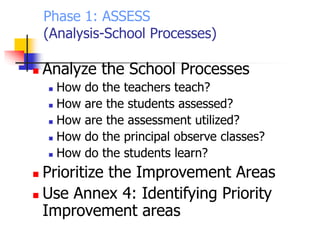
(Analysis-School Processes)
 Analyze the School Processes
 How do the teachers teach?
 How are the students assessed?
 How are the assessment utilized?
 How do the principal observe classes?
 How do the students learn?
 Prioritize the Improvement Areas
 Use Annex 4: Identifying Priority
Improvement areas
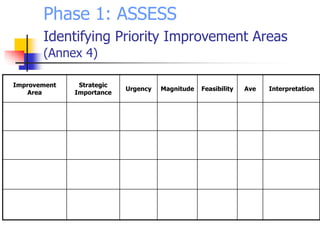
Phase 1: ASSESS
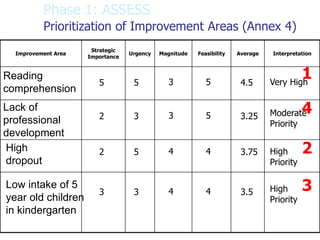
Identifying Priority Improvement Areas
(Annex 4)
Improvement
Area
Strategic
Importance
Urgency Magnitude Feasibility Ave Interpretation
Rubric in Identifying Priority Improvement Areas
Criteria Description Scale
Strategic
Importance
The number of other areas that will
benefit when the improvement
area is addressed
5 – Very High
4 – High
3 – Moderate
2 – Low
1 – Very Low
Urgency
The urgency or need to improve
the area as soon as possible
Magnitude
The number of learners that will
benefit when the improvement
area is addressed
Feasibility
The degree to which the
improvement area is within the
school’s mandate and control
Improvement Area
Strategic
Importance
Urgency Magnitude Feasibility Average Interpretation
Reading
comprehension
Lack of
professional
development
High
dropout
Low intake of 5
year old children
in kindergarten
5
2
2
3
5
3
5
3
3
3
4
4
5
5
4
4
4.5
3.25
3.75
3.5
Very High
Moderate
Priority
High
Priority
High
Priority
1
2
3
4
Phase 1: ASSESS
Prioritization of Improvement Areas (Annex 4)
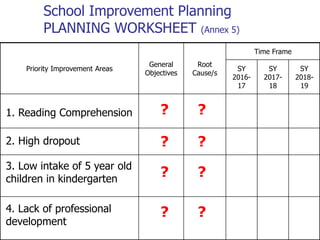
School Improvement Planning
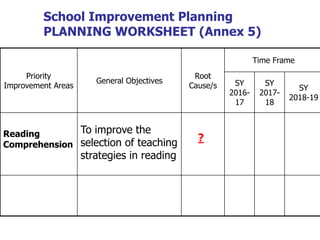
PLANNING WORKSHEET (Annex 5)
Priority Improvement Areas
General
Objectives
Root
Cause/s
Time Frame
SY
2016-
17
SY
2017-
18
SY
2018-
19
1. Reading Comprehension
2. High dropout
3. Low intake of 5 year old
children in kindergarten
4. Lack of professional
development
? ?
? ?
? ?
? ?
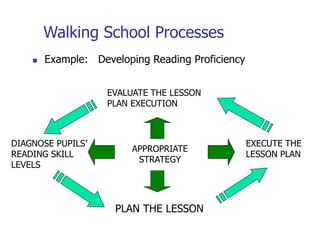
Walking School Processes
 Example: Developing Reading Proficiency
PLAN THE LESSON
EXECUTE THE
LESSON PLAN
EVALUATE THE LESSON
PLAN EXECUTION
DIAGNOSE PUPILS’
READING SKILL
LEVELS
APPROPRIATE
STRATEGY
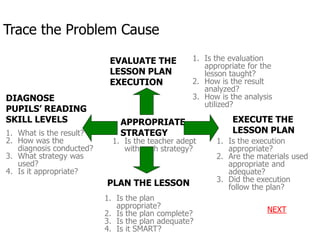
Trace the Problem Cause
PLAN THE LESSON
EXECUTE THE
LESSON PLAN
EVALUATE THE
LESSON PLAN
EXECUTION
DIAGNOSE
PUPILS’ READING
SKILL LEVELS APPROPRIATE
STRATEGY1. What is the result?
2. How was the
diagnosis conducted?
3. What strategy was
used?
4. Is it appropriate?
1. Is the plan
appropriate?
2. Is the plan complete?
3. Is the plan adequate?
4. Is it SMART?
1. Is the execution
appropriate?
2. Are the materials used
appropriate and
adequate?
3. Did the execution
follow the plan?
1. Is the evaluation
appropriate for the
lesson taught?
2. How is the result
analyzed?
3. How is the analysis
utilized?
1. Is the teacher adept
with such strategy?
NEXT
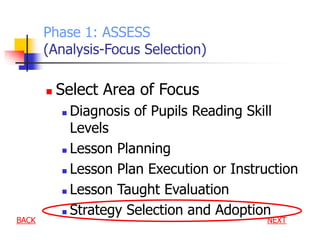
Phase 1: ASSESS
(Analysis-Focus Selection)
 Select Area of Focus
 Diagnosis of Pupils Reading Skill
Levels
 Lesson Planning
 Lesson Plan Execution or Instruction
 Lesson Taught Evaluation
 Strategy Selection and Adoption
NEXTBACK
Priority
Improvement Areas
General Objectives
Root
Cause/s
Time Frame
SY
2016-
17
SY
2017-
18
SY
2018-19
Reading
Comprehension
To improve the
selection of teaching
strategies in reading
?
School Improvement Planning
PLANNING WORKSHEET (Annex 5)
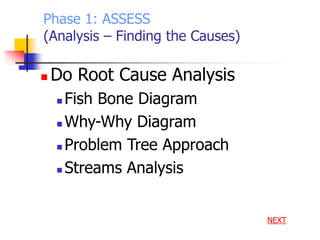
Phase 1: ASSESS
(Analysis – Finding the Causes)
 Do Root Cause Analysis
 Fish Bone Diagram
 Why-Why Diagram
 Problem Tree Approach
 Streams Analysis
NEXT
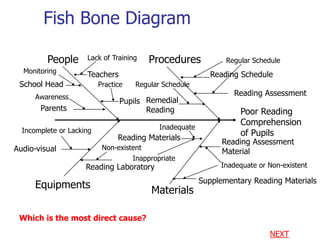
Fish Bone Diagram
Poor Reading
Comprehension
of Pupils
People Procedures
Equipments
Materials
Teachers
School Head
Pupils
Parents
Audio-visual
Reading Laboratory
Supplementary Reading Materials
Reading Materials
Reading Schedule
Reading Assessment
Material
Remedial
Reading
Reading Assessment
Lack of Training
Practice
Awareness
Monitoring
Incomplete or Lacking
Non-existent
Inappropriate
Inadequate
Inadequate or Non-existent
Regular Schedule
Regular Schedule
NEXT
Which is the most direct cause?
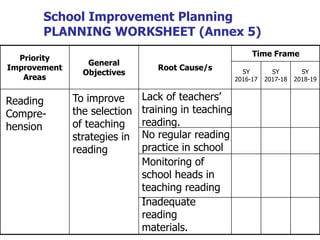
Priority
Improvement
Areas
General
Objectives
Root Cause/s
Time Frame
SY
2016-17
SY
2017-18
SY
2018-19
Reading
Compre-
hension
To improve
the selection
of teaching
strategies in
reading
Lack of teachers’
training in teaching
reading.
No regular reading
practice in school
Monitoring of
school heads in
teaching reading
Inadequate
reading
materials.
School Improvement Planning
PLANNING WORKSHEET (Annex 5)
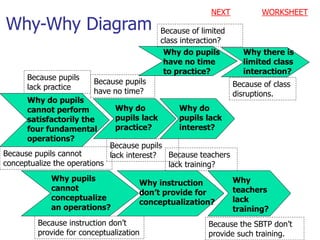
Why-Why Diagram
Why do pupils
cannot perform
satisfactorily the
four fundamental
operations?
Why do
pupils lack
practice?
Why do
pupils lack
interest?
Because pupils
lack practice
Because pupils
have no time?
Because pupils
lack interest?
Why do pupils
have no time
to practice?
Because pupils cannot
conceptualize the operations
Why pupils
cannot
conceptualize
an operations?
Because instruction don’t
provide for conceptualization
Why instruction
don’t provide for
conceptualization?
Why
teachers
lack
training?
Because teachers
lack training?
Because of limited
class interaction?
Because the SBTP don’t
provide such training.
Why there is
limited class
interaction?
Because of class
disruptions.
NEXT WORKSHEET
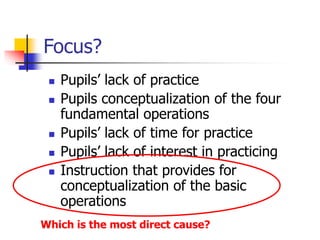
Focus?
 Pupils’ lack of practice
 Pupils conceptualization of the four
fundamental operations
 Pupils’ lack of time for practice
 Pupils’ lack of interest in practicing
 Instruction that provides for
conceptualization of the basic
operations
Which is the most direct cause?
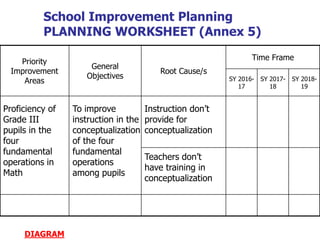
Priority
Improvement
Areas
General
Objectives
Root Cause/s
Time Frame
SY 2016-
17
SY 2017-
18
SY 2018-
19
Proficiency of
Grade III
pupils in the
four
fundamental
operations in
Math
To improve
instruction in the
conceptualization
of the four
fundamental
operations
among pupils
DIAGRAM
Instruction don’t
provide for
conceptualization
Teachers don’t
have training in
conceptualization
School Improvement Planning
PLANNING WORKSHEET (Annex 5)
Problem Tree
English NAT MPS is 54%
for SY 2014-2015
Reading
Comprehension of
Pupils is very poor
Teaching Strategies
employed by teachers
don’t facilitate reading
comprehension
development
Pupils don’t
practice reading.
Which is the
Root
Problem?
Lack of
appropriate
reading materials
Teachers lack
training in reading
comprehension
development
strategies
Teacher-Pupil
contact time
is very limited
No appropriate
reading materials
issued to the school
from IMDC.
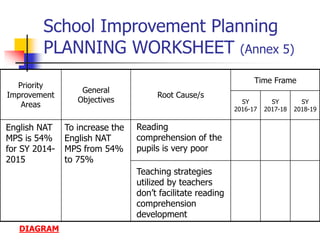
School Improvement Planning
PLANNING WORKSHEET (Annex 5)
Priority
Improvement
Areas
General
Objectives
Root Cause/s
Time Frame
SY
2016-17
SY
2017-18
SY
2018-19
English NAT
MPS is 54%
for SY 2014-
2015
To increase the
English NAT
MPS from 54%
to 75%
DIAGRAM
Reading
comprehension of the
pupils is very poor
Teaching strategies
utilized by teachers
don’t facilitate reading
comprehension
development
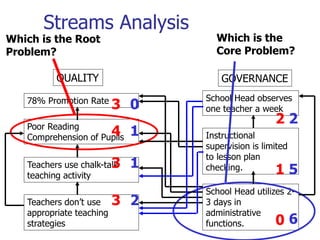
Streams Analysis
QUALITY GOVERNANCE
78% Promotion Rate
Teachers use chalk-talk
teaching activity
School Head observes
one teacher a week
Poor Reading
Comprehension of Pupils
Teachers don’t use
appropriate teaching
strategies
Instructional
supervision is limited
to lesson plan
checking.
School Head utilizes 2-
3 days in
administrative
functions.
Which is the Root
Problem?
Which is the
Core Problem?
3
3
2
4
3
1
0
0
1
1
2
2
5
6
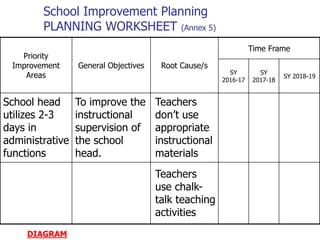
School Improvement Planning
PLANNING WORKSHEET (Annex 5)
Priority
Improvement
Areas
General Objectives Root Cause/s
Time Frame
SY
2016-17
SY
2017-18
SY 2018-19
School head
utilizes 2-3
days in
administrative
functions
To improve the
instructional
supervision of
the school
head.
DIAGRAM
Teachers
don’t use
appropriate
instructional
materials
Teachers
use chalk-
talk teaching
activities
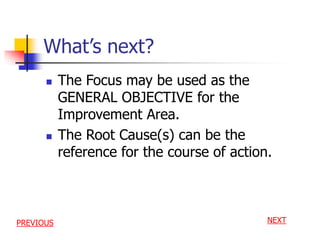
What’s next?
 The Focus may be used as the
GENERAL OBJECTIVE for the
Improvement Area.
 The Root Cause(s) can be the
reference for the course of action.
NEXTPREVIOUS
School Improvement Planning
PLANNING WORKSHEET (Annex 5)
Priority Improvement
Areas
General Objectives Root Cause/s
Time Frame
SY
2016-
17
SY
2017-
18
SY
2018-19
Reading
Comprehension
To improve
the selection
of teaching
strategies in
reading
Lack of teachers’
training in
teaching reading.
No regular
reading practice
in school
Monitoring of
school heads in
teaching reading
Inadequate
reading materials.
School Improvement Planning
PLANNING WORKSHEET (Annex 5)
Priority Improvement
Areas
General Objectives Root Cause/s
Time Frame
SY
2016-
17
SY
2017-
18
SY
2018-19
Proficiency of
Grade III
pupils in the
four
fundamental
operations in
Math
To improve
instruction in the
conceptualization
of the four
fundamental
operations
among pupils
Instruction don’t
provide for
conceptualization
Teachers don’t have
training in
conceptualization of
the basic operations
English NAT
MPS is 54%
for SY 2014-
2015
To increase the
English NAT MPS
from 54% to
75%
Reading
comprehension
of the pupils is
very poor
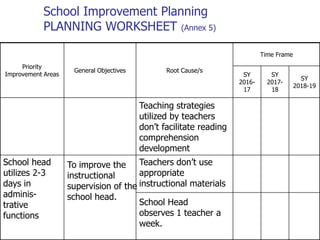
School Improvement Planning
PLANNING WORKSHEET (Annex 5)
Priority
Improvement Areas
General Objectives Root Cause/s
Time Frame
SY
2016-
17
SY
2017-
18
SY
2018-19
School head
utilizes 2-3
days in
adminis-
trative
functions
To improve the
instructional
supervision of the
school head.
Teaching strategies
utilized by teachers
don’t facilitate reading
comprehension
development
School Head
observes 1 teacher a
week.
Teachers don’t use
appropriate
instructional materials
Phase 1: ASSESS
(Analysis of PIA)
 What about the GAPS of the
implemented projects in the past?
 What can we do with those GAPS?
Gap Analysis Template
A.
DIVISION
TARGETS
B. SCHOOL PERFORMANCE
B1. Data
Needed
B2. Currently Contributing
B3. Inhibiting
Factors
B4. Projects
Implemented
B5. Groups
that Require
AttentionYes/No Explanation
Example:
Zero
Dropout
1. Dropout
Rate for last 3
School Years
2. Reason
for Dropping
out
NO
Dropout
rate in
the last 3
years has
been
greater
than 2%
Dropout rates
due to:
-Financial
matters
-Health
problems
-Child labor
1. New
strategy in
attendance
monitoring
2. Teacher
counseling
students
Disadvantaged
students
Reading
Compre-
hension
Develop-
ment
1. Phil-IRI
Results for
the last 3 SY
2. Analysis
of Phil-IRI
Results (IR,
InR,
NonReader)
NO
Average
non-readers
of the
school has
been
greater than
10%
Non-Readers
due to:
-Poor practice
-No supp
reading
materials
1. Enhanced
School Reading
Program
2. SBTP on
developing
Reading
Comprehension
of students
Non-
Readers
May serve as objectives.
School Improvement Planning
PLANNING WORKSHEET (Annex 5)
Priority Improvement
Areas
General Objectives Root Cause/s
Time Frame
SY
2016-
17
SY
2017-
18
SY
2018-19
Reading
Comprehension
Development
To improve the
school reading
program
Pupils have irregular
reading practice
No supplementary
reading materials
Phase 1: ASSESS
(Analysis of PIA)
 Listen to the Voice of the learners
and other stakeholders. Consider the
following:
 Non-Planners’ Perspective (Observers)
 Clients (Experience)
 Teachers (Implementers)
Phase 1: ASSESS
 Organize the Project Teams
 Team Leader
 Assistant Team Leader
 Secretary
 Members
 Project Teams shall Take Charge of the
Project Design, Implementation and
Monitoring and Evaluation
SPT Output 3
 Identify Improvement Areas
 Prioritize Improvement Areas (Annex 4)
 Fill-up the Planning Worksheet (Annex 5)
 Walking the Process (Annex 7)
 Trace the Root Cause(s) (Annex 8)
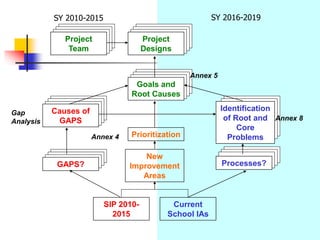
SIP 2010-
2015
Current
School IAs
New
Improvement
Areas
GAPS? Processes?
Prioritization
Goals and
Root Causes
Identification
of Root and
Core
Problems
Causes of
GAPS
Project
Design
Annex 4
Gap
Analysis Annex 8
Annex 5
SY 2010-2015 SY 2016-2019
Project
Team
SIP 2010-
2015
Current
School IAs
New
Improvement
Areas
GAPS? Processes?
Prioritization
Goals and
Root Causes
Identification
of Root and
Core
Problems
Causes of
GAPS
Project
Designs
Annex 4
Gap
Analysis Annex 8
Annex 5
SY 2010-2015 SY 2016-2019
Project
Team
 Formulate Programs, Projects or
Activities (PPAs) for each
improvement areas under:
 ACCESS
 QUALITY
 GOVERNANCE
 These PPAs are CONTRIBUTORS to
the solution of these IAs
Phase 2: PLAN
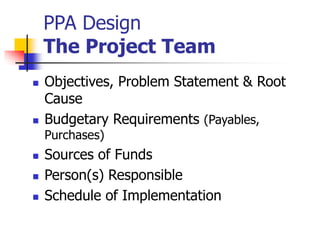
PPA Design
The Project Team
 Objectives, Problem Statement & Root
Cause
 Budgetary Requirements (Payables,
Purchases)
 Sources of Funds
 Person(s) Responsible
 Schedule of Implementation
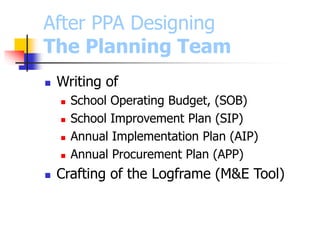
After PPA Designing
The Planning Team
 Writing of
 School Operating Budget, (SOB)
 School Improvement Plan (SIP)
 Annual Implementation Plan (AIP)
 Annual Procurement Plan (APP)
 Crafting of the Logframe (M&E Tool)
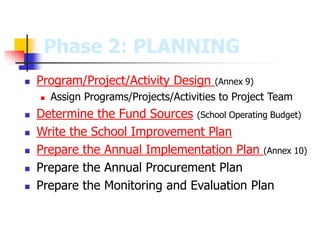
Phase 2: PLANNING
 Program/Project/Activity Design (Annex 9)
 Assign Programs/Projects/Activities to Project Team
 Determine the Fund Sources (School Operating Budget)
 Write the School Improvement Plan
 Prepare the Annual Implementation Plan (Annex 10)
 Prepare the Annual Procurement Plan
 Prepare the Monitoring and Evaluation Plan
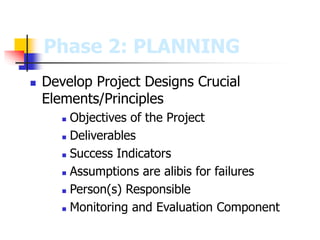
 Develop Project Designs Crucial
Elements/Principles
 Objectives of the Project
 Deliverables
 Success Indicators
 Assumptions are alibis for failures
 Person(s) Responsible
 Monitoring and Evaluation Component
Phase 2: PLANNING
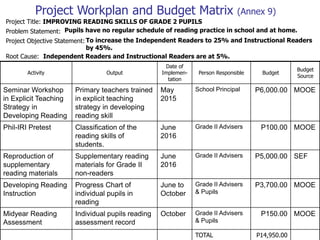
Project Workplan and Budget Matrix (Annex 9)
Project Title: IMPROVING READING SKILLS OF GRADE 2 PUPILS
Pupils have no regular schedule of reading practice in school and at home.
To increase the Independent Readers to 25% and Instructional Readers
by 45%.
Root Cause:
Activity Output
Date of
Implemen-
tation
Person Responsible Budget
Budget
Source
Seminar Workshop
in Explicit Teaching
Strategy in
Developing Reading
Primary teachers trained
in explicit teaching
strategy in developing
reading skill
May
2015
School Principal P6,000.00 MOOE
Phil-IRI Pretest Classification of the
reading skills of
students.
June
2016
Grade II Advisers P100.00 MOOE
Reproduction of
supplementary
reading materials
Supplementary reading
materials for Grade II
non-readers
June
2016
Grade II Advisers P5,000.00 SEF
Developing Reading
Instruction
Progress Chart of
individual pupils in
reading
June to
October
Grade II Advisers
& Pupils
P3,700.00 MOOE
Midyear Reading
Assessment
Individual pupils reading
assessment record
October Grade II Advisers
& Pupils
P150.00 MOOE
TOTAL P14,950.00
Problem Statement:
Project Objective Statement:
Independent Readers and Instructional Readers are at 5%.
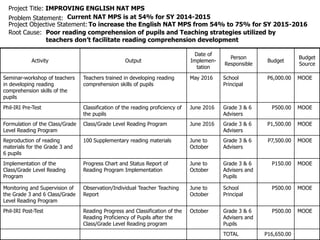
Project Title: IMPROVING ENGLISH NAT MPS
Current NAT MPS is at 54% for SY 2014-2015
To increase the English NAT MPS from 54% to 75% for SY 2015-2016
Root Cause:
Activity Output
Date of
Implemen-
tation
Person
Responsible
Budget
Budget
Source
Seminar-workshop of teachers
in developing reading
comprehension skills of the
pupils
Teachers trained in developing reading
comprehension skills of pupils
May 2016 School
Principal
P6,000.00 MOOE
Phil-IRI Pre-Test Classification of the reading proficiency of
the pupils
June 2016 Grade 3 & 6
Advisers
P500.00 MOOE
Formulation of the Class/Grade
Level Reading Program
Class/Grade Level Reading Program June 2016 Grade 3 & 6
Advisers
P1,500.00 MOOE
Reproduction of reading
materials for the Grade 3 and
6 pupils
100 Supplementary reading materials June to
October
Grade 3 & 6
Advisers
P7,500.00 MOOE
Implementation of the
Class/Grade Level Reading
Program
Progress Chart and Status Report of
Reading Program Implementation
June to
October
Grade 3 & 6
Advisers and
Pupils
P150.00 MOOE
Monitoring and Supervision of
the Grade 3 and 6 Class/Grade
Level Reading Program
Observation/Individual Teacher Teaching
Report
June to
October
School
Principal
P500.00 MOOE
Phil-IRI Post-Test Reading Progress and Classification of the
Reading Proficiency of Pupils after the
Class/Grade Level Reading program
October Grade 3 & 6
Advisers and
Pupils
P500.00 MOOE
TOTAL P16,650.00
Problem Statement:
Project Objective Statement:
Poor reading comprehension of pupils and Teaching strategies utilized by
teachers don’t facilitate reading comprehension development
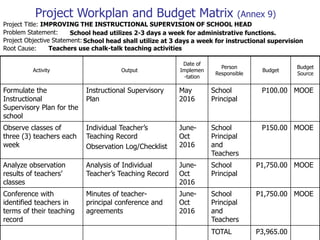
Project Workplan and Budget Matrix (Annex 9)
Project Title: IMPROVING THE INSTRUCTIONAL SUPERVISION OF SCHOOL HEAD
School head utilizes 2-3 days a week for administrative functions.
School head shall utilize at 3 days a week for instructional supervision
Root Cause:
Activity Output
Date of
Implemen
-tation
Person
Responsible
Budget
Budget
Source
Formulate the
Instructional
Supervisory Plan for the
school
Instructional Supervisory
Plan
May
2016
School
Principal
P100.00 MOOE
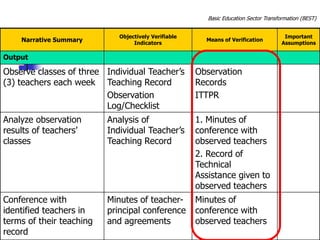
Observe classes of
three (3) teachers each
week
Individual Teacher’s
Teaching Record
Observation Log/Checklist
June-
Oct
2016
School
Principal
and
Teachers
P150.00 MOOE
Analyze observation
results of teachers’
classes
Analysis of Individual
Teacher’s Teaching Record
June-
Oct
2016
School
Principal
P1,750.00 MOOE
Conference with
identified teachers in
terms of their teaching
record
Minutes of teacher-
principal conference and
agreements
June-
Oct
2016
School
Principal
and
Teachers
P1,750.00 MOOE
TOTAL P3,965.00
Problem Statement:
Project Objective Statement:
Teachers use chalk-talk teaching activities
School Operating Budget
Program/ Projects/ Activities
Source of Funds
Remarks
MOOE SEF IGP PTA DONATIONS
ACCESS
QUALITY
GOVERNANCE
BACK NEXT
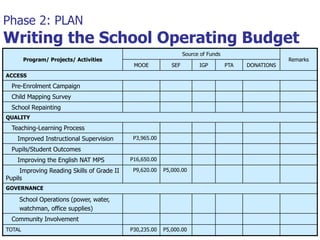
Phase 2: PLAN
Writing the School Operating Budget
Program/ Projects/ Activities
Source of Funds
Remarks
MOOE SEF IGP PTA DONATIONS
ACCESS
Pre-Enrolment Campaign
Child Mapping Survey
School Repainting
QUALITY
Teaching-Learning Process
Improved Instructional Supervision P3,965.00
Pupils/Student Outcomes
Improving the English NAT MPS P16,650.00
Improving Reading Skills of Grade II
Pupils
P9,620.00 P5,000.00
GOVERNANCE
School Operations (power, water,
watchman, office supplies)
Community Involvement
TOTAL P30,235.00 P5,000.00
Writing the School Improvement Plan
SCHOOL IMPROVEMENT PLAN
Name of School
SY 2016-2019
I. DepED Vision, Mission and Core Values
(a narrative of the PT’s shared vision of the school’s stakeholders)
II. School’s Current Situation
(a narrative based on the SCDT and SRC)
III. Planning Worksheet
IV. Monitoring and Evaluation
(include a brief description of the Monitoring and Evaluation arrangements in
the implementation of the SIP. Refer to the Check Progress part of the
Guide)
BACK
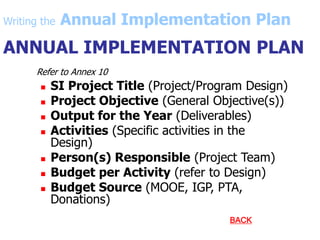
ANNUAL IMPLEMENTATION PLAN
Refer to Annex 10
 SI Project Title (Project/Program Design)
 Project Objective (General Objective(s))
 Output for the Year (Deliverables)
 Activities (Specific activities in the
Design)
 Person(s) Responsible (Project Team)
 Budget per Activity (refer to Design)
 Budget Source (MOOE, IGP, PTA,
Donations)
BACK
Writing the Annual Implementation Plan
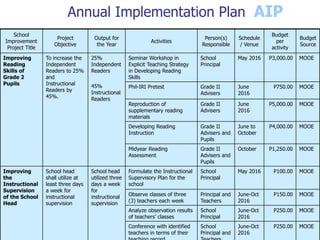
Annual Implementation Plan
School
Improvement
Project Title
Project
Objective
Output for
the Year
Activities
Person(s)
Responsible
Schedule
/ Venue
Budget
per
activity
Budget
Source
Improving
Reading
Skills of
Grade 2
Pupils
To increase the
Independent
Readers to 25%
and
Instructional
Readers by
45%.
25%
Independent
Readers
45%
Instructional
Readers
Seminar Workshop in
Explicit Teaching Strategy
in Developing Reading
Skills
School
Principal
May 2016 P3,000.00 MOOE
Phil-IRI Pretest Grade II
Advisers
June
2016
P750.00 MOOE
Reproduction of
supplementary reading
materials
Grade II
Advisers
June
2016
P5,000.00 MOOE
Developing Reading
Instruction
Grade II
Advisers and
Pupils
June to
October
P4,000.00 MOOE
Midyear Reading
Assessment
Grade II
Advisers and
Pupils
October P1,250.00 MOOE
Improving
the
Instructional
Supervision
of the School
Head
School head
shall utilize at
least three days
a week for
instructional
supervision
School head
utilized three
days a week
for
instructional
supervision
Formulate the Instructional
Supervisory Plan for the
school
School
Principal
May 2016 P100.00 MOOE
Observe classes of three
(3) teachers each week
Principal and
Teachers
June-Oct
2016
P150.00 MOOE
Analyze observation results
of teachers’ classes
School
Principal
June-Oct
2016
P250.00 MOOE
Conference with identified
teachers in terms of their
School
Principal and
June-Oct
2016
P250.00 MOOE
AIP
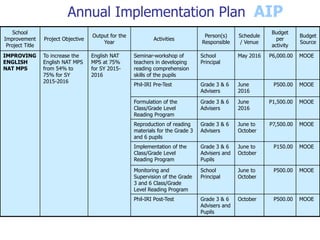
Annual Implementation Plan
School
Improvement
Project Title
Project Objective
Output for the
Year
Activities
Person(s)
Responsible
Schedule
/ Venue
Budget
per
activity
Budget
Source
IMPROVING
ENGLISH
NAT MPS
To increase the
English NAT MPS
from 54% to
75% for SY
2015-2016
English NAT
MPS at 75%
for SY 2015-
2016
Seminar-workshop of
teachers in developing
reading comprehension
skills of the pupils
School
Principal
May 2016 P6,000.00 MOOE
Phil-IRI Pre-Test Grade 3 & 6
Advisers
June
2016
P500.00 MOOE
Formulation of the
Class/Grade Level
Reading Program
Grade 3 & 6
Advisers
June
2016
P1,500.00 MOOE
Reproduction of reading
materials for the Grade 3
and 6 pupils
Grade 3 & 6
Advisers
June to
October
P7,500.00 MOOE
Implementation of the
Class/Grade Level
Reading Program
Grade 3 & 6
Advisers and
Pupils
June to
October
P150.00 MOOE
Monitoring and
Supervision of the Grade
3 and 6 Class/Grade
Level Reading Program
School
Principal
June to
October
P500.00 MOOE
Phil-IRI Post-Test Grade 3 & 6
Advisers and
Pupils
October P500.00 MOOE
AIP
Annual Procurement Plan
Description Quantity Unit
Unit
Cost
Total
Month (Jan to Dec)
Total
Cost
Source of
FundsQuantity Total
Cost
Twelve split columns for the months.
Final column of the APP
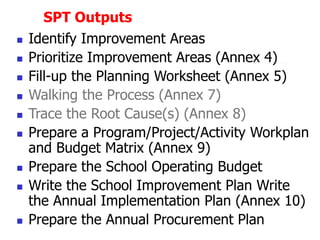
SPT Outputs
 Identify Improvement Areas
 Prioritize Improvement Areas (Annex 4)
 Fill-up the Planning Worksheet (Annex 5)
 Walking the Process (Annex 7)
 Trace the Root Cause(s) (Annex 8)
 Prepare a Program/Project/Activity Workplan
and Budget Matrix (Annex 9)
 Prepare the School Operating Budget
 Write the School Improvement Plan Write
the Annual Implementation Plan (Annex 10)
 Prepare the Annual Procurement Plan
 Consideration before
implementation
 Documentation (pictures, results,
minutes, resolutions, etc)
 Organize Documentation
Committee
Phase 3: ACT
Phase 3: ACT
 Before we ACT,
 Look back on your shared vision of the
students, the school and your
contributions to the vision.
 Will your program designs contribute to
the realization of that vision?
Phase 3: Before ACTing
 Test the Solutions
 Check and analyze testing results to avoid
risks of failures
 Revise if needed.
 Roll Out the Solutions
Sample of Testing a Mechanism
 Explicit Teaching Reading Strategy
 Group of 10 Grade 1 Pupils with the Third
Grading Period
 Section 1 out of 3 sections in the Third
Grading Period
Sample of Testing a
Mechanism
 Counseling of SARDO’s in Grade 1
 Observation of Teachers by SH/MT
 Teaching Strategy/Technique
AFTER TESTING
Project Team should discuss with the
School Planning Team the results/findings
during testing.
When ACTing immediately
ASSESS the implementation
 Check the Progress of the AIP
 MONITORING AND EVALUATION
PLAN
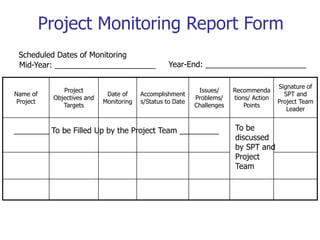
Project Monitoring Report Form
Name of
Project
Project
Objectives and
Targets
Date of
Monitoring
Accomplishment
s/Status to Date
Issues/
Problems/
Challenges
Recommenda
tions/ Action
Points
Signature of
SPT and
Project Team
Leader
Scheduled Dates of Monitoring
Mid-Year: _______________________ Year-End: _______________________
________ To be Filled Up by the Project Team _________ To be
discussed
by SPT and
Project
Team
Everybody, Somebody,
Anybody and Nobody
This is a little story about four people
named Everybody, Somebody, Anybody
and Nobody.
There was an important job to be done
and Everybody was sure that Somebody
would do it.
Anybody could have done it, but
Nobody did it.
Somebody got angry about that
because it was Everybody’s job.
Everybody thought that Anybody could
do it, but Nobody realized that
Everybody wouldn’t do it.
In ended up that Everybody blamed
Somebody when Nobody did what
Anybody could have done.
Importance of School M&E
Activities
 This will provide valuable information to
SDOs, ROs and CO units on the
applicability of the curriculum, learning
materials, and equipments.
Misconceptions about M&E
 M&E is about forms and reports
 Meet the information requirements of
stakeholders
 M&E is EN-M-E (enemy)
 M&E activities are to be undertaken
only by the M&E Unit
Misconceptions about M&E
 M&E is a year round activity
 Gather as much data as we can
 We are already delayed. No more time
for M&E activities
 Everything is going fine
 M&E as an after thought
School Monitoring and Evaluation
Mechanisms
 Monitor – check, watch, observe,
scrutinize, examine
 Evaluation – assessment, appraisal,
valuation
M&E Defined
Monitoring and Evaluation is the systematic
process of gathering, processing,
analyzing, interpreting, and storing of data
and information about the performance,
setting into motion a series of managerial
actions, for the purpose of ascertaining the
realization of set objectives.
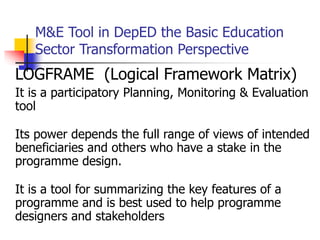
M&E Tool in DepED the Basic Education
Sector Transformation Perspective
LOGFRAME (Logical Framework Matrix)
It is a participatory Planning, Monitoring & Evaluation
tool
Its power depends the full range of views of intended
beneficiaries and others who have a stake in the
programme design.
It is a tool for summarizing the key features of a
programme and is best used to help programme
designers and stakeholders
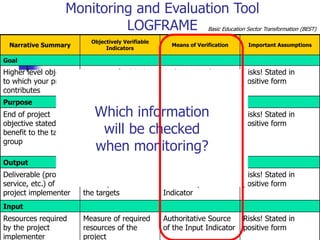
Monitoring and Evaluation Tool
LOGFRAME
Narrative Summary
Objectively Verifiable
Indicators
Means of Verification Important Assumptions
Goal
Higher level objective
to which your project
contributes
Measure of achieving
the goal statement
Authoritative Source
of the Goal Indicator
Risks! Stated in
positive form
Purpose
End of project
objective stated as a
benefit to the target
group
Measures of
achieving the purpose
statement. These are
the success
indicators.
Authoritative Source
of the Purpose
Indicators
Risks! Stated in
positive form
Output
Deliverable (product,
service, etc.) of the
project implementer
Measure of achieving
the output. These are
the targets
Authoritative Source
of the Output
Indicator
Risks! Stated in
positive form
Input
Resources required
by the project
implementer
Measure of required
resources of the
project
Authoritative Source
of the Input Indicator
Risks! Stated in
positive form
Basic Education Sector Transformation (BEST)
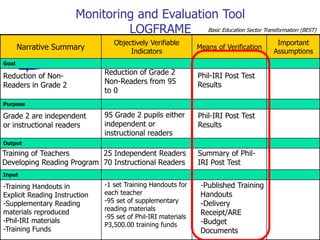
Which information
will be checked
when monitoring?
Narrative Summary
Objectively Verifiable
Indicators
Means of Verification
Important
Assumptions
Goal
Purpose
Output
Input
Basic Education Sector Transformation (BEST)
-Training Handouts in
Explicit Reading Instruction
-Supplementary Reading
materials reproduced
-Phil-IRI materials
-Training Funds
-1 set Training Handouts for
each teacher
-95 set of supplementary
reading materials
-95 set of Phil-IRI materials
P3,500.00 training funds
-Published Training
Handouts
-Delivery
Receipt/ARE
-Budget
Documents
Training of Teachers
Developing Reading Program
25 Independent Readers
70 Instructional Readers
Summary of Phil-
IRI Post Test
Grade 2 are independent
or instructional readers
95 Grade 2 pupils either
independent or
instructional readers
Phil-IRI Post Test
Results
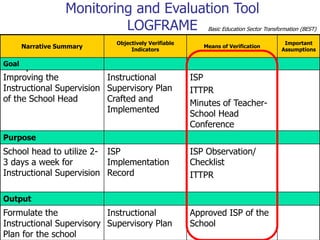
Phil-IRI Post Test
Results
Reduction of Grade 2
Non-Readers from 95
to 0
Reduction of Non-
Readers in Grade 2
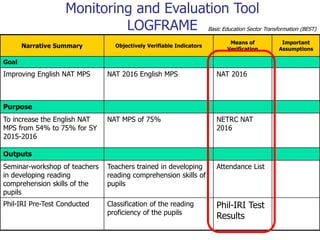
Monitoring and Evaluation Tool
LOGFRAME
Monitoring and Evaluation Tool
LOGFRAME
Narrative Summary Objectively Verifiable Indicators
Means of
Verification
Important
Assumptions
Goal
Improving English NAT MPS NAT 2016 English MPS NAT 2016
Purpose
To increase the English NAT
MPS from 54% to 75% for SY
2015-2016
NAT MPS of 75% NETRC NAT
2016
Outputs
Seminar-workshop of teachers
in developing reading
comprehension skills of the
pupils
Teachers trained in developing
reading comprehension skills of
pupils
Attendance List
Phil-IRI Pre-Test Conducted Classification of the reading
proficiency of the pupils
Phil-IRI Test
Results
Basic Education Sector Transformation (BEST)
Narrative Summary Objectively Verifiable Indicators Means of Verification
Important
Assumptions
Outputs
Formulation of the
Class/Grade Level
Reading Program
Class/Grade Level Reading
Program
Copies of Class/Grade
Level Reading Program
Reproduction of reading
materials for the Grade 3
and 6 pupils
100 Supplementary
reading materials
Utilization of the
Supplementary
Reading Materials
Implementation of the
Class/Grade Level
Reading Program
Progress Chart and Status
Report of Reading
Program Implementation
Positive
increment/increase of
reading results of the
Grade 3 and Grade 6
pupils
Monitoring and
Supervision of the Grade
3 and 6 Class/Grade
Level Reading Program
Observation/Individual
Teacher Teaching Report
Record of manifested
developing reading
comprehension
strategies by teachers
Phil-IRI Post-Test Reading Progress and
Classification of the
Reading Proficiency of
Progress Chart of
Reading Proficiency of
Grade 3 & 6 pupils
Basic Education Sector Transformation (BEST)
Narrative Summary Objectively Verifiable Indicators Means of Verification
Important
Assumptions
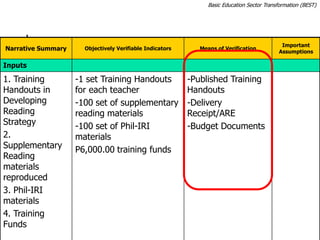
Inputs
1. Training
Handouts in
Developing
Reading
Strategy
2.
Supplementary
Reading
materials
reproduced
3. Phil-IRI
materials
4. Training
Funds
-1 set Training Handouts
for each teacher
-100 set of supplementary
reading materials
-100 set of Phil-IRI
materials
P6,000.00 training funds
-Published Training
Handouts
-Delivery
Receipt/ARE
-Budget Documents
Basic Education Sector Transformation (BEST)