

PLC NCMSC


March 18th, 2012
Purpose:

    How can we strengthen our
    capacity to work together in
 professional learning to become
   successful at creating learning
  environments that provide high
levels of learning for all students?
Essential Questions
• What does a PLC meeting look like?
• How can a continuous improvement
  cycle lead a professional learning
  community?
• How can data analysis drive instruction
  on a regular basis?
• How can I start a PLC at my school?
What does a PLC look like?
 The experts:
 Richard and Rebecca DuFour
 Doug Reeves


    Professional Learning Communities – Doug Reeves
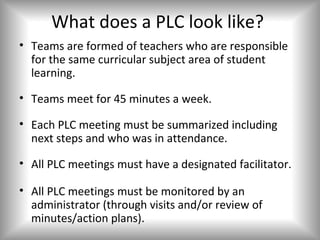
What does a PLC look like?
• Teams are formed of teachers who are responsible
  for the same curricular subject area of student
  learning.

• Teams meet for 45 minutes a week.

• Each PLC meeting must be summarized including
  next steps and who was in attendance.

• All PLC meetings must have a designated facilitator.

• All PLC meetings must be monitored by an
  administrator (through visits and/or review of
  minutes/action plans).
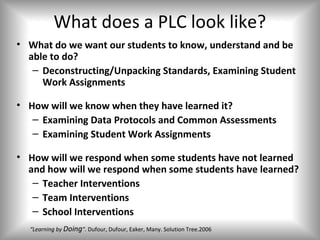
What does a PLC look like?
• What do we want our students to know, understand and be
  able to do?
   – Deconstructing/Unpacking Standards, Examining Student
     Work Assignments

• How will we know when they have learned it?
   – Examining Data Protocols and Common Assessments
   – Examining Student Work Assignments

• How will we respond when some students have not learned
  and how will we respond when some students have learned?
   – Teacher Interventions
   – Team Interventions
   – School Interventions
  “Learning by Doing”. Dufour, Dufour, Eaker, Many. Solution Tree.2006
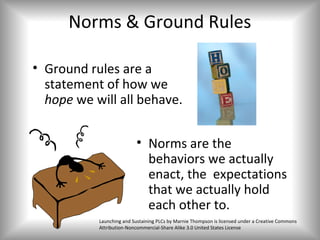
Norms & Ground Rules

• Ground rules are a
  statement of how we
  hope we will all behave.


                           • Norms are the
                             behaviors we actually
                             enact, the expectations
                             that we actually hold
                             each other to.
           Launching and Sustaining PLCs by Marnie Thompson is licensed under a Creative Commons
           Attribution-Noncommercial-Share Alike 3.0 United States License
For example…

– Your group may have a ground
  rule that states that PLC time is
  not to be used for grading
  papers

– But if people grade papers in
  the meeting and no one
  intervenes, then the norm of
  your group is that it is okay to
  grade papers during a PLC
  meeting
Ground rules and Norms
                              Teams should formally evaluate their
                               effectiveness at least twice a year.

                             Are we adhering to our norms?

                             Do we need to establish a new
                             norm to address a problem
                             reoccurring on our team?

                             Are we working interdependently
                             to achieve our team goal?

*Article Resource – Norms put the ‘Golden Rule’ into practice for groups
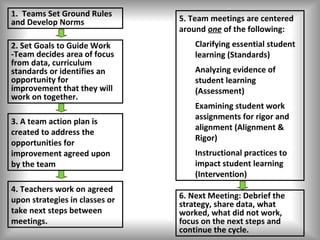
1. Teams Set Ground Rules
and Develop Norms               5. Team meetings are centered
                                around one of the following:
2. Set Goals to Guide Work          Clarifying essential student
-Team decides area of focus         learning (Standards)
from data, curriculum
standards or identifies an          Analyzing evidence of
opportunity for                     student learning
improvement that they will          (Assessment)
work on together.
                                    Examining student work
                                    assignments for rigor and
3. A team action plan is
                                    alignment (Alignment &
created to address the
                                    Rigor)
opportunities for
improvement agreed upon             Instructional practices to
by the team                         impact student learning
                                    (Intervention)
4. Teachers work on agreed
upon strategies in classes or   6. Next Meeting: Debrief the
                                strategy, share data, what
take next steps between         worked, what did not work,
meetings.                       focus on the next steps and
                                continue the cycle.
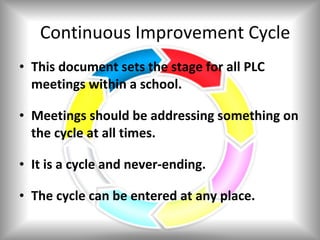
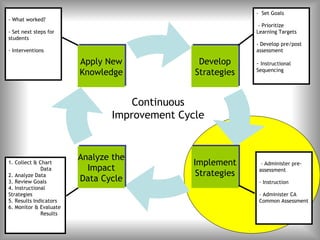
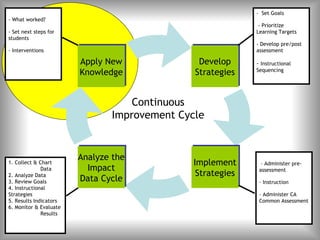
Continuous Improvement Cycle
• This document sets the stage for all PLC
  meetings within a school.

• Meetings should be addressing something on
  the cycle at all times.

• It is a cycle and never-ending.

• The cycle can be entered at any place.
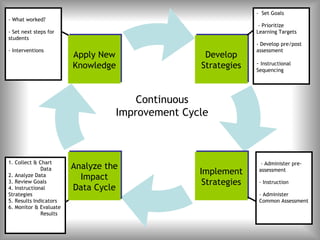
- Set Goals
- What worked?
                                                                 - Prioritize
- Set next steps for                                            Learning Targets
students
                                                                - Develop pre/post
- Interventions                                                 assessment
                        Apply New
                        Apply New                 Develop
                                                  Develop
                        Knowledge
                        Knowledge                Strategies
                                                 Strategies     - Instructional
                                                                Sequencing


                                      Continuous
                                  Improvement Cycle


1. Collect & Chart
                        Analyze the
                        Analyze the                               - Administer pre-
              Data                                Implement
                                                 Implement       assessment
2. Analyze Data            Impact
                          Impact
3. Review Goals                                    Strategies
                                                  Strategies     - Instruction
4. Instructional         Data Cycle
                        Data Cycle
Strategies                                                       - Administer
5. Results Indicators                                            Common Assessment
6. Monitor & Evaluate
              Results
- Set Goals
- What worked?
                                                              - Prioritize
- Set next steps for                                         Learning Targets
students
                                                             - Develop pre/post
- Interventions                                              assessment

                        Apply New
                        Apply New              Develop
                                               Develop       - Instructional
                        Knowledge
                        Knowledge             Strategies
                                              Strategies     Sequencing


                                   Continuous
                               Improvement Cycle


                        Analyze the
                        Analyze the
1. Collect & Chart                             Implement
                                              Implement        - Administer pre-
              Data         Impact
                          Impact                Strategies
                                               Strategies     assessment
2. Analyze Data
3. Review Goals
                         Data Cycle
                        Data Cycle                            - Instruction
4. Instructional
Strategies                                                    - Administer CA
5. Results Indicators                                         Common Assessment
6. Monitor & Evaluate
              Results
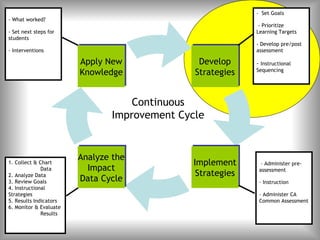
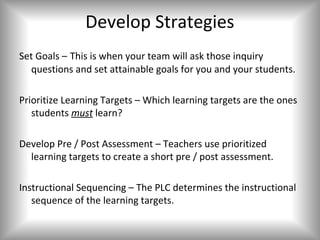
Develop Strategies
Set Goals – This is when your team will ask those inquiry
   questions and set attainable goals for you and your students.

Prioritize Learning Targets – Which learning targets are the ones
   students must learn?

Develop Pre / Post Assessment – Teachers use prioritized
  learning targets to create a short pre / post assessment.

Instructional Sequencing – The PLC determines the instructional
   sequence of the learning targets.
- Set Goals
- What worked?
                                                              - Prioritize
- Set next steps for                                         Learning Targets
students
                                                             - Develop pre/post
- Interventions                                              assessment

                        Apply New
                        Apply New              Develop
                                               Develop       - Instructional
                        Knowledge
                        Knowledge             Strategies
                                              Strategies     Sequencing


                                   Continuous
                               Improvement Cycle


                        Analyze the
                        Analyze the
1. Collect & Chart                             Implement
                                              Implement        - Administer pre-
              Data         Impact
                          Impact                Strategies
                                               Strategies     assessment
2. Analyze Data
3. Review Goals
                         Data Cycle
                        Data Cycle                            - Instruction
4. Instructional
Strategies                                                    - Administer CA
5. Results Indicators                                         Common Assessment
6. Monitor & Evaluate
              Results
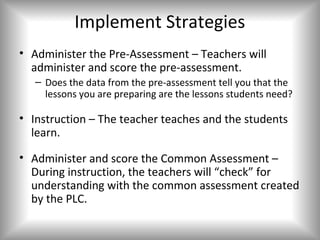
Implement Strategies
• Administer the Pre-Assessment – Teachers will
  administer and score the pre-assessment.
   – Does the data from the pre-assessment tell you that the
     lessons you are preparing are the lessons students need?

• Instruction – The teacher teaches and the students
  learn.

• Administer and score the Common Assessment –
  During instruction, the teachers will “check” for
  understanding with the common assessment created
  by the PLC.
- Set Goals
- What worked?
                                                              - Prioritize
- Set next steps for                                         Learning Targets
students
                                                             - Develop pre/post
- Interventions                                              assessment

                        Apply New
                        Apply New              Develop
                                               Develop       - Instructional
                        Knowledge
                        Knowledge             Strategies
                                              Strategies     Sequencing


                                   Continuous
                               Improvement Cycle


                        Analyze the
                        Analyze the
1. Collect & Chart                             Implement
                                              Implement        - Administer pre-
              Data         Impact
                          Impact                Strategies
                                               Strategies     assessment
2. Analyze Data
3. Review Goals
                         Data Cycle
                        Data Cycle                            - Instruction
4. Instructional
Strategies                                                    - Administer CA
5. Results Indicators                                         Common Assessment
6. Monitor & Evaluate
              Results
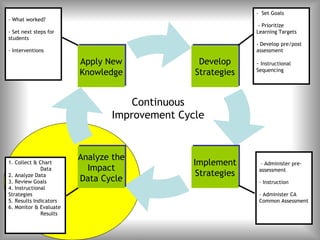
Analyze the Impact

Step 1: Collect and Chart Data
Step 2: Analyze the Data
Step 3: Review Goals
Step 4: Instructional Strategies
Step 5: Results Indicators
Step 6: Monitor and Evaluate Results
- Set Goals
- What worked?
                                                              - Prioritize
- Set next steps for                                         Learning Targets
students
                                                             - Develop pre/post
- Interventions                                              assessment

                        Apply New
                        Apply New              Develop
                                               Develop       - Instructional
                        Knowledge
                        Knowledge             Strategies
                                              Strategies     Sequencing


                                   Continuous
                               Improvement Cycle


                        Analyze the
                        Analyze the
1. Collect & Chart                             Implement
                                              Implement        - Administer pre-
              Data         Impact
                          Impact                Strategies
                                               Strategies     assessment
2. Analyze Data
3. Review Goals
                         Data Cycle
                        Data Cycle                            - Instruction
4. Instructional
Strategies                                                    - Administer CA
5. Results Indicators                                         Common Assessment
6. Monitor & Evaluate
              Results
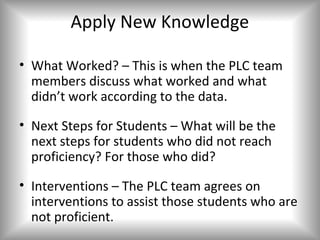
Apply New Knowledge

• What Worked? – This is when the PLC team
  members discuss what worked and what
  didn’t work according to the data.

• Next Steps for Students – What will be the
  next steps for students who did not reach
  proficiency? For those who did?

• Interventions – The PLC team agrees on
  interventions to assist those students who are
  not proficient.
Current Reality
Does this process resemble what happens
 throughout the year in your school?
How can data analysis drive
           instruction?
• Shanon to add slides or add some
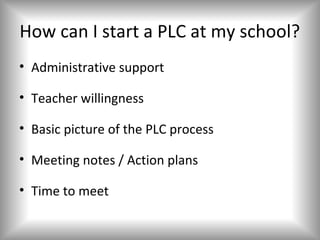
How can I start a PLC at my school?
• Administrative support

• Teacher willingness

• Basic picture of the PLC process

• Meeting notes / Action plans

• Time to meet
Start with a book study…
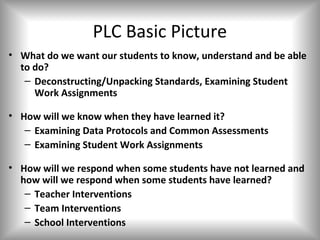
PLC Basic Picture
• What do we want our students to know, understand and be able
  to do?
   – Deconstructing/Unpacking Standards, Examining Student
     Work Assignments

• How will we know when they have learned it?
   – Examining Data Protocols and Common Assessments
   – Examining Student Work Assignments

• How will we respond when some students have not learned and
  how will we respond when some students have learned?
   – Teacher Interventions
   – Team Interventions
   – School Interventions
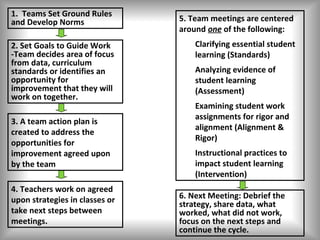
1. Teams Set Ground Rules
and Develop Norms               5. Team meetings are centered
                                around one of the following:
2. Set Goals to Guide Work          Clarifying essential student
-Team decides area of focus         learning (Standards)
from data, curriculum
standards or identifies an          Analyzing evidence of
opportunity for                     student learning
improvement that they will          (Assessment)
work on together.
                                    Examining student work
                                    assignments for rigor and
3. A team action plan is
                                    alignment (Alignment &
created to address the
                                    Rigor)
opportunities for
improvement agreed upon             Instructional practices to
by the team                         impact student learning
                                    (Intervention)
4. Teachers work on agreed
upon strategies in classes or   6. Next Meeting: Debrief the
                                strategy, share data, what
take next steps between         worked, what did not work,
meetings.                       focus on the next steps and
                                continue the cycle.
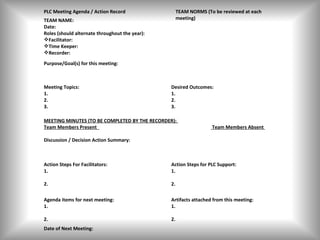
PLC Meeting Agenda / Action Record                   TEAM NORMS (To be reviewed at each
TEAM NAME:                                           meeting)
Date:
Roles (should alternate throughout the year):
Facilitator:
Time Keeper:
Recorder:

Purpose/Goal(s) for this meeting:


Meeting Topics:                                 Desired Outcomes:
1.                                              1.
2.                                              2.
3.                                              3.

MEETING MINUTES (TO BE COMPLETED BY THE RECORDER):
Team Members Present                                               Team Members Absent

Discussion / Decision Action Summary:


Action Steps For Facilitators:                  Action Steps for PLC Support:
1.                                              1.

2.                                              2.

Agenda items for next meeting:                  Artifacts attached from this meeting:
1.                                              1.

2.                                              2.
Date of Next Meeting:
Resources
• Learning by Doing – DuFour
• All Things PLC website -
  http://www.allthingsplc.info/
Questions
• Thank you for your attention.


Contact information:
Cathy Barlow – cabarlow@caldwellschools.com
Shanon White – swhite@ccaldwellschools.com

Personal Learning Communities

  • 1.
  • 2.
    Purpose: How can we strengthen our capacity to work together in professional learning to become successful at creating learning environments that provide high levels of learning for all students?
  • 3.
    Essential Questions • Whatdoes a PLC meeting look like? • How can a continuous improvement cycle lead a professional learning community? • How can data analysis drive instruction on a regular basis? • How can I start a PLC at my school?
  • 4.
    What does aPLC look like? The experts: Richard and Rebecca DuFour Doug Reeves Professional Learning Communities – Doug Reeves
  • 5.
    What does aPLC look like? • Teams are formed of teachers who are responsible for the same curricular subject area of student learning. • Teams meet for 45 minutes a week. • Each PLC meeting must be summarized including next steps and who was in attendance. • All PLC meetings must have a designated facilitator. • All PLC meetings must be monitored by an administrator (through visits and/or review of minutes/action plans).
  • 6.
    What does aPLC look like? • What do we want our students to know, understand and be able to do? – Deconstructing/Unpacking Standards, Examining Student Work Assignments • How will we know when they have learned it? – Examining Data Protocols and Common Assessments – Examining Student Work Assignments • How will we respond when some students have not learned and how will we respond when some students have learned? – Teacher Interventions – Team Interventions – School Interventions “Learning by Doing”. Dufour, Dufour, Eaker, Many. Solution Tree.2006
  • 7.
    Norms & GroundRules • Ground rules are a statement of how we hope we will all behave. • Norms are the behaviors we actually enact, the expectations that we actually hold each other to. Launching and Sustaining PLCs by Marnie Thompson is licensed under a Creative Commons Attribution-Noncommercial-Share Alike 3.0 United States License
  • 8.
    For example… – Yourgroup may have a ground rule that states that PLC time is not to be used for grading papers – But if people grade papers in the meeting and no one intervenes, then the norm of your group is that it is okay to grade papers during a PLC meeting
  • 9.
    Ground rules andNorms Teams should formally evaluate their effectiveness at least twice a year. Are we adhering to our norms? Do we need to establish a new norm to address a problem reoccurring on our team? Are we working interdependently to achieve our team goal? *Article Resource – Norms put the ‘Golden Rule’ into practice for groups
  • 10.
    1. Teams SetGround Rules and Develop Norms 5. Team meetings are centered around one of the following: 2. Set Goals to Guide Work Clarifying essential student -Team decides area of focus learning (Standards) from data, curriculum standards or identifies an Analyzing evidence of opportunity for student learning improvement that they will (Assessment) work on together. Examining student work assignments for rigor and 3. A team action plan is alignment (Alignment & created to address the Rigor) opportunities for improvement agreed upon Instructional practices to by the team impact student learning (Intervention) 4. Teachers work on agreed upon strategies in classes or 6. Next Meeting: Debrief the strategy, share data, what take next steps between worked, what did not work, meetings. focus on the next steps and continue the cycle.
  • 11.
    Continuous Improvement Cycle •This document sets the stage for all PLC meetings within a school. • Meetings should be addressing something on the cycle at all times. • It is a cycle and never-ending. • The cycle can be entered at any place.
  • 12.
    - Set Goals -What worked? - Prioritize - Set next steps for Learning Targets students - Develop pre/post - Interventions assessment Apply New Apply New Develop Develop Knowledge Knowledge Strategies Strategies - Instructional Sequencing Continuous Improvement Cycle 1. Collect & Chart Analyze the Analyze the - Administer pre- Data Implement Implement assessment 2. Analyze Data Impact Impact 3. Review Goals Strategies Strategies - Instruction 4. Instructional Data Cycle Data Cycle Strategies - Administer 5. Results Indicators Common Assessment 6. Monitor & Evaluate Results
  • 13.
    - Set Goals -What worked? - Prioritize - Set next steps for Learning Targets students - Develop pre/post - Interventions assessment Apply New Apply New Develop Develop - Instructional Knowledge Knowledge Strategies Strategies Sequencing Continuous Improvement Cycle Analyze the Analyze the 1. Collect & Chart Implement Implement - Administer pre- Data Impact Impact Strategies Strategies assessment 2. Analyze Data 3. Review Goals Data Cycle Data Cycle - Instruction 4. Instructional Strategies - Administer CA 5. Results Indicators Common Assessment 6. Monitor & Evaluate Results
  • 14.
    Develop Strategies Set Goals– This is when your team will ask those inquiry questions and set attainable goals for you and your students. Prioritize Learning Targets – Which learning targets are the ones students must learn? Develop Pre / Post Assessment – Teachers use prioritized learning targets to create a short pre / post assessment. Instructional Sequencing – The PLC determines the instructional sequence of the learning targets.
  • 15.
    - Set Goals -What worked? - Prioritize - Set next steps for Learning Targets students - Develop pre/post - Interventions assessment Apply New Apply New Develop Develop - Instructional Knowledge Knowledge Strategies Strategies Sequencing Continuous Improvement Cycle Analyze the Analyze the 1. Collect & Chart Implement Implement - Administer pre- Data Impact Impact Strategies Strategies assessment 2. Analyze Data 3. Review Goals Data Cycle Data Cycle - Instruction 4. Instructional Strategies - Administer CA 5. Results Indicators Common Assessment 6. Monitor & Evaluate Results
  • 16.
    Implement Strategies • Administerthe Pre-Assessment – Teachers will administer and score the pre-assessment. – Does the data from the pre-assessment tell you that the lessons you are preparing are the lessons students need? • Instruction – The teacher teaches and the students learn. • Administer and score the Common Assessment – During instruction, the teachers will “check” for understanding with the common assessment created by the PLC.
  • 17.
    - Set Goals -What worked? - Prioritize - Set next steps for Learning Targets students - Develop pre/post - Interventions assessment Apply New Apply New Develop Develop - Instructional Knowledge Knowledge Strategies Strategies Sequencing Continuous Improvement Cycle Analyze the Analyze the 1. Collect & Chart Implement Implement - Administer pre- Data Impact Impact Strategies Strategies assessment 2. Analyze Data 3. Review Goals Data Cycle Data Cycle - Instruction 4. Instructional Strategies - Administer CA 5. Results Indicators Common Assessment 6. Monitor & Evaluate Results
  • 18.
    Analyze the Impact Step1: Collect and Chart Data Step 2: Analyze the Data Step 3: Review Goals Step 4: Instructional Strategies Step 5: Results Indicators Step 6: Monitor and Evaluate Results
  • 19.
    - Set Goals -What worked? - Prioritize - Set next steps for Learning Targets students - Develop pre/post - Interventions assessment Apply New Apply New Develop Develop - Instructional Knowledge Knowledge Strategies Strategies Sequencing Continuous Improvement Cycle Analyze the Analyze the 1. Collect & Chart Implement Implement - Administer pre- Data Impact Impact Strategies Strategies assessment 2. Analyze Data 3. Review Goals Data Cycle Data Cycle - Instruction 4. Instructional Strategies - Administer CA 5. Results Indicators Common Assessment 6. Monitor & Evaluate Results
  • 20.
    Apply New Knowledge •What Worked? – This is when the PLC team members discuss what worked and what didn’t work according to the data. • Next Steps for Students – What will be the next steps for students who did not reach proficiency? For those who did? • Interventions – The PLC team agrees on interventions to assist those students who are not proficient.
  • 21.
    Current Reality Does thisprocess resemble what happens throughout the year in your school?
  • 22.
    How can dataanalysis drive instruction? • Shanon to add slides or add some
  • 23.
    How can Istart a PLC at my school? • Administrative support • Teacher willingness • Basic picture of the PLC process • Meeting notes / Action plans • Time to meet
  • 24.
    Start with abook study…
  • 25.
    PLC Basic Picture •What do we want our students to know, understand and be able to do? – Deconstructing/Unpacking Standards, Examining Student Work Assignments • How will we know when they have learned it? – Examining Data Protocols and Common Assessments – Examining Student Work Assignments • How will we respond when some students have not learned and how will we respond when some students have learned? – Teacher Interventions – Team Interventions – School Interventions
  • 26.
    1. Teams SetGround Rules and Develop Norms 5. Team meetings are centered around one of the following: 2. Set Goals to Guide Work Clarifying essential student -Team decides area of focus learning (Standards) from data, curriculum standards or identifies an Analyzing evidence of opportunity for student learning improvement that they will (Assessment) work on together. Examining student work assignments for rigor and 3. A team action plan is alignment (Alignment & created to address the Rigor) opportunities for improvement agreed upon Instructional practices to by the team impact student learning (Intervention) 4. Teachers work on agreed upon strategies in classes or 6. Next Meeting: Debrief the strategy, share data, what take next steps between worked, what did not work, meetings. focus on the next steps and continue the cycle.
  • 27.
    PLC Meeting Agenda/ Action Record TEAM NORMS (To be reviewed at each TEAM NAME: meeting) Date: Roles (should alternate throughout the year): Facilitator: Time Keeper: Recorder: Purpose/Goal(s) for this meeting: Meeting Topics: Desired Outcomes: 1. 1. 2. 2. 3. 3. MEETING MINUTES (TO BE COMPLETED BY THE RECORDER): Team Members Present Team Members Absent Discussion / Decision Action Summary: Action Steps For Facilitators: Action Steps for PLC Support: 1. 1. 2. 2. Agenda items for next meeting: Artifacts attached from this meeting: 1. 1. 2. 2. Date of Next Meeting:
  • 28.
    Resources • Learning byDoing – DuFour • All Things PLC website - http://www.allthingsplc.info/
  • 29.
    Questions • Thank youfor your attention. Contact information: Cathy Barlow – cabarlow@caldwellschools.com Shanon White – swhite@ccaldwellschools.com

Editor's Notes

  • #7 The focus on learning centers around 3 questions that encompass knowing and understanding the essential standards/goals/objectives of our content; common formative assessments and the ways we know students have learned as well as how we use that information; what will we do when some of our students have not learned and some have…..interventions, reteaching, extending and enriching—What will we do to ensure high levels of learning for all students?
  • #8 How does a school level facilitator help address this?
  • #10 These serve as our shared values…our collective commitments of how we must behave to achieve our vision.
  • #15 Refer back to The Continuous Improvement Cycle and the handout while describing each piece.