Group Members:
   Nicole Rivers
   Kerry Graham

   Natalia Wilson

   Abigail Christopher


ADHD
INTRODUCTION
Good morning to everyone and welcome to team six workshop on ADHD

which means Attention Deficit Hyperactivity Disorder. It is our privilege to

stand here to let you all know that children with disabilities can, and are able

to do the work as a “normal” child in the classroom. However they cannot

achieve this by themselves, but with the aid of the teacher, the proper use of

the technology, and correct technology in the classroom, things will be of

great success with these children. Today we will be focusing on the child that

has ADHD and the technologies that can be used, and the ways teachers can

teach them in the classroom. Sit back and enjoy today’s proceedings.
As it was mention before that ADHD means, Attention Deficit
  Hyperactivity Disorder.
Then what can we say about ADHD. ADHD is “a condition of the
  brain that makes it hard for children to control their behavior”.
  Therefore can we say that there are ADHD students in our
  classroom? Think about it.
How would you know as a teacher that a child has ADHD? There
  are signs and symptoms that you as a teacher can look for.
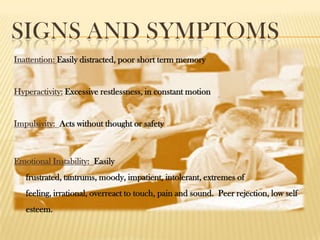
SIGNS AND SYMPTOMS
Inattention: Easily distracted, poor short term memory


Hyperactivity: Excessive restlessness, in constant motion


Impulsivity: Acts without thought or safety


Emotional Instability: Easily
   frustrated, tantrums, moody, impatient, intolerant, extremes of
   feeling, irrational, overreact to touch, pain and sound. Peer rejection, low self
   esteem.
SOLUTIONS USED
  IN TEACHING
STUDENTS WITH
      ADHD
Teachers who are successful in educating children with ADHD use a three-pronged
   strategy/solution. They begin by:

Identifying the unique needs of the child. For example, the teacher determines
   how, when, and why the child is inattentive, impulsive, and hyperactive. The
   teacher

assess the unique educational needs and strengths of a child with ADHD in the class.

Assessments, such as learning style inventories, can be used to determine children's
   strengths and enable instruction to build on their existing abilities.

Selects different educational practices associated with academic
   instruction, behavioral interventions, and classroom accommodations that are
   appropriate to meet that child's needs.

The teacher determines which instructional practices will meet the academic and
   behavioral needs identified for the child. Select practices that fit the content
Combines these practices into an individualized educational program

  (IEP) or other individualized plan and integrates this program with

  educational activities provided to other children in the class.

The teacher develops /creates an IEP to reflect annual goals and the

  special education-related services, along with supplementary aids

  and services necessary for attaining those goals.
STRATEGIES FOR COMBATING

HYPERACTIVITY CONSIST OF CREATIVE

WAYS TO ALLOW THE CHILD WITH

ADD/ADHD TO MOVE IN APPROPRIATE

WAYS AT APPROPRIATE TIMES
   Ask children with ADD/ADHD to run an errand or do a task for

    you, even if it just means walking across the room to sharpen

    pencils or put dishes away.

   Encourage the child to play a sport—or at least run around before

    and after school.

   Provide a stress ball, small toy, or other object for the child to

    squeeze or play with discreetly at his or her seat.

   Limit screen time in favor of time for movement.

   Make sure a child with ADD/ADHD never misses recess or P.E.
ADD / ADHD AND SCHOOL: HELPING
CHILDREN WITH ADHD SUCCEED AT
SCHOOL

http://www.educationworld.com/a_issues/issues148c.shtml
20 TIPS TO TEACH KIDS WHO HAVE ADHD

When teachers understand the struggle of a student
 with ADHD, they can better help that student in
 the classroom. Because children with ADHD do
 better when their lives are ordered and
 predictable, the most important things teachers
 can do for those children is establish a
 calm, structured classroom environment with clear
 and consistent rules and regular classroom
 routines.
CHADD and the American Academy of Pediatrics offer suggestions
  on what teachers can do in the classroom to help students who have
  ADHD:
 Display classroom rules. Classroom rules must be very clear and
  concise.
 Provide clear and concise instructions for academic assignments.

 Break complex instructions into small parts.

 Show students how to use an assignment book to keep track of
  their homework and daily assignments.
 Post a daily schedule and homework assignments in the same place
  each day. Tape a copy on the child's desk.
 Plan academic subjects for the morning hours.

 Provide regular and frequent breaks.

 Seat the child away from distractions and next to students who will
  be positive role models.
Form small group settings when possible. Children with ADHD can
   become easily distracted in large groups.

Find a quiet spot in the classroom (such as a place in the back of the
    room) where students can go to do their work away from
    distractions.

Train the student with ADHD to recognize "begin work" cues.

Establish a secret signal with the child to use as a reminder when he or
    she is off task.

Help the child with transitions between other classes and activities by
   providing clear directions and cues, such as a five-minute warning
   before the transition.
Assign tutors to help children with ADHD stay on task. Tutors can help
    them get more work done in less time and provide constant
    reinforcement.

Focus on a specific behavior you wish to improve and reinforce it. Teachers
    can reinforce target behaviors by paying attention to the
    behavior, praising the child, and awarding jobs and extra free time.

Offer more positive reinforcements than negative consequences.

Explain to the student what to do to avoid negative consequences.

Reward target behaviors immediately and continuously.

Use negative consequences only after a positive reinforcement program has
    enough time to become effective.

Deliver negative consequences in a firm, business-like way without
    emotion, lectures, or long-winded explanations.
TECHNOLOGY
Teacher Student Collaboration:

Math Software and Gadgets

    These tools help ADHD students who struggle with computing, aligning, and copying math problems

    on paper.

Electronic math worksheet software enables students to organize and work through problems on a

    computer screen. Numbers that appear onscreen can be read aloud by a speech synthesizer.


Talking calculators have a built-in speech synthesizer that reads aloud each number, symbol, or operation

    key a student presses, as well as the answer. The aural feedback lets an attention deficit student know

    whether he pressed the right keys and verifies the answer before he transfers it to paper.

Portable word processors are lightweight devices that look like a computer keyboard with a screen. They

    can be helpful to ADHD children who have trouble with handwriting. These battery-powered

    machines can be brought to school for note-taking and writing assignments.
REFERENCES
   Technology
http://www.additudemag.com/adhd/article/6585-2.html
   ADHD: A brief Introduction for teachers
http://www.youtube.com/watch?v=wbgEwUKQbGQ
   Top 10 reasons to use technology in education- ADHD: A brief
    introduction for teachers.
http://www.youtube.com/watch?v=mzi2RIt8_nk
   Technology in the Classroom: Amplified Classrooms Help Education
http://www.youtube.com/watch?v=hbEbBrE6L7Q

Team6 updated adhd_computer_assisted_presentation[1]

  • 1.
    Group Members: Nicole Rivers Kerry Graham Natalia Wilson Abigail Christopher ADHD
  • 2.
    INTRODUCTION Good morning toeveryone and welcome to team six workshop on ADHD which means Attention Deficit Hyperactivity Disorder. It is our privilege to stand here to let you all know that children with disabilities can, and are able to do the work as a “normal” child in the classroom. However they cannot achieve this by themselves, but with the aid of the teacher, the proper use of the technology, and correct technology in the classroom, things will be of great success with these children. Today we will be focusing on the child that has ADHD and the technologies that can be used, and the ways teachers can teach them in the classroom. Sit back and enjoy today’s proceedings.
  • 3.
    As it wasmention before that ADHD means, Attention Deficit Hyperactivity Disorder. Then what can we say about ADHD. ADHD is “a condition of the brain that makes it hard for children to control their behavior”. Therefore can we say that there are ADHD students in our classroom? Think about it. How would you know as a teacher that a child has ADHD? There are signs and symptoms that you as a teacher can look for.
  • 4.
    SIGNS AND SYMPTOMS Inattention:Easily distracted, poor short term memory Hyperactivity: Excessive restlessness, in constant motion Impulsivity: Acts without thought or safety Emotional Instability: Easily frustrated, tantrums, moody, impatient, intolerant, extremes of feeling, irrational, overreact to touch, pain and sound. Peer rejection, low self esteem.
  • 5.
    SOLUTIONS USED IN TEACHING STUDENTS WITH ADHD
  • 6.
    Teachers who aresuccessful in educating children with ADHD use a three-pronged strategy/solution. They begin by: Identifying the unique needs of the child. For example, the teacher determines how, when, and why the child is inattentive, impulsive, and hyperactive. The teacher assess the unique educational needs and strengths of a child with ADHD in the class. Assessments, such as learning style inventories, can be used to determine children's strengths and enable instruction to build on their existing abilities. Selects different educational practices associated with academic instruction, behavioral interventions, and classroom accommodations that are appropriate to meet that child's needs. The teacher determines which instructional practices will meet the academic and behavioral needs identified for the child. Select practices that fit the content
  • 7.
    Combines these practicesinto an individualized educational program (IEP) or other individualized plan and integrates this program with educational activities provided to other children in the class. The teacher develops /creates an IEP to reflect annual goals and the special education-related services, along with supplementary aids and services necessary for attaining those goals.
  • 8.
    STRATEGIES FOR COMBATING HYPERACTIVITYCONSIST OF CREATIVE WAYS TO ALLOW THE CHILD WITH ADD/ADHD TO MOVE IN APPROPRIATE WAYS AT APPROPRIATE TIMES
  • 9.
    Ask children with ADD/ADHD to run an errand or do a task for you, even if it just means walking across the room to sharpen pencils or put dishes away.  Encourage the child to play a sport—or at least run around before and after school.  Provide a stress ball, small toy, or other object for the child to squeeze or play with discreetly at his or her seat.  Limit screen time in favor of time for movement.  Make sure a child with ADD/ADHD never misses recess or P.E.
  • 10.
    ADD / ADHDAND SCHOOL: HELPING CHILDREN WITH ADHD SUCCEED AT SCHOOL http://www.educationworld.com/a_issues/issues148c.shtml
  • 11.
    20 TIPS TOTEACH KIDS WHO HAVE ADHD When teachers understand the struggle of a student with ADHD, they can better help that student in the classroom. Because children with ADHD do better when their lives are ordered and predictable, the most important things teachers can do for those children is establish a calm, structured classroom environment with clear and consistent rules and regular classroom routines.
  • 12.
    CHADD and theAmerican Academy of Pediatrics offer suggestions on what teachers can do in the classroom to help students who have ADHD:  Display classroom rules. Classroom rules must be very clear and concise.  Provide clear and concise instructions for academic assignments.  Break complex instructions into small parts.  Show students how to use an assignment book to keep track of their homework and daily assignments.  Post a daily schedule and homework assignments in the same place each day. Tape a copy on the child's desk.  Plan academic subjects for the morning hours.  Provide regular and frequent breaks.  Seat the child away from distractions and next to students who will be positive role models.
  • 13.
    Form small groupsettings when possible. Children with ADHD can become easily distracted in large groups. Find a quiet spot in the classroom (such as a place in the back of the room) where students can go to do their work away from distractions. Train the student with ADHD to recognize "begin work" cues. Establish a secret signal with the child to use as a reminder when he or she is off task. Help the child with transitions between other classes and activities by providing clear directions and cues, such as a five-minute warning before the transition.
  • 14.
    Assign tutors tohelp children with ADHD stay on task. Tutors can help them get more work done in less time and provide constant reinforcement. Focus on a specific behavior you wish to improve and reinforce it. Teachers can reinforce target behaviors by paying attention to the behavior, praising the child, and awarding jobs and extra free time. Offer more positive reinforcements than negative consequences. Explain to the student what to do to avoid negative consequences. Reward target behaviors immediately and continuously. Use negative consequences only after a positive reinforcement program has enough time to become effective. Deliver negative consequences in a firm, business-like way without emotion, lectures, or long-winded explanations.
  • 15.
  • 16.
    Teacher Student Collaboration: MathSoftware and Gadgets These tools help ADHD students who struggle with computing, aligning, and copying math problems on paper. Electronic math worksheet software enables students to organize and work through problems on a computer screen. Numbers that appear onscreen can be read aloud by a speech synthesizer. Talking calculators have a built-in speech synthesizer that reads aloud each number, symbol, or operation key a student presses, as well as the answer. The aural feedback lets an attention deficit student know whether he pressed the right keys and verifies the answer before he transfers it to paper. Portable word processors are lightweight devices that look like a computer keyboard with a screen. They can be helpful to ADHD children who have trouble with handwriting. These battery-powered machines can be brought to school for note-taking and writing assignments.
  • 17.
    REFERENCES  Technology http://www.additudemag.com/adhd/article/6585-2.html  ADHD: A brief Introduction for teachers http://www.youtube.com/watch?v=wbgEwUKQbGQ  Top 10 reasons to use technology in education- ADHD: A brief introduction for teachers. http://www.youtube.com/watch?v=mzi2RIt8_nk  Technology in the Classroom: Amplified Classrooms Help Education http://www.youtube.com/watch?v=hbEbBrE6L7Q