


Integrative Educational Partners, LLC 6739 Courtland Drive, Suite 101, Rockford, MI 49341  616.874.7490  www.ieptherapy.com Integrative Educational Partners, LLC is a place that offers  educational therapy  to people who experience learning differences. We draw from  expertise in several disciplines  to assess the client and we take a  holistic approach to a solution .  Our staff is made up of people with  educational, nutritional, medical, and psychological expertise . We employ  certified teachers, a nurse practitioner, an occupational therapist, and a speech and language therapist , and can refer our clients to psychologists who specialize in children.
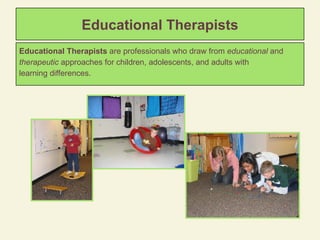
Educational Therapists Educational Therapists  are professionals who draw from  educational  and  therapeutic  approaches for children, adolescents, and adults with  learning differences.
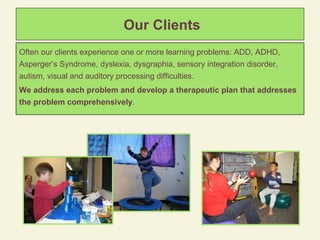
Our Clients Often our clients experience one or more learning problems: ADD, ADHD, Asperger’s Syndrome, dyslexia, dysgraphia, sensory integration disorder, autism, visual and auditory processing difficulties.  We address each problem and develop a therapeutic plan that addresses the problem comprehensively .
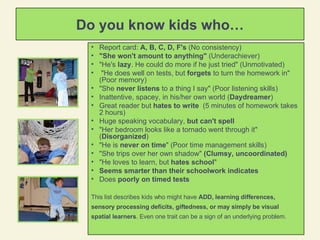
Do you know kids who… Report card:  A, B, C, D, F's  (No consistency) "She won't amount to anything"  (Underachiever) "He's  lazy . He could do more if he just tried" (Unmotivated) "He does well on tests, but  forgets  to turn the homework in" (Poor memory) "She  never listens  to a thing I say" (Poor listening skills) Inattentive, spacey, in his/her own world ( Daydreamer ) Great reader but  hates to write   (5 minutes of homework takes 2 hours) Huge speaking vocabulary,  but can't spell   "Her bedroom looks like a tornado went through it" ( Disorganized ) "He is  never on time " (Poor time management skills)  "She trips over her own shadow"  (Clumsy, uncoordinated)  "He loves to learn, but  hates school "  Seems smarter than their schoolwork indicates Does  poorly on timed tests This list describes kids who might have  ADD, learning differences, sensory processing deficits, giftedness, or may simply be visual spatial learners . Even one trait can be a sign of an underlying problem.
Our Diagnostic Process During the  Initial Consultation , we observe the child. We determine which assessments are necessary.  During the  Assessment/ Evaluation session , we perform one or more of the following: Competency Assessment Battery Dr. Mel Levine’s Neuro-Developmental Assessment Retained Reflex Testing TAPS- Test of Auditory Processing GORT- Gray Oral Reading Test Dibels- Reading Assessment REO- Receptive Expressive Observation ADD/ADHD Assessment Neurofunctional Assessment
Dyspraxia Developmental Dyspraxia  is neurologically based disorder of the processes involved in praxis (motor planning). Praxis consists of three components. Ideation  - forming an idea of using a known movement  to achieve a planned purpose. Motor Planning  -  planning the action needed to achieve the idea. Execution  - carrying out the planned movement.
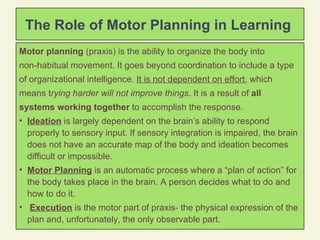
Motor planning  (praxis) is the ability to organize the body into  non-habitual movement. It goes beyond coordination to include a type of organizational intelligence.  It is not dependent on effort , which means t rying harder will not improve things . It is a result of  all  systems working together  to accomplish the response. Ideation  is largely dependent on the brain’s ability to respond properly to sensory input. If sensory integration is impaired, the brain does not have an accurate map of the body and ideation becomes difficult or impossible. Motor Planning  is an automatic process where a “plan of action” for the body takes place in the brain. A person decides what to do and how to do it. Execution  is the motor part of praxis- the physical expression of the plan and, unfortunately, the only observable part.  The Role of Motor Planning in Learning
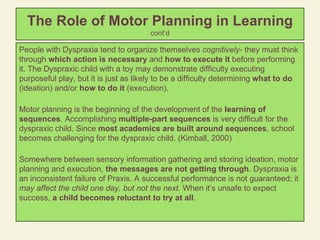
The Role of Motor Planning in Learning   cont’d People with Dyspraxia tend to organize themselves  cognitively-  they must think through  which action is necessary  and  how to execute it  before performing it. The Dyspraxic child with a toy may demonstrate difficulty executing purposeful play, but it is just as likely to be a difficulty determining  what to do  (ideation) and/or  how to do it  (execution). Motor planning is the beginning of the development of the  learning of sequences . Accomplishing  multiple-part sequences  is very difficult for the dyspraxic child. Since  most academics are built around sequences , school becomes challenging for the dyspraxic child. (Kimball, 2000) Somewhere between sensory information gathering and storing ideation, motor planning and execution,  the messages are not getting through . Dyspraxia is an inconsistent failure of Praxis. A successful performance is not guaranteed; it  may affect the child one day, but not the next.  When it’s unsafe to expect success,  a child becomes reluctant to try at all .
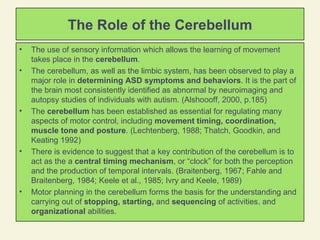
The Role of the Cerebellum The use of sensory information which allows the learning of movement takes place in the  cerebellum .  The cerebellum, as well as the limbic system, has been observed to play a major role in  determining ASD symptoms and behaviors . It is the part of the brain most consistently identified as abnormal by neuroimaging and autopsy studies of individuals with autism. (Alshoooff, 2000, p.185) The  cerebellum  has been established as essential for regulating many aspects of motor control, including  movement timing, coordination, muscle tone and posture . (Lechtenberg, 1988; Thatch, Goodkin, and Keating 1992) There is evidence to suggest that a key contribution of the cerebellum is to act as the a  central timing mechanism , or “clock” for both the perception and the production of temporal intervals. (Braitenberg, 1967; Fahle and Braitenberg, 1984; Keele et al., 1985; Ivry and Keele, 1989)  Motor planning in the cerebellum forms the basis for the understanding and carrying out of  stopping, starting,  and  sequencing  of activities, and  organizational  abilities.
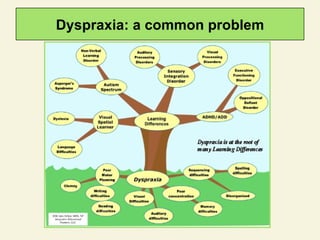
Dyspraxia: a common problem
Indicators of Dyspraxia May be physically uncoordinated Poor motivation Difficulty  spelling Difficulty reading Difficulty sequencing Poor short term memory Poor auditory skills Poor concentration Poor rote memorization skills Poor handwriting Disorganized Develops “unique” solutions Poor in timed situations Poor visual skills
IEP Services Educational Therapy  in our office where we are able to take advantage of the equipment and facilities Tutoring services  by an IEP-employed, state certified teacher, conveniently offered during your child’s school hours  Phone Consultations Special Education Services Advocacy / School Meetings Gifted Educational Planning Homeschool Support : classes for struggling children Family Sessions
Sample IEP Therapies Sensory Integration Auditory Retraining Visual Retraining Occupational Services Counseling/Coaching Speech and  Language Services
Targeted Skills Gross Motor Fine Motor Proprioceptive Bilateral Integration Balance Short Term Memory Sequencing Auditory Processing Strategy Eye-Hand Coordination Vision Tracking Auditory Processing Visual Processing Processing Speed Breathing Control Expressive Language Problem Solving Social Skills Speech Reading Comprehension Phonics Vestibular Crossing Midline
Academic Areas We use a multi-sensory approach, borrowing from many  different programs so as to individualize for each client:   Visualizing Verbalizing AVKO J.F.I. Right-Brained/Visual-Spatial Learner Techniques  Making Math Easy Base Ten Blocks Seeing Stars Picture Me Reading Touch Math Winston Grammar Various Reading Skills Games Lots of Academic Computer Programs … and many others!
A Typical Session… We begin with games and  activities specifically designed to address the neurological deficits  that are part of dyspraxia. These activities are specifically developed to  engage both halves of the brain  to work in concert, as well as facilitate the communication necessary between brain and body. This groundbreaking approach has yielded  significant results in our clientele . Addressed in every session*:  Fine motor Gross motor Sensory work Hand-eye coordination Visual processing Academic weak areas   * This will be adjusted to the individual needs of each client.
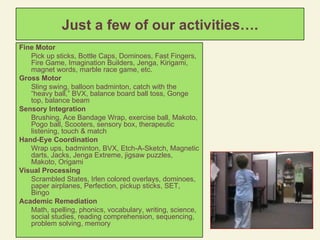
Just a few of our activities…. Fine Motor  Pick up sticks, Bottle Caps, Dominoes, Fast Fingers, Fire Game, Imagination Builders, Jenga, Kirigami, magnet words, marble race game, etc. Gross Motor  Sling swing, balloon badminton, catch with the “heavy ball,” BVX, balance board ball toss, Gonge top, balance beam Sensory Integration Brushing, Ace Bandage Wrap, exercise ball, Makoto, Pogo ball, Scooters, sensory box, therapeutic listening, touch & match Hand-Eye Coordination Wrap ups, badminton, BVX, Etch-A-Sketch, Magnetic darts, Jacks, Jenga Extreme, jigsaw puzzles, Makoto, Origami Visual Processing Scrambled States, Irlen colored overlays, dominoes, paper airplanes, Perfection, pickup sticks, SET, Bingo Academic Remediation Math, spelling, phonics, vocabulary, writing, science, social studies, reading comprehension, sequencing, problem solving, memory
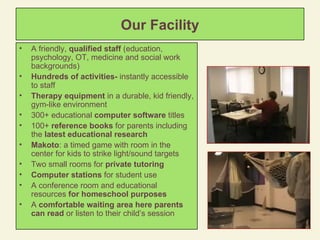
Our Facility A friendly,  qualified staff  (education, psychology, OT, medicine and social work backgrounds) Hundreds of activities-  instantly accessible to staff Therapy equipment  in a durable, kid friendly, gym-like environment  300+ educational  computer software  titles 100+  reference books  for parents including the  latest educational research Makoto : a timed game with room in the center for kids to strike light/sound targets Two small rooms for  private tutoring Computer stations  for student use A conference room and educational resources  for homeschool purposes A  comfortable waiting area here parents can read  or listen to their child’s session
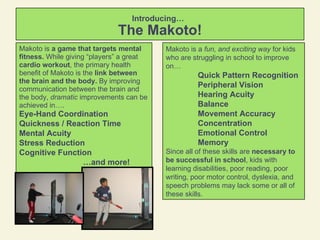
Introducing…   The Makoto! Makoto is  a game that targets mental fitness.  While giving “players” a great  cardio workout , the primary health benefit of Makoto is the  link between the brain and the body.  By improving communication between the brain and the body,  dramatic  improvements can be achieved in…. Eye-Hand Coordination Quickness / Reaction Time Mental Acuity Stress Reduction Cognitive Function … and more! Makoto is a  fun, and exciting way  for kids who are struggling in school to improve on… Quick Pattern Recognition Peripheral Vision Hearing Acuity Balance Movement Accuracy Concentration Emotional Control Memory Since all of these skills are  necessary to be successful in school , kids with learning disabilities, poor reading, poor writing, poor motor control, dyslexia, and speech problems may lack some or all of these skills.
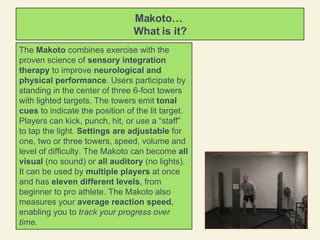
Makoto…  What is it? The  Makoto  combines exercise with the proven science of  sensory integration   therapy  to improve  neurological and physical performance . Users participate by standing in the center of three 6-foot towers with lighted targets. The towers emit  tonal cues  to indicate the position of the lit target. Players can kick, punch, hit, or use a “staff” to tap the light.  Settings are adjustable  for one, two or three towers, speed, volume and level of difficulty. The Makoto can become  all visual  (no sound) or  all auditory  (no lights). It can be used by  multiple players  at once and has  eleven different levels , from beginner to pro athlete. The Makoto also measures your  average reaction speed , enabling you to  track your progress over time.
IEP Do  YOU  know anyone who would  benefit from our services? Integrative Educational Partners, LLC 6739 Courtland Drive Rockford, MI 49341  (616) 874-7490 www.ieptherapy.com Thank You!

IEP Presentation

  • 1.
  • 2.
    Integrative Educational Partners,LLC 6739 Courtland Drive, Suite 101, Rockford, MI 49341 616.874.7490 www.ieptherapy.com Integrative Educational Partners, LLC is a place that offers educational therapy to people who experience learning differences. We draw from expertise in several disciplines to assess the client and we take a holistic approach to a solution . Our staff is made up of people with educational, nutritional, medical, and psychological expertise . We employ certified teachers, a nurse practitioner, an occupational therapist, and a speech and language therapist , and can refer our clients to psychologists who specialize in children.
  • 3.
    Educational Therapists EducationalTherapists are professionals who draw from educational and therapeutic approaches for children, adolescents, and adults with learning differences.
  • 4.
    Our Clients Oftenour clients experience one or more learning problems: ADD, ADHD, Asperger’s Syndrome, dyslexia, dysgraphia, sensory integration disorder, autism, visual and auditory processing difficulties. We address each problem and develop a therapeutic plan that addresses the problem comprehensively .
  • 5.
    Do you knowkids who… Report card: A, B, C, D, F's (No consistency) "She won't amount to anything" (Underachiever) "He's lazy . He could do more if he just tried" (Unmotivated) "He does well on tests, but forgets to turn the homework in" (Poor memory) "She never listens to a thing I say" (Poor listening skills) Inattentive, spacey, in his/her own world ( Daydreamer ) Great reader but hates to write (5 minutes of homework takes 2 hours) Huge speaking vocabulary, but can't spell "Her bedroom looks like a tornado went through it" ( Disorganized ) "He is never on time " (Poor time management skills) "She trips over her own shadow" (Clumsy, uncoordinated) "He loves to learn, but hates school " Seems smarter than their schoolwork indicates Does poorly on timed tests This list describes kids who might have ADD, learning differences, sensory processing deficits, giftedness, or may simply be visual spatial learners . Even one trait can be a sign of an underlying problem.
  • 6.
    Our Diagnostic ProcessDuring the Initial Consultation , we observe the child. We determine which assessments are necessary. During the Assessment/ Evaluation session , we perform one or more of the following: Competency Assessment Battery Dr. Mel Levine’s Neuro-Developmental Assessment Retained Reflex Testing TAPS- Test of Auditory Processing GORT- Gray Oral Reading Test Dibels- Reading Assessment REO- Receptive Expressive Observation ADD/ADHD Assessment Neurofunctional Assessment
  • 7.
    Dyspraxia Developmental Dyspraxia is neurologically based disorder of the processes involved in praxis (motor planning). Praxis consists of three components. Ideation - forming an idea of using a known movement to achieve a planned purpose. Motor Planning - planning the action needed to achieve the idea. Execution - carrying out the planned movement.
  • 8.
    Motor planning (praxis) is the ability to organize the body into non-habitual movement. It goes beyond coordination to include a type of organizational intelligence. It is not dependent on effort , which means t rying harder will not improve things . It is a result of all systems working together to accomplish the response. Ideation is largely dependent on the brain’s ability to respond properly to sensory input. If sensory integration is impaired, the brain does not have an accurate map of the body and ideation becomes difficult or impossible. Motor Planning is an automatic process where a “plan of action” for the body takes place in the brain. A person decides what to do and how to do it. Execution is the motor part of praxis- the physical expression of the plan and, unfortunately, the only observable part. The Role of Motor Planning in Learning
  • 9.
    The Role ofMotor Planning in Learning cont’d People with Dyspraxia tend to organize themselves cognitively- they must think through which action is necessary and how to execute it before performing it. The Dyspraxic child with a toy may demonstrate difficulty executing purposeful play, but it is just as likely to be a difficulty determining what to do (ideation) and/or how to do it (execution). Motor planning is the beginning of the development of the learning of sequences . Accomplishing multiple-part sequences is very difficult for the dyspraxic child. Since most academics are built around sequences , school becomes challenging for the dyspraxic child. (Kimball, 2000) Somewhere between sensory information gathering and storing ideation, motor planning and execution, the messages are not getting through . Dyspraxia is an inconsistent failure of Praxis. A successful performance is not guaranteed; it may affect the child one day, but not the next. When it’s unsafe to expect success, a child becomes reluctant to try at all .
  • 10.
    The Role ofthe Cerebellum The use of sensory information which allows the learning of movement takes place in the cerebellum . The cerebellum, as well as the limbic system, has been observed to play a major role in determining ASD symptoms and behaviors . It is the part of the brain most consistently identified as abnormal by neuroimaging and autopsy studies of individuals with autism. (Alshoooff, 2000, p.185) The cerebellum has been established as essential for regulating many aspects of motor control, including movement timing, coordination, muscle tone and posture . (Lechtenberg, 1988; Thatch, Goodkin, and Keating 1992) There is evidence to suggest that a key contribution of the cerebellum is to act as the a central timing mechanism , or “clock” for both the perception and the production of temporal intervals. (Braitenberg, 1967; Fahle and Braitenberg, 1984; Keele et al., 1985; Ivry and Keele, 1989) Motor planning in the cerebellum forms the basis for the understanding and carrying out of stopping, starting, and sequencing of activities, and organizational abilities.
  • 11.
  • 12.
    Indicators of DyspraxiaMay be physically uncoordinated Poor motivation Difficulty spelling Difficulty reading Difficulty sequencing Poor short term memory Poor auditory skills Poor concentration Poor rote memorization skills Poor handwriting Disorganized Develops “unique” solutions Poor in timed situations Poor visual skills
  • 13.
    IEP Services EducationalTherapy in our office where we are able to take advantage of the equipment and facilities Tutoring services by an IEP-employed, state certified teacher, conveniently offered during your child’s school hours Phone Consultations Special Education Services Advocacy / School Meetings Gifted Educational Planning Homeschool Support : classes for struggling children Family Sessions
  • 14.
    Sample IEP TherapiesSensory Integration Auditory Retraining Visual Retraining Occupational Services Counseling/Coaching Speech and Language Services
  • 15.
    Targeted Skills GrossMotor Fine Motor Proprioceptive Bilateral Integration Balance Short Term Memory Sequencing Auditory Processing Strategy Eye-Hand Coordination Vision Tracking Auditory Processing Visual Processing Processing Speed Breathing Control Expressive Language Problem Solving Social Skills Speech Reading Comprehension Phonics Vestibular Crossing Midline
  • 16.
    Academic Areas Weuse a multi-sensory approach, borrowing from many different programs so as to individualize for each client: Visualizing Verbalizing AVKO J.F.I. Right-Brained/Visual-Spatial Learner Techniques Making Math Easy Base Ten Blocks Seeing Stars Picture Me Reading Touch Math Winston Grammar Various Reading Skills Games Lots of Academic Computer Programs … and many others!
  • 17.
    A Typical Session…We begin with games and activities specifically designed to address the neurological deficits that are part of dyspraxia. These activities are specifically developed to engage both halves of the brain to work in concert, as well as facilitate the communication necessary between brain and body. This groundbreaking approach has yielded significant results in our clientele . Addressed in every session*: Fine motor Gross motor Sensory work Hand-eye coordination Visual processing Academic weak areas * This will be adjusted to the individual needs of each client.
  • 18.
    Just a fewof our activities…. Fine Motor Pick up sticks, Bottle Caps, Dominoes, Fast Fingers, Fire Game, Imagination Builders, Jenga, Kirigami, magnet words, marble race game, etc. Gross Motor Sling swing, balloon badminton, catch with the “heavy ball,” BVX, balance board ball toss, Gonge top, balance beam Sensory Integration Brushing, Ace Bandage Wrap, exercise ball, Makoto, Pogo ball, Scooters, sensory box, therapeutic listening, touch & match Hand-Eye Coordination Wrap ups, badminton, BVX, Etch-A-Sketch, Magnetic darts, Jacks, Jenga Extreme, jigsaw puzzles, Makoto, Origami Visual Processing Scrambled States, Irlen colored overlays, dominoes, paper airplanes, Perfection, pickup sticks, SET, Bingo Academic Remediation Math, spelling, phonics, vocabulary, writing, science, social studies, reading comprehension, sequencing, problem solving, memory
  • 19.
    Our Facility Afriendly, qualified staff (education, psychology, OT, medicine and social work backgrounds) Hundreds of activities- instantly accessible to staff Therapy equipment in a durable, kid friendly, gym-like environment 300+ educational computer software titles 100+ reference books for parents including the latest educational research Makoto : a timed game with room in the center for kids to strike light/sound targets Two small rooms for private tutoring Computer stations for student use A conference room and educational resources for homeschool purposes A comfortable waiting area here parents can read or listen to their child’s session
  • 20.
    Introducing… The Makoto! Makoto is a game that targets mental fitness. While giving “players” a great cardio workout , the primary health benefit of Makoto is the link between the brain and the body. By improving communication between the brain and the body, dramatic improvements can be achieved in…. Eye-Hand Coordination Quickness / Reaction Time Mental Acuity Stress Reduction Cognitive Function … and more! Makoto is a fun, and exciting way for kids who are struggling in school to improve on… Quick Pattern Recognition Peripheral Vision Hearing Acuity Balance Movement Accuracy Concentration Emotional Control Memory Since all of these skills are necessary to be successful in school , kids with learning disabilities, poor reading, poor writing, poor motor control, dyslexia, and speech problems may lack some or all of these skills.
  • 21.
    Makoto… Whatis it? The Makoto combines exercise with the proven science of sensory integration therapy to improve neurological and physical performance . Users participate by standing in the center of three 6-foot towers with lighted targets. The towers emit tonal cues to indicate the position of the lit target. Players can kick, punch, hit, or use a “staff” to tap the light. Settings are adjustable for one, two or three towers, speed, volume and level of difficulty. The Makoto can become all visual (no sound) or all auditory (no lights). It can be used by multiple players at once and has eleven different levels , from beginner to pro athlete. The Makoto also measures your average reaction speed , enabling you to track your progress over time.
  • 22.
    IEP Do YOU know anyone who would benefit from our services? Integrative Educational Partners, LLC 6739 Courtland Drive Rockford, MI 49341 (616) 874-7490 www.ieptherapy.com Thank You!