AN EDUCATORS GUIDE
ADHD
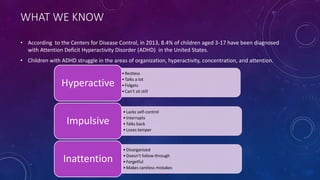
WHAT WE KNOW
• According to the Centers for Disease Control, in 2013, 8.4% of children aged 3-17 have been diagnosed
with Attention Deficit Hyperactivity Disorder (ADHD) in the United States.
• Children with ADHD struggle in the areas of organization, hyperactivity, concentration, and attention.
•Restless
•Talks a lot
•Fidgets
•Can’t sit still
Hyperactive
•Lacks self-control
•Interrupts
•Talks back
•Loses temper
Impulsive
•Disorganized
•Doesn’t follow through
•Forgetful
•Makes careless mistakes
Inattention
WHAT MIGHT NOT
BE SO OBVIOUS
According to Chris Ziegler Dendy, ADHD is similar
to an iceberg, the obvious symptoms are only a
fraction of what is really going on. See Figure 2
to learn more about the underlying problems
that might accompany ADHD. It is important for
educators to keep these factors in mind when
choosing strategies for students with ADHD.
Fig. 1
THE EDUCATOR’S ROLE
Teach
organizational
skills
Address
impulsivity
and
hyperactivity
Assist with
learning
problems
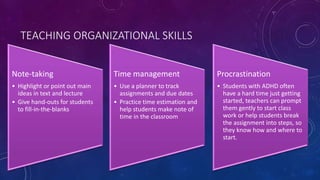
TEACHING ORGANIZATIONAL SKILLS
Note-taking
• Highlight or point out main
ideas in text and lecture
• Give hand-outs for students
to fill-in-the-blanks
Time management
• Use a planner to track
assignments and due dates
• Practice time estimation and
help students make note of
time in the classroom
Procrastination
• Students with ADHD often
have a hard time just getting
started, teachers can prompt
them gently to start class
work or help students break
the assignment into steps, so
they know how and where to
start.
ADDRESSING HYPERACTIVITY AND IMPULSIVITY
• It is important to address inappropriate behaviors, but students with ADHD can sometimes feel
inundated with negative messages
• Teachers can help by taking a positive approach:
• Point out what the student is doing well, acknowledging even small steps is important
• Ignore mild misbehavior or off-task behavior when appropriate
• Intentionally model appropriate social interactions
• Provide a structured classroom routine
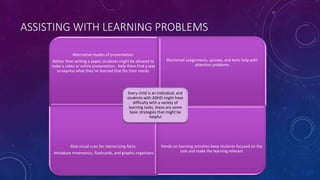
ASSISTING WITH LEARNING PROBLEMS
Alternative modes of presentation-
Rather than writing a paper, students might be allowed to
make a video or online presentation. Help them find a way
to express what they’ve learned that fits their needs.
Shortened assignments, quizzes, and tests help with
attention problems
Give visual cues for memorizing facts:
Introduce mnemonics, flashcards, and graphic organizers
Hands-on learning activities keep students focused on the
task and make the learning relevant
Every child is an individual, and
students with ADHD might have
difficulty with a variety of
learning tasks, these are some
basic strategies that might be
helpful
RESOURCES FOR TEACHERS AND PARENTS
• Both Mayo Clinic and the National Institute on Mental Health websites have basic information about
the causes, diagnosis, and treatments for ADHD. They outline some of the drugs available (along with
the side-effects) as well as alternative treatments that patients may try with the guidance of a doctor.
• WebMD, has not only the basics of diagnosis and treatment, but a wealth of information for children,
parents, and teachers about how to manage ADHD.
• ADDitude Magazine provides some helpful tips for parents to communicate to teachers about working
with students with ADHD.
RESOURCES
• Ahmann, E. (2014). Encouraging positive behavior in ‘challenging’ children: The nurtured heart approach(TM). Pediatric
Nursing, 40(1), 38-42. Retrieved from http://search.proquest.com/docview/1508688473?accountid=26879
• Ashley, S. (2005) The ADD & ADHD answer book. Naperville, IL: Sourcebooks, Inc.
• Centers for Disease Control and Prevention (CDC). (2013). Attention deficit hyperactivity disorder. Fast stats. Retrieved from
http://www.cdc.gov/nchs/fastats/adhd.htm
• DuPaul, G. J., Weyandt, L. L., & Janusis, G. M. (2011). ADHD in the Classroom: Effective Intervention Strategies. Theory Into
Practice, 50(1), 35-42. doi:10.1080/00405841.2011.534935
• Schultz, B. K., Storer, J., Watabe, Y., Sadler, J., & Evans, S. W. (2011). School-based treatment of attention-deficit/hyperactivity
disorder. Psychology In The Schools, 48(3), 254-262. doi:10.1002/pits.20553
• Ziegler Dendy, C.A. (2006). Teenagers with ADD and ADHD: A guide for parents and professionals. Bethesda, MD: Woodbine
House
• Figure 1, accessed at: http://landmark97.com/2014/04/16/the-addadhd-iceberg/

ADHD: The teacher's guide

  • 1.
  • 2.
    WHAT WE KNOW •According to the Centers for Disease Control, in 2013, 8.4% of children aged 3-17 have been diagnosed with Attention Deficit Hyperactivity Disorder (ADHD) in the United States. • Children with ADHD struggle in the areas of organization, hyperactivity, concentration, and attention. •Restless •Talks a lot •Fidgets •Can’t sit still Hyperactive •Lacks self-control •Interrupts •Talks back •Loses temper Impulsive •Disorganized •Doesn’t follow through •Forgetful •Makes careless mistakes Inattention
  • 3.
    WHAT MIGHT NOT BESO OBVIOUS According to Chris Ziegler Dendy, ADHD is similar to an iceberg, the obvious symptoms are only a fraction of what is really going on. See Figure 2 to learn more about the underlying problems that might accompany ADHD. It is important for educators to keep these factors in mind when choosing strategies for students with ADHD. Fig. 1
  • 4.
  • 5.
    TEACHING ORGANIZATIONAL SKILLS Note-taking •Highlight or point out main ideas in text and lecture • Give hand-outs for students to fill-in-the-blanks Time management • Use a planner to track assignments and due dates • Practice time estimation and help students make note of time in the classroom Procrastination • Students with ADHD often have a hard time just getting started, teachers can prompt them gently to start class work or help students break the assignment into steps, so they know how and where to start.
  • 6.
    ADDRESSING HYPERACTIVITY ANDIMPULSIVITY • It is important to address inappropriate behaviors, but students with ADHD can sometimes feel inundated with negative messages • Teachers can help by taking a positive approach: • Point out what the student is doing well, acknowledging even small steps is important • Ignore mild misbehavior or off-task behavior when appropriate • Intentionally model appropriate social interactions • Provide a structured classroom routine
  • 7.
    ASSISTING WITH LEARNINGPROBLEMS Alternative modes of presentation- Rather than writing a paper, students might be allowed to make a video or online presentation. Help them find a way to express what they’ve learned that fits their needs. Shortened assignments, quizzes, and tests help with attention problems Give visual cues for memorizing facts: Introduce mnemonics, flashcards, and graphic organizers Hands-on learning activities keep students focused on the task and make the learning relevant Every child is an individual, and students with ADHD might have difficulty with a variety of learning tasks, these are some basic strategies that might be helpful
  • 8.
    RESOURCES FOR TEACHERSAND PARENTS • Both Mayo Clinic and the National Institute on Mental Health websites have basic information about the causes, diagnosis, and treatments for ADHD. They outline some of the drugs available (along with the side-effects) as well as alternative treatments that patients may try with the guidance of a doctor. • WebMD, has not only the basics of diagnosis and treatment, but a wealth of information for children, parents, and teachers about how to manage ADHD. • ADDitude Magazine provides some helpful tips for parents to communicate to teachers about working with students with ADHD.
  • 9.
    RESOURCES • Ahmann, E.(2014). Encouraging positive behavior in ‘challenging’ children: The nurtured heart approach(TM). Pediatric Nursing, 40(1), 38-42. Retrieved from http://search.proquest.com/docview/1508688473?accountid=26879 • Ashley, S. (2005) The ADD & ADHD answer book. Naperville, IL: Sourcebooks, Inc. • Centers for Disease Control and Prevention (CDC). (2013). Attention deficit hyperactivity disorder. Fast stats. Retrieved from http://www.cdc.gov/nchs/fastats/adhd.htm • DuPaul, G. J., Weyandt, L. L., & Janusis, G. M. (2011). ADHD in the Classroom: Effective Intervention Strategies. Theory Into Practice, 50(1), 35-42. doi:10.1080/00405841.2011.534935 • Schultz, B. K., Storer, J., Watabe, Y., Sadler, J., & Evans, S. W. (2011). School-based treatment of attention-deficit/hyperactivity disorder. Psychology In The Schools, 48(3), 254-262. doi:10.1002/pits.20553 • Ziegler Dendy, C.A. (2006). Teenagers with ADD and ADHD: A guide for parents and professionals. Bethesda, MD: Woodbine House • Figure 1, accessed at: http://landmark97.com/2014/04/16/the-addadhd-iceberg/