ADHDBy Danielle Krucker       Music by Pat Kelly
What is ADHDAttention deficit hyperactivity disorder is a condition of the brain that makes it difficult for children to control their behavior. ADHD is a neuro-psychiatric (behavioral)condition. Doctors and researchers are still unclear of what causes ADHD but they do haveevidence linking it to a genetic disorder.  Children with ADHD usually have a close relative with the same disorder. Cigarette smoking during pregnancy, premature delivery, low birth weightand injuries to the brain are all contributing factors to this disorder. Research has indicated that children with ADHD do not produce enough chemicals that control organized thought. Thesechemicals called Neurotransmitters are responsible for sending messages betweennerve cells in the brain. The neurotransmitter dopamine stimulates the brains attention centers. So, a person with low amounts of this chemical may show symptoms of ADHD.
Inattentive onlyChildren with this form of ADHD are not overly active. Because they do not disrupt the classroom or other activities, their symptoms may not be noticed. Among girls with ADHD, this form is most commonHyperactive/ImpulsiveChildren with this type of ADHD show both hyperactive and impulsive behavior, but can pay attention. They are the least common group and are frequently youngerCombined Inattentive/Hyperactive/ImpulsiveChildren with this type of ADHD show a number of symptoms in all 3 dimensions. This is the most common type of ADHD.Types of ADHD
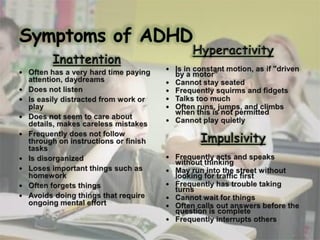
Symptoms of ADHDHyperactivityIs in constant motion, as if "driven by a motor”Cannot stay seatedFrequently squirms and fidgetsTalks too muchOften runs, jumps, and climbs when this is not permittedCannot play quietlyImpulsivityFrequently acts and speaks without thinkingMay run into the street without looking for traffic firstFrequently has trouble taking turnsCannot wait for thingsOften calls out answers before the question is completeFrequently interrupts othersInattentionOften has a very hard time paying attention, daydreamsDoes not listen Is easily distracted from work or playDoes not seem to care about details, makes careless mistakesFrequently does not follow through on instructions or finish tasksIs disorganizedLoses important things such as homeworkOften forgets thingsAvoids doing things that require ongoing mental effort
Coexisting ConditionsOppositional Defiant Disorder (ODD) and Conduct Disorder (CD) At least 35% of kids with ADHD also have oppositional defiant disorder, which is characterized by stubbornness, outbursts of temper, acts of defiance and rule breaking. Conduct disorder is similar to ODD but it deals with excessive hostility and aggression. Kids who have conduct disorder are more likely to get in trouble with authority figures Mood Disorders About 18% of kids with ADHD also experience depression. They may feel inadequate, isolated, frustrated by school failures and social problems, and have low self-esteemAnxiety Disorders 	Anxiety disorders affect about 25% of kids with ADHD. Symptoms include excessive worry, fear, or panic, which can also lead to physical symptoms such as a racing heart, sweating and stomach pains. Other forms of anxiety that can accompany ADHD are obsessive-compulsive disorder and Tourette syndromeEmotional or Behavioral DisordersADHD often coexists with EBD, 42% of children receive services  under the EBD category.  Students must receive mental health services to help with internalizing, externalizing and low incidence behaviors. Examples are temper tantrums, being hostile or defiant, threatening others, depressed, socially withdrawn and excessive worrying.Learning DisabilitiesAbout half of all kids with ADHD also have a specific learning disability. The most common learning problems are with reading (dyslexia) and handwriting.
Myths about ADHD	Myth #1: All kids with ADHD are hyperactiveMyth #2: Kids with ADHD can never pay attention
Myth #3: Kids with ADHD choose to be difficult, they could behave better if they wanted to
Myth #4: Kids will eventually grow out of ADHD
Myth #5: Medication is the best treatment option for ADHD
Myth#6: Only boys have ADHD
Myth#7: Bad Parenting
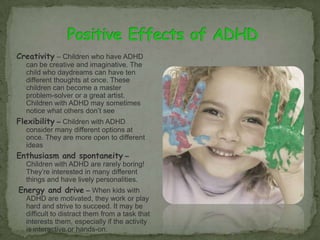
Myth#8: Children who take ADHD medication are more likely to abuse drugs when they become teenagersPositive Effects of ADHDCreativity – Children who have ADHD can be creative and imaginative. The child who daydreams can have ten different thoughts at once. These children can become a master problem-solver or a great artist. Children with ADHD may sometimes notice what others don’t seeFlexibility – Children with ADHD consider many different options at once. They are more open to different ideasEnthusiasm and spontaneity – Children with ADHD are rarely boring! They’re interested in many different things and have lively personalities.Energy and drive – When kids with ADHD are motivated, they work or play hard and strive to succeed. It may be difficult to distract them from a task that interests them, especially if the activity is interactive or hands-on.
Surprising Facts Out of 100 People with ADHD40 have tried alcohol at an early age 						25 will repeat at least one grade	30 have engaged in theft 								75 have interpersonal problems52 are abusing drugs and alcohol	   	 20 have set fires		25 will be expelled from high school for misconduct 	Studies show that approximately 50% of inmates have been found to have ADHDPeople with ADHD have a higher percentage of motor vehicle accidents, speeding tickets, citations for driving without a license, suspended or revoked licenses, medical visits, and emergency room visitsParents of ADHD children divorce three times more often than the general populationTeenagers with ADHD are six times more likely to have adversarial contact with the law and five times more likely to spend time in a juvenile justice facilityBetween 40% and 59% of the children diagnosed with ADHD will eventually develop behaviors that meet the criteria for a diagnosis of oppositional defiant disorderStudies have found that nearly 40% of all cocaine and opiate abusers meet the diagnostic criteria for ADHD
Assessment
Tips for Effective Teaching Set expectations and define goals clearly by providing concrete examples

4588e674d3f0faf

  • 1.
    ADHDBy Danielle Krucker Music by Pat Kelly
  • 2.
    What is ADHDAttentiondeficit hyperactivity disorder is a condition of the brain that makes it difficult for children to control their behavior. ADHD is a neuro-psychiatric (behavioral)condition. Doctors and researchers are still unclear of what causes ADHD but they do haveevidence linking it to a genetic disorder. Children with ADHD usually have a close relative with the same disorder. Cigarette smoking during pregnancy, premature delivery, low birth weightand injuries to the brain are all contributing factors to this disorder. Research has indicated that children with ADHD do not produce enough chemicals that control organized thought. Thesechemicals called Neurotransmitters are responsible for sending messages betweennerve cells in the brain. The neurotransmitter dopamine stimulates the brains attention centers. So, a person with low amounts of this chemical may show symptoms of ADHD.
  • 3.
    Inattentive onlyChildren withthis form of ADHD are not overly active. Because they do not disrupt the classroom or other activities, their symptoms may not be noticed. Among girls with ADHD, this form is most commonHyperactive/ImpulsiveChildren with this type of ADHD show both hyperactive and impulsive behavior, but can pay attention. They are the least common group and are frequently youngerCombined Inattentive/Hyperactive/ImpulsiveChildren with this type of ADHD show a number of symptoms in all 3 dimensions. This is the most common type of ADHD.Types of ADHD
  • 4.
    Symptoms of ADHDHyperactivityIsin constant motion, as if "driven by a motor”Cannot stay seatedFrequently squirms and fidgetsTalks too muchOften runs, jumps, and climbs when this is not permittedCannot play quietlyImpulsivityFrequently acts and speaks without thinkingMay run into the street without looking for traffic firstFrequently has trouble taking turnsCannot wait for thingsOften calls out answers before the question is completeFrequently interrupts othersInattentionOften has a very hard time paying attention, daydreamsDoes not listen Is easily distracted from work or playDoes not seem to care about details, makes careless mistakesFrequently does not follow through on instructions or finish tasksIs disorganizedLoses important things such as homeworkOften forgets thingsAvoids doing things that require ongoing mental effort
  • 5.
    Coexisting ConditionsOppositional DefiantDisorder (ODD) and Conduct Disorder (CD) At least 35% of kids with ADHD also have oppositional defiant disorder, which is characterized by stubbornness, outbursts of temper, acts of defiance and rule breaking. Conduct disorder is similar to ODD but it deals with excessive hostility and aggression. Kids who have conduct disorder are more likely to get in trouble with authority figures Mood Disorders About 18% of kids with ADHD also experience depression. They may feel inadequate, isolated, frustrated by school failures and social problems, and have low self-esteemAnxiety Disorders Anxiety disorders affect about 25% of kids with ADHD. Symptoms include excessive worry, fear, or panic, which can also lead to physical symptoms such as a racing heart, sweating and stomach pains. Other forms of anxiety that can accompany ADHD are obsessive-compulsive disorder and Tourette syndromeEmotional or Behavioral DisordersADHD often coexists with EBD, 42% of children receive services under the EBD category. Students must receive mental health services to help with internalizing, externalizing and low incidence behaviors. Examples are temper tantrums, being hostile or defiant, threatening others, depressed, socially withdrawn and excessive worrying.Learning DisabilitiesAbout half of all kids with ADHD also have a specific learning disability. The most common learning problems are with reading (dyslexia) and handwriting.
  • 6.
    Myths about ADHD Myth#1: All kids with ADHD are hyperactiveMyth #2: Kids with ADHD can never pay attention
  • 7.
    Myth #3: Kidswith ADHD choose to be difficult, they could behave better if they wanted to
  • 8.
    Myth #4: Kidswill eventually grow out of ADHD
  • 9.
    Myth #5: Medicationis the best treatment option for ADHD
  • 10.
  • 11.
  • 12.
    Myth#8: Children whotake ADHD medication are more likely to abuse drugs when they become teenagersPositive Effects of ADHDCreativity – Children who have ADHD can be creative and imaginative. The child who daydreams can have ten different thoughts at once. These children can become a master problem-solver or a great artist. Children with ADHD may sometimes notice what others don’t seeFlexibility – Children with ADHD consider many different options at once. They are more open to different ideasEnthusiasm and spontaneity – Children with ADHD are rarely boring! They’re interested in many different things and have lively personalities.Energy and drive – When kids with ADHD are motivated, they work or play hard and strive to succeed. It may be difficult to distract them from a task that interests them, especially if the activity is interactive or hands-on.
  • 13.
    Surprising Facts Outof 100 People with ADHD40 have tried alcohol at an early age 25 will repeat at least one grade 30 have engaged in theft 75 have interpersonal problems52 are abusing drugs and alcohol 20 have set fires 25 will be expelled from high school for misconduct Studies show that approximately 50% of inmates have been found to have ADHDPeople with ADHD have a higher percentage of motor vehicle accidents, speeding tickets, citations for driving without a license, suspended or revoked licenses, medical visits, and emergency room visitsParents of ADHD children divorce three times more often than the general populationTeenagers with ADHD are six times more likely to have adversarial contact with the law and five times more likely to spend time in a juvenile justice facilityBetween 40% and 59% of the children diagnosed with ADHD will eventually develop behaviors that meet the criteria for a diagnosis of oppositional defiant disorderStudies have found that nearly 40% of all cocaine and opiate abusers meet the diagnostic criteria for ADHD
  • 14.
  • 15.
    Tips for EffectiveTeaching Set expectations and define goals clearly by providing concrete examples

Editor's Notes

  • #4 Danielle Krucker