Team  Orienta+on  Process™  
Execu+ve  Summary  
Ge8ng  more  done  with  others  over  whom  you  have  no  control  may  
be  the  most  important  skill  to  develop.  
  
The  steps  in  the  Team  Orienta+on  Process  are  proven  to  give  a  group  
of  people  the  best  chance  of  coming  together  as  a  high  performance  
team.  
  
Accomplish  each  step  in  dialog  among  team  members.  
  
The  same  list  has  been  found  to  be  worth  re-­‐visi+ng  any  +me  a  team  
has  lost  energy  or  direc+on  and  needs  re-­‐orien+ng.    
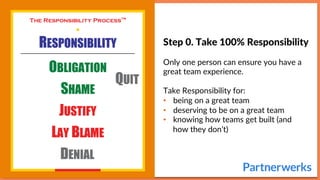
Step  0.  Take  100%  Responsibility  
  
Only  one  person  can  ensure  you  have  a  
great  team  experience.  
  
Take  Responsibility  for:  
•  being  on  a  great  team  
•  deserving  to  be  on  a  great  team  
•  knowing  how  teams  get  built  (and  
how  they  don’t)  
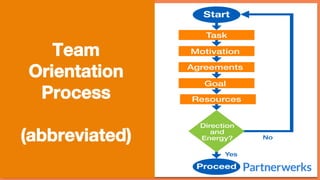
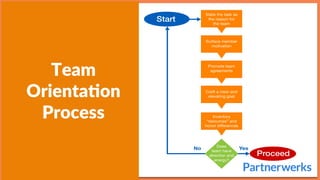
Team  
Orienta+on  
Process  
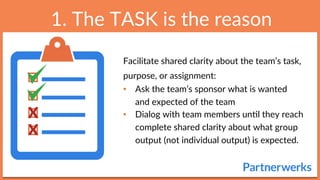
1.  The  TASK  is  the  reason  
Facilitate  shared  clarity  about  the  team’s  task,  
purpose,  or  assignment:  
•  Ask  the  team’s  sponsor  what  is  wanted  
and  expected  of  the  team  
•  Dialog  with  team  members  un+l  they  reach  
complete  shared  clarity  about  what  group  
output  (not  individual  output)  is  expected.  
2.  Surface  Member  MOTIVATION  
Align  individual  and  team  outcomes:  
•  Ask  each  team  member  to  clarify  what  is  in  it  
for  them  (beyond  a  paycheck)  
•  Acknowledge  that  unique  personal  outcomes  
are  held  by  each  team  member  
•  Explore  poten+al  compe+ng  loyal+es  or  
commitments  between  the  role  on  this  team  
and  other  responsibili+es  
•  Invite  the  group  to  commit  to  support  each  
member  in  ge8ng  their  individual  outcomes.  
3.  Promote  Team  AGREEMENTS  
Make  and  keep  agreements:  
•  With  the  team,  develop  5  to  9  
behavioral  (i.e.,  observable)  agreements  
team  members  vow  to  abide  by  in  
dealings  with  each  other  
•  Consider  mee+ng  frequency,  
procedures,  and  roles;  workload  
distribu+on;  communica+on  policy;  
problem  solving  policy;  conflict  
resolu+on  policy;  etc.  
4.  Clear  and  Eleva+ng  Goal  
To  cra]  a  clear  and  eleva+ng  goal:  
•  Understand  the  TASK  is  what  must  be  
done;  the  GOAL  is  what  makes  it  worth  
doing  
•  Listen  for  the  emergence  of  a  stretch  goal  
that  energizes  the  team  to  complete  the  
task  AND  delivers  on  each  of  the  individual  
outcomes  
•  Such  a  goal  will  o]en  emerge  from  the  
storming  phase  
5.  Discover  what  PEOPLE  bring  
Inventory  team  resources:  
•  Ask  each  team  member  to  
discuss  what  they  can  bring  to  
the  team  in  terms  of  skill,  
experience,  contacts,  exper+se,  
etc.    
•  Reinforce  how  each  member’s  
gi]s  can  bring  value  
Team
Orientation
Process
(abbreviated)
Think  about  it  
As  a  leader…  
  
Knowing  how  to  get  more  done  with  others  may  be  your  
most  important  skill.  
  
Do  you  have  a  proven  and  repeatable  process  for  building  any  
team  any  +me?  
  
Do  you  lead  in  such  a  way  that  people  want  to  share  
responsibility  with  you  to  get  the  project  done?  
  
Read  more:  Teamwork  Is  An  Individual  Skill:  Ge6ng  Your  Work  
Done  When  Sharing  Responsibility,  Christopher  Avery  
  ©	
  2015	
  Partnerwerks	
  Inc.	
  All	
  Rights	
  Reserved	
  

Team Orientation Process

  • 1.
  • 2.
    Execu+ve  Summary   Ge8ng more  done  with  others  over  whom  you  have  no  control  may   be  the  most  important  skill  to  develop.     The  steps  in  the  Team  Orienta+on  Process  are  proven  to  give  a  group   of  people  the  best  chance  of  coming  together  as  a  high  performance   team.     Accomplish  each  step  in  dialog  among  team  members.     The  same  list  has  been  found  to  be  worth  re-­‐visi+ng  any  +me  a  team   has  lost  energy  or  direc+on  and  needs  re-­‐orien+ng.    
  • 3.
    Step  0.  Take 100%  Responsibility     Only  one  person  can  ensure  you  have  a   great  team  experience.     Take  Responsibility  for:   •  being  on  a  great  team   •  deserving  to  be  on  a  great  team   •  knowing  how  teams  get  built  (and   how  they  don’t)  
  • 4.
  • 5.
    1.  The  TASK is  the  reason   Facilitate  shared  clarity  about  the  team’s  task,   purpose,  or  assignment:   •  Ask  the  team’s  sponsor  what  is  wanted   and  expected  of  the  team   •  Dialog  with  team  members  un+l  they  reach   complete  shared  clarity  about  what  group   output  (not  individual  output)  is  expected.  
  • 6.
    2.  Surface  Member MOTIVATION   Align  individual  and  team  outcomes:   •  Ask  each  team  member  to  clarify  what  is  in  it   for  them  (beyond  a  paycheck)   •  Acknowledge  that  unique  personal  outcomes   are  held  by  each  team  member   •  Explore  poten+al  compe+ng  loyal+es  or   commitments  between  the  role  on  this  team   and  other  responsibili+es   •  Invite  the  group  to  commit  to  support  each   member  in  ge8ng  their  individual  outcomes.  
  • 7.
    3.  Promote  Team AGREEMENTS   Make  and  keep  agreements:   •  With  the  team,  develop  5  to  9   behavioral  (i.e.,  observable)  agreements   team  members  vow  to  abide  by  in   dealings  with  each  other   •  Consider  mee+ng  frequency,   procedures,  and  roles;  workload   distribu+on;  communica+on  policy;   problem  solving  policy;  conflict   resolu+on  policy;  etc.  
  • 8.
    4.  Clear  and Eleva+ng  Goal   To  cra]  a  clear  and  eleva+ng  goal:   •  Understand  the  TASK  is  what  must  be   done;  the  GOAL  is  what  makes  it  worth   doing   •  Listen  for  the  emergence  of  a  stretch  goal   that  energizes  the  team  to  complete  the   task  AND  delivers  on  each  of  the  individual   outcomes   •  Such  a  goal  will  o]en  emerge  from  the   storming  phase  
  • 9.
    5.  Discover  what PEOPLE  bring   Inventory  team  resources:   •  Ask  each  team  member  to   discuss  what  they  can  bring  to   the  team  in  terms  of  skill,   experience,  contacts,  exper+se,   etc.     •  Reinforce  how  each  member’s   gi]s  can  bring  value  
  • 10.
  • 11.
    Think  about  it  As  a  leader…     Knowing  how  to  get  more  done  with  others  may  be  your   most  important  skill.     Do  you  have  a  proven  and  repeatable  process  for  building  any   team  any  +me?     Do  you  lead  in  such  a  way  that  people  want  to  share   responsibility  with  you  to  get  the  project  done?     Read  more:  Teamwork  Is  An  Individual  Skill:  Ge6ng  Your  Work   Done  When  Sharing  Responsibility,  Christopher  Avery    ©  2015  Partnerwerks  Inc.  All  Rights  Reserved