Tuckman's stages of group development
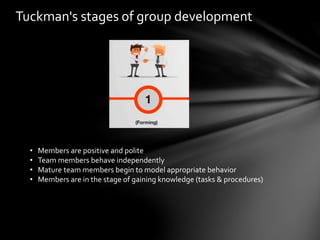
• Members are positive and polite
• Team members behave independently
• Mature team members begin to model appropriate behavior
• Members are in the stage of gaining knowledge (tasks & procedures)
Tuckman's stages of group development
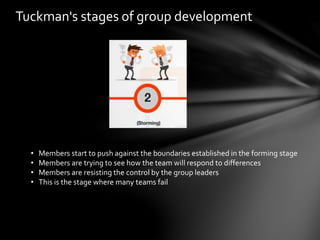
• Members start to push against the boundaries established in the forming stage
• Members are trying to see how the team will respond to differences
• Members are resisting the control by the group leaders
• This is the stage where many teams fail
Tuckman's stages of group development
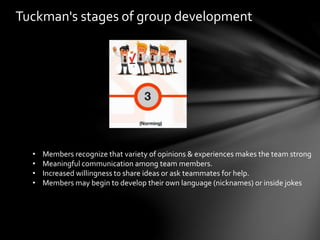
• Members recognize that variety of opinions & experiences makes the team strong
• Meaningful communication among team members.
• Increased willingness to share ideas or ask teammates for help.
• Members may begin to develop their own language (nicknames) or inside jokes
Tuckman's stages of group development
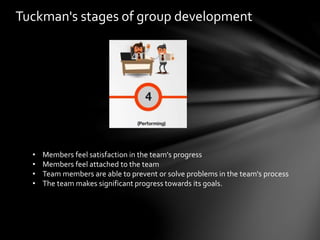
• Members feel satisfaction in the team's progress
• Members feel attached to the team
• Team members are able to prevent or solve problems in the team's process
• The team makes significant progress towards its goals.
Tuckman's stages of group development
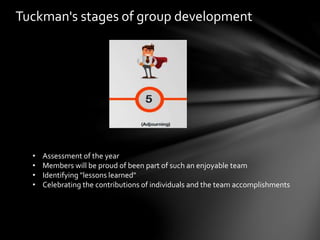
• Assessment of the year
• Members will be proud of been part of such an enjoyable team
• Identifying "lessons learned"
• Celebrating the contributions of individuals and the team accomplishments
• Developmental sequence in small groups.Tuckman, Bruce
W.Psychological Bulletin,Vol 63(6), Jun 1965, 384-
399. http://dx.doi.org/10.1037/h0022100
• https://en.wikipedia.org/wiki/Tuckman%27s_stages_of_group_developm
ent
References
ThankYou

Tuckman's stages of group development

  • 2.
    Tuckman's stages ofgroup development • Members are positive and polite • Team members behave independently • Mature team members begin to model appropriate behavior • Members are in the stage of gaining knowledge (tasks & procedures)
  • 3.
    Tuckman's stages ofgroup development • Members start to push against the boundaries established in the forming stage • Members are trying to see how the team will respond to differences • Members are resisting the control by the group leaders • This is the stage where many teams fail
  • 4.
    Tuckman's stages ofgroup development • Members recognize that variety of opinions & experiences makes the team strong • Meaningful communication among team members. • Increased willingness to share ideas or ask teammates for help. • Members may begin to develop their own language (nicknames) or inside jokes
  • 5.
    Tuckman's stages ofgroup development • Members feel satisfaction in the team's progress • Members feel attached to the team • Team members are able to prevent or solve problems in the team's process • The team makes significant progress towards its goals.
  • 6.
    Tuckman's stages ofgroup development • Assessment of the year • Members will be proud of been part of such an enjoyable team • Identifying "lessons learned" • Celebrating the contributions of individuals and the team accomplishments
  • 7.
    • Developmental sequencein small groups.Tuckman, Bruce W.Psychological Bulletin,Vol 63(6), Jun 1965, 384- 399. http://dx.doi.org/10.1037/h0022100 • https://en.wikipedia.org/wiki/Tuckman%27s_stages_of_group_developm ent References
  • 8.