


Team change
• How to improve team effectiveness
• What team change looks like
Management of Change- Team Change 1
Nguyen Ngoc Minh Tri
Nguyen Duy Linh
Huynh Hanh Nguyen
Group
1
Management of Change- Team Change 2
How to improve
team effectiveness
Management of Change- Team Change 3
1
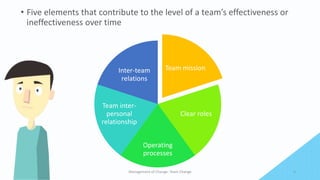
• Five elements that contribute to the level of a team’s effectiveness or
ineffectiveness over time
Management of Change- Team Change 4
Team mission
Clear roles
Operating
processes
Team inter-
personal
relationship
Inter-team
relations
• The most effective team
• have a strong sense of their purpose
• organize their work around that purpose
• plan and set goals in line with that purpose
Management of Change- Team Change 5
Team mission planning and goal
setting
“In every case, without exception, when an
effectively functioning team was identified, it was
described by the respondent as having a clear
understanding of its objective”
(Larson & LaFasto, 1989)
Team mission planning and goal
setting
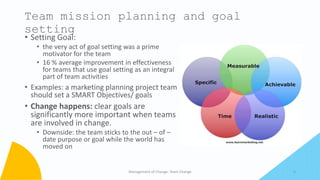
• Setting Goal:
• the very act of goal setting was a prime
motivator for the team
• 16 % average improvement in effectiveness
for teams that use goal setting as an integral
part of team activities
• Examples: a marketing planning project team
should set a SMART Objectives/ goals
• Change happens: clear goals are
significantly more important when teams
are involved in change.
• Downside: the team sticks to the out – of –
date purpose or goal while the world has
moved on
Management of Change- Team Change 6
Team roles
• The best way for a team to achieve its goals is to be structured
logically around those goals
• Individual team members need to
• have clear roles and accountabilities
• understanding of both what their individual role and the roles and accountabilities of
other team members .
• Change happens - clarity around role has two useful functions
• provides a clear sense of purpose
• provides a supportive framework for task accomplishment
• Downside: situation becomes more fluid => the rigidity results in the task
falling down the gaps between roles
Management of Change- Team Change 7
Team operating processes
• Needs of having certain enabling
processes in place for team member
to carry out their work together
=> will allow the task to be achieved in
a way that is as efficient and as
effective as possible
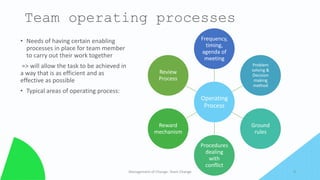
• Typical areas of operating process:
Management of Change- Team Change 8
Operating
Process
Frequency,
timing,
agenda of
meeting
Problem
solving &
Decision
making
method
Ground
rules
Procedures
dealing
with
conflict
Reward
mechanism
Review
Process
Team operating processes
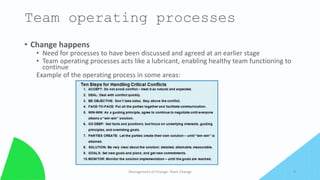
• Change happens
• Need for processes to have been discussed and agreed at an earlier stage
• Team operating processes acts like a lubricant, enabling healthy team functioning to
continue
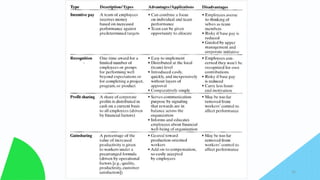
Example of the operating process in some areas:
Management of Change- Team Change 9
Management of Change- Team Change 10
Team interpersonal
relationships
• Communicate together-> Understanding among team
• Trust and help every teams member to be better
• Person to person (team)
Management of Change- Team Change 11
Inter- team relations
• Working across boundaries (We are team not group)
• Team to team, organization to organization
Management of Change- Team Change 12
Example of Effective team
• Diamond couple: http://www.viethome.co.uk/tin-tuc/tin-tuc-o-anh/30241-
dam-cuoi-kim-cuong-gay-xuc-dong-cua-cap-vo-chong-gia-nguoi-anh
• Team mission, planning and goal setting
• Team roles
• Team operating processes
• Team interpersonal relationship
• Inter- team relations
Management of Change- Team Change 13
Management of Change- Team Change 14
What team change looks like
Management of Change- Team Change 15
2
Management of Change- Team Change 16
All teams go through a change process when:
• They first formed
• A new member arriving
• A key member leaving
• A change of scope
• Increased pressure from outside
• Change in organizational climate
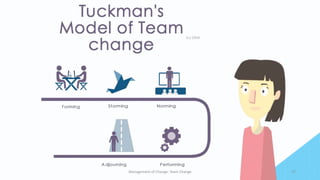
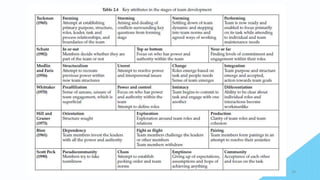
Tuckman’s
Model of
Team
change
Any team will undergo distinct stages of
development as it works or struggles toward
effective team functioning.
Management of Change- Team Change 17
Management of Change- Team Change 18
Forming
• What is our primary purpose?
• How do we structure ourselves as a team to achieve our purpose?
• What roles do we each have?
• Who is the leader?
• How will we work together?
• How will we relate together?
• What are the boundaries of the team?
• Most important: Why do we exist on Earth?
Management of Change- Team Change 19
Storming
• Have a storm inside a team.
• Why?
• The storming phase – if successfully traversed will achieve clarity
around all the fundamental questions of the first phase, and enable
common understanding of purpose and roles to be achieved
• Remember
It is a natural part of the process.
 It is a healthy part of the process.
It is an important part of the process
Management of Change- Team Change 20
Norming
Management of Change- Team Change 21
• Settling down of team dynamic and stepping into team norms and
agreed ways of working
• As further challenges develop, or as individuals growth further into
their roles, then further scrutiny of the fundamental questions may
happen.
• Tuckman suggested that this settling process can be straightforward
and sequential.
• In fact, there are team that permanently move back and forth
between the norming and storming stages.
Performing
Management of Change- Team Change 22
• The team has developed a capacity to change and
develop, and has learnt how to learn.
• The team is now ready and enable to focus primarily
on its task while attending to individual and team
maintenance needs.
Adjourning
Management of Change- Team Change 23
This stage represent the period when the team’s task has been
completed and team member disperse.
• Mourning: highlighting the emotional component
• Transforming: as team members develop other ways of working
Management of Change- Team Change 24
Thanks for your listening!

Team change

  • 1.
    Team change • Howto improve team effectiveness • What team change looks like Management of Change- Team Change 1 Nguyen Ngoc Minh Tri Nguyen Duy Linh Huynh Hanh Nguyen Group 1
  • 2.
    Management of Change-Team Change 2
  • 3.
    How to improve teameffectiveness Management of Change- Team Change 3 1
  • 4.
    • Five elementsthat contribute to the level of a team’s effectiveness or ineffectiveness over time Management of Change- Team Change 4 Team mission Clear roles Operating processes Team inter- personal relationship Inter-team relations
  • 5.
    • The mosteffective team • have a strong sense of their purpose • organize their work around that purpose • plan and set goals in line with that purpose Management of Change- Team Change 5 Team mission planning and goal setting “In every case, without exception, when an effectively functioning team was identified, it was described by the respondent as having a clear understanding of its objective” (Larson & LaFasto, 1989)
  • 6.
    Team mission planningand goal setting • Setting Goal: • the very act of goal setting was a prime motivator for the team • 16 % average improvement in effectiveness for teams that use goal setting as an integral part of team activities • Examples: a marketing planning project team should set a SMART Objectives/ goals • Change happens: clear goals are significantly more important when teams are involved in change. • Downside: the team sticks to the out – of – date purpose or goal while the world has moved on Management of Change- Team Change 6
  • 7.
    Team roles • Thebest way for a team to achieve its goals is to be structured logically around those goals • Individual team members need to • have clear roles and accountabilities • understanding of both what their individual role and the roles and accountabilities of other team members . • Change happens - clarity around role has two useful functions • provides a clear sense of purpose • provides a supportive framework for task accomplishment • Downside: situation becomes more fluid => the rigidity results in the task falling down the gaps between roles Management of Change- Team Change 7
  • 8.
    Team operating processes •Needs of having certain enabling processes in place for team member to carry out their work together => will allow the task to be achieved in a way that is as efficient and as effective as possible • Typical areas of operating process: Management of Change- Team Change 8 Operating Process Frequency, timing, agenda of meeting Problem solving & Decision making method Ground rules Procedures dealing with conflict Reward mechanism Review Process
  • 9.
    Team operating processes •Change happens • Need for processes to have been discussed and agreed at an earlier stage • Team operating processes acts like a lubricant, enabling healthy team functioning to continue Example of the operating process in some areas: Management of Change- Team Change 9
  • 10.
    Management of Change-Team Change 10
  • 11.
    Team interpersonal relationships • Communicatetogether-> Understanding among team • Trust and help every teams member to be better • Person to person (team) Management of Change- Team Change 11
  • 12.
    Inter- team relations •Working across boundaries (We are team not group) • Team to team, organization to organization Management of Change- Team Change 12
  • 13.
    Example of Effectiveteam • Diamond couple: http://www.viethome.co.uk/tin-tuc/tin-tuc-o-anh/30241- dam-cuoi-kim-cuong-gay-xuc-dong-cua-cap-vo-chong-gia-nguoi-anh • Team mission, planning and goal setting • Team roles • Team operating processes • Team interpersonal relationship • Inter- team relations Management of Change- Team Change 13
  • 14.
    Management of Change-Team Change 14
  • 15.
    What team changelooks like Management of Change- Team Change 15 2
  • 16.
    Management of Change-Team Change 16 All teams go through a change process when: • They first formed • A new member arriving • A key member leaving • A change of scope • Increased pressure from outside • Change in organizational climate Tuckman’s Model of Team change Any team will undergo distinct stages of development as it works or struggles toward effective team functioning.
  • 17.
    Management of Change-Team Change 17
  • 18.
    Management of Change-Team Change 18
  • 19.
    Forming • What isour primary purpose? • How do we structure ourselves as a team to achieve our purpose? • What roles do we each have? • Who is the leader? • How will we work together? • How will we relate together? • What are the boundaries of the team? • Most important: Why do we exist on Earth? Management of Change- Team Change 19
  • 20.
    Storming • Have astorm inside a team. • Why? • The storming phase – if successfully traversed will achieve clarity around all the fundamental questions of the first phase, and enable common understanding of purpose and roles to be achieved • Remember It is a natural part of the process.  It is a healthy part of the process. It is an important part of the process Management of Change- Team Change 20
  • 21.
    Norming Management of Change-Team Change 21 • Settling down of team dynamic and stepping into team norms and agreed ways of working • As further challenges develop, or as individuals growth further into their roles, then further scrutiny of the fundamental questions may happen. • Tuckman suggested that this settling process can be straightforward and sequential. • In fact, there are team that permanently move back and forth between the norming and storming stages.
  • 22.
    Performing Management of Change-Team Change 22 • The team has developed a capacity to change and develop, and has learnt how to learn. • The team is now ready and enable to focus primarily on its task while attending to individual and team maintenance needs.
  • 23.
    Adjourning Management of Change-Team Change 23 This stage represent the period when the team’s task has been completed and team member disperse. • Mourning: highlighting the emotional component • Transforming: as team members develop other ways of working
  • 24.
    Management of Change-Team Change 24 Thanks for your listening!