Strategies in Teaching Numeracy
Prepared by:
ALMA D.TAYABAN
OBJECTIVES
 1.Comprehend the purpose and features of learning
mathematics in the elementary grades
 2.Follow the teaching cycle in teaching Mathematics
 3.Demonstrate and appreciate the most common
models in planning instructions in mathematics
 4.Adapt and apply new strategies in teaching
mathematics
Teacher ,why?
 The hardest time I had was in Math class. I really liked math and
thought I was good at it. But, my math teacher always marked my
homework and tests wrong, and it made me cry every day. The problem
was that I kept getting the positive and negative signs mixed up, even
though I knew how to do the problems. Sadly, my answers were always
wrong because of the sign mix-ups.
 Reflect; The scenario illustrates the difficulties experience by some unfortunate learners
.But can we afford to let such kind teachers? They affect the way our learners feel about
math. Therefore it depends upon every teacher to strive to improve her/his teaching style
to increase the number of children liking and even loving math. Thus, use of varied and
appropriate approaches can entice more learners to like and love math
Mathematics in the Elementary
 Why do we need to learn and teach math?
 What are the goals across all levels in each topic
of the mathematics contents?
 What are the important principles in teaching
and learning mathematics?
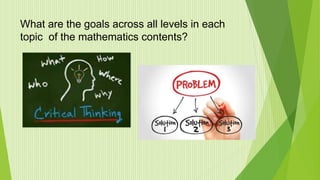
What are the goals across all levels in each
topic of the mathematics contents?
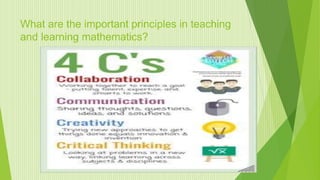
What are the important principles in teaching
and learning mathematics?
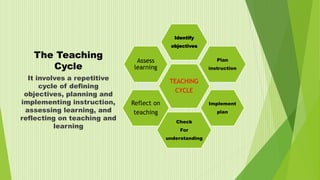
The Teaching
Cycle
TEACHING
CYCLE
Identify
objectives
Plan
instruction
Implement
plan
Check
For
understanding
Reflect on
teaching
Assess
learning
It involves a repetitive
cycle of defining
objectives, planning and
implementing instruction,
assessing learning, and
reflecting on teaching and
learning
Things to consider in planning
Instruction in Mathematics
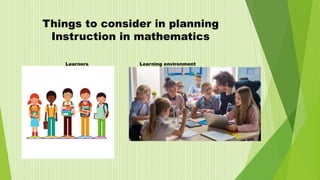
Things to consider in planning
Instruction in mathematics
Learners Learning environment
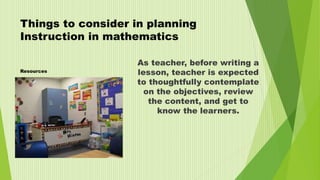
Things to consider in planning
Instruction in mathematics
Resources
As teacher, before writing a
lesson, teacher is expected
to thoughtfully contemplate
on the objectives, review
the content, and get to
know the learners.
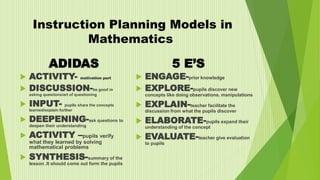
Instruction Planning Models in
Mathematics
ADIDAS
 ACTIVITY- motivation part
 DISCUSSION-be good in
asking questions/art of questioning
 INPUT- pupils share the concepts
learned/explain further
 DEEPENING-ask questions to
deepen their understanding
 ACTIVITY –pupils verify
what they learned by solving
mathematical problems
 SYNTHESIS-summary of the
lesson .It should come out form the pupils
5 E’S
 ENGAGE-prior knowledge
 EXPLORE-pupils discover new
concepts like doing observations. manipulations
 EXPLAIN-teacher facilitate the
discussion from what the pupils discover
 ELABORATE-pupils expand their
understanding of the concept
 EVALUATE-teacher give evaluation
to pupils
Activity 1
 Dis you notice any similarity
between the ADIDAS and the 5E’s
model? Match the components of
the two models to summarize the
similarities that you saw.
ACTIVITY 2
Extract parts of a lesson plan
and exhibits the components of
ADIDAS and 5E’s Models
Instructional Strategies
for Mathematics
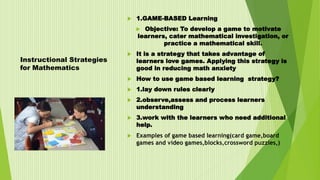
 1.GAME-BASED Learning
 Objective: To develop a game to motivate
learners, cater mathematical investigation, or
practice a mathematical skill.
 It is a strategy that takes advantage of
learners love games. Applying this strategy is
good in reducing math anxiety
 How to use game based learning strategy?
 1.lay down rules clearly
 2.observe,assess and process learners
understanding
 3.work with the learners who need additional
help.
 Examples of game based learning(card game,board
games and video games,blocks,crossword puzzles,)
Instructional Strategies for
Mathematics
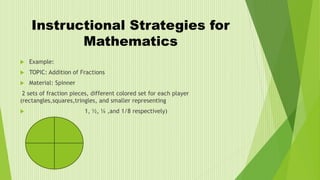
 Example:
 TOPIC: Addition of Fractions
 Material: Spinner
2 sets of fraction pieces, different colored set for each player
(rectangles,squares,tringles, and smaller representing
 1, ½, ¼ ,and 1/8 respectively)
Mechanics
 1.Players take turns to spin
 2.After each spin, the player picks fraction piece(s)that represent(s) the
fraction indicated on the spinner and adds it on the game board.
 3.A player may exchange two or more of his/her adjacent fraction
pieces on the game board for an equivalent fraction piece.
 4.A fraction piece placed on the game car cannot be moved unless for
exchanging purpose.
 5.When the game board has been competently covered, the player
whose fraction pieces cover up a large area is the winner.
 6.In case of a tie, the payer who used less fraction pieces is the winner.
Instructional Strategies
for Mathematics
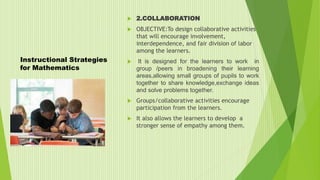
 2.COLLABORATION
 OBJECTIVE:To design collaborative activities
that will encourage involvement,
interdependence, and fair division of labor
among the learners.
 It is designed for the learners to work in
group /peers in broadening their learning
areas,allowing small groups of pupils to work
together to share knowledge,exchange ideas
and solve problems together.
 Groups/collaborative activities encourage
participation from the learners.
 It also allows the learners to develop a
stronger sense of empathy among them.
How to prepare, monitor and process
collaborative tasks/activities?
 1.Identify the Instructional objectives
 2.Determine the group size
 3.Decide how will you divide the class
 4.Give team building task before assigning the actual task
 5.Delegate a specific task to each member
 6.Share the reasons why doing the collaborative work
 7.Give your instructions clearly
 8.Go around and keep your ears open
 9.provide closure to the group activities.
Examples of doing collaborative
activities
 BUZZ group
 Topic: Perimeter
 Objective: To discuss various solutions to a geometric problem
involving perimeter
 Time:15 minutes
 Task: The rectangular playground has 214m long and 367m wide
.can you tell the perimeter of the playground?
 Activity: Ask the pupils to solve in their own. After 5 minutes let them
turn to their seatmates to discuss their understanding in solving the
problem.
QUESTIONS TO ASK:
 -What are the things that you don’t understand in the problem?
-What are the possible solutions to solve the problem?
 -What method can be used to check if the solutions are correct?
 After 5 minutes, reconvene as a class and have a general
discussion in which pupils share their ideas or questions that
arose within their subgroups.
Example: Snowball technique
 How to do it?
 It is a technique for pupils/leaners to teach each other important
concept and information. The students begin by working
individually. Next, they collaborate with a partner. Afre that,
partners form groups of four. Groups of four join together to form
groups of eight etc..
 This snowballing effect continues until the class is working
together as one large group. Identify a topic in intermediate math
in which this collaboration activity can be used. Write down a
sequence of increasingly complex that can be given in this
activity.
Instructional Strategies
for Mathematics
 3.BANSHO
 A method of teaching developed in Japan that
focuses on teaching math through problem
solving. It allows learners to see the connections
and progressions of thinking involved when
developing strategies to solve a problem.
What is “bansho”?
 Bansho is an instructional strategy that captures the development of students’ individual
and collective thinking. Bansho allows students to:
• solve problems in ways that make sense to them
• build understanding of tools, strategies, and concepts by listening to, discussing, and
reflecting on their peers’ solutions
• build understanding of concepts through explicit connection-making facilitated by the
teacher’s board writing
 to complete the lesson without having to erase anything from the
whiteboard. Keeping everything on the whiteboard allows students to see
connections and progressions of the thinking involved when developing
strategies to solve a problem. It also allows students to compare and
contrast the various methods shared.

Steps in implementing a math lesson
using BANSHO?
 1.Showing the problem
 2.Showing the task
 3.Showing pupils ideas/solutions
 4.Arranging the ideas
 5.Summarizing the ideas
 6.Doing the exercises
 7.What has been learnt?(reflection)
 Note :This can be done during presentation of
lessons or during group activities after discussion
of the new lesson
A Blackboard Plan
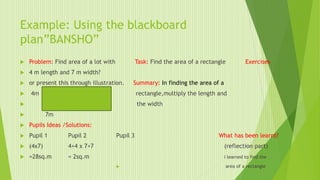
Example: Using the blackboard
plan”BANSHO”
 Problem: Find area of a lot with Task: Find the area of a rectangle Exercises
 4 m length and 7 m width?
 or present this through illustration. Summary: In finding the area of a
 4m rectangle,multiply the length and
 the width
 7m
 Pupils Ideas /Solutions:
 Pupil 1 Pupil 2 Pupil 3 What has been learnt?
 (4x7) 4+4 x 7+7 (reflection part)
 =28sq.m = 2sq.m I learned to find the
 area of a rectangle
Activity 1
Design a “Bansho” Plan
for your lesson planned
Thank you for
listening!

teaching-math-in-the-Intermediate-grades.pptx

  • 1.
    Strategies in TeachingNumeracy Prepared by: ALMA D.TAYABAN
  • 2.
    OBJECTIVES  1.Comprehend thepurpose and features of learning mathematics in the elementary grades  2.Follow the teaching cycle in teaching Mathematics  3.Demonstrate and appreciate the most common models in planning instructions in mathematics  4.Adapt and apply new strategies in teaching mathematics
  • 3.
    Teacher ,why?  Thehardest time I had was in Math class. I really liked math and thought I was good at it. But, my math teacher always marked my homework and tests wrong, and it made me cry every day. The problem was that I kept getting the positive and negative signs mixed up, even though I knew how to do the problems. Sadly, my answers were always wrong because of the sign mix-ups.  Reflect; The scenario illustrates the difficulties experience by some unfortunate learners .But can we afford to let such kind teachers? They affect the way our learners feel about math. Therefore it depends upon every teacher to strive to improve her/his teaching style to increase the number of children liking and even loving math. Thus, use of varied and appropriate approaches can entice more learners to like and love math
  • 4.
    Mathematics in theElementary  Why do we need to learn and teach math?  What are the goals across all levels in each topic of the mathematics contents?  What are the important principles in teaching and learning mathematics?
  • 5.
    What are thegoals across all levels in each topic of the mathematics contents?
  • 6.
    What are theimportant principles in teaching and learning mathematics?
  • 7.
    The Teaching Cycle TEACHING CYCLE Identify objectives Plan instruction Implement plan Check For understanding Reflect on teaching Assess learning Itinvolves a repetitive cycle of defining objectives, planning and implementing instruction, assessing learning, and reflecting on teaching and learning
  • 8.
    Things to considerin planning Instruction in Mathematics
  • 9.
    Things to considerin planning Instruction in mathematics Learners Learning environment
  • 10.
    Things to considerin planning Instruction in mathematics Resources As teacher, before writing a lesson, teacher is expected to thoughtfully contemplate on the objectives, review the content, and get to know the learners.
  • 11.
    Instruction Planning Modelsin Mathematics ADIDAS  ACTIVITY- motivation part  DISCUSSION-be good in asking questions/art of questioning  INPUT- pupils share the concepts learned/explain further  DEEPENING-ask questions to deepen their understanding  ACTIVITY –pupils verify what they learned by solving mathematical problems  SYNTHESIS-summary of the lesson .It should come out form the pupils 5 E’S  ENGAGE-prior knowledge  EXPLORE-pupils discover new concepts like doing observations. manipulations  EXPLAIN-teacher facilitate the discussion from what the pupils discover  ELABORATE-pupils expand their understanding of the concept  EVALUATE-teacher give evaluation to pupils
  • 12.
    Activity 1  Disyou notice any similarity between the ADIDAS and the 5E’s model? Match the components of the two models to summarize the similarities that you saw.
  • 13.
    ACTIVITY 2 Extract partsof a lesson plan and exhibits the components of ADIDAS and 5E’s Models
  • 14.
    Instructional Strategies for Mathematics 1.GAME-BASED Learning  Objective: To develop a game to motivate learners, cater mathematical investigation, or practice a mathematical skill.  It is a strategy that takes advantage of learners love games. Applying this strategy is good in reducing math anxiety  How to use game based learning strategy?  1.lay down rules clearly  2.observe,assess and process learners understanding  3.work with the learners who need additional help.  Examples of game based learning(card game,board games and video games,blocks,crossword puzzles,)
  • 15.
    Instructional Strategies for Mathematics Example:  TOPIC: Addition of Fractions  Material: Spinner 2 sets of fraction pieces, different colored set for each player (rectangles,squares,tringles, and smaller representing  1, ½, ¼ ,and 1/8 respectively)
  • 16.
    Mechanics  1.Players taketurns to spin  2.After each spin, the player picks fraction piece(s)that represent(s) the fraction indicated on the spinner and adds it on the game board.  3.A player may exchange two or more of his/her adjacent fraction pieces on the game board for an equivalent fraction piece.  4.A fraction piece placed on the game car cannot be moved unless for exchanging purpose.  5.When the game board has been competently covered, the player whose fraction pieces cover up a large area is the winner.  6.In case of a tie, the payer who used less fraction pieces is the winner.
  • 17.
    Instructional Strategies for Mathematics 2.COLLABORATION  OBJECTIVE:To design collaborative activities that will encourage involvement, interdependence, and fair division of labor among the learners.  It is designed for the learners to work in group /peers in broadening their learning areas,allowing small groups of pupils to work together to share knowledge,exchange ideas and solve problems together.  Groups/collaborative activities encourage participation from the learners.  It also allows the learners to develop a stronger sense of empathy among them.
  • 18.
    How to prepare,monitor and process collaborative tasks/activities?  1.Identify the Instructional objectives  2.Determine the group size  3.Decide how will you divide the class  4.Give team building task before assigning the actual task  5.Delegate a specific task to each member  6.Share the reasons why doing the collaborative work  7.Give your instructions clearly  8.Go around and keep your ears open  9.provide closure to the group activities.
  • 19.
    Examples of doingcollaborative activities  BUZZ group  Topic: Perimeter  Objective: To discuss various solutions to a geometric problem involving perimeter  Time:15 minutes  Task: The rectangular playground has 214m long and 367m wide .can you tell the perimeter of the playground?  Activity: Ask the pupils to solve in their own. After 5 minutes let them turn to their seatmates to discuss their understanding in solving the problem.
  • 20.
    QUESTIONS TO ASK: -What are the things that you don’t understand in the problem? -What are the possible solutions to solve the problem?  -What method can be used to check if the solutions are correct?  After 5 minutes, reconvene as a class and have a general discussion in which pupils share their ideas or questions that arose within their subgroups.
  • 21.
    Example: Snowball technique How to do it?  It is a technique for pupils/leaners to teach each other important concept and information. The students begin by working individually. Next, they collaborate with a partner. Afre that, partners form groups of four. Groups of four join together to form groups of eight etc..  This snowballing effect continues until the class is working together as one large group. Identify a topic in intermediate math in which this collaboration activity can be used. Write down a sequence of increasingly complex that can be given in this activity.
  • 22.
    Instructional Strategies for Mathematics 3.BANSHO  A method of teaching developed in Japan that focuses on teaching math through problem solving. It allows learners to see the connections and progressions of thinking involved when developing strategies to solve a problem.
  • 23.
    What is “bansho”? Bansho is an instructional strategy that captures the development of students’ individual and collective thinking. Bansho allows students to: • solve problems in ways that make sense to them • build understanding of tools, strategies, and concepts by listening to, discussing, and reflecting on their peers’ solutions • build understanding of concepts through explicit connection-making facilitated by the teacher’s board writing  to complete the lesson without having to erase anything from the whiteboard. Keeping everything on the whiteboard allows students to see connections and progressions of the thinking involved when developing strategies to solve a problem. It also allows students to compare and contrast the various methods shared. 
  • 24.
    Steps in implementinga math lesson using BANSHO?  1.Showing the problem  2.Showing the task  3.Showing pupils ideas/solutions  4.Arranging the ideas  5.Summarizing the ideas  6.Doing the exercises  7.What has been learnt?(reflection)  Note :This can be done during presentation of lessons or during group activities after discussion of the new lesson
  • 25.
  • 26.
    Example: Using theblackboard plan”BANSHO”  Problem: Find area of a lot with Task: Find the area of a rectangle Exercises  4 m length and 7 m width?  or present this through illustration. Summary: In finding the area of a  4m rectangle,multiply the length and  the width  7m  Pupils Ideas /Solutions:  Pupil 1 Pupil 2 Pupil 3 What has been learnt?  (4x7) 4+4 x 7+7 (reflection part)  =28sq.m = 2sq.m I learned to find the  area of a rectangle
  • 27.
    Activity 1 Design a“Bansho” Plan for your lesson planned
  • 28.