Best Practices in Math
Using the Habits of Mind and Interaction
 Integrating effective math instruction
(think Common Core Mathematical
Practices) with district curriculum
(Engage New York).
The Big Picture
Where to begin?
 Locate your first unit of study
 Found on the CIA: https://salkeiz-cia.orvsd.org/
 Be sure to log in first
 username: lastname_firstname
password: the same as you use to log in for the district
 Open your first unit of study under your grade’s
“instruction” tab
 Take time to look through the unit of study (curriculum
map)
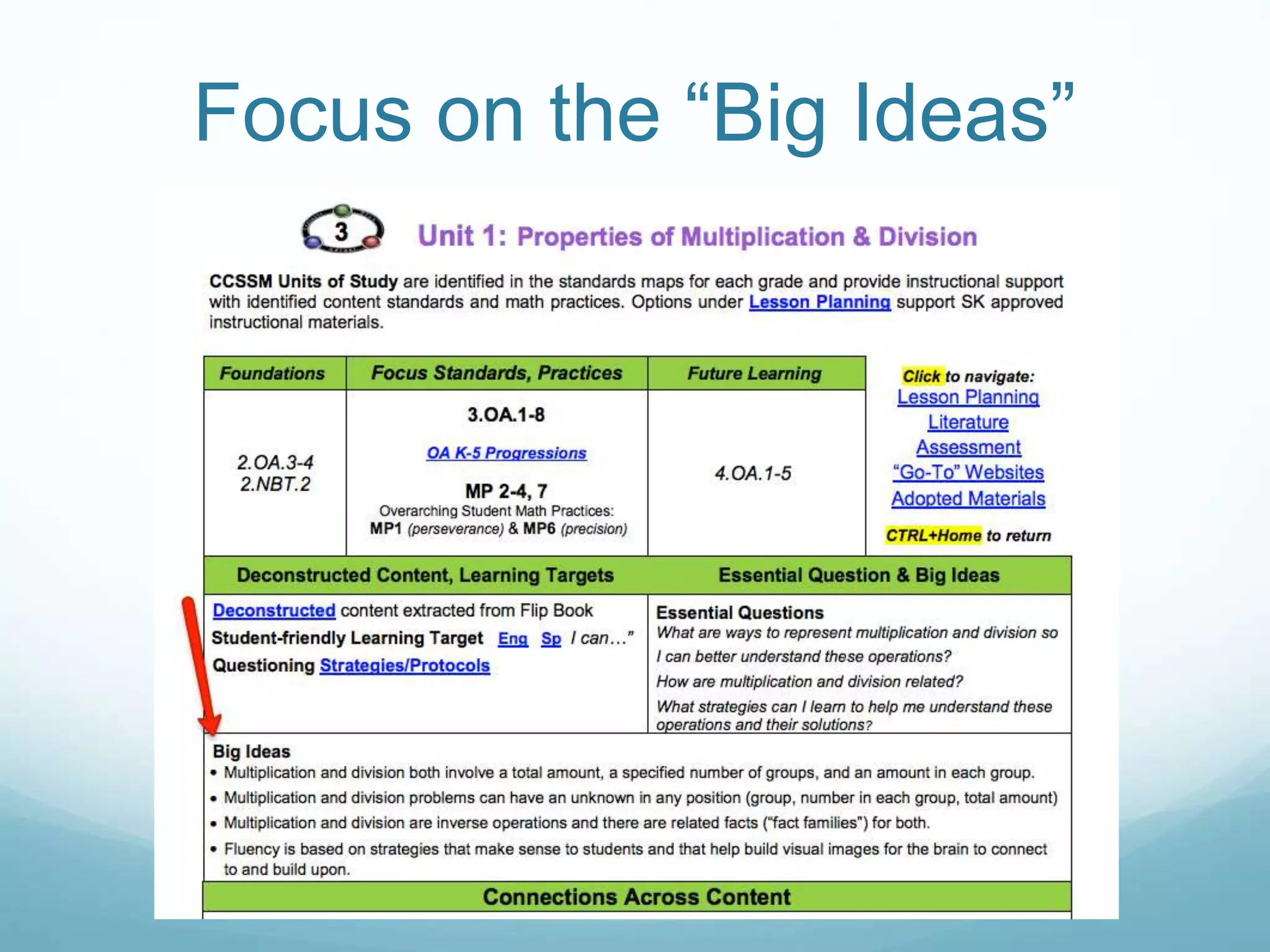
Focus on the “Big Ideas”
Engage New York
 All grades will use Engage New York (ENY).
 As a PLC, you may decide to supplement with other
resources.
 You should have:
 Paper copy of each unit’s teacher’s guide/lessons
 Electronic teacher’s guides are on U drive and also uploaded
on Digital Storefront.
 Non-consumable workbooks (student Problem Sets), not to
be written in.
Engage New York
 Exit Tickets: you will need to order print or decide as a
PLC how you’d like to assess
 Homework: Also, as a PLC, decide what you’d like to
do. Use the ENY homework as is? Modify? Use
something else?
 Mid-module and end-of-module assessments: you will
need to look at these with your PLC, and order print
ENY and Student Mathematical Practices
 All grades are required to implement the Student
Mathematical Practices.
 Located on the CIA site: https://salkeiz-cia.orvsd.org/math
 How can we be sure that they are a part of our
everyday math instruction/learning?
 How can we get our students to understand these
practices and eventually start implementing them on
their own?
 What is a way to teach these practices in a “student-
friendly” way?
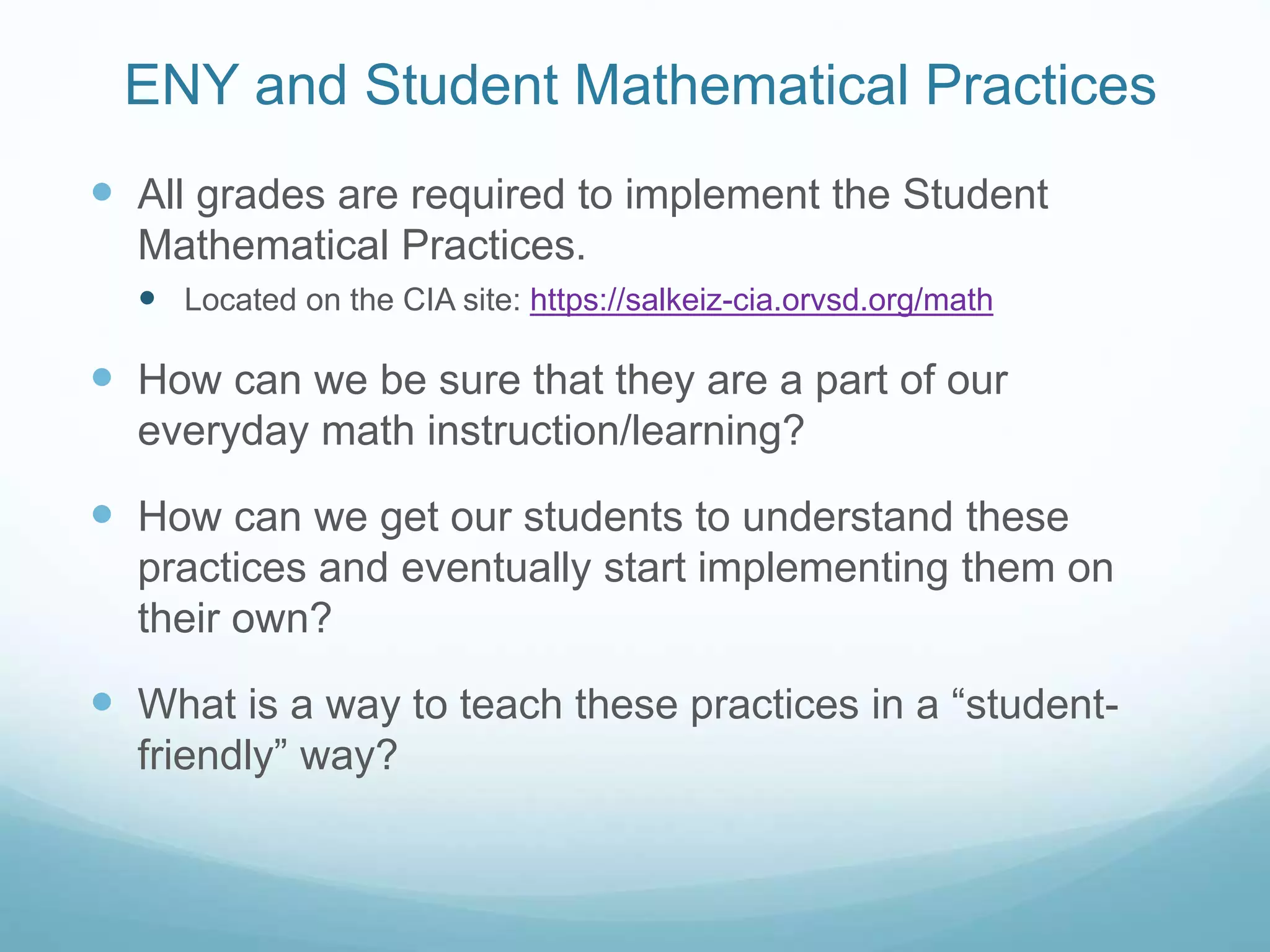
Mathematical Productive
Thinking Routines
Explain your thinking/reasoning in a
variety of ways.
Explain why your
ideas/solutions/conjectures are always,
sometimes ,or never true.
Clarify, deepen, and expand thinking by
making conjectures based on the math
you know combined with relationships
noticed.
Mathematical Habits of Mind
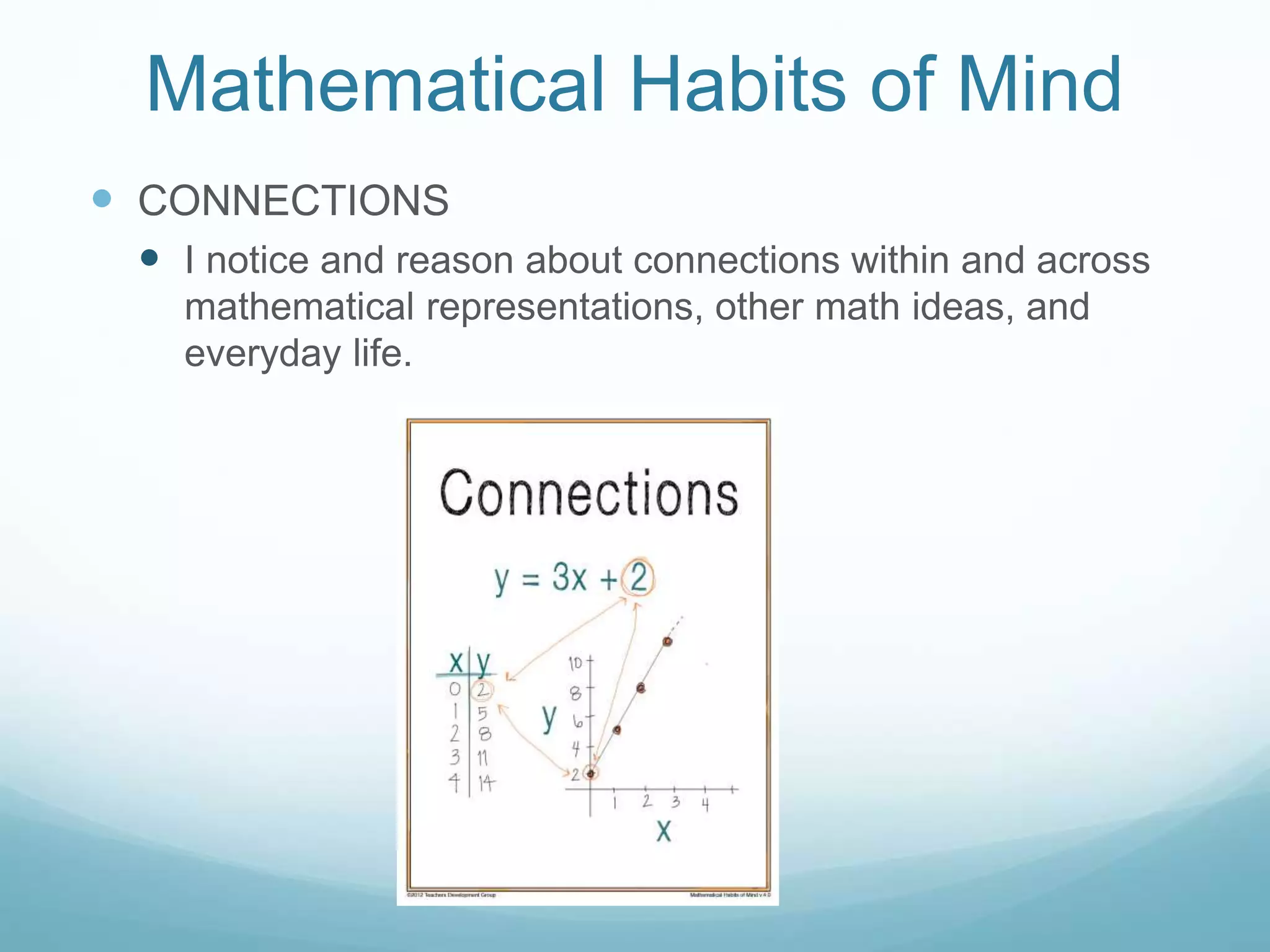
 CONNECTIONS
 I notice and reason about connections within and across
mathematical representations, other math ideas, and
everyday life.
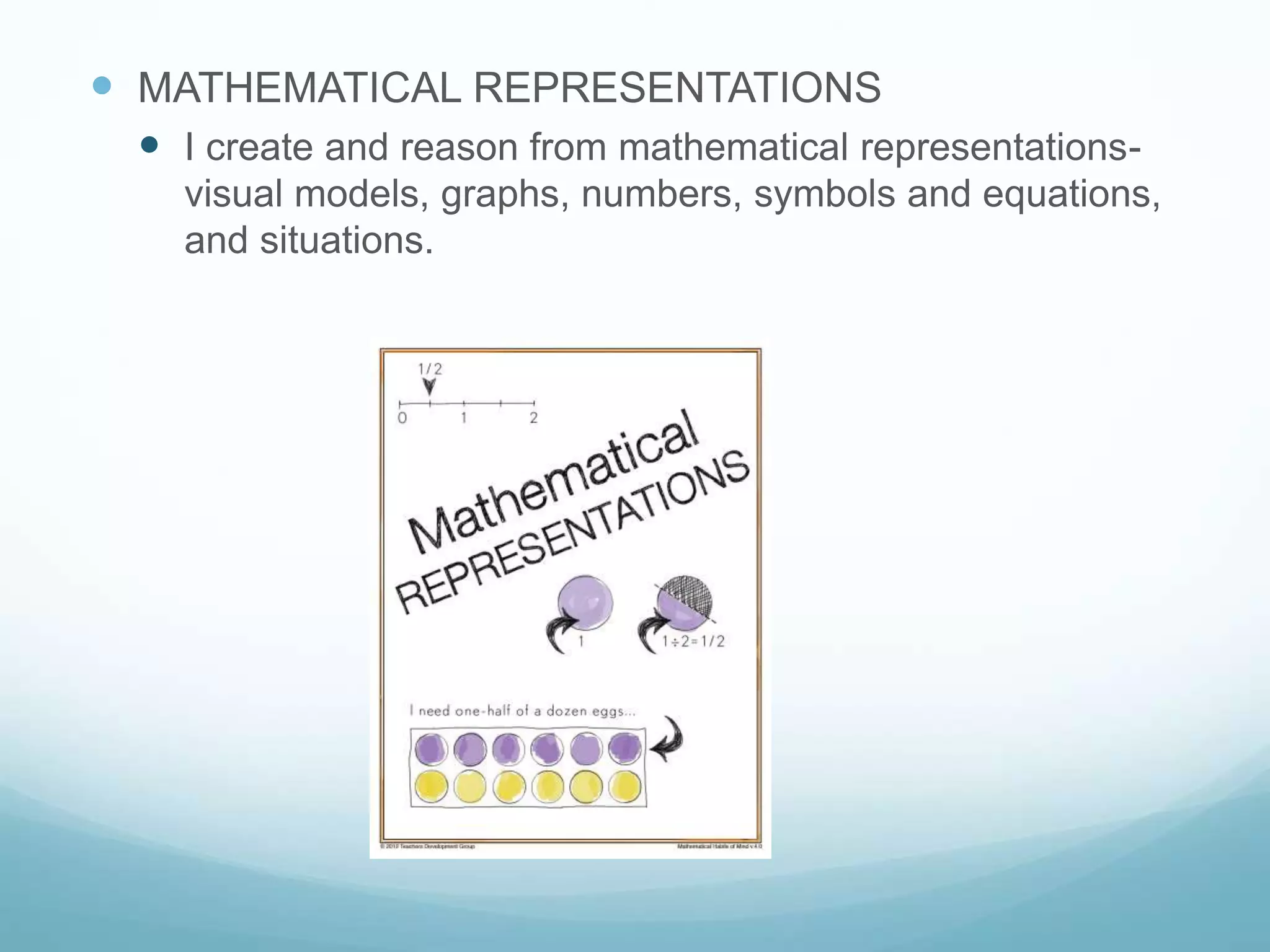
 MATHEMATICAL REPRESENTATIONS
 I create and reason from mathematical representations-
visual models, graphs, numbers, symbols and equations,
and situations.
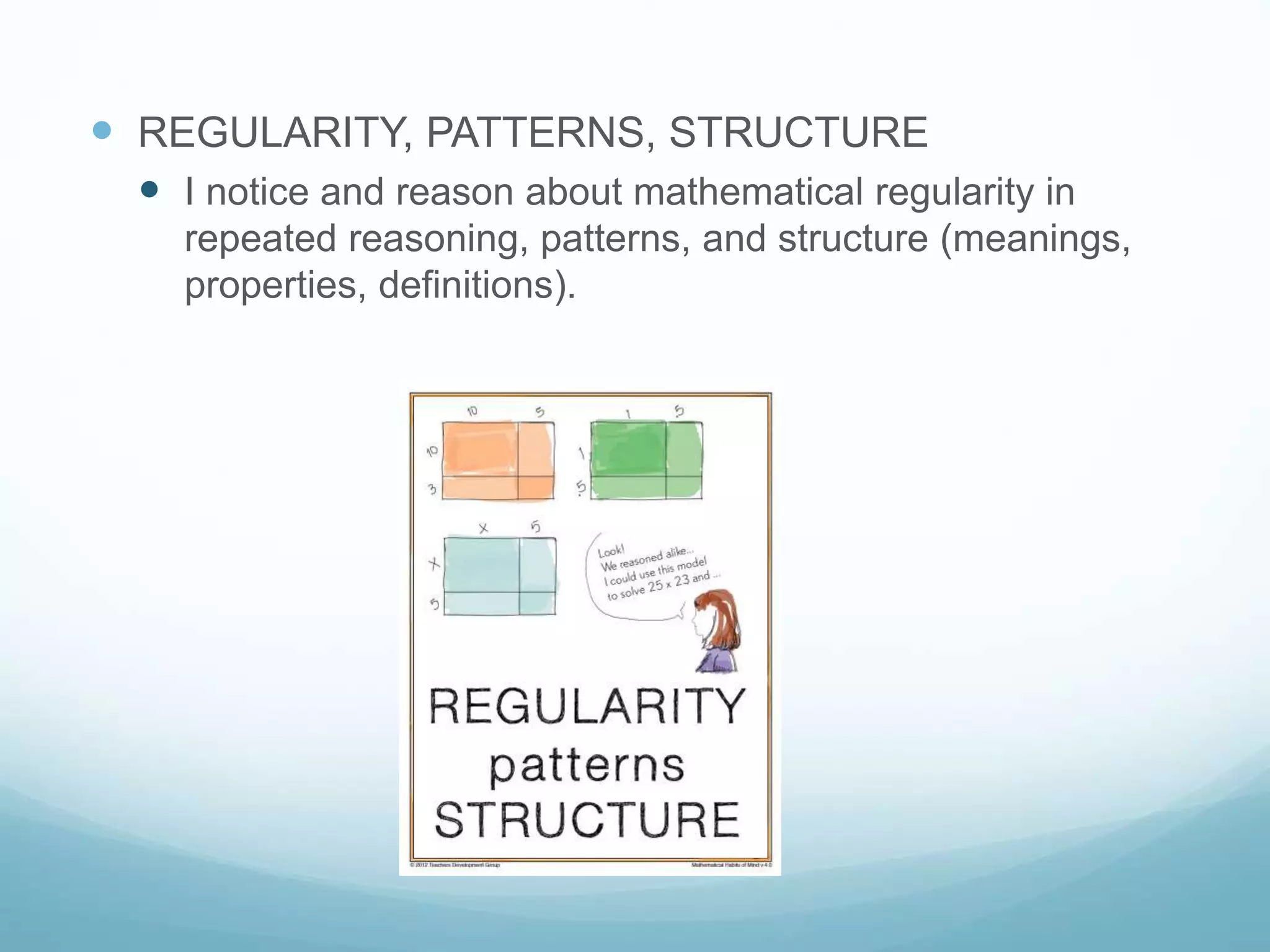
 REGULARITY, PATTERNS, STRUCTURE
 I notice and reason about mathematical regularity in
repeated reasoning, patterns, and structure (meanings,
properties, definitions).
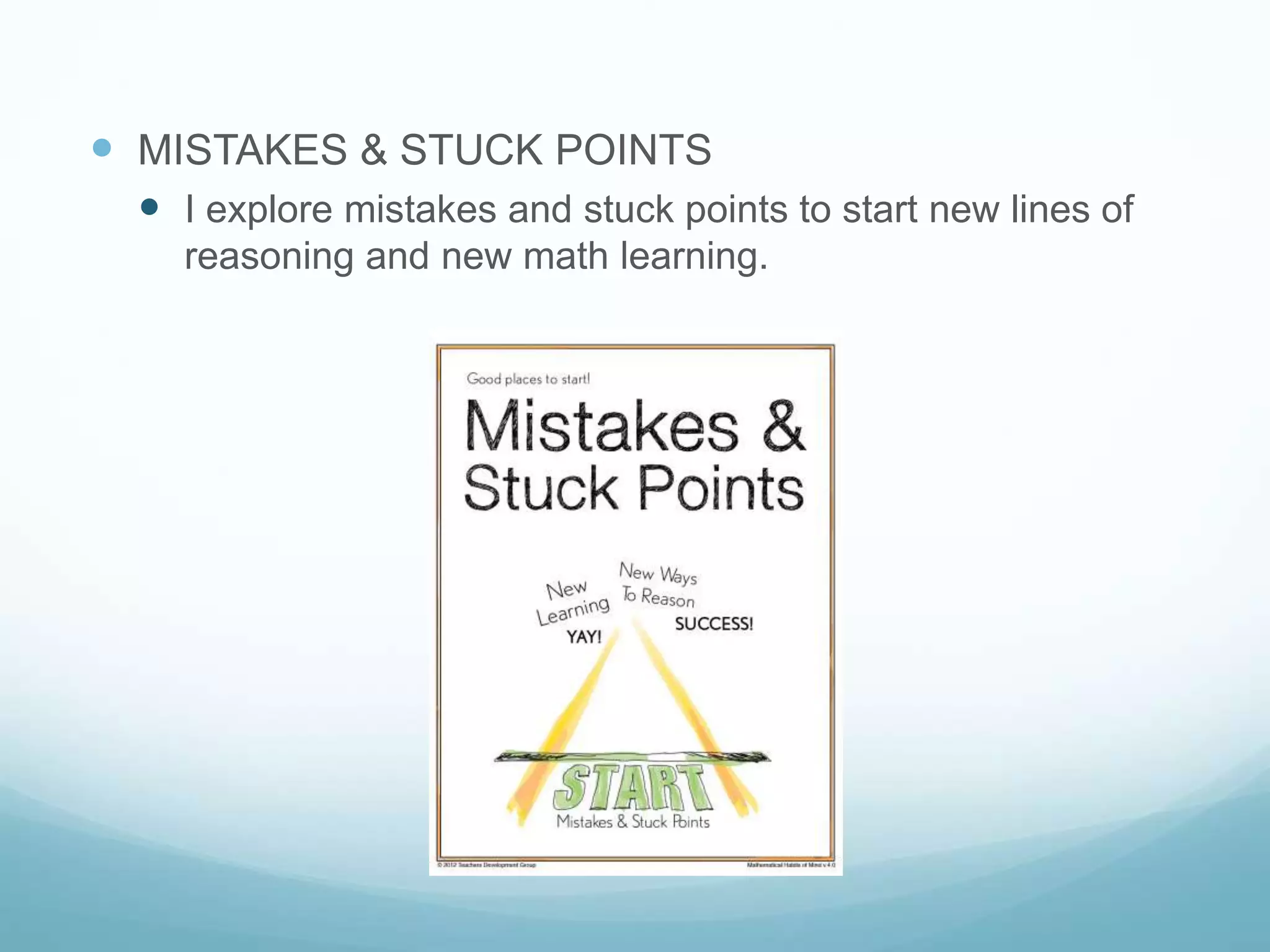
 MISTAKES & STUCK POINTS
 I explore mistakes and stuck points to start new lines of
reasoning and new math learning.
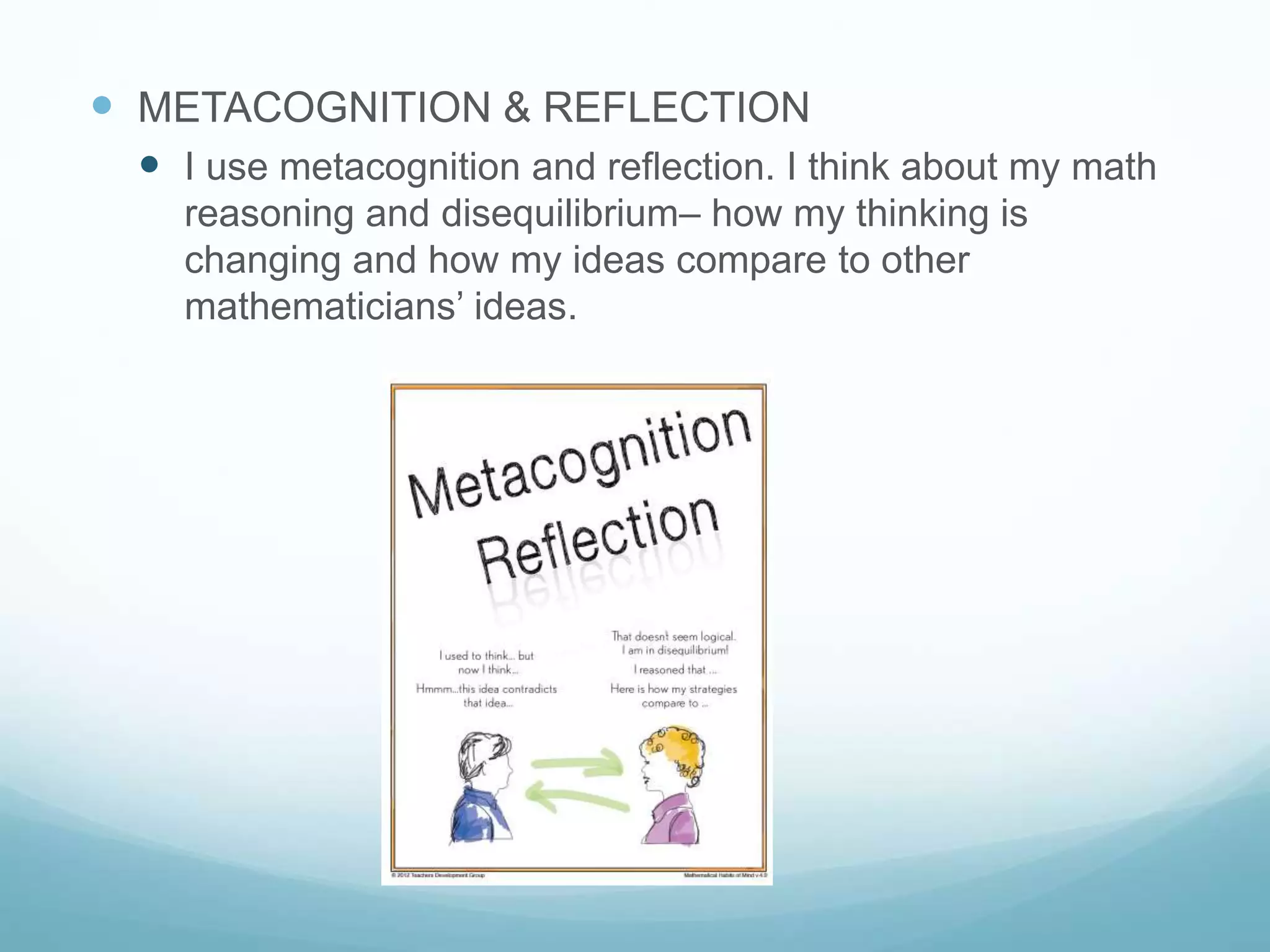
 METACOGNITION & REFLECTION
 I use metacognition and reflection. I think about my math
reasoning and disequilibrium– how my thinking is
changing and how my ideas compare to other
mathematicians’ ideas.
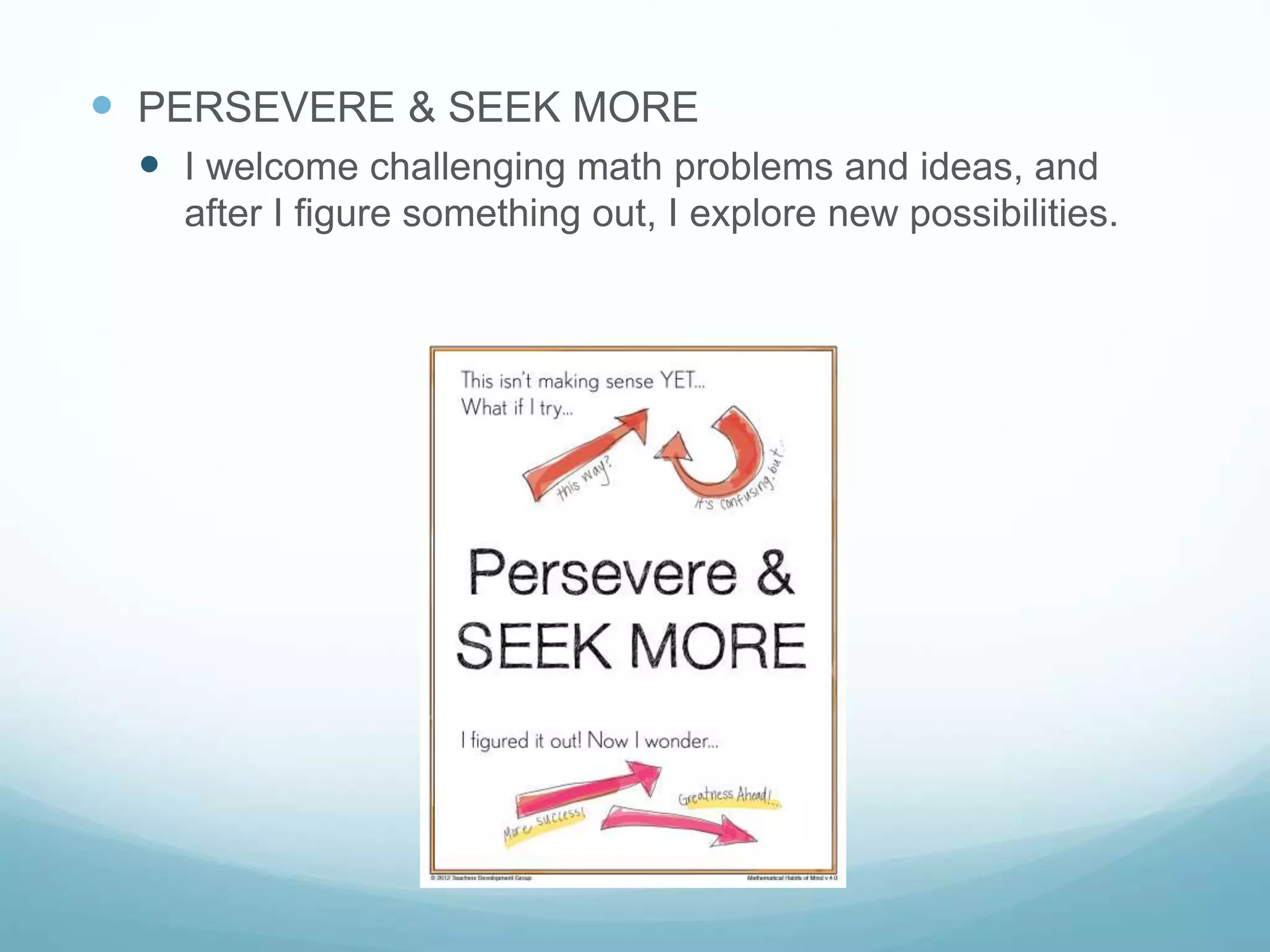
 PERSEVERE & SEEK MORE
 I welcome challenging math problems and ideas, and
after I figure something out, I explore new possibilities.
Mathematical Habits of Interaction
When I do math with other mathematicians, we:
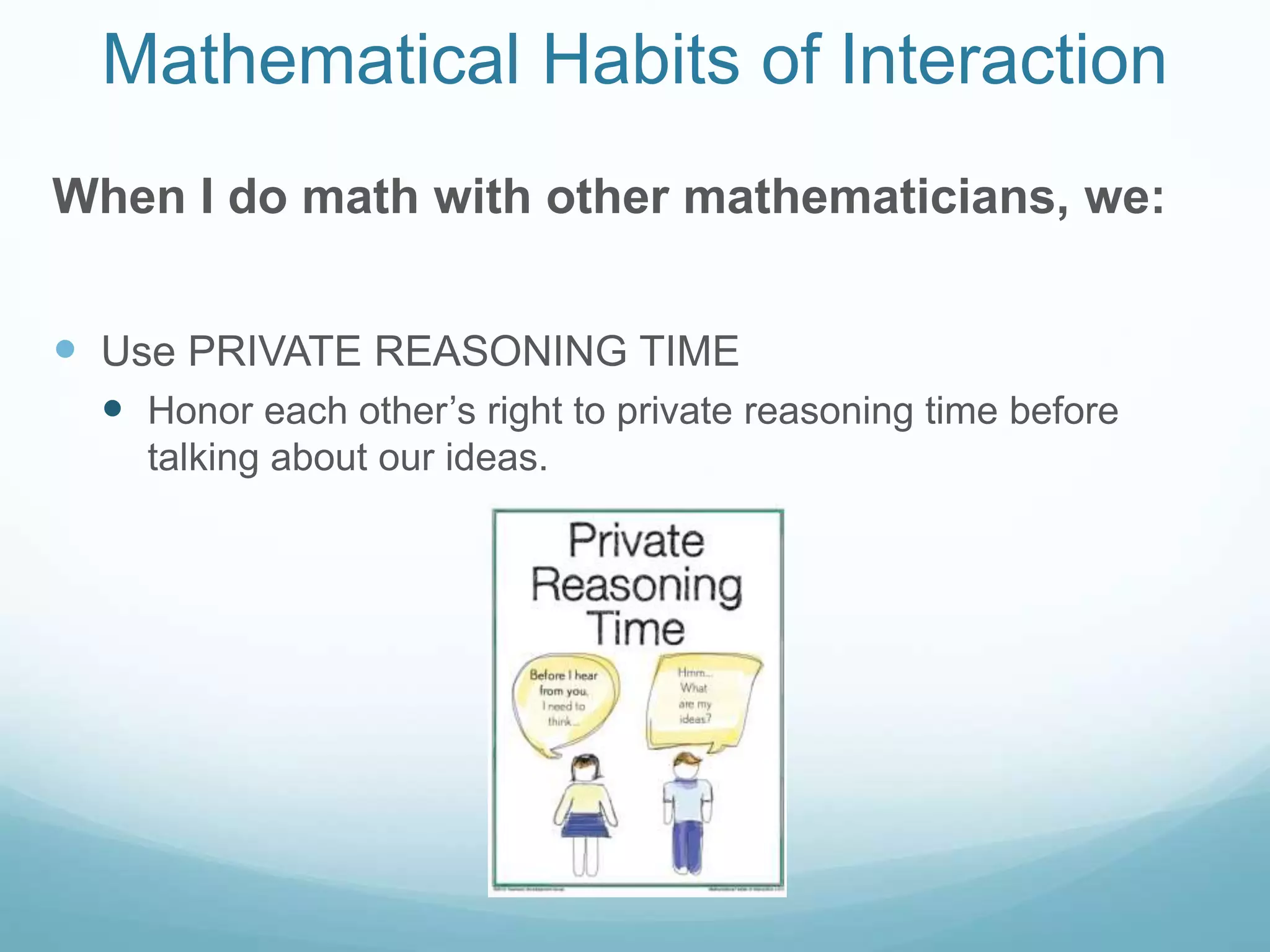
 Use PRIVATE REASONING TIME
 Honor each other’s right to private reasoning time before
talking about our ideas.
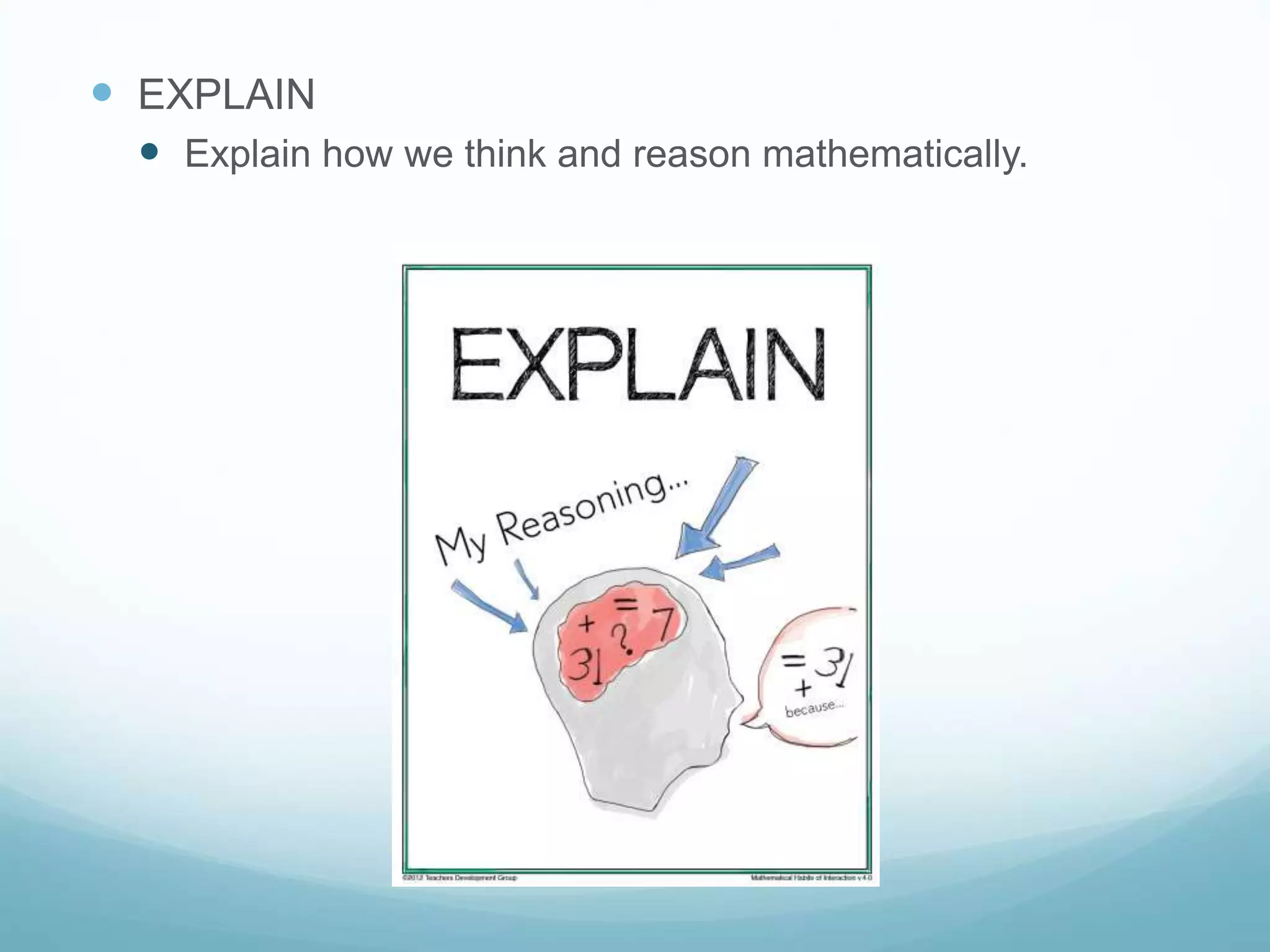
 EXPLAIN
 Explain how we think and reason mathematically.
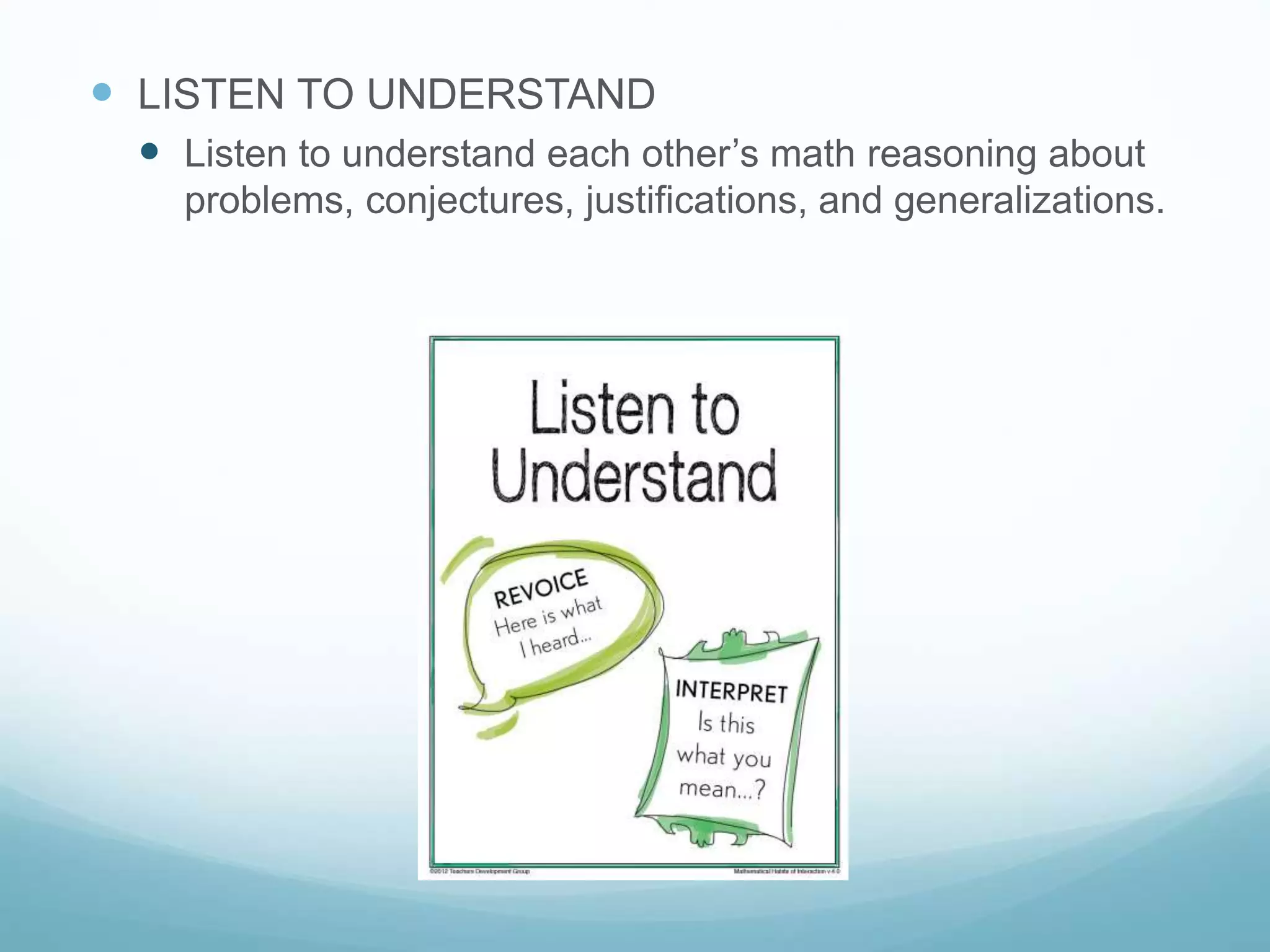
 LISTEN TO UNDERSTAND
 Listen to understand each other’s math reasoning about
problems, conjectures, justifications, and generalizations.
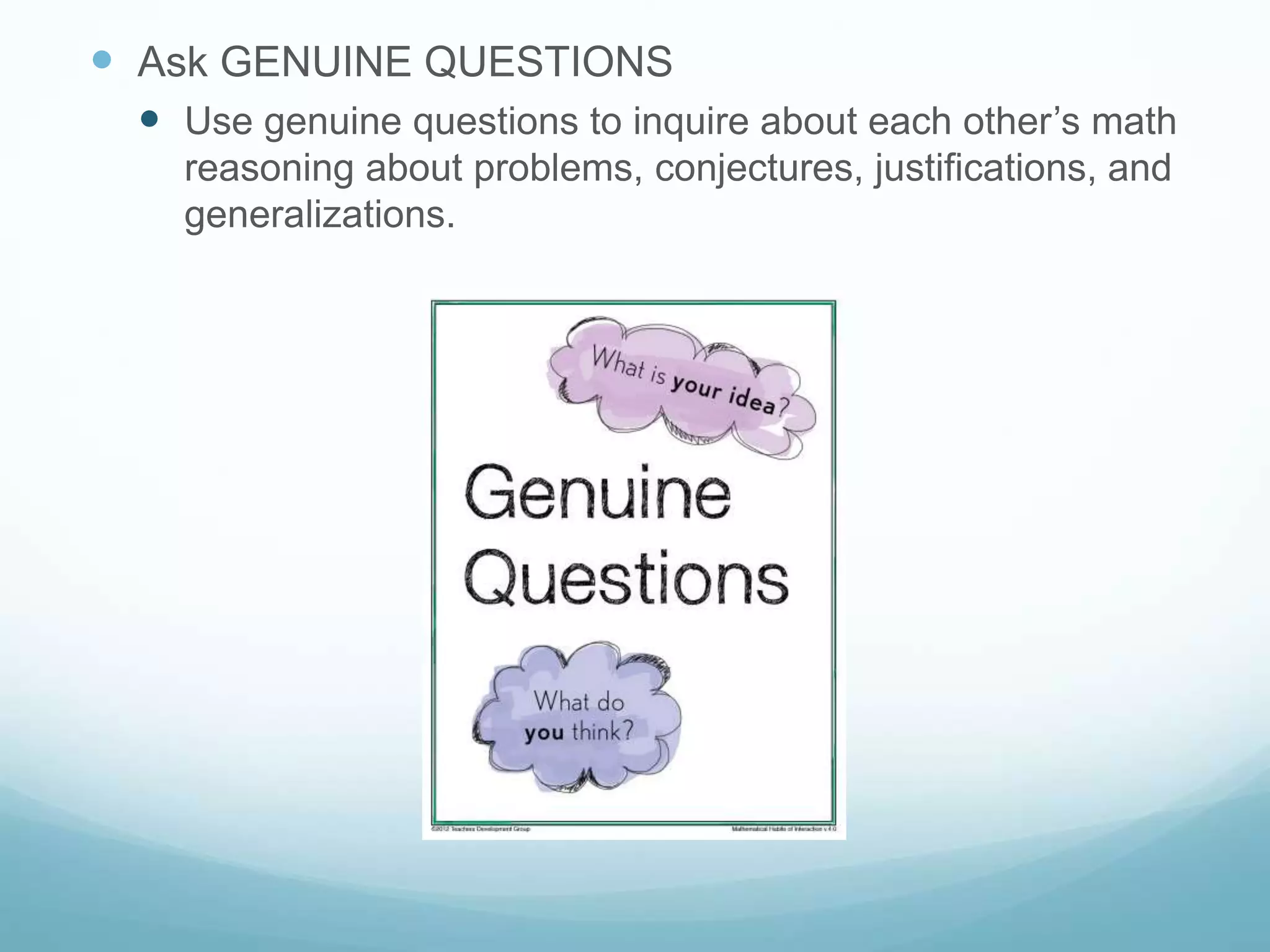
 Ask GENUINE QUESTIONS
 Use genuine questions to inquire about each other’s math
reasoning about problems, conjectures, justifications, and
generalizations.
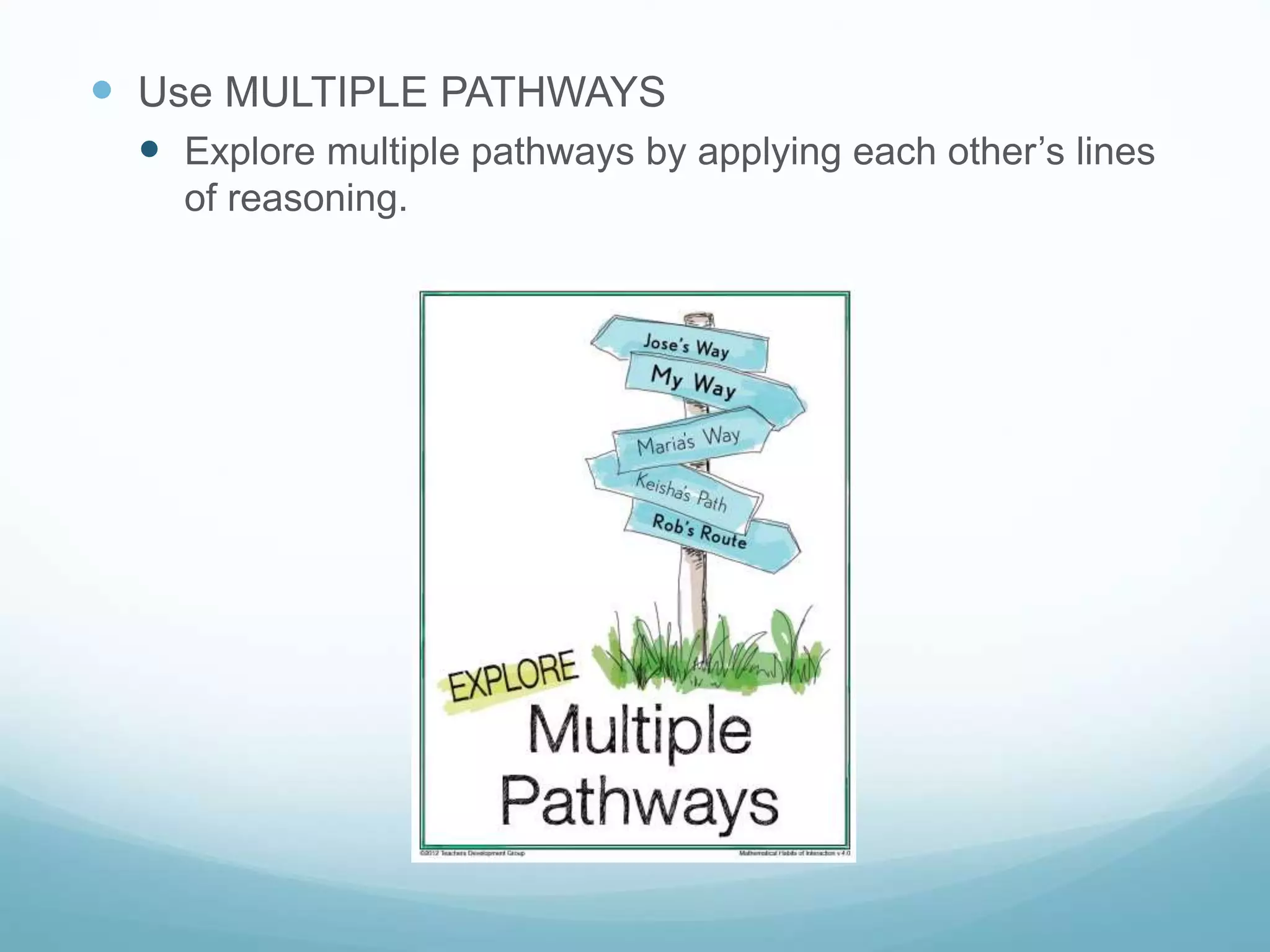
 Use MULTIPLE PATHWAYS
 Explore multiple pathways by applying each other’s lines
of reasoning.
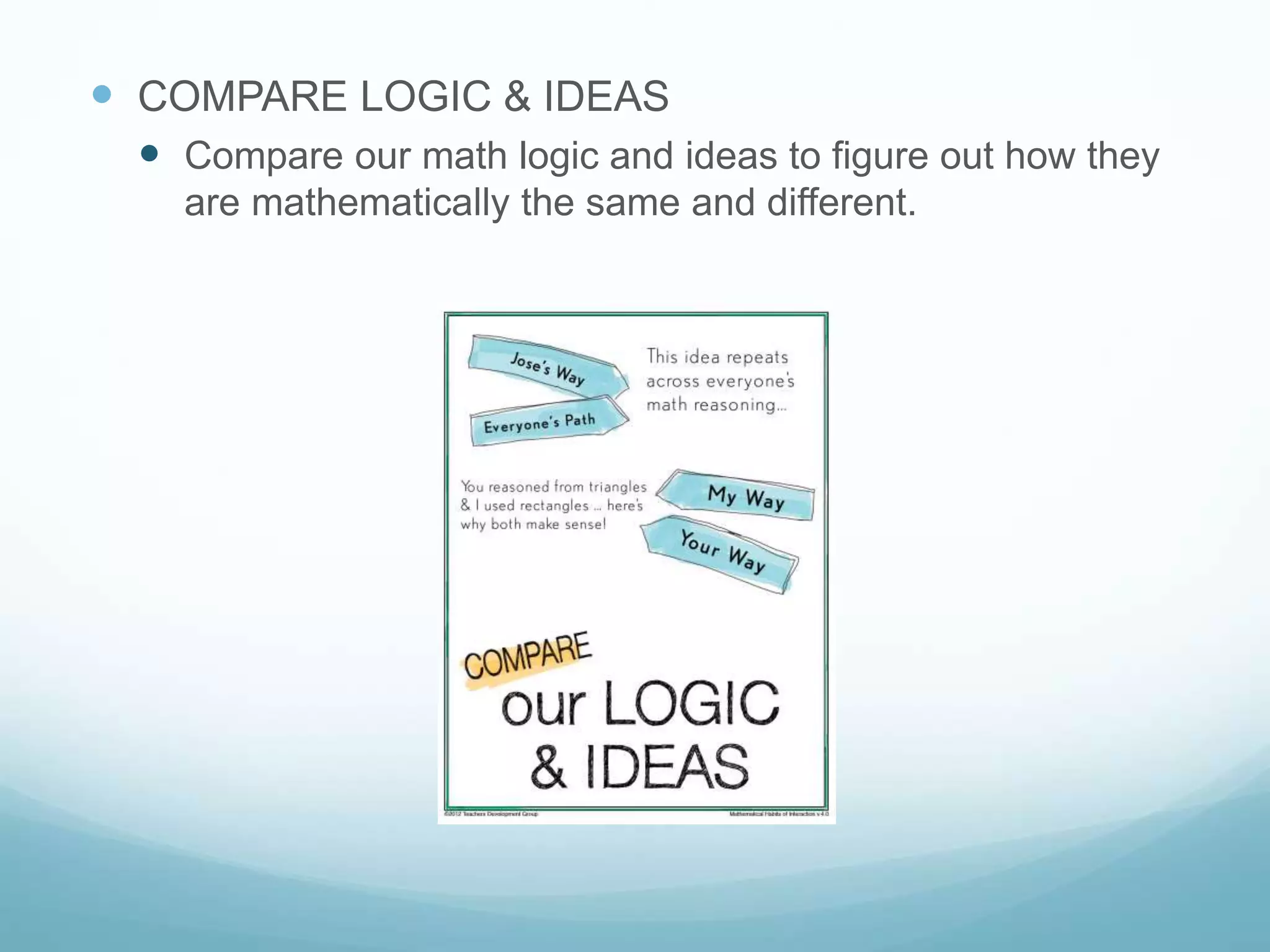
 COMPARE LOGIC & IDEAS
 Compare our math logic and ideas to figure out how they
are mathematically the same and different.
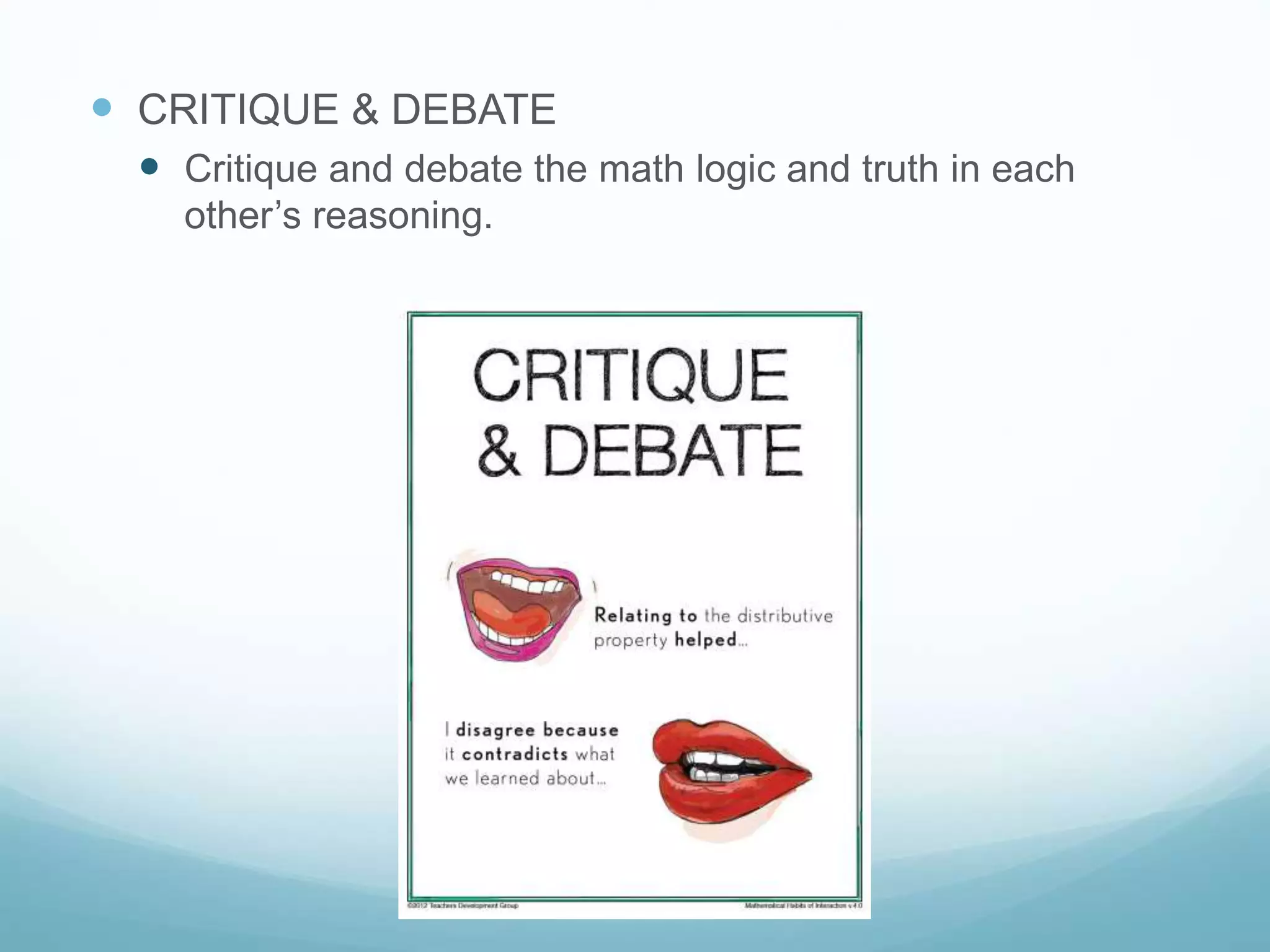
 CRITIQUE & DEBATE
 Critique and debate the math logic and truth in each
other’s reasoning.
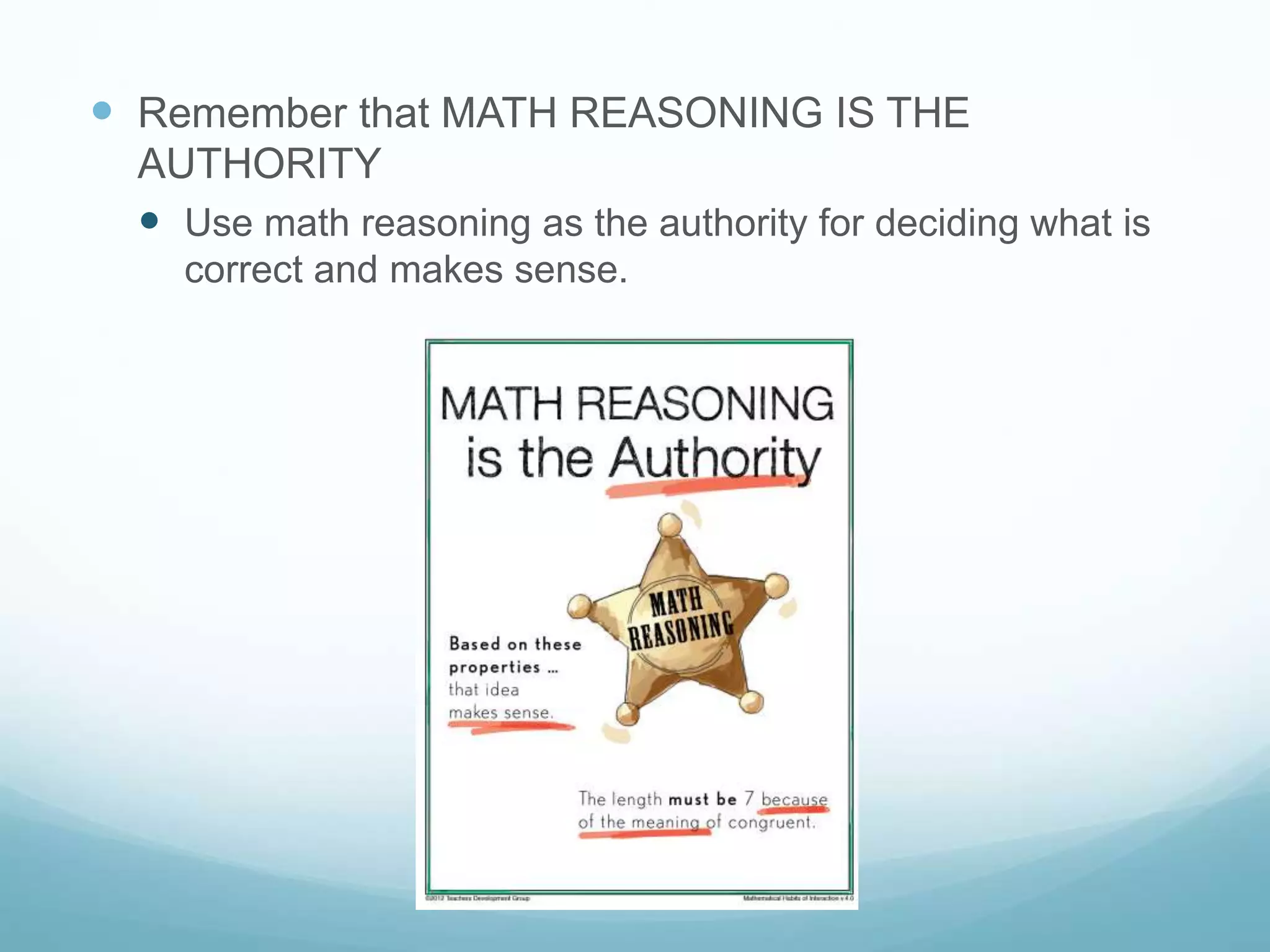
 Remember that MATH REASONING IS THE
AUTHORITY
 Use math reasoning as the authority for deciding what is
correct and makes sense.
Question of the Day
 Focus lesson around one main problem. This gives you
freedom to go “off script” from the teacher’s guide.
 It would most likely come from your ENY lesson for the
day (modify if needed)
 The problem would be one that is focused on your “big
idea.”
 The problem would lend itself to integrating one or
more of the habits of mind and interaction.
Strategies and
Representations
 Do the math!
 Plan ahead of time for what strategies and
representations you’d like to feature (sketch out on your
plans).
 Think about what mistakes/stuck points may come up
and how to approach that.
 Write out “genuine questions” that you plan to ask.
 Think about the habits of mind and interaction you’d
like to focus on for the lesson.
 Some of these habits will come naturally, especially after
implementing them regularly.
Student Math-Talk
 Let’s try it…
Math Task
 Brock makes 21 jars of tomato sauce with the tomatoes
from his garden. He puts 7 jars in each box to sell at
the farmers’ market. How many boxes does Brock
need?
Step 1: Take private reasoning time to work through
this problem using mathematical representations.
Student Math Talk
 Step 2: Student Math Talk
Strategy: Listen & Compare: Partner A
speaks while Partner B listens without
interrupting. When teacher announces
“Finish your thought and switch roles,”
Partner B speaks, including comparative
language (sentences frames would come in
handy with this one).
More Strategies
 Strategy: Revoice & Compare:
 As with the previous strategy, Partner A shares
while Partner B listens silently. Instead of
immediately switching roles, Partner B revoices
Partner A’s ideas without modifying them.
Partner A clarifies as needed. The partners
then switch roles and the process is repeated.
Strategic “Share”
 As students are working, teacher circulates. When s/he
sees a strategy or representation to highlight with the
group, the teacher places a sticky note near the
student.
 The teacher then helps transition back to whole-group
time, and asks the students with sticky notes to share.
 Often, the teacher uses these ideas to construct a
public record (anchor chart).
Creating “Public Records”
 Part of “doing the math” ahead of time is envisioning
how you want the public record (aka anchor chart) to
look.
 Think about the representations you want students to
use. They should discover them on their own, but if
they don’t, how will you guide them without directly
feeding it to them?
 Hint: “I once saw a student do it this way…”
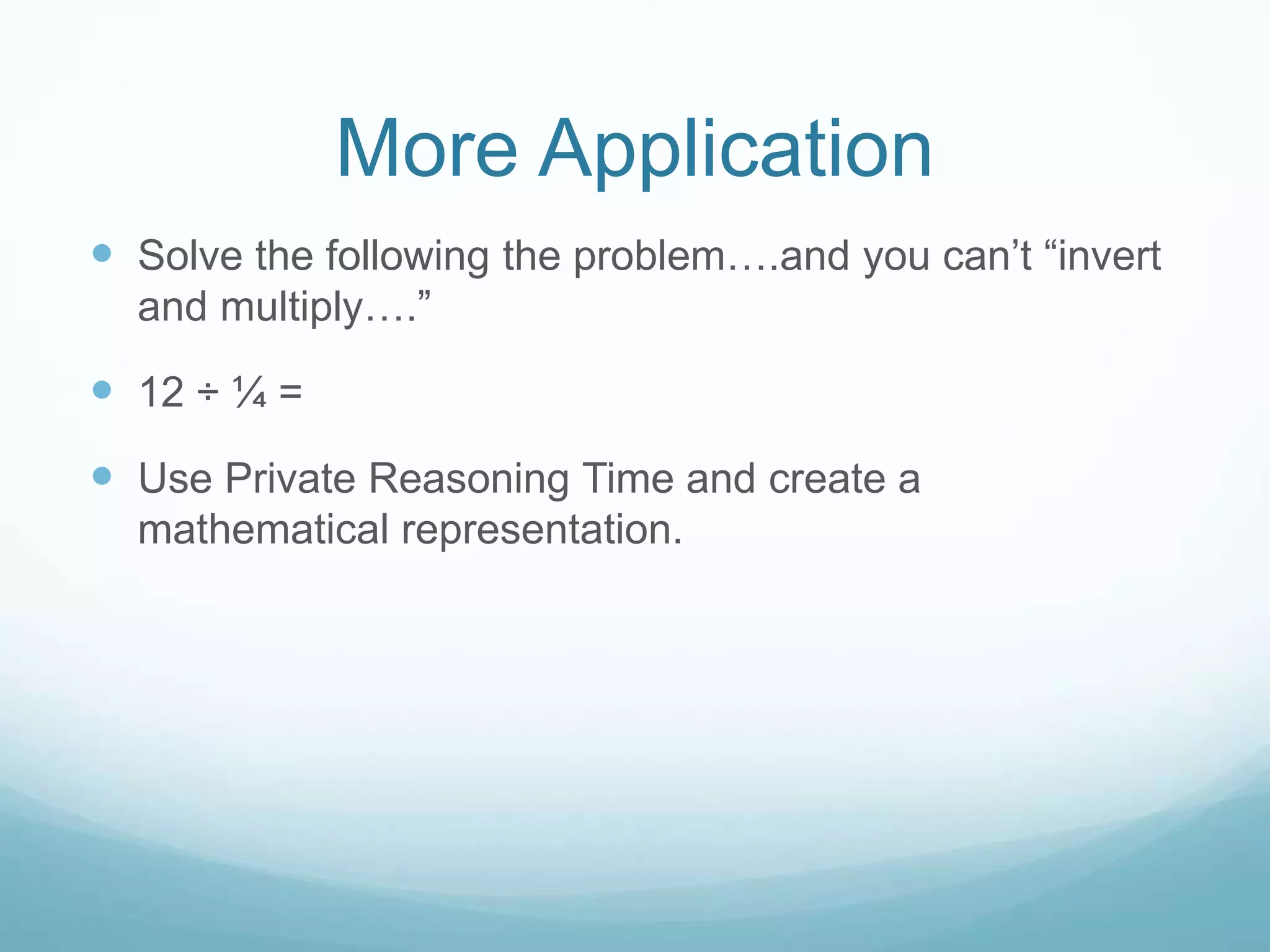
More Application
 Solve the following the problem….and you can’t “invert
and multiply….”
 12 ÷ ¼ =
 Use Private Reasoning Time and create a
mathematical representation.
So……
 How did that feel? Was it comfortable?
 Welcome to…Productive Disequilibrium!
 This is an example of using Mistakes and Stuck Points
to further learning. It’s a paradigm shift to view being
stuck as a positive part of learning. As teachers, we
need to remember to not jump in and give them the
answer to alleviate our own discomfort.
Planning a Lesson
 Use created template or some other method you
decide on as a PLC.
 Walk through…
Final Thoughts
 This is a shift to student-centered mathematics
instruction. Think of yourself as the facilitator. Plan
ahead for what you want the students to understand
and what strategies you want them to discover. Have a
plan for facilitating these things if they don’t naturally
discover them. Ask genuine questions that will lead to
sense-making and generalizing.

Math practices

  • 1.
    Best Practices inMath Using the Habits of Mind and Interaction
  • 2.
     Integrating effectivemath instruction (think Common Core Mathematical Practices) with district curriculum (Engage New York). The Big Picture
  • 3.
    Where to begin? Locate your first unit of study  Found on the CIA: https://salkeiz-cia.orvsd.org/  Be sure to log in first  username: lastname_firstname password: the same as you use to log in for the district  Open your first unit of study under your grade’s “instruction” tab  Take time to look through the unit of study (curriculum map)
  • 4.
    Focus on the“Big Ideas”
  • 5.
    Engage New York All grades will use Engage New York (ENY).  As a PLC, you may decide to supplement with other resources.  You should have:  Paper copy of each unit’s teacher’s guide/lessons  Electronic teacher’s guides are on U drive and also uploaded on Digital Storefront.  Non-consumable workbooks (student Problem Sets), not to be written in.
  • 6.
    Engage New York Exit Tickets: you will need to order print or decide as a PLC how you’d like to assess  Homework: Also, as a PLC, decide what you’d like to do. Use the ENY homework as is? Modify? Use something else?  Mid-module and end-of-module assessments: you will need to look at these with your PLC, and order print
  • 7.
    ENY and StudentMathematical Practices  All grades are required to implement the Student Mathematical Practices.  Located on the CIA site: https://salkeiz-cia.orvsd.org/math  How can we be sure that they are a part of our everyday math instruction/learning?  How can we get our students to understand these practices and eventually start implementing them on their own?  What is a way to teach these practices in a “student- friendly” way?
  • 8.
    Mathematical Productive Thinking Routines Explainyour thinking/reasoning in a variety of ways. Explain why your ideas/solutions/conjectures are always, sometimes ,or never true. Clarify, deepen, and expand thinking by making conjectures based on the math you know combined with relationships noticed.
  • 9.
    Mathematical Habits ofMind  CONNECTIONS  I notice and reason about connections within and across mathematical representations, other math ideas, and everyday life.
  • 10.
     MATHEMATICAL REPRESENTATIONS I create and reason from mathematical representations- visual models, graphs, numbers, symbols and equations, and situations.
  • 11.
     REGULARITY, PATTERNS,STRUCTURE  I notice and reason about mathematical regularity in repeated reasoning, patterns, and structure (meanings, properties, definitions).
  • 12.
     MISTAKES &STUCK POINTS  I explore mistakes and stuck points to start new lines of reasoning and new math learning.
  • 13.
     METACOGNITION &REFLECTION  I use metacognition and reflection. I think about my math reasoning and disequilibrium– how my thinking is changing and how my ideas compare to other mathematicians’ ideas.
  • 14.
     PERSEVERE &SEEK MORE  I welcome challenging math problems and ideas, and after I figure something out, I explore new possibilities.
  • 15.
    Mathematical Habits ofInteraction When I do math with other mathematicians, we:  Use PRIVATE REASONING TIME  Honor each other’s right to private reasoning time before talking about our ideas.
  • 16.
     EXPLAIN  Explainhow we think and reason mathematically.
  • 17.
     LISTEN TOUNDERSTAND  Listen to understand each other’s math reasoning about problems, conjectures, justifications, and generalizations.
  • 18.
     Ask GENUINEQUESTIONS  Use genuine questions to inquire about each other’s math reasoning about problems, conjectures, justifications, and generalizations.
  • 19.
     Use MULTIPLEPATHWAYS  Explore multiple pathways by applying each other’s lines of reasoning.
  • 20.
     COMPARE LOGIC& IDEAS  Compare our math logic and ideas to figure out how they are mathematically the same and different.
  • 21.
     CRITIQUE &DEBATE  Critique and debate the math logic and truth in each other’s reasoning.
  • 22.
     Remember thatMATH REASONING IS THE AUTHORITY  Use math reasoning as the authority for deciding what is correct and makes sense.
  • 23.
    Question of theDay  Focus lesson around one main problem. This gives you freedom to go “off script” from the teacher’s guide.  It would most likely come from your ENY lesson for the day (modify if needed)  The problem would be one that is focused on your “big idea.”  The problem would lend itself to integrating one or more of the habits of mind and interaction.
  • 24.
    Strategies and Representations  Dothe math!  Plan ahead of time for what strategies and representations you’d like to feature (sketch out on your plans).  Think about what mistakes/stuck points may come up and how to approach that.  Write out “genuine questions” that you plan to ask.  Think about the habits of mind and interaction you’d like to focus on for the lesson.  Some of these habits will come naturally, especially after implementing them regularly.
  • 25.
  • 26.
    Math Task  Brockmakes 21 jars of tomato sauce with the tomatoes from his garden. He puts 7 jars in each box to sell at the farmers’ market. How many boxes does Brock need? Step 1: Take private reasoning time to work through this problem using mathematical representations.
  • 27.
    Student Math Talk Step 2: Student Math Talk Strategy: Listen & Compare: Partner A speaks while Partner B listens without interrupting. When teacher announces “Finish your thought and switch roles,” Partner B speaks, including comparative language (sentences frames would come in handy with this one).
  • 28.
    More Strategies  Strategy:Revoice & Compare:  As with the previous strategy, Partner A shares while Partner B listens silently. Instead of immediately switching roles, Partner B revoices Partner A’s ideas without modifying them. Partner A clarifies as needed. The partners then switch roles and the process is repeated.
  • 29.
    Strategic “Share”  Asstudents are working, teacher circulates. When s/he sees a strategy or representation to highlight with the group, the teacher places a sticky note near the student.  The teacher then helps transition back to whole-group time, and asks the students with sticky notes to share.  Often, the teacher uses these ideas to construct a public record (anchor chart).
  • 30.
    Creating “Public Records” Part of “doing the math” ahead of time is envisioning how you want the public record (aka anchor chart) to look.  Think about the representations you want students to use. They should discover them on their own, but if they don’t, how will you guide them without directly feeding it to them?  Hint: “I once saw a student do it this way…”
  • 31.
    More Application  Solvethe following the problem….and you can’t “invert and multiply….”  12 ÷ ¼ =  Use Private Reasoning Time and create a mathematical representation.
  • 32.
    So……  How didthat feel? Was it comfortable?  Welcome to…Productive Disequilibrium!  This is an example of using Mistakes and Stuck Points to further learning. It’s a paradigm shift to view being stuck as a positive part of learning. As teachers, we need to remember to not jump in and give them the answer to alleviate our own discomfort.
  • 33.
    Planning a Lesson Use created template or some other method you decide on as a PLC.  Walk through…
  • 34.
    Final Thoughts  Thisis a shift to student-centered mathematics instruction. Think of yourself as the facilitator. Plan ahead for what you want the students to understand and what strategies you want them to discover. Have a plan for facilitating these things if they don’t naturally discover them. Ask genuine questions that will lead to sense-making and generalizing.

Editor's Notes

  • #4 Time to look through. Timer
  • #8 Insert math practices
  • #10 Add visuals
  • #29 Have one of the partners stand to revoice in front of group