NCF -2005
Developing children's abilities for mathematisation is the
main goal of mathematics education.
Mathematisation means is to
• develop the child's resources to think
• reason mathematically
• to pursue assumptions to their logical conclusion
• to handle abstraction.
• to develop the ability
• To develop attitude to formulate and solve problems.
Vision for School Mathematics
1. As mathematics is a compulsory subject at the
secondary stage, access to quality mathematics
education is the right of every child.
2. The aim of Mathematics education is to
engage the mind of every student and to
strengthen the student's resources.
3. There is also a need to make connections
between Mathematics and real life and other
subjects of study.
Vision for School Mathematics
4. Children learn to enjoy mathematics rather than fear
it.
5. Children learn important mathematics:
Mathematics is more than for formulas and
mechanical procedures.
6. Children see mathematics as something to talk
about, to communicate through, to discuss among
themselves.
7. Children pose and solve meaningful problems.
8. Children use abstractions to perceive relationships,
to see structures, to reason out things, to argue .
Vision for School Mathematics
9. Teachers engage every child in class with the
conviction that everyone can learn mathematics.
The twin concerns of the
Mathematics curriculum are:
What can mathematics education do
to engage the mind of every student
and how can it strengthen the
student's resources?
How???
Sustained & Active
engagement with every
child.
Methods
• Hands on-Activity based learning
• Problem Solving
• Modeling
• Experimentation & Demonstration
• Self learning
• Peer to peer collaborative learning
• Online resources
• Culture of Beyond Text books and inquiry based
learning.
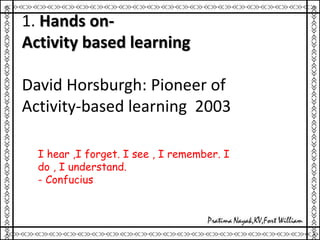
1. Hands on-
Activity based learning
David Horsburgh: Pioneer of
Activity-based learning 2003
I hear ,I forget. I see , I remember. I
do , I understand.
- Confucius
Activity Based Approach
• Students learn by doing
• Encourages independent and team learning
• Provides students experience and active participation
in the exploration of their environment
• Helps students develop at their own rate –the rate
that is with their abilities, interest and motivations
• Encourages self-reliance.
• It develops the skills of Problem-solving, critical and
creative thinking .
1. Hands on-Activity based learning
takes place through
• songs
• Stories
• colourful teaching resources ( cards, Dice)
• games
• Solving Puzzles
• Magic squares
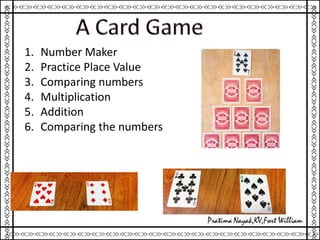
1. Number Maker
2. Practice Place Value
3. Comparing numbers
4. Multiplication
5. Addition
6. Comparing the numbers
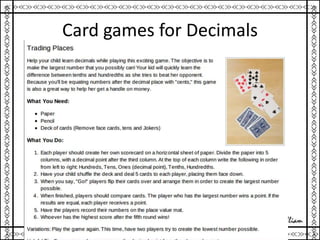
Card games for Decimals
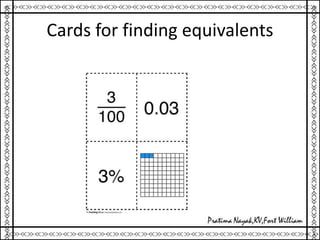
Cards for finding equivalents
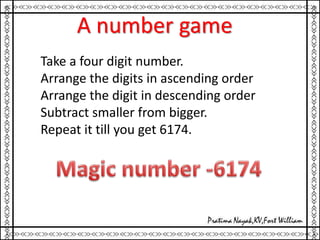
A number game
Take a four digit number.
Arrange the digits in ascending order
Arrange the digit in descending order
Subtract smaller from bigger.
Repeat it till you get 6174.
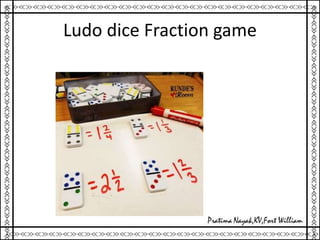
Ludo dice Fraction game
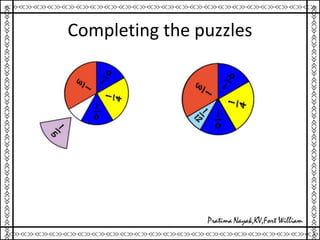
Completing the puzzles
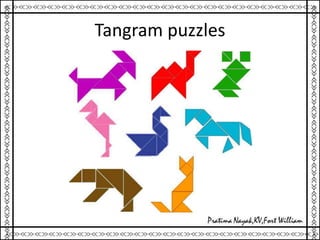
Tangram puzzles
2. Problem Solving
Problem solving focuses on:
• developing skills and the ability to apply these
skills to unfamiliar situations
• gathering, organising, interpreting and
communicating information
• analyzing and conceptualizing problems
• developing curiosity, confidence and open-
mindedness (NCTM, 1980, pp.2-3).
2. Problem Solving
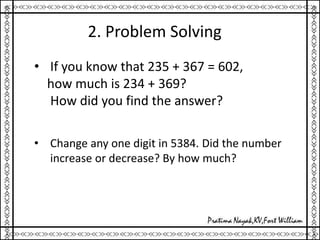
• If you know that 235 + 367 = 602,
how much is 234 + 369?
How did you find the answer?
• Change any one digit in 5384. Did the number
increase or decrease? By how much?
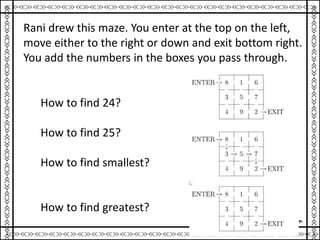
Rani drew this maze. You enter at the top on the left,
move either to the right or down and exit bottom right.
You add the numbers in the boxes you pass through.
How to find 24?
How to find 25?
How to find smallest?
How to find greatest?
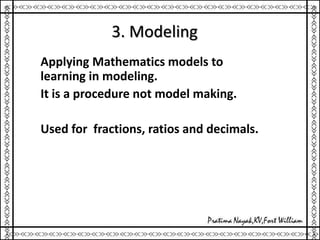
3. Modeling
Applying Mathematics models to
learning in modeling.
It is a procedure not model making.
Used for fractions, ratios and decimals.
3. Modeling
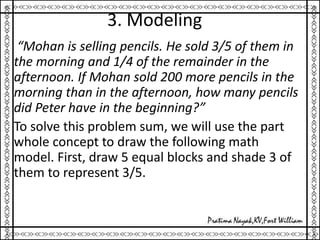
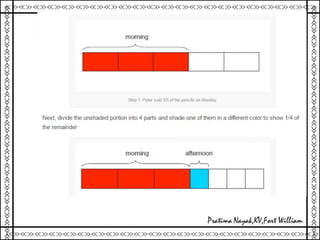
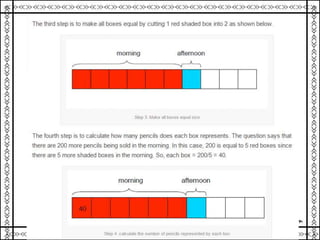
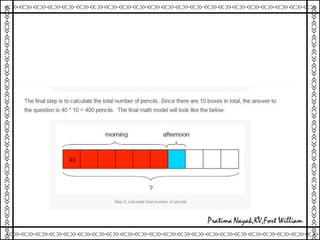
“Mohan is selling pencils. He sold 3/5 of them in
the morning and 1/4 of the remainder in the
afternoon. If Mohan sold 200 more pencils in the
morning than in the afternoon, how many pencils
did Peter have in the beginning?”
To solve this problem sum, we will use the part
whole concept to draw the following math
model. First, draw 5 equal blocks and shade 3 of
them to represent 3/5.
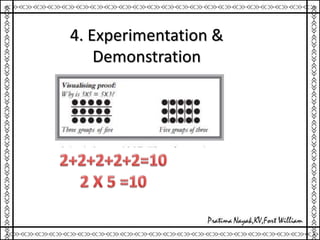
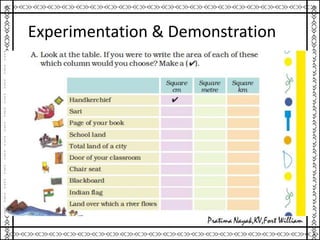
4. Experimentation &
Demonstration
4. Experimentation &
Demonstration
• Count the number of objects in your
immediate surroundings.
• Observe the different shapes that the
numbers have.
• Dividing the numbers / articles among
them for verification
Experimentation & Demonstration
• Have you noticed the different kinds of
patterns that objects in your surroundings
have?
• What kind of a pattern does your frock/ shirt/
bedspread/ matka/ chatai/ have?
• Are there any patterns in the books you
study?
Patterns
Experimentation & Demonstration
5. Self learning
• Demonstrate the usefulness of
Mathematics in the real world
• Motivate students to set achievable
goals
• Brain storming
• Incorporate Technology into Lessons
• Entice students with a Magical Math
Problem
6. Use of Online resources
• http://www.math-play.com/
• https://www.mathplayground.com/
• http://www.softschools.com/
• https://www.edutopia.org
• www.nroer.gov.in
• http://www.education.com/games/
• http://e-pathsala.nic.in
• http://ncert.nic.in
• http://www.youtube.com
• http://www.mathsisfun.com/
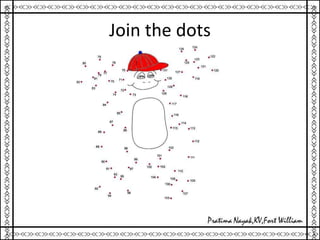
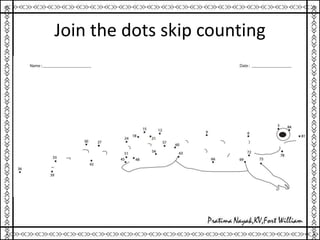
Join the dots
Join the dots skip counting
6.Peer to peer collaborative learning
It develops 21st century skills as well as social
skills
• Communication skill
• Interpersonal relationship
• Empathy
• Team work
7.Culture of beyond Text books and
inquiry based learning.
(Thinking out-of-box)
• Mathematics Olympiad
• Use of Technology
• Project based learning
• Online learning
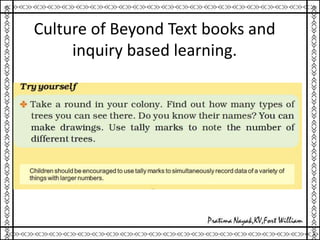
Culture of Beyond Text books and
inquiry based learning.
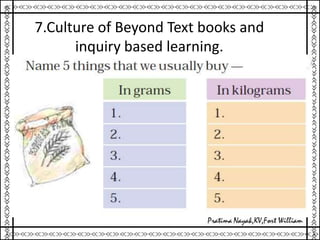
7.Culture of Beyond Text books and
inquiry based learning.
Teacher’s role
1.Children learn to enjoy mathematics rather
than fear it.
2.Children learn important mathematics:
Mathematics is more than for fomulas and
mechanical procedures.
3. Use more and more ICT tools for teaching.
4. Teach them how to learn
Teacher’s role
5. Allow children to pose and solve
meaningful problems.
6. Engage every child in class as it is his/her
right .Everyone can learn mathematics.
7. Help children develop a positive attitude
towards Mathematics
8. Help them to develop liking for
Mathematics as the primary stage is more
important.
Teacher’s role
Mathematical games, puzzles and stories help in
developing a positive attitude and in making
connections between mathematics and
everyday thinking.
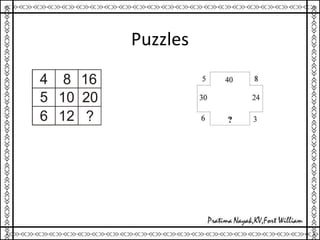
Puzzles
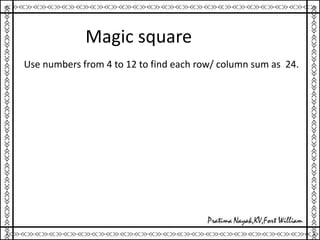
Magic square
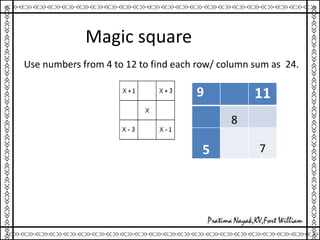
Use numbers from 4 to 12 to find each row/ column sum as 24.
Magic square
Use numbers from 4 to 12 to find each row/ column sum as 24.
9 11
8
5 7
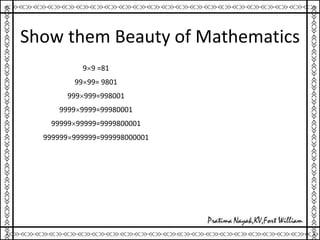
Show them Beauty of Mathematics
99 =81
9999= 9801
999999=998001
99999999=99980001
9999999999=9999800001
999999999999=999998000001
•Speak about Mathematicians
Aryabhatta
Barahmihira
Lilabati
Bhaskar
Ramanujan
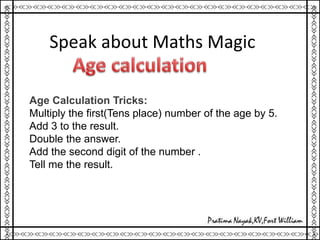
Speak about Maths Magic
Age Calculation Tricks:
Multiply the first(Tens place) number of the age by 5.
Add 3 to the result.
Double the answer.
Add the second digit of the number .
Tell me the result.
Speak about Maths Magic
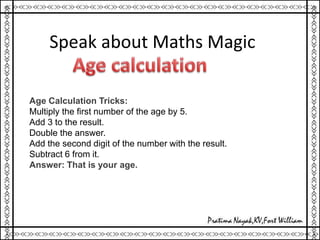
Age Calculation Tricks:
Multiply the first number of the age by 5.
Add 3 to the result.
Double the answer.
Add the second digit of the number with the result.
Subtract 6 from it.
Answer: That is your age.
Speak about Maths Magic
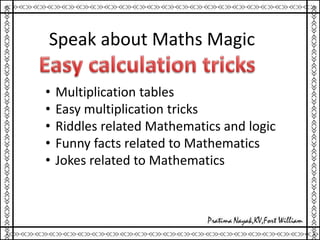
• Multiplication tables
• Easy multiplication tricks
• Riddles related Mathematics and logic
• Funny facts related to Mathematics
• Jokes related to Mathematics
Teacher’s role
Innovations and experimentations for
sustained engagement
Use of Technology/ICT tools
• Ms Excel
• Power point
• GeoGebra
• Microsoft Mathematics
• Websites
• Blogs
• Social forum
Our New Year Resolutions:
More and more Technology in
the Mathematics classes
Sustained &  active_engagement_with_every_child - Pratima Nayak

Sustained & active_engagement_with_every_child - Pratima Nayak

  • 2.
    NCF -2005 Developing children'sabilities for mathematisation is the main goal of mathematics education. Mathematisation means is to • develop the child's resources to think • reason mathematically • to pursue assumptions to their logical conclusion • to handle abstraction. • to develop the ability • To develop attitude to formulate and solve problems.
  • 3.
    Vision for SchoolMathematics 1. As mathematics is a compulsory subject at the secondary stage, access to quality mathematics education is the right of every child. 2. The aim of Mathematics education is to engage the mind of every student and to strengthen the student's resources. 3. There is also a need to make connections between Mathematics and real life and other subjects of study.
  • 4.
    Vision for SchoolMathematics 4. Children learn to enjoy mathematics rather than fear it. 5. Children learn important mathematics: Mathematics is more than for formulas and mechanical procedures. 6. Children see mathematics as something to talk about, to communicate through, to discuss among themselves. 7. Children pose and solve meaningful problems. 8. Children use abstractions to perceive relationships, to see structures, to reason out things, to argue .
  • 5.
    Vision for SchoolMathematics 9. Teachers engage every child in class with the conviction that everyone can learn mathematics.
  • 6.
    The twin concernsof the Mathematics curriculum are: What can mathematics education do to engage the mind of every student and how can it strengthen the student's resources?
  • 7.
  • 8.
    Methods • Hands on-Activitybased learning • Problem Solving • Modeling • Experimentation & Demonstration • Self learning • Peer to peer collaborative learning • Online resources • Culture of Beyond Text books and inquiry based learning.
  • 9.
    1. Hands on- Activitybased learning David Horsburgh: Pioneer of Activity-based learning 2003 I hear ,I forget. I see , I remember. I do , I understand. - Confucius
  • 10.
    Activity Based Approach •Students learn by doing • Encourages independent and team learning • Provides students experience and active participation in the exploration of their environment • Helps students develop at their own rate –the rate that is with their abilities, interest and motivations • Encourages self-reliance. • It develops the skills of Problem-solving, critical and creative thinking .
  • 11.
    1. Hands on-Activitybased learning takes place through • songs • Stories • colourful teaching resources ( cards, Dice) • games • Solving Puzzles • Magic squares
  • 14.
    1. Number Maker 2.Practice Place Value 3. Comparing numbers 4. Multiplication 5. Addition 6. Comparing the numbers
  • 15.
  • 17.
    Cards for findingequivalents
  • 19.
    A number game Takea four digit number. Arrange the digits in ascending order Arrange the digit in descending order Subtract smaller from bigger. Repeat it till you get 6174.
  • 21.
  • 22.
  • 23.
  • 24.
    2. Problem Solving Problemsolving focuses on: • developing skills and the ability to apply these skills to unfamiliar situations • gathering, organising, interpreting and communicating information • analyzing and conceptualizing problems • developing curiosity, confidence and open- mindedness (NCTM, 1980, pp.2-3).
  • 26.
    2. Problem Solving •If you know that 235 + 367 = 602, how much is 234 + 369? How did you find the answer? • Change any one digit in 5384. Did the number increase or decrease? By how much?
  • 27.
    Rani drew thismaze. You enter at the top on the left, move either to the right or down and exit bottom right. You add the numbers in the boxes you pass through. How to find 24? How to find 25? How to find smallest? How to find greatest?
  • 31.
    3. Modeling Applying Mathematicsmodels to learning in modeling. It is a procedure not model making. Used for fractions, ratios and decimals.
  • 34.
    3. Modeling “Mohan isselling pencils. He sold 3/5 of them in the morning and 1/4 of the remainder in the afternoon. If Mohan sold 200 more pencils in the morning than in the afternoon, how many pencils did Peter have in the beginning?” To solve this problem sum, we will use the part whole concept to draw the following math model. First, draw 5 equal blocks and shade 3 of them to represent 3/5.
  • 38.
  • 39.
    4. Experimentation & Demonstration •Count the number of objects in your immediate surroundings. • Observe the different shapes that the numbers have. • Dividing the numbers / articles among them for verification
  • 40.
    Experimentation & Demonstration •Have you noticed the different kinds of patterns that objects in your surroundings have? • What kind of a pattern does your frock/ shirt/ bedspread/ matka/ chatai/ have? • Are there any patterns in the books you study? Patterns
  • 41.
  • 42.
    5. Self learning •Demonstrate the usefulness of Mathematics in the real world • Motivate students to set achievable goals • Brain storming • Incorporate Technology into Lessons • Entice students with a Magical Math Problem
  • 43.
    6. Use ofOnline resources • http://www.math-play.com/ • https://www.mathplayground.com/ • http://www.softschools.com/ • https://www.edutopia.org • www.nroer.gov.in • http://www.education.com/games/ • http://e-pathsala.nic.in • http://ncert.nic.in • http://www.youtube.com • http://www.mathsisfun.com/
  • 44.
  • 45.
    Join the dotsskip counting
  • 48.
    6.Peer to peercollaborative learning It develops 21st century skills as well as social skills • Communication skill • Interpersonal relationship • Empathy • Team work
  • 49.
    7.Culture of beyondText books and inquiry based learning. (Thinking out-of-box) • Mathematics Olympiad • Use of Technology • Project based learning • Online learning
  • 50.
    Culture of BeyondText books and inquiry based learning.
  • 51.
    7.Culture of BeyondText books and inquiry based learning.
  • 52.
    Teacher’s role 1.Children learnto enjoy mathematics rather than fear it. 2.Children learn important mathematics: Mathematics is more than for fomulas and mechanical procedures. 3. Use more and more ICT tools for teaching. 4. Teach them how to learn
  • 53.
    Teacher’s role 5. Allowchildren to pose and solve meaningful problems. 6. Engage every child in class as it is his/her right .Everyone can learn mathematics. 7. Help children develop a positive attitude towards Mathematics 8. Help them to develop liking for Mathematics as the primary stage is more important.
  • 54.
    Teacher’s role Mathematical games,puzzles and stories help in developing a positive attitude and in making connections between mathematics and everyday thinking.
  • 55.
  • 56.
    Magic square Use numbersfrom 4 to 12 to find each row/ column sum as 24.
  • 57.
    Magic square Use numbersfrom 4 to 12 to find each row/ column sum as 24. 9 11 8 5 7
  • 58.
    Show them Beautyof Mathematics 99 =81 9999= 9801 999999=998001 99999999=99980001 9999999999=9999800001 999999999999=999998000001
  • 59.
  • 60.
    Speak about MathsMagic Age Calculation Tricks: Multiply the first(Tens place) number of the age by 5. Add 3 to the result. Double the answer. Add the second digit of the number . Tell me the result.
  • 61.
    Speak about MathsMagic Age Calculation Tricks: Multiply the first number of the age by 5. Add 3 to the result. Double the answer. Add the second digit of the number with the result. Subtract 6 from it. Answer: That is your age.
  • 62.
  • 63.
    Speak about MathsMagic • Multiplication tables • Easy multiplication tricks • Riddles related Mathematics and logic • Funny facts related to Mathematics • Jokes related to Mathematics
  • 64.
    Teacher’s role Innovations andexperimentations for sustained engagement
  • 65.
    Use of Technology/ICTtools • Ms Excel • Power point • GeoGebra • Microsoft Mathematics • Websites • Blogs • Social forum
  • 66.
    Our New YearResolutions: More and more Technology in the Mathematics classes