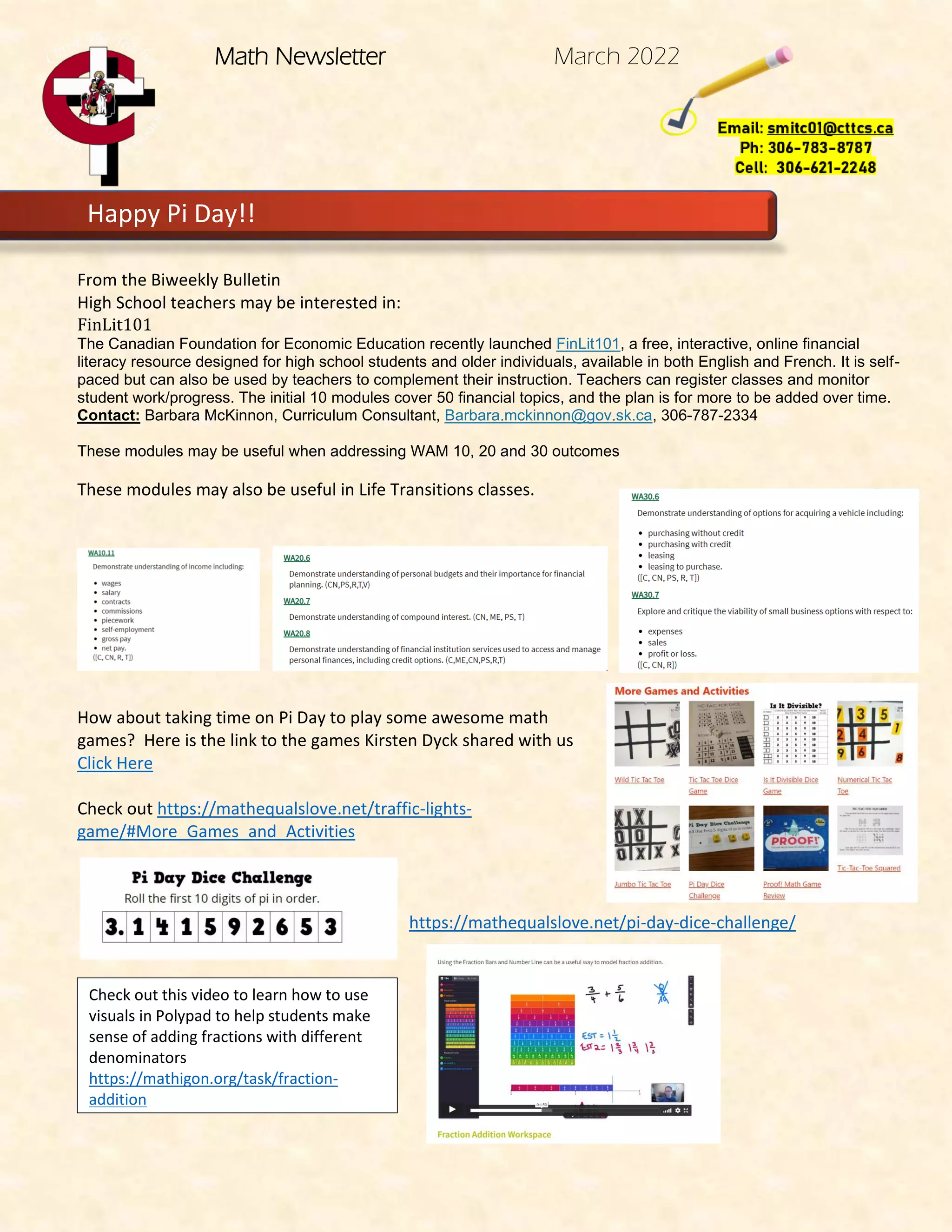
From the Biweekly Bulletin
High School teachers may be interested in:
FinLit101
The Canadian Foundation for Economic Education recently launched FinLit101, a free, interactive, online financial
literacy resource designed for high school students and older individuals, available in both English and French. It is self-
paced but can also be used by teachers to complement their instruction. Teachers can register classes and monitor
student work/progress. The initial 10 modules cover 50 financial topics, and the plan is for more to be added over time.
Contact: Barbara McKinnon, Curriculum Consultant, Barbara.mckinnon@gov.sk.ca, 306-787-2334
These modules may be useful when addressing WAM 10, 20 and 30 outcomes
These modules may also be useful in Life Transitions classes.
How about taking time on Pi Day to play some awesome math
games? Here is the link to the games Kirsten Dyck shared with us
Click Here
Check out https://mathequalslove.net/traffic-lights-
game/#More_Games_and_Activities
https://mathequalslove.net/pi-day-dice-challenge/
Math Newsletter March 2022
Happy Pi Day!!
Check out this video to learn how to use
visuals in Polypad to help students make
sense of adding fractions with different
denominators
https://mathigon.org/task/fraction-
addition
Thanks to Jenn Angove for submitting this!
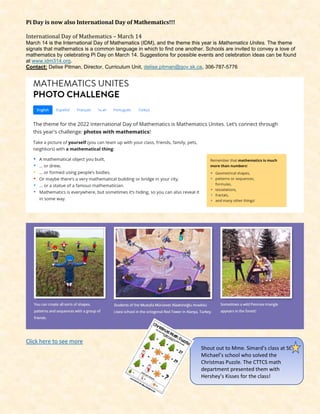
Pi Day is now also International Day of Mathematics!!!
International Day of Mathematics – March 14
March 14 is the International Day of Mathematics (IDM), and the theme this year is Mathematics Unites. The theme
signals that mathematics is a common language in which to find one another. Schools are invited to convey a love of
mathematics by celebrating Pi Day on March 14. Suggestions for possible events and celebration ideas can be found
at www.idm314.org.
Contact: Delise Pitman, Director, Curriculum Unit, delise.pitman@gov.sk.ca, 306-787-5776
Click here to see more
Shout out to Mme. Simard’s class at St.
Michael’s school who solved the
Christmas Puzzle. The CTTCS math
department presented them with
Hershey’s Kisses for the class!
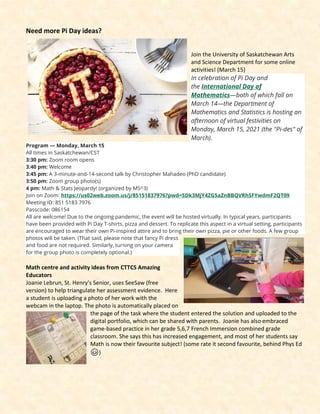
Need more Pi Day ideas?
Join the University of Saskatchewan Arts
and Science Department for some online
activities! (March 15)
In celebration of Pi Day and
the International Day of
Mathematics—both of which fall on
March 14—the Department of
Mathematics and Statistics is hosting an
afternoon of virtual festivities on
Monday, March 15, 2021 (the "Pi-des" of
March).
Program — Monday, March 15
All times in Saskatchewan/CST
3:30 pm: Zoom room opens
3:40 pm: Welcome
3:45 pm: A 3-minute-and-14-second talk by Christopher Mahadeo (PhD candidate)
3:50 pm: Zoom group photo(s)
4 pm: Math & Stats Jeopardy! (organized by MS^3)
Join on Zoom: https://us02web.zoom.us/j/85151837976?pwd=SDk3MjY4ZG5aZnBBQVRhSFYwdmF2QT09
Meeting ID: 851 5183 7976
Passcode: 086154
All are welcome! Due to the ongoing pandemic, the event will be hosted virtually. In typical years, participants
have been provided with Pi Day T-shirts, pizza and dessert. To replicate this aspect in a virtual setting, participants
are encouraged to wear their own Pi-inspired attire and to bring their own pizza, pie or other foods. A few group
photos will be taken. (That said, please note that fancy Pi dress
and food are not required. Similarly, turning on your camera
for the group photo is completely optional.)
Math centre and activity ideas from CTTCS Amazing
Educators
Joanie Lebrun, St. Henry’s Senior, uses SeeSaw (free
version) to help triangulate her assessment evidence. Here
a student is uploading a photo of her work with the
webcam in the laptop. The photo is automatically placed on
the page of the task where the student entered the solution and uploaded to the
digital portfolio, which can be shared with parents. Joanie has also embraced
game-based practice in her grade 5,6,7 French Immersion combined grade
classroom. She says this has increased engagement, and most of her students say
Math is now their favourite subject! (some rate it second favourite, behind Phys Ed
😊)
Some of Joanie’s favourite games (In French!) https://laclassedemallory.net/2017/04/26/bataille-de-
fractions/#more-2229 and https://www.learn-with-math-games.com/division-games.html
A couple of Joanie’s favourite resources for meaningful math games: (click image for link)
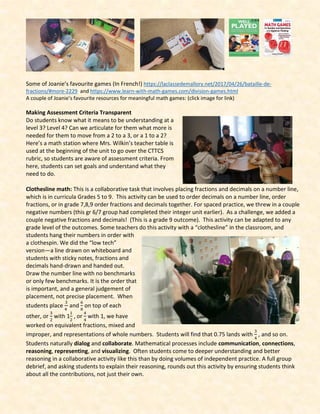
Making Assessment Criteria Transparent
Do students know what it means to be understanding at a
level 3? Level 4? Can we articulate for them what more is
needed for them to move from a 2 to a 3, or a 1 to a 2?
Here’s a math station where Mrs. Wilkin’s teacher table is
used at the beginning of the unit to go over the CTTCS
rubric, so students are aware of assessment criteria. From
here, students can set goals and understand what they
need to do.
Clothesline math: This is a collaborative task that involves placing fractions and decimals on a number line,
which is in curricula Grades 5 to 9. This activity can be used to order decimals on a number line, order
fractions, or in grade 7,8,9 order fractions and decimals together. For spaced practice, we threw in a couple
negative numbers (this gr 6/7 group had completed their integer unit earlier). As a challenge, we added a
couple negative fractions and decimals! (This is a grade 9 outcome). This activity can be adapted to any
grade level of the outcomes. Some teachers do this activity with a “clothesline” in the classroom, and
students hang their numbers in order with
a clothespin. We did the “low tech”
version—a line drawn on whiteboard and
students with sticky notes, fractions and
decimals hand-drawn and handed out.
Draw the number line with no benchmarks
or only few benchmarks. It is the order that
is important, and a general judgement of
placement, not precise placement. When
students place
3
4
and
6
8
on top of each
other, or
3
2
with 1
1
2
, or
4
4
with 1, we have
worked on equivalent fractions, mixed and
improper, and representations of whole numbers. Students will find that 0.75 lands with
3
4
, and so on.
Students naturally dialog and collaborate. Mathematical processes include communication, connections,
reasoning, representing, and visualizing. Often students come to deeper understanding and better
reasoning in a collaborative activity like this than by doing volumes of independent practice. A full group
debrief, and asking students to explain their reasoning, rounds out this activity by ensuring students think
about all the contributions, not just their own.
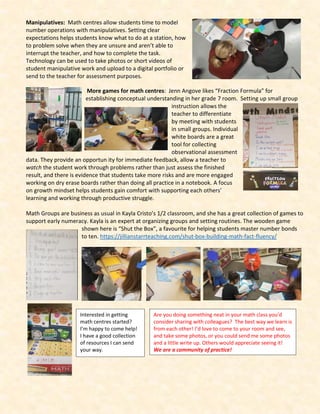
Manipulatives: Math centres allow students time to model
number operations with manipulatives. Setting clear
expectations helps students know what to do at a station, how
to problem solve when they are unsure and aren’t able to
interrupt the teacher, and how to complete the task.
Technology can be used to take photos or short videos of
student manipulative work and upload to a digital portfolio or
send to the teacher for assessment purposes.
More games for math centres: Jenn Angove likes “Fraction Formula” for
establishing conceptual understanding in her grade 7 room. Setting up small group
instruction allows the
teacher to differentiate
by meeting with students
in small groups. Individual
white boards are a great
tool for collecting
observational assessment
data. They provide an opportun ity for immediate feedback, allow a teacher to
watch the student work through problems rather than just assess the finished
result, and there is evidence that students take more risks and are more engaged
working on dry erase boards rather than doing all practice in a notebook. A focus
on growth mindset helps students gain comfort with supporting each others’
learning and working through productive struggle.
Math Groups are business as usual in Kayla Cristo’s 1/2 classroom, and she has a great collection of games to
support early numeracy. Kayla is an expert at organizing groups and setting routines. The wooden game
shown here is “Shut the Box”, a favourite for helping students master number bonds
to ten. https://jillianstarrteaching.com/shut-box-building-math-fact-fluency/
Are you doing something neat in your math class you’d
consider sharing with colleagues? The best way we learn is
from each other! I’d love to come to your room and see,
and take some photos, or you could send me some photos
and a little write up. Others would appreciate seeing it!
We are a community of practice!
Interested in getting
math centres started?
I’m happy to come help!
I have a good collection
of resources I can send
your way.
Why manipulatives? First, they build
the conceptual understanding. Some
students easily go to the procedural
math and don’t “need” the
manipulatives (or so we think)
.but:
Sometimes what is simple to do as a
procedure can be complex to model, and
with procedure alone we don’t think as
deeply about the mathematics. Second,
they highlight relationships that we will
draw on later. Some students really
benefit from algebra tiles
but not as
much if they haven’t seen area models
with base ten blocks in middle years—
and that can have a lot to do with
understanding binomial squares,
trinomial factoring, and completing the
square. Third, emerging research on
how memories form in the brain indicate
that memories are multifaceted. Each
memory is coded with physical
experiences, and all senses involved in
the experience. The more senses we involve in teaching math, the more solidly we build memory, and
improve recall. Collaborative experiences, movement, textures, and hands on experiences create more
robust memories of mathematical content.
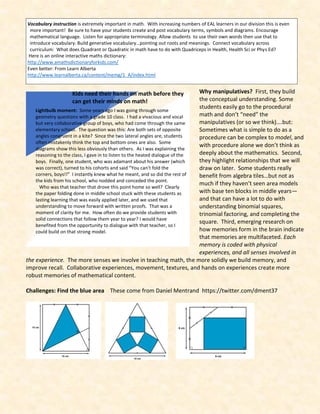
Challenges: Find the blue area These come from Daniel Mentrand https://twitter.com/dment37
Vocabulary instruction is extremely important in math. With increasing numbers of EAL learners in our division this is even
more important! Be sure to have your students create and post vocabulary terms, symbols and diagrams. Encourage
mathematical language. Listen for appropriate terminology. Allow students to use their own words then use that to
introduce vocabulary. Build generative vocabulary
pointing out roots and meanings. Connect vocabulary across
curriculum: What does Quadrant or Quadratic in math have to do with Quadriceps in Health, Health Sci or Phys Ed?
Here is an online interactive maths dictionary:
http://www.amathsdictionaryforkids.com/
Even better: From Learn Alberta
http://www.learnalberta.ca/content/memg/1_A/index.html
Lightbulb moment: Some years ago I was going through some
geometry questions with a grade 10 class. I had a vivacious and vocal
but very collaborative group of boys, who had come through the same
elementary school. The question was this: Are both sets of opposite
angles congruent in a kite? Since the two lateral angles are, students
often mistakenly think the top and bottom ones are also. Some
diagrams show this less obviously than others. As I was explaining the
reasoning to the class, I gave in to listen to the heated dialogue of the
boys. Finally, one student, who was adamant about his answer (which
was correct), turned to his cohorts and said “You can’t fold the
corners, boys!!” I instantly knew what he meant, and so did the rest of
the kids from his school, who nodded and conceded the point.
Who was that teacher that drove this point home so well? Clearly
the paper folding done in middle school stuck with these students as
lasting learning that was easily applied later, and we used that
understanding to move forward with written proofs. That was a
moment of clarity for me. How often do we provide students with
solid connections that follow them year to year? I would have
benefited from the opportunity to dialogue with that teacher, so I
could build on that strong model.
Kids need their hands on math before they
can get their minds on math!

Newsletter March 2022.pdf

  • 1.
    From the BiweeklyBulletin High School teachers may be interested in: FinLit101 The Canadian Foundation for Economic Education recently launched FinLit101, a free, interactive, online financial literacy resource designed for high school students and older individuals, available in both English and French. It is self- paced but can also be used by teachers to complement their instruction. Teachers can register classes and monitor student work/progress. The initial 10 modules cover 50 financial topics, and the plan is for more to be added over time. Contact: Barbara McKinnon, Curriculum Consultant, Barbara.mckinnon@gov.sk.ca, 306-787-2334 These modules may be useful when addressing WAM 10, 20 and 30 outcomes These modules may also be useful in Life Transitions classes. How about taking time on Pi Day to play some awesome math games? Here is the link to the games Kirsten Dyck shared with us Click Here Check out https://mathequalslove.net/traffic-lights- game/#More_Games_and_Activities https://mathequalslove.net/pi-day-dice-challenge/ Math Newsletter March 2022 Happy Pi Day!! Check out this video to learn how to use visuals in Polypad to help students make sense of adding fractions with different denominators https://mathigon.org/task/fraction- addition Thanks to Jenn Angove for submitting this!
  • 2.
    Pi Day isnow also International Day of Mathematics!!! International Day of Mathematics – March 14 March 14 is the International Day of Mathematics (IDM), and the theme this year is Mathematics Unites. The theme signals that mathematics is a common language in which to find one another. Schools are invited to convey a love of mathematics by celebrating Pi Day on March 14. Suggestions for possible events and celebration ideas can be found at www.idm314.org. Contact: Delise Pitman, Director, Curriculum Unit, delise.pitman@gov.sk.ca, 306-787-5776 Click here to see more Shout out to Mme. Simard’s class at St. Michael’s school who solved the Christmas Puzzle. The CTTCS math department presented them with Hershey’s Kisses for the class!
  • 3.
    Need more PiDay ideas? Join the University of Saskatchewan Arts and Science Department for some online activities! (March 15) In celebration of Pi Day and the International Day of Mathematics—both of which fall on March 14—the Department of Mathematics and Statistics is hosting an afternoon of virtual festivities on Monday, March 15, 2021 (the "Pi-des" of March). Program — Monday, March 15 All times in Saskatchewan/CST 3:30 pm: Zoom room opens 3:40 pm: Welcome 3:45 pm: A 3-minute-and-14-second talk by Christopher Mahadeo (PhD candidate) 3:50 pm: Zoom group photo(s) 4 pm: Math & Stats Jeopardy! (organized by MS^3) Join on Zoom: https://us02web.zoom.us/j/85151837976?pwd=SDk3MjY4ZG5aZnBBQVRhSFYwdmF2QT09 Meeting ID: 851 5183 7976 Passcode: 086154 All are welcome! Due to the ongoing pandemic, the event will be hosted virtually. In typical years, participants have been provided with Pi Day T-shirts, pizza and dessert. To replicate this aspect in a virtual setting, participants are encouraged to wear their own Pi-inspired attire and to bring their own pizza, pie or other foods. A few group photos will be taken. (That said, please note that fancy Pi dress and food are not required. Similarly, turning on your camera for the group photo is completely optional.) Math centre and activity ideas from CTTCS Amazing Educators Joanie Lebrun, St. Henry’s Senior, uses SeeSaw (free version) to help triangulate her assessment evidence. Here a student is uploading a photo of her work with the webcam in the laptop. The photo is automatically placed on the page of the task where the student entered the solution and uploaded to the digital portfolio, which can be shared with parents. Joanie has also embraced game-based practice in her grade 5,6,7 French Immersion combined grade classroom. She says this has increased engagement, and most of her students say Math is now their favourite subject! (some rate it second favourite, behind Phys Ed 😊)
  • 4.
    Some of Joanie’sfavourite games (In French!) https://laclassedemallory.net/2017/04/26/bataille-de- fractions/#more-2229 and https://www.learn-with-math-games.com/division-games.html A couple of Joanie’s favourite resources for meaningful math games: (click image for link) Making Assessment Criteria Transparent Do students know what it means to be understanding at a level 3? Level 4? Can we articulate for them what more is needed for them to move from a 2 to a 3, or a 1 to a 2? Here’s a math station where Mrs. Wilkin’s teacher table is used at the beginning of the unit to go over the CTTCS rubric, so students are aware of assessment criteria. From here, students can set goals and understand what they need to do. Clothesline math: This is a collaborative task that involves placing fractions and decimals on a number line, which is in curricula Grades 5 to 9. This activity can be used to order decimals on a number line, order fractions, or in grade 7,8,9 order fractions and decimals together. For spaced practice, we threw in a couple negative numbers (this gr 6/7 group had completed their integer unit earlier). As a challenge, we added a couple negative fractions and decimals! (This is a grade 9 outcome). This activity can be adapted to any grade level of the outcomes. Some teachers do this activity with a “clothesline” in the classroom, and students hang their numbers in order with a clothespin. We did the “low tech” version—a line drawn on whiteboard and students with sticky notes, fractions and decimals hand-drawn and handed out. Draw the number line with no benchmarks or only few benchmarks. It is the order that is important, and a general judgement of placement, not precise placement. When students place 3 4 and 6 8 on top of each other, or 3 2 with 1 1 2 , or 4 4 with 1, we have worked on equivalent fractions, mixed and improper, and representations of whole numbers. Students will find that 0.75 lands with 3 4 , and so on. Students naturally dialog and collaborate. Mathematical processes include communication, connections, reasoning, representing, and visualizing. Often students come to deeper understanding and better reasoning in a collaborative activity like this than by doing volumes of independent practice. A full group debrief, and asking students to explain their reasoning, rounds out this activity by ensuring students think about all the contributions, not just their own.
  • 5.
    Manipulatives: Math centresallow students time to model number operations with manipulatives. Setting clear expectations helps students know what to do at a station, how to problem solve when they are unsure and aren’t able to interrupt the teacher, and how to complete the task. Technology can be used to take photos or short videos of student manipulative work and upload to a digital portfolio or send to the teacher for assessment purposes. More games for math centres: Jenn Angove likes “Fraction Formula” for establishing conceptual understanding in her grade 7 room. Setting up small group instruction allows the teacher to differentiate by meeting with students in small groups. Individual white boards are a great tool for collecting observational assessment data. They provide an opportun ity for immediate feedback, allow a teacher to watch the student work through problems rather than just assess the finished result, and there is evidence that students take more risks and are more engaged working on dry erase boards rather than doing all practice in a notebook. A focus on growth mindset helps students gain comfort with supporting each others’ learning and working through productive struggle. Math Groups are business as usual in Kayla Cristo’s 1/2 classroom, and she has a great collection of games to support early numeracy. Kayla is an expert at organizing groups and setting routines. The wooden game shown here is “Shut the Box”, a favourite for helping students master number bonds to ten. https://jillianstarrteaching.com/shut-box-building-math-fact-fluency/ Are you doing something neat in your math class you’d consider sharing with colleagues? The best way we learn is from each other! I’d love to come to your room and see, and take some photos, or you could send me some photos and a little write up. Others would appreciate seeing it! We are a community of practice! Interested in getting math centres started? I’m happy to come help! I have a good collection of resources I can send your way.
  • 6.
    Why manipulatives? First,they build the conceptual understanding. Some students easily go to the procedural math and don’t “need” the manipulatives (or so we think)
.but: Sometimes what is simple to do as a procedure can be complex to model, and with procedure alone we don’t think as deeply about the mathematics. Second, they highlight relationships that we will draw on later. Some students really benefit from algebra tiles
but not as much if they haven’t seen area models with base ten blocks in middle years— and that can have a lot to do with understanding binomial squares, trinomial factoring, and completing the square. Third, emerging research on how memories form in the brain indicate that memories are multifaceted. Each memory is coded with physical experiences, and all senses involved in the experience. The more senses we involve in teaching math, the more solidly we build memory, and improve recall. Collaborative experiences, movement, textures, and hands on experiences create more robust memories of mathematical content. Challenges: Find the blue area These come from Daniel Mentrand https://twitter.com/dment37 Vocabulary instruction is extremely important in math. With increasing numbers of EAL learners in our division this is even more important! Be sure to have your students create and post vocabulary terms, symbols and diagrams. Encourage mathematical language. Listen for appropriate terminology. Allow students to use their own words then use that to introduce vocabulary. Build generative vocabulary
pointing out roots and meanings. Connect vocabulary across curriculum: What does Quadrant or Quadratic in math have to do with Quadriceps in Health, Health Sci or Phys Ed? Here is an online interactive maths dictionary: http://www.amathsdictionaryforkids.com/ Even better: From Learn Alberta http://www.learnalberta.ca/content/memg/1_A/index.html Lightbulb moment: Some years ago I was going through some geometry questions with a grade 10 class. I had a vivacious and vocal but very collaborative group of boys, who had come through the same elementary school. The question was this: Are both sets of opposite angles congruent in a kite? Since the two lateral angles are, students often mistakenly think the top and bottom ones are also. Some diagrams show this less obviously than others. As I was explaining the reasoning to the class, I gave in to listen to the heated dialogue of the boys. Finally, one student, who was adamant about his answer (which was correct), turned to his cohorts and said “You can’t fold the corners, boys!!” I instantly knew what he meant, and so did the rest of the kids from his school, who nodded and conceded the point. Who was that teacher that drove this point home so well? Clearly the paper folding done in middle school stuck with these students as lasting learning that was easily applied later, and we used that understanding to move forward with written proofs. That was a moment of clarity for me. How often do we provide students with solid connections that follow them year to year? I would have benefited from the opportunity to dialogue with that teacher, so I could build on that strong model. Kids need their hands on math before they can get their minds on math!