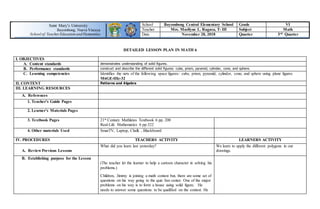
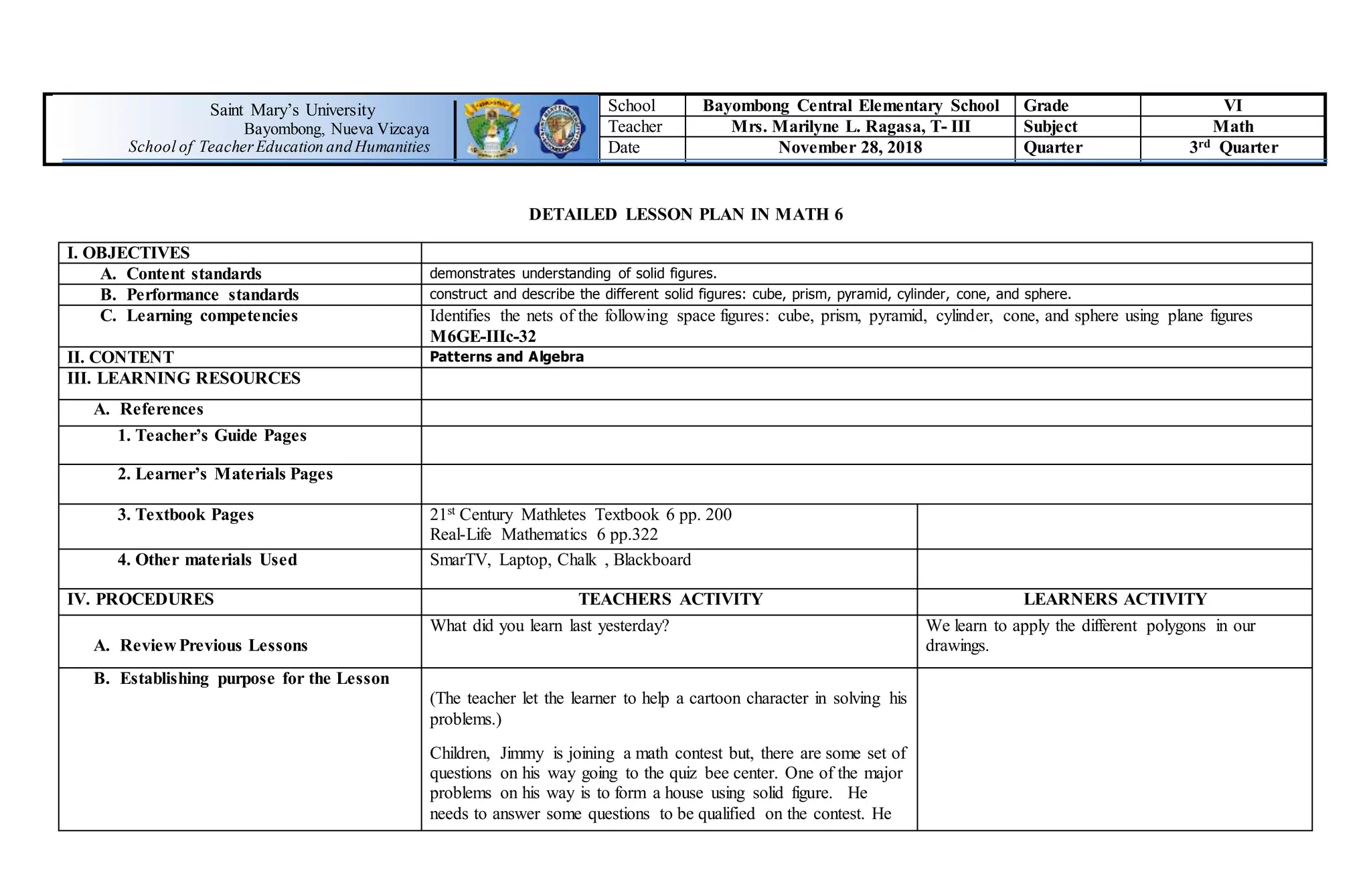
School Bayombong Central Elementary School Grade VI
Teacher Mrs. Marilyne L. Ragasa, T- III Subject Math
Date November 28, 2018 Quarter 3rd Quarter
DETAILED LESSON PLAN IN MATH 6
I. OBJECTIVES
A. Content standards demonstrates understanding of solid figures.
B. Performance standards construct and describe the different solid figures: cube, prism, pyramid, cylinder, cone, and sphere.
C. Learning competencies Identifies the nets of the following space figures: cube, prism, pyramid, cylinder, cone, and sphere using plane figures
M6GE-IIIc-32
II. CONTENT Patterns and Algebra
III. LEARNING RESOURCES
A. References
1. Teacher’s Guide Pages
2. Learner’s Materials Pages
3. Textbook Pages 21st Century Mathletes Textbook 6 pp. 200
Real-Life Mathematics 6 pp.322
4. Other materials Used SmarTV, Laptop, Chalk , Blackboard
IV. PROCEDURES TEACHERS ACTIVITY LEARNERS ACTIVITY
A. Review Previous Lessons
What did you learn last yesterday? We learn to apply the different polygons in our
drawings.
B. Establishing purpose for the Lesson
(The teacher let the learner to help a cartoon character in solving his
problems.)
Children, Jimmy is joining a math contest but, there are some set of
questions on his way going to the quiz bee center. One of the major
problems on his way is to form a house using solid figure. He
needs to answer some questions to be qualified on the contest. He
Saint Mary’s University
Bayombong, Nueva Vizcaya
School of TeacherEducation and Humanities
wants us to help him. Do you want to help him?
(the quiz master ask)
Can you tell me some solid figures, in your surroundings?
So what did you know about solid figures?
Ok very good
Our topic for the day is about net of a solid figures
Do you know how to form solid figures?
The learners will give some solid figures.
Figures that have three dimensions such as length,
width, and height.
Yes/No Sir
C. Presenting examples /instances of the
new lessons
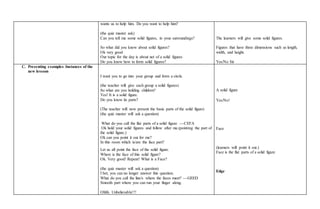
I want you to go into your group and form a circle.
(the teacher will give each group a solid figures)
So what are you holding children?
Yes! It is a solid figure.
Do you know its parts?
(The teacher will now present the basic parts of the solid figure)
(the quiz master will ask a question)
What do you call the flat parts of a solid figure ---CEFA
Ok hold your solid figures and follow after me.(pointing the part of
the solid figure.)
Ok can you point it out for me?
In this room which is/are the face part?
Let us all point the face of the solid figure.
Where is the face of this solid figure?
Ok. Very good! Repeat! What is a Face?
(the quiz master will ask a question)
I bet, you can no longer answer this question.
What do you call the line/s where the faces meet? ---GEED
Smooth part where you can run your finger along.
Ohhh. Unbelievable!!!
A solid figure
Yes/No!
Face
(learners will point it out.)
Face is the flat parts of a solid figure
Edge
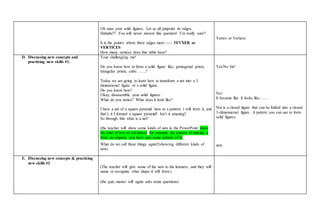
Ok raise your solid figures. Let us all pinpoint its edges.
Hahaha!!! You will never answer this question! I’m really sure!!
It is the point/s where three edges meet.----- TEVXER or
VERTICES
How many vertices does this table have?
Vertex or Vertices
D. Discussing new concepts and
practicing new skills #1.
Your challenging me!
Do you know how to form a solid figure like, pentagonal prism,
triangular prism, cube…….?
Today we are going to learn how to transform a net into a 3
dimensional figure or a solid figure.
Do you know how?
Okay, disassemble your solid figures.
What do you notice? What does it look like?
I have a net of a square pyramid here or a pattern. I will form it, and
that’s it I formed a square pyramid! Isn’t it amazing?
So through this what is a net?
(the teacher will show some kinds of nets in the PowerPoint show
the kind of box of calculator) for example the pattern of making a
boat, an origami, you have also some pattern of it)
What do we call these things again?(showing different kinds of
nets)
Yes/No Sir!
No!
It became flat. It looks like…….
Net is a closed figure that can be folded into a closed
3-dimensional figure. A pattern you can use to form
solid figures.
nets
E. Discussing new concepts & practicing
new skills #2
(The teacher will give some of the nets to the learners, and they will
name or recognize what shape it will form.)
(the quiz master will again asks some questions)
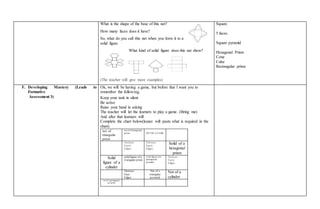
What is the shape of the base of this net?
How many faces does it have?
So, what do you call this net when you form it to a
solid figure
What kind of solid figure does this net show?
(The teacher will give more examples)
Square
5 faces.
Square pyramid
Hexagonal Prism
Cone
Cube
Rectangular prism
F. Developing Mastery (Leads to
Formative
Assessment 3)
Ok, we will be having a game, but before that I want you to
remember the following.
Keep your task in silent
Be active
Raise your hand in asking
The teacher will let the learners to play a game. (Bring me)
And after that learners will
Complete the chart below(leaner will paste what is required in the
chart)
net of
triangular
prism
net of a hexagonal
prism NET OF A CUBE
Vertices:
Faces:
Edges:
Vertices:
Faces:
Edges:
Solid of a
hexagonal
prism
Solid
figure of a
cylinder
solidfigure of a
triangular prism
solid figure ofa
pentagonal
pyramid
Vertices:
Faces:
Edges:
Vertices:
Face:
Edges:
Net of s
triangular
pyramid
Net of a
cylinder
net of a pentagonal
pyramid
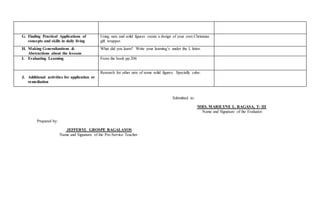
G. Finding Practical Applications of
concepts and skills in daily living
Using nets and solid figures create a design of your own Christmas
gift wrapper.
H. Making Generalizations &
Abstractions about the lessons
What did you learn? Write your learning’s under the L letter.
I. Evaluating Learning From the book pp.206
J. Additional activities for application or
remediation
Research for other nets of some solid figures. Specially cube.
Submitted to:
MRS. MARILYNE L. RAGASA, T- III
Name and Signature of the Evaluator
Prepared by:
JEFFERYL GROSPE BAGALAYOS
Name and Signature of the Pre-Service Teacher

Solid figures

  • 1.
    School Bayombong CentralElementary School Grade VI Teacher Mrs. Marilyne L. Ragasa, T- III Subject Math Date November 28, 2018 Quarter 3rd Quarter DETAILED LESSON PLAN IN MATH 6 I. OBJECTIVES A. Content standards demonstrates understanding of solid figures. B. Performance standards construct and describe the different solid figures: cube, prism, pyramid, cylinder, cone, and sphere. C. Learning competencies Identifies the nets of the following space figures: cube, prism, pyramid, cylinder, cone, and sphere using plane figures M6GE-IIIc-32 II. CONTENT Patterns and Algebra III. LEARNING RESOURCES A. References 1. Teacher’s Guide Pages 2. Learner’s Materials Pages 3. Textbook Pages 21st Century Mathletes Textbook 6 pp. 200 Real-Life Mathematics 6 pp.322 4. Other materials Used SmarTV, Laptop, Chalk , Blackboard IV. PROCEDURES TEACHERS ACTIVITY LEARNERS ACTIVITY A. Review Previous Lessons What did you learn last yesterday? We learn to apply the different polygons in our drawings. B. Establishing purpose for the Lesson (The teacher let the learner to help a cartoon character in solving his problems.) Children, Jimmy is joining a math contest but, there are some set of questions on his way going to the quiz bee center. One of the major problems on his way is to form a house using solid figure. He needs to answer some questions to be qualified on the contest. He Saint Mary’s University Bayombong, Nueva Vizcaya School of TeacherEducation and Humanities
  • 2.
    wants us tohelp him. Do you want to help him? (the quiz master ask) Can you tell me some solid figures, in your surroundings? So what did you know about solid figures? Ok very good Our topic for the day is about net of a solid figures Do you know how to form solid figures? The learners will give some solid figures. Figures that have three dimensions such as length, width, and height. Yes/No Sir C. Presenting examples /instances of the new lessons I want you to go into your group and form a circle. (the teacher will give each group a solid figures) So what are you holding children? Yes! It is a solid figure. Do you know its parts? (The teacher will now present the basic parts of the solid figure) (the quiz master will ask a question) What do you call the flat parts of a solid figure ---CEFA Ok hold your solid figures and follow after me.(pointing the part of the solid figure.) Ok can you point it out for me? In this room which is/are the face part? Let us all point the face of the solid figure. Where is the face of this solid figure? Ok. Very good! Repeat! What is a Face? (the quiz master will ask a question) I bet, you can no longer answer this question. What do you call the line/s where the faces meet? ---GEED Smooth part where you can run your finger along. Ohhh. Unbelievable!!! A solid figure Yes/No! Face (learners will point it out.) Face is the flat parts of a solid figure Edge
  • 3.
    Ok raise yoursolid figures. Let us all pinpoint its edges. Hahaha!!! You will never answer this question! I’m really sure!! It is the point/s where three edges meet.----- TEVXER or VERTICES How many vertices does this table have? Vertex or Vertices D. Discussing new concepts and practicing new skills #1. Your challenging me! Do you know how to form a solid figure like, pentagonal prism, triangular prism, cube…….? Today we are going to learn how to transform a net into a 3 dimensional figure or a solid figure. Do you know how? Okay, disassemble your solid figures. What do you notice? What does it look like? I have a net of a square pyramid here or a pattern. I will form it, and that’s it I formed a square pyramid! Isn’t it amazing? So through this what is a net? (the teacher will show some kinds of nets in the PowerPoint show the kind of box of calculator) for example the pattern of making a boat, an origami, you have also some pattern of it) What do we call these things again?(showing different kinds of nets) Yes/No Sir! No! It became flat. It looks like……. Net is a closed figure that can be folded into a closed 3-dimensional figure. A pattern you can use to form solid figures. nets E. Discussing new concepts & practicing new skills #2 (The teacher will give some of the nets to the learners, and they will name or recognize what shape it will form.) (the quiz master will again asks some questions)
  • 4.
    What is theshape of the base of this net? How many faces does it have? So, what do you call this net when you form it to a solid figure What kind of solid figure does this net show? (The teacher will give more examples) Square 5 faces. Square pyramid Hexagonal Prism Cone Cube Rectangular prism F. Developing Mastery (Leads to Formative Assessment 3) Ok, we will be having a game, but before that I want you to remember the following. Keep your task in silent Be active Raise your hand in asking The teacher will let the learners to play a game. (Bring me) And after that learners will Complete the chart below(leaner will paste what is required in the chart) net of triangular prism net of a hexagonal prism NET OF A CUBE Vertices: Faces: Edges: Vertices: Faces: Edges: Solid of a hexagonal prism Solid figure of a cylinder solidfigure of a triangular prism solid figure ofa pentagonal pyramid Vertices: Faces: Edges: Vertices: Face: Edges: Net of s triangular pyramid Net of a cylinder net of a pentagonal pyramid
  • 5.
    G. Finding PracticalApplications of concepts and skills in daily living Using nets and solid figures create a design of your own Christmas gift wrapper. H. Making Generalizations & Abstractions about the lessons What did you learn? Write your learning’s under the L letter. I. Evaluating Learning From the book pp.206 J. Additional activities for application or remediation Research for other nets of some solid figures. Specially cube. Submitted to: MRS. MARILYNE L. RAGASA, T- III Name and Signature of the Evaluator Prepared by: JEFFERYL GROSPE BAGALAYOS Name and Signature of the Pre-Service Teacher