Teaching Listening Understanding the Listening Process
Perspectives on Listening  Listening as a skill Listening as a product Listening as a process
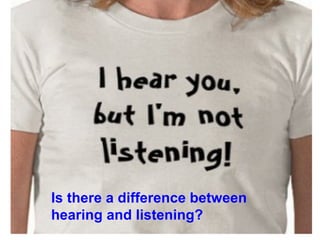
Is there a difference between hearing and listening?
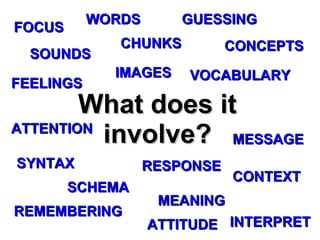
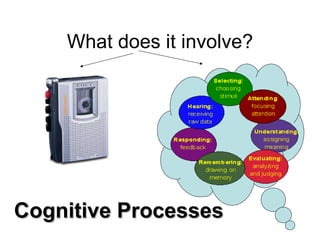
What does it involve? IMAGES WORDS SOUNDS CONCEPTS SYNTAX SCHEMA MESSAGE MEANING FEELINGS RESPONSE REMEMBERING INTERPRET VOCABULARY FOCUS GUESSING ATTENTION CONTEXT CHUNKS ATTITUDE
An Activity To Understand Language Processing Monitoring Your Own Listening Processes
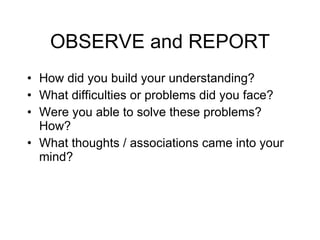
OBSERVE and REPORT How did you build your understanding? What difficulties or problems did you face?  Were you able to solve these problems? How? What thoughts / associations came into your mind?
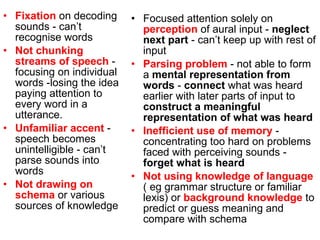
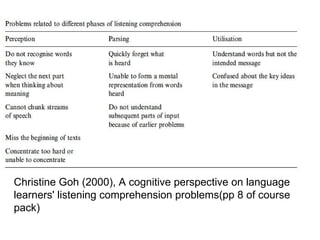
Fixation  on decoding sounds - can’t recognise words  Not chunking streams of speech  - focusing on individual words - losing the idea paying attention to every word in a utterance. Unfamiliar accent  - speech becomes unintelligible - can’t parse sounds into words Not drawing on schema  or various sources of knowledge  Focused attention solely on  perception  of aural input -  neglect next part  - can’t keep up with rest of input Parsing problem  - not able to form a  mental representation from words  -  connect  what was heard earlier with later parts of input to  construct a meaningful representation of what was heard Inefficient use of memory  - concentrating too hard on problems faced with perceiving sounds -  forget what is heard Not using knowledge of language  ( eg grammar structure or familiar lexis) or  background knowledge  to predict or guess meaning and compare with schema
Christine Goh (2000), A cognitive perspective on language  learners' listening comprehension problems(pp 8 of course pack)
What does it involve? Cognitive Processes
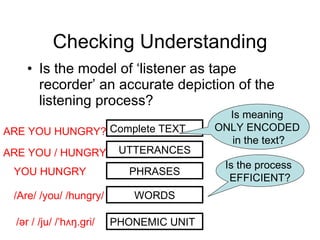
Checking Understanding Is the model of ‘listener as tape recorder’ an accurate depiction of the listening process? PHONEMIC UNIT WORDS PHRASES UTTERANCES Complete TEXT /ər / /ju/ / ˈ h ʌ ŋ.gri/   /Are/ /you/ /hungry/   YOU HUNGRY ARE YOU / HUNGRY   ARE YOU HUNGRY?   Is meaning  ONLY ENCODED  in the text? Is the process  EFFICIENT?
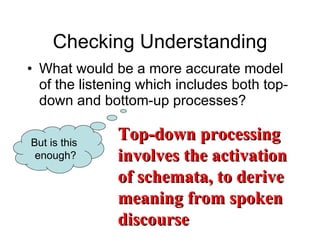
Checking Understanding What would be a more accurate model of the listening which includes both top-down and bottom-up processes? But is this  enough? Top-down processing involves the activation of schemata, to derive meaning from spoken discourse
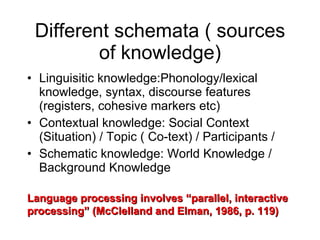
Different schemata ( sources of knowledge) Linguisitic knowledge:Phonology/lexical knowledge, syntax, discourse features (registers, cohesive markers etc) Contextual knowledge: Social Context (Situation) / Topic ( Co-text) / Participants /  Schematic knowledge: World Knowledge / Background Knowledge Language processing involves “parallel, interactive  processing” (McClelland and Elman, 1986, p. 119)
Understanding Top-down and Bottom-up Processing QUIZ TIME: Go to your course website and look at Mini Quiz: Understanding Listening Processes at the bottom of the Lesson Page. Click See Assignment.
Listening as a Process Cognitive Perspective - how aural input is processed Perception / Parsing / Utilisation (p 8) Top-down and Bottom-up Processing
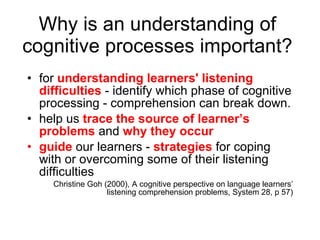
Why is an understanding of cognitive processes important? for  understanding learners' listening difficulties  - identify which phase of cognitive processing - comprehension can break down.  help us  trace the source of learner’s problems  and  why they occur   guide  our learners -  strategies  for coping with or overcoming some of their listening difficulties Christine Goh (2000), A cognitive perspective on language learners’ listening comprehension problems, System 28, p 57)
What factors could cause difficulties in listening? Download a copy of  Handout 1  from Lesson 3 in our course website. Read through the list of listening problems described by the students. Discuss in your groups and fill in column 2 and 3.
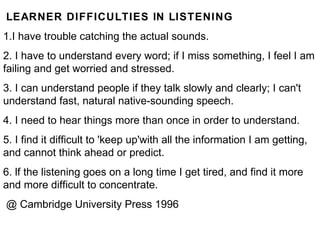
LEARNER DIFFICULTIES lN LISTENING   1.I have trouble catching the actual sounds. 2. I have to understand every word; if I miss something, I feel I am failing and get worried and stressed.  3. I can understand people if they talk slowly and clearly; I can't understand fast, natural native-sounding speech.  4. I need to hear things more than once in order to understand.  5. I find it difficult to 'keep up'with all the information I am getting, and cannot think ahead or predict.  6. lf the listening goes on a long time I get tired, and find it more and more difficult to concentrate. @ Cambridge University Press 1996
Listening as a skill Purposeful Listening (pg 7) Why is listening considered a complex skill? Does it involve just understanding what words mean? Why is it important to consider the different purposes for listening?
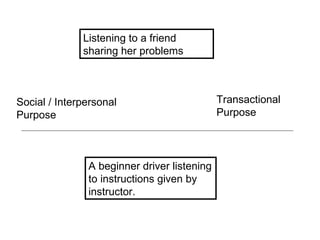
Social / Interpersonal Purpose Transactional Purpose A beginner driver listening to instructions given by instructor. Listening to a friend sharing her problems
Listening Comprehension Skills Listening for details Listening for gist Drawing inferences Listening selectively Making predictions
How to develop listening skills? Through teaching students listening strategies - LEARNING to LISTEN important that they learn to adopt listening strategies that can assist or enhance their comprehension Cognitive, Metacognitive and Social-Affective strategies
Cognitive strategies -  act directly on the input to make sense of it Metacognitive strategies - manage cognitive processes and difficulties during listening social strategies - involve other people in achieving understanding Affective strategies - manage unproductive emotions during comprehension.
Why Teach Strategies? AWARENESS of difficulties  -  to  think  about how their cognitive processes could be affected and WHEN comprehension could potentially break down - develop  greater responsibility for own learning  and in long-run  greater independence and autonomy  Help them  SEE  that difficulties encountered  CAN BE solved  or dealt with in a systematic way - develop their  self-confidence, problem-solving behaviour and right attitude  towards learning difficulties and problem-solving - stop blaming difficulties on task
Why Teach Strategies? increased metacognitive awareness about their learning processes - take a  more active part  in overcoming some of their listening difficulties, rather than accept all their problems as unavoidable and insurmountable ( avoid LEARNED HELPLESSNESS )
How to raise learners’ awareness about learning to listen? set aside lesson time for discussion and reports about listening problems and useful strategies encourage students to `think aloud' soon after they have completed a listening task provide opportunities for individual reaction through listening diaries extend the scope of pre-listening and post-listening tasks to include metacognitive tasks. Christine Goh (2000), A cognitive perspective on language learners' listening comprehension problems ( pp 73)
Listening as a Product Outcomes (p 11) - what listeners can DO  Demonstrate understanding Verbal or non-verbal / Multimodal Why is this important? Listening - invisible process  Product - evidence of learning  Provide feedback for T and S - AFL - progress made - diagnose problem areas and help T design follow-up lesson and for S to set learning goals - develp strategies to overcome problem
 
EL SYLLABUS 2010 Teaching Listening and Viewing Implications for Teaching: Outcomes, Focus Areas and Aims
What should teachers strive to do? To develop competent and critical listeners: Model  positive listening  attitudes and behaviour .  (DISPOSITION) Guide  pupils in  constructing meaning  from a variety of spoken, audio and visual texts, beginning with the perception and recognition of sounds and words in context.  (SKILLS/STRATEGIES)
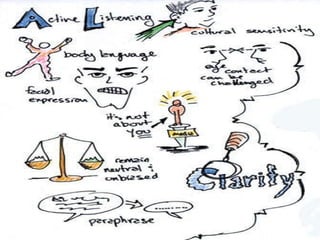
Help  pupils develop  active listening and viewing skills , that is, to listen/ view for details and listen for the gist, make inferences, make predictions and listen selectively.  (SKILLS/STRATEGIES) Scaffold  and  Model  the learning of  critical listening and viewing skills  through the use of  strategies  and activities.  (SKILLS/STRATEGIES) Provide  opportunities  for pupils to listen to and view a  variety of spoken, audio and visual texts  for  appreciation, enjoyment and personal development  (EXTENSIVE VIEWING / LISTENING)
Learning and Teaching Principles Effective listening must be  AUTOMATIC and EFFICIENT  - fast, natural speech esp interactive / reciprocal listening ( eg conversations) Listening to understand meaning is NOT about understanding what words and sentences mean -  UNDERSTAND what SPEAKERS MEAN  -  PRAGMATIC/SOCIAL  meaning -  INFERENTIAL PROCESS PURPOSE  for listening also affects the processes / sources of knowledge we use.
Learning and Teaching Principles Knowledge about Language ( eg what word means or whether it is noun or adjective) is important BUT knowing  HOW TO USE  this knowledge of language ( eg quickly access meaning of word) to develop  INTERPRETATIONS  is MORE important.
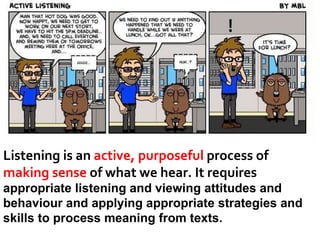
Listening is an  active, purposeful  process of  making sense  of what we hear. It requires  appropriate listening and viewing attitudes and behaviour and applying appropriate strategies and skills to process meaning from texts.
 

Understanding Listening Tutorial 2

  • 1.
    Teaching Listening Understandingthe Listening Process
  • 2.
    Perspectives on Listening Listening as a skill Listening as a product Listening as a process
  • 3.
    Is there adifference between hearing and listening?
  • 4.
    What does itinvolve? IMAGES WORDS SOUNDS CONCEPTS SYNTAX SCHEMA MESSAGE MEANING FEELINGS RESPONSE REMEMBERING INTERPRET VOCABULARY FOCUS GUESSING ATTENTION CONTEXT CHUNKS ATTITUDE
  • 5.
    An Activity ToUnderstand Language Processing Monitoring Your Own Listening Processes
  • 6.
    OBSERVE and REPORTHow did you build your understanding? What difficulties or problems did you face? Were you able to solve these problems? How? What thoughts / associations came into your mind?
  • 7.
    Fixation ondecoding sounds - can’t recognise words Not chunking streams of speech - focusing on individual words - losing the idea paying attention to every word in a utterance. Unfamiliar accent - speech becomes unintelligible - can’t parse sounds into words Not drawing on schema or various sources of knowledge Focused attention solely on perception of aural input - neglect next part - can’t keep up with rest of input Parsing problem - not able to form a mental representation from words - connect what was heard earlier with later parts of input to construct a meaningful representation of what was heard Inefficient use of memory - concentrating too hard on problems faced with perceiving sounds - forget what is heard Not using knowledge of language ( eg grammar structure or familiar lexis) or background knowledge to predict or guess meaning and compare with schema
  • 8.
    Christine Goh (2000),A cognitive perspective on language learners' listening comprehension problems(pp 8 of course pack)
  • 9.
    What does itinvolve? Cognitive Processes
  • 10.
    Checking Understanding Isthe model of ‘listener as tape recorder’ an accurate depiction of the listening process? PHONEMIC UNIT WORDS PHRASES UTTERANCES Complete TEXT /ər / /ju/ / ˈ h ʌ ŋ.gri/ /Are/ /you/ /hungry/ YOU HUNGRY ARE YOU / HUNGRY ARE YOU HUNGRY? Is meaning ONLY ENCODED in the text? Is the process EFFICIENT?
  • 11.
    Checking Understanding Whatwould be a more accurate model of the listening which includes both top-down and bottom-up processes? But is this enough? Top-down processing involves the activation of schemata, to derive meaning from spoken discourse
  • 12.
    Different schemata (sources of knowledge) Linguisitic knowledge:Phonology/lexical knowledge, syntax, discourse features (registers, cohesive markers etc) Contextual knowledge: Social Context (Situation) / Topic ( Co-text) / Participants / Schematic knowledge: World Knowledge / Background Knowledge Language processing involves “parallel, interactive processing” (McClelland and Elman, 1986, p. 119)
  • 13.
    Understanding Top-down andBottom-up Processing QUIZ TIME: Go to your course website and look at Mini Quiz: Understanding Listening Processes at the bottom of the Lesson Page. Click See Assignment.
  • 14.
    Listening as aProcess Cognitive Perspective - how aural input is processed Perception / Parsing / Utilisation (p 8) Top-down and Bottom-up Processing
  • 15.
    Why is anunderstanding of cognitive processes important? for understanding learners' listening difficulties - identify which phase of cognitive processing - comprehension can break down. help us trace the source of learner’s problems and why they occur guide our learners - strategies for coping with or overcoming some of their listening difficulties Christine Goh (2000), A cognitive perspective on language learners’ listening comprehension problems, System 28, p 57)
  • 16.
    What factors couldcause difficulties in listening? Download a copy of Handout 1 from Lesson 3 in our course website. Read through the list of listening problems described by the students. Discuss in your groups and fill in column 2 and 3.
  • 17.
    LEARNER DIFFICULTIES lNLISTENING 1.I have trouble catching the actual sounds. 2. I have to understand every word; if I miss something, I feel I am failing and get worried and stressed. 3. I can understand people if they talk slowly and clearly; I can't understand fast, natural native-sounding speech. 4. I need to hear things more than once in order to understand. 5. I find it difficult to 'keep up'with all the information I am getting, and cannot think ahead or predict. 6. lf the listening goes on a long time I get tired, and find it more and more difficult to concentrate. @ Cambridge University Press 1996
  • 18.
    Listening as askill Purposeful Listening (pg 7) Why is listening considered a complex skill? Does it involve just understanding what words mean? Why is it important to consider the different purposes for listening?
  • 19.
    Social / InterpersonalPurpose Transactional Purpose A beginner driver listening to instructions given by instructor. Listening to a friend sharing her problems
  • 20.
    Listening Comprehension SkillsListening for details Listening for gist Drawing inferences Listening selectively Making predictions
  • 21.
    How to developlistening skills? Through teaching students listening strategies - LEARNING to LISTEN important that they learn to adopt listening strategies that can assist or enhance their comprehension Cognitive, Metacognitive and Social-Affective strategies
  • 22.
    Cognitive strategies - act directly on the input to make sense of it Metacognitive strategies - manage cognitive processes and difficulties during listening social strategies - involve other people in achieving understanding Affective strategies - manage unproductive emotions during comprehension.
  • 23.
    Why Teach Strategies?AWARENESS of difficulties - to think about how their cognitive processes could be affected and WHEN comprehension could potentially break down - develop greater responsibility for own learning and in long-run greater independence and autonomy Help them SEE that difficulties encountered CAN BE solved or dealt with in a systematic way - develop their self-confidence, problem-solving behaviour and right attitude towards learning difficulties and problem-solving - stop blaming difficulties on task
  • 24.
    Why Teach Strategies?increased metacognitive awareness about their learning processes - take a more active part in overcoming some of their listening difficulties, rather than accept all their problems as unavoidable and insurmountable ( avoid LEARNED HELPLESSNESS )
  • 25.
    How to raiselearners’ awareness about learning to listen? set aside lesson time for discussion and reports about listening problems and useful strategies encourage students to `think aloud' soon after they have completed a listening task provide opportunities for individual reaction through listening diaries extend the scope of pre-listening and post-listening tasks to include metacognitive tasks. Christine Goh (2000), A cognitive perspective on language learners' listening comprehension problems ( pp 73)
  • 26.
    Listening as aProduct Outcomes (p 11) - what listeners can DO Demonstrate understanding Verbal or non-verbal / Multimodal Why is this important? Listening - invisible process Product - evidence of learning Provide feedback for T and S - AFL - progress made - diagnose problem areas and help T design follow-up lesson and for S to set learning goals - develp strategies to overcome problem
  • 27.
  • 28.
    EL SYLLABUS 2010Teaching Listening and Viewing Implications for Teaching: Outcomes, Focus Areas and Aims
  • 29.
    What should teachersstrive to do? To develop competent and critical listeners: Model positive listening attitudes and behaviour . (DISPOSITION) Guide pupils in constructing meaning from a variety of spoken, audio and visual texts, beginning with the perception and recognition of sounds and words in context. (SKILLS/STRATEGIES)
  • 30.
    Help pupilsdevelop active listening and viewing skills , that is, to listen/ view for details and listen for the gist, make inferences, make predictions and listen selectively. (SKILLS/STRATEGIES) Scaffold and Model the learning of critical listening and viewing skills through the use of strategies and activities. (SKILLS/STRATEGIES) Provide opportunities for pupils to listen to and view a variety of spoken, audio and visual texts for appreciation, enjoyment and personal development (EXTENSIVE VIEWING / LISTENING)
  • 31.
    Learning and TeachingPrinciples Effective listening must be AUTOMATIC and EFFICIENT - fast, natural speech esp interactive / reciprocal listening ( eg conversations) Listening to understand meaning is NOT about understanding what words and sentences mean - UNDERSTAND what SPEAKERS MEAN - PRAGMATIC/SOCIAL meaning - INFERENTIAL PROCESS PURPOSE for listening also affects the processes / sources of knowledge we use.
  • 32.
    Learning and TeachingPrinciples Knowledge about Language ( eg what word means or whether it is noun or adjective) is important BUT knowing HOW TO USE this knowledge of language ( eg quickly access meaning of word) to develop INTERPRETATIONS is MORE important.
  • 33.
    Listening is an active, purposeful process of making sense of what we hear. It requires appropriate listening and viewing attitudes and behaviour and applying appropriate strategies and skills to process meaning from texts.
  • 34.