Date: 8-10 January 2010
Venue: H M Patel Institute of English
Training and Research
Vallabh Vidyanagar, Gujarat
Presented by
Dilip Barad
dilipbarad@gmail.com
International Conference on
Interactive Media in Pedagogy:
Learning English In & Beyond
Classrooms
Learning Literature through
Web 2.0 Tools:
Does it really help?
 The initial skepticism regarding the effectiveness
of computer-enabled teaching and learning has
given way to intense exploration and
implementation of such learning technology in
teaching practices in India.
 The focus has shifted from simply describing and
examining computer technology to exploring how
to integrate it more effectively into the teaching
and learning of languages and literatures in order
to enhance learning in contextualized
environment.
 Educators have realized that effective use of
technology can influence student learning.
 This is true so far as language learning is
concerned.
 When we come to teaching of literature, we find
that still technology is not used the way it should
have been.
Limited use of technology in literature
classroom
 Tape recorder
 Video cassette player
 VCD/DVD player
 PPT presentation
 Where are ICT or Web Tools for teaching
literature ?..?..?
 How innovatively are they used? If ever they are
used…
 Does it address pedagogical issues pertaining to
teaching literature through web 2.0 tools?
Experiments in Teaching Literature
through Technology
 BBC production of Shakespearean Tragedies and
Comedies.
 Poem recitation – downloaded from
www.librivox.org.
 Skype for online teaching.
 YouTube videos for selected scenes in
plays/novels and animation movie.
 Film adaptations of novels.
 Websites and Blogs by eminent writers and CALL
experts
BBC production of Shakespearean
Tragedies and Comedies
 Advantages:
 Plays are not for reading but for viewing… how
about performing?!?!?
 Viewing gives better understanding. . .
 The internal conflict of Hamlet
 Anguish and suffering of Macbeth and Lady
Macbeth
 The somber effect of witch scenes in Macbeth
 Play within Play in Hamlet
 Nunnery, bed-chamber, duel scenes in Hamlet
 Night walking scenes in Macbeth
 Gaiety, joviality, comedy, wit – As You Like It
Poem recitation – downloaded from
www.librivox.org
 Advantages:
 Poetry is best enjoyed when listened and recited.
 The sound of the words, musical melody of the
diction…
 Poet‟s own recitation or by native speaker with
sweet, clear voice gives special effect in listening
a poem.
 Language embellished with artistic ornament can
be better felt while listening poem.
 We teach poems of Nissim Ezekiel, Sarojini
Naidu, Eliot, Keats, Donne… Got best results with
Waste Land, Keats‟ Odes, Donne…
Skype for online teaching.
 Prof from Kolkata delivered online lecture on „Old
Man & the Sea to the students of Bhavnagar
University…
 Advantages:
 An expert‟s interaction with students….
 Cost effective – saves money and time in travel
and other itinerary
 Students get exposure to new ideas and creative
ways of criticizing literary text.
YouTube videos for selected scenes
in plays/novels and animation movie.
 Advantages:
 www.youtube.com
 Animation of Novels, short stories, poems, plays .
. .
 Edited scenes of long plays and novels …
 Edgar Allen Poe‟s Short Stories – “the effect is all
important in short stories”
 Instead of watching entire novel or play, it is
better to view selected scenes – youtube helps
in selecting scenes.
 Animation movies are short and sweet version of
literary text – web resources helps…
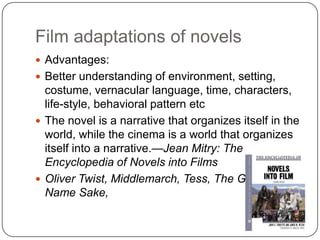
Film adaptations of novels
 Advantages:
 Better understanding of environment, setting,
costume, vernacular language, time, characters,
life-style, behavioral pattern etc
 The novel is a narrative that organizes itself in the
world, while the cinema is a world that organizes
itself into a narrative.—Jean Mitry: The
Encyclopedia of Novels into Films
 Oliver Twist, Middlemarch, Tess, The Guide,
Name Sake,
Blogs by eminent writers, critics and
CALL experts
 There are innumerable blogs by writers/critics…
for instance…
 www.chetanbhagat.com/blog: writers views on
reader/critic‟s comments
 http://sarojinisahoo.blogsopt.com
 http://daily-english-activities.blogspot.com/2009/10/study-classic-
of-literature.html
 Advantages:
 Having interaction with living writer/critic leads
to better understanding of his/her ideas…
Study classic literature through web
resources – an example
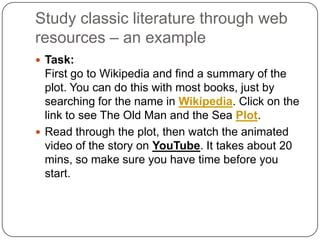
 Task:
First go to Wikipedia and find a summary of the
plot. You can do this with most books, just by
searching for the name in Wikipedia. Click on the
link to see The Old Man and the Sea Plot.
 Read through the plot, then watch the animated
video of the story on YouTube. It takes about 20
mins, so make sure you have time before you
start.
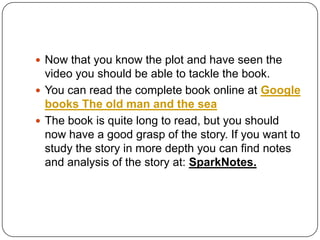
 Now that you know the plot and have seen the
video you should be able to tackle the book.
 You can read the complete book online at Google
books The old man and the sea
 The book is quite long to read, but you should
now have a good grasp of the story. If you want to
study the story in more depth you can find notes
and analysis of the story at: SparkNotes.
Pedagogically speaking…
 Thus, we can identify scientific way of learning
literature through technology…
 We an identify various methods and activities of
teaching literature through technology…
 Its advantages are many…
It seems technology is very helpful…
 „It seems….in reality, it is not‟.
 It is very helpful because we think in terms of
‘Foreign Literature’ …
 If we take „Literature‟ as a whole into
consideration, I mean, regional literature, mother
language literature then….???
Foreign literature – difficulties in
comprehension
 Literature being product of culture, myths and
legends, collective consciousness, society,
environment, time, nation and its people… one
cannot understand literature without
understanding all these aspects which are basic
ingredients of literature…
 These all makes „English Literature‟ difficult to
comprehend…
 A flute player of Vrindavan
 Urubhanga – the Broken Thigh
 On the eve of St. Agnes
 Ode to Psyche
Literatures in regional languages
 Do we need help of technology in comprehension
of regional literature?
 Isn‟t is better understood without any
technological aid?
 Literature is the creative product of human
emotions, feelings, observations, imagination and
fancy.
 Technology kills creative interpretations of
literature.
 The free-play of fancy and imagination is limited
by its adaptations to movie/animation.
 Reading literature cultivates mental capabilities to
think beyond horizons… viewing it limits our
horizons…
 Example: Reading of Kubla Khan. Rhyme of
Ancient Mariner and viewing of Avatar.
 literature is a narrative that organizes itself in the
world - - -it is the word created solely of WORDS.
A few examples from The
Encyclopedia of Novels into Films:
Tibbets and Welsh
 The film (TESS) does succeed in depicting the
essential tragic quality of Tess and her
victimization at the hands of fate and of men but
the complexity through metaphor and
symbolism is not wholly captured in the film.
 Polanski‟s Tess, Nastassja Kinski, while beautiful
and captivating in her own right, is too childlike,
submissive, and withdrawn to be the strong,
intelligent, and resilient Tess of Hardy‟s novel.
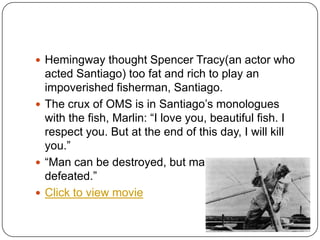
 Hemingway thought Spencer Tracy(an actor who
acted Santiago) too fat and rich to play an
impoverished fisherman, Santiago.
 The crux of OMS is in Santiago‟s monologues
with the fish, Marlin: “I love you, beautiful fish. I
respect you. But at the end of this day, I will kill
you.”
 “Man can be destroyed, but man cannot be
defeated.”
 Click to view movie
The difference in viewing literature
and reading literature…
 There is vast difference in interpretation of literary
text in reading and in viewing…
 Literature is ‘Words, words, words’ (Hamlet)
 Isn‟t the beauty of WORDS lost in its adaptations
by various technological means…??
 Isn‟t is something like - - - playing games on the
field and on the computers…Spoon feeding and
eating with one‟s own hands…
Inconclusive conclusion…
 The Literature should be read, interpreted and
enjoyed only by READING…
 Is technology killing the art of story telling?
 All other attempts of teaching or learning literature
through technology displays incompetency on the
part of reader / teacher / learner.
 The real aesthetic pleasure lies in the delightful
reading of literature…
 Reading gives free play of imagination and fancy to
reader . . . It helps in cultivating mental capabilities of
the reader…
 Technology mars the beauty and real essence of
literature.
 Free play of meaning is delimited when technology
interferes…
Thank You . . .
 May be, by disagreeing with my views,
you may agree with me.
 And by agreeing with my views, you may
disagree with me.
 dilipbarad@gmail.com

Teaching Literatuer through Web 2.0 Tools: Does it Really Help?

  • 1.
    Date: 8-10 January2010 Venue: H M Patel Institute of English Training and Research Vallabh Vidyanagar, Gujarat Presented by Dilip Barad dilipbarad@gmail.com International Conference on Interactive Media in Pedagogy: Learning English In & Beyond Classrooms
  • 2.
    Learning Literature through Web2.0 Tools: Does it really help?
  • 3.
     The initialskepticism regarding the effectiveness of computer-enabled teaching and learning has given way to intense exploration and implementation of such learning technology in teaching practices in India.  The focus has shifted from simply describing and examining computer technology to exploring how to integrate it more effectively into the teaching and learning of languages and literatures in order to enhance learning in contextualized environment.
  • 4.
     Educators haverealized that effective use of technology can influence student learning.  This is true so far as language learning is concerned.  When we come to teaching of literature, we find that still technology is not used the way it should have been.
  • 5.
    Limited use oftechnology in literature classroom  Tape recorder  Video cassette player  VCD/DVD player  PPT presentation  Where are ICT or Web Tools for teaching literature ?..?..?  How innovatively are they used? If ever they are used…  Does it address pedagogical issues pertaining to teaching literature through web 2.0 tools?
  • 6.
    Experiments in TeachingLiterature through Technology  BBC production of Shakespearean Tragedies and Comedies.  Poem recitation – downloaded from www.librivox.org.  Skype for online teaching.  YouTube videos for selected scenes in plays/novels and animation movie.  Film adaptations of novels.  Websites and Blogs by eminent writers and CALL experts
  • 7.
    BBC production ofShakespearean Tragedies and Comedies  Advantages:  Plays are not for reading but for viewing… how about performing?!?!?  Viewing gives better understanding. . .  The internal conflict of Hamlet  Anguish and suffering of Macbeth and Lady Macbeth  The somber effect of witch scenes in Macbeth  Play within Play in Hamlet  Nunnery, bed-chamber, duel scenes in Hamlet  Night walking scenes in Macbeth  Gaiety, joviality, comedy, wit – As You Like It
  • 8.
    Poem recitation –downloaded from www.librivox.org  Advantages:  Poetry is best enjoyed when listened and recited.  The sound of the words, musical melody of the diction…  Poet‟s own recitation or by native speaker with sweet, clear voice gives special effect in listening a poem.  Language embellished with artistic ornament can be better felt while listening poem.  We teach poems of Nissim Ezekiel, Sarojini Naidu, Eliot, Keats, Donne… Got best results with Waste Land, Keats‟ Odes, Donne…
  • 9.
    Skype for onlineteaching.  Prof from Kolkata delivered online lecture on „Old Man & the Sea to the students of Bhavnagar University…  Advantages:  An expert‟s interaction with students….  Cost effective – saves money and time in travel and other itinerary  Students get exposure to new ideas and creative ways of criticizing literary text.
  • 10.
    YouTube videos forselected scenes in plays/novels and animation movie.  Advantages:  www.youtube.com  Animation of Novels, short stories, poems, plays . . .  Edited scenes of long plays and novels …  Edgar Allen Poe‟s Short Stories – “the effect is all important in short stories”  Instead of watching entire novel or play, it is better to view selected scenes – youtube helps in selecting scenes.  Animation movies are short and sweet version of literary text – web resources helps…
  • 11.
    Film adaptations ofnovels  Advantages:  Better understanding of environment, setting, costume, vernacular language, time, characters, life-style, behavioral pattern etc  The novel is a narrative that organizes itself in the world, while the cinema is a world that organizes itself into a narrative.—Jean Mitry: The Encyclopedia of Novels into Films  Oliver Twist, Middlemarch, Tess, The Guide, Name Sake,
  • 12.
    Blogs by eminentwriters, critics and CALL experts  There are innumerable blogs by writers/critics… for instance…  www.chetanbhagat.com/blog: writers views on reader/critic‟s comments  http://sarojinisahoo.blogsopt.com  http://daily-english-activities.blogspot.com/2009/10/study-classic- of-literature.html  Advantages:  Having interaction with living writer/critic leads to better understanding of his/her ideas…
  • 13.
    Study classic literaturethrough web resources – an example  Task: First go to Wikipedia and find a summary of the plot. You can do this with most books, just by searching for the name in Wikipedia. Click on the link to see The Old Man and the Sea Plot.  Read through the plot, then watch the animated video of the story on YouTube. It takes about 20 mins, so make sure you have time before you start.
  • 14.
     Now thatyou know the plot and have seen the video you should be able to tackle the book.  You can read the complete book online at Google books The old man and the sea  The book is quite long to read, but you should now have a good grasp of the story. If you want to study the story in more depth you can find notes and analysis of the story at: SparkNotes.
  • 15.
    Pedagogically speaking…  Thus,we can identify scientific way of learning literature through technology…  We an identify various methods and activities of teaching literature through technology…  Its advantages are many…
  • 16.
    It seems technologyis very helpful…  „It seems….in reality, it is not‟.  It is very helpful because we think in terms of ‘Foreign Literature’ …  If we take „Literature‟ as a whole into consideration, I mean, regional literature, mother language literature then….???
  • 17.
    Foreign literature –difficulties in comprehension  Literature being product of culture, myths and legends, collective consciousness, society, environment, time, nation and its people… one cannot understand literature without understanding all these aspects which are basic ingredients of literature…  These all makes „English Literature‟ difficult to comprehend…  A flute player of Vrindavan  Urubhanga – the Broken Thigh  On the eve of St. Agnes  Ode to Psyche
  • 18.
    Literatures in regionallanguages  Do we need help of technology in comprehension of regional literature?  Isn‟t is better understood without any technological aid?
  • 19.
     Literature isthe creative product of human emotions, feelings, observations, imagination and fancy.  Technology kills creative interpretations of literature.  The free-play of fancy and imagination is limited by its adaptations to movie/animation.  Reading literature cultivates mental capabilities to think beyond horizons… viewing it limits our horizons…  Example: Reading of Kubla Khan. Rhyme of Ancient Mariner and viewing of Avatar.  literature is a narrative that organizes itself in the world - - -it is the word created solely of WORDS.
  • 20.
    A few examplesfrom The Encyclopedia of Novels into Films: Tibbets and Welsh  The film (TESS) does succeed in depicting the essential tragic quality of Tess and her victimization at the hands of fate and of men but the complexity through metaphor and symbolism is not wholly captured in the film.  Polanski‟s Tess, Nastassja Kinski, while beautiful and captivating in her own right, is too childlike, submissive, and withdrawn to be the strong, intelligent, and resilient Tess of Hardy‟s novel.
  • 21.
     Hemingway thoughtSpencer Tracy(an actor who acted Santiago) too fat and rich to play an impoverished fisherman, Santiago.  The crux of OMS is in Santiago‟s monologues with the fish, Marlin: “I love you, beautiful fish. I respect you. But at the end of this day, I will kill you.”  “Man can be destroyed, but man cannot be defeated.”  Click to view movie
  • 22.
    The difference inviewing literature and reading literature…  There is vast difference in interpretation of literary text in reading and in viewing…  Literature is ‘Words, words, words’ (Hamlet)  Isn‟t the beauty of WORDS lost in its adaptations by various technological means…??  Isn‟t is something like - - - playing games on the field and on the computers…Spoon feeding and eating with one‟s own hands…
  • 23.
    Inconclusive conclusion…  TheLiterature should be read, interpreted and enjoyed only by READING…  Is technology killing the art of story telling?  All other attempts of teaching or learning literature through technology displays incompetency on the part of reader / teacher / learner.  The real aesthetic pleasure lies in the delightful reading of literature…  Reading gives free play of imagination and fancy to reader . . . It helps in cultivating mental capabilities of the reader…  Technology mars the beauty and real essence of literature.  Free play of meaning is delimited when technology interferes…
  • 24.
    Thank You .. .  May be, by disagreeing with my views, you may agree with me.  And by agreeing with my views, you may disagree with me.  dilipbarad@gmail.com