Comparative Literature: Origins,
Etymology And Quotations
Term “comparative”
derived from Latin“comparativus”
used by Shakespeare in Henry IV: Falstaff describing Prince Hal
used by Francis Meres in 1598- “A Comparative Discourse of Our English Poets with the
Greek, Latin and Italian Poets”
used by Thomas Warton in Preface to Vol.I of History of English Poetry (“a comparative survey of the poetry of other
nations”)
“Comparative Literature”- first used by Matthew Arnold in 1848
-decisive use in English by H.M.Posnett
• Cours de litterature comparee- French Anthologies by Noel and Laplace-1816
• Term “Litterature comparee” popularized in France by Abel-Francois Villemain
• The text which made the term a stable one: An obituary of Ampere by Saint-
Beuve
• Paul Van Tieghem distinguishes between Comparative Literature and General
Literature:
Comparative Literature- concerned with “binary relations”
General Literature- “research into facts common to several literatures”
(James Montgomery used “general literature” in the sense of “theory of literature” or
“principles of criticism”).
“WORLD LITERATURE”
- first used by Goethe in 1827- in a commentary on a translation of his drama Tasso into French
• “CL is a bogus term that makes neither sense nor syntax”– Lane Cooper
• “Theobject of CL is essentiallythe studyof diverse literaturesin their relations withone another”– Paul Van
Tieghem.
• “CL is the general theoryof literary evolution”- H.M.Posnett
Wellek and Warren: CL= cultural equivalent of the movement towards a UN
Assembly
Susan Bassnett: “CL as a discipline has had its day” in “Reflections on
Comparative Literature in the 21st Century”
G.N.Devy: CL is to assert national cultural identity.
EMILY APTER
• “The rush to globalize the literary canon in recent years
may be viewed as the ‘comp-lit-ization’ of national
literatures throughout the humanities”
• Baldensperger objected to folklore studies because it studied
only the content.
• Tieghem was also of the view that folklore should be
excluded from CL.
• J.M.Carre- CL is the study of international spiritual relations
(“rapport de fait”).
It is a branch of literary history.
Rene Wellek attacked Carre’s views as “pseudo-literary”
SOME SEMINAL WORKS ON CL
(WORKS BY INDIAN ACADEMICIANS MENTIONED IN SEPARATE SECTION)
 THEORYOF LITERATURE- RENEWELLEKANDAUSTINWARREN
GROUNDSFORCOMPARISON- HARRYLEVIN
COMPARATIVELITERATUREINTHEAGEOFGLOBALISATION-CHARLESBERNHEIMER. ed.
INTRODUCTIONTOCOMPARATIVELITERATURE- FRANCOISJOST
THECHALLENGEOFCOMPARATIVELITERATURE- CLAUDIOGUILLEN
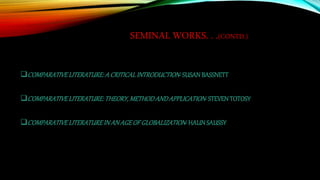
SEMINAL WORKS. . .(CONTD.)
COMPARATIVELITERATURE:A CRITICALINTRODUCTION- SUSANBASSNETT
COMPARATIVELITERATURE:THEORY,METHODANDAPPLICATION- STEVENTOTOSY
COMPARATIVELITERATUREINANAGEOFGLOBALIZATION- HAUNSAUSSY
CL origins, etymology, quotations...

CL origins, etymology, quotations...

  • 1.
  • 2.
    Term “comparative” derived fromLatin“comparativus” used by Shakespeare in Henry IV: Falstaff describing Prince Hal used by Francis Meres in 1598- “A Comparative Discourse of Our English Poets with the Greek, Latin and Italian Poets” used by Thomas Warton in Preface to Vol.I of History of English Poetry (“a comparative survey of the poetry of other nations”)
  • 3.
    “Comparative Literature”- firstused by Matthew Arnold in 1848 -decisive use in English by H.M.Posnett
  • 4.
    • Cours delitterature comparee- French Anthologies by Noel and Laplace-1816 • Term “Litterature comparee” popularized in France by Abel-Francois Villemain • The text which made the term a stable one: An obituary of Ampere by Saint- Beuve
  • 5.
    • Paul VanTieghem distinguishes between Comparative Literature and General Literature: Comparative Literature- concerned with “binary relations” General Literature- “research into facts common to several literatures” (James Montgomery used “general literature” in the sense of “theory of literature” or “principles of criticism”).
  • 6.
    “WORLD LITERATURE” - firstused by Goethe in 1827- in a commentary on a translation of his drama Tasso into French
  • 7.
    • “CL isa bogus term that makes neither sense nor syntax”– Lane Cooper • “Theobject of CL is essentiallythe studyof diverse literaturesin their relations withone another”– Paul Van Tieghem. • “CL is the general theoryof literary evolution”- H.M.Posnett
  • 8.
    Wellek and Warren:CL= cultural equivalent of the movement towards a UN Assembly Susan Bassnett: “CL as a discipline has had its day” in “Reflections on Comparative Literature in the 21st Century” G.N.Devy: CL is to assert national cultural identity.
  • 9.
    EMILY APTER • “Therush to globalize the literary canon in recent years may be viewed as the ‘comp-lit-ization’ of national literatures throughout the humanities”
  • 10.
    • Baldensperger objectedto folklore studies because it studied only the content. • Tieghem was also of the view that folklore should be excluded from CL.
  • 11.
    • J.M.Carre- CLis the study of international spiritual relations (“rapport de fait”). It is a branch of literary history. Rene Wellek attacked Carre’s views as “pseudo-literary”
  • 12.
    SOME SEMINAL WORKSON CL (WORKS BY INDIAN ACADEMICIANS MENTIONED IN SEPARATE SECTION)  THEORYOF LITERATURE- RENEWELLEKANDAUSTINWARREN GROUNDSFORCOMPARISON- HARRYLEVIN COMPARATIVELITERATUREINTHEAGEOFGLOBALISATION-CHARLESBERNHEIMER. ed. INTRODUCTIONTOCOMPARATIVELITERATURE- FRANCOISJOST THECHALLENGEOFCOMPARATIVELITERATURE- CLAUDIOGUILLEN
  • 13.
    SEMINAL WORKS. ..(CONTD.) COMPARATIVELITERATURE:A CRITICALINTRODUCTION- SUSANBASSNETT COMPARATIVELITERATURE:THEORY,METHODANDAPPLICATION- STEVENTOTOSY COMPARATIVELITERATUREINANAGEOFGLOBALIZATION- HAUNSAUSSY