National Literature in a
Multilingual Nation
Sujit R. Chandak
Pre-Ph.D. Course presentation
Department of English,
University of Mumbai
In this presentation I would attempt to
understand:•
•
•
•
•

Nation and National Literature
Problematic of Multilingual Nation
National Literature: Multiple Languages
Simplistic solutions
Alternative approaches in constructing the
National Literature in Multilingual Nations
such as India
• Questions
Nation and National Literature
• Emergence of ‘Nations’ in Europe
• Eric Hobswam & famously Benedict Anderson
have explained the emergence of Nation
• There has been a flood of Nation states in the
post 1940s; the colonies getting free
• Political elite –western educated- made the
choice of organizing themselves in terms of
Nation; Nationalist consciousness developed
with struggle for freedom
Nation and National Literature
• Thus, an essentially European concept came to
colonies, where it needed to be altered
• In post-colonial world ‘Nation’ invests aesthetic
expressions with a sense of identifying with the
long struggle against the colonial oppression
and struggle for independence.
• Bruce King describes post-colonial nations as
‘the new centre of consciousness’ (1)
Nation and National Literature
• In the Euro-American model of Nation hood
the National Literature was that written in the
national Language; they were mono or bilingual countries
• Most of the post-colonial nations have many
languages, at times multitude
• But still the ‘colonial modernity’ of the leaders
wanted that there should be a national
construction of Art & Literature
Problematic of Multilingual Nation
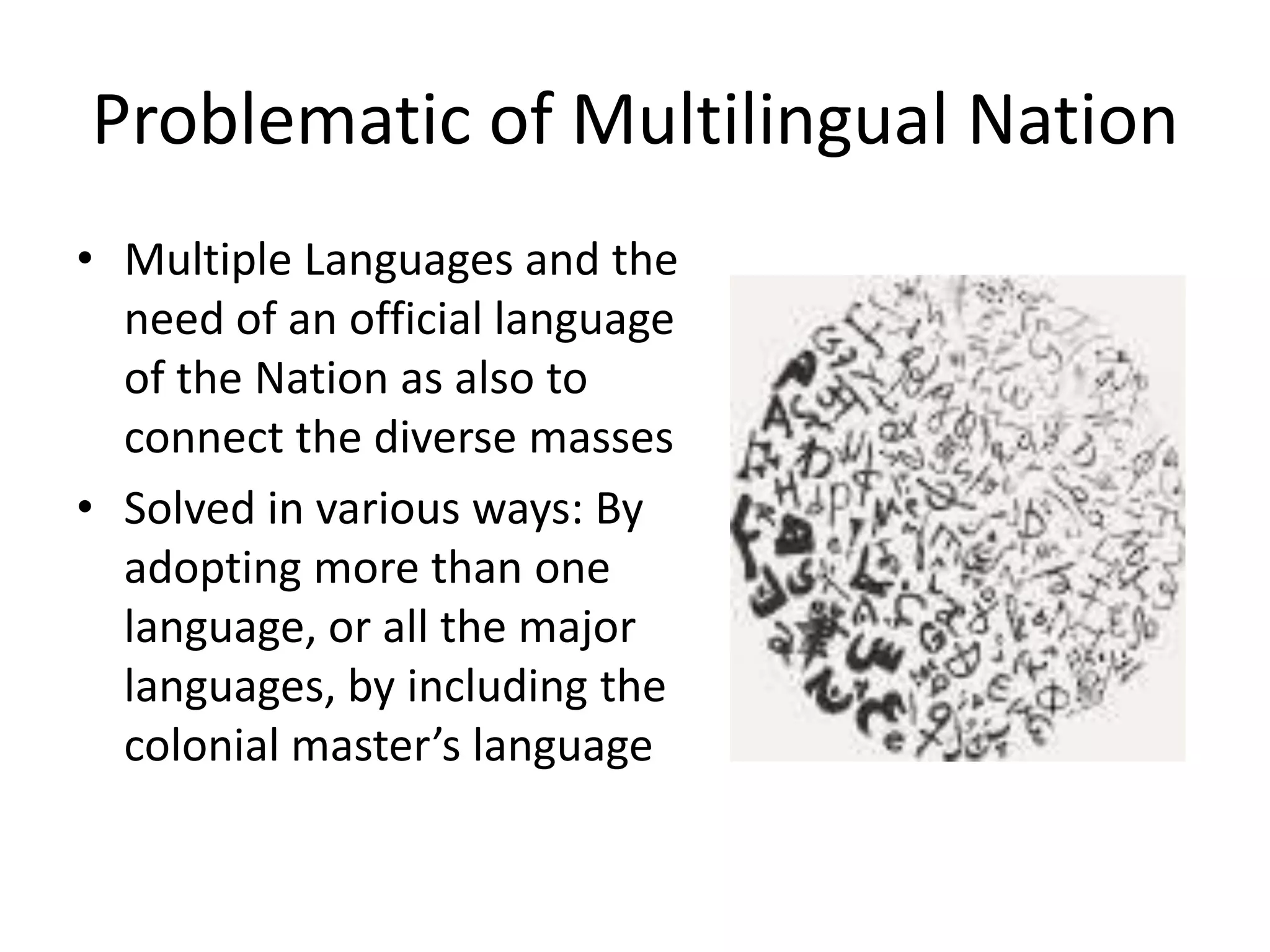
• Multiple Languages and the
need of an official language
of the Nation as also to
connect the diverse masses
• Solved in various ways: By
adopting more than one
language, or all the major
languages, by including the
colonial master’s language
Problematic of Multilingual Nation
•

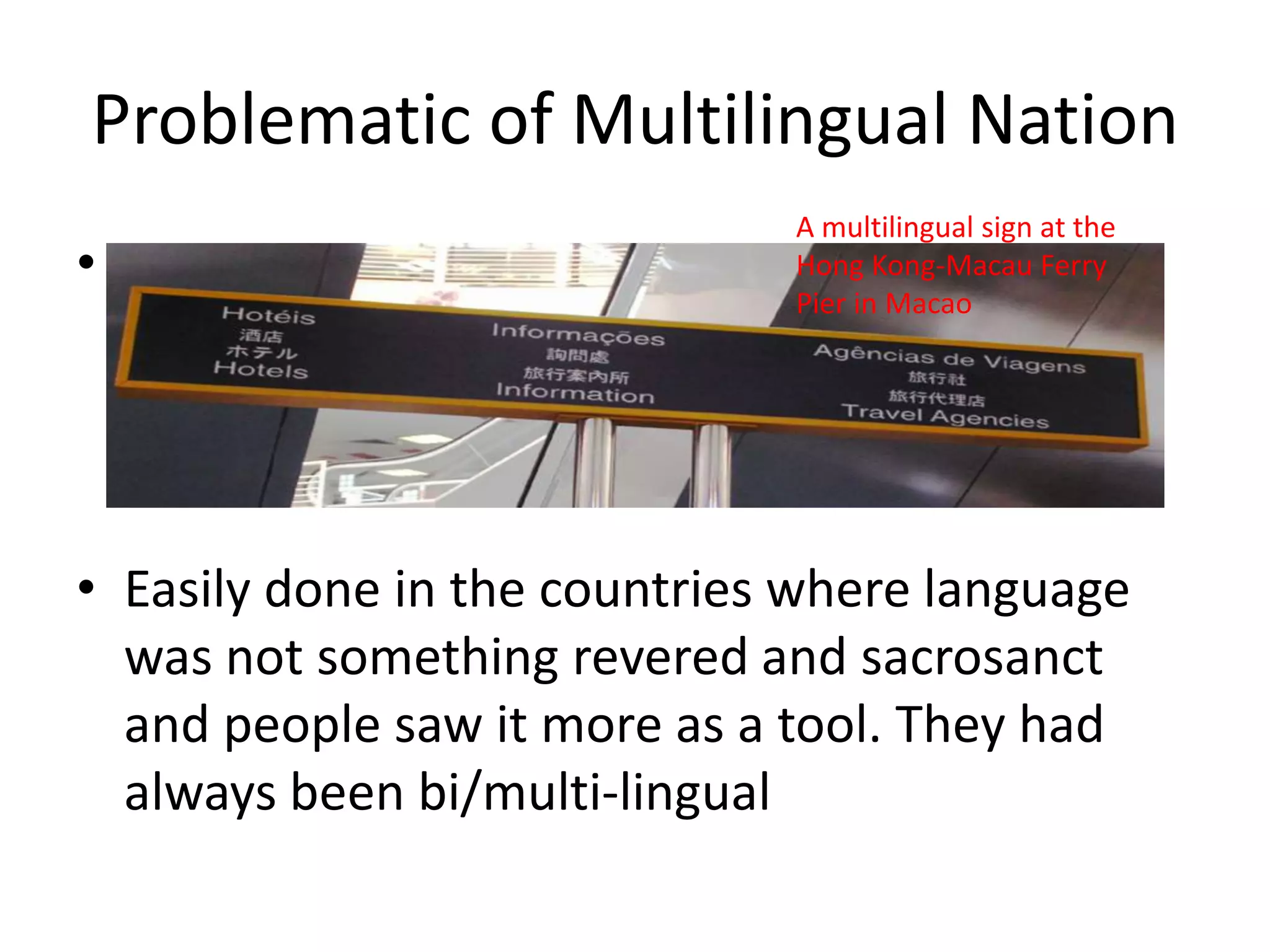
A multilingual sign at the
Hong Kong-Macau Ferry
Pier in Macao

• Easily done in the countries where language
was not something revered and sacrosanct
and people saw it more as a tool. They had
always been bi/multi-lingual
National Literature: Multiple
Languages
• Defining and categorizing the National
Literature, as in ‘Indian Literature’, was a much
more tricky issue
• Apprehension was there that it may involve
the privileging of one or some of these
Literature and culture; those which were
expressed in a language spoken by more
number of people & hence patronized by the
state
National Literature: Multiple
Languages
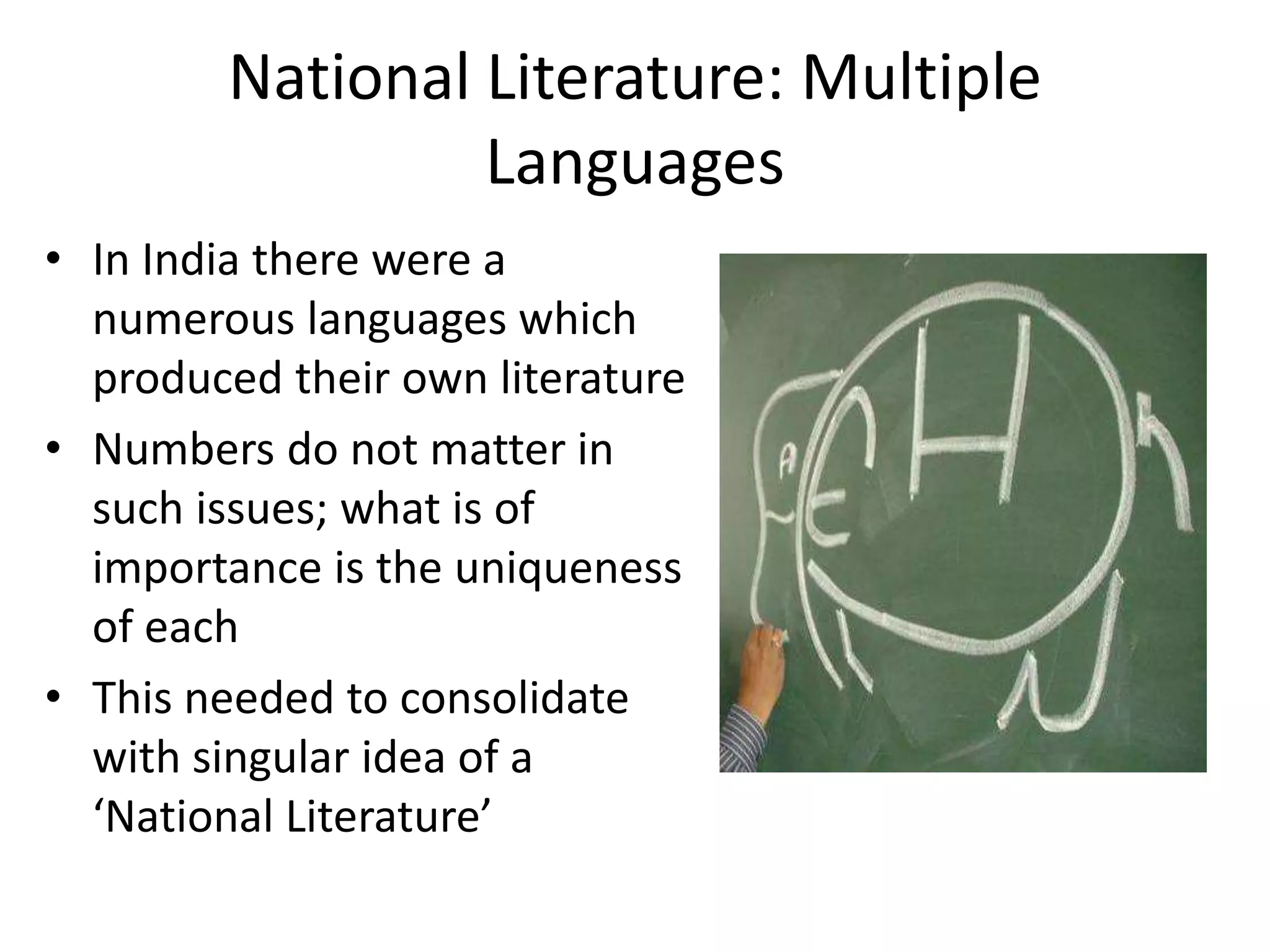
• In India there were a
numerous languages which
produced their own literature
• Numbers do not matter in
such issues; what is of
importance is the uniqueness
of each
• This needed to consolidate
with singular idea of a
‘National Literature’
Simplistic solutions
• All literature produced in all the languages of
that country as the National Literature
• With reference to Canada, French, English and
Quebec French; in Srilanka Sinhalese, Tamil
and English; in India all the 18 constitutional
languages plus four patronized by Sahitya
Akademi
Simplistic solutions
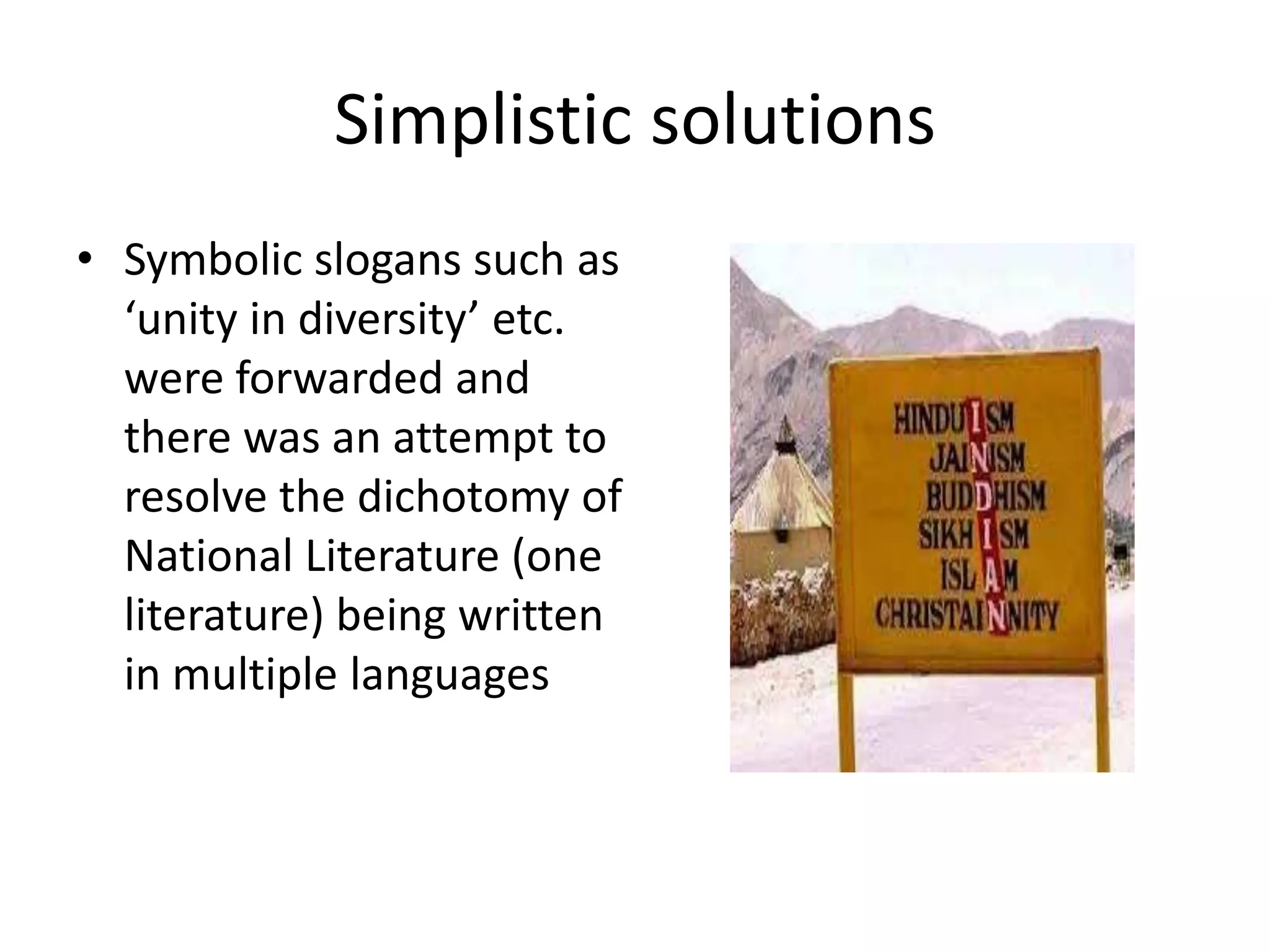
• Symbolic slogans such as
‘unity in diversity’ etc.
were forwarded and
there was an attempt to
resolve the dichotomy of
National Literature (one
literature) being written
in multiple languages
Simplistic solutions
• The motto of the Sahitya Akademi was fixed in
the words of Dr. Sarvapalli Radhakrishnan as
“Indian Literature is one though written in
many languages”
• The resultant retort to Sahitya Akedmi’s
motto: “Indian Literature is one because it is
written in many languages”
Alternative approaches to the issue
• The nature of National Literature has also to be
interrogated by asking whether Indian in ‘Indian
Literature’ is same as the Indian in ‘Indian Nation’
or in ‘Indian Cricket team’
• Do and can the word ‘Indian’ signify different
meaning
• P. P. Raveendran discusses this in his essay,
“Genealogies of Indian Literature” and questions
whether Indian literature as a unified field
bearing the marks of a unified literary sensibility
in fact exists, and goes on to add:
Alternative approaches to the issue
• “It might be pertinent to point out that
“Indian literature”, ontologically unified object
that is theorised as connected by a shared
discursive history and shared epistemological
concerns, is not the same as “literature in
India” or “literatures in India”.(2)
• What belongs to the regional is also national;
one cannot belong to the whole of India
without belonging to a specific part of India.
Alternative approaches to the issue
• This position of dual identity is explored by
the Marathi playwright, and critic G. P.
Deshpande:
• “When we speak of National Theatre we do so
with almost no knowledge of the various
Indian theatres….the terminology of
“regional” is misleading when it comes to
cultural production. Each mode is uniquely
important; each mode is uniquely Indian” (3)
Alternative approaches to the issue
• To define the Indianness of Indian (National)
Literature, framework of Interliterary process
as propounded by the Slovak theorist Durisin
can be used
• He argues to look for relationships arising
from contactual co-existense (4)
• Indian Scholars such as Amiya Dev and others
point to similar directions. Dev, defines Indian
Literature as:
Alternative approaches to the issue
• “not an entity but an interliterary condition in
the widest possible sense of the concept
which is related to Goethe's original idea of
Weltliteratur ... The interliterary condition of
India, we should remember, reaches
backmuch farther than its manuscript or print
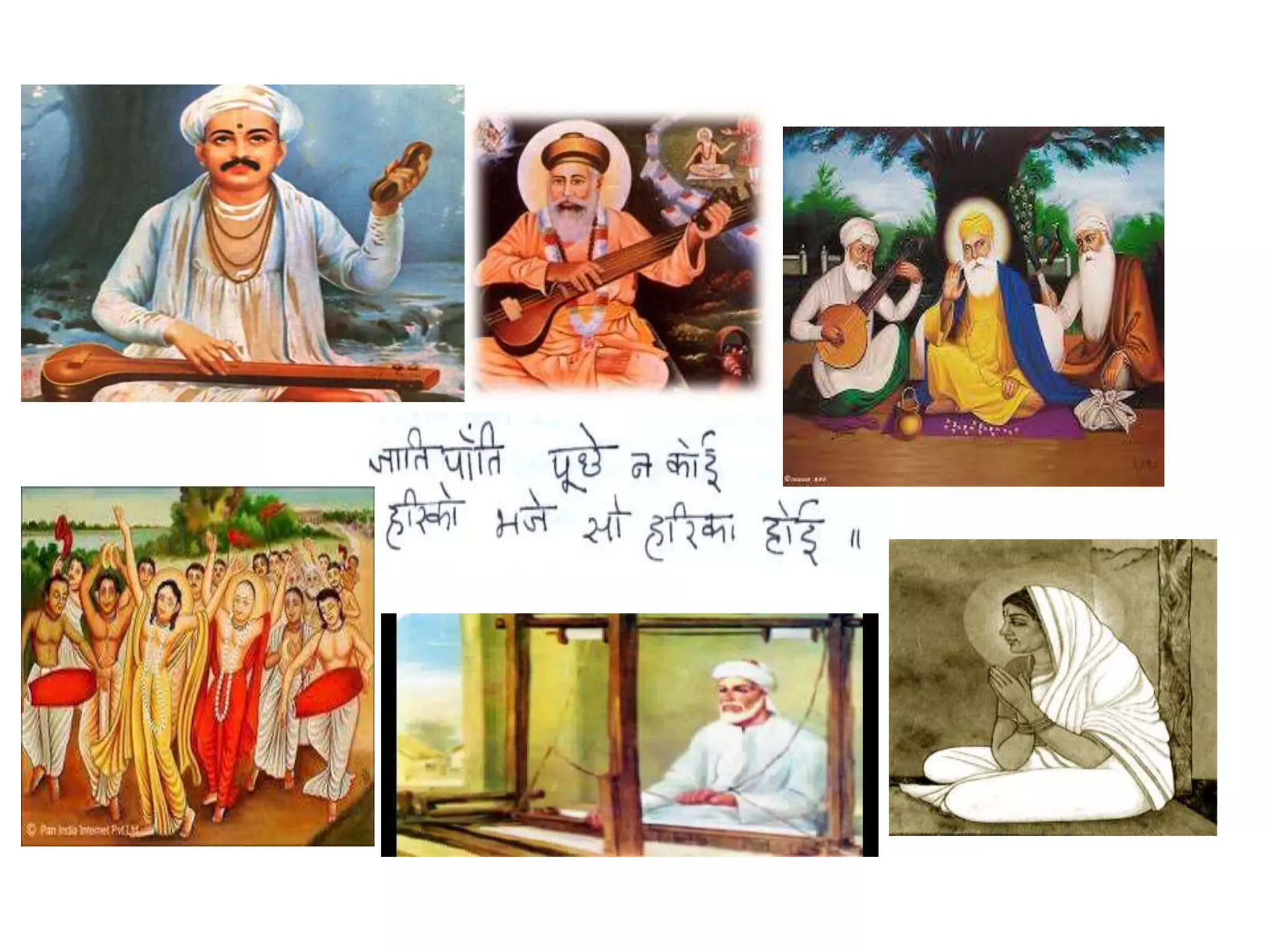
culture ... bhakti a popular religious
movement as both theme and social issue…”(5)
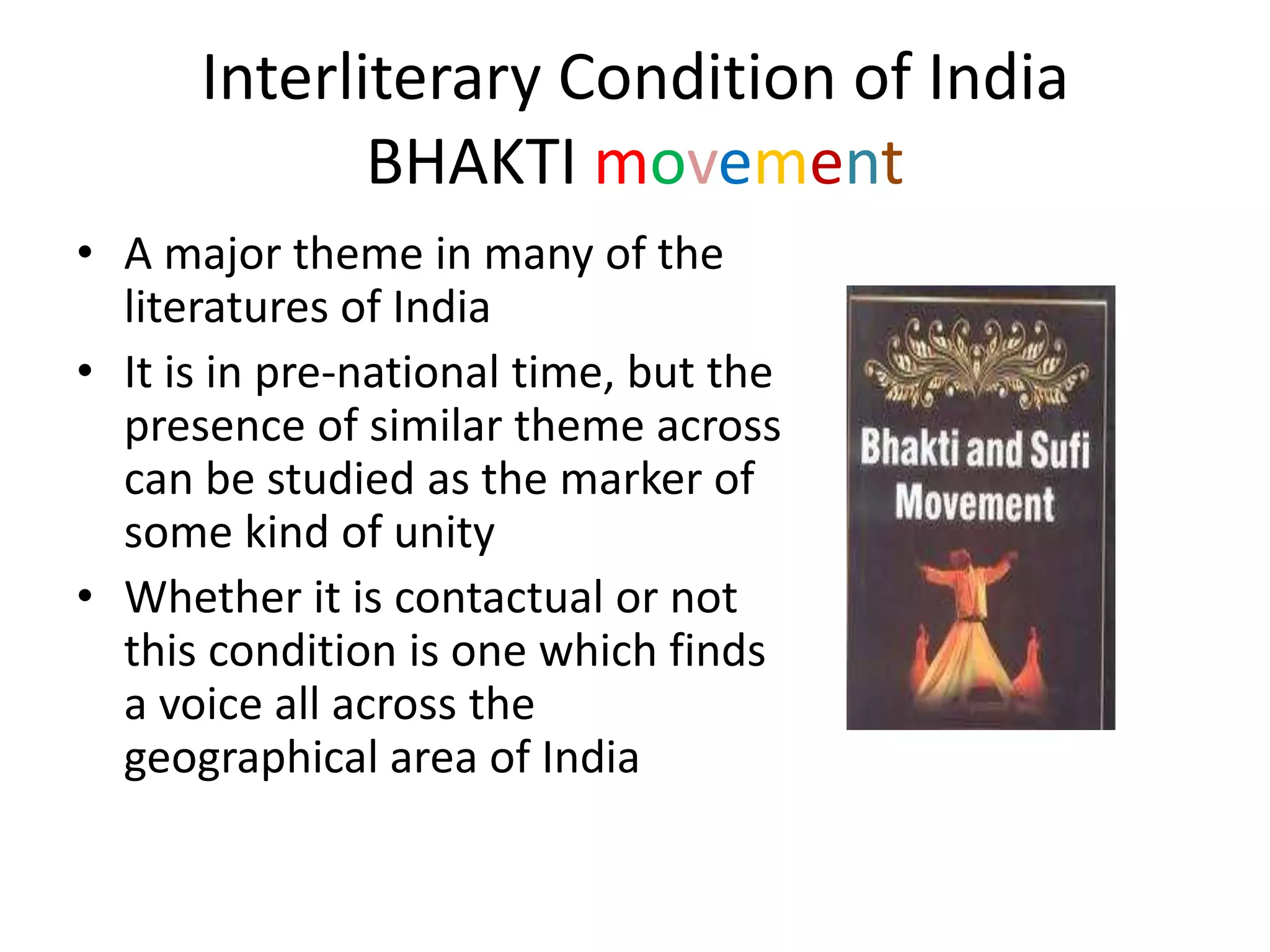
Interliterary Condition of India
BHAKTI movement
• A major theme in many of the
literatures of India
• It is in pre-national time, but the
presence of similar theme across
can be studied as the marker of
some kind of unity
• Whether it is contactual or not
this condition is one which finds
a voice all across the
geographical area of India
To Conclude…
• Multilingual nations and the corresponding
need to look for a literature which defines a
Nation are a reality. This cannot be done in a
simplistic manner, without taking into account
the differences of not just language but also
cultures, way and forms of expression and the
life worlds. A Comparative and relativist
approach is the way forward.
References
1.

King, Bruce, ed. New National and Post colonial Literatures: an
Introduction, Oxford, Clarendon Press, 1996

2.

Raveendran, P.P. “Genealogies of Indian Literature.” Economic and

Political Weekly June 24, 2006: 2558-2563
3.

Deshpande, G. P. “History, Politics and the Modern Playwright”.
Theatre India I, 91-97

4.

Durisin, Dionýz. Theory of Interliterary Process. Bratislava:
VEDA/Slovak Academy of Sciences, 1989.

5.

DevAmiya, "Unity and Diversity in Indiaand Comparative

Literature," in Comparative Literature Now: Theories and Practice,
Paris: Honoré Champion, 1999. 65-74.
National Literature in a Multilingual Nation. Sujit chandak pre ph d presentation

National Literature in a Multilingual Nation. Sujit chandak pre ph d presentation

  • 1.
    National Literature ina Multilingual Nation Sujit R. Chandak Pre-Ph.D. Course presentation Department of English, University of Mumbai
  • 2.
    In this presentationI would attempt to understand:• • • • • Nation and National Literature Problematic of Multilingual Nation National Literature: Multiple Languages Simplistic solutions Alternative approaches in constructing the National Literature in Multilingual Nations such as India • Questions
  • 3.
    Nation and NationalLiterature • Emergence of ‘Nations’ in Europe • Eric Hobswam & famously Benedict Anderson have explained the emergence of Nation • There has been a flood of Nation states in the post 1940s; the colonies getting free • Political elite –western educated- made the choice of organizing themselves in terms of Nation; Nationalist consciousness developed with struggle for freedom
  • 4.
    Nation and NationalLiterature • Thus, an essentially European concept came to colonies, where it needed to be altered • In post-colonial world ‘Nation’ invests aesthetic expressions with a sense of identifying with the long struggle against the colonial oppression and struggle for independence. • Bruce King describes post-colonial nations as ‘the new centre of consciousness’ (1)
  • 5.
    Nation and NationalLiterature • In the Euro-American model of Nation hood the National Literature was that written in the national Language; they were mono or bilingual countries • Most of the post-colonial nations have many languages, at times multitude • But still the ‘colonial modernity’ of the leaders wanted that there should be a national construction of Art & Literature
  • 6.
    Problematic of MultilingualNation • Multiple Languages and the need of an official language of the Nation as also to connect the diverse masses • Solved in various ways: By adopting more than one language, or all the major languages, by including the colonial master’s language
  • 7.
    Problematic of MultilingualNation • A multilingual sign at the Hong Kong-Macau Ferry Pier in Macao • Easily done in the countries where language was not something revered and sacrosanct and people saw it more as a tool. They had always been bi/multi-lingual
  • 8.
    National Literature: Multiple Languages •Defining and categorizing the National Literature, as in ‘Indian Literature’, was a much more tricky issue • Apprehension was there that it may involve the privileging of one or some of these Literature and culture; those which were expressed in a language spoken by more number of people & hence patronized by the state
  • 9.
    National Literature: Multiple Languages •In India there were a numerous languages which produced their own literature • Numbers do not matter in such issues; what is of importance is the uniqueness of each • This needed to consolidate with singular idea of a ‘National Literature’
  • 10.
    Simplistic solutions • Allliterature produced in all the languages of that country as the National Literature • With reference to Canada, French, English and Quebec French; in Srilanka Sinhalese, Tamil and English; in India all the 18 constitutional languages plus four patronized by Sahitya Akademi
  • 11.
    Simplistic solutions • Symbolicslogans such as ‘unity in diversity’ etc. were forwarded and there was an attempt to resolve the dichotomy of National Literature (one literature) being written in multiple languages
  • 12.
    Simplistic solutions • Themotto of the Sahitya Akademi was fixed in the words of Dr. Sarvapalli Radhakrishnan as “Indian Literature is one though written in many languages” • The resultant retort to Sahitya Akedmi’s motto: “Indian Literature is one because it is written in many languages”
  • 13.
    Alternative approaches tothe issue • The nature of National Literature has also to be interrogated by asking whether Indian in ‘Indian Literature’ is same as the Indian in ‘Indian Nation’ or in ‘Indian Cricket team’ • Do and can the word ‘Indian’ signify different meaning • P. P. Raveendran discusses this in his essay, “Genealogies of Indian Literature” and questions whether Indian literature as a unified field bearing the marks of a unified literary sensibility in fact exists, and goes on to add:
  • 14.
    Alternative approaches tothe issue • “It might be pertinent to point out that “Indian literature”, ontologically unified object that is theorised as connected by a shared discursive history and shared epistemological concerns, is not the same as “literature in India” or “literatures in India”.(2) • What belongs to the regional is also national; one cannot belong to the whole of India without belonging to a specific part of India.
  • 15.
    Alternative approaches tothe issue • This position of dual identity is explored by the Marathi playwright, and critic G. P. Deshpande: • “When we speak of National Theatre we do so with almost no knowledge of the various Indian theatres….the terminology of “regional” is misleading when it comes to cultural production. Each mode is uniquely important; each mode is uniquely Indian” (3)
  • 16.
    Alternative approaches tothe issue • To define the Indianness of Indian (National) Literature, framework of Interliterary process as propounded by the Slovak theorist Durisin can be used • He argues to look for relationships arising from contactual co-existense (4) • Indian Scholars such as Amiya Dev and others point to similar directions. Dev, defines Indian Literature as:
  • 17.
    Alternative approaches tothe issue • “not an entity but an interliterary condition in the widest possible sense of the concept which is related to Goethe's original idea of Weltliteratur ... The interliterary condition of India, we should remember, reaches backmuch farther than its manuscript or print culture ... bhakti a popular religious movement as both theme and social issue…”(5)
  • 18.
    Interliterary Condition ofIndia BHAKTI movement • A major theme in many of the literatures of India • It is in pre-national time, but the presence of similar theme across can be studied as the marker of some kind of unity • Whether it is contactual or not this condition is one which finds a voice all across the geographical area of India
  • 20.
    To Conclude… • Multilingualnations and the corresponding need to look for a literature which defines a Nation are a reality. This cannot be done in a simplistic manner, without taking into account the differences of not just language but also cultures, way and forms of expression and the life worlds. A Comparative and relativist approach is the way forward.
  • 21.
    References 1. King, Bruce, ed.New National and Post colonial Literatures: an Introduction, Oxford, Clarendon Press, 1996 2. Raveendran, P.P. “Genealogies of Indian Literature.” Economic and Political Weekly June 24, 2006: 2558-2563 3. Deshpande, G. P. “History, Politics and the Modern Playwright”. Theatre India I, 91-97 4. Durisin, Dionýz. Theory of Interliterary Process. Bratislava: VEDA/Slovak Academy of Sciences, 1989. 5. DevAmiya, "Unity and Diversity in Indiaand Comparative Literature," in Comparative Literature Now: Theories and Practice, Paris: Honoré Champion, 1999. 65-74.