•What is Literature?:
• Its Definitions:
• Kinds of Literature:
• Literary Types or
Genre:
• Popular Examples:
• Recommended Books:
Dr. Sudhir Mathpati
Assistant Professor
Department of English
Adarsh Mahavidyalaya, Omerga
Dist. Osmanabad, MS, India
What is Literature ?
Deriving from the Latin littera, “a letter of the alphabet,”
literature is first and foremost humankind’s entire body of
writing; after that it is the body of writing belonging to a
given language or people; then it is individual pieces of
writing.
R. J. Rees says that study of literature cannot solve our
problems like malnutrition, war, violence, etc. So, literature
seems unimportant.
In a serious sense, literature is writing which expresses and
communicates feelings and attitudes towards life.
Mirror of Human Nature…..R. J. Rees
Bhelkar says, “Science concerns with facts, reasons,
causes and effect and literature too deals with facts but in
it facts are presented in modified forms” (Bhelkar,XV).
Why we Study Literature ?
• To Expand the Horizons:
• To Develop the Skill of Critical Thinking:
• To Explore the Past:
• To Know other Cultures:
• To Develop L/S/R/W Skills:
• To Develop Positive Outlook:
• To Gain the Source of Inspiration:
• To Inculcate Values and Ethics:
• To Understand the Essence of Life:
• To Appreciate our Literary Heritage:
• To Get Pleasure and Contentment:
Definitions of Literature…
R. J. Rees gives two meanings of the term. In general sense,
“anything that is written is literature. From this point of view,
time – tables, catalogs, text – books, travel – brochures,
advertisements, news – items etc. are literature.”
In a serious sense, “literature is writing which expresses and
communicates feelings and attitudes towards life.”
Salman Rushdie says, “Literature is where I go to explore the
highest and lowest places in human society and in the human
spirit, where I hope to find not absolute truth but the truth of
the tale, of the imagination and of the heart.”
According to Bwalya. L (2006) the term ‘Literature’ is a
latin word ‘litera’ which means ‘Writing.’ From this
background, it is believed that literature is anything that is
written.
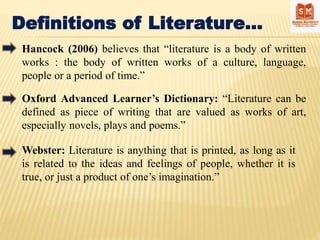
Definitions of Literature…
Hancock (2006) believes that “literature is a body of written
works : the body of written works of a culture, language,
people or a period of time.”
Oxford Advanced Learner’s Dictionary: “Literature can be
defined as piece of writing that are valued as works of art,
especially novels, plays and poems.”
Webster: Literature is anything that is printed, as long as it
is related to the ideas and feelings of people, whether it is
true, or just a product of one’s imagination.”
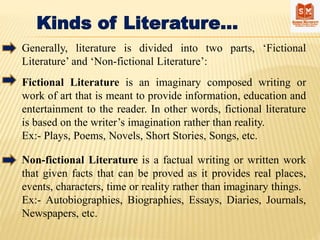
Kinds of Literature…
Generally, literature is divided into two parts, ‘Fictional
Literature’ and ‘Non-fictional Literature’:
Fictional Literature is an imaginary composed writing or
work of art that is meant to provide information, education and
entertainment to the reader. In other words, fictional literature
is based on the writer’s imagination rather than reality.
Ex:- Plays, Poems, Novels, Short Stories, Songs, etc.
Non-fictional Literature is a factual writing or written work
that given facts that can be proved as it provides real places,
events, characters, time or reality rather than imaginary things.
Ex:- Autobiographies, Biographies, Essays, Diaries, Journals,
Newspapers, etc.
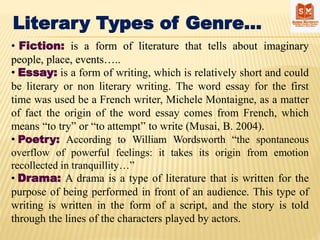
Literary Types of Genre…
• Fiction: is a form of literature that tells about imaginary
people, place, events…..
• Essay: is a form of writing, which is relatively short and could
be literary or non literary writing. The word essay for the first
time was used be a French writer, Michele Montaigne, as a matter
of fact the origin of the word essay comes from French, which
means “to try” or “to attempt” to write (Musai, B. 2004).
• Poetry: According to William Wordsworth “the spontaneous
overflow of powerful feelings: it takes its origin from emotion
recollected in tranquillity…”
• Drama: A drama is a type of literature that is written for the
purpose of being performed in front of an audience. This type of
writing is written in the form of a script, and the story is told
through the lines of the characters played by actors.
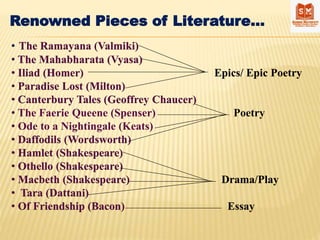
Renowned Pieces of Literature…
• The Ramayana (Valmiki)
• The Mahabharata (Vyasa)
• Iliad (Homer) Epics/ Epic Poetry
• Paradise Lost (Milton)
• Canterbury Tales (Geoffrey Chaucer)
• The Faerie Queene (Spenser) Poetry
• Ode to a Nightingale (Keats)
• Daffodils (Wordsworth)
• Hamlet (Shakespeare)
• Othello (Shakespeare)
• Macbeth (Shakespeare) Drama/Play
• Tara (Dattani)
• Of Friendship (Bacon) Essay
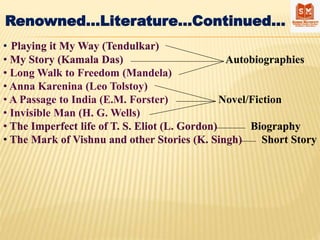
Renowned…Literature…Continued…
• Playing it My Way (Tendulkar)
• My Story (Kamala Das) Autobiographies
• Long Walk to Freedom (Mandela)
• Anna Karenina (Leo Tolstoy)
• A Passage to India (E.M. Forster) Novel/Fiction
• Invisible Man (H. G. Wells)
• The Imperfect life of T. S. Eliot (L. Gordon) Biography
• The Mark of Vishnu and other Stories (K. Singh) Short Story
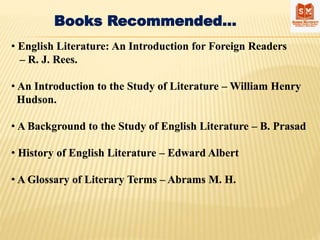
Books Recommended…
• English Literature: An Introduction for Foreign Readers
– R. J. Rees.
• An Introduction to the Study of Literature – William Henry
Hudson.
• A Background to the Study of English Literature – B. Prasad
• History of English Literature – Edward Albert
• A Glossary of Literary Terms – Abrams M. H.

Ppt what is literature

  • 1.
    •What is Literature?: •Its Definitions: • Kinds of Literature: • Literary Types or Genre: • Popular Examples: • Recommended Books: Dr. Sudhir Mathpati Assistant Professor Department of English Adarsh Mahavidyalaya, Omerga Dist. Osmanabad, MS, India
  • 2.
    What is Literature? Deriving from the Latin littera, “a letter of the alphabet,” literature is first and foremost humankind’s entire body of writing; after that it is the body of writing belonging to a given language or people; then it is individual pieces of writing. R. J. Rees says that study of literature cannot solve our problems like malnutrition, war, violence, etc. So, literature seems unimportant. In a serious sense, literature is writing which expresses and communicates feelings and attitudes towards life. Mirror of Human Nature…..R. J. Rees Bhelkar says, “Science concerns with facts, reasons, causes and effect and literature too deals with facts but in it facts are presented in modified forms” (Bhelkar,XV).
  • 3.
    Why we StudyLiterature ? • To Expand the Horizons: • To Develop the Skill of Critical Thinking: • To Explore the Past: • To Know other Cultures: • To Develop L/S/R/W Skills: • To Develop Positive Outlook: • To Gain the Source of Inspiration: • To Inculcate Values and Ethics: • To Understand the Essence of Life: • To Appreciate our Literary Heritage: • To Get Pleasure and Contentment:
  • 4.
    Definitions of Literature… R.J. Rees gives two meanings of the term. In general sense, “anything that is written is literature. From this point of view, time – tables, catalogs, text – books, travel – brochures, advertisements, news – items etc. are literature.” In a serious sense, “literature is writing which expresses and communicates feelings and attitudes towards life.” Salman Rushdie says, “Literature is where I go to explore the highest and lowest places in human society and in the human spirit, where I hope to find not absolute truth but the truth of the tale, of the imagination and of the heart.” According to Bwalya. L (2006) the term ‘Literature’ is a latin word ‘litera’ which means ‘Writing.’ From this background, it is believed that literature is anything that is written.
  • 5.
    Definitions of Literature… Hancock(2006) believes that “literature is a body of written works : the body of written works of a culture, language, people or a period of time.” Oxford Advanced Learner’s Dictionary: “Literature can be defined as piece of writing that are valued as works of art, especially novels, plays and poems.” Webster: Literature is anything that is printed, as long as it is related to the ideas and feelings of people, whether it is true, or just a product of one’s imagination.”
  • 6.
    Kinds of Literature… Generally,literature is divided into two parts, ‘Fictional Literature’ and ‘Non-fictional Literature’: Fictional Literature is an imaginary composed writing or work of art that is meant to provide information, education and entertainment to the reader. In other words, fictional literature is based on the writer’s imagination rather than reality. Ex:- Plays, Poems, Novels, Short Stories, Songs, etc. Non-fictional Literature is a factual writing or written work that given facts that can be proved as it provides real places, events, characters, time or reality rather than imaginary things. Ex:- Autobiographies, Biographies, Essays, Diaries, Journals, Newspapers, etc.
  • 7.
    Literary Types ofGenre… • Fiction: is a form of literature that tells about imaginary people, place, events….. • Essay: is a form of writing, which is relatively short and could be literary or non literary writing. The word essay for the first time was used be a French writer, Michele Montaigne, as a matter of fact the origin of the word essay comes from French, which means “to try” or “to attempt” to write (Musai, B. 2004). • Poetry: According to William Wordsworth “the spontaneous overflow of powerful feelings: it takes its origin from emotion recollected in tranquillity…” • Drama: A drama is a type of literature that is written for the purpose of being performed in front of an audience. This type of writing is written in the form of a script, and the story is told through the lines of the characters played by actors.
  • 8.
    Renowned Pieces ofLiterature… • The Ramayana (Valmiki) • The Mahabharata (Vyasa) • Iliad (Homer) Epics/ Epic Poetry • Paradise Lost (Milton) • Canterbury Tales (Geoffrey Chaucer) • The Faerie Queene (Spenser) Poetry • Ode to a Nightingale (Keats) • Daffodils (Wordsworth) • Hamlet (Shakespeare) • Othello (Shakespeare) • Macbeth (Shakespeare) Drama/Play • Tara (Dattani) • Of Friendship (Bacon) Essay
  • 9.
    Renowned…Literature…Continued… • Playing itMy Way (Tendulkar) • My Story (Kamala Das) Autobiographies • Long Walk to Freedom (Mandela) • Anna Karenina (Leo Tolstoy) • A Passage to India (E.M. Forster) Novel/Fiction • Invisible Man (H. G. Wells) • The Imperfect life of T. S. Eliot (L. Gordon) Biography • The Mark of Vishnu and other Stories (K. Singh) Short Story
  • 10.
    Books Recommended… • EnglishLiterature: An Introduction for Foreign Readers – R. J. Rees. • An Introduction to the Study of Literature – William Henry Hudson. • A Background to the Study of English Literature – B. Prasad • History of English Literature – Edward Albert • A Glossary of Literary Terms – Abrams M. H.