What is ComparativeWhat is Comparative
Literature?Literature?
George SteinerGeorge Steiner
Amalia Ortiz de Zárate F.Amalia Ortiz de Zárate F.
Universidad Austral de ChileUniversidad Austral de Chile
Group workGroup work
1.1. What do you think is ComparativeWhat do you think is Comparative
Literature?Literature?
2.2. In what way the following words can beIn what way the following words can be
related to comparative literature:related to comparative literature:
frontalierfrontalier, marginalization and, marginalization and diaspora.diaspora.
3.3. Explain the relationship (or not) betweenExplain the relationship (or not) between
comparative literaturecomparative literature andand translationtranslation..
4.4. What are the steps you should follow toWhat are the steps you should follow to
compare texts (in any format)?compare texts (in any format)?
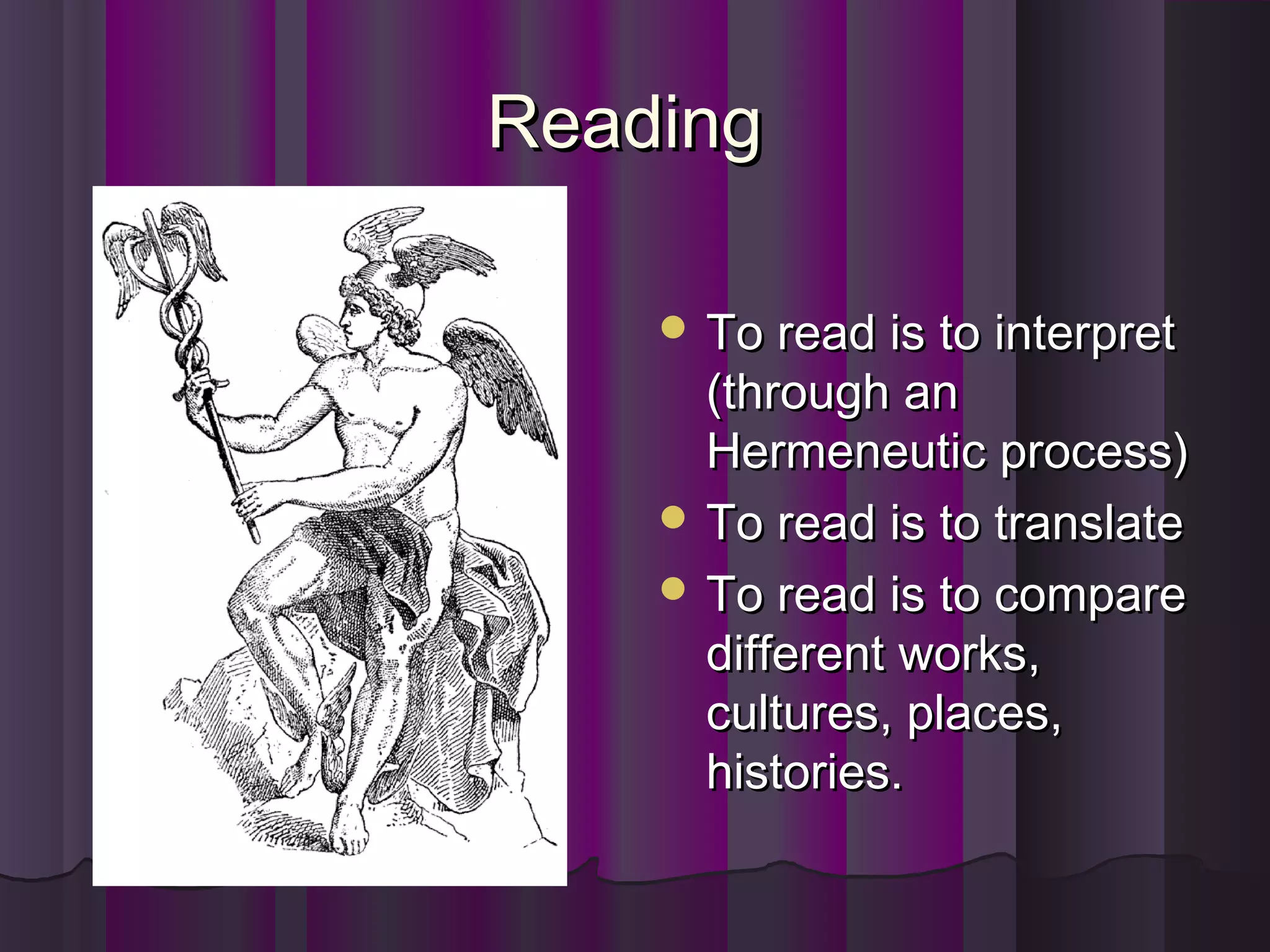
ReadingReading
 To read is to interpretTo read is to interpret
(through an(through an
Hermeneutic process)Hermeneutic process)
 To read is to translateTo read is to translate
 To read is to compareTo read is to compare
different works,different works,
cultures, places,cultures, places,
histories.histories.
HermeneuticsHermeneutics
 There is no innocence in perception and in the
answer to the intelligible.
 In the dynamic process called “hermeneutics”
the comparison is implicit.
 The notion of novelty (making new in Ezra
Pound words) is comparative in sense and
substance. (3)
 How do we relate a novel or a symphony with
that which we have previously read or heard,
with our anticipations towards any expressive
form?
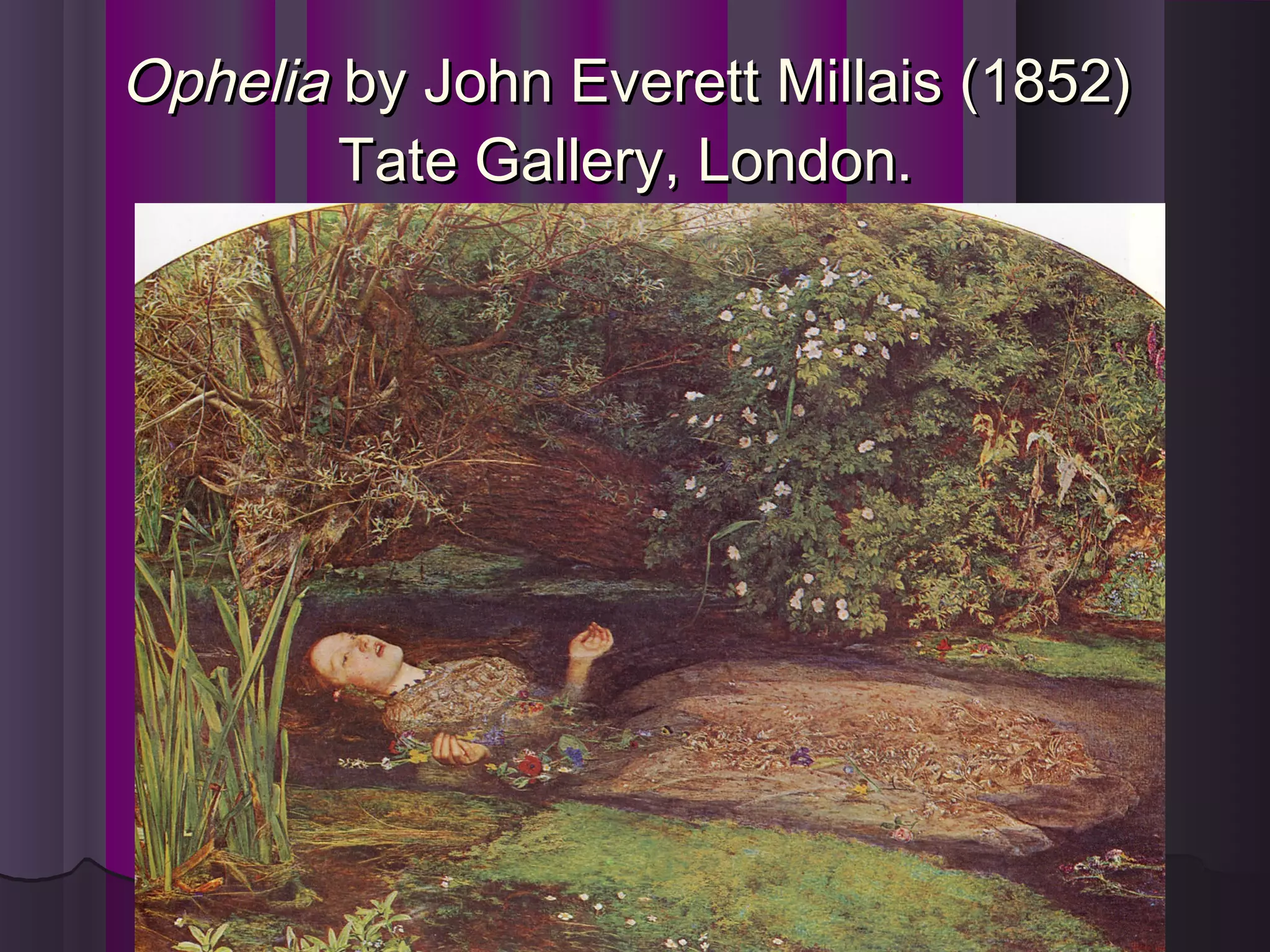
OpheliaOphelia by John Everett Millais (1852)by John Everett Millais (1852)
Tate Gallery, London.Tate Gallery, London.
Extratextual linksExtratextual links
Each word in a written or spoken message
comes to us burdened with all its history.
All the previous uses of this word or
phrase are implicit in it, or, as the
physicists would say, implode in it.
déja vu
 In our tongue we choose the words diacritically;
that means, according to the features that
differentiate them from the other words.(3)
 In poetry, as Coleridge suggests in his
Biographia Litteraria, both comprehension and
pleasure come from the tension between the
foreseeable and the impression of something
new, which is in itself an impression of
recognition, a déja vu.
 The semantic process is one of differentiation.
 To read is to compare
Foundation for Comparative LiteratureFoundation for Comparative Literature
 The study of other languages and literaryThe study of other languages and literary
traditions, the appreciation both of their intrinsictraditions, the appreciation both of their intrinsic
value and that which interweaves them with thevalue and that which interweaves them with the
sum of the human condition, ‘enriches’ thatsum of the human condition, ‘enriches’ that
condition.condition.
 It is integral to ‘free trade’ in an intellectual andIt is integral to ‘free trade’ in an intellectual and
spiritual sense. In the life of the mind, as in thatspiritual sense. In the life of the mind, as in that
of politics, isolationism and nationalist arroganceof politics, isolationism and nationalist arrogance
are the road to brutal ruin. (6)are the road to brutal ruin. (6)
What is ComparativeWhat is Comparative
Literature?Literature?
 Discipline of studying literature internationally:Discipline of studying literature internationally:
 across national bordersacross national borders
 across time periodsacross time periods
 across languagesacross languages
 across genresacross genres
 across boundaries between literature and the otheracross boundaries between literature and the other
arts (music, painting, dance, film, etc.)arts (music, painting, dance, film, etc.)
 across disciplines: literature and psychology,across disciplines: literature and psychology,
philosophy, science, history, architecture, etc.philosophy, science, history, architecture, etc.
 It is the study of "It is the study of "literature without wallsliterature without walls."."
What is ComparativeWhat is Comparative
Literature?Literature?
 ComparatistsComparatists include people who are:include people who are:
   studying literacy and social statusstudying literacy and social status
   studying medieval epic and romancestudying medieval epic and romance
   studying the links of literature to folklore andstudying the links of literature to folklore and
mythologymythology
   studying colonial and postcolonial writings instudying colonial and postcolonial writings in
different parts of the worlddifferent parts of the world
   asking fundamental questions about definitions ofasking fundamental questions about definitions of
literature itselfliterature itself
 Desire to study literature beyond national boundaries and an interestDesire to study literature beyond national boundaries and an interest
in languages.in languages.
 Many comparatists share the desire to integrate literary experienceMany comparatists share the desire to integrate literary experience
with other cultural phenomena such as historical change,with other cultural phenomena such as historical change,
philosophical concepts, and social movements.philosophical concepts, and social movements.
Comparative LiteratureComparative Literature
 Peter Brook says that Comparative Literature isPeter Brook says that Comparative Literature is
the quintessential ‘the quintessential ‘undisciplined disciplineundisciplined discipline’.’.
 Comparative literature is just a correct and
rigorous reading technique, a way to pay
attention to the oral and written manifestations of
language, one that privileges certain
components of those acts.
 Those components are not forgotten in any
literary study, but are highlighted in comparative
literature.
Compare -Compare - TranslateTranslate
 As a whole, comparative literature is a
comparative technique centred in the
particularities of translation.
 This process begins with the own language, that
the individuals, generations, groups, social
classes, professions and ideologies, past and
present, “translate” when understanding any
communicative discourse inside the own
language.
Understanding after BabelUnderstanding after Babel
Encouraged by the endless diversity of
Babel, Comparative Literature favours a
double principle:
unveil the essence, the historical and present
nucleus of the “sense of the world” (genius
loci) in language.
clarify, at its most, the conditions, strategies
and limits of the reciprocal understanding and
lack of understanding between languages.
Understanding after BabelUnderstanding after Babel
 Comparative literature listens and reads after
Babel.
 It marks the intuition, the hypothesis that far from
being a catastrophe, the multiplicity of human
languages –about twenty thousand which have been
spoken in different epochs in this tiny planet- has
been the condition that has made possible the
freedom of women and men to perceive, articulate
and re-create the existential world in plural freedom.
(9)
 Ex. The lives of Hamlet are also those of the different
operas, films and paintings, even ballets which the
play has generated.(16)
What to compare with?What to compare with?
 Comparative literature is the study of literature beyondComparative literature is the study of literature beyond
the boundaries of a single country.the boundaries of a single country.
 It is the study of the relationships between literature andIt is the study of the relationships between literature and
other areas of knowledge and beliefs:other areas of knowledge and beliefs:
 The arts in general (painting, sculpture, architecture, music)The arts in general (painting, sculpture, architecture, music)
 Philosophy, History, social sciences (e.g. political science,Philosophy, History, social sciences (e.g. political science,
economy, sociology)economy, sociology)
 The experimental sciences as the new technologiesThe experimental sciences as the new technologies
 Religion, etc.Religion, etc.
 To sum up, it is the comparison of a given literature withTo sum up, it is the comparison of a given literature with
other fields of human expression.other fields of human expression.
COMPARATIVE LITERATURE PAPERCOMPARATIVE LITERATURE PAPER
How to CompareHow to Compare
 1) A summary introduction of the1) A summary introduction of the authorsauthors,, periodsperiods andand
contextscontexts (one paragraph);(one paragraph);
 2) A2) A summarysummary of theof the works’works’ form and contentform and content (one(one
paragraph)paragraph)
 Original thesisOriginal thesis you will prove in your explication.you will prove in your explication.
A plot summary will amount to a failure for theA plot summary will amount to a failure for the
assignment.assignment.
 3) Explication of the work related to the3) Explication of the work related to the thesisthesis youyou
intend to solve, paying attention as much as possible tointend to solve, paying attention as much as possible to
the formal and thematic elements of the work.the formal and thematic elements of the work.
 In your thesis you will carry out a closeIn your thesis you will carry out a close studystudy
on one or moreon one or more elementselements (such as plot, setting,(such as plot, setting,
characters, theme, language, dramatic structure,characters, theme, language, dramatic structure,
imagery, symbolism, etc.)imagery, symbolism, etc.) of the work.of the work.
How to CompareHow to Compare
 Give examples to support your thesis.Give examples to support your thesis.
 *You must quote the “work” (*You must quote the “work” (primary sourceprimary source))
 IncludeInclude differentdifferent secondary sourcessecondary sources
 At least,At least, 2 library2 library databasesdatabases andand 2 authoritative2 authoritative
websiteswebsites on youron your authorauthor and theand the workwork..
 4)4) AAnn intertextualintertextual and/orand/or extratextualextratextual
relationship.relationship.
 5) A5) A works citedworks cited//bibliographicalbibliographical
referencesreferences
 2000 words2000 words excludingexcluding the abstract and thethe abstract and the
bibliography.bibliography.
SOURCESSOURCES
 Primary SourcesPrimary Sources
 Shakespeare, W. (XXXX). The Tragedy of Richard IIIShakespeare, W. (XXXX). The Tragedy of Richard III..
Harvard Classics,
 http://www.bartleby.comhttp://www.bartleby.com
 The Tragedy of Richard III, (1983)The Tragedy of Richard III, (1983) BBC production, Director:BBC production, Director:
Jane HowellJane Howell
 Pacino, Al (1996),Pacino, Al (1996), Looking for RichardLooking for Richard
http://www.imdb.com
 Secondary SourcesSecondary Sources
 AboutAbout ShakespeareShakespeare – plenty of books in the library– plenty of books in the library
 Authoritative websites:Authoritative websites:
http://www.academicinfo.net/englitwill.htmlhttp://www.academicinfo.net/englitwill.html
 About theAbout the other two artistsother two artists – search for info. in– search for info. in
authoritative websites.authoritative websites.
 AboutAbout literature & movie analysisliterature & movie analysis - plenty of books in the- plenty of books in the
library and authoritative websites.library and authoritative websites.

Comparative literature- summary

  • 1.
    What is ComparativeWhatis Comparative Literature?Literature? George SteinerGeorge Steiner Amalia Ortiz de Zárate F.Amalia Ortiz de Zárate F. Universidad Austral de ChileUniversidad Austral de Chile
  • 2.
    Group workGroup work 1.1.What do you think is ComparativeWhat do you think is Comparative Literature?Literature? 2.2. In what way the following words can beIn what way the following words can be related to comparative literature:related to comparative literature: frontalierfrontalier, marginalization and, marginalization and diaspora.diaspora. 3.3. Explain the relationship (or not) betweenExplain the relationship (or not) between comparative literaturecomparative literature andand translationtranslation.. 4.4. What are the steps you should follow toWhat are the steps you should follow to compare texts (in any format)?compare texts (in any format)?
  • 3.
    ReadingReading  To readis to interpretTo read is to interpret (through an(through an Hermeneutic process)Hermeneutic process)  To read is to translateTo read is to translate  To read is to compareTo read is to compare different works,different works, cultures, places,cultures, places, histories.histories.
  • 4.
    HermeneuticsHermeneutics  There isno innocence in perception and in the answer to the intelligible.  In the dynamic process called “hermeneutics” the comparison is implicit.  The notion of novelty (making new in Ezra Pound words) is comparative in sense and substance. (3)  How do we relate a novel or a symphony with that which we have previously read or heard, with our anticipations towards any expressive form?
  • 5.
    OpheliaOphelia by JohnEverett Millais (1852)by John Everett Millais (1852) Tate Gallery, London.Tate Gallery, London.
  • 6.
    Extratextual linksExtratextual links Eachword in a written or spoken message comes to us burdened with all its history. All the previous uses of this word or phrase are implicit in it, or, as the physicists would say, implode in it.
  • 7.
    déja vu  Inour tongue we choose the words diacritically; that means, according to the features that differentiate them from the other words.(3)  In poetry, as Coleridge suggests in his Biographia Litteraria, both comprehension and pleasure come from the tension between the foreseeable and the impression of something new, which is in itself an impression of recognition, a déja vu.  The semantic process is one of differentiation.  To read is to compare
  • 8.
    Foundation for ComparativeLiteratureFoundation for Comparative Literature  The study of other languages and literaryThe study of other languages and literary traditions, the appreciation both of their intrinsictraditions, the appreciation both of their intrinsic value and that which interweaves them with thevalue and that which interweaves them with the sum of the human condition, ‘enriches’ thatsum of the human condition, ‘enriches’ that condition.condition.  It is integral to ‘free trade’ in an intellectual andIt is integral to ‘free trade’ in an intellectual and spiritual sense. In the life of the mind, as in thatspiritual sense. In the life of the mind, as in that of politics, isolationism and nationalist arroganceof politics, isolationism and nationalist arrogance are the road to brutal ruin. (6)are the road to brutal ruin. (6)
  • 9.
    What is ComparativeWhatis Comparative Literature?Literature?  Discipline of studying literature internationally:Discipline of studying literature internationally:  across national bordersacross national borders  across time periodsacross time periods  across languagesacross languages  across genresacross genres  across boundaries between literature and the otheracross boundaries between literature and the other arts (music, painting, dance, film, etc.)arts (music, painting, dance, film, etc.)  across disciplines: literature and psychology,across disciplines: literature and psychology, philosophy, science, history, architecture, etc.philosophy, science, history, architecture, etc.  It is the study of "It is the study of "literature without wallsliterature without walls."."
  • 10.
    What is ComparativeWhatis Comparative Literature?Literature?  ComparatistsComparatists include people who are:include people who are:    studying literacy and social statusstudying literacy and social status    studying medieval epic and romancestudying medieval epic and romance    studying the links of literature to folklore andstudying the links of literature to folklore and mythologymythology    studying colonial and postcolonial writings instudying colonial and postcolonial writings in different parts of the worlddifferent parts of the world    asking fundamental questions about definitions ofasking fundamental questions about definitions of literature itselfliterature itself  Desire to study literature beyond national boundaries and an interestDesire to study literature beyond national boundaries and an interest in languages.in languages.  Many comparatists share the desire to integrate literary experienceMany comparatists share the desire to integrate literary experience with other cultural phenomena such as historical change,with other cultural phenomena such as historical change, philosophical concepts, and social movements.philosophical concepts, and social movements.
  • 11.
    Comparative LiteratureComparative Literature Peter Brook says that Comparative Literature isPeter Brook says that Comparative Literature is the quintessential ‘the quintessential ‘undisciplined disciplineundisciplined discipline’.’.  Comparative literature is just a correct and rigorous reading technique, a way to pay attention to the oral and written manifestations of language, one that privileges certain components of those acts.  Those components are not forgotten in any literary study, but are highlighted in comparative literature.
  • 12.
    Compare -Compare -TranslateTranslate  As a whole, comparative literature is a comparative technique centred in the particularities of translation.  This process begins with the own language, that the individuals, generations, groups, social classes, professions and ideologies, past and present, “translate” when understanding any communicative discourse inside the own language.
  • 13.
    Understanding after BabelUnderstandingafter Babel Encouraged by the endless diversity of Babel, Comparative Literature favours a double principle: unveil the essence, the historical and present nucleus of the “sense of the world” (genius loci) in language. clarify, at its most, the conditions, strategies and limits of the reciprocal understanding and lack of understanding between languages.
  • 14.
    Understanding after BabelUnderstandingafter Babel  Comparative literature listens and reads after Babel.  It marks the intuition, the hypothesis that far from being a catastrophe, the multiplicity of human languages –about twenty thousand which have been spoken in different epochs in this tiny planet- has been the condition that has made possible the freedom of women and men to perceive, articulate and re-create the existential world in plural freedom. (9)  Ex. The lives of Hamlet are also those of the different operas, films and paintings, even ballets which the play has generated.(16)
  • 15.
    What to comparewith?What to compare with?  Comparative literature is the study of literature beyondComparative literature is the study of literature beyond the boundaries of a single country.the boundaries of a single country.  It is the study of the relationships between literature andIt is the study of the relationships between literature and other areas of knowledge and beliefs:other areas of knowledge and beliefs:  The arts in general (painting, sculpture, architecture, music)The arts in general (painting, sculpture, architecture, music)  Philosophy, History, social sciences (e.g. political science,Philosophy, History, social sciences (e.g. political science, economy, sociology)economy, sociology)  The experimental sciences as the new technologiesThe experimental sciences as the new technologies  Religion, etc.Religion, etc.  To sum up, it is the comparison of a given literature withTo sum up, it is the comparison of a given literature with other fields of human expression.other fields of human expression.
  • 16.
  • 17.
    How to CompareHowto Compare  1) A summary introduction of the1) A summary introduction of the authorsauthors,, periodsperiods andand contextscontexts (one paragraph);(one paragraph);  2) A2) A summarysummary of theof the works’works’ form and contentform and content (one(one paragraph)paragraph)  Original thesisOriginal thesis you will prove in your explication.you will prove in your explication. A plot summary will amount to a failure for theA plot summary will amount to a failure for the assignment.assignment.  3) Explication of the work related to the3) Explication of the work related to the thesisthesis youyou intend to solve, paying attention as much as possible tointend to solve, paying attention as much as possible to the formal and thematic elements of the work.the formal and thematic elements of the work.  In your thesis you will carry out a closeIn your thesis you will carry out a close studystudy on one or moreon one or more elementselements (such as plot, setting,(such as plot, setting, characters, theme, language, dramatic structure,characters, theme, language, dramatic structure, imagery, symbolism, etc.)imagery, symbolism, etc.) of the work.of the work.
  • 18.
    How to CompareHowto Compare  Give examples to support your thesis.Give examples to support your thesis.  *You must quote the “work” (*You must quote the “work” (primary sourceprimary source))  IncludeInclude differentdifferent secondary sourcessecondary sources  At least,At least, 2 library2 library databasesdatabases andand 2 authoritative2 authoritative websiteswebsites on youron your authorauthor and theand the workwork..  4)4) AAnn intertextualintertextual and/orand/or extratextualextratextual relationship.relationship.  5) A5) A works citedworks cited//bibliographicalbibliographical referencesreferences  2000 words2000 words excludingexcluding the abstract and thethe abstract and the bibliography.bibliography.
  • 19.
    SOURCESSOURCES  Primary SourcesPrimarySources  Shakespeare, W. (XXXX). The Tragedy of Richard IIIShakespeare, W. (XXXX). The Tragedy of Richard III.. Harvard Classics,  http://www.bartleby.comhttp://www.bartleby.com  The Tragedy of Richard III, (1983)The Tragedy of Richard III, (1983) BBC production, Director:BBC production, Director: Jane HowellJane Howell  Pacino, Al (1996),Pacino, Al (1996), Looking for RichardLooking for Richard http://www.imdb.com  Secondary SourcesSecondary Sources  AboutAbout ShakespeareShakespeare – plenty of books in the library– plenty of books in the library  Authoritative websites:Authoritative websites: http://www.academicinfo.net/englitwill.htmlhttp://www.academicinfo.net/englitwill.html  About theAbout the other two artistsother two artists – search for info. in– search for info. in authoritative websites.authoritative websites.  AboutAbout literature & movie analysisliterature & movie analysis - plenty of books in the- plenty of books in the library and authoritative websites.library and authoritative websites.