Introduction :
What is Comparative
Literature Today ?
-Susan Bassnett
Comparative Literature
A Critical Introduction(1993)
Prepared by…
★ Jignesh Panchasara
★ Riddhi Bhatt
Task assigned by…
MAHARAJA KRISHNAKUMARSINHJI BHAVNAGAR UNIVERSITY
DEPARTMENT OF ENGLISH
Dr. Dilip Barad
Head of English Department,MKBU
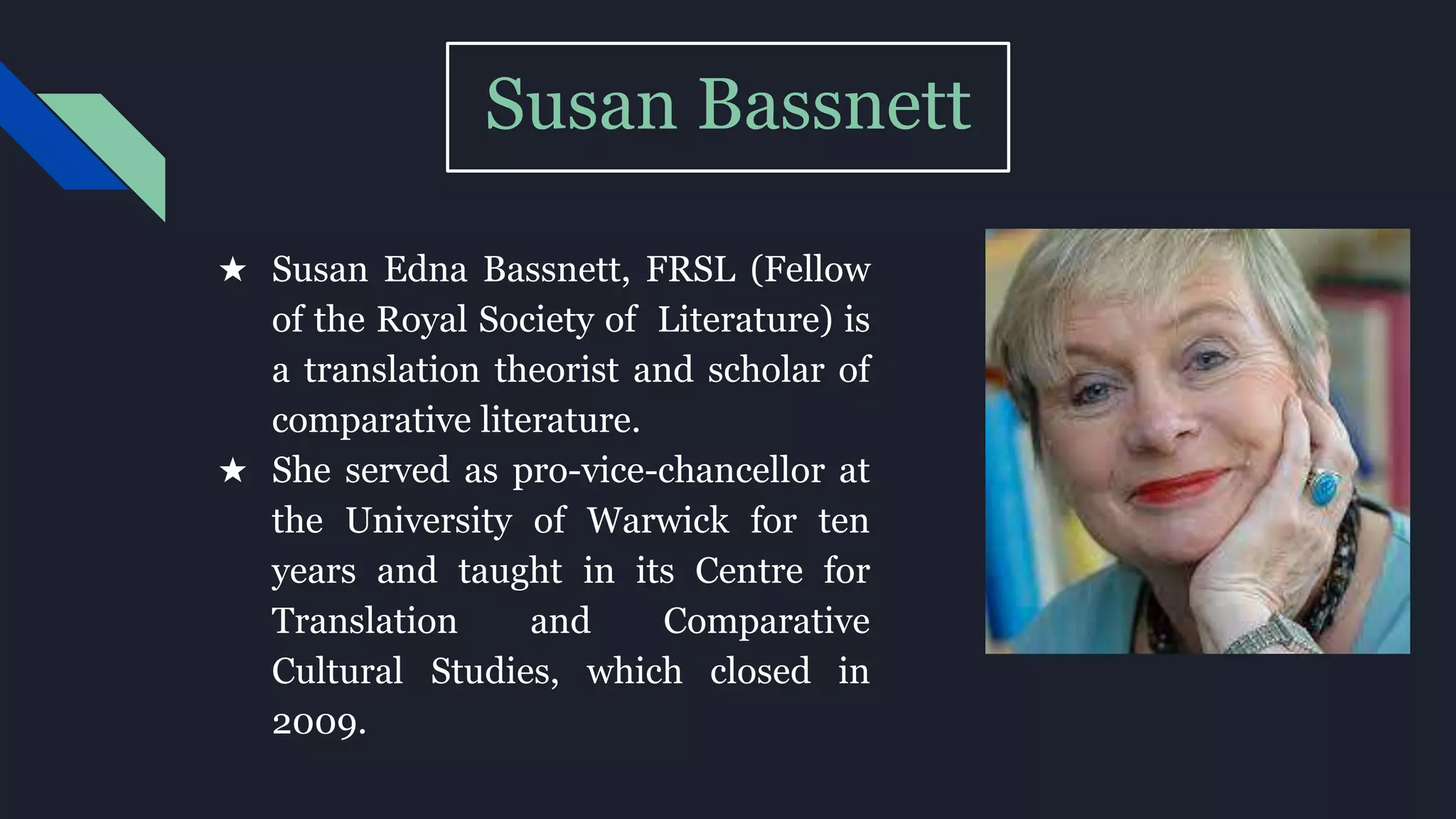
Susan Bassnett
★ Susan Edna Bassnett, FRSL (Fellow
of the Royal Society of Literature) is
a translation theorist and scholar of
comparative literature.
★ She served as pro-vice-chancellor at
the University of Warwick for ten
years and taught in its Centre for
Translation and Comparative
Cultural Studies, which closed in
2009.
Abstract
➔ Sooner or later, anyone who claims to be working in comparative
literature has to try and answer the inevitable question : What is it ? The
simplest answer is that comparative literature involves the study of texts
across cultures, that it is interdisciplinary and that it is concerned with
patterns of connection in literature across both time and space.
➔ Susan Bassnett gives a critical understanding of Comparative literature.
She says that there is no particular object for studying comparative
literature. Another thing is, we cannot give a definite term for
comparative literature.
➔ Different authors of literature give various perspectives about
comparative literature.The popular understanding of comparative
literature means different cultures across the world, expressed in the
Key Arguments
➔ Critics at the end of the twentieth century,in the age of postmodernism,still wrestle with
the same questions that were posed more than a century ago:
“What is the object of the study in comparative literature? How can comparison be the
objective of anything? If individual literatures have canon,what might a comparative canon be?
How can be comparatist select what to compare ?Is comparative literature a discipline? Or is it
simply a field of study ?”
➔ Susan Bassnett argues that there are different terms used by different scholars for
comparative literature studies. Therefore, we cannot put in a single compartment for
comparative literature.
➔ The second thing she argues is that the west students of 1960 claimed that comparative
literature could be put in single boundaries for comparative literature study, but she says
that there is no particular method used for claiming.
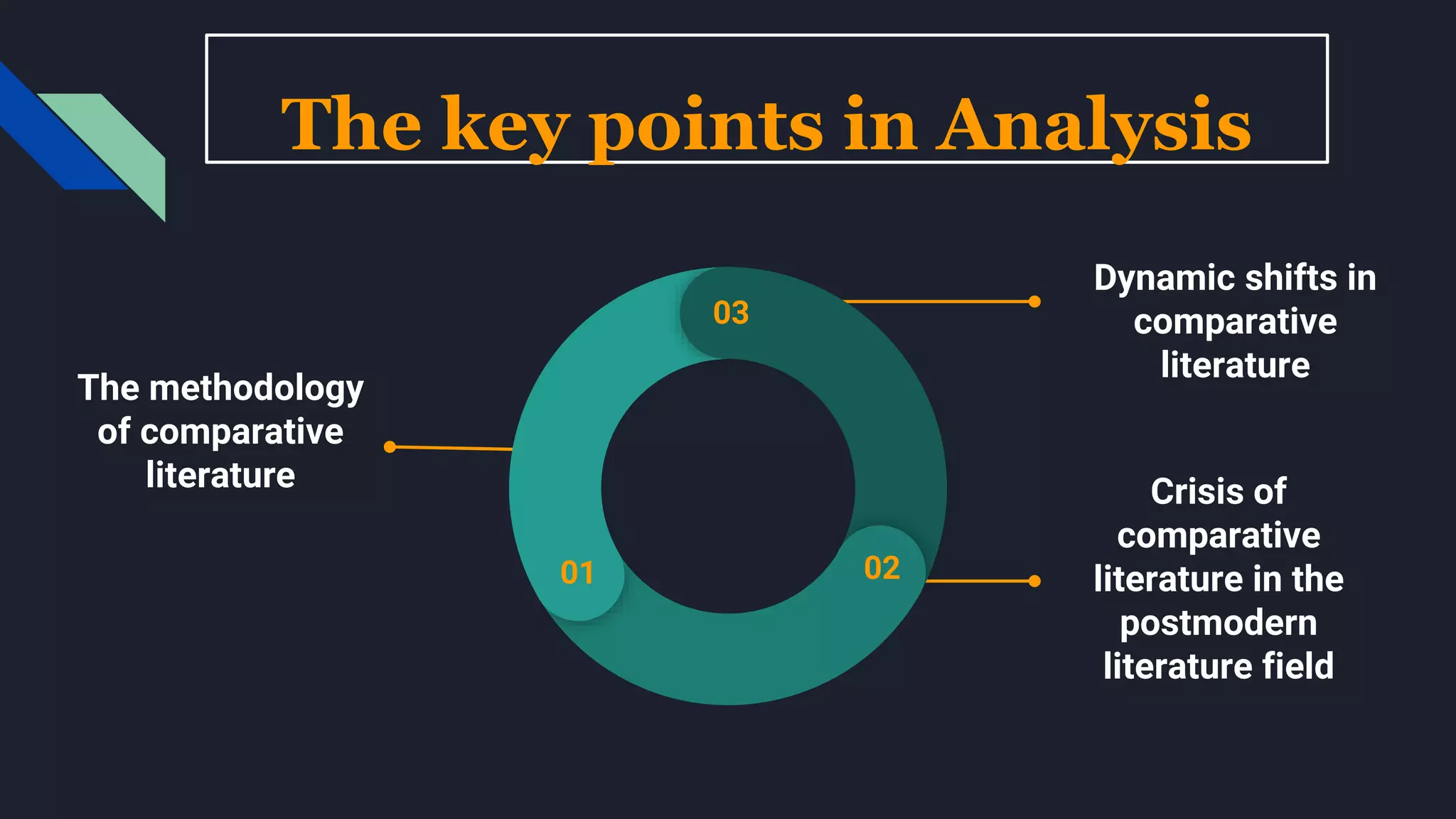
The key points in Analysis
The methodology
of comparative
literature
Dynamic shifts in
comparative
literature
Crisis of
comparative
literature in the
postmodern
literature field
03
01 02
Analysis
➔ The comparative literature has been developed through the
progress of the world and through various cultures of different
continents.
➔ A different cultures of the continents have played a vital role in
comparative literature studies, be it European, African,
American and Eastern so on.
➔ Matthew Arnold in his Inaugural lecture at Oxford in 1857 when he said :
“Everywhere there is connection, everywhere there is illustration.
No single event,no single literature is adequately
comprehend except in relation to other events,to other literature.”
➔ Goethe termed Weltliteratur.Goethe noted that he liked to “keep informed about foreign
productions’ and advised anyone else to do the same.It is becoming more and more
obvious to me,”he remarked, “that poetry is the common property of all mankind.”
➔ Benedetto Croce argued that comparative literature was a non-subject,contemptuously
dismissing the suggestion that it might be seen as separate discipline.
➔ Wellek and Warren in their Theory of Literature, a book that was enormously significant
in comparative literature when it first appeared in 1949,suggest that :
“Comparative Literature …will make high demands on the linguistic proficiencies of our
scholars.It asks for a widening of perspectives,
a suppression of local and provincial sentiments,not easy to achieve.”
Conclusion
➔ The comparative literature could not be brought under one umbrella unless it
becomes a particular branch of the discipline of literature. There are a lot of
efforts are being taken to study comparative literature through a common
language that is done in translation, which is understood by all people.
➔ Comparative Literature has traditionally claimed translation as a sub-
category,but this assumption in now being questioned.The work of scholars such
as Toury,Lefevere,Hermans,Lembert and many others has shown that translation
is especially at moments of great cultural changes.
➔ Evan Zohar argued that extensive translation activity takes place when a culture is
in a period of translation :when it is expanding,when it needs renewal,when it isin
a pre-revolutionary phase,then translation plays a vital part.
➔ Comparative Literature have always claimed that translation as a sub-
category,but as translation studies establishes itself firmly as a
subject based in inter-cultural study and offering a methodology of
some rigour, both in terms of theoretical and descriptive work, so
comparative literature appears less like a discipline and more like a
branch of something else.
➔ Seenin this way, the problem of the crisis could then be put into
perspective,and the long,unresolved debate on whether comparative
literature is or is not a discipline i its own right could finally and
definitely be shelved.
Thank you
Riddhi Bhatt
riddhi28bhatt@gmail.com
Jignesh Panchasara
jigneshpanchasra5758@gmail.com

Introduction : what is comparative literature today ?

  • 1.
    Introduction : What isComparative Literature Today ? -Susan Bassnett Comparative Literature A Critical Introduction(1993)
  • 2.
    Prepared by… ★ JigneshPanchasara ★ Riddhi Bhatt Task assigned by… MAHARAJA KRISHNAKUMARSINHJI BHAVNAGAR UNIVERSITY DEPARTMENT OF ENGLISH Dr. Dilip Barad Head of English Department,MKBU
  • 3.
    Susan Bassnett ★ SusanEdna Bassnett, FRSL (Fellow of the Royal Society of Literature) is a translation theorist and scholar of comparative literature. ★ She served as pro-vice-chancellor at the University of Warwick for ten years and taught in its Centre for Translation and Comparative Cultural Studies, which closed in 2009.
  • 4.
    Abstract ➔ Sooner orlater, anyone who claims to be working in comparative literature has to try and answer the inevitable question : What is it ? The simplest answer is that comparative literature involves the study of texts across cultures, that it is interdisciplinary and that it is concerned with patterns of connection in literature across both time and space. ➔ Susan Bassnett gives a critical understanding of Comparative literature. She says that there is no particular object for studying comparative literature. Another thing is, we cannot give a definite term for comparative literature. ➔ Different authors of literature give various perspectives about comparative literature.The popular understanding of comparative literature means different cultures across the world, expressed in the
  • 5.
    Key Arguments ➔ Criticsat the end of the twentieth century,in the age of postmodernism,still wrestle with the same questions that were posed more than a century ago: “What is the object of the study in comparative literature? How can comparison be the objective of anything? If individual literatures have canon,what might a comparative canon be? How can be comparatist select what to compare ?Is comparative literature a discipline? Or is it simply a field of study ?” ➔ Susan Bassnett argues that there are different terms used by different scholars for comparative literature studies. Therefore, we cannot put in a single compartment for comparative literature. ➔ The second thing she argues is that the west students of 1960 claimed that comparative literature could be put in single boundaries for comparative literature study, but she says that there is no particular method used for claiming.
  • 6.
    The key pointsin Analysis The methodology of comparative literature Dynamic shifts in comparative literature Crisis of comparative literature in the postmodern literature field 03 01 02
  • 7.
    Analysis ➔ The comparativeliterature has been developed through the progress of the world and through various cultures of different continents. ➔ A different cultures of the continents have played a vital role in comparative literature studies, be it European, African, American and Eastern so on.
  • 8.
    ➔ Matthew Arnoldin his Inaugural lecture at Oxford in 1857 when he said : “Everywhere there is connection, everywhere there is illustration. No single event,no single literature is adequately comprehend except in relation to other events,to other literature.” ➔ Goethe termed Weltliteratur.Goethe noted that he liked to “keep informed about foreign productions’ and advised anyone else to do the same.It is becoming more and more obvious to me,”he remarked, “that poetry is the common property of all mankind.” ➔ Benedetto Croce argued that comparative literature was a non-subject,contemptuously dismissing the suggestion that it might be seen as separate discipline. ➔ Wellek and Warren in their Theory of Literature, a book that was enormously significant in comparative literature when it first appeared in 1949,suggest that : “Comparative Literature …will make high demands on the linguistic proficiencies of our scholars.It asks for a widening of perspectives, a suppression of local and provincial sentiments,not easy to achieve.”
  • 9.
    Conclusion ➔ The comparativeliterature could not be brought under one umbrella unless it becomes a particular branch of the discipline of literature. There are a lot of efforts are being taken to study comparative literature through a common language that is done in translation, which is understood by all people. ➔ Comparative Literature has traditionally claimed translation as a sub- category,but this assumption in now being questioned.The work of scholars such as Toury,Lefevere,Hermans,Lembert and many others has shown that translation is especially at moments of great cultural changes. ➔ Evan Zohar argued that extensive translation activity takes place when a culture is in a period of translation :when it is expanding,when it needs renewal,when it isin a pre-revolutionary phase,then translation plays a vital part.
  • 10.
    ➔ Comparative Literaturehave always claimed that translation as a sub- category,but as translation studies establishes itself firmly as a subject based in inter-cultural study and offering a methodology of some rigour, both in terms of theoretical and descriptive work, so comparative literature appears less like a discipline and more like a branch of something else. ➔ Seenin this way, the problem of the crisis could then be put into perspective,and the long,unresolved debate on whether comparative literature is or is not a discipline i its own right could finally and definitely be shelved.
  • 11.
    Thank you Riddhi Bhatt riddhi28bhatt@gmail.com JigneshPanchasara jigneshpanchasra5758@gmail.com