“Teaching Large
Classes”
Challenges and Solutions
}1
“Teaching Large
Classes”
i - What are large classes?
ii - What makes large
classes difficult to teach?
iii - What techniques make
it possible for students to
learn in these classes?
21
i - What are large
classes?
 a) A class with more than 30 students
?
 b) A class with more than 40 students
?
 c) A class with more than 50 students
?
 d) A class with more than 60 students
31
The Fact is :
Researches showed
that benefits in
achievement generally
occur when class size
is reduced to less than
20 students.
41
ii - What makes large
classes difficult to teach?
(Problems with large classes
)
1- A tremendous
effort that teacher
will have to make.
51
2- It is difficult to get a
satisfactory knowledge
of students’ needs.
3- The noise level is
high which adds more
stress on teachers.
61
4- Organizing,
planning
and presenting
lessons, may
constitute another
challenge for teachers
in such classes as
students’ abilities 71
5- Intimacy with
students
and remembering
names might be a
problem.
6- Engaging learners
actively in the learning
81
7- It is hard to
imagine how a large
class would benefit
from school
resources such as
computers, books,
references… 91
8- With a crowded
classroom, teachers
may have difficulties
to measure
effectiveness.
9- A large class gives
reluctant students a
place to hide. 10
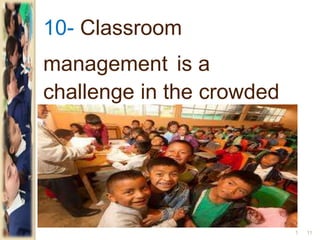
10- Classroom
management is a
challenge in the crowded
classrooms.
111
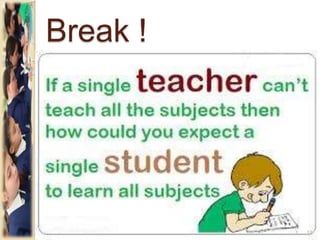
Break !
121
iii - What techniques make it
possible for students to learn
in these classes?
1-Train
students to
work in small
groups 131
2- Groups
should include
fewer
members.
141
3-Pair work may be
also a good
alternative to
practice
conversations,
exercises and other
151
4- Pairing weaker
students with stronger
ones might be an
option unless you fear
the weaker students
feel intimidated.
161
5- Changing the
classroom
desk
arrangement.
171
6- To optimize your work
with students with
learning difficulties,
give them seats in front
of you, closer to you so
that you can spot
difficulties easily while
teaching.
181
7- To reduce stress and
noise level, set simple
rules for class
management:
a. Establish simple
rules of acceptable
behavior for everybody to
observe when working in
groups, in pairs or
191
b. Train your students to deal
with classroom chores:
➬ getting into and out of the
classroom at the start and
end of lesson or during
recess time
➬ handing out books,
papers, and other materials;
➬ putting away school
materials at the end of the
lesson.
201
8- More able
students can play
the role of teachers’
assistants.
211
9- Split the class
into weak students
and more able
students.
221
10- Use technology?
➬ A large class will be better
off with social media where
students and the teacher
could meet at home.
231
11- Budget your own time
carefully.
➬ Teaching a large
class takes a great deal
of time and energy. If
you feel rushed or
overwhelmed, your
students will feel it.
241
12- Maximize
classroom space by
removing
unnecessary
furniture, and use
space outside of the
classroom as learning
and activity centres. 251
13- Do everything
possible to get to know
your students.
14- Have your students
introduce themselves to
everyone in an interactive
manner. You introduce
yourself, as well.
261
15- Move around the class
when talking.
16- Be natural and personal
in class and outside of it –
be yourself !
17- Tell your students you
will be available before and
after class to answer any
questions they might have.
271
18- Try to learn students’
names.
19- Pay attention to
individual students.
20- Come to class early.
21- Use audio-visual
aids.
22- Accept that things
281
Thank you !
➬The End !
North Sinai
English
Supervision.
Collected by:
Ahmed Ma’youf
291

Teaching large classes

  • 1.
  • 2.
    “Teaching Large Classes” i -What are large classes? ii - What makes large classes difficult to teach? iii - What techniques make it possible for students to learn in these classes? 21
  • 3.
    i - Whatare large classes?  a) A class with more than 30 students ?  b) A class with more than 40 students ?  c) A class with more than 50 students ?  d) A class with more than 60 students 31
  • 4.
    The Fact is: Researches showed that benefits in achievement generally occur when class size is reduced to less than 20 students. 41
  • 5.
    ii - Whatmakes large classes difficult to teach? (Problems with large classes ) 1- A tremendous effort that teacher will have to make. 51
  • 6.
    2- It isdifficult to get a satisfactory knowledge of students’ needs. 3- The noise level is high which adds more stress on teachers. 61
  • 7.
    4- Organizing, planning and presenting lessons,may constitute another challenge for teachers in such classes as students’ abilities 71
  • 8.
    5- Intimacy with students andremembering names might be a problem. 6- Engaging learners actively in the learning 81
  • 9.
    7- It ishard to imagine how a large class would benefit from school resources such as computers, books, references… 91
  • 10.
    8- With acrowded classroom, teachers may have difficulties to measure effectiveness. 9- A large class gives reluctant students a place to hide. 10
  • 11.
    10- Classroom management isa challenge in the crowded classrooms. 111
  • 12.
  • 13.
    iii - Whattechniques make it possible for students to learn in these classes? 1-Train students to work in small groups 131
  • 14.
  • 15.
    3-Pair work maybe also a good alternative to practice conversations, exercises and other 151
  • 16.
    4- Pairing weaker studentswith stronger ones might be an option unless you fear the weaker students feel intimidated. 161
  • 17.
  • 18.
    6- To optimizeyour work with students with learning difficulties, give them seats in front of you, closer to you so that you can spot difficulties easily while teaching. 181
  • 19.
    7- To reducestress and noise level, set simple rules for class management: a. Establish simple rules of acceptable behavior for everybody to observe when working in groups, in pairs or 191
  • 20.
    b. Train yourstudents to deal with classroom chores: ➬ getting into and out of the classroom at the start and end of lesson or during recess time ➬ handing out books, papers, and other materials; ➬ putting away school materials at the end of the lesson. 201
  • 21.
    8- More able studentscan play the role of teachers’ assistants. 211
  • 22.
    9- Split theclass into weak students and more able students. 221
  • 23.
    10- Use technology? ➬A large class will be better off with social media where students and the teacher could meet at home. 231
  • 24.
    11- Budget yourown time carefully. ➬ Teaching a large class takes a great deal of time and energy. If you feel rushed or overwhelmed, your students will feel it. 241
  • 25.
    12- Maximize classroom spaceby removing unnecessary furniture, and use space outside of the classroom as learning and activity centres. 251
  • 26.
    13- Do everything possibleto get to know your students. 14- Have your students introduce themselves to everyone in an interactive manner. You introduce yourself, as well. 261
  • 27.
    15- Move aroundthe class when talking. 16- Be natural and personal in class and outside of it – be yourself ! 17- Tell your students you will be available before and after class to answer any questions they might have. 271
  • 28.
    18- Try tolearn students’ names. 19- Pay attention to individual students. 20- Come to class early. 21- Use audio-visual aids. 22- Accept that things 281
  • 29.
    Thank you ! ➬TheEnd ! North Sinai English Supervision. Collected by: Ahmed Ma’youf 291