Instructions in the Classroom
LTC Eastbourne © 2014
Martin Sketchley
Today’s Training Session
Preparing and delivering instructions
Good and poor classroom instructions
Preparing instructions for a range of classroom
based activities
Incorporating ICQs in the classroom
Further reading to learn more
What are instructions?
Instructions are given when setting up and
delivering activities in the classroom.
They are needed so students know what they have
to do.
All teachers are expected to deliver instructions
during a lesson whatever the activity.
Instructions provide an opportunity for authentic
listening for students.
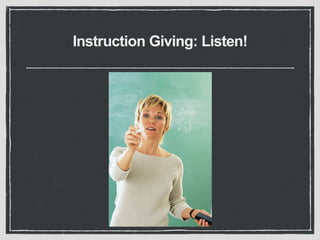
Instruction Giving: Listen!
Good & Poor Instructions
Write down your own ideas for good and/or poor
instructions
Work together in small groups
You have three minutes
Share your ideas after three minutes
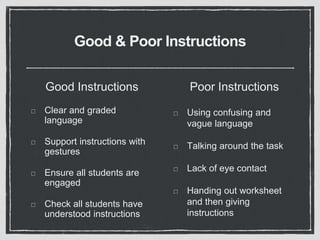
Good & Poor Instructions
Clear and graded
language
Support instructions with
gestures
Ensure all students are
engaged
Check all students have
understood instructions
Good Instructions Poor Instructions
Using confusing and
vague language
Talking around the task
Lack of eye contact
Handing out worksheet
and then giving
instructions
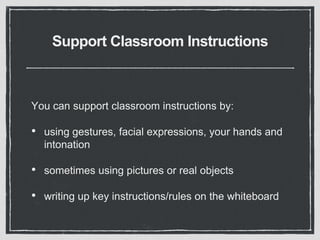
Support Classroom Instructions
You can support classroom instructions by:
• using gestures, facial expressions, your hands and
intonation
• sometimes using pictures or real objects
• writing up key instructions/rules on the whiteboard
Think of Gestures
Stand up.
Work on your own.
Five minutes left.
Quieten down.
Listen to me.
Give a longer answer.
Please stop talking
now.
Stop a noisy student
talking.
Listen to her.
Can you repeat that?
Think of gestures you could use for the following instructions
Planning Instructions
You will be given materials
from different coursebooks
Instructions will be for
different activities (listening,
role-play, etc)
Instructions shall be practiced
Work together in your groups
Peer feedback will be
provided after the instructions
What Are ICQs?
ICQs are “Instruction Concept Questions”
Can be used to check understanding of instructions
They can be tailored to the relevant task
Don‟t patronise students
Contain two options so students can respond with
„x‟ or „y‟
http://efl-resource.com/icqs-making-sure-your-students-know-what-to-do/
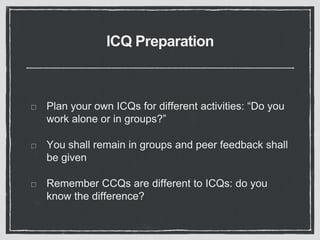
ICQ Preparation
Plan your own ICQs for different activities: “Do you
work alone or in groups?”
You shall remain in groups and peer feedback shall
be given
Remember CCQs are different to ICQs: do you
know the difference?
Instructions & ICQs: Additional
Reading
Further reading available:
• “Learning Teaching” (2011) by Scrivener
• “The Practice of English Language Teaching” (2007) by Harmer
• “Classroom Management” (2013) by Scrivener
Online reading:
• http://efl-resource.com/icqs-making-sure-your-students-know-what-to-do/
• http://eltrantsreviewsreflections.wordpress.com/2012/02/25/the-cult-of-icqs/
• http://eltnotebook.blogspot.co.uk/2006/11/giving-and-checking-instructions.html
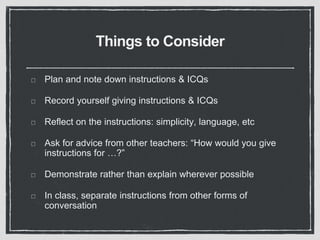
Things to Consider
Plan and note down instructions & ICQs
Record yourself giving instructions & ICQs
Reflect on the instructions: simplicity, language, etc
Ask for advice from other teachers: “How would you give
instructions for …?”
Demonstrate rather than explain wherever possible
In class, separate instructions from other forms of
conversation
Any
Questions?

Instructions in the classroom

  • 1.
    Instructions in theClassroom LTC Eastbourne © 2014 Martin Sketchley
  • 2.
    Today’s Training Session Preparingand delivering instructions Good and poor classroom instructions Preparing instructions for a range of classroom based activities Incorporating ICQs in the classroom Further reading to learn more
  • 3.
    What are instructions? Instructionsare given when setting up and delivering activities in the classroom. They are needed so students know what they have to do. All teachers are expected to deliver instructions during a lesson whatever the activity. Instructions provide an opportunity for authentic listening for students.
  • 4.
  • 5.
    Good & PoorInstructions Write down your own ideas for good and/or poor instructions Work together in small groups You have three minutes Share your ideas after three minutes
  • 6.
    Good & PoorInstructions Clear and graded language Support instructions with gestures Ensure all students are engaged Check all students have understood instructions Good Instructions Poor Instructions Using confusing and vague language Talking around the task Lack of eye contact Handing out worksheet and then giving instructions
  • 7.
    Support Classroom Instructions Youcan support classroom instructions by: • using gestures, facial expressions, your hands and intonation • sometimes using pictures or real objects • writing up key instructions/rules on the whiteboard
  • 8.
    Think of Gestures Standup. Work on your own. Five minutes left. Quieten down. Listen to me. Give a longer answer. Please stop talking now. Stop a noisy student talking. Listen to her. Can you repeat that? Think of gestures you could use for the following instructions
  • 9.
    Planning Instructions You willbe given materials from different coursebooks Instructions will be for different activities (listening, role-play, etc) Instructions shall be practiced Work together in your groups Peer feedback will be provided after the instructions
  • 10.
    What Are ICQs? ICQsare “Instruction Concept Questions” Can be used to check understanding of instructions They can be tailored to the relevant task Don‟t patronise students Contain two options so students can respond with „x‟ or „y‟ http://efl-resource.com/icqs-making-sure-your-students-know-what-to-do/
  • 11.
    ICQ Preparation Plan yourown ICQs for different activities: “Do you work alone or in groups?” You shall remain in groups and peer feedback shall be given Remember CCQs are different to ICQs: do you know the difference?
  • 12.
    Instructions & ICQs:Additional Reading Further reading available: • “Learning Teaching” (2011) by Scrivener • “The Practice of English Language Teaching” (2007) by Harmer • “Classroom Management” (2013) by Scrivener Online reading: • http://efl-resource.com/icqs-making-sure-your-students-know-what-to-do/ • http://eltrantsreviewsreflections.wordpress.com/2012/02/25/the-cult-of-icqs/ • http://eltnotebook.blogspot.co.uk/2006/11/giving-and-checking-instructions.html
  • 13.
    Things to Consider Planand note down instructions & ICQs Record yourself giving instructions & ICQs Reflect on the instructions: simplicity, language, etc Ask for advice from other teachers: “How would you give instructions for …?” Demonstrate rather than explain wherever possible In class, separate instructions from other forms of conversation
  • 14.