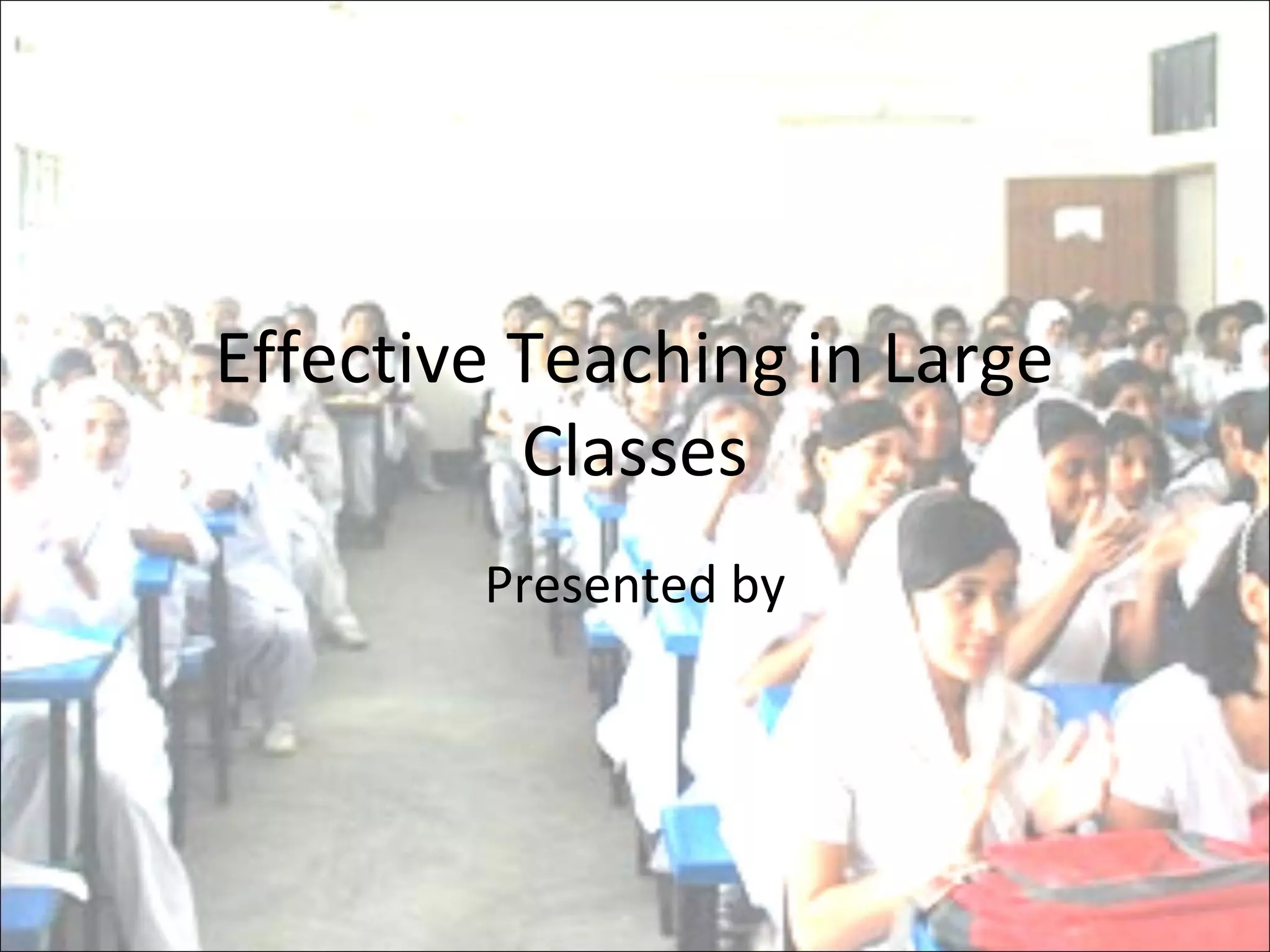
Effective Teaching in Large
Classes
Presented by
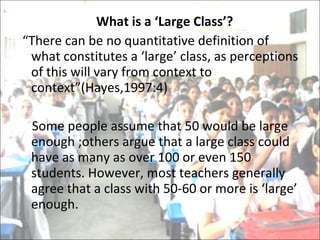
Do you see a ‘Large Class’?
What is a ‘Large Class’?
“There can be no quantitative definition of
what constitutes a ‘large’ class, as perceptions
of this will vary from context to
context”(Hayes,1997:4)
Some people assume that 50 would be large
enough ;others argue that a large class could
have as many as over 100 or even 150
students. However, most teachers generally
agree that a class with 50-60 or more is ‘large’
enough.
How can a teacher respond the
challenges?
• Complete Lecture
• Part Lecture
• All Multiple Sections
• One Large Class,Structured around Small
Group Learning
How can a teacher maintain discipline
in a large class?
• Have rules
• Have expectations
• Make students aware of the rules
• Review rules regularly
• Be firm and consistent
• Be professional
• Deal with troublemakers
How can a teacher develop the class
exercise?
• Whole class activities:interactive lecturing,brainstroming,class
response to questions
• Individual or small group activities using prompts solve a problem
- describe response to a prompt
- analyze/ conclude from data
- brainstorm why a result is wrong
- relate to personal experience
- compare/contrast
- analyze in terms of theory
- estimate implications or significance
- locate weakness in argument
- list pros and cons
- evaluate in terms of criteria
- reorder in an appropriate sequence
How can a teacher better manage the
class climate?
• Keep the class interested
• Practice fairness
• Practice humor
• Do not threaten
• Give students opportunities
• Do not humiliate
• Be alert
What kinds of active learning can a
teacher do?
• Ask question(s)
• Encourage students to think
• Summarize main points of lecture
• use feedback to target problem areas
• Give small problems/questions
How can a teacher improve the
lectures?
• Lead-off stories or interesting visuals
• Initial case problems
• Questions
• Headlines
• Examples and analogies
• Visual backups
• Spot challenges
• Illuminating activities
How can a teacher reduce the feeling
of anonymity?
• By knowing the names of the students
• By arriving early and chat with students
• By fostering bonds among students
• By asking their experiences

Effective Teaching in Large Classes

  • 1.
    Effective Teaching inLarge Classes Presented by
  • 2.
    Do you seea ‘Large Class’?
  • 3.
    What is a‘Large Class’? “There can be no quantitative definition of what constitutes a ‘large’ class, as perceptions of this will vary from context to context”(Hayes,1997:4) Some people assume that 50 would be large enough ;others argue that a large class could have as many as over 100 or even 150 students. However, most teachers generally agree that a class with 50-60 or more is ‘large’ enough.
  • 4.
    How can ateacher respond the challenges? • Complete Lecture • Part Lecture • All Multiple Sections • One Large Class,Structured around Small Group Learning
  • 5.
    How can ateacher maintain discipline in a large class? • Have rules • Have expectations • Make students aware of the rules • Review rules regularly • Be firm and consistent • Be professional • Deal with troublemakers
  • 6.
    How can ateacher develop the class exercise? • Whole class activities:interactive lecturing,brainstroming,class response to questions • Individual or small group activities using prompts solve a problem - describe response to a prompt - analyze/ conclude from data - brainstorm why a result is wrong - relate to personal experience - compare/contrast - analyze in terms of theory - estimate implications or significance - locate weakness in argument - list pros and cons - evaluate in terms of criteria - reorder in an appropriate sequence
  • 7.
    How can ateacher better manage the class climate? • Keep the class interested • Practice fairness • Practice humor • Do not threaten • Give students opportunities • Do not humiliate • Be alert
  • 8.
    What kinds ofactive learning can a teacher do? • Ask question(s) • Encourage students to think • Summarize main points of lecture • use feedback to target problem areas • Give small problems/questions
  • 9.
    How can ateacher improve the lectures? • Lead-off stories or interesting visuals • Initial case problems • Questions • Headlines • Examples and analogies • Visual backups • Spot challenges • Illuminating activities
  • 10.
    How can ateacher reduce the feeling of anonymity? • By knowing the names of the students • By arriving early and chat with students • By fostering bonds among students • By asking their experiences