




1
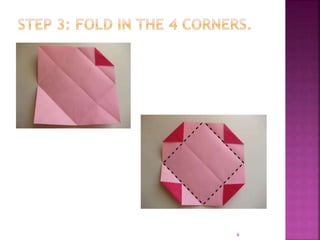
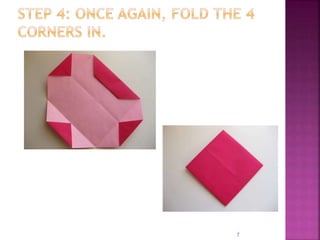
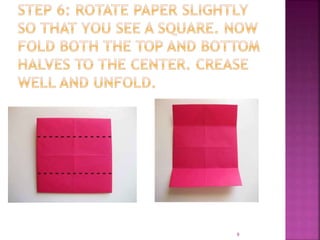
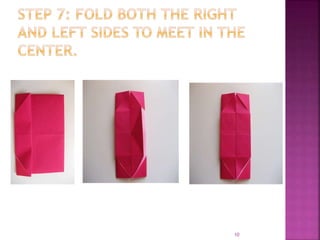
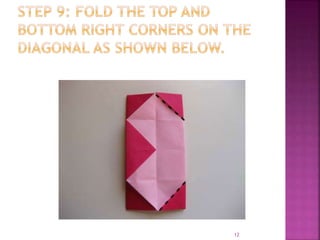
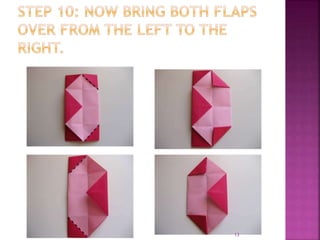
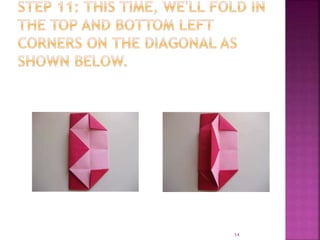
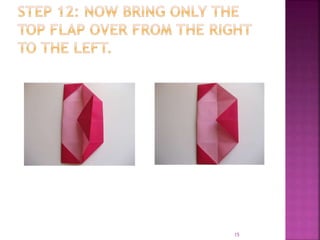
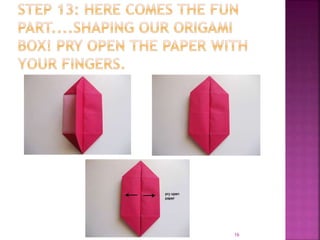
Have 3 pieces of paper.
 Be ready to make an origami –
utility box.
 Follow the instructions given
you.
2
3
4
5
6
7
8
9
10
11
12
13
14
15
16
17
 Call on somebody to demonstrate
how to make an origami box.
 Display your origami boxes on top of
your table.
18
Get a copy of the Learning Style
Inventory and the Learning Assessment
Style worksheets.
Accomplish the worksheets and
determine your score per learning
area.
 Read the interpretation of your
scores.
19
1.Active Involvement
Learning requires the active, constructive
involvement of the learner
In the classroom
*Avoid situations where the students are
passive listeners for long periods of time
*Provide students with hands-on activities,
such as experiments, observations, projects
*Encourage participation in classroom
discussions and other collaborative activities
2. Social Participation
Learning is primarily a social activity and
participation in the social life of the school is
central for learning to occur.
In the Classroom
*Assign students to work in groups and assume the
role of a coach who provides guidance and
support to the groups.
*Link the school to the community at large
3. Meaningful Activities
People learn best when they participate in
activities that are perceived to be useful in
real life and are culturally relevant.
In the Classroom
*Oral language and communication skills can be
improved by letting students participate
in debates.
*Writing skills can be improved by letting
students be involved in news writing
4. Relating new information to prior knowledge
New knowledge is constructed on the basis of
what is already understood and believed
In the classroom
*Teachers need to investigate students’ prior
knowledge in detail so that false beliefs and
misconceptions can be identified.
5. Being Strategic
People learn by employing effective and
flexible strategies that help them to
understand, reason, memorize and solve
problems
In the classroom
*Teachers should ensure that students learn to
use strategies on their own.
6. Engaging in self-regulation and being
reflective
Learners must know how to plan and monitor
their learning, how to set their own learning
goals and how to correct errors
In the classroom
*Teachers can help students become self-regulated
and reflective by providing opportunities:
--To check their thinking and ask themselves
questions about their understanding(Why am I
doing what I am doing?, How well am I doing ?,
What remains to be done?)
7. Restructuring prior knowledge
Sometimes prior knowledge can stand in the way
of learning something new. Students must learn
how to solve internal inconsistencies and
restructure existing conceptions when necessary.
In the classroom
*Teachers need to be aware that students have
prior beliefs and incomplete understandings that
can conflict with what is being taught at school.
*It is important to create the circumstances where
alternative beliefs and explanations can be
externalized and expressed.
8. Aiming towards understanding rather than
memorization
Learning is better when material is organized
around general principles and explanations, rather
than when it is based on memorization of isolated
facts and procedures.
In the classroom
*Ask students to explain a concept in their own
words
*Show students how to provide examples that
illustrate how a principle applies or how a law
works
9. Helping students learn to transfer
Learning becomes more meaningful when the
lessons are applied to real-life situations
In the classroom
*Insisting on mastery of subject matter
*Applying what has been learned in one subject-
matter area to other areas to which it may be
related
10. Taking time to practice
Learning is a complex cognitive activity that
cannot be rushed. It requires considerable time
and periods of practice to start building
expertise in an area
In the classroom
*Increase the amount of time students spend on
learning in the classroom
*Do not try to cover too many topics at once . Give
students time to understand the new information
*Be in contact with parents so that they can learn
to provide richer educational experiences for
their children.
11. Developmental and individual differences
Children learn best when their individual
differences are taken into consideration
In the classroom
*Learn how to assess children’s knowledge,
strategies and modes of learning adequately.
*Create connections to the real world by
introducing problems and materials drawn
from everyday situations
12. Creating motivated learners
Learning is critically influenced by learner
motivation. Teachers can help students become
more motivated learners by their behavior and the
statements they make.
In the classroom
*Teachers must use encouraging statements that
reflect an honest evaluation of learner performance
*Recognize student accomplishments.
*Refrain from grouping students according to their
ability
*Provide cooperation rather than competition
 Common learning styles
- Visual
- Auditory
- Tactile
Source: www.odessa.edu/dept/govt/dille/brian/
32
Understanding how students learn
starts by understanding how you as a
teacher learn.
It is best achieved when insights
gained from understanding
psychological principles are valued
and put into the teaching practice.
33
 Visual
- Minds sometimes strays during verbal
activities
- Observes rather than act or talk
- Likes to read
- Memorizes by seeing graphics
- Finds verbal instructions difficult
- Meticulous, neat in appearance
- Notices details
34
 Auditory
- Talks to self aloud
- Enjoys talking
- Easily distracted
- Likes to be read to
- Enjoys music
- Hums or sings
- Outgoing by nature
- Enjoys listening activities
35
 Kinesthetic
- Likes physical rewards
- In motion most of the time
- Likes to touch people when talking
- Taps pencil or foot when studying
- Enjoys doing activities
- Poor speller
- Tries new things
- Outgoing by nature
- Dresses for comfort
36
 Teacher Behavior
 Teacher Characteristics
 Student Behavior
 Student Characteristics
 Curriculum
 Time
 School Policies
 Community Characteristics
 Classroom Set-up
37
Determine why you learn the way you
do. A good teacher knows his/her own
strengths and weaknesses, as well as
the basic understanding of the way
students prefer to learn.
38
 Recognize how personality type
affects one’s teaching style.
 It is easy to teach students when
their preferred learning styles are
addressed.
39
 Develop varied strategies to
help students with different
learning styles.
 Provide the most productive
learning environment possible.
40
 Working by learning team, brainstorm on
teaching practices/strategies to ensure
positive learning environment and address
the different learning styles of learners.
 Write these strategies on manila paper to be
posted on the board.
 Ask a representative from the group to read
the output.
41
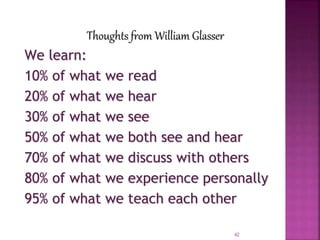
Thoughts from William Glasser
We learn:
10% of what we read
20% of what we hear
30% of what we see
50% of what we both see and hear
70% of what we discuss with others
80% of what we experience personally
95% of what we teach each other
42
THANK YOU
AND
MAY YOU
ALWAYS
FIND JOY
IN TEACHING!
43

How children learn

  • 1.
  • 2.
    Have 3 piecesof paper.  Be ready to make an origami – utility box.  Follow the instructions given you. 2
  • 3.
  • 4.
  • 5.
  • 6.
  • 7.
  • 8.
  • 9.
  • 10.
  • 11.
  • 12.
  • 13.
  • 14.
  • 15.
  • 16.
  • 17.
  • 18.
     Call onsomebody to demonstrate how to make an origami box.  Display your origami boxes on top of your table. 18
  • 19.
    Get a copyof the Learning Style Inventory and the Learning Assessment Style worksheets. Accomplish the worksheets and determine your score per learning area.  Read the interpretation of your scores. 19
  • 20.
    1.Active Involvement Learning requiresthe active, constructive involvement of the learner In the classroom *Avoid situations where the students are passive listeners for long periods of time *Provide students with hands-on activities, such as experiments, observations, projects *Encourage participation in classroom discussions and other collaborative activities
  • 21.
    2. Social Participation Learningis primarily a social activity and participation in the social life of the school is central for learning to occur. In the Classroom *Assign students to work in groups and assume the role of a coach who provides guidance and support to the groups. *Link the school to the community at large
  • 22.
    3. Meaningful Activities Peoplelearn best when they participate in activities that are perceived to be useful in real life and are culturally relevant. In the Classroom *Oral language and communication skills can be improved by letting students participate in debates. *Writing skills can be improved by letting students be involved in news writing
  • 23.
    4. Relating newinformation to prior knowledge New knowledge is constructed on the basis of what is already understood and believed In the classroom *Teachers need to investigate students’ prior knowledge in detail so that false beliefs and misconceptions can be identified.
  • 24.
    5. Being Strategic Peoplelearn by employing effective and flexible strategies that help them to understand, reason, memorize and solve problems In the classroom *Teachers should ensure that students learn to use strategies on their own.
  • 25.
    6. Engaging inself-regulation and being reflective Learners must know how to plan and monitor their learning, how to set their own learning goals and how to correct errors In the classroom *Teachers can help students become self-regulated and reflective by providing opportunities: --To check their thinking and ask themselves questions about their understanding(Why am I doing what I am doing?, How well am I doing ?, What remains to be done?)
  • 26.
    7. Restructuring priorknowledge Sometimes prior knowledge can stand in the way of learning something new. Students must learn how to solve internal inconsistencies and restructure existing conceptions when necessary. In the classroom *Teachers need to be aware that students have prior beliefs and incomplete understandings that can conflict with what is being taught at school. *It is important to create the circumstances where alternative beliefs and explanations can be externalized and expressed.
  • 27.
    8. Aiming towardsunderstanding rather than memorization Learning is better when material is organized around general principles and explanations, rather than when it is based on memorization of isolated facts and procedures. In the classroom *Ask students to explain a concept in their own words *Show students how to provide examples that illustrate how a principle applies or how a law works
  • 28.
    9. Helping studentslearn to transfer Learning becomes more meaningful when the lessons are applied to real-life situations In the classroom *Insisting on mastery of subject matter *Applying what has been learned in one subject- matter area to other areas to which it may be related
  • 29.
    10. Taking timeto practice Learning is a complex cognitive activity that cannot be rushed. It requires considerable time and periods of practice to start building expertise in an area In the classroom *Increase the amount of time students spend on learning in the classroom *Do not try to cover too many topics at once . Give students time to understand the new information *Be in contact with parents so that they can learn to provide richer educational experiences for their children.
  • 30.
    11. Developmental andindividual differences Children learn best when their individual differences are taken into consideration In the classroom *Learn how to assess children’s knowledge, strategies and modes of learning adequately. *Create connections to the real world by introducing problems and materials drawn from everyday situations
  • 31.
    12. Creating motivatedlearners Learning is critically influenced by learner motivation. Teachers can help students become more motivated learners by their behavior and the statements they make. In the classroom *Teachers must use encouraging statements that reflect an honest evaluation of learner performance *Recognize student accomplishments. *Refrain from grouping students according to their ability *Provide cooperation rather than competition
  • 32.
     Common learningstyles - Visual - Auditory - Tactile Source: www.odessa.edu/dept/govt/dille/brian/ 32
  • 33.
    Understanding how studentslearn starts by understanding how you as a teacher learn. It is best achieved when insights gained from understanding psychological principles are valued and put into the teaching practice. 33
  • 34.
     Visual - Mindssometimes strays during verbal activities - Observes rather than act or talk - Likes to read - Memorizes by seeing graphics - Finds verbal instructions difficult - Meticulous, neat in appearance - Notices details 34
  • 35.
     Auditory - Talksto self aloud - Enjoys talking - Easily distracted - Likes to be read to - Enjoys music - Hums or sings - Outgoing by nature - Enjoys listening activities 35
  • 36.
     Kinesthetic - Likesphysical rewards - In motion most of the time - Likes to touch people when talking - Taps pencil or foot when studying - Enjoys doing activities - Poor speller - Tries new things - Outgoing by nature - Dresses for comfort 36
  • 37.
     Teacher Behavior Teacher Characteristics  Student Behavior  Student Characteristics  Curriculum  Time  School Policies  Community Characteristics  Classroom Set-up 37
  • 38.
    Determine why youlearn the way you do. A good teacher knows his/her own strengths and weaknesses, as well as the basic understanding of the way students prefer to learn. 38
  • 39.
     Recognize howpersonality type affects one’s teaching style.  It is easy to teach students when their preferred learning styles are addressed. 39
  • 40.
     Develop variedstrategies to help students with different learning styles.  Provide the most productive learning environment possible. 40
  • 41.
     Working bylearning team, brainstorm on teaching practices/strategies to ensure positive learning environment and address the different learning styles of learners.  Write these strategies on manila paper to be posted on the board.  Ask a representative from the group to read the output. 41
  • 42.
    Thoughts from WilliamGlasser We learn: 10% of what we read 20% of what we hear 30% of what we see 50% of what we both see and hear 70% of what we discuss with others 80% of what we experience personally 95% of what we teach each other 42
  • 43.