ENGLISH TEACHING PRACTICUM
TEACHER: MSC.MARICELA MADRID
STUDENT: VERÓNICA MORENO
LEARNING ACTIVITY 2.1
INDIVIDUAL
DIFFERENCES
There are some styles and strategies of second
language learning, a few words are in order to
explain the differences among process, style and
strategies.
PROCESS
STYLE
STRATEGIES
All humans of normal intelligence
engage in certain levels or types of
learning
Consistent and rather enduring
tendencies or preferences within an
individual.
Are specific methods of approaching a problem
or tasks, modes of operation for achieving a
particular end, planned designs for controlling
and manipulating information.
LEARNING STYLES
Learning styles refers to the
understanding that every student
learns differently. Technically, an
individual’s learning style refers
to the preferential way in which
the student absorbs, processes,
comprehends and retains
information.
Learning styles might be thought
of as cognitive ,affective and
psychological traits
FIELD INDEPENDENCE
LEFT AND RIGHT BRAIN FUNCTIONING
AMBIGUITY TOLERANCE
REFLECTIVITY AND IMPULSIVITY
VISUAL AND AUDITORY STYLES
STRATEGIES
COMMUNICATION STRATEGIES
STRATEGIES BASED INSTRUCTION
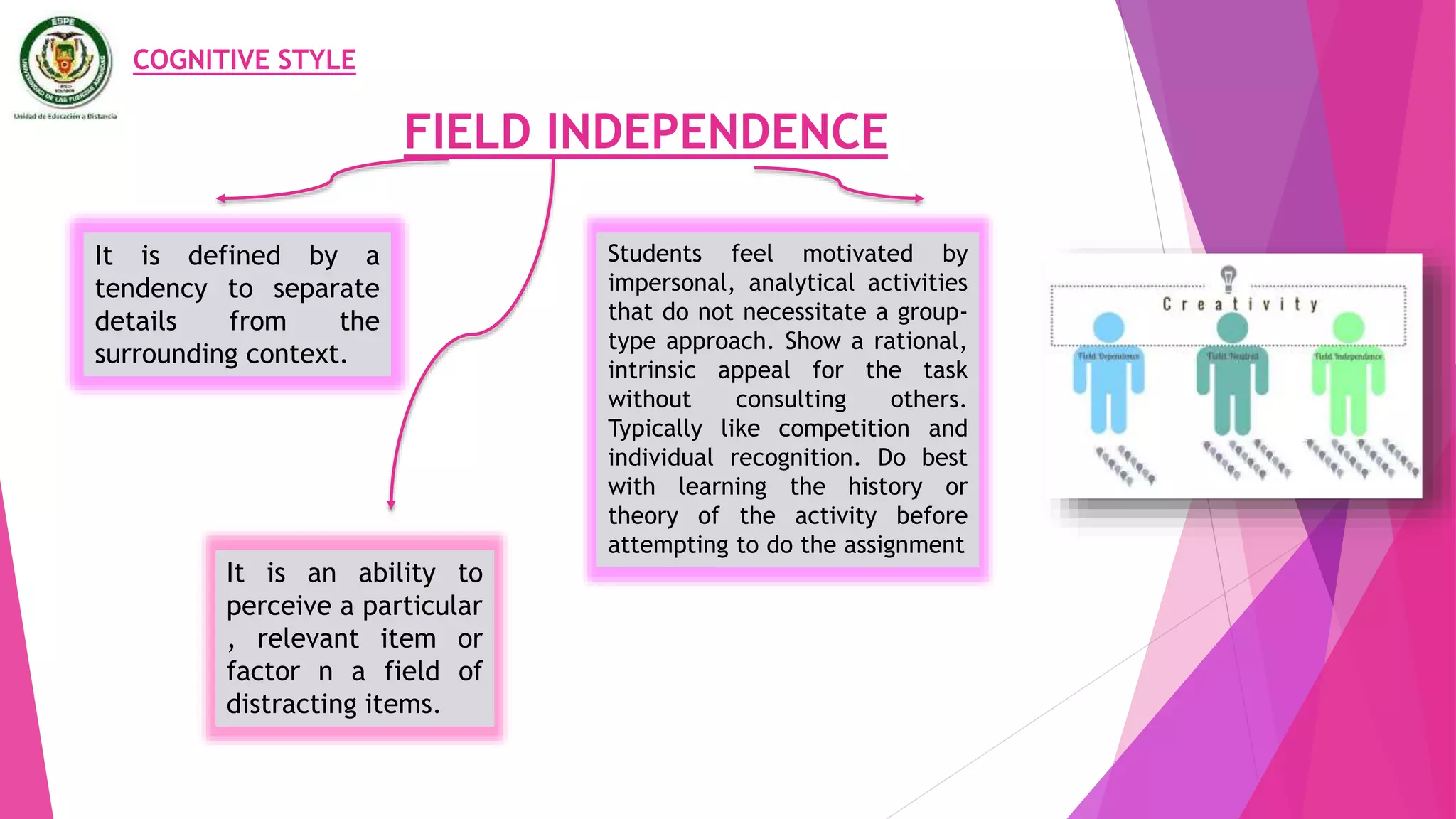
FIELD INDEPENDENCE
COGNITIVE STYLE
It is defined by a
tendency to separate
details from the
surrounding context.
It is an ability to
perceive a particular
, relevant item or
factor n a field of
distracting items.
Students feel motivated by
impersonal, analytical activities
that do not necessitate a group-
type approach. Show a rational,
intrinsic appeal for the task
without consulting others.
Typically like competition and
individual recognition. Do best
with learning the history or
theory of the activity before
attempting to do the assignment
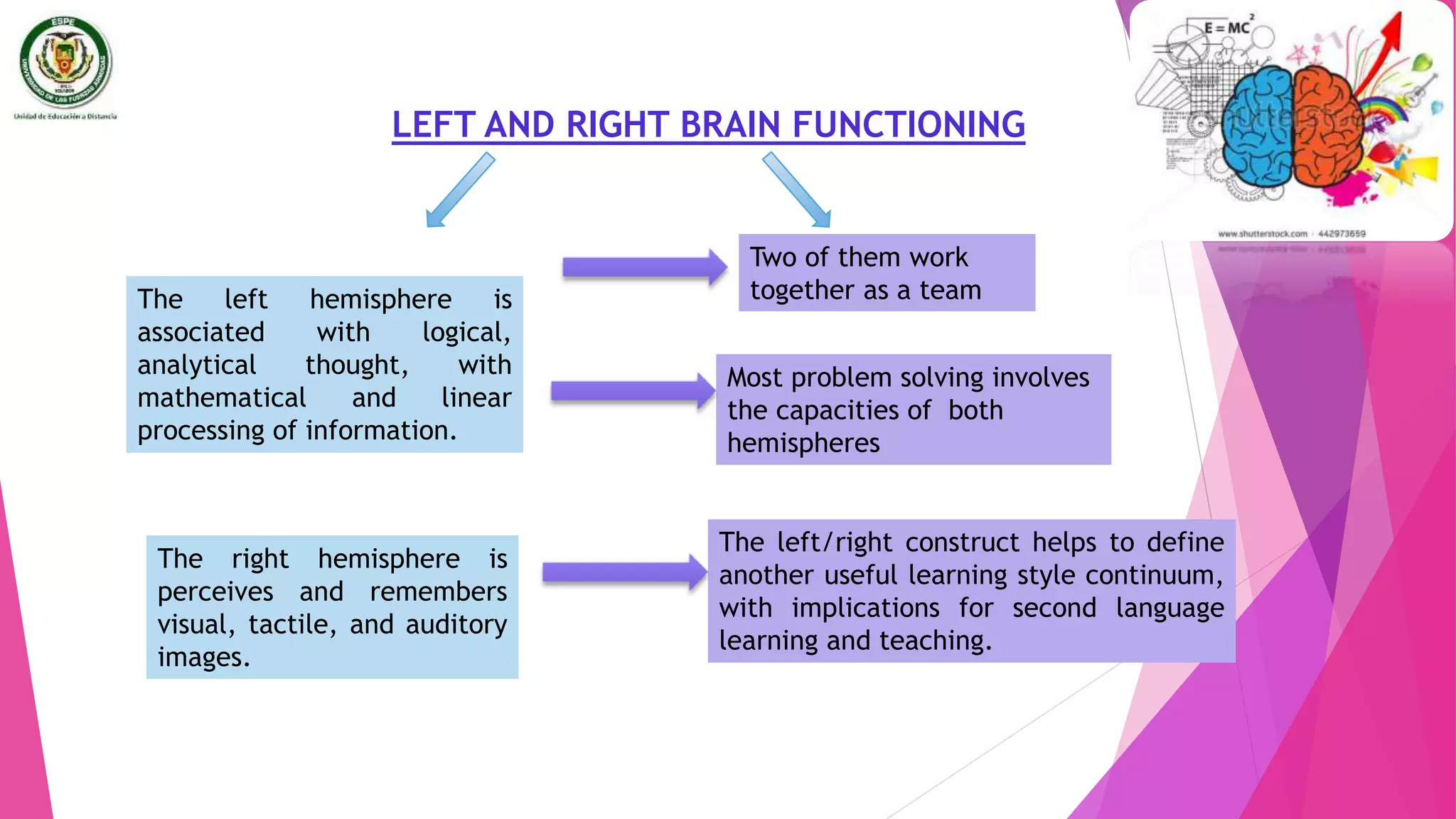
LEFT AND RIGHT BRAIN FUNCTIONING
The left hemisphere is
associated with logical,
analytical thought, with
mathematical and linear
processing of information.
The right hemisphere is
perceives and remembers
visual, tactile, and auditory
images.
Two of them work
together as a team
Most problem solving involves
the capacities of both
hemispheres
The left/right construct helps to define
another useful learning style continuum,
with implications for second language
learning and teaching.
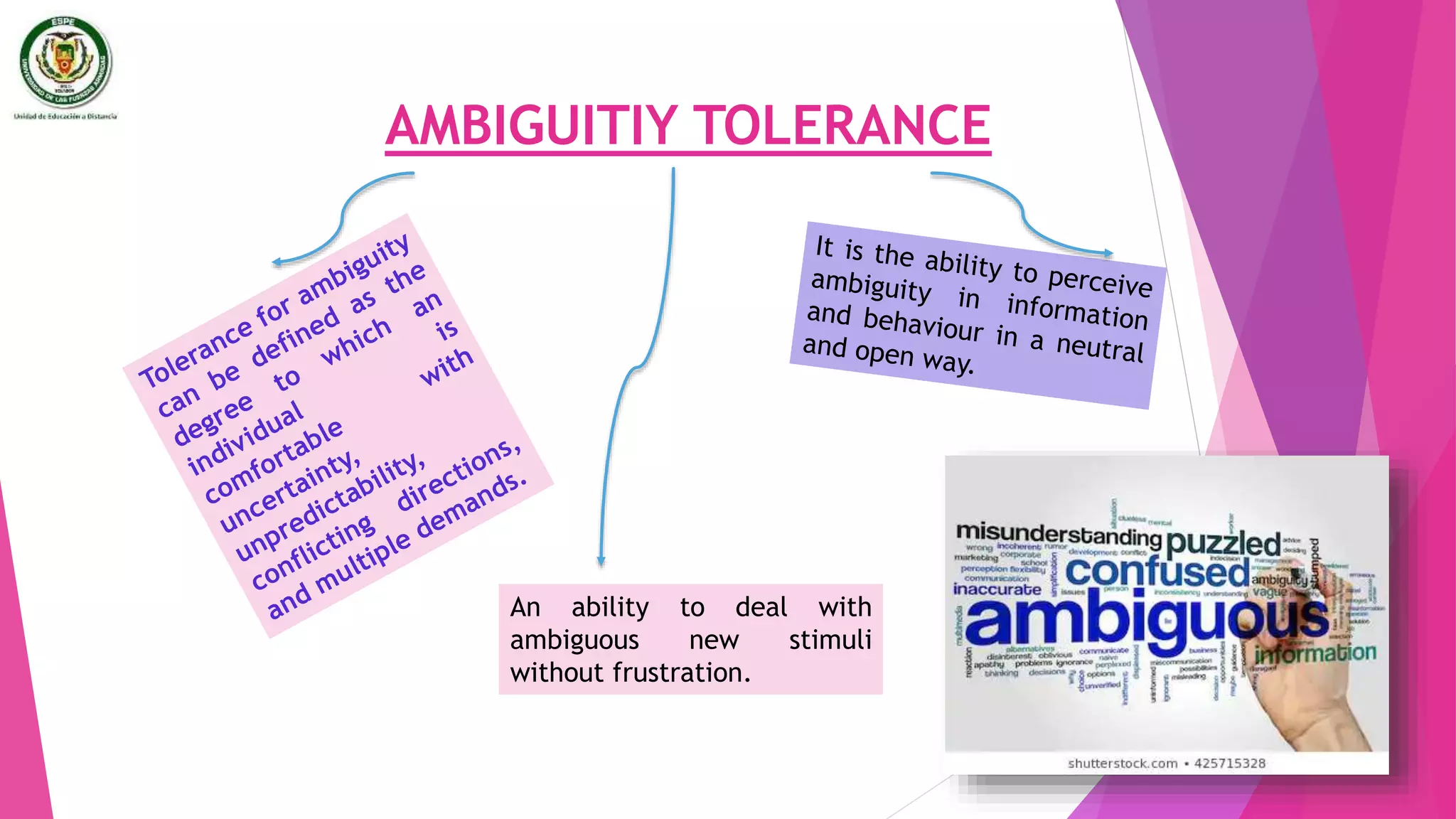
AMBIGUITIY TOLERANCE
An ability to deal with
ambiguous new stimuli
without frustration.
REFLECTIVITY AND IMPULSIVITY
It is common for us
to show in our
personalities certain
tendencies toward
reflectivity
sometimes and
impulsivity at other
times.
when students take more time
in their work and it is more
accurate they are considered
as “ reflective”
Students who rush to
perform a task often
have errors. they are
“impulsive”
Slower, more
calculated decision
Systematic
Make fewer errors in reading
Quick or gambling guess
at an answer to a
problem
Intuitive
Faster reader
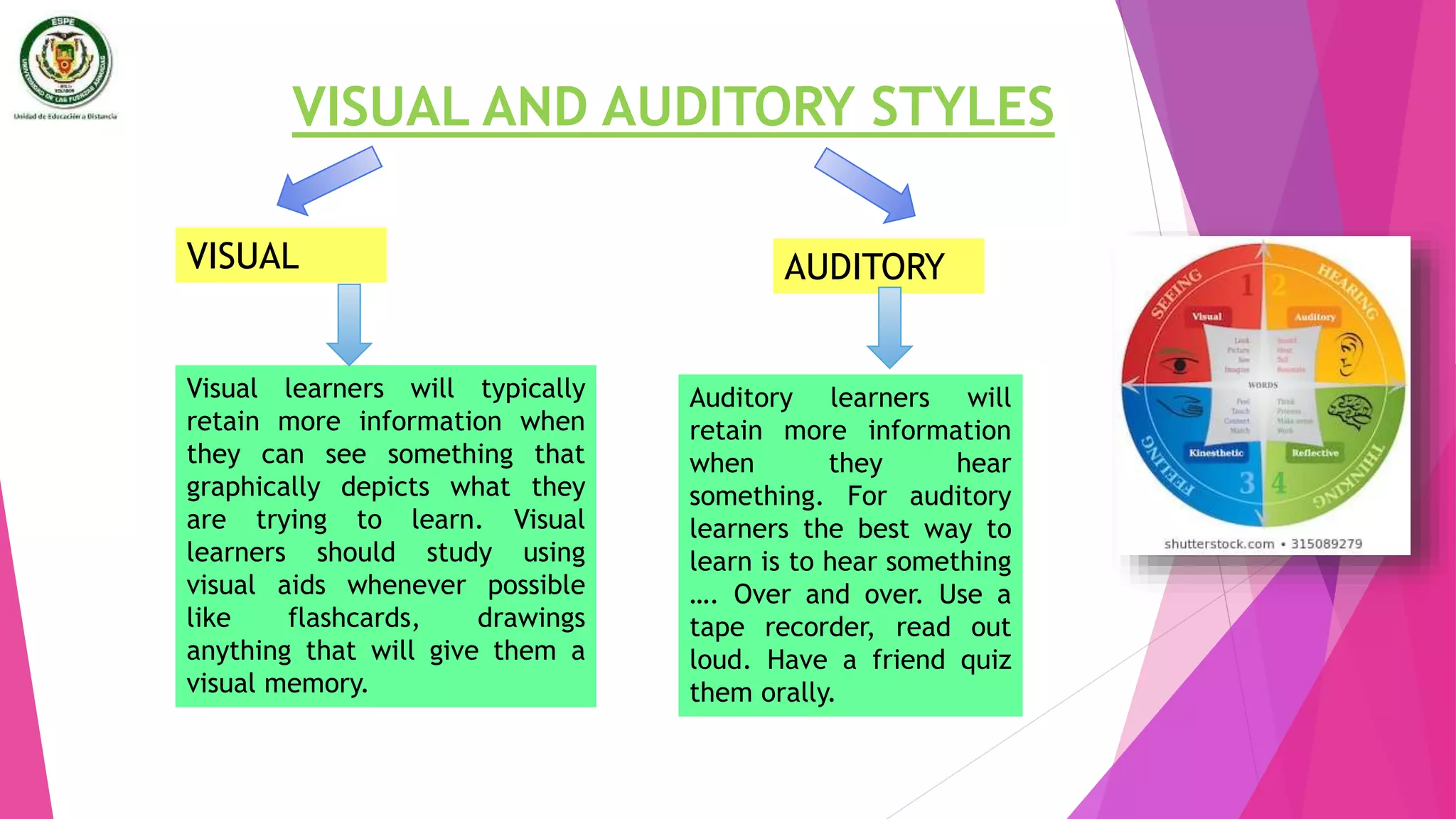
VISUAL AND AUDITORY STYLES
AUDITORYVISUAL
Visual learners will typically
retain more information when
they can see something that
graphically depicts what they
are trying to learn. Visual
learners should study using
visual aids whenever possible
like flashcards, drawings
anything that will give them a
visual memory.
Auditory learners will
retain more information
when they hear
something. For auditory
learners the best way to
learn is to hear something
…. Over and over. Use a
tape recorder, read out
loud. Have a friend quiz
them orally.
STRATEGIES
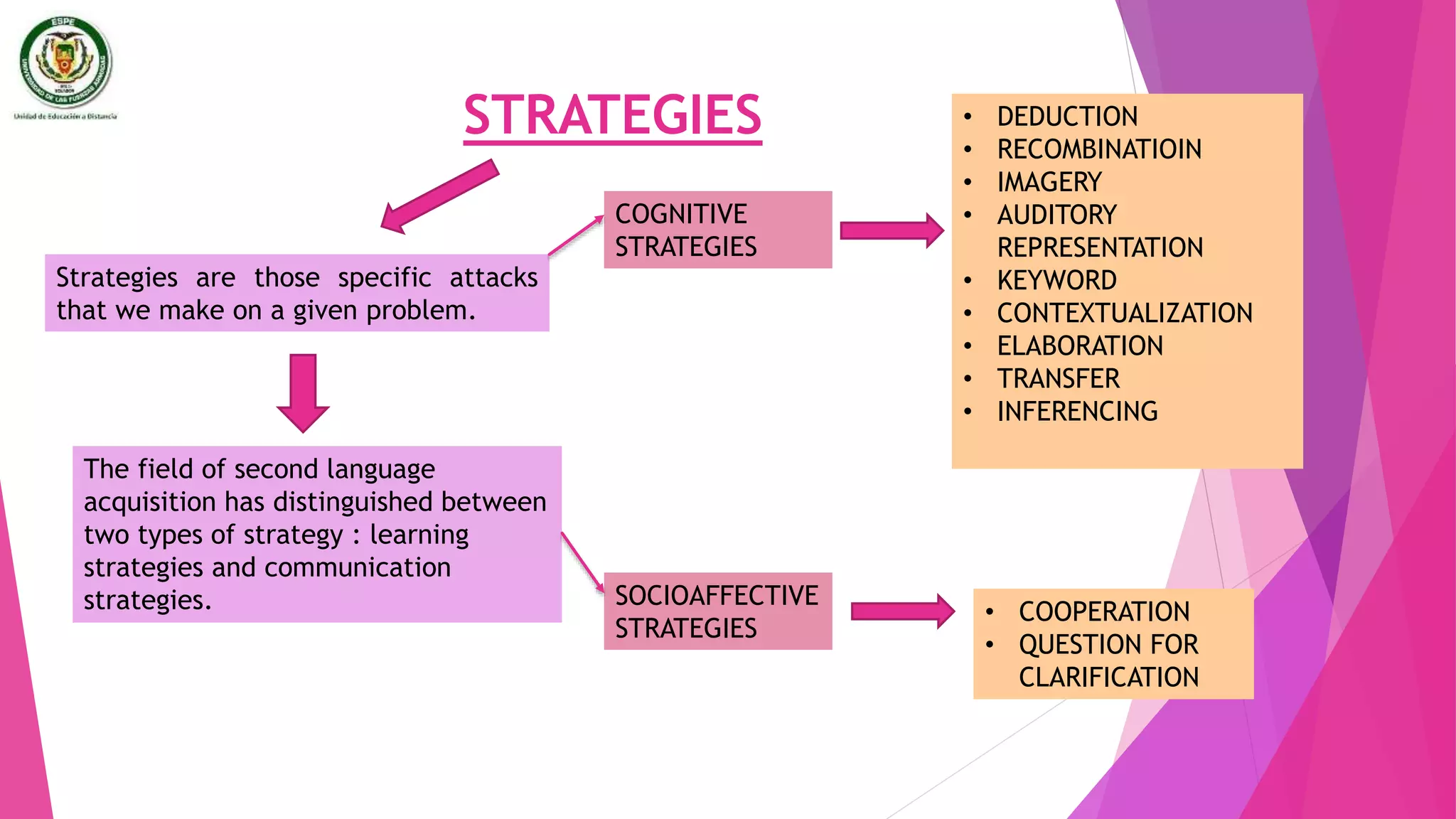
Strategies are those specific attacks
that we make on a given problem.
The field of second language
acquisition has distinguished between
two types of strategy : learning
strategies and communication
strategies.
COGNITIVE
STRATEGIES
• DEDUCTION
• RECOMBINATIOIN
• IMAGERY
• AUDITORY
REPRESENTATION
• KEYWORD
• CONTEXTUALIZATION
• ELABORATION
• TRANSFER
• INFERENCING
SOCIOAFFECTIVE
STRATEGIES
• COOPERATION
• QUESTION FOR
CLARIFICATION
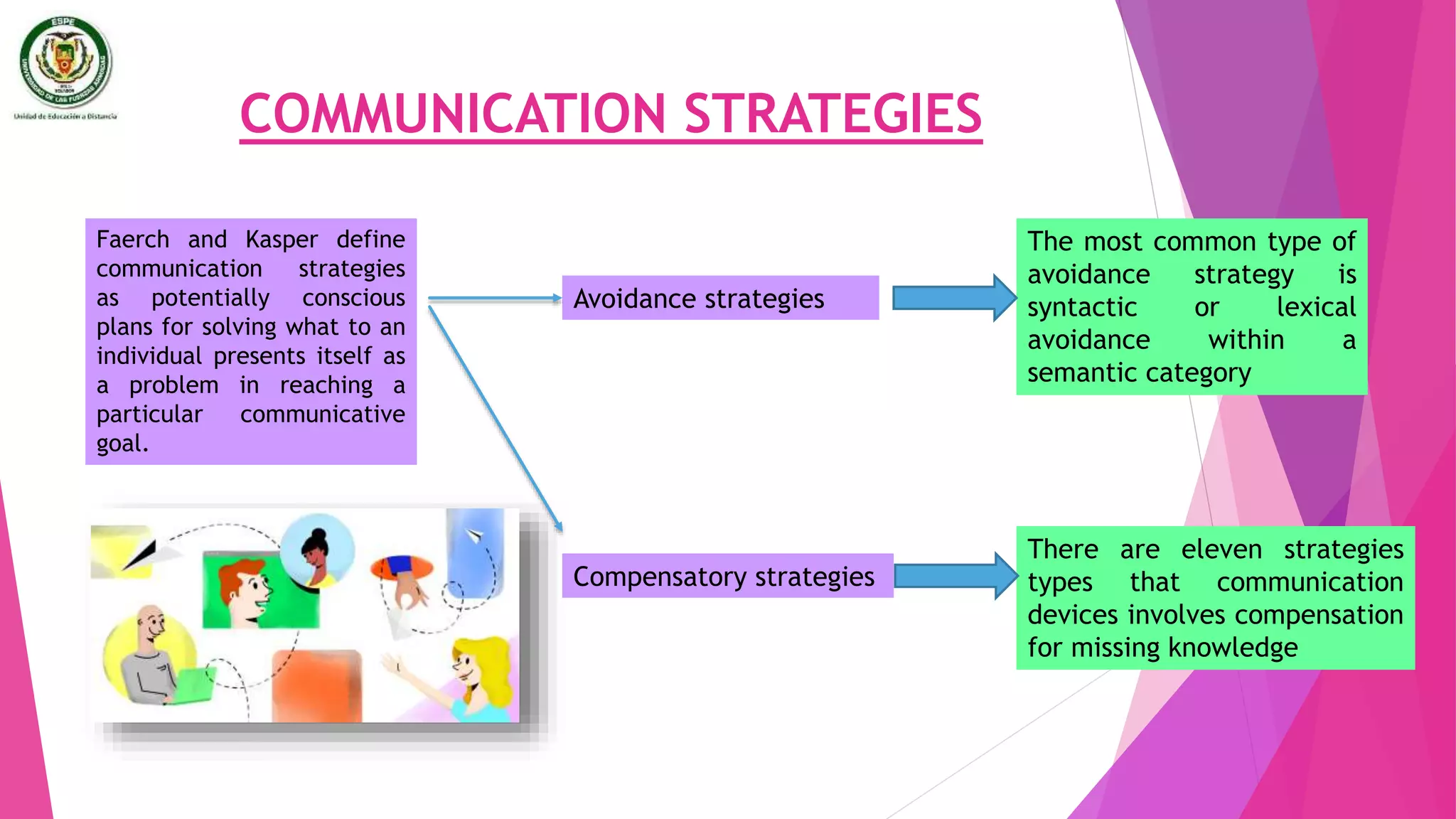
COMMUNICATION STRATEGIES
Faerch and Kasper define
communication strategies
as potentially conscious
plans for solving what to an
individual presents itself as
a problem in reaching a
particular communicative
goal.
Avoidance strategies
Compensatory strategies
The most common type of
avoidance strategy is
syntactic or lexical
avoidance within a
semantic category
There are eleven strategies
types that communication
devices involves compensation
for missing knowledge
STRATEGIES BASED INSTRUCTION
Much of the work of researches and
teachers on the application of both learning
and communication strategies to classroom
learning has come to be know generically as
STRATEGIES BASED INTRODUCCION (SBI) or
as learner strategy training.
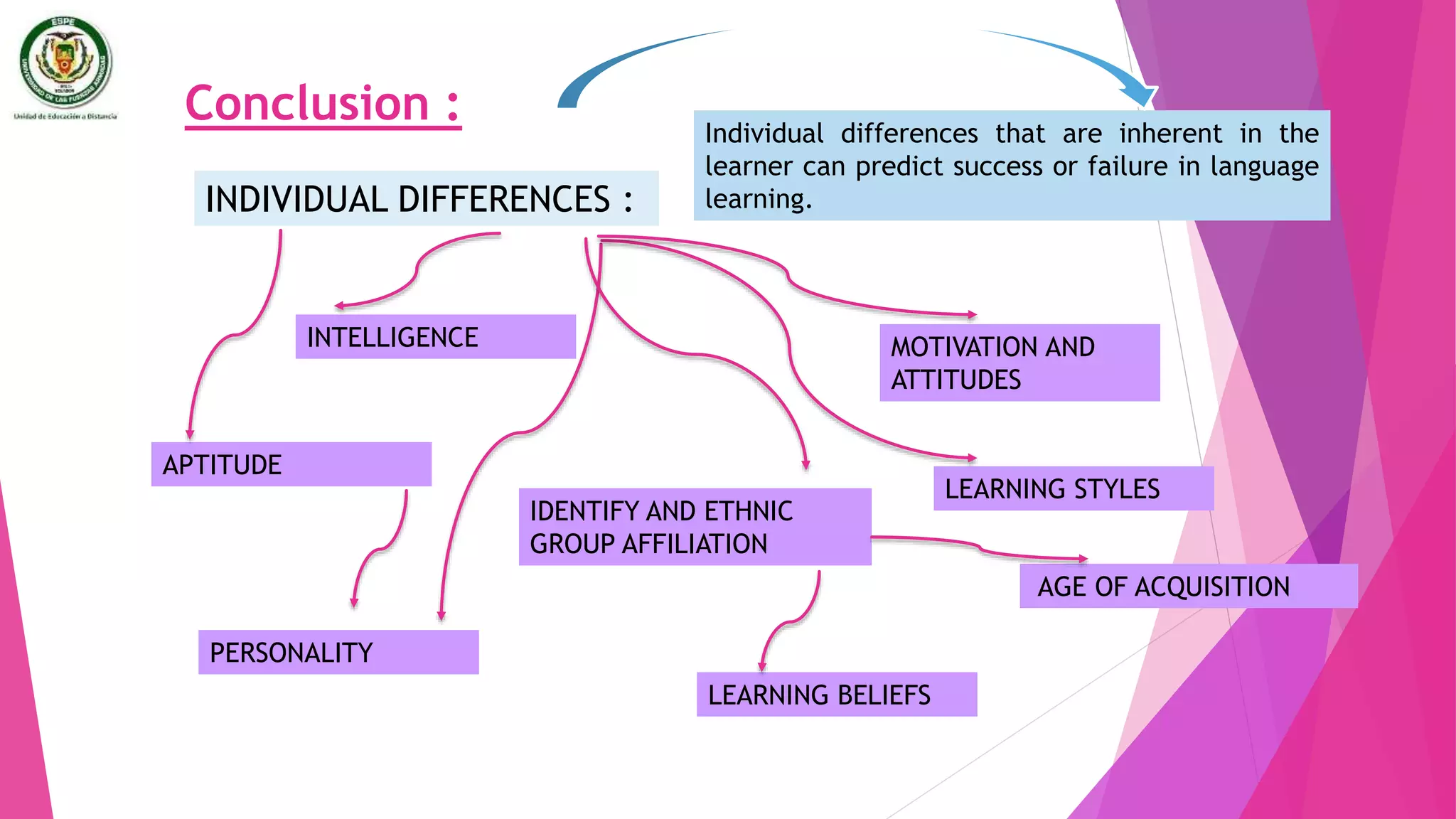
Conclusion :
INDIVIDUAL DIFFERENCES :
LEARNING STYLES
INTELLIGENCE
APTITUDE
PERSONALITY
AGE OF ACQUISITION
MOTIVATION AND
ATTITUDES
IDENTIFY AND ETHNIC
GROUP AFFILIATION
LEARNING BELIEFS
Individual differences that are inherent in the
learner can predict success or failure in language
learning.
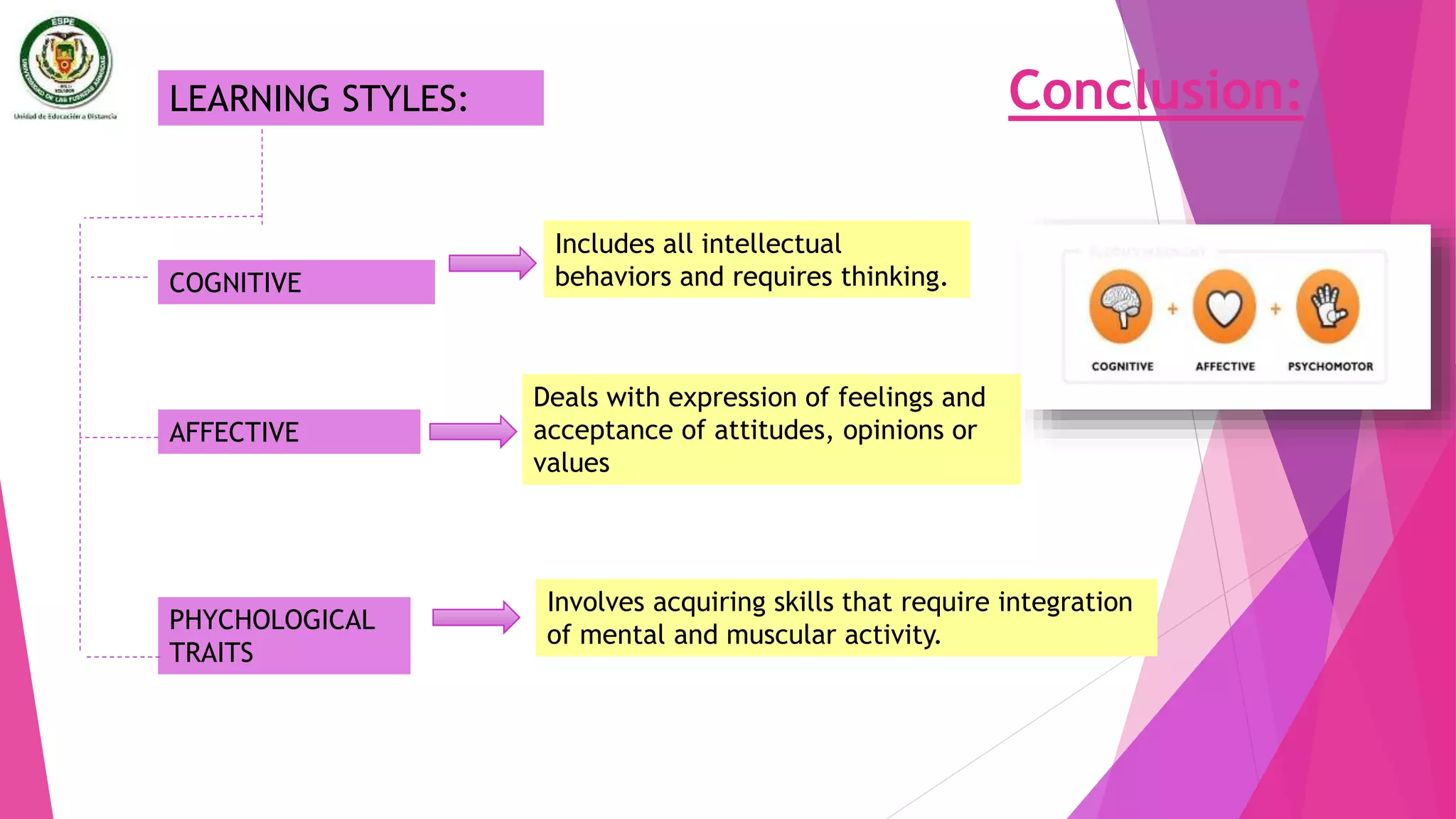
Conclusion:LEARNING STYLES:
COGNITIVE
Includes all intellectual
behaviors and requires thinking.
AFFECTIVE
Deals with expression of feelings and
acceptance of attitudes, opinions or
values
PHYCHOLOGICAL
TRAITS
Involves acquiring skills that require integration
of mental and muscular activity.
Building strategies techniques
1. To lower inhibitions
2.To encourage risk taking
3.To build students – self-
confidence
4.To help them to develop
intrinsic motivation
5. To promote cooperative
learning
6.To encourage them to use right-brain processing
7.To promote ambiguity tolerance
8.To help them use their intuition
9. To get students to make their mistakes work
for them.
10. To get students to set their own goals.
Conclusion:
I think so that the individual differences and learning styles are very important
to improve skill into the class with our students. Its important to know their
feelings, thinking , knowledge, behavior, etc.
Teachers should focus their energy on developing teaching strategies which
match those learning preferences which correlate. In this way teachers will
achieve success with their students outside and inside class

Power point presentation English teaching practicum learning activity 2.1 [autoguardado]

  • 1.
    ENGLISH TEACHING PRACTICUM TEACHER:MSC.MARICELA MADRID STUDENT: VERÓNICA MORENO LEARNING ACTIVITY 2.1
  • 2.
    INDIVIDUAL DIFFERENCES There are somestyles and strategies of second language learning, a few words are in order to explain the differences among process, style and strategies. PROCESS STYLE STRATEGIES All humans of normal intelligence engage in certain levels or types of learning Consistent and rather enduring tendencies or preferences within an individual. Are specific methods of approaching a problem or tasks, modes of operation for achieving a particular end, planned designs for controlling and manipulating information.
  • 3.
    LEARNING STYLES Learning stylesrefers to the understanding that every student learns differently. Technically, an individual’s learning style refers to the preferential way in which the student absorbs, processes, comprehends and retains information. Learning styles might be thought of as cognitive ,affective and psychological traits FIELD INDEPENDENCE LEFT AND RIGHT BRAIN FUNCTIONING AMBIGUITY TOLERANCE REFLECTIVITY AND IMPULSIVITY VISUAL AND AUDITORY STYLES STRATEGIES COMMUNICATION STRATEGIES STRATEGIES BASED INSTRUCTION
  • 4.
    FIELD INDEPENDENCE COGNITIVE STYLE Itis defined by a tendency to separate details from the surrounding context. It is an ability to perceive a particular , relevant item or factor n a field of distracting items. Students feel motivated by impersonal, analytical activities that do not necessitate a group- type approach. Show a rational, intrinsic appeal for the task without consulting others. Typically like competition and individual recognition. Do best with learning the history or theory of the activity before attempting to do the assignment
  • 5.
    LEFT AND RIGHTBRAIN FUNCTIONING The left hemisphere is associated with logical, analytical thought, with mathematical and linear processing of information. The right hemisphere is perceives and remembers visual, tactile, and auditory images. Two of them work together as a team Most problem solving involves the capacities of both hemispheres The left/right construct helps to define another useful learning style continuum, with implications for second language learning and teaching.
  • 6.
    AMBIGUITIY TOLERANCE An abilityto deal with ambiguous new stimuli without frustration.
  • 7.
    REFLECTIVITY AND IMPULSIVITY Itis common for us to show in our personalities certain tendencies toward reflectivity sometimes and impulsivity at other times. when students take more time in their work and it is more accurate they are considered as “ reflective” Students who rush to perform a task often have errors. they are “impulsive” Slower, more calculated decision Systematic Make fewer errors in reading Quick or gambling guess at an answer to a problem Intuitive Faster reader
  • 8.
    VISUAL AND AUDITORYSTYLES AUDITORYVISUAL Visual learners will typically retain more information when they can see something that graphically depicts what they are trying to learn. Visual learners should study using visual aids whenever possible like flashcards, drawings anything that will give them a visual memory. Auditory learners will retain more information when they hear something. For auditory learners the best way to learn is to hear something …. Over and over. Use a tape recorder, read out loud. Have a friend quiz them orally.
  • 9.
    STRATEGIES Strategies are thosespecific attacks that we make on a given problem. The field of second language acquisition has distinguished between two types of strategy : learning strategies and communication strategies. COGNITIVE STRATEGIES • DEDUCTION • RECOMBINATIOIN • IMAGERY • AUDITORY REPRESENTATION • KEYWORD • CONTEXTUALIZATION • ELABORATION • TRANSFER • INFERENCING SOCIOAFFECTIVE STRATEGIES • COOPERATION • QUESTION FOR CLARIFICATION
  • 10.
    COMMUNICATION STRATEGIES Faerch andKasper define communication strategies as potentially conscious plans for solving what to an individual presents itself as a problem in reaching a particular communicative goal. Avoidance strategies Compensatory strategies The most common type of avoidance strategy is syntactic or lexical avoidance within a semantic category There are eleven strategies types that communication devices involves compensation for missing knowledge
  • 11.
    STRATEGIES BASED INSTRUCTION Muchof the work of researches and teachers on the application of both learning and communication strategies to classroom learning has come to be know generically as STRATEGIES BASED INTRODUCCION (SBI) or as learner strategy training.
  • 12.
    Conclusion : INDIVIDUAL DIFFERENCES: LEARNING STYLES INTELLIGENCE APTITUDE PERSONALITY AGE OF ACQUISITION MOTIVATION AND ATTITUDES IDENTIFY AND ETHNIC GROUP AFFILIATION LEARNING BELIEFS Individual differences that are inherent in the learner can predict success or failure in language learning.
  • 13.
    Conclusion:LEARNING STYLES: COGNITIVE Includes allintellectual behaviors and requires thinking. AFFECTIVE Deals with expression of feelings and acceptance of attitudes, opinions or values PHYCHOLOGICAL TRAITS Involves acquiring skills that require integration of mental and muscular activity.
  • 14.
    Building strategies techniques 1.To lower inhibitions 2.To encourage risk taking 3.To build students – self- confidence 4.To help them to develop intrinsic motivation 5. To promote cooperative learning 6.To encourage them to use right-brain processing 7.To promote ambiguity tolerance 8.To help them use their intuition 9. To get students to make their mistakes work for them. 10. To get students to set their own goals.
  • 15.
    Conclusion: I think sothat the individual differences and learning styles are very important to improve skill into the class with our students. Its important to know their feelings, thinking , knowledge, behavior, etc. Teachers should focus their energy on developing teaching strategies which match those learning preferences which correlate. In this way teachers will achieve success with their students outside and inside class