MAKING SENSE OF
THE TEACHING
AND LEARNING
PROCESS
CHAPTER IV : LESSON I
OBJECTIVES :
> UNDERSTAND THE UNDERLYING CONCEPTS ON
TEACHING AND LEARNING
> APPRECIATE THE TEACHING AND LEARNING
PROCESS
“It is the supreme art of the teacher to
awaken joy in creative expression
and knowledge”
-Albert Einstein
THE TEACHING AND LEARNING PROCESS
- It is an essential life hack where we learn basic
things such as survival skills, social skills, and
many others.
- Over the past century, new perspectives on
teaching and learning continually emerge such
as cognitivist and constructivist to ensure the
quality of learning acquisition.
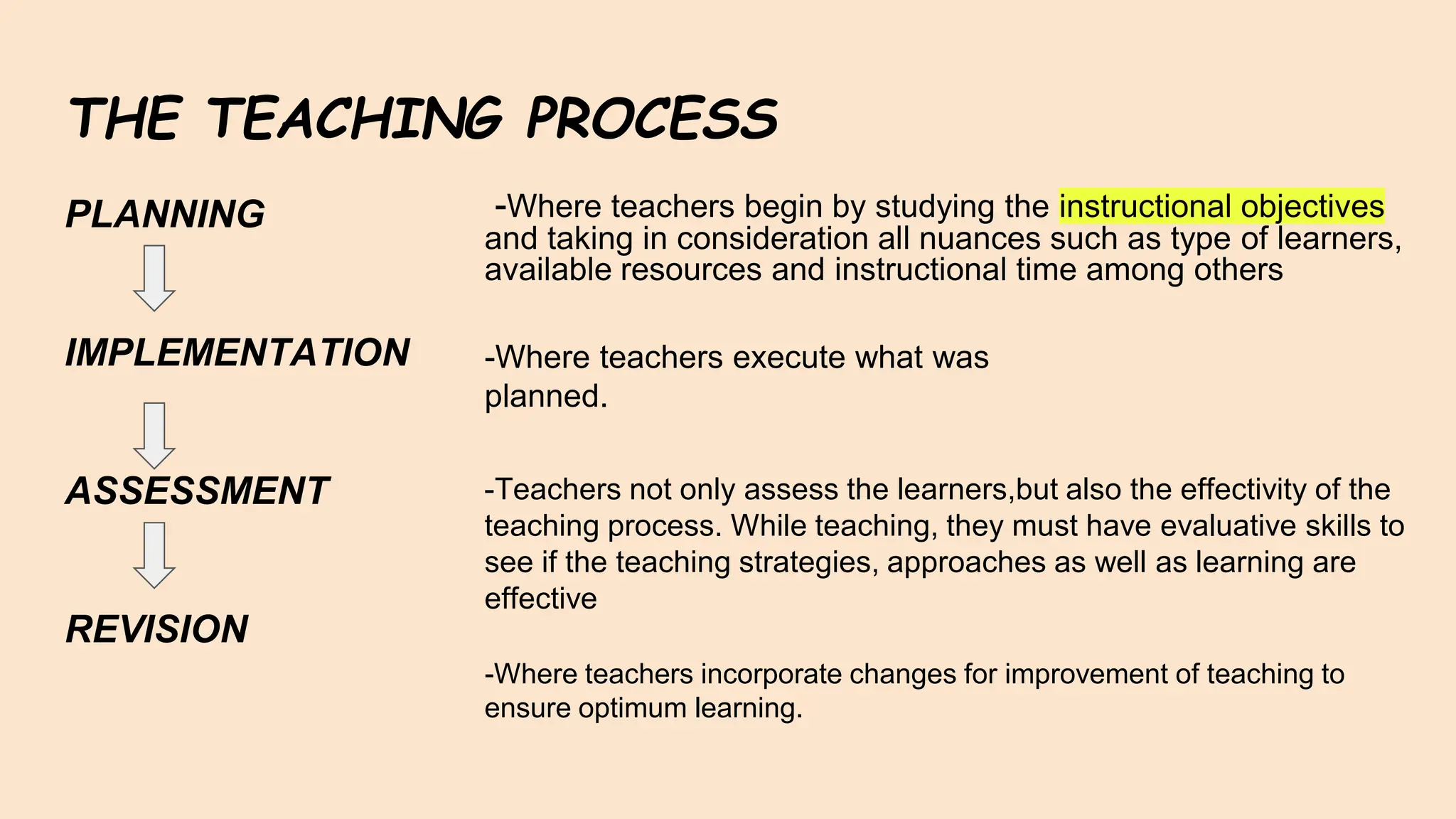
THE TEACHING PROCESS
PLANNING
IMPLEMENTATION
ASSESSMENT
REVISION
-Where teachers begin by studying the instructional objectives
and taking in consideration all nuances such as type of learners,
available resources and instructional time among others
-Where teachers execute what was
planned.
-Teachers not only assess the learners,but also the effectivity of the
teaching process. While teaching, they must have evaluative skills to
see if the teaching strategies, approaches as well as learning are
effective
-Where teachers incorporate changes for improvement of teaching to
ensure optimum learning.
GOALS OF TEACHING by Arends( 2012)
- Our students must be trained not to be depend on teachers all the time,
because in life, they will face tons of situations where they need to decide for
themselves.
- It is technically “learning how to learn“and this metacognitive learning is quite
difficult to develop. Hence, teachers must really plan ahead of time to ensure
the quality of instruction.
Goals of teaching
Assist Students to
become independent
learners
Guide students to
become self regulated
learners
LEARNING
- Is the process of acquiring knowledge, skills, values and attitudes. It directly
means “change” for whatever we learn impacts our lives permanently.
- As TEACHERS , this gives us the realization that we must always provide
quality instruction, because what our students learn in our class will be
brought with them wherever they go.
LEARNING DOMAINS
COGNITIVE DOMAIN - focuses on the intellectual development of our
learners.
AFFECTIVE DOMAIN - is linked on personal development. It deals with
values and attitudes needed to understand themselves ,others and their society.
PSYCHOMOTOR DOMAIN - concerned with the development of motor skills
and coordination.This enables the learners to develop their manipulative skills that
will help them develop their physical skills. This gives you the impression that
there is more learning.
> Ian Reece and Stephen Walker(2000) forwarded the EXPERIENCE ,
REFLECTION LEARNING MODEL TO ENHANCE LEARNING
LEARNING
Usually skills and
knowledge and varying
student to student
EXPERIENCE
Existing and/or provided
as part of the learning
programme
REFLECTION
Guided by the teacher
usually serving to
consolidate,
interpret,develop concepts
and theories
Perceive attitudes and
values, etc.
Indicating need for
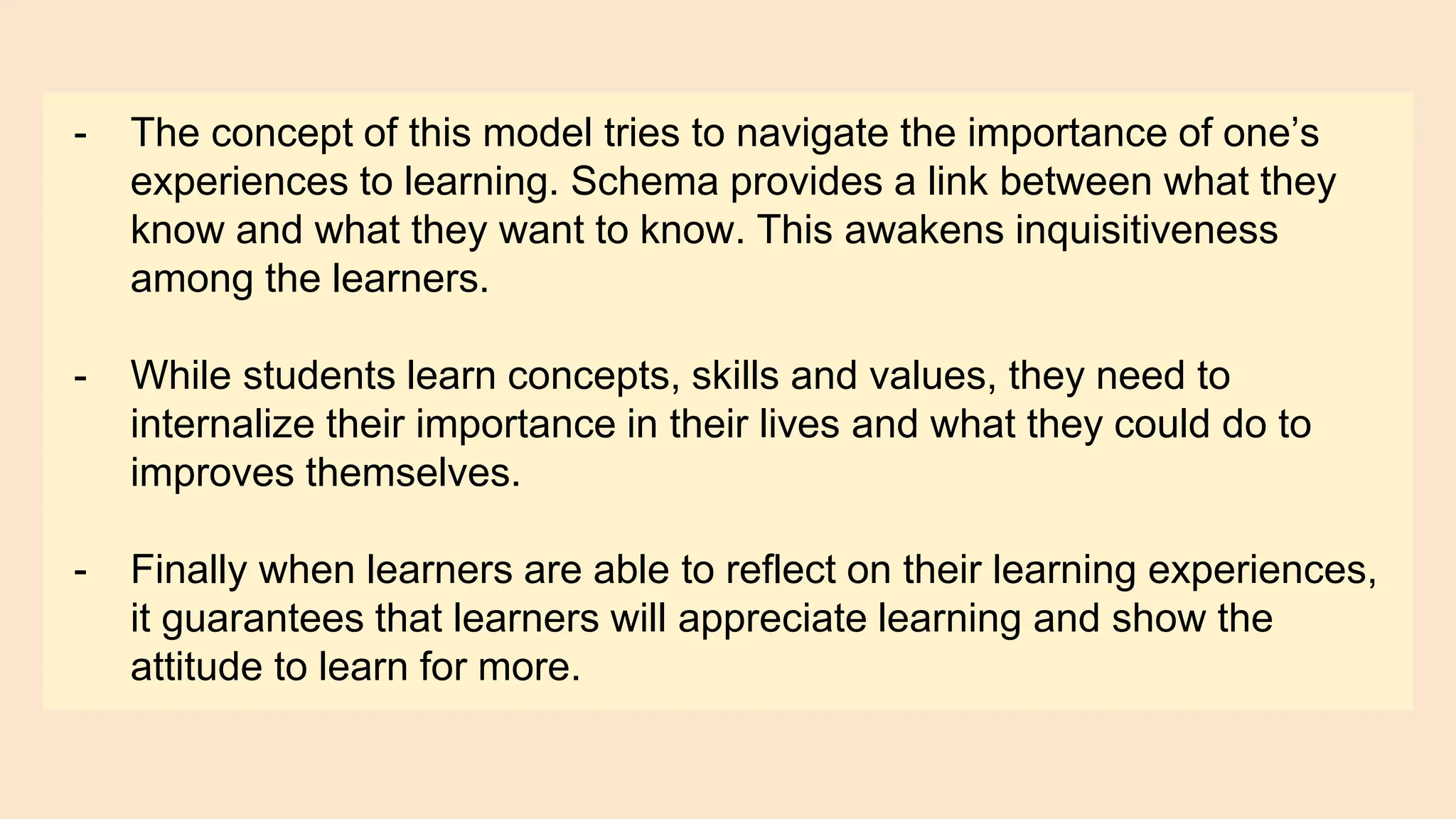
- The concept of this model tries to navigate the importance of one’s
experiences to learning. Schema provides a link between what they
know and what they want to know. This awakens inquisitiveness
among the learners.
- While students learn concepts, skills and values, they need to
internalize their importance in their lives and what they could do to
improves themselves.
- Finally when learners are able to reflect on their learning experiences,
it guarantees that learners will appreciate learning and show the
attitude to learn for more.
REFLECTING ON PEDAGOGY
PEDAGOGY - is an educational concept that has been used by your
professors in your class.
- It can be described as a science
of teaching and an art as well
- It can be associated with the importance
of dialogue
- It could be emphasize the concept
of dynamism
WARING and EVANS(2015)
- a teachers understanding of pedagogy can affect his/her conception about
education, the types of learning, the learners, and the society where they belong.
LEACH and MOON(2008)
- express that teachers are really inquisitive about pedagogy, but there is a
great deal of confusion, contestation and uncertainty on what pedagogy is.
- As dynamic process informed by theories, beliefs and dialogue, but only
realized in the daily interactions of teachers and learners.
SMYTH(1987)
- it is the science of teaching has to be discredited , because if we are to
consider science in an interpretive perspective, it will be associated to positive
paradigm which negates any notion of teachers’ and learners’ consciousness and
potential for transformative capacity.
BETHAM and SHARPEE(2007)
- defined pedagogy in the context of guidance to learn. They posited that
learning must be in the context of teaching and the goal of teaching shall be
learning. Therefore, there must be a congruent dialogue between teaching
and learning.
PRINCIPLES
OF
EFFECTIVE
TEACHING
AND
LEARNING
Principle 1. The Teacher must be a role model.
- You are the propeller of the teaching and learning
process. Everything starts from you. As a role model,
you need to practice what you say and you need to
demonstrate what you want your students to learn.
Principle 2. Learning is an active process where learners need
to be involved.
- They will appreciate the process if they themselves
discover the solutions to problems, engage
communication to their classmates and collaborate for
the attainment of goals. This also promotes lifelong
learning.
PRINCIPLES
OF
EFFECTIVE
TEACHING
AND
LEARNING
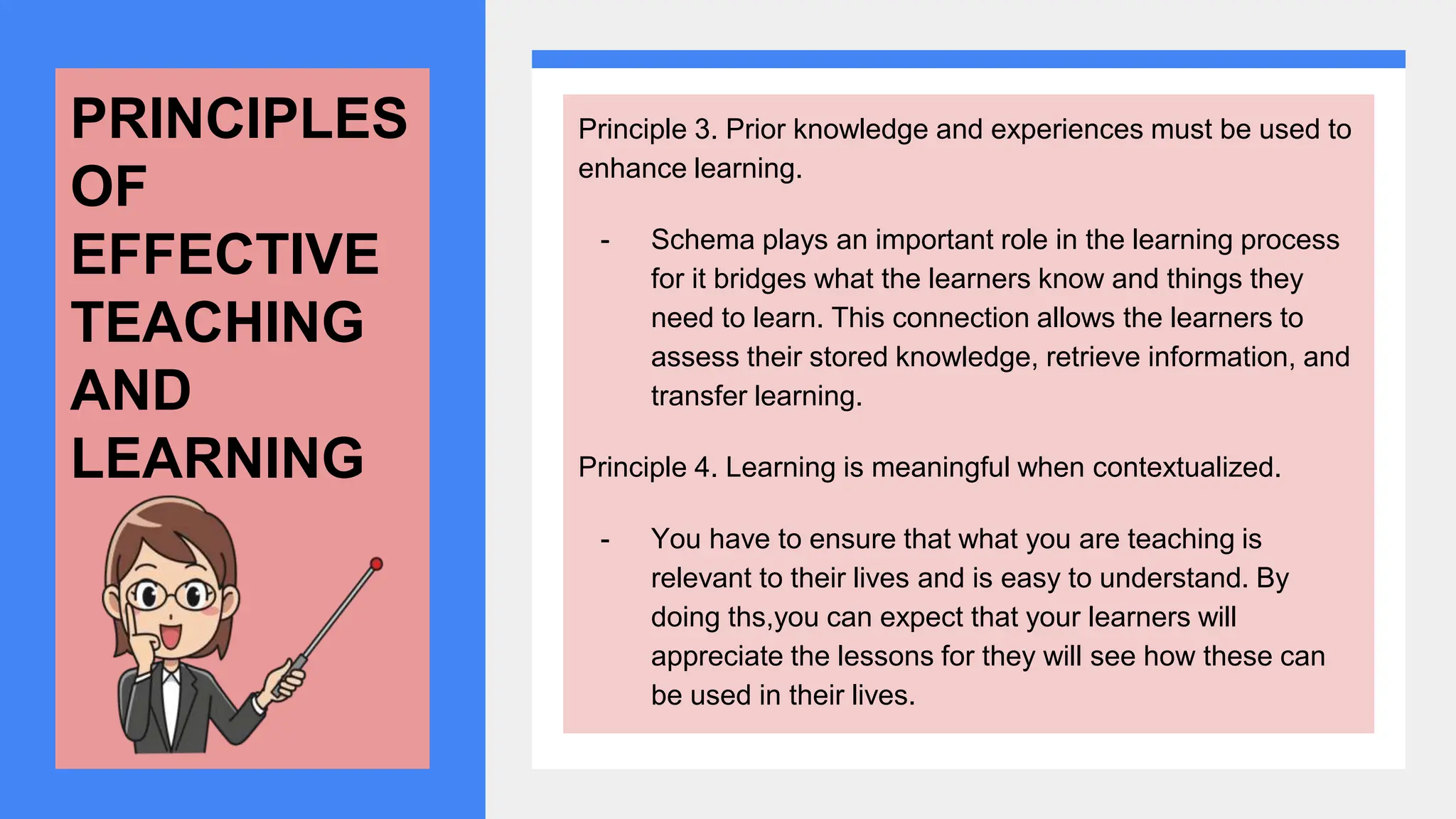
Principle 3. Prior knowledge and experiences must be used to
enhance learning.
- Schema plays an important role in the learning process
for it bridges what the learners know and things they
need to learn. This connection allows the learners to
assess their stored knowledge, retrieve information, and
transfer learning.
Principle 4. Learning is meaningful when contextualized.
- You have to ensure that what you are teaching is
relevant to their lives and is easy to understand. By
doing ths,you can expect that your learners will
appreciate the lessons for they will see how these can
be used in their lives.
Principle 5. Cooperation enhances learning
- This will allow the learners to appreciate the existence of
others in their lives and give importance to relationship.
In the context of learning, make sure that learners are
grouped properly where everyone shares their strength
and talents.
Principle 6. Learning is influence by interpersonal relations
and communications.
- Good Communication breeds positive relations.
Learners must feell safe to communicate what is in their
mind so that communication will take place. This can
only happen if teachers know how to establish positive
classroom climate where expressing an opinion is highly
encouraged. moreover , listening to learners must also
be practiced by teachers.
PRINCIPLES
OF
EFFECTIVE
TEACHING
AND
LEARNING
Principle 7. Learner’s motivation can define effective learning.
- Motivation is a key for successful teaching and learning.
Teachers need to plan for tasks where intrinsic
motivation must be developed. Motivation also drives
learners to become self-regulated and independent
learners.
Principle 8.Learning takes place in different ways.
- Teachers must always uphold to the principles of
multiple intelligences. Differentiated instruction is the
answer to this. So, in planning, make sure that you
employ various strategies and tasks that can enhance
multiple skills of the learners.
PRINCIPLES
OF
EFFECTIVE
TEACHING
AND
LEARNING
Principle 9. Feedback enhances learning
- It is easier for learners to learn if they are aware of their
own progress. Positive feedback and praise allow
learners to exert more efforts because it encourages
motivation. Moreover, knowing their strengths and
weaknesses will enable them to use metacognitive
strategies to maintain their strength and work on their
weaknesses.
Principle 10. Learning must always be goal-oriented
- The learners must always see why they are studying a
certain lesson. Teachers must always establish the
purpose of the lesson and infuse some tasks to
challenge the learners.
PRINCIPLES
OF
EFFECTIVE
TEACHING
AND
LEARNING
=THE END=
Thank you for listening

MAKING SENSE OF THE TEACHING AND LEARNING PROCESS.pptx

  • 1.
    MAKING SENSE OF THETEACHING AND LEARNING PROCESS CHAPTER IV : LESSON I
  • 2.
    OBJECTIVES : > UNDERSTANDTHE UNDERLYING CONCEPTS ON TEACHING AND LEARNING > APPRECIATE THE TEACHING AND LEARNING PROCESS
  • 3.
    “It is thesupreme art of the teacher to awaken joy in creative expression and knowledge” -Albert Einstein
  • 4.
    THE TEACHING ANDLEARNING PROCESS - It is an essential life hack where we learn basic things such as survival skills, social skills, and many others. - Over the past century, new perspectives on teaching and learning continually emerge such as cognitivist and constructivist to ensure the quality of learning acquisition.
  • 5.
    THE TEACHING PROCESS PLANNING IMPLEMENTATION ASSESSMENT REVISION -Whereteachers begin by studying the instructional objectives and taking in consideration all nuances such as type of learners, available resources and instructional time among others -Where teachers execute what was planned. -Teachers not only assess the learners,but also the effectivity of the teaching process. While teaching, they must have evaluative skills to see if the teaching strategies, approaches as well as learning are effective -Where teachers incorporate changes for improvement of teaching to ensure optimum learning.
  • 6.
    GOALS OF TEACHINGby Arends( 2012) - Our students must be trained not to be depend on teachers all the time, because in life, they will face tons of situations where they need to decide for themselves. - It is technically “learning how to learn“and this metacognitive learning is quite difficult to develop. Hence, teachers must really plan ahead of time to ensure the quality of instruction. Goals of teaching Assist Students to become independent learners Guide students to become self regulated learners
  • 7.
    LEARNING - Is theprocess of acquiring knowledge, skills, values and attitudes. It directly means “change” for whatever we learn impacts our lives permanently. - As TEACHERS , this gives us the realization that we must always provide quality instruction, because what our students learn in our class will be brought with them wherever they go. LEARNING DOMAINS COGNITIVE DOMAIN - focuses on the intellectual development of our learners. AFFECTIVE DOMAIN - is linked on personal development. It deals with values and attitudes needed to understand themselves ,others and their society. PSYCHOMOTOR DOMAIN - concerned with the development of motor skills and coordination.This enables the learners to develop their manipulative skills that will help them develop their physical skills. This gives you the impression that there is more learning.
  • 8.
    > Ian Reeceand Stephen Walker(2000) forwarded the EXPERIENCE , REFLECTION LEARNING MODEL TO ENHANCE LEARNING LEARNING Usually skills and knowledge and varying student to student EXPERIENCE Existing and/or provided as part of the learning programme REFLECTION Guided by the teacher usually serving to consolidate, interpret,develop concepts and theories Perceive attitudes and values, etc. Indicating need for
  • 9.
    - The conceptof this model tries to navigate the importance of one’s experiences to learning. Schema provides a link between what they know and what they want to know. This awakens inquisitiveness among the learners. - While students learn concepts, skills and values, they need to internalize their importance in their lives and what they could do to improves themselves. - Finally when learners are able to reflect on their learning experiences, it guarantees that learners will appreciate learning and show the attitude to learn for more.
  • 10.
    REFLECTING ON PEDAGOGY PEDAGOGY- is an educational concept that has been used by your professors in your class. - It can be described as a science of teaching and an art as well - It can be associated with the importance of dialogue - It could be emphasize the concept of dynamism
  • 11.
    WARING and EVANS(2015) -a teachers understanding of pedagogy can affect his/her conception about education, the types of learning, the learners, and the society where they belong. LEACH and MOON(2008) - express that teachers are really inquisitive about pedagogy, but there is a great deal of confusion, contestation and uncertainty on what pedagogy is. - As dynamic process informed by theories, beliefs and dialogue, but only realized in the daily interactions of teachers and learners. SMYTH(1987) - it is the science of teaching has to be discredited , because if we are to consider science in an interpretive perspective, it will be associated to positive paradigm which negates any notion of teachers’ and learners’ consciousness and potential for transformative capacity.
  • 12.
    BETHAM and SHARPEE(2007) -defined pedagogy in the context of guidance to learn. They posited that learning must be in the context of teaching and the goal of teaching shall be learning. Therefore, there must be a congruent dialogue between teaching and learning.
  • 13.
    PRINCIPLES OF EFFECTIVE TEACHING AND LEARNING Principle 1. TheTeacher must be a role model. - You are the propeller of the teaching and learning process. Everything starts from you. As a role model, you need to practice what you say and you need to demonstrate what you want your students to learn. Principle 2. Learning is an active process where learners need to be involved. - They will appreciate the process if they themselves discover the solutions to problems, engage communication to their classmates and collaborate for the attainment of goals. This also promotes lifelong learning.
  • 14.
    PRINCIPLES OF EFFECTIVE TEACHING AND LEARNING Principle 3. Priorknowledge and experiences must be used to enhance learning. - Schema plays an important role in the learning process for it bridges what the learners know and things they need to learn. This connection allows the learners to assess their stored knowledge, retrieve information, and transfer learning. Principle 4. Learning is meaningful when contextualized. - You have to ensure that what you are teaching is relevant to their lives and is easy to understand. By doing ths,you can expect that your learners will appreciate the lessons for they will see how these can be used in their lives.
  • 15.
    Principle 5. Cooperationenhances learning - This will allow the learners to appreciate the existence of others in their lives and give importance to relationship. In the context of learning, make sure that learners are grouped properly where everyone shares their strength and talents. Principle 6. Learning is influence by interpersonal relations and communications. - Good Communication breeds positive relations. Learners must feell safe to communicate what is in their mind so that communication will take place. This can only happen if teachers know how to establish positive classroom climate where expressing an opinion is highly encouraged. moreover , listening to learners must also be practiced by teachers. PRINCIPLES OF EFFECTIVE TEACHING AND LEARNING
  • 16.
    Principle 7. Learner’smotivation can define effective learning. - Motivation is a key for successful teaching and learning. Teachers need to plan for tasks where intrinsic motivation must be developed. Motivation also drives learners to become self-regulated and independent learners. Principle 8.Learning takes place in different ways. - Teachers must always uphold to the principles of multiple intelligences. Differentiated instruction is the answer to this. So, in planning, make sure that you employ various strategies and tasks that can enhance multiple skills of the learners. PRINCIPLES OF EFFECTIVE TEACHING AND LEARNING
  • 17.
    Principle 9. Feedbackenhances learning - It is easier for learners to learn if they are aware of their own progress. Positive feedback and praise allow learners to exert more efforts because it encourages motivation. Moreover, knowing their strengths and weaknesses will enable them to use metacognitive strategies to maintain their strength and work on their weaknesses. Principle 10. Learning must always be goal-oriented - The learners must always see why they are studying a certain lesson. Teachers must always establish the purpose of the lesson and infuse some tasks to challenge the learners. PRINCIPLES OF EFFECTIVE TEACHING AND LEARNING
  • 18.
    =THE END= Thank youfor listening