
Development Of Educational
Technology & Shift From Teacher-
Centered and Learner-Centered
Mr.@mol Ub@le
Development Of Educational Technology
“Technology is commonly thought of in
terms of gadgets, instrument, machines,
and devices….most (educators) will
defer to technology as computers”
-- Muffoletto(1994)-p.5 Integrating Education
Technology into Teaching (IETIT)
“Only about a decade ago, a
history of technology in
education since 1920 placed
the emphasis on radio and
television, with computers as
an afterthought .”
--Cuban, 1986 (IETIT) p.5
However, Saettler (1990) urges
“The historical function of
educational technology is a
process rather than a
product.”
Any useful definition of
educational technology,
therefore, must focus on the
process of applying tools for
educational purposes, and the
materials used.
In education, the combination
of process and product
merges instructional
procedures with instructional
tools.
Technology in Education as
Media and Audiovisual
Communications
 Audiovisual movement: ways of delivering information that could be
used as alternatives to lectures and books.
 Audiovisual communications: the “branch of educational theory and
practice concerned primarily with the design and use of messages
which control the learning process.” (Saettler, IETIE,p6)
 AECT- Association for Ed. Commo. and Technology.
Technology in Education as
Instructional Systems
 1960s and 1970s
 Human and non-human resources
( teachers and media).
 Systematic approach to designing, developing, and delivering
instruction matched to carefully identified needs.
 International Society for Performance Improvement.
 Validating and creating instruction.
Technology in Education as
Vocational Training Tools
 Technology in Education:
1. School learning prepares students for the world of work.
2. Vocational training can be a practical means of teaching.
 ITEA (International Technology Education Association).
Technology in Education as
Computers and Computer-
based Systems
 Instructional and supportive applications of computers.
 Computers began to be used in classrooms in 1960s
until 1990 and was known as educational
computing.
 By the mid-1990s, educational computing became
known as educational technology.
 ISTE (International Society for Technology in Education) holds
the following views:
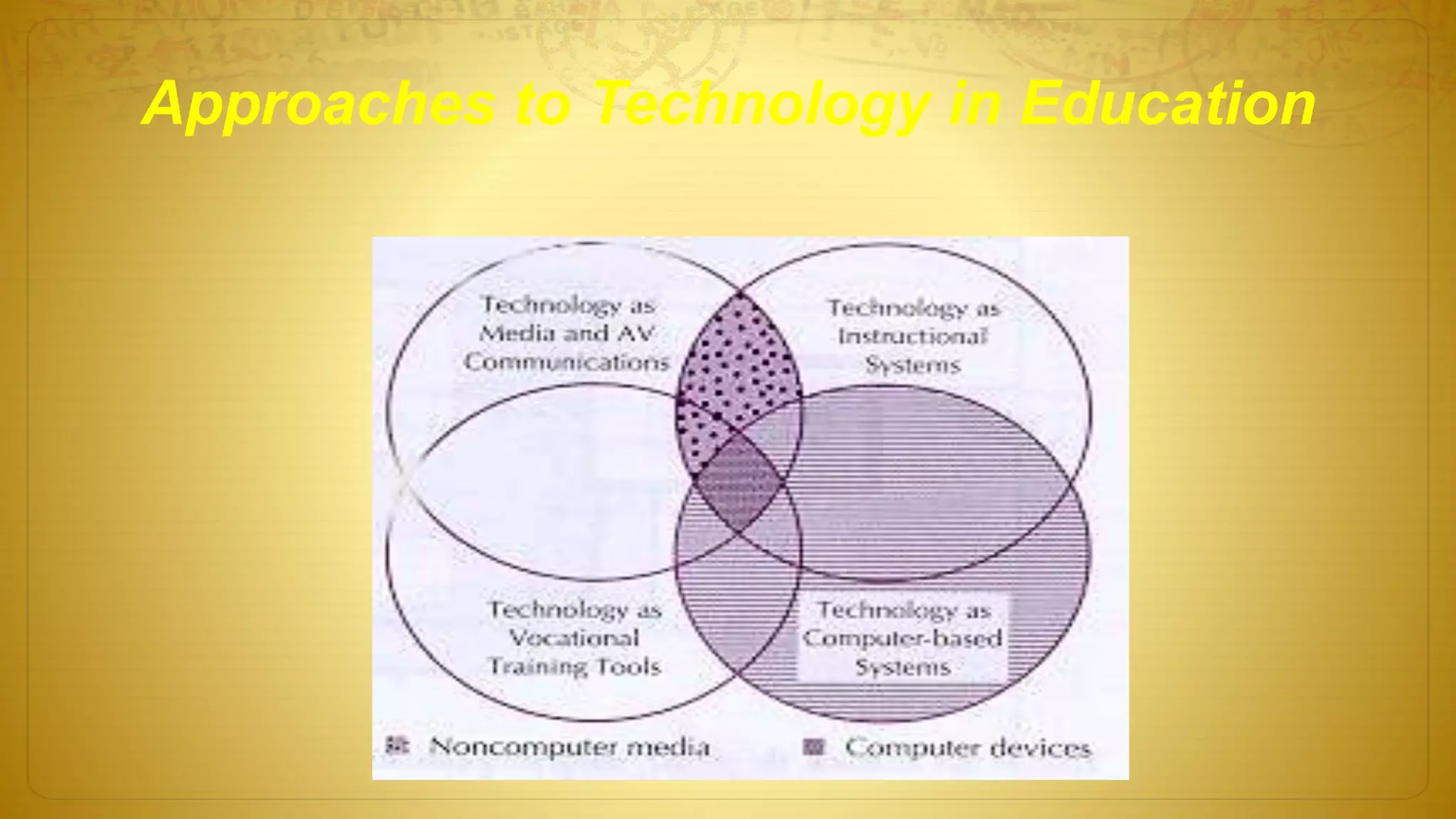
Approaches to Technology in Education
An emphasis on Computer Systems
 Computers as media are becoming more complex and more
capable.
 Computer systems are subsuming other forms of media.
 The perceived complexity of computer-based systems has made it
more difficult for educators to effectively integrate software and
computer media into classrooms.
Background on
Computer-based
Educational Technology
What’s a Computer??
Hardware
Providing the Electronic Capability
Software
Communicating with the Hardware
 Any electromechanical device that accepts input, processes input and produces output.
Software in a Computer System
Systems Software ( Types of
Operating Systems)
Applications Software (used for
Education, Entertainment, or
Edutainment)
Systems Software (Types of Operating
Systems)
 Unix
 Ms-DOS
 Apple Dos, ProDOS
 Macintosh DOS, System 7
 Windows 95
Using technology For teaching Learning
through
 Computer-based learning
 Computer networking
 Online learning environments
 Social media
Teacher-Centered and Learner-Centered
Comparison of Paradigms
Teacher-Centered
Learner-Centered
Students passively receive information.
Students are actively involved.
Comparison of Paradigms
Teacher-Centered
Learner-Centered
Emphasis is on acquisition of knowledge
outside the context in which it will be used.
Emphasis is on using and communicating
knowledge effectively to address enduring
and emerging issues and problems in real-life
contexts.
Comparison of Paradigms
Teacher-Centered
Learner-Centered
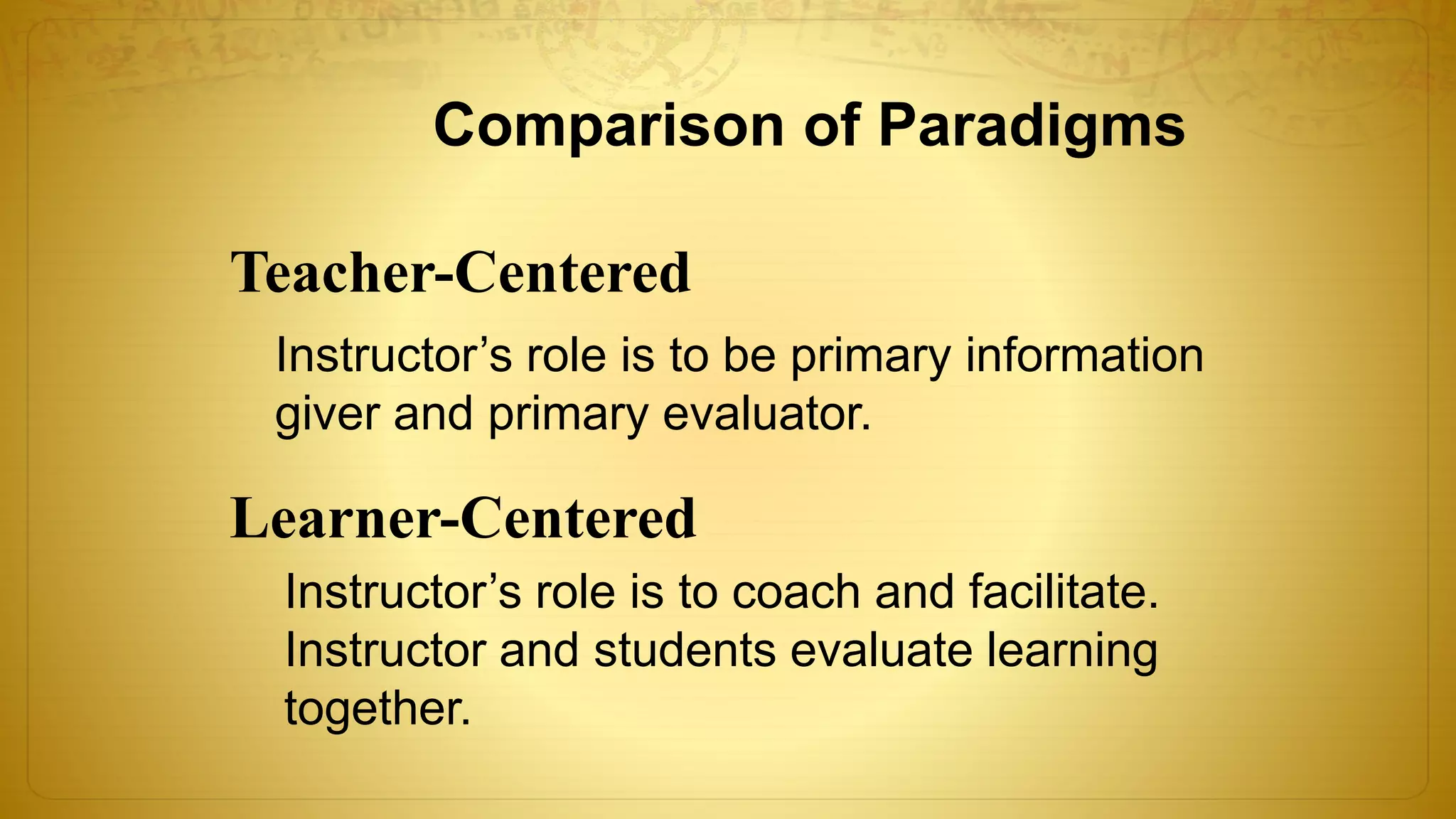
Instructor’s role is to be primary information
giver and primary evaluator.
Instructor’s role is to coach and facilitate.
Instructor and students evaluate learning
together.
Comparison of Paradigms
Teacher-Centered
Learner-Centered
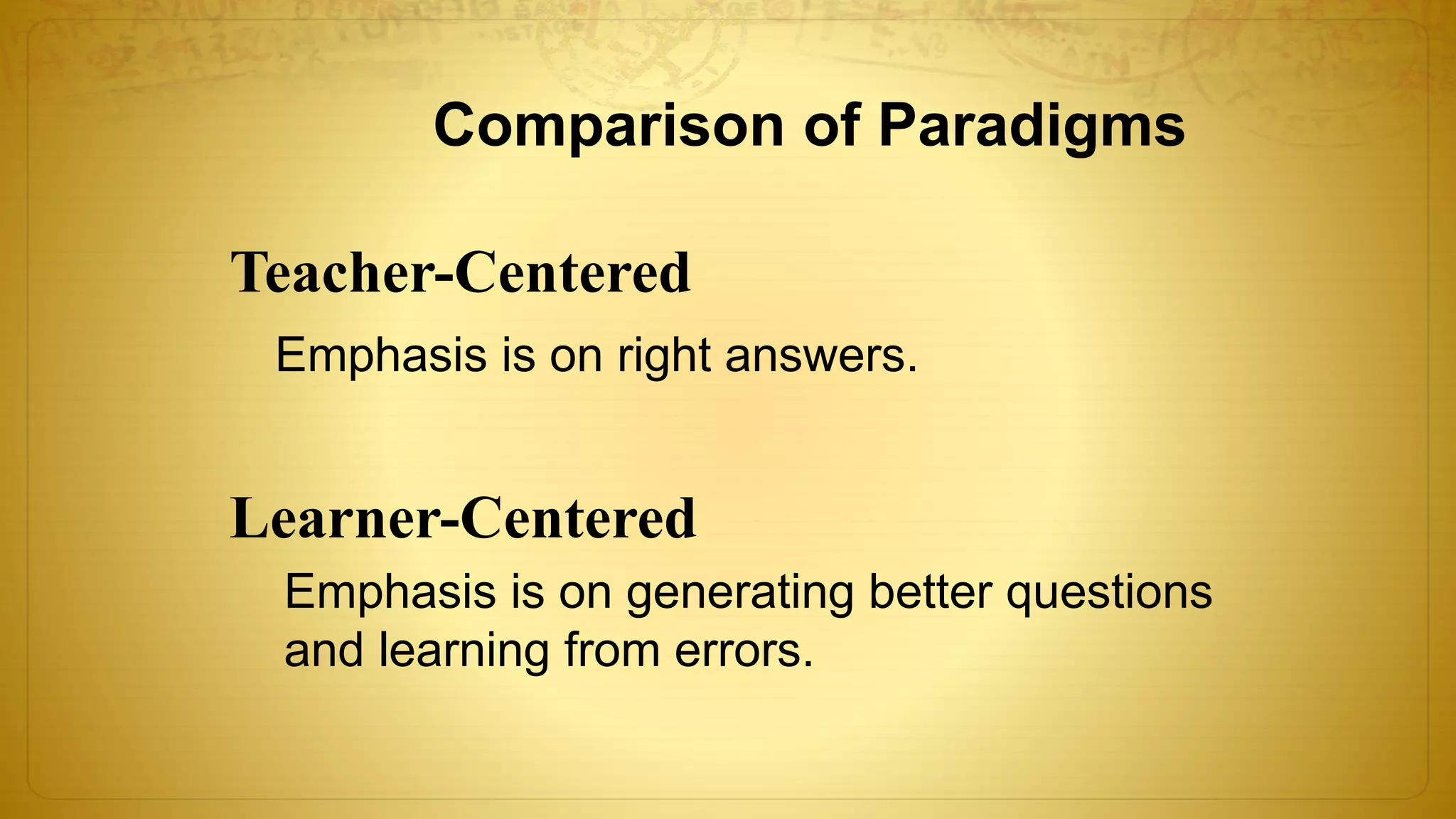
Emphasis is on right answers.
Emphasis is on generating better questions
and learning from errors.
Comparison of Paradigms
Teacher-Centered
Learner-Centered
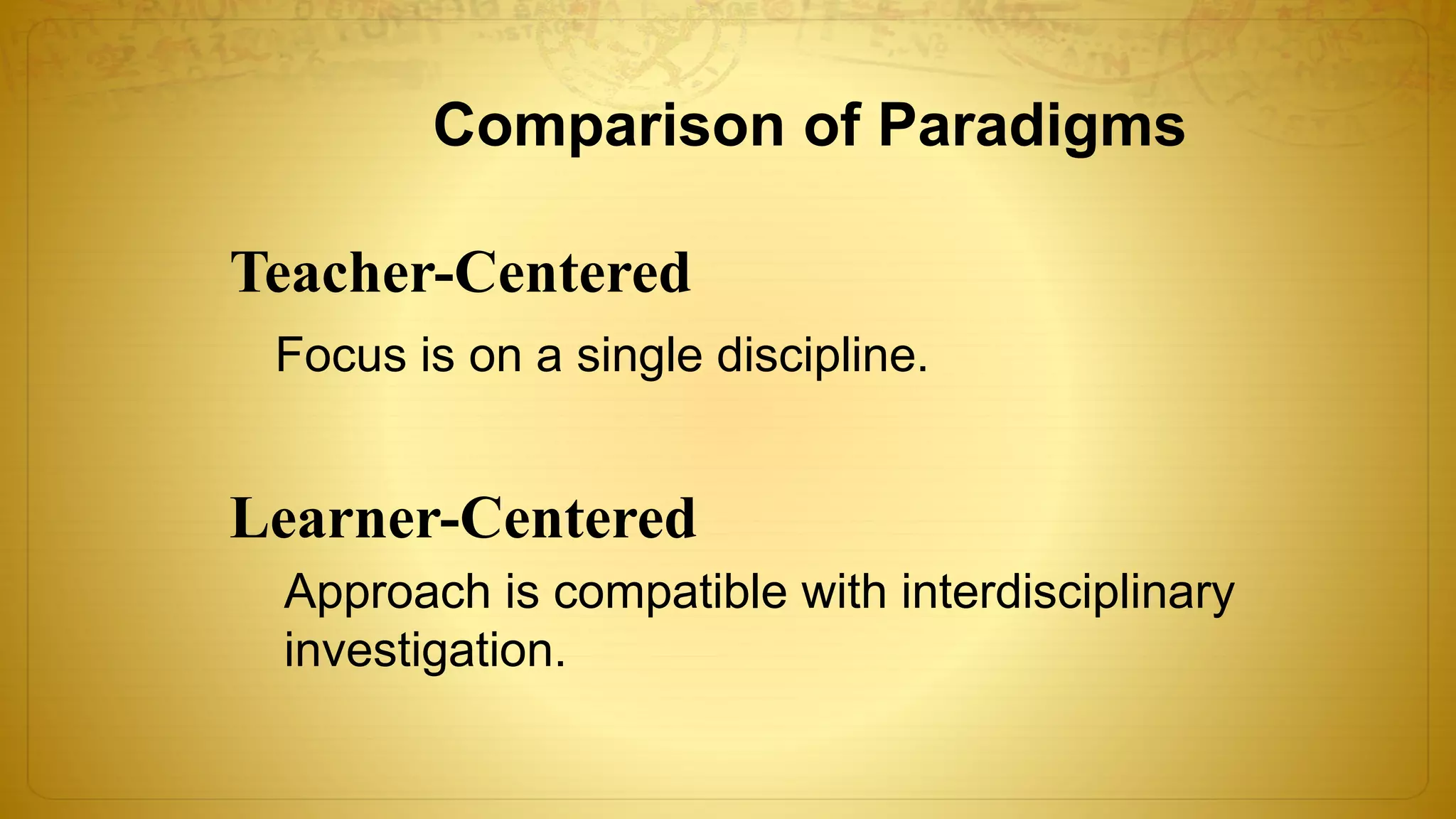
Focus is on a single discipline.
Approach is compatible with interdisciplinary
investigation.
Comparison of Paradigms
Teacher-Centered
Learner-Centered
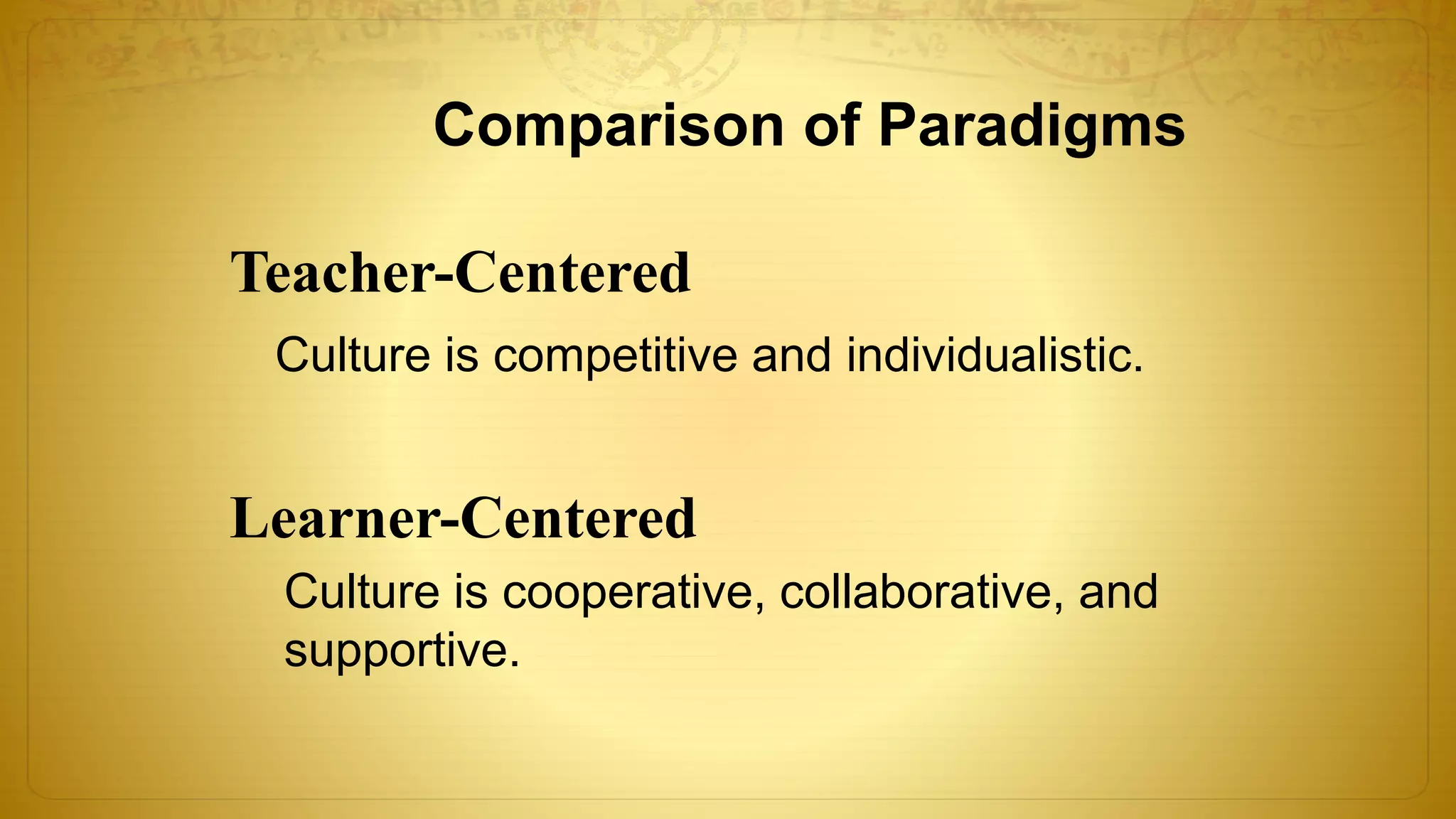
Culture is competitive and individualistic.
Culture is cooperative, collaborative, and
supportive.
Comparison of Paradigms
Teacher-Centered
Learner-Centered
Only students are viewed as learners.
Professor and students learn together.
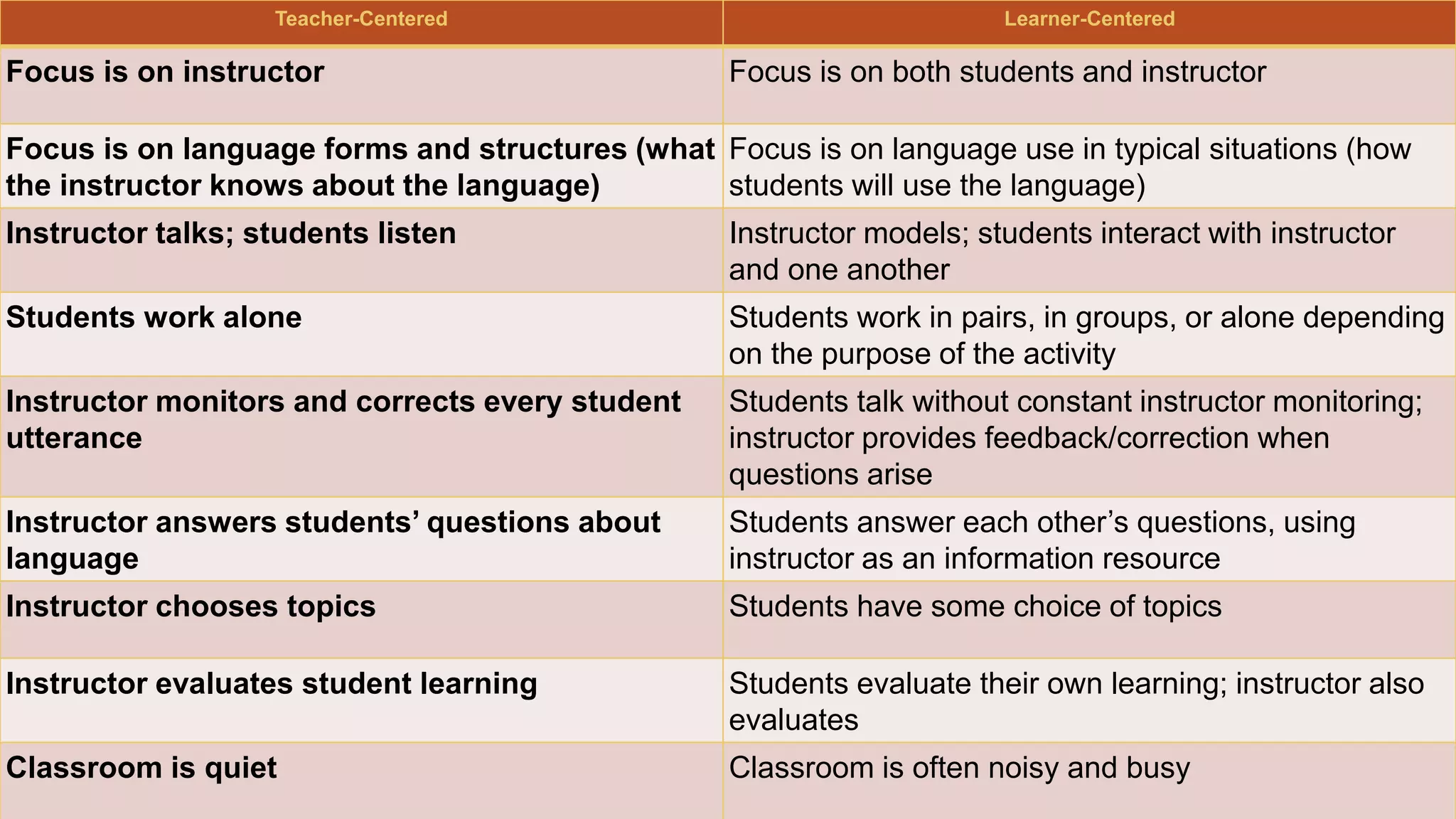
Teacher-Centered Learner-Centered
Focus is on instructor Focus is on both students and instructor
Focus is on language forms and structures (what
the instructor knows about the language)
Focus is on language use in typical situations (how
students will use the language)
Instructor talks; students listen Instructor models; students interact with instructor
and one another
Students work alone Students work in pairs, in groups, or alone depending
on the purpose of the activity
Instructor monitors and corrects every student
utterance
Students talk without constant instructor monitoring;
instructor provides feedback/correction when
questions arise
Instructor answers students’ questions about
language
Students answer each other’s questions, using
instructor as an information resource
Instructor chooses topics Students have some choice of topics
Instructor evaluates student learning Students evaluate their own learning; instructor also
evaluates
Classroom is quiet Classroom is often noisy and busy
Concept ,importance, Meaning And Nature of
ICT
Meaning
ICT is technology that supports activities involving
information.Such activities include gathering, processing, storing
and presenting data. Increasingly these activities also involve
collaboration and communication. Hence IT has become ICT:
information and communication technology.
Definition
 "ICT stand for information and communication technologies and is defined, as a "diverse set of
technological tools and resources used to communicate, and to create, disseminate, store, and
manage information.
 ICT implies the technology which consists of electronic devices and associated human interactive
materials that enable the user to employ them for a wide range of teaching - learning processes in
addition to personal use.
 ICT is that technology which uses the information to meet human need or purposes including
processing and exchanging.
 ICT is a generic term referring to technologies, which are being used for collecting, storing, editing
and passing on information in various forms (SER,1997)
 Information and communications technology (ICT) is often used as an extended synonym for
information technology (IT)
 It is a more extensive term (i.e. more broad in scope) that stresses the role of unified
communications and the integration of telecommunications (telephone lines and wireless signals),
computers as well as necessary enterprise software, middleware, storage, and audio-visual
systems, which enable users to access, store, transmit, and manipulate information.
 The term ICT is also used to refer to the convergence of audio-visual and telephone networks with
computer networks through a various linking systems.
 ICT covers any product that will store, retrieve, manipulate, transmit or receive information
electronically in a digital form.
 Information and communication technology, or ICT, is defined as the combination of informatics
technology with other, related technologies, specifically communication technology.
 ICT has no universal definition, since "the concepts, methods and applications involved in ICT are
constantly evolving on an almost daily basis.”
Need
• Education is a life long process therefore anytime anywhere access to it is the need
• Information explosion is an ever increasing phenomena therefore there is need to
get access to this information
• Education should meet the needs of variety of learners and therefore IT is important
in meeting this need
• It is a requirement of the society that the individuals should posses technological
literacy
• We need to increase access and bring down the cost of education to meet the
challenges of illiteracy and poverty-IT is the answer
Importance access to variety of learning resources
 immediacy to information
 anytime learning
 anywhere learning
 collaborative learning
 multimedia approach to education
 authentic and up to date information
 access to online libraries
 teaching of different subjects made interesting
 educational data storage
 distance education
 access to the source of information
 multiple communication channels-e-mail,chat,forum,blogs,etc.
 access to open courseware
 better accesses to children with disabilities
 reduces time on many routine tasks
Scope of ICT in Education
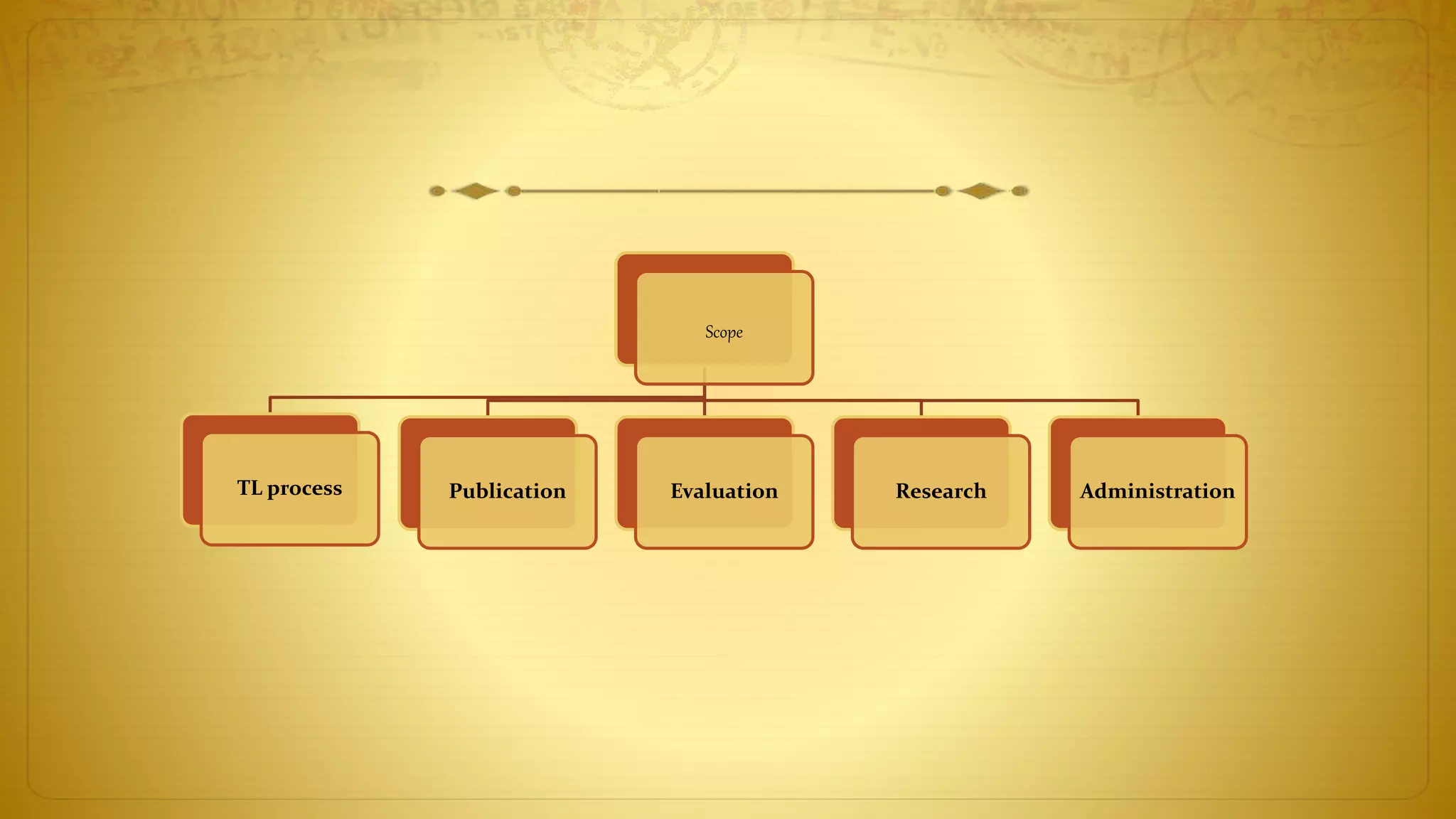
Scope
TL process Publication Evaluation Research Administration
Teaching learning process
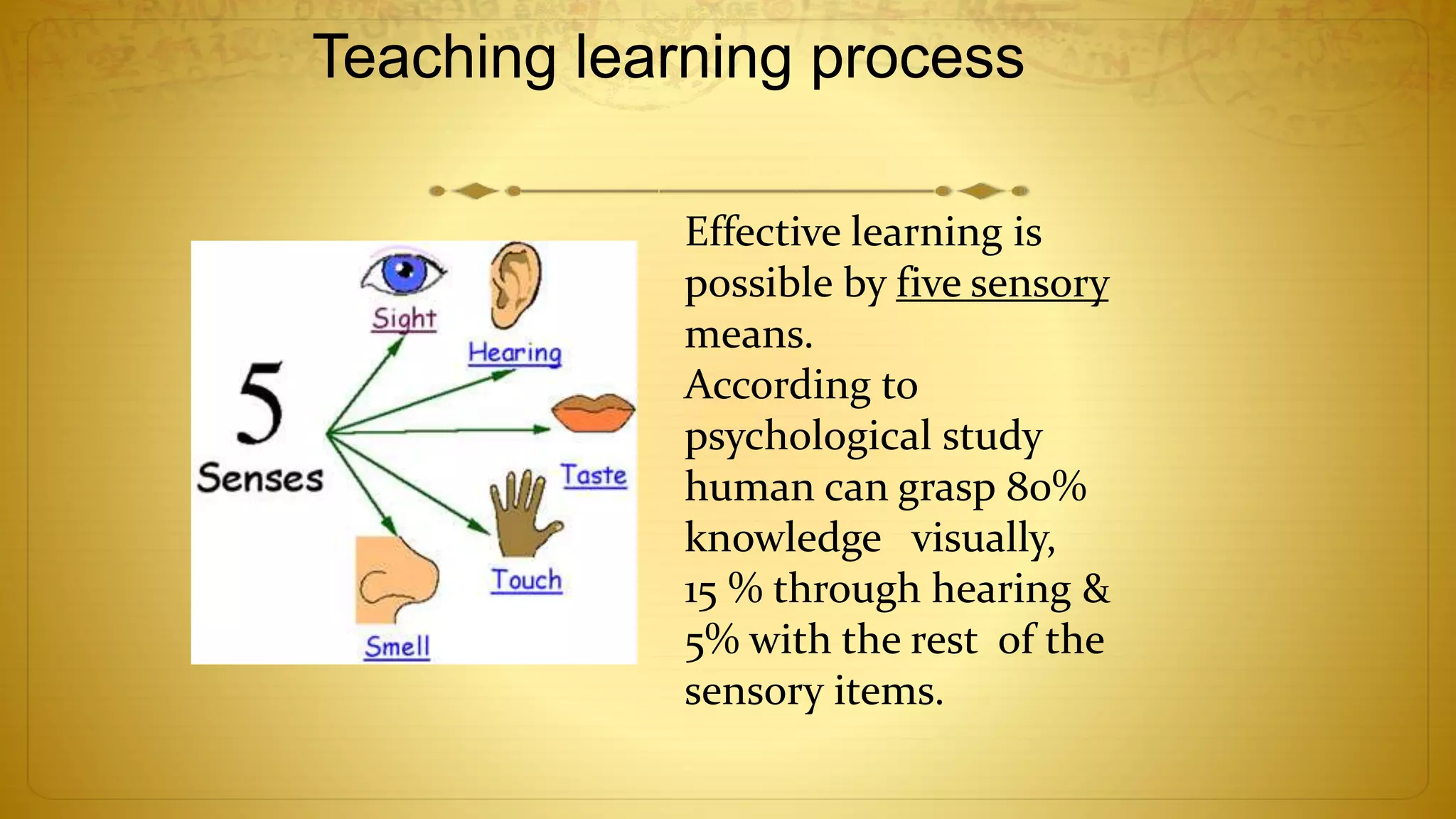
Effective learning is
possible by five sensory
means.
According to
psychological study
human can grasp 80%
knowledge visually,
15 % through hearing &
5% with the rest of the
sensory items.
 So it becomes necessary to present the content by attractive means.
Computer technology helps us to provide rich presentation.
 To provide rich presentation, it is necessary to use the various
components like:-
1. Text matter presentation
2. Animation presentation
3. Graphic presentation
4. Audio presentation
5. Video presentation
Computer Aided Teaching has become popular now a days.
publication
 The notes, printed text books can be digitized with the help of computer technology.
 Many e-books are available on websites developed by different publishers.
 FreeBookSpot , 4eBooks,Free-
eBooks,ManyBooks,FreeTechBooks,Scribd,Globusz,KnowFree,OnlineFreeEBooks,MemoWar
e,SnipFiles,BookYards
 Encyclopedia is also available on internet.
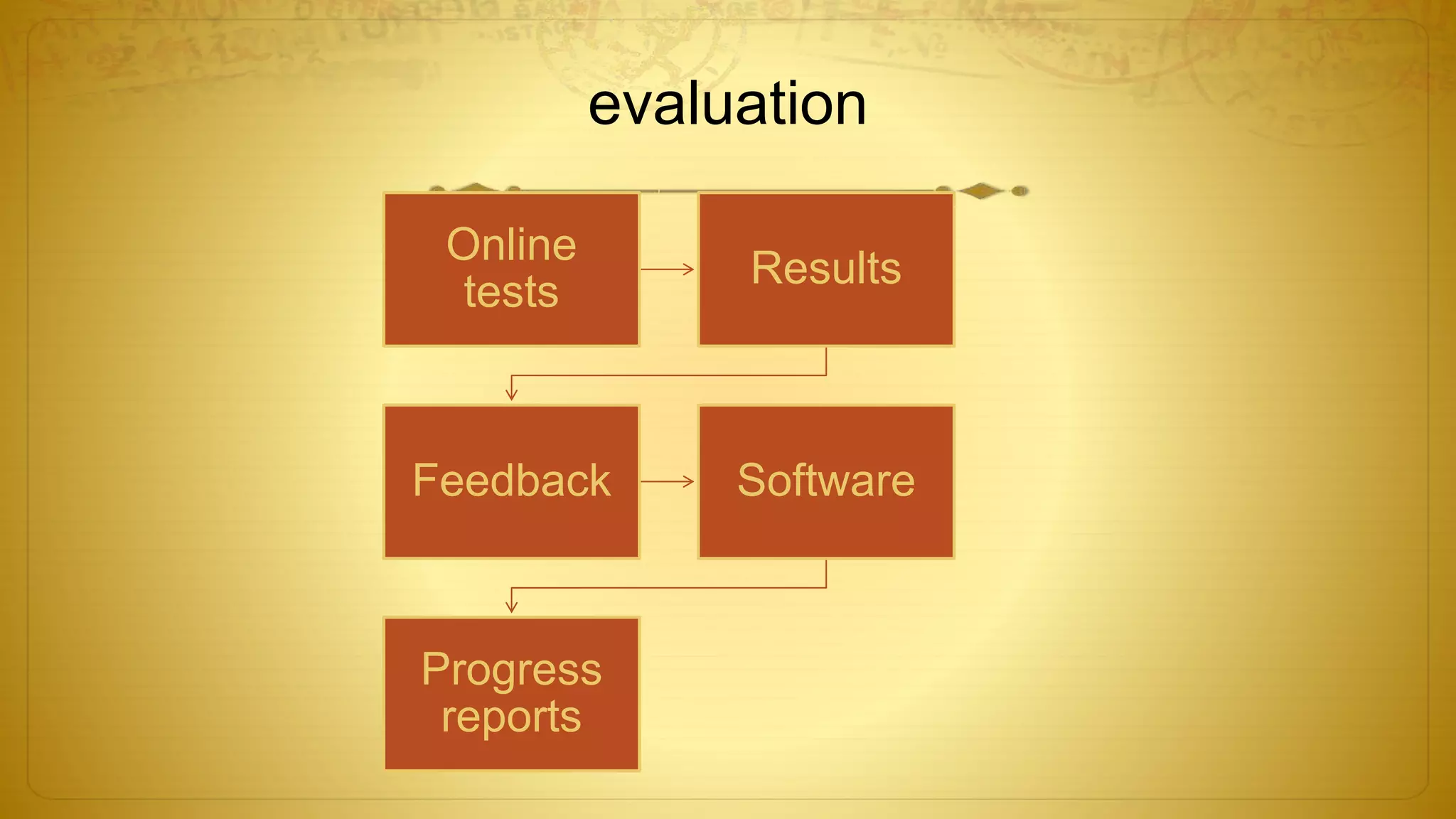
evaluation
Online
tests
Results
Feedback Software
Progress
reports
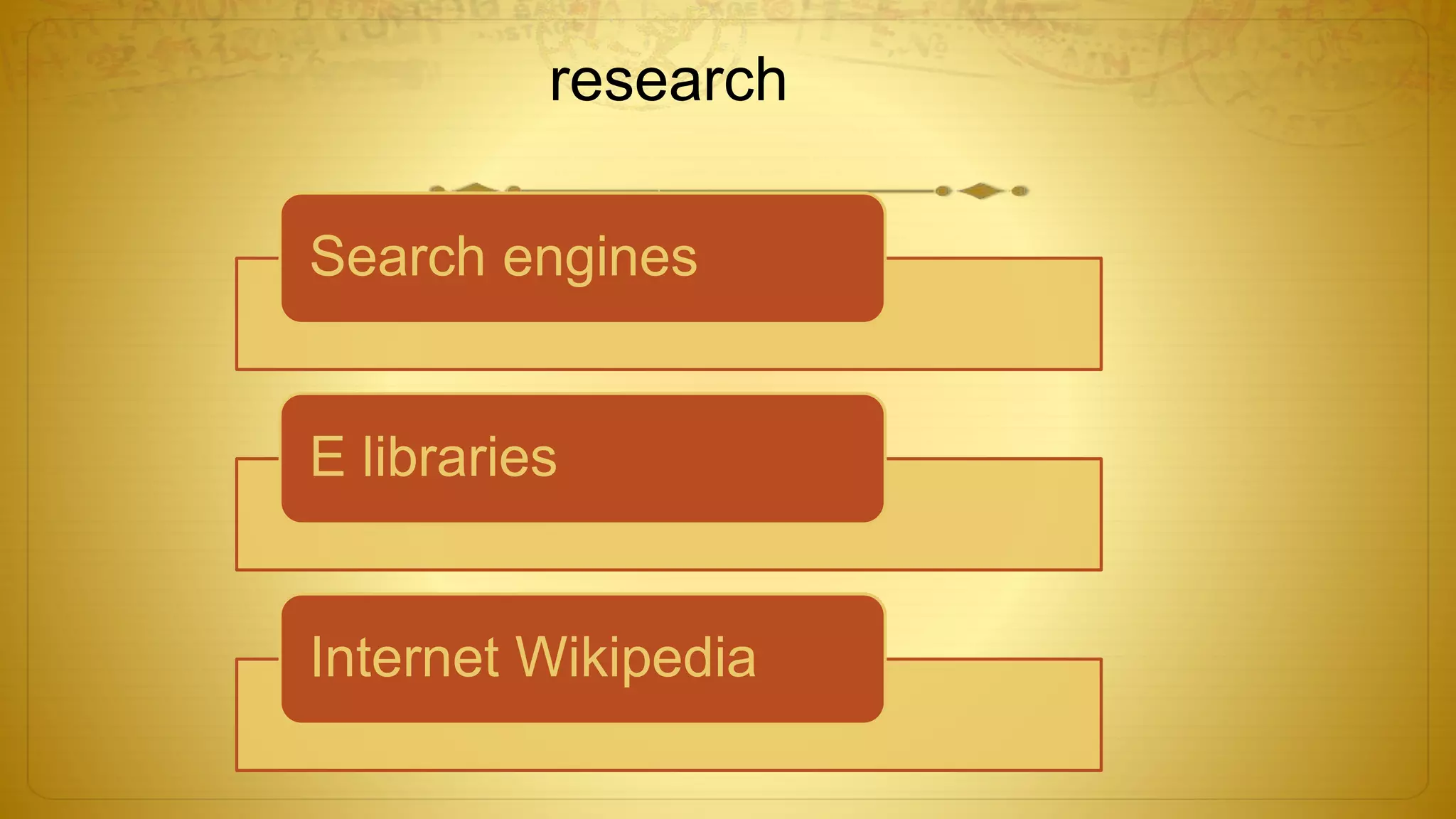
research
Search engines
E libraries
Internet Wikipedia
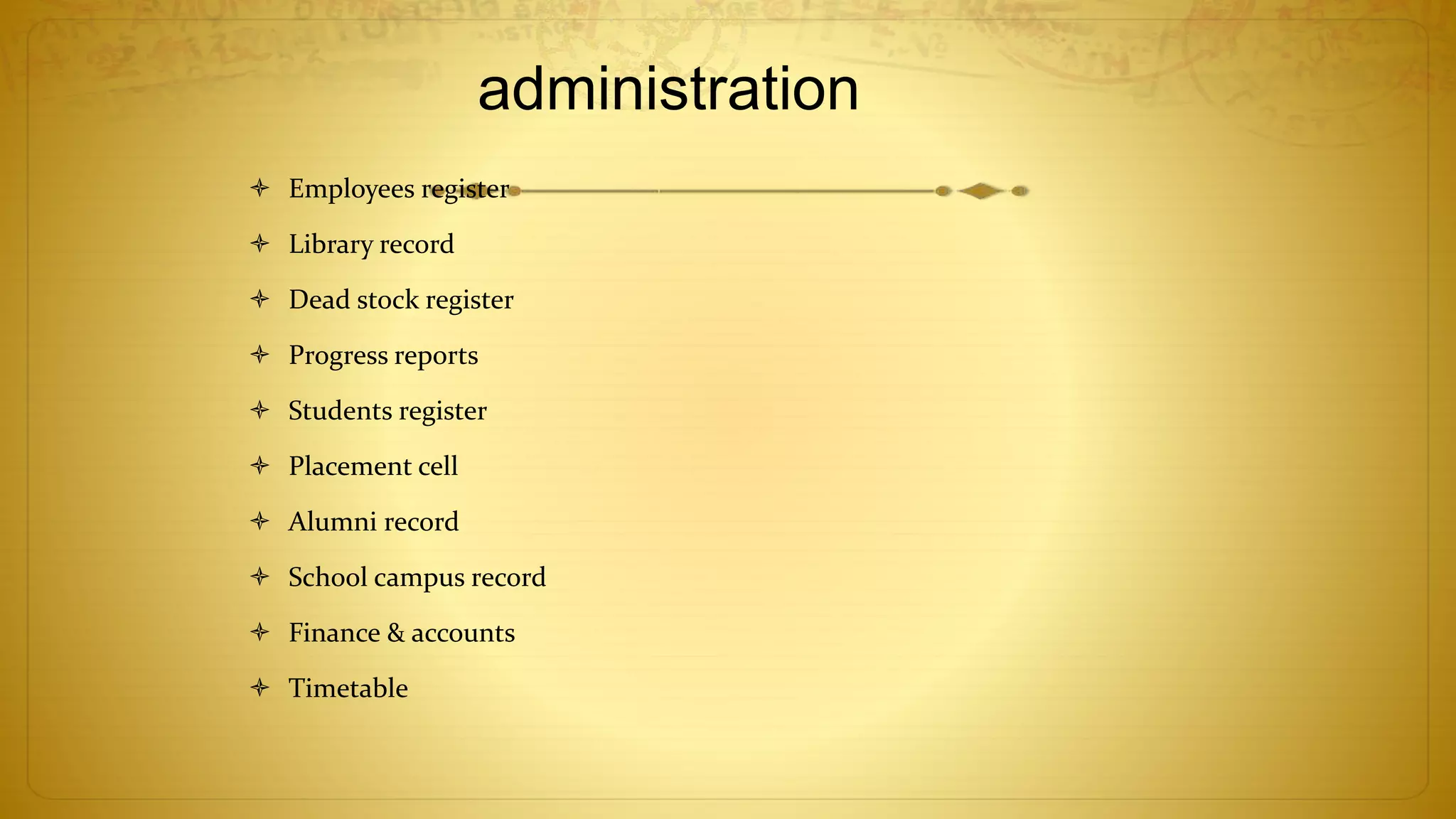
administration
 Employees register
 Library record
 Dead stock register
 Progress reports
 Students register
 Placement cell
 Alumni record
 School campus record
 Finance & accounts
 Timetable
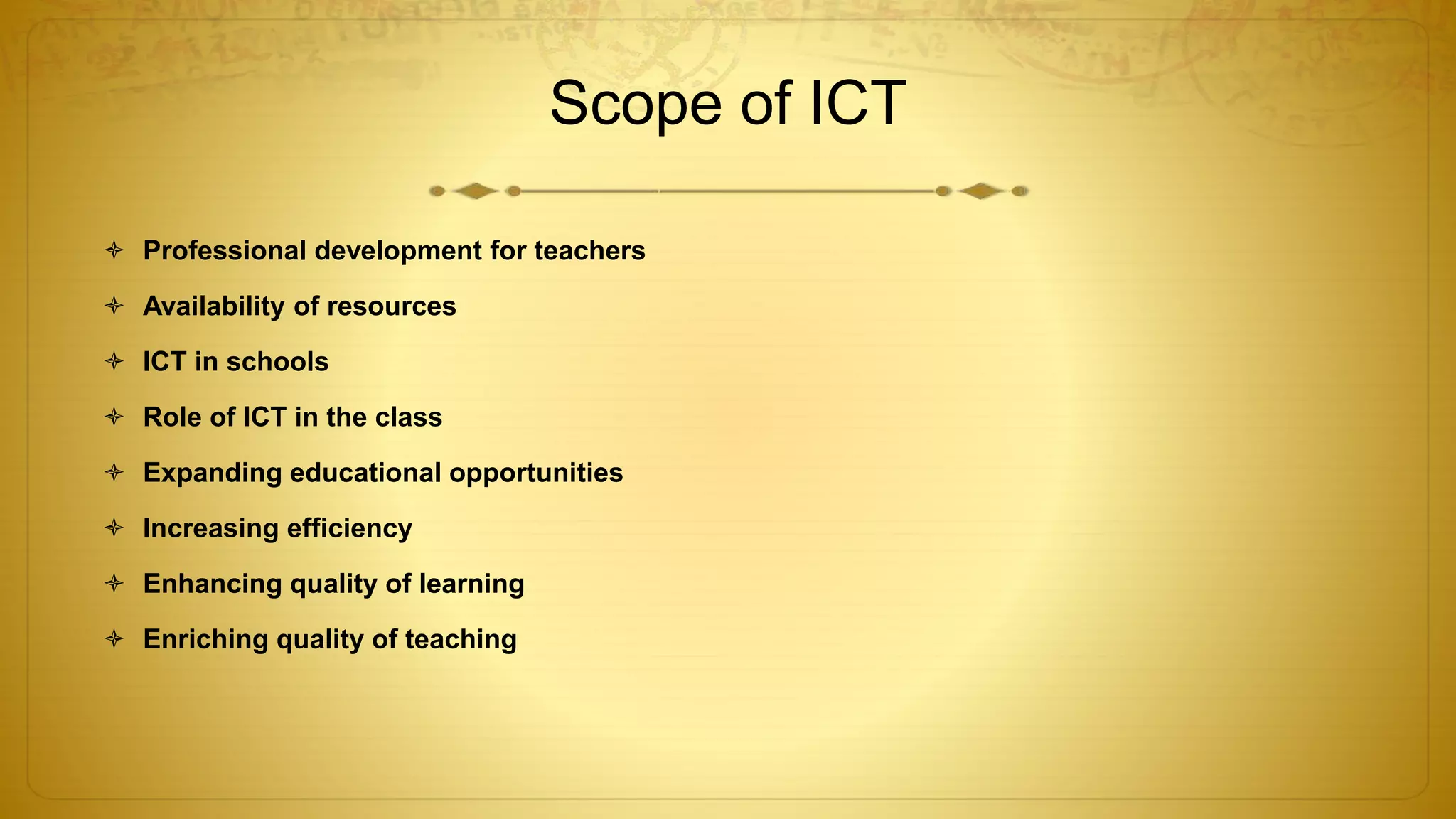
Scope of ICT
 Professional development for teachers
 Availability of resources
 ICT in schools
 Role of ICT in the class
 Expanding educational opportunities
 Increasing efficiency
 Enhancing quality of learning
 Enriching quality of teaching
 Facilitating skill formation
 Establishing and sustaining lifelong learning
 Improving policy planning and management
 Advancing community linkages
 IT-Professional and Vocational Education in Information Technology
 Distance Learning
 Lifelong Learning
 Information Technology in Educational Management
 enhance teaching
 helping the student learn
 that students can find information, they need proper instructions, they need scope for
creativity, expectations of the teacher brings forth performance.
 Lively teaching learning process
Teacher center to learner centered

Teacher center to learner centered

  • 1.
    Development Of Educational Technology& Shift From Teacher- Centered and Learner-Centered Mr.@mol Ub@le
  • 2.
    Development Of EducationalTechnology “Technology is commonly thought of in terms of gadgets, instrument, machines, and devices….most (educators) will defer to technology as computers” -- Muffoletto(1994)-p.5 Integrating Education Technology into Teaching (IETIT)
  • 3.
    “Only about adecade ago, a history of technology in education since 1920 placed the emphasis on radio and television, with computers as an afterthought .” --Cuban, 1986 (IETIT) p.5
  • 4.
    However, Saettler (1990)urges “The historical function of educational technology is a process rather than a product.”
  • 5.
    Any useful definitionof educational technology, therefore, must focus on the process of applying tools for educational purposes, and the materials used.
  • 6.
    In education, thecombination of process and product merges instructional procedures with instructional tools.
  • 7.
    Technology in Educationas Media and Audiovisual Communications
  • 8.
     Audiovisual movement:ways of delivering information that could be used as alternatives to lectures and books.  Audiovisual communications: the “branch of educational theory and practice concerned primarily with the design and use of messages which control the learning process.” (Saettler, IETIE,p6)  AECT- Association for Ed. Commo. and Technology.
  • 9.
    Technology in Educationas Instructional Systems
  • 10.
     1960s and1970s  Human and non-human resources ( teachers and media).  Systematic approach to designing, developing, and delivering instruction matched to carefully identified needs.  International Society for Performance Improvement.  Validating and creating instruction.
  • 11.
    Technology in Educationas Vocational Training Tools
  • 12.
     Technology inEducation: 1. School learning prepares students for the world of work. 2. Vocational training can be a practical means of teaching.  ITEA (International Technology Education Association).
  • 13.
    Technology in Educationas Computers and Computer- based Systems
  • 14.
     Instructional andsupportive applications of computers.  Computers began to be used in classrooms in 1960s until 1990 and was known as educational computing.  By the mid-1990s, educational computing became known as educational technology.  ISTE (International Society for Technology in Education) holds the following views:
  • 15.
  • 16.
    An emphasis onComputer Systems  Computers as media are becoming more complex and more capable.  Computer systems are subsuming other forms of media.  The perceived complexity of computer-based systems has made it more difficult for educators to effectively integrate software and computer media into classrooms.
  • 17.
  • 18.
    What’s a Computer?? Hardware Providingthe Electronic Capability Software Communicating with the Hardware  Any electromechanical device that accepts input, processes input and produces output.
  • 19.
    Software in aComputer System Systems Software ( Types of Operating Systems) Applications Software (used for Education, Entertainment, or Edutainment)
  • 20.
    Systems Software (Typesof Operating Systems)  Unix  Ms-DOS  Apple Dos, ProDOS  Macintosh DOS, System 7  Windows 95
  • 21.
    Using technology Forteaching Learning through  Computer-based learning  Computer networking  Online learning environments  Social media
  • 22.
  • 23.
    Comparison of Paradigms Teacher-Centered Learner-Centered Studentspassively receive information. Students are actively involved.
  • 24.
    Comparison of Paradigms Teacher-Centered Learner-Centered Emphasisis on acquisition of knowledge outside the context in which it will be used. Emphasis is on using and communicating knowledge effectively to address enduring and emerging issues and problems in real-life contexts.
  • 25.
    Comparison of Paradigms Teacher-Centered Learner-Centered Instructor’srole is to be primary information giver and primary evaluator. Instructor’s role is to coach and facilitate. Instructor and students evaluate learning together.
  • 26.
    Comparison of Paradigms Teacher-Centered Learner-Centered Emphasisis on right answers. Emphasis is on generating better questions and learning from errors.
  • 27.
    Comparison of Paradigms Teacher-Centered Learner-Centered Focusis on a single discipline. Approach is compatible with interdisciplinary investigation.
  • 28.
    Comparison of Paradigms Teacher-Centered Learner-Centered Cultureis competitive and individualistic. Culture is cooperative, collaborative, and supportive.
  • 29.
    Comparison of Paradigms Teacher-Centered Learner-Centered Onlystudents are viewed as learners. Professor and students learn together.
  • 30.
    Teacher-Centered Learner-Centered Focus ison instructor Focus is on both students and instructor Focus is on language forms and structures (what the instructor knows about the language) Focus is on language use in typical situations (how students will use the language) Instructor talks; students listen Instructor models; students interact with instructor and one another Students work alone Students work in pairs, in groups, or alone depending on the purpose of the activity Instructor monitors and corrects every student utterance Students talk without constant instructor monitoring; instructor provides feedback/correction when questions arise Instructor answers students’ questions about language Students answer each other’s questions, using instructor as an information resource Instructor chooses topics Students have some choice of topics Instructor evaluates student learning Students evaluate their own learning; instructor also evaluates Classroom is quiet Classroom is often noisy and busy
  • 31.
    Concept ,importance, MeaningAnd Nature of ICT Meaning ICT is technology that supports activities involving information.Such activities include gathering, processing, storing and presenting data. Increasingly these activities also involve collaboration and communication. Hence IT has become ICT: information and communication technology.
  • 32.
    Definition  "ICT standfor information and communication technologies and is defined, as a "diverse set of technological tools and resources used to communicate, and to create, disseminate, store, and manage information.  ICT implies the technology which consists of electronic devices and associated human interactive materials that enable the user to employ them for a wide range of teaching - learning processes in addition to personal use.  ICT is that technology which uses the information to meet human need or purposes including processing and exchanging.  ICT is a generic term referring to technologies, which are being used for collecting, storing, editing and passing on information in various forms (SER,1997)
  • 33.
     Information andcommunications technology (ICT) is often used as an extended synonym for information technology (IT)  It is a more extensive term (i.e. more broad in scope) that stresses the role of unified communications and the integration of telecommunications (telephone lines and wireless signals), computers as well as necessary enterprise software, middleware, storage, and audio-visual systems, which enable users to access, store, transmit, and manipulate information.
  • 34.
     The termICT is also used to refer to the convergence of audio-visual and telephone networks with computer networks through a various linking systems.  ICT covers any product that will store, retrieve, manipulate, transmit or receive information electronically in a digital form.  Information and communication technology, or ICT, is defined as the combination of informatics technology with other, related technologies, specifically communication technology.  ICT has no universal definition, since "the concepts, methods and applications involved in ICT are constantly evolving on an almost daily basis.”
  • 35.
    Need • Education isa life long process therefore anytime anywhere access to it is the need • Information explosion is an ever increasing phenomena therefore there is need to get access to this information • Education should meet the needs of variety of learners and therefore IT is important in meeting this need • It is a requirement of the society that the individuals should posses technological literacy • We need to increase access and bring down the cost of education to meet the challenges of illiteracy and poverty-IT is the answer
  • 36.
    Importance access tovariety of learning resources  immediacy to information  anytime learning  anywhere learning  collaborative learning  multimedia approach to education  authentic and up to date information  access to online libraries  teaching of different subjects made interesting  educational data storage  distance education  access to the source of information  multiple communication channels-e-mail,chat,forum,blogs,etc.  access to open courseware  better accesses to children with disabilities  reduces time on many routine tasks
  • 37.
    Scope of ICTin Education
  • 38.
    Scope TL process PublicationEvaluation Research Administration
  • 39.
    Teaching learning process Effectivelearning is possible by five sensory means. According to psychological study human can grasp 80% knowledge visually, 15 % through hearing & 5% with the rest of the sensory items.
  • 40.
     So itbecomes necessary to present the content by attractive means. Computer technology helps us to provide rich presentation.  To provide rich presentation, it is necessary to use the various components like:- 1. Text matter presentation 2. Animation presentation 3. Graphic presentation 4. Audio presentation 5. Video presentation Computer Aided Teaching has become popular now a days.
  • 41.
    publication  The notes,printed text books can be digitized with the help of computer technology.  Many e-books are available on websites developed by different publishers.  FreeBookSpot , 4eBooks,Free- eBooks,ManyBooks,FreeTechBooks,Scribd,Globusz,KnowFree,OnlineFreeEBooks,MemoWar e,SnipFiles,BookYards  Encyclopedia is also available on internet.
  • 42.
  • 43.
  • 44.
    administration  Employees register Library record  Dead stock register  Progress reports  Students register  Placement cell  Alumni record  School campus record  Finance & accounts  Timetable
  • 45.
    Scope of ICT Professional development for teachers  Availability of resources  ICT in schools  Role of ICT in the class  Expanding educational opportunities  Increasing efficiency  Enhancing quality of learning  Enriching quality of teaching
  • 46.
     Facilitating skillformation  Establishing and sustaining lifelong learning  Improving policy planning and management  Advancing community linkages  IT-Professional and Vocational Education in Information Technology  Distance Learning  Lifelong Learning  Information Technology in Educational Management
  • 47.
     enhance teaching helping the student learn  that students can find information, they need proper instructions, they need scope for creativity, expectations of the teacher brings forth performance.  Lively teaching learning process