Modern day application of advanced technologies have completely transformed human life. 21st Century is the age of
Information and Technology. It has touched all the spheres of education and has become one of the eminent in today’s
education system.
ICT [Information and Communication Technology] provide access to information sources, enable communications, create
interacting learning environment and promote change in methods of teaching. It is a dynamic force in the life of every
individual influencing his physical, mental, emotional, social and ethical developments. The use of ICT in education lends
itself to “student-centered” learning.
The explosion of digital technology has created a revolution in educational instructions. The growing use of ICT as an
instructional medium is changing and will change many of the strategies employed by teachers, resulting in constructive
learning. Government of India has launched various National Programs to promote ICT at school levels.
However, the mere availability of computers does not impact students learning. It is necessary to assure that new
generation of teachers, as well as current teachers are well prepared to use new learning methods, processes and
materials with the new ICT tools for learning. It requires combinations of input factors that can work together to influence
learning. Coordinating the introduction of computers with national policies related to curriculum, pedagogy, assessment
and teachers training would have greater impact on our system of education.
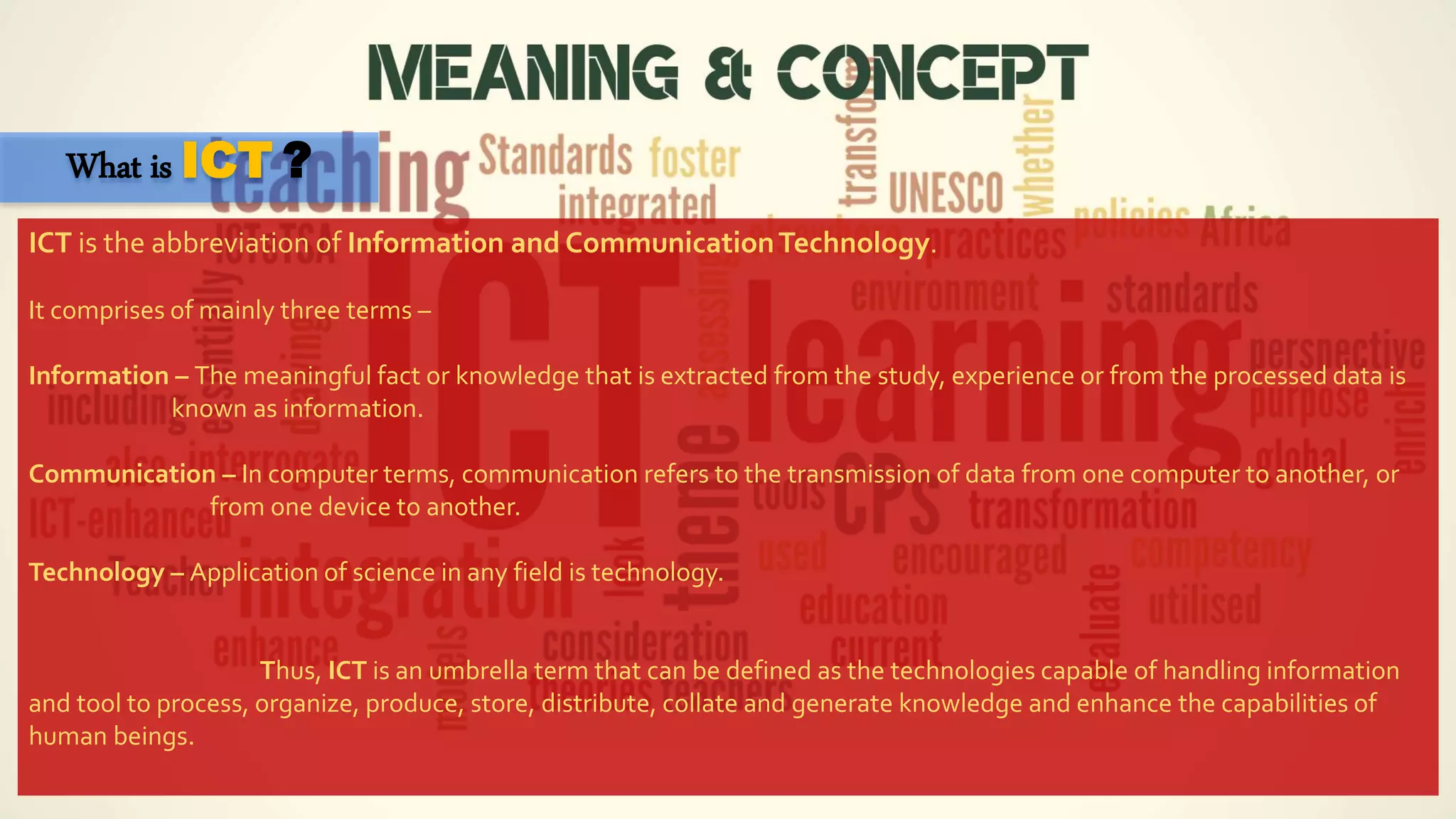
What is ICT ?
ICT is the abbreviation of Information and CommunicationTechnology.
It comprises of mainly three terms –
Information – The meaningful fact or knowledge that is extracted from the study, experience or from the processed data is
known as information.
Communication – In computer terms, communication refers to the transmission of data from one computer to another, or
from one device to another.
Technology – Application of science in any field is technology.
Thus, ICT is an umbrella term that can be defined as the technologies capable of handling information
and tool to process, organize, produce, store, distribute, collate and generate knowledge and enhance the capabilities of
human beings.
According to UNESCO (2002) :
“ICT is a scientific, technological and engineering discipline and a management technique used in handling information, its
application and association with social, economic and cultural matters”.
National Education Policy, 2012 connected ICT with education by defining it as :
“Information and CommunicationTechnologies are defined as all devices, tools, content, resources, forums, and services,
digital and those that can be converted into or delivered through digital forms, which can be deployed for realising the goals
of teaching learning, enhancing access to and reach of resources, building of capacities, as well as management of the
educational system.
These will not only include hardware devices connected to computers, and software applications, but also interactive digital
content, internet and other satellite communication devices, radio and television services, web-based content repositories,
interactive forums, learning management systems, and management information systems.
These will also include processes for digitisation, deployment and management of content, development and deployment of
platforms and processes for capacity development, and creation of forums for interaction and exchange.”
ICT is new technique in education to tackle all the problems that were existed in the
conventional teaching learning process. It has become the driving force of change in the new world. Now-a-days ICT is
transforming schools and classrooms into a new look by bringing in new curriculum based on real world problems, projects,
providing tools for enhancing learning, providing teachers and students more facilities and opportunities for feedback.
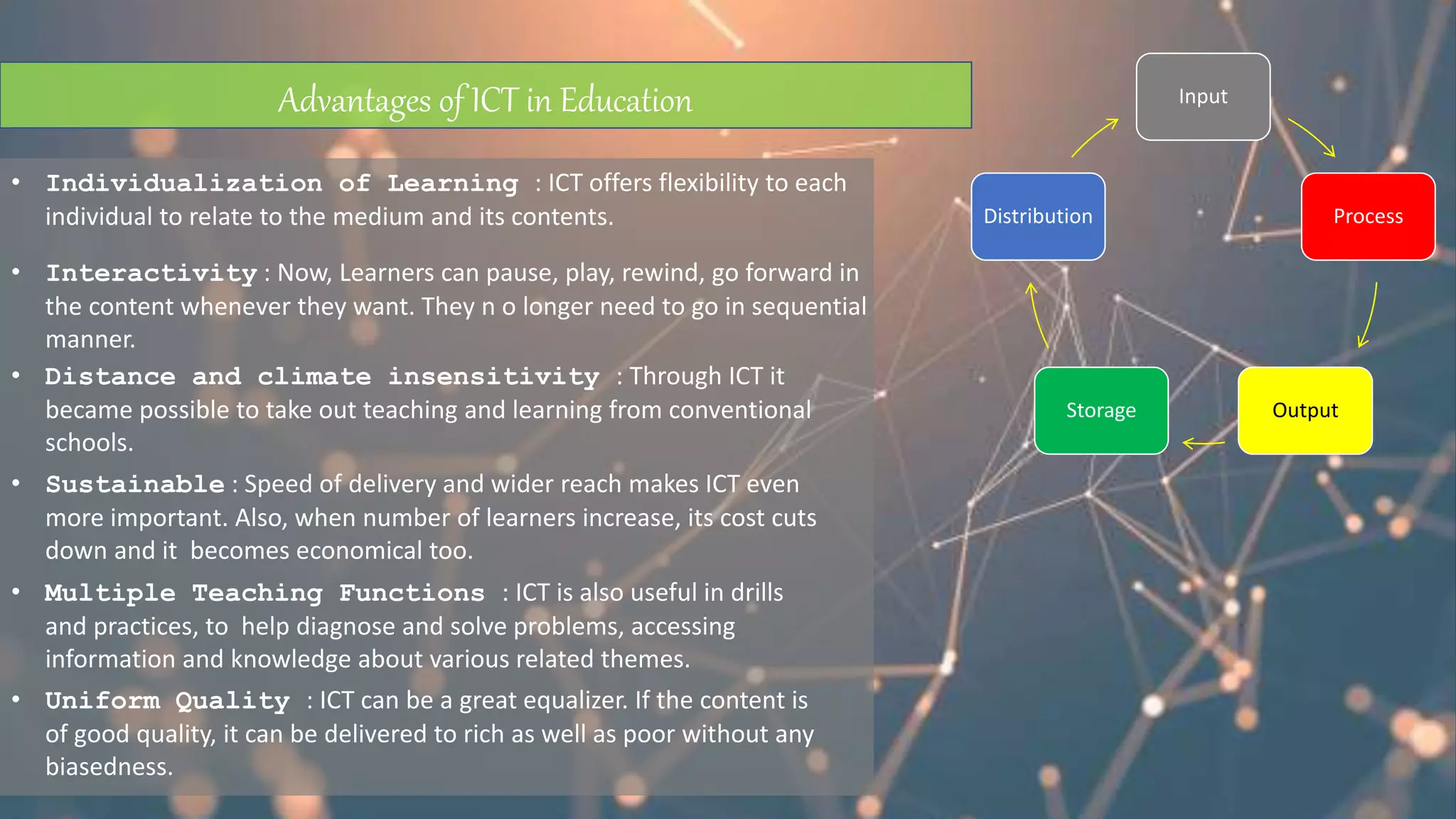
Input
Process
OutputStorage
Distribution
Advantages of ICT in Education
• Individualization of Learning : ICT offers flexibility to each
individual to relate to the medium and its contents.
• Interactivity : Now, Learners can pause, play, rewind, go forward in
the content whenever they want. They n o longer need to go in sequential
manner.
• Distance and climate insensitivity : Through ICT it
became possible to take out teaching and learning from conventional
schools.
• Sustainable : Speed of delivery and wider reach makes ICT even
more important. Also, when number of learners increase, its cost cuts
down and it becomes economical too.
• Multiple Teaching Functions : ICT is also useful in drills
and practices, to help diagnose and solve problems, accessing
information and knowledge about various related themes.
• Uniform Quality : ICT can be a great equalizer. If the content is
of good quality, it can be delivered to rich as well as poor without any
biasedness.
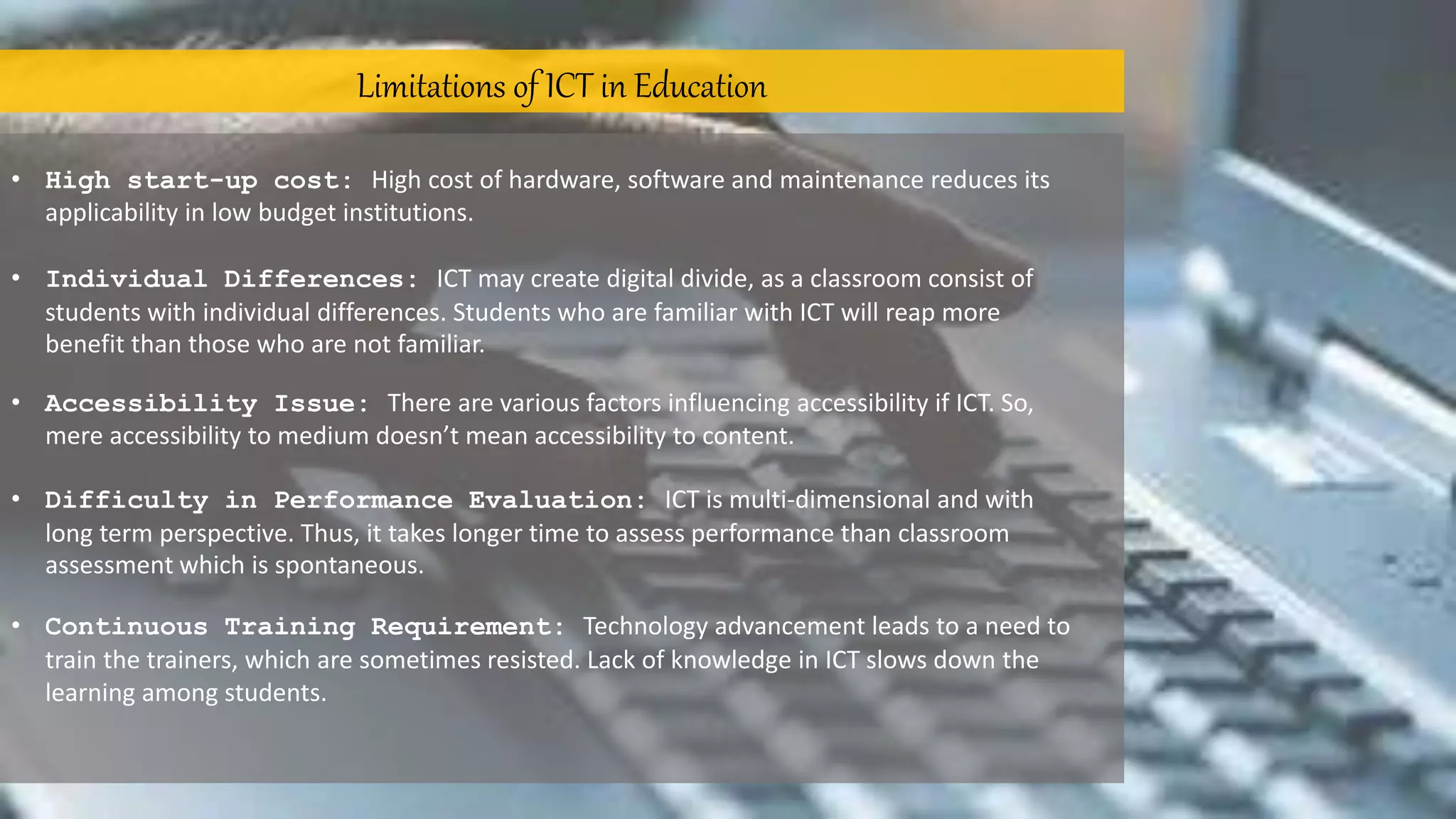
Limitations of ICT in Education
• High start-up cost: High cost of hardware, software and maintenance reduces its
applicability in low budget institutions.
• Individual Differences: ICT may create digital divide, as a classroom consist of
students with individual differences. Students who are familiar with ICT will reap more
benefit than those who are not familiar.
• Accessibility Issue: There are various factors influencing accessibility if ICT. So,
mere accessibility to medium doesn’t mean accessibility to content.
• Difficulty in Performance Evaluation: ICT is multi-dimensional and with
long term perspective. Thus, it takes longer time to assess performance than classroom
assessment which is spontaneous.
• Continuous Training Requirement: Technology advancement leads to a need to
train the trainers, which are sometimes resisted. Lack of knowledge in ICT slows down the
learning among students.
Areas in which Technology has influenced Education
• Curriculum and Development.
• Revolutionary change in teaching & learning methodology.
• Shift in emphasis from teaching to learning.
• Media application in education and development of media
taxanomy.
• Quantitative and Qualitative expansion of education.
• Emphasis on non-formal education and special education
systems.
• New assessment criteria and procedures.
• Emphasis and research, continued evaluation and recycling
process in education
• New role & position of teachers and an increase on emphasis
on in-service training for teachers.
• Change in structural patterns of educational organisation to
facilitate interaction between program producers, course
• PROJECT SHARADA in Delhi
• GIRI PRAGNA PROJECT in Andhra Pradesh
• ICT @ SCHOOL PROJECT in Kerala
• Intel Teach Program
• Project Shiksha by Microsoft
• Hole in the Wall Education Limited
(HiWEL) by NIIT & IFC
• Namma Dhwani
• Literacy for a Billion by Planet Read
• Sarva Shiksha Abhiyan by GOI
• Gyan Darshan
• Gyan Vani
• EDUSAT
• SWAYAMPRABHA
With the above discussion, we can conclude that –
ICT plays a critical in this Digital age.The
optimum use of ICTs in Indian education system
can propel the country to become a knowledge
superpower.The innovative use of Information
Technology (IT) in higher education addresses the
three fundamental challenges: access, equity and
quality.
ICT is seen as a change agent for Informative
Society. It has shifted the role of teacher from a
authoritarian to a guide.
With the help of ICT education is now learner-
centered. Inspite of few limitations, it can
improve the effectiveness of Indian Education to
face the competition from multi-national forces.

ICT and Education

  • 4.
    Modern day applicationof advanced technologies have completely transformed human life. 21st Century is the age of Information and Technology. It has touched all the spheres of education and has become one of the eminent in today’s education system. ICT [Information and Communication Technology] provide access to information sources, enable communications, create interacting learning environment and promote change in methods of teaching. It is a dynamic force in the life of every individual influencing his physical, mental, emotional, social and ethical developments. The use of ICT in education lends itself to “student-centered” learning. The explosion of digital technology has created a revolution in educational instructions. The growing use of ICT as an instructional medium is changing and will change many of the strategies employed by teachers, resulting in constructive learning. Government of India has launched various National Programs to promote ICT at school levels. However, the mere availability of computers does not impact students learning. It is necessary to assure that new generation of teachers, as well as current teachers are well prepared to use new learning methods, processes and materials with the new ICT tools for learning. It requires combinations of input factors that can work together to influence learning. Coordinating the introduction of computers with national policies related to curriculum, pedagogy, assessment and teachers training would have greater impact on our system of education.
  • 5.
    What is ICT? ICT is the abbreviation of Information and CommunicationTechnology. It comprises of mainly three terms – Information – The meaningful fact or knowledge that is extracted from the study, experience or from the processed data is known as information. Communication – In computer terms, communication refers to the transmission of data from one computer to another, or from one device to another. Technology – Application of science in any field is technology. Thus, ICT is an umbrella term that can be defined as the technologies capable of handling information and tool to process, organize, produce, store, distribute, collate and generate knowledge and enhance the capabilities of human beings.
  • 6.
    According to UNESCO(2002) : “ICT is a scientific, technological and engineering discipline and a management technique used in handling information, its application and association with social, economic and cultural matters”. National Education Policy, 2012 connected ICT with education by defining it as : “Information and CommunicationTechnologies are defined as all devices, tools, content, resources, forums, and services, digital and those that can be converted into or delivered through digital forms, which can be deployed for realising the goals of teaching learning, enhancing access to and reach of resources, building of capacities, as well as management of the educational system. These will not only include hardware devices connected to computers, and software applications, but also interactive digital content, internet and other satellite communication devices, radio and television services, web-based content repositories, interactive forums, learning management systems, and management information systems. These will also include processes for digitisation, deployment and management of content, development and deployment of platforms and processes for capacity development, and creation of forums for interaction and exchange.” ICT is new technique in education to tackle all the problems that were existed in the conventional teaching learning process. It has become the driving force of change in the new world. Now-a-days ICT is transforming schools and classrooms into a new look by bringing in new curriculum based on real world problems, projects, providing tools for enhancing learning, providing teachers and students more facilities and opportunities for feedback.
  • 7.
    Input Process OutputStorage Distribution Advantages of ICTin Education • Individualization of Learning : ICT offers flexibility to each individual to relate to the medium and its contents. • Interactivity : Now, Learners can pause, play, rewind, go forward in the content whenever they want. They n o longer need to go in sequential manner. • Distance and climate insensitivity : Through ICT it became possible to take out teaching and learning from conventional schools. • Sustainable : Speed of delivery and wider reach makes ICT even more important. Also, when number of learners increase, its cost cuts down and it becomes economical too. • Multiple Teaching Functions : ICT is also useful in drills and practices, to help diagnose and solve problems, accessing information and knowledge about various related themes. • Uniform Quality : ICT can be a great equalizer. If the content is of good quality, it can be delivered to rich as well as poor without any biasedness.
  • 8.
    Limitations of ICTin Education • High start-up cost: High cost of hardware, software and maintenance reduces its applicability in low budget institutions. • Individual Differences: ICT may create digital divide, as a classroom consist of students with individual differences. Students who are familiar with ICT will reap more benefit than those who are not familiar. • Accessibility Issue: There are various factors influencing accessibility if ICT. So, mere accessibility to medium doesn’t mean accessibility to content. • Difficulty in Performance Evaluation: ICT is multi-dimensional and with long term perspective. Thus, it takes longer time to assess performance than classroom assessment which is spontaneous. • Continuous Training Requirement: Technology advancement leads to a need to train the trainers, which are sometimes resisted. Lack of knowledge in ICT slows down the learning among students.
  • 9.
    Areas in whichTechnology has influenced Education • Curriculum and Development. • Revolutionary change in teaching & learning methodology. • Shift in emphasis from teaching to learning. • Media application in education and development of media taxanomy. • Quantitative and Qualitative expansion of education. • Emphasis on non-formal education and special education systems. • New assessment criteria and procedures. • Emphasis and research, continued evaluation and recycling process in education • New role & position of teachers and an increase on emphasis on in-service training for teachers. • Change in structural patterns of educational organisation to facilitate interaction between program producers, course
  • 12.
    • PROJECT SHARADAin Delhi • GIRI PRAGNA PROJECT in Andhra Pradesh • ICT @ SCHOOL PROJECT in Kerala • Intel Teach Program • Project Shiksha by Microsoft • Hole in the Wall Education Limited (HiWEL) by NIIT & IFC • Namma Dhwani • Literacy for a Billion by Planet Read • Sarva Shiksha Abhiyan by GOI • Gyan Darshan • Gyan Vani • EDUSAT • SWAYAMPRABHA
  • 13.
    With the abovediscussion, we can conclude that – ICT plays a critical in this Digital age.The optimum use of ICTs in Indian education system can propel the country to become a knowledge superpower.The innovative use of Information Technology (IT) in higher education addresses the three fundamental challenges: access, equity and quality. ICT is seen as a change agent for Informative Society. It has shifted the role of teacher from a authoritarian to a guide. With the help of ICT education is now learner- centered. Inspite of few limitations, it can improve the effectiveness of Indian Education to face the competition from multi-national forces.