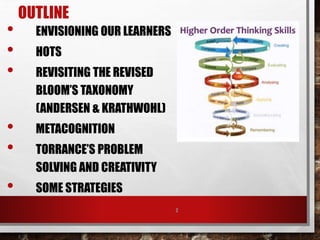
OUTLINE
• ENVISIONING OUR LEARNERS
• HOTS
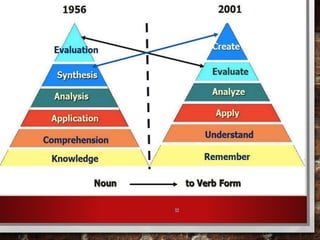
• REVISITING THE REVISED
BLOOM’S TAXONOMY
(ANDERSEN & KRATHWOHL)
• METACOGNITION
• TORRANCE’S PROBLEM
SOLVING AND CREATIVITY
• SOME STRATEGIES
2
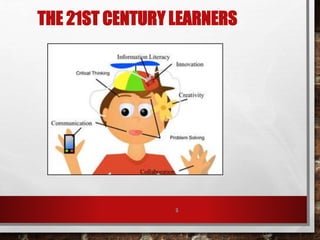
THE 21ST CENTURY LEARNERS
3
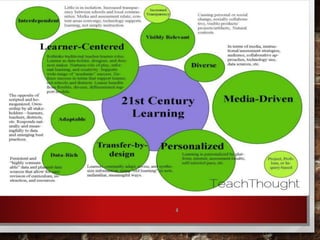
4
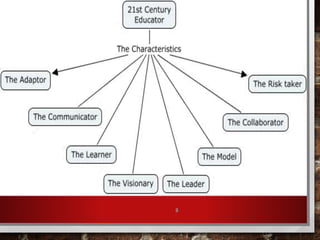
WHAT IS EXPECTED OF THE TEACHER
IN THIS CENTURY?
5
Learning to Change,
and Changing to Learn
6
7
• LEARNER-CENTERED CLASSROOM AND PERSONALIZED
INSTRUCTIONS
• LOOK AT STUDENTS AS PRODUCERS
• LEARN NEW TECHNOLOGIES (CHECK
WWW.LYNDA.COM)
• GO GLOBAL
• BE SMART AND USE SMART PHONES
• BUILD YOU OWN DIGITAL FOOTPRINT
• BLOG
• COLLABORATE
• CONNECT
• PROJECT-BASED LEARNING
• INNOVATE
• KEEP LEARNING
WHAT IS HIGHER-ORDER THINKING
SKILLS?
8
9
This is when our learners use
complex ways to think about
what they are learning.
WHAT IS HOTS?
THIS REQUIRES LEARNERS
• TO UNDERSTAND FACTS
• INFER FROM THEM
• CONNECT THEM TO OTHER FACTS AND CONCEPTS
• CATEGORIZE THEM
• MANIPULATE THEM
• PUT THEM TOGETHER IN A NEW OR NOVEL WAY
• APPLY THEM AS THEY SEEK NEW SOLUTIONS TO PROBLEMS
10
11
12
13
Let’s view this five-
minute video clip
on the revised
version of Bloom’s
Taxonomy
14
15
Metacognition is awareness of
one’s own thought processes.
Metacognition refers to higher
order thinking which involves
active control over the
cognitive processes engaged in
learning.
16
Activities such as
• planning how to approach a
given learning task,
• monitoring comprehension,
• and evaluating progress
toward the completion of a
task are metacognitive in
nature.
17
“I make the learner become aware
of his accountability to learn for his
own sake and clarify my role in his
learning.”
18
Let’s view teacher’s self-
made video/podcast on
the metacognition
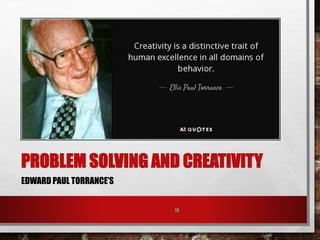
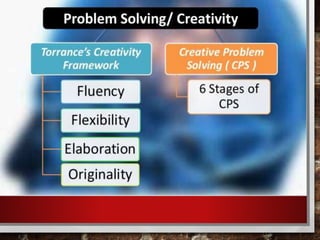
PROBLEM SOLVING AND CREATIVITY
EDWARD PAUL TORRANCE’S
19
Problem solving
and creativity go
hand in hand.
FLUENCY
Production of a great number of
ideas
Key Words: compare, convert,
count, define, describe, explain,
identify, label, list, match, name,
outline, paraphrase, predict,
summarize
Application Activities:
• Trace a picture and label the parts
• Outline an article you find on your
topic
• How many uses can you think of for
a clothes hanger?
• List 10 things that are commonly
red or contain red.
FLEXIBILITY
Production of ideas that show
variety of possibilities or realms of
thought
Key Words: change, demonstrate,
distinguish, employ, extrapolate,
interpolate, interpret, predict
Application Activities
• What would happen if …there
were no automobiles?
• How would you feel if …you were
invisible for a day?
• How would you group the ideas
about “red” into categories?
ELABORATION
Enhancing ideas by providing more
details. Additional detail and clarity
improves interest in, and understanding
of, the topic.
Key Words: appraise, critique,
determine, evaluate, grade, judge,
measure, select, test
Application Ideas
• Tell your classmate about your last
family feast using as many details as
possible
• What can you do…to improve its quality
or performance?
• Describe all the possible characteristics
of the red quality in a wagon.
ORIGINALITY
Production of ideas that are unique or
unusual; putting info together in a new
way
Key Words: compose, create, design,
generate, integrate, modify, rearrange,
reconstruct, reorganize, revise
Application Ideas
• Find an original use for ___.
• What is the strangest way to get
out of bed?
• Design a new ___ that is better
than the one you have.
• Write an unusual title for the
ideas about red.
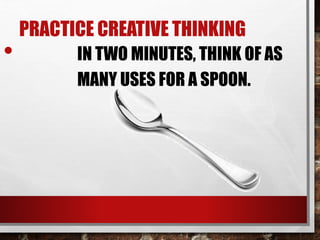
PRACTICE CREATIVE THINKING
• IN TWO MINUTES, THINK OF AS
MANY USES FOR A SPOON.
The test measures divergent
thinking across four sub-categories:
• FLUENCY
• ORIGINALITY
• FLEXIBILITY
• ELABORATION
What would happen if humans
had one more eye at the back?
Task: Write as many answers and
explain why.
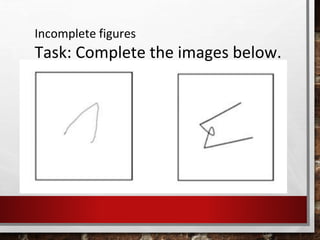
Incomplete figures
Task: Complete the images below.
36
Riddle
A man has married 20 women in
small town. All of the women are
still alive and none of them are
divorced. The man has broken
no laws. Who is this man?
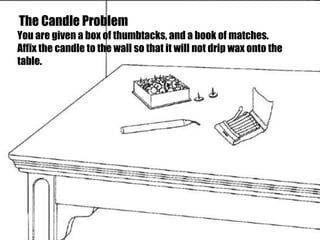
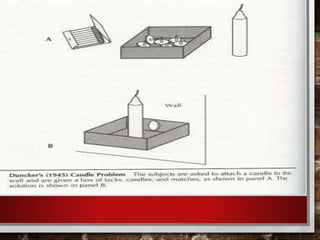
The Candle Problem
You are given a box of thumbtacks, and a book of matches.
Affix the candle to the wall so that it will not drip wax onto the
table.
39
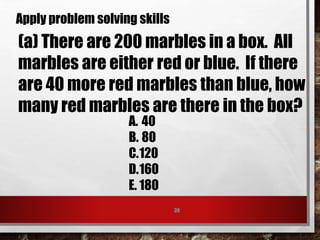
Apply problem solving skills
(a) There are 200 marbles in a box. All
marbles are either red or blue. If there
are 40 more red marbles than blue, how
many red marbles are there in the box?
A. 40
B. 80
C.120
D.160
E. 180
40
41
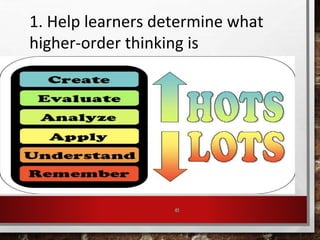
1. Help learners determine what
higher-order thinking is
42
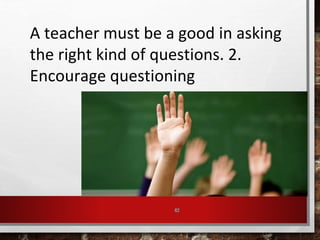
A teacher must be a good in asking
the right kind of questions. 2.
Encourage questioning
43
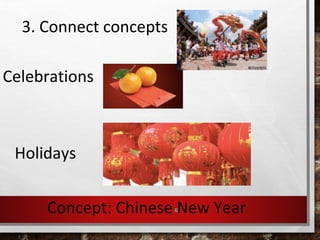
3. Connect concepts
Concept: Chinese New Year
Holidays
Celebrations
44
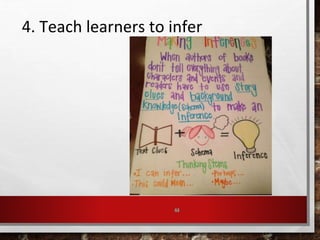
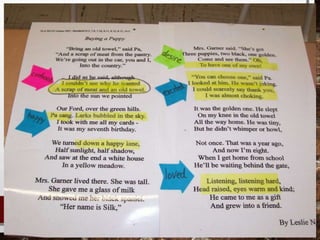
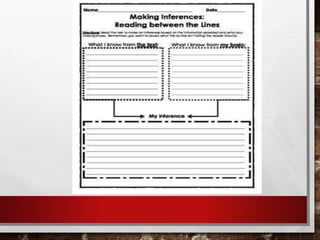
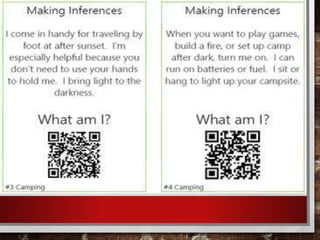
4. Teach learners to infer
48
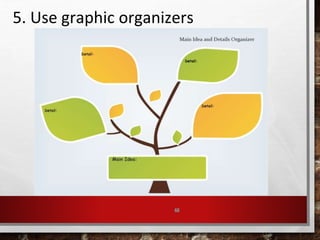
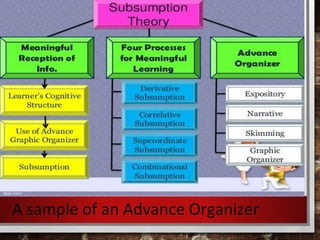
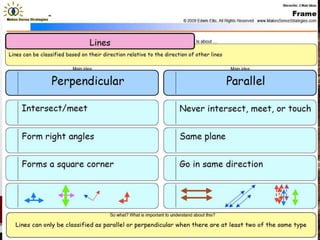
5. Use graphic organizers
A sample of an Advance Organizer
51
6. Teach Problem-solving
activities
Allow learners to use alternative
methods to solve problems, and
offer them different problem-
solving methods
52
7. Encourage creative thinking
Let them INVENT, IMAGINE,
DESIGN what they are
thinking.
Let’s use our creative sense to
help our learners utilise HOTS.
Let’s make them think ‘outside of
the box.’
53
8. Use Mind Movies
When concepts being taught are hard,
encourage learners to create a movie
in their mind.
54
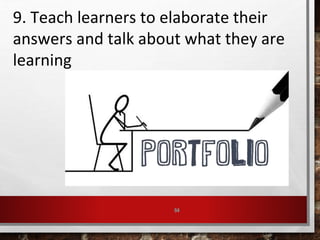
9. Teach learners to elaborate their
answers and talk about what they are
learning
55
9. Teach QARs
Question-Answer-Relationships
Learners must decipher if the answer
is found in text or in the internet or
rely on their prior knowledge…
They manage their own understanding
56
57
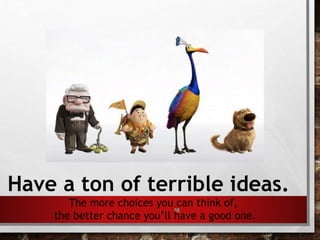
Have a ton of terrible ideas.
The more choices you can think of, the better chance you’ll have a good one.
58
Have a ton of terrible ideas.
The more choices you can think of,
the better chance you’ll have a good one.
59
Step away and do something else.
Anything else.
60
Listen to or watch something funny.
Laughter relaxes us.
61
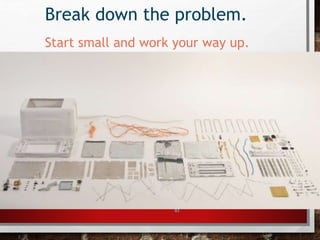
Break down the problem.
Start small and work your way up.
62
Give yourself restrictions.
We aren’t good at making decisions.
63
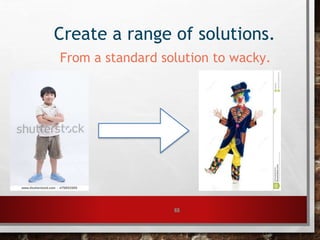
Create a range of solutions.
From a standard solution to wacky.
64
Don’t be afraid of a blank canvas.
Just put anything down.
65
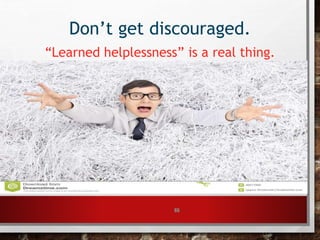
Don’t get discouraged.
“Learned helplessness” is a real thing.
66
Ernest Hemingway
Bet he could make an entire story in six words
For sale: baby shoes, never worn.
67
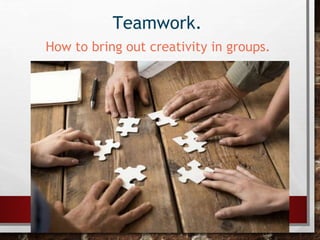
Teamwork.
How to bring out creativity in groups.
68
• ENVISIONING OUR LEARNERS
• HOTS
• REVISITING THE REVISED BLOOM’S TAXONOMY
(ANDERSEN & KRATHWOHL)
• METACOGNITION
• TORRANCE’S PROBLEM SOLVING AND CREATIVITY
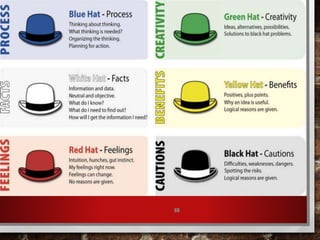
• SOME STRATEGIES
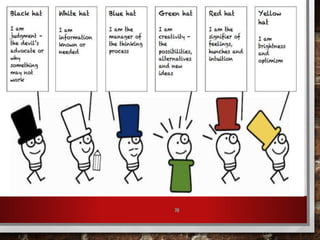
• CULTIVATE CREATIVITY (THINKING HATS OF BONO)
69
70
https://www.edutopia.org/discussion/15-characteristics-21st-century-teacher
References
file:///Users/mtb-mle/Desktop/How%20to%20be%20More%20Creative.pdf
Lucas, R. & Corpuz, B. (2014). Facilitating Learning: A Metacognitive Process.
Outcomes-based and K to 12-Based. Lorimar Publishing, Inc.
Thomas, A., & Thorne, G.(2009). How to Increase Higher Order Thinking Metarie, LA:
Centre for Development and Learning. Retrieved December 7, 2009.
Crockett, Lee. W. 10 Team-Building Games that promote Critical Thinking
HIGHER ORDER THINKING SKILLS

  • 2.
    OUTLINE • ENVISIONING OURLEARNERS • HOTS • REVISITING THE REVISED BLOOM’S TAXONOMY (ANDERSEN & KRATHWOHL) • METACOGNITION • TORRANCE’S PROBLEM SOLVING AND CREATIVITY • SOME STRATEGIES 2
  • 3.
    THE 21ST CENTURYLEARNERS 3
  • 4.
  • 5.
    WHAT IS EXPECTEDOF THE TEACHER IN THIS CENTURY? 5 Learning to Change, and Changing to Learn
  • 6.
  • 7.
    7 • LEARNER-CENTERED CLASSROOMAND PERSONALIZED INSTRUCTIONS • LOOK AT STUDENTS AS PRODUCERS • LEARN NEW TECHNOLOGIES (CHECK WWW.LYNDA.COM) • GO GLOBAL • BE SMART AND USE SMART PHONES • BUILD YOU OWN DIGITAL FOOTPRINT • BLOG • COLLABORATE • CONNECT • PROJECT-BASED LEARNING • INNOVATE • KEEP LEARNING
  • 8.
    WHAT IS HIGHER-ORDERTHINKING SKILLS? 8
  • 9.
    9 This is whenour learners use complex ways to think about what they are learning.
  • 10.
    WHAT IS HOTS? THISREQUIRES LEARNERS • TO UNDERSTAND FACTS • INFER FROM THEM • CONNECT THEM TO OTHER FACTS AND CONCEPTS • CATEGORIZE THEM • MANIPULATE THEM • PUT THEM TOGETHER IN A NEW OR NOVEL WAY • APPLY THEM AS THEY SEEK NEW SOLUTIONS TO PROBLEMS 10
  • 11.
  • 12.
  • 13.
    13 Let’s view thisfive- minute video clip on the revised version of Bloom’s Taxonomy
  • 14.
  • 15.
    15 Metacognition is awarenessof one’s own thought processes. Metacognition refers to higher order thinking which involves active control over the cognitive processes engaged in learning.
  • 16.
    16 Activities such as •planning how to approach a given learning task, • monitoring comprehension, • and evaluating progress toward the completion of a task are metacognitive in nature.
  • 17.
    17 “I make thelearner become aware of his accountability to learn for his own sake and clarify my role in his learning.”
  • 18.
    18 Let’s view teacher’sself- made video/podcast on the metacognition
  • 19.
    PROBLEM SOLVING ANDCREATIVITY EDWARD PAUL TORRANCE’S 19
  • 20.
  • 22.
    FLUENCY Production of agreat number of ideas Key Words: compare, convert, count, define, describe, explain, identify, label, list, match, name, outline, paraphrase, predict, summarize
  • 23.
    Application Activities: • Tracea picture and label the parts • Outline an article you find on your topic • How many uses can you think of for a clothes hanger? • List 10 things that are commonly red or contain red.
  • 24.
    FLEXIBILITY Production of ideasthat show variety of possibilities or realms of thought Key Words: change, demonstrate, distinguish, employ, extrapolate, interpolate, interpret, predict
  • 25.
    Application Activities • Whatwould happen if …there were no automobiles? • How would you feel if …you were invisible for a day? • How would you group the ideas about “red” into categories?
  • 26.
    ELABORATION Enhancing ideas byproviding more details. Additional detail and clarity improves interest in, and understanding of, the topic. Key Words: appraise, critique, determine, evaluate, grade, judge, measure, select, test
  • 27.
    Application Ideas • Tellyour classmate about your last family feast using as many details as possible • What can you do…to improve its quality or performance? • Describe all the possible characteristics of the red quality in a wagon.
  • 28.
    ORIGINALITY Production of ideasthat are unique or unusual; putting info together in a new way Key Words: compose, create, design, generate, integrate, modify, rearrange, reconstruct, reorganize, revise
  • 29.
    Application Ideas • Findan original use for ___. • What is the strangest way to get out of bed? • Design a new ___ that is better than the one you have. • Write an unusual title for the ideas about red.
  • 30.
    PRACTICE CREATIVE THINKING •IN TWO MINUTES, THINK OF AS MANY USES FOR A SPOON.
  • 31.
    The test measuresdivergent thinking across four sub-categories: • FLUENCY • ORIGINALITY • FLEXIBILITY • ELABORATION
  • 34.
    What would happenif humans had one more eye at the back? Task: Write as many answers and explain why.
  • 35.
  • 36.
    36 Riddle A man hasmarried 20 women in small town. All of the women are still alive and none of them are divorced. The man has broken no laws. Who is this man?
  • 37.
    The Candle Problem Youare given a box of thumbtacks, and a book of matches. Affix the candle to the wall so that it will not drip wax onto the table.
  • 39.
    39 Apply problem solvingskills (a) There are 200 marbles in a box. All marbles are either red or blue. If there are 40 more red marbles than blue, how many red marbles are there in the box? A. 40 B. 80 C.120 D.160 E. 180
  • 40.
  • 41.
    41 1. Help learnersdetermine what higher-order thinking is
  • 42.
    42 A teacher mustbe a good in asking the right kind of questions. 2. Encourage questioning
  • 43.
    43 3. Connect concepts Concept:Chinese New Year Holidays Celebrations
  • 44.
  • 48.
  • 49.
    A sample ofan Advance Organizer
  • 51.
    51 6. Teach Problem-solving activities Allowlearners to use alternative methods to solve problems, and offer them different problem- solving methods
  • 52.
    52 7. Encourage creativethinking Let them INVENT, IMAGINE, DESIGN what they are thinking. Let’s use our creative sense to help our learners utilise HOTS. Let’s make them think ‘outside of the box.’
  • 53.
    53 8. Use MindMovies When concepts being taught are hard, encourage learners to create a movie in their mind.
  • 54.
    54 9. Teach learnersto elaborate their answers and talk about what they are learning
  • 55.
    55 9. Teach QARs Question-Answer-Relationships Learnersmust decipher if the answer is found in text or in the internet or rely on their prior knowledge… They manage their own understanding
  • 56.
  • 57.
    57 Have a tonof terrible ideas. The more choices you can think of, the better chance you’ll have a good one.
  • 58.
    58 Have a tonof terrible ideas. The more choices you can think of, the better chance you’ll have a good one.
  • 59.
    59 Step away anddo something else. Anything else.
  • 60.
    60 Listen to orwatch something funny. Laughter relaxes us.
  • 61.
    61 Break down theproblem. Start small and work your way up.
  • 62.
    62 Give yourself restrictions. Wearen’t good at making decisions.
  • 63.
    63 Create a rangeof solutions. From a standard solution to wacky.
  • 64.
    64 Don’t be afraidof a blank canvas. Just put anything down.
  • 65.
    65 Don’t get discouraged. “Learnedhelplessness” is a real thing.
  • 66.
    66 Ernest Hemingway Bet hecould make an entire story in six words For sale: baby shoes, never worn.
  • 67.
    67 Teamwork. How to bringout creativity in groups.
  • 68.
    68 • ENVISIONING OURLEARNERS • HOTS • REVISITING THE REVISED BLOOM’S TAXONOMY (ANDERSEN & KRATHWOHL) • METACOGNITION • TORRANCE’S PROBLEM SOLVING AND CREATIVITY • SOME STRATEGIES • CULTIVATE CREATIVITY (THINKING HATS OF BONO)
  • 69.
  • 70.
  • 71.
    https://www.edutopia.org/discussion/15-characteristics-21st-century-teacher References file:///Users/mtb-mle/Desktop/How%20to%20be%20More%20Creative.pdf Lucas, R. &Corpuz, B. (2014). Facilitating Learning: A Metacognitive Process. Outcomes-based and K to 12-Based. Lorimar Publishing, Inc. Thomas, A., & Thorne, G.(2009). How to Increase Higher Order Thinking Metarie, LA: Centre for Development and Learning. Retrieved December 7, 2009. Crockett, Lee. W. 10 Team-Building Games that promote Critical Thinking