Using storytelling in learning and teaching
Julie Attenborough and Rachael-Anne Knight
@CityJoolz @r_a_knight
Session learning outcomes
▪ Identify opportunities to incorporate storytelling into
your educational practice
▪ Describe the indications for storytelling
▪ Reflect on storytelling in your educational practice
▪ Recognise the impact of storytelling on learners
▪ Articulate the impact of storytelling on your own
identity as educators
Introductions via stories
▪ Icebreaker activity (5 mins)
▪ Please use the storytelling cards on your tables
▪ Using the cards as prompts, please tell the story of
your journey to this SEDA conference. You have three
minutes each!
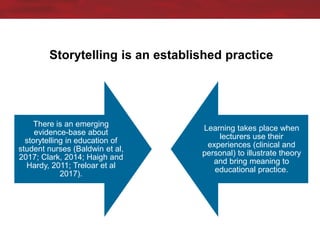
Storytelling is an established practice
There is an emerging
evidence-base about
storytelling in education of
student nurses (Baldwin et al,
2017; Clark, 2014; Haigh and
Hardy, 2011; Treloar et al
2017).
Learning takes place when
lecturers use their
experiences (clinical and
personal) to illustrate theory
and bring meaning to
educational practice.
Storytelling project – back ground
▪ Attenborough and Abbott (2018) examined how student
nurses and midwives build their professional identity
▪ Student views about the clinical credibility of their lecturers
▪ Students suggested that lecturers’ stories from practice
helped them feel their way into the role
▪ “Telling us stories, before we’ve gone on our first placement,
about how working on a ward is actually like, I think is really
important – because it gears you up a bit more and then it
also gives you a bit of hope for the future, like, ‘Oh you’ve had
a good career out of this, maybe I could too?’.” (Student 4)
Recontextualisation
Sometimes described as invisible learning this takes
place when lecturers use their experience (in this case
clinical experience) to illustrate theory and bring
meaning to educational practice (Evans et al 2010;
Evans and Guile, 2012).
Recontextualisation or reworking knowledge plays an
important part in professional education.
Storytelling, Invisible learning and the
hidden curriculum
▪ Invisible learning has been discussed in relation to
the 'hidden curriculum' which entails the ‘processes,
pressures and constraints which fall outside…the
formal curriculum and which are often unarticulated
or unexplored’ (Bignold & Cribb, 1999; 24).
▪ Influences that function at the level of organisational
structure and culture including, for example, implicit
rules for how to survive the institution, such as
customs, rituals, and culture (Lempp & Seale, 2004;
McHaffie, 2014).
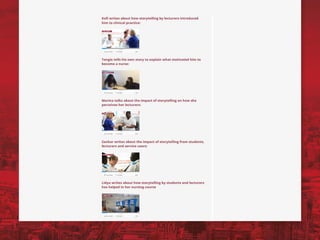
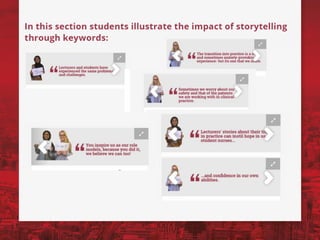
Co-creation of an online resource to
support lecturers in storytelling
▪ Nursing and midwifery students invited to contribute
▪ Eight Nursing students volunteered
▪ Produced videos, narrative, key words and top tips for
storytelling
▪ Included some background and examples from other
disciplines and institutions
▪ Worked with the students to produce an online resource
▪ Then we asked lecturers to view the module and invited them
to be interviewed, 11 volunteered.
Click to add text
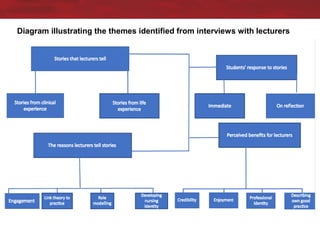
Diagram illustrating the themes identified from interviews with lecturers
Top tips activity
▪ Students provided top-tips for lecturers using
storytelling
▪ We will talk through these briefly now, and you also
have copies on your tables
▪ Small group activity (10 mins)
▪ How do these top tips relate to your discipline?
▪ Which do you use already, and which could you adopt
or adapt?
▪ Are there others you would add?
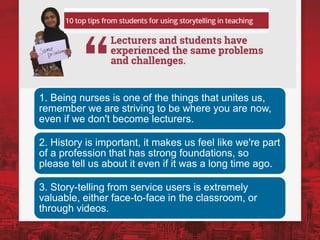
1. Being nurses is one of the things that unites us,
remember we are striving to be where you are now,
even if we don't become lecturers.
2. History is important, it makes us feel like we're part
of a profession that has strong foundations, so
please tell us about it even if it was a long time ago.
3. Story-telling from service users is extremely
valuable, either face-to-face in the classroom, or
through videos.
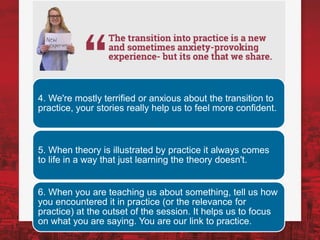
4. We're mostly terrified or anxious about the transition to
practice, your stories really help us to feel more confident.
5. When theory is illustrated by practice it always comes
to life in a way that just learning the theory doesn't.
6. When you are teaching us about something, tell us how
you encountered it in practice (or the relevance for
practice) at the outset of the session. It helps us to focus
on what you are saying. You are our link to practice.
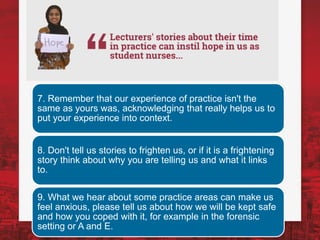
7. Remember that our experience of practice isn't the
same as yours was, acknowledging that really helps us to
put your experience into context.
8. Don't tell us stories to frighten us, or if it is a frightening
story think about why you are telling us and what it links
to.
9. What we hear about some practice areas can make us
feel anxious, please tell us about how we will be kept safe
and how you coped with it, for example in the forensic
setting or A and E.
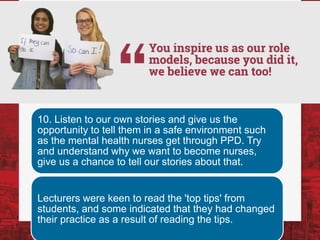
10. Listen to our own stories and give us the
opportunity to tell them in a safe environment such
as the mental health nurses get through PPD. Try
and understand why we want to become nurses,
give us a chance to tell our stories about that.
Lecturers were keen to read the 'top tips' from
students, and some indicated that they had changed
their practice as a result of reading the tips.
Storytelling in practice
▪ Paired activity (10 minutes)
▪ Using the information so far, share one story from your
educational practice that is, or could be, used with
students
▪ Feedback (10 minutes)
▪ Volunteers share their stories, or thoughts on their
practice
Broader work
▪ As we’ve seen, stories do not just have to be about
clinical practice
▪ Stanford montage of lecturer failure and growth
▪ https://www.youtube.com/watch?v=ndjETeffRi4
▪ Neither do they have to be just from staff to
students
▪ Rachael-Anne uses videos made by students to
prepare others for oral exams
▪ Our future work will collect student stories of growth
and resilience across disciplines
Action plan
▪ What would you like to take forward from this
session?
▪ What stories could you use?
▪ When?
▪ In what context?
▪ What effect would you hope them to have?
References
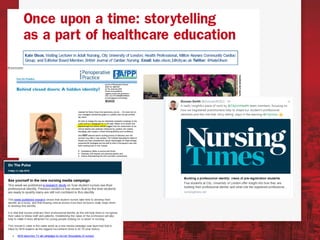
Attenborough, J.A. and Abbott, S. (2018). Building a professional identity: views of
pre-registration students. Nursing Times, 114(8), pp. 52–55.
Bignold, S., & Cribb, A. (1999). Towards The Reflexive Medical School: The hidden
curriculum and medical education research. Studies in Higher Education. 24(2),
195 - 209.
Clark, P.G., (2014) Narrative in interprofrssional education and practice:
implications for professional identity, provider-patient communication and
teamwork. Journal of Interprofessional Care 28 (1) pp 34-39
Evans, K., Guile, D., Harris, J., Allan, H. T. (2010). Putting Knowledge To Work: A
new approach. Nurse Education Today, 30, 245-51
Evans, K., & Guile, D. (2012). Putting Different Forms Of Knowledge To Work In
Practice. In Practice-Based Education: Perspectives And Strategies, Eds Higgs, J.,
Billett, S., Hutchings, M., & Trede, F. 113 – 136. Rotterdam: Sense Publishers
Haigh, C and Hardy, P., (2011) Tell me a story- a conceptual exploration pf
storytelling in healthcare edcuation. Nurse Education Today 31(4) pp 408-411
Lempp, H., & Seale, C. (2004). The Hidden Curriculum In
Undergraduate Medical Education: Qualitative Study Of
Medical Students' Perceptions Of Teaching. British Medical
Journal, 329(7469), 770-3
McHaffie, J (2014) Storytelling a powerful tool for nurse
educators Nursing New Zealand vol 20: 11 28-29
Treloar, A., McMillan, M. and Stone, T., 2017. Nursing in an
imperfect world: Storytelling as preparation for mental health
nursing practice. International Journal of Mental Health
Nursing, 26(3), pp.293-300.
Response to the online resource by
lecturers
Endorsement of storytelling practice
Heightened awareness
Liked the tips
Would like a greater range of academics and
More video on different topics
Stories that work well and those that don’t (examples)
Lack of research-base for promotion of storytelling
Students were enthusiasts, self-selecting
The resurce was experienced as warm and affirming
What sort of stories do people tell?
▪ The stories were mainly about the clinical setting though some
lecturers use their personal experiences
▪ Lecturers worried that they might be out of date, for some this
constrained their storytelling
▪ They talk about patients they remember, who made an impact
▪ But mental health lecturers were more cautious
‘I don’t really tell stories of patients… something about that feels
exploitative, I’d feel a bit uncomfortable with that. … if a story
was being told in a way that was sort of mocking or derogatory
or even things like making people fearful of, for example,
someone with mental illness … the aims of why you’re telling
your story must be underpinned by something about
encouraging best, good practice and good attitudes and a big
part of that is about being respectful to the people that we see
as patients, service users.’
Described as ‘othering’ in the literature
Why do lecturers tell stories?
▪ To get attention
▪ To get away from a formal structure and encourage
debate
▪ To lighten the mood
▪ To address anxiety about the transition
▪ Stories sometimes told as warnings, to illustrate risk
or danger
▪ …a colleague of mine who left her diary on the roof of her car
and drove off. And the prescription pad was inside the diary,
and she had a phone call from the police saying that the
prescription pad was blowing round Sainsbury’s car park. This
was obviously an issue and it led to a disciplinary… it’s quite
a negative story but I’ve used it regularly to demonstrate that
you’ve got to be careful with your prescription pads.’
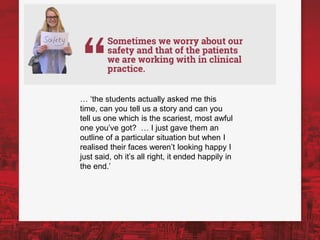
… ‘the students actually asked me this
time, can you tell us a story and can you
tell us one which is the scariest, most awful
one you’ve got? … I just gave them an
outline of a particular situation but when I
realised their faces weren’t looking happy I
just said, oh it’s all right, it ended happily in
the end.’
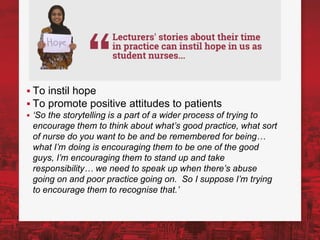
▪ To instil hope
▪ To promote positive attitudes to patients
▪ ‘So the storytelling is a part of a wider process of trying to
encourage them to think about what’s good practice, what sort
of nurse do you want to be and be remembered for being…
what I’m doing is encouraging them to be one of the good
guys, I’m encouraging them to stand up and take
responsibility… we need to speak up when there’s abuse
going on and poor practice going on. So I suppose I’m trying
to encourage them to recognise that.’
Impact on the lecturer
▪ ‘it’s partly demonstrating your credibility as a practitioner’
▪ ‘…. quite often you’ll hear students say, you don’t know what
it’s like, you’re not in the wards, and when you start telling
stories of your experiences on the ward or the community, or
wherever it would be, or A&E, they suddenly see you a little bit
differently’
▪ ‘….when you start telling stories about your clinical life, they
see you less as an academic and more as a clinician, and they
see that you’ve actually lived.’
▪ ‘makes you feel like your practice and your knowledge is still
relevant and up to date, that you’re not just having to rely on
reading things … your practice was also important.’
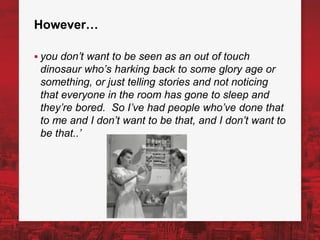
However…
▪ you don’t want to be seen as an out of touch
dinosaur who’s harking back to some glory age or
something, or just telling stories and not noticing
that everyone in the room has gone to sleep and
they’re bored. So I’ve had people who’ve done that
to me and I don’t want to be that, and I don’t want to
be that..’
How storytelling makes lecturers feel
▪ ‘The truth is it makes me feel good about myself…
it’s stroking your ego a little bit, you’re sort of saying
I’m one of the good guys and I don’t quite say that
but you’re sort of, you’re saying it’
▪ ‘I enjoy the story, the stories, ……I’m a bit like a
comedian really.’
▪ ‘I think you’ve got to be quite relaxed with your
teaching before you can tell stories. Because
there’s something about telling a story that’s
sharing something of you.’
Professional identity of lecturers
▪ ‘it does remind you of your role and your professional identity.’
▪ ‘it reminds me very much of the times I enjoyed and how
much my patients meant to me, and sometimes now, how
much my students mean to me… And I guess it just reminds
you that we are all more than our title. We do all have lots of
different experiences, and we do learn from them.’
▪ ‘I think it makes you feel you are, you’re, deep down you still
are a nurse… in some sort of a strange way reconnects you
with your nursing’
▪ ‘it reinforces my sense of identity. My identity is not as an
academic, it’s very much as a nurse, so it helps keep that
alive’

Using storytelling in learning and teaching

  • 1.
    Using storytelling inlearning and teaching Julie Attenborough and Rachael-Anne Knight @CityJoolz @r_a_knight
  • 2.
    Session learning outcomes ▪Identify opportunities to incorporate storytelling into your educational practice ▪ Describe the indications for storytelling ▪ Reflect on storytelling in your educational practice ▪ Recognise the impact of storytelling on learners ▪ Articulate the impact of storytelling on your own identity as educators
  • 3.
    Introductions via stories ▪Icebreaker activity (5 mins) ▪ Please use the storytelling cards on your tables ▪ Using the cards as prompts, please tell the story of your journey to this SEDA conference. You have three minutes each!
  • 4.
    Storytelling is anestablished practice There is an emerging evidence-base about storytelling in education of student nurses (Baldwin et al, 2017; Clark, 2014; Haigh and Hardy, 2011; Treloar et al 2017). Learning takes place when lecturers use their experiences (clinical and personal) to illustrate theory and bring meaning to educational practice.
  • 5.
    Storytelling project –back ground ▪ Attenborough and Abbott (2018) examined how student nurses and midwives build their professional identity ▪ Student views about the clinical credibility of their lecturers ▪ Students suggested that lecturers’ stories from practice helped them feel their way into the role ▪ “Telling us stories, before we’ve gone on our first placement, about how working on a ward is actually like, I think is really important – because it gears you up a bit more and then it also gives you a bit of hope for the future, like, ‘Oh you’ve had a good career out of this, maybe I could too?’.” (Student 4)
  • 6.
    Recontextualisation Sometimes described asinvisible learning this takes place when lecturers use their experience (in this case clinical experience) to illustrate theory and bring meaning to educational practice (Evans et al 2010; Evans and Guile, 2012). Recontextualisation or reworking knowledge plays an important part in professional education.
  • 7.
    Storytelling, Invisible learningand the hidden curriculum ▪ Invisible learning has been discussed in relation to the 'hidden curriculum' which entails the ‘processes, pressures and constraints which fall outside…the formal curriculum and which are often unarticulated or unexplored’ (Bignold & Cribb, 1999; 24). ▪ Influences that function at the level of organisational structure and culture including, for example, implicit rules for how to survive the institution, such as customs, rituals, and culture (Lempp & Seale, 2004; McHaffie, 2014).
  • 8.
    Co-creation of anonline resource to support lecturers in storytelling ▪ Nursing and midwifery students invited to contribute ▪ Eight Nursing students volunteered ▪ Produced videos, narrative, key words and top tips for storytelling ▪ Included some background and examples from other disciplines and institutions ▪ Worked with the students to produce an online resource ▪ Then we asked lecturers to view the module and invited them to be interviewed, 11 volunteered.
  • 11.
    Click to addtext Diagram illustrating the themes identified from interviews with lecturers
  • 12.
    Top tips activity ▪Students provided top-tips for lecturers using storytelling ▪ We will talk through these briefly now, and you also have copies on your tables ▪ Small group activity (10 mins) ▪ How do these top tips relate to your discipline? ▪ Which do you use already, and which could you adopt or adapt? ▪ Are there others you would add?
  • 13.
    1. Being nursesis one of the things that unites us, remember we are striving to be where you are now, even if we don't become lecturers. 2. History is important, it makes us feel like we're part of a profession that has strong foundations, so please tell us about it even if it was a long time ago. 3. Story-telling from service users is extremely valuable, either face-to-face in the classroom, or through videos.
  • 14.
    4. We're mostlyterrified or anxious about the transition to practice, your stories really help us to feel more confident. 5. When theory is illustrated by practice it always comes to life in a way that just learning the theory doesn't. 6. When you are teaching us about something, tell us how you encountered it in practice (or the relevance for practice) at the outset of the session. It helps us to focus on what you are saying. You are our link to practice.
  • 15.
    7. Remember thatour experience of practice isn't the same as yours was, acknowledging that really helps us to put your experience into context. 8. Don't tell us stories to frighten us, or if it is a frightening story think about why you are telling us and what it links to. 9. What we hear about some practice areas can make us feel anxious, please tell us about how we will be kept safe and how you coped with it, for example in the forensic setting or A and E.
  • 16.
    10. Listen toour own stories and give us the opportunity to tell them in a safe environment such as the mental health nurses get through PPD. Try and understand why we want to become nurses, give us a chance to tell our stories about that. Lecturers were keen to read the 'top tips' from students, and some indicated that they had changed their practice as a result of reading the tips.
  • 17.
    Storytelling in practice ▪Paired activity (10 minutes) ▪ Using the information so far, share one story from your educational practice that is, or could be, used with students ▪ Feedback (10 minutes) ▪ Volunteers share their stories, or thoughts on their practice
  • 18.
    Broader work ▪ Aswe’ve seen, stories do not just have to be about clinical practice ▪ Stanford montage of lecturer failure and growth ▪ https://www.youtube.com/watch?v=ndjETeffRi4 ▪ Neither do they have to be just from staff to students ▪ Rachael-Anne uses videos made by students to prepare others for oral exams ▪ Our future work will collect student stories of growth and resilience across disciplines
  • 19.
    Action plan ▪ Whatwould you like to take forward from this session? ▪ What stories could you use? ▪ When? ▪ In what context? ▪ What effect would you hope them to have?
  • 20.
    References Attenborough, J.A. andAbbott, S. (2018). Building a professional identity: views of pre-registration students. Nursing Times, 114(8), pp. 52–55. Bignold, S., & Cribb, A. (1999). Towards The Reflexive Medical School: The hidden curriculum and medical education research. Studies in Higher Education. 24(2), 195 - 209. Clark, P.G., (2014) Narrative in interprofrssional education and practice: implications for professional identity, provider-patient communication and teamwork. Journal of Interprofessional Care 28 (1) pp 34-39 Evans, K., Guile, D., Harris, J., Allan, H. T. (2010). Putting Knowledge To Work: A new approach. Nurse Education Today, 30, 245-51 Evans, K., & Guile, D. (2012). Putting Different Forms Of Knowledge To Work In Practice. In Practice-Based Education: Perspectives And Strategies, Eds Higgs, J., Billett, S., Hutchings, M., & Trede, F. 113 – 136. Rotterdam: Sense Publishers Haigh, C and Hardy, P., (2011) Tell me a story- a conceptual exploration pf storytelling in healthcare edcuation. Nurse Education Today 31(4) pp 408-411
  • 21.
    Lempp, H., &Seale, C. (2004). The Hidden Curriculum In Undergraduate Medical Education: Qualitative Study Of Medical Students' Perceptions Of Teaching. British Medical Journal, 329(7469), 770-3 McHaffie, J (2014) Storytelling a powerful tool for nurse educators Nursing New Zealand vol 20: 11 28-29 Treloar, A., McMillan, M. and Stone, T., 2017. Nursing in an imperfect world: Storytelling as preparation for mental health nursing practice. International Journal of Mental Health Nursing, 26(3), pp.293-300.
  • 22.
    Response to theonline resource by lecturers Endorsement of storytelling practice Heightened awareness Liked the tips Would like a greater range of academics and More video on different topics Stories that work well and those that don’t (examples) Lack of research-base for promotion of storytelling Students were enthusiasts, self-selecting The resurce was experienced as warm and affirming
  • 24.
    What sort ofstories do people tell? ▪ The stories were mainly about the clinical setting though some lecturers use their personal experiences ▪ Lecturers worried that they might be out of date, for some this constrained their storytelling ▪ They talk about patients they remember, who made an impact ▪ But mental health lecturers were more cautious ‘I don’t really tell stories of patients… something about that feels exploitative, I’d feel a bit uncomfortable with that. … if a story was being told in a way that was sort of mocking or derogatory or even things like making people fearful of, for example, someone with mental illness … the aims of why you’re telling your story must be underpinned by something about encouraging best, good practice and good attitudes and a big part of that is about being respectful to the people that we see as patients, service users.’ Described as ‘othering’ in the literature
  • 25.
    Why do lecturerstell stories? ▪ To get attention ▪ To get away from a formal structure and encourage debate ▪ To lighten the mood ▪ To address anxiety about the transition ▪ Stories sometimes told as warnings, to illustrate risk or danger ▪ …a colleague of mine who left her diary on the roof of her car and drove off. And the prescription pad was inside the diary, and she had a phone call from the police saying that the prescription pad was blowing round Sainsbury’s car park. This was obviously an issue and it led to a disciplinary… it’s quite a negative story but I’ve used it regularly to demonstrate that you’ve got to be careful with your prescription pads.’
  • 26.
    … ‘the studentsactually asked me this time, can you tell us a story and can you tell us one which is the scariest, most awful one you’ve got? … I just gave them an outline of a particular situation but when I realised their faces weren’t looking happy I just said, oh it’s all right, it ended happily in the end.’
  • 27.
    ▪ To instilhope ▪ To promote positive attitudes to patients ▪ ‘So the storytelling is a part of a wider process of trying to encourage them to think about what’s good practice, what sort of nurse do you want to be and be remembered for being… what I’m doing is encouraging them to be one of the good guys, I’m encouraging them to stand up and take responsibility… we need to speak up when there’s abuse going on and poor practice going on. So I suppose I’m trying to encourage them to recognise that.’
  • 28.
    Impact on thelecturer ▪ ‘it’s partly demonstrating your credibility as a practitioner’ ▪ ‘…. quite often you’ll hear students say, you don’t know what it’s like, you’re not in the wards, and when you start telling stories of your experiences on the ward or the community, or wherever it would be, or A&E, they suddenly see you a little bit differently’ ▪ ‘….when you start telling stories about your clinical life, they see you less as an academic and more as a clinician, and they see that you’ve actually lived.’ ▪ ‘makes you feel like your practice and your knowledge is still relevant and up to date, that you’re not just having to rely on reading things … your practice was also important.’
  • 29.
    However… ▪ you don’twant to be seen as an out of touch dinosaur who’s harking back to some glory age or something, or just telling stories and not noticing that everyone in the room has gone to sleep and they’re bored. So I’ve had people who’ve done that to me and I don’t want to be that, and I don’t want to be that..’
  • 30.
    How storytelling makeslecturers feel ▪ ‘The truth is it makes me feel good about myself… it’s stroking your ego a little bit, you’re sort of saying I’m one of the good guys and I don’t quite say that but you’re sort of, you’re saying it’ ▪ ‘I enjoy the story, the stories, ……I’m a bit like a comedian really.’ ▪ ‘I think you’ve got to be quite relaxed with your teaching before you can tell stories. Because there’s something about telling a story that’s sharing something of you.’
  • 31.
    Professional identity oflecturers ▪ ‘it does remind you of your role and your professional identity.’ ▪ ‘it reminds me very much of the times I enjoyed and how much my patients meant to me, and sometimes now, how much my students mean to me… And I guess it just reminds you that we are all more than our title. We do all have lots of different experiences, and we do learn from them.’ ▪ ‘I think it makes you feel you are, you’re, deep down you still are a nurse… in some sort of a strange way reconnects you with your nursing’ ▪ ‘it reinforces my sense of identity. My identity is not as an academic, it’s very much as a nurse, so it helps keep that alive’