BIODETERGE
NTS
INTRODUCTION
In Dairy and Food Industry, the maintenance of
hygienic conditions is a prerequisite to the production
of quality products.
This is accomplished by the use of appropriate
cleaning agents with or without sanitizers.
DETERGENTS
Thus, the word Detergent, as it applies to the
dairy industry means a substance or
formulation used for cleansing or removal of
soil, dirt or foreign matter from a surface.
For efficient cleaning of dairy and food
equipment's different types of detergents are
being currently employed.
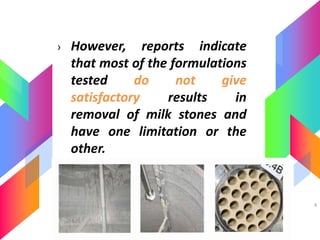
› However, reports indicate
that most of the formulations
tested do not give
satisfactory results in
removal of milk stones and
have one limitation or the
other.
4
Proteinaceous Milk Stones
One of the most difficult problems in dairy
processing is the removal of proteinaceous
milk stones formed during pasteurization and
UHT sterilization of milk.
Adoption of new processing technologies
such as ultrafiltration (UF) and reverse
osmosis (RO) offers new challenges to
cleaning operations.
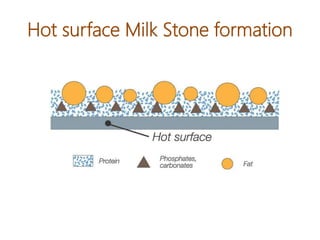
Hot surface Milk Stone formation
Membrane Fouling
• The membranes employed in these operations
are susceptible to fouling, leading to blockage
of membranes pores.
• Synthetic detergent formulations are not
efficient in handling these specific problems of
the dairy and food industry.
• Furthermore, these detergents are corrosive,
toxic and non- biodegradable and cause
environmental contamination.
Membrane Fouling
× The membranes employed in these
operations are susceptible to fouling,
leading to blockage of membranes
pores.
× Synthetic detergent formulations are
not efficient in handling these specific
problems of the dairy and food
industry.
× Furthermore, these detergents are
corrosive, toxic and non-
biodegradable and cause
environmental contamination.
8
Fouling on Membrane
Skim Milk
Salts
Fouling layer
ENZYME BASED DETERGENTS
• To counter these limitations, enzyme-based detergents are
fast emerging as an alternative to synthetic detergents
owing to their
• biodegradability,
• low toxicity,
• non- corrosiveness,
• environmental friendliness,
• enhanced cleaning properties,
• increased efficiency and stability in different formulations.
• They are therefore also being referred to as “green
chemicals”
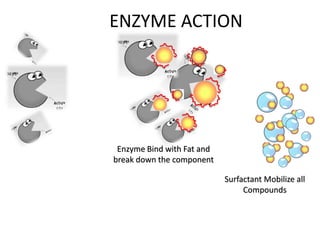
ENZYME ACTION
Enzyme Bind with Fat and
break down the component
Surfactant Mobilize all
Compounds
Reference
Reference
BIODETERGENT
• In this context, there is a need to use
“biodetergent or biocleaners”, which offer a
better option to the synthetic detergents with
respect to their biodegradability, low toxicity,
non-corrosiveness environmental-friendliness,
enhanced cleaning properties and their
increased efficiency and stability in different
formulations.
ENZYME BASED DETERGENTS
FORMULATION
• Presently, proteases, amylases, lipases and
cellulases make up the major portion of the
market for industrial enzymes in cleaning
applications.
• Reference
16
ENZYME BASED DETERGENTS
FORMULATION
Proteases
Amylases
Lipases
Celluloses
PROTEASE
• Proteases, the first enzymes to be introduced
into detergent formulation, are used to clean
or remove protein-based residues like,
• Blood,
• Egg
• Milk (casein and whey proteins).
• Amylases have been included in detergent
formulations to remove starch based stains,
such as gravy, pudding and potato.
• Lipases demonstrate their cleaning
advantages and triglyceride based residues,
such as margarine, milk fat and oil.
• All of these enzymes are specific for a
particular application, yet all are classified as
hydrolyzing enzymes or hydrolases based on
their mechanism of action .
History
• The original idea of using enzymes as
biodetergent was first described by Dr. Otto
Rohm.
• He patented the use of pancreatic enzymes in
pre-soak detergent composition to improve
their ability to remove proteinaceous stains
and first enzymatic detergent, named
“Burnus” was launched.
• However, it was not commercialized because
enzyme could be made available by extraction
of pancreatic glands in only limited amounts.
Moreover, functional enzymes trypsin and
chymotrypsin with pH optimum detergent
between 7-9 were sold only until 1940s.
• The first detergent containing a bacterial
protease BIO 40, produced by Schnyder in
Switzerland appeared on market in 1959, swiftly
followed by very successful market in
Netherlands.
• The enzymes used were alkaline serine protease
from Bacillus licheniformis. Consequently, since
1971 application of amylases, lipases and
cellulases also came to picture in detergent
formulations.
Protease
• Protease enzymes were first hydrolases
introduced into detergent formulations
specifically for the degradation of protein-
based stains. Proteases have been classified
according to the nucleophile or reactive
component found at their catalytic sites
Categories of proteases
Proteas
es
Serine
Sulfhyd
ral
Metall
o
Aspar
tyl
• All these classes of proteases, only the serine
proteases are suited for inclusion in detergent
formulations. The aspartyl proteinases
function poorly or not at all in alkaline pH
range of detergent formulation
• Reference to previous slide to eliminate this
slide
The metallo proteases do not
survive the builders present to
reduce water hardness, and
the sulfhydral enzymes are
generally too slow and are not
compatible with oxidants, such
as bleach
Sulfhydral Enzymes
• The first enzymatic detergent contained enzymes
from pig pancreatic glands. However, it was not
very effective in cleaning purposes because it was
not stable in high alkalinity of detergent
formulation. Therefore, a large number of
microorganisms, such as yeasts, fungi and
bacteria were screened. Among bacteria, bacilli
are superior to other genera for large-scale
enzyme production in large fermentation vessels
of certain technological advantages.
Advantages of Microbial
Proteases
• Cultivation time of microbial proteases is short as
compared to other microorganisms, which reduces
costs by keeping aeration time and agitation time
brief
• Desired proteases are secreted into fermentation
broth and usually proteases are pure. Other enzymes
are secreted in only small amounts (or are digested
by protease: i.e. autopurification)
Advantages of Microbial
Proteases
• Cell mass can be easily removed by basic operations, such
as centrifugation or filtration, with filter presses or belt
filters
• Bacillus species produced proteases with sufficient
stability in alkalinity of detergent formulation
• Enzymes are not inactivated by surfactants, oxidative
(bleaching) agents and elevated temperatures (to 90°C)
normally higher temperature employed during CIP in dairy
and food industry
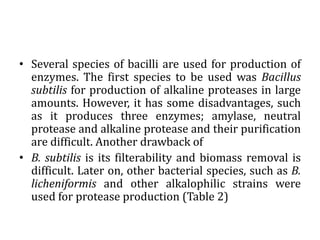
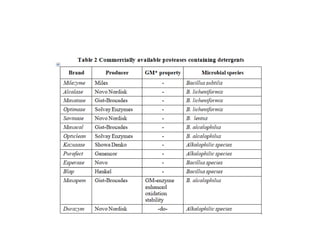
• Several species of bacilli are used for production of
enzymes. The first species to be used was Bacillus
subtilis for production of alkaline proteases in large
amounts. However, it has some disadvantages, such
as it produces three enzymes; amylase, neutral
protease and alkaline protease and their purification
are difficult. Another drawback of
• B. subtilis is its filterability and biomass removal is
difficult. Later on, other bacterial species, such as B.
licheniformis and other alkalophilic strains were
used for protease production (Table 2)
Lipases
• Different greasy food stains, such as tomato
based sauces, butter, dressings, edible oils
and chocolate, etc; cosmetic stains, animal
and vegetable fat including milk fat
components of milk stones deposited on
equipment's of dairy and food industry are
not removed completely by the application
of proteases in detergent formulations.
History of Lipases
• The introduction of lipase in detergent formulations is
of more recent than introduction of protease and
amylase.
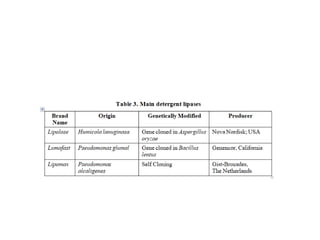
• Novo Nordisk launched the first lipase product in 1987.
Lion incorporated lipase from Humicola lanuginose –
the trade name Lipolase in their HI Top
brand on the Japanese market.
• Subsequently, Genencor Inc. followed in 1993 with
Lumafast (a cutinase from Pseudomonas meddocina)
and Gist-Brocades in 1995 with Lipomax (lipase from
Pseudomonas alcaligenes)
Mode of action
• Lipases are glycerol ester hydrolases
capable of hydrolyzing the water-insoluble
triglyceride components into more water-
soluble products, such as mono and
diglycerides, free fatty acids and glycerol.
• Fatty acid moiety of triacylglycerol can
range from short-chain to long chain C18 =
stearic acid) or may be saturated or
unsaturated fatty acid
• Only those with shorter chain lengths are
slightly soluble. Lipases show substrate
specificity. Its activity is neglected towards
monomeric, water-soluble form and is largely
increased when substrate is in aggregated i.e.
emulsified insoluble form.
• Because lipase is apparently active only at
water-substrate interface, this phenomenon is
referred to as interfacial activation.
Mechanism of action of lipase
Physical binding of enzyme to the surface (at lipid-water
interface), leading to a confirmation change that make the
active site accessible to substrate molecule
Enzymes form a complex with substrate molecule which
results in carboxyl ester bond hydrolysis.
Limitation of lipases as detergent
Lipase similar to proteins are adversely affected by
extremes in temperature, pH ionic strength and matrix
composition
Temperature effects are extremely pronounced in lipase
ability to hydrolyse fatty oils in situ. Its activity is higher
at elevated temperature but remarkably reduced at low
temperatures (20°C/10 min., granular detergent +
lipolase) as the target sites are solids, reducing
accessibility to lipase
It shows complete removal after several washing cycles
and is considered a major drawback
It shows sensitivity towards the inhibition by various
detergent ingredients
• Surfactants, non ionics and particularly anions, generally cause
irreversible unfolding, denaturation and inactivation of enzymes
• Bleaching agents-capable of oxidizing amino acids, such as
cysteine, methionine and aromatic ones, such as tryptophan,
phenylalanine and tyrosine. The oxidized enzyme can be
considered to be cropped with a reduced catalytic efficiency
• Binders- because of their ability to bind divalent cations, such as
Ca++ results in unfolding and irreversible inactivation of
enzymes
• Finally, the presence of protease in a detergent may cause
proteolysis of other enzymes present.
Genetically modified lipases:
• To counteract the above limitations, the
properties of lipase are improved by genetic
engineering. Pseudomonas alcaligenes lipase
has been improved by inducing mutation at
active site i.e. replacement of methionine at
position 21 by leucine influences the
cleaning performance
• On inducing mutation, it has been found that mutant M21L
would become active ingredient of new product Lipomax
instead of wild type enzyme. The gene from lipase of
Humicola lanuginose has been cloned into fungus Aspergillus
oryzae because of good fermentation properties of this
genus..
• The activity of enzyme is improved in terms of
increased washing performance, increased
cleaning in first wash cycle, and improved
efficiency preferentially at lower temperature;
broaden stain specificity and lower sensitivity
towards inhibition by appropriate mutation
(deletion or substitution) or transfer of gene
from one organism to another
Starch
• Starch is a major component of most of our
daily food all over the world. Consequently,
it is found on clothes or dishes in most
stains generated during preparation or
consumption of meals containing food
ingredients, such as sauce, porridge, mashed
potatoes or chocolate. This creates a need
for effective removal of starch from clothes,
dishes by detergent composition especially
in automatic dishwashing.
• Phosphorylated starches are used as
emulsifiers for preparation of salad dressings,
ice cream, mustard, gravy, and similar food
products. Therefore, residues removal is
essential in food and dairy industry
equipments after their manufacture as well as
from textiles and clothes after its consumption
by the consumers.
• The starch degrading enzymes are a-amylase,
isoamylase, pullulanase, glucoamylase, etc.
The a-amylases are mainly used in detergents,
although recently pullulanases or isoamylases
are also prepared from B. subtilis, B.
amyloliquefaciens and
• B. licheniformis and are available under
different trade names (Table 4).
APPLICATIONS OF BIODETERGENTS IN
MEMBRANE CLEANING
Membrane fouling during UF
• The application of UF and RO membrane
systems in the dairy, food, pharmaceutical and
chemical industries are becoming
indispensable. However, in dairy and food
industries, these processes offer capability of
concentrating and fractionating liquid foods
like milk, whey, fruit juices and egg white,
clarification and sterilization of fruit juices,
wines, vinegar and beverages and whey
desalting without thermal denaturation or
degradation of heat-sensitive constituents like
proteins or vitamins
• . As active membrane surface comes in
contact with stock and even a small degree of
adsorption causes pore blockage resulting in
clogging of filters and the phenomenon is
referred as membrane fouling, thereby cause
a reduction in permeate flux rate and loss in
product.
Common agents causing membrane
fouling
• The common agents involved in membrane
fouling are mostly proteins, inorganic salts,
such as Ca++ ion and fat residues. Whey
proteins are smaller than casein micelles thus
constitute main fouling agents. a-lactalbumin
has strongest gel forming tendency than BSA
and existed as granules while b-lactoglobulin
is found to be major fouling agent as capable
of forming strands or sheets. These whey
proteins,
• a-lactalbumin and b- lactoglobulin formed 95 per cent of
proteinaceous membrane deposits during UF of whole milk.
During whey concentration, Ca also forms one of primary
fouling agent as it exists in two forms, a permeable and
impermeable fraction.
• The latter exist as colloidal phosphate and attached to b-
lactoglobulin. When concentration of calcium phosphate in
whey retentate exceeds its solubility index, it tends to
crystallize forming deposits as specific membrane fouling
agent, thereby reducing the flux.
Control of membrane fouling:
MILK-STONES FORMATION ON DAIRY
EQUIPMENTS
• For efficient cleaning of dairy equipments,
different types of detergents are being
currently employed. However, these do not
give satisfactory results in removal of milk
stones. Milk stones consist largely of calcium
phosphate, precipitated and denatured milk
proteins and insoluble calcium salts from hard
water and washing solutions.
• Therefore efficient removal of milk stones
from dairy equipments can be achieved by
using biodetergents containing proteases, as
denatured proteins are very difficult to
remove even by using strong alkali solution
practiced under normal CIP cleaning.
BIOFILM FORMATION ON DAIRY AND
FOOD CONTACT SURFACES
• In nature and food systems, microorganisms get
attracted to solids surface conditioned with
nutrients sufficient for their viability and growth.
These microorganisms initially are deposited on
the surfaces and later get attached, grow and
actively multiply to form a colony of cells. These
masses of cells further become large enough to
entrap organic and inorganic debris, nutrients
and other micro organisms leading to the
formation of a microbial biofilm.
• In dairy and food processing equipments,
when any food or milk residues remains, they
deposit on the surface and then
microorganisms start forming biofilms and
even CIP procedures can not prevent the
accumulation of micro organisms on
equipment.
• Generally, an effective cleaning and
sanitization programme, when included in the
process from beginning, will inhibit both
accumulation of particulates and bacterial
cells on equipment surfaces and subsequent
biofilm formation. However, removal of
biofilm is very difficult and demanding task, a
complete and cost-effective cleaning
procedure should be developed.
Biodetergents and biocleaners in controlling biofilm
• Biodetergent and biocleaners have proved
effective in cleaning the extracellular
polymers, which form the biofilm matrix and
thus helps in removal of biofilms. The specific
enzymes required vary according to the type
of microflora making up the biofilm.
• In one study, a blend of enzyme mixture
consisting of protease, a-amylase and β-
glucanase was found effective in cleaning a
simulated industrial biofilm. Workers of
Genencor International, Inc., USA have
developed enzymes called endoglycosidases,
which deglycosylate biopolymers like
glycoproteins, which are widely distributed in
living organisms.
• They employed r-DNA technology to develop
Endo-a-N-acetyl- glucosaminidase H (endo H)
as cleaning agents. Endo H had a unique
property to remove bacteria, such as
staphylococci and E. coli from contact
surfaces.
• Very recently, an enzymatic preparation
comprising of exopolysaccharide-degrading
enzymes, particularly cationic acid-degrading
enzymes derived from a Streptomyces isolates
was reported for the removal and prevention
of biofilm formation. By using enzyme
detergents such as biodetergents and
biocleaners, we can prevent the biofilm
formation on dairy and food industry
equipments/processing lines.
CONCLUSION
😉
66
Thanks

BIODETERGENTS

  • 1.
  • 2.
    INTRODUCTION In Dairy andFood Industry, the maintenance of hygienic conditions is a prerequisite to the production of quality products. This is accomplished by the use of appropriate cleaning agents with or without sanitizers.
  • 3.
    DETERGENTS Thus, the wordDetergent, as it applies to the dairy industry means a substance or formulation used for cleansing or removal of soil, dirt or foreign matter from a surface. For efficient cleaning of dairy and food equipment's different types of detergents are being currently employed.
  • 4.
    › However, reportsindicate that most of the formulations tested do not give satisfactory results in removal of milk stones and have one limitation or the other. 4
  • 5.
    Proteinaceous Milk Stones Oneof the most difficult problems in dairy processing is the removal of proteinaceous milk stones formed during pasteurization and UHT sterilization of milk. Adoption of new processing technologies such as ultrafiltration (UF) and reverse osmosis (RO) offers new challenges to cleaning operations.
  • 6.
    Hot surface MilkStone formation
  • 7.
    Membrane Fouling • Themembranes employed in these operations are susceptible to fouling, leading to blockage of membranes pores. • Synthetic detergent formulations are not efficient in handling these specific problems of the dairy and food industry. • Furthermore, these detergents are corrosive, toxic and non- biodegradable and cause environmental contamination.
  • 8.
    Membrane Fouling × Themembranes employed in these operations are susceptible to fouling, leading to blockage of membranes pores. × Synthetic detergent formulations are not efficient in handling these specific problems of the dairy and food industry. × Furthermore, these detergents are corrosive, toxic and non- biodegradable and cause environmental contamination. 8
  • 9.
    Fouling on Membrane SkimMilk Salts Fouling layer
  • 10.
    ENZYME BASED DETERGENTS •To counter these limitations, enzyme-based detergents are fast emerging as an alternative to synthetic detergents owing to their • biodegradability, • low toxicity, • non- corrosiveness, • environmental friendliness, • enhanced cleaning properties, • increased efficiency and stability in different formulations. • They are therefore also being referred to as “green chemicals”
  • 11.
    ENZYME ACTION Enzyme Bindwith Fat and break down the component Surfactant Mobilize all Compounds
  • 12.
  • 13.
  • 14.
    BIODETERGENT • In thiscontext, there is a need to use “biodetergent or biocleaners”, which offer a better option to the synthetic detergents with respect to their biodegradability, low toxicity, non-corrosiveness environmental-friendliness, enhanced cleaning properties and their increased efficiency and stability in different formulations.
  • 15.
    ENZYME BASED DETERGENTS FORMULATION •Presently, proteases, amylases, lipases and cellulases make up the major portion of the market for industrial enzymes in cleaning applications. • Reference
  • 16.
  • 17.
    PROTEASE • Proteases, thefirst enzymes to be introduced into detergent formulation, are used to clean or remove protein-based residues like, • Blood, • Egg • Milk (casein and whey proteins).
  • 18.
    • Amylases havebeen included in detergent formulations to remove starch based stains, such as gravy, pudding and potato. • Lipases demonstrate their cleaning advantages and triglyceride based residues, such as margarine, milk fat and oil.
  • 19.
    • All ofthese enzymes are specific for a particular application, yet all are classified as hydrolyzing enzymes or hydrolases based on their mechanism of action .
  • 21.
    History • The originalidea of using enzymes as biodetergent was first described by Dr. Otto Rohm. • He patented the use of pancreatic enzymes in pre-soak detergent composition to improve their ability to remove proteinaceous stains and first enzymatic detergent, named “Burnus” was launched.
  • 22.
    • However, itwas not commercialized because enzyme could be made available by extraction of pancreatic glands in only limited amounts. Moreover, functional enzymes trypsin and chymotrypsin with pH optimum detergent between 7-9 were sold only until 1940s.
  • 23.
    • The firstdetergent containing a bacterial protease BIO 40, produced by Schnyder in Switzerland appeared on market in 1959, swiftly followed by very successful market in Netherlands. • The enzymes used were alkaline serine protease from Bacillus licheniformis. Consequently, since 1971 application of amylases, lipases and cellulases also came to picture in detergent formulations.
  • 24.
    Protease • Protease enzymeswere first hydrolases introduced into detergent formulations specifically for the degradation of protein- based stains. Proteases have been classified according to the nucleophile or reactive component found at their catalytic sites
  • 25.
  • 26.
    • All theseclasses of proteases, only the serine proteases are suited for inclusion in detergent formulations. The aspartyl proteinases function poorly or not at all in alkaline pH range of detergent formulation • Reference to previous slide to eliminate this slide
  • 27.
    The metallo proteasesdo not survive the builders present to reduce water hardness, and the sulfhydral enzymes are generally too slow and are not compatible with oxidants, such as bleach Sulfhydral Enzymes
  • 28.
    • The firstenzymatic detergent contained enzymes from pig pancreatic glands. However, it was not very effective in cleaning purposes because it was not stable in high alkalinity of detergent formulation. Therefore, a large number of microorganisms, such as yeasts, fungi and bacteria were screened. Among bacteria, bacilli are superior to other genera for large-scale enzyme production in large fermentation vessels of certain technological advantages.
  • 29.
    Advantages of Microbial Proteases •Cultivation time of microbial proteases is short as compared to other microorganisms, which reduces costs by keeping aeration time and agitation time brief • Desired proteases are secreted into fermentation broth and usually proteases are pure. Other enzymes are secreted in only small amounts (or are digested by protease: i.e. autopurification)
  • 30.
    Advantages of Microbial Proteases •Cell mass can be easily removed by basic operations, such as centrifugation or filtration, with filter presses or belt filters • Bacillus species produced proteases with sufficient stability in alkalinity of detergent formulation • Enzymes are not inactivated by surfactants, oxidative (bleaching) agents and elevated temperatures (to 90°C) normally higher temperature employed during CIP in dairy and food industry
  • 31.
    • Several speciesof bacilli are used for production of enzymes. The first species to be used was Bacillus subtilis for production of alkaline proteases in large amounts. However, it has some disadvantages, such as it produces three enzymes; amylase, neutral protease and alkaline protease and their purification are difficult. Another drawback of • B. subtilis is its filterability and biomass removal is difficult. Later on, other bacterial species, such as B. licheniformis and other alkalophilic strains were used for protease production (Table 2)
  • 33.
    Lipases • Different greasyfood stains, such as tomato based sauces, butter, dressings, edible oils and chocolate, etc; cosmetic stains, animal and vegetable fat including milk fat components of milk stones deposited on equipment's of dairy and food industry are not removed completely by the application of proteases in detergent formulations.
  • 34.
    History of Lipases •The introduction of lipase in detergent formulations is of more recent than introduction of protease and amylase. • Novo Nordisk launched the first lipase product in 1987. Lion incorporated lipase from Humicola lanuginose – the trade name Lipolase in their HI Top brand on the Japanese market. • Subsequently, Genencor Inc. followed in 1993 with Lumafast (a cutinase from Pseudomonas meddocina) and Gist-Brocades in 1995 with Lipomax (lipase from Pseudomonas alcaligenes)
  • 35.
    Mode of action •Lipases are glycerol ester hydrolases capable of hydrolyzing the water-insoluble triglyceride components into more water- soluble products, such as mono and diglycerides, free fatty acids and glycerol. • Fatty acid moiety of triacylglycerol can range from short-chain to long chain C18 = stearic acid) or may be saturated or unsaturated fatty acid
  • 37.
    • Only thosewith shorter chain lengths are slightly soluble. Lipases show substrate specificity. Its activity is neglected towards monomeric, water-soluble form and is largely increased when substrate is in aggregated i.e. emulsified insoluble form. • Because lipase is apparently active only at water-substrate interface, this phenomenon is referred to as interfacial activation.
  • 38.
    Mechanism of actionof lipase Physical binding of enzyme to the surface (at lipid-water interface), leading to a confirmation change that make the active site accessible to substrate molecule Enzymes form a complex with substrate molecule which results in carboxyl ester bond hydrolysis.
  • 39.
    Limitation of lipasesas detergent Lipase similar to proteins are adversely affected by extremes in temperature, pH ionic strength and matrix composition Temperature effects are extremely pronounced in lipase ability to hydrolyse fatty oils in situ. Its activity is higher at elevated temperature but remarkably reduced at low temperatures (20°C/10 min., granular detergent + lipolase) as the target sites are solids, reducing accessibility to lipase It shows complete removal after several washing cycles and is considered a major drawback It shows sensitivity towards the inhibition by various detergent ingredients
  • 40.
    • Surfactants, nonionics and particularly anions, generally cause irreversible unfolding, denaturation and inactivation of enzymes • Bleaching agents-capable of oxidizing amino acids, such as cysteine, methionine and aromatic ones, such as tryptophan, phenylalanine and tyrosine. The oxidized enzyme can be considered to be cropped with a reduced catalytic efficiency • Binders- because of their ability to bind divalent cations, such as Ca++ results in unfolding and irreversible inactivation of enzymes • Finally, the presence of protease in a detergent may cause proteolysis of other enzymes present.
  • 41.
    Genetically modified lipases: •To counteract the above limitations, the properties of lipase are improved by genetic engineering. Pseudomonas alcaligenes lipase has been improved by inducing mutation at active site i.e. replacement of methionine at position 21 by leucine influences the cleaning performance
  • 42.
    • On inducingmutation, it has been found that mutant M21L would become active ingredient of new product Lipomax instead of wild type enzyme. The gene from lipase of Humicola lanuginose has been cloned into fungus Aspergillus oryzae because of good fermentation properties of this genus..
  • 43.
    • The activityof enzyme is improved in terms of increased washing performance, increased cleaning in first wash cycle, and improved efficiency preferentially at lower temperature; broaden stain specificity and lower sensitivity towards inhibition by appropriate mutation (deletion or substitution) or transfer of gene from one organism to another
  • 45.
    Starch • Starch isa major component of most of our daily food all over the world. Consequently, it is found on clothes or dishes in most stains generated during preparation or consumption of meals containing food ingredients, such as sauce, porridge, mashed potatoes or chocolate. This creates a need for effective removal of starch from clothes, dishes by detergent composition especially in automatic dishwashing.
  • 46.
    • Phosphorylated starchesare used as emulsifiers for preparation of salad dressings, ice cream, mustard, gravy, and similar food products. Therefore, residues removal is essential in food and dairy industry equipments after their manufacture as well as from textiles and clothes after its consumption by the consumers.
  • 47.
    • The starchdegrading enzymes are a-amylase, isoamylase, pullulanase, glucoamylase, etc. The a-amylases are mainly used in detergents, although recently pullulanases or isoamylases are also prepared from B. subtilis, B. amyloliquefaciens and • B. licheniformis and are available under different trade names (Table 4).
  • 49.
    APPLICATIONS OF BIODETERGENTSIN MEMBRANE CLEANING
  • 50.
    Membrane fouling duringUF • The application of UF and RO membrane systems in the dairy, food, pharmaceutical and chemical industries are becoming indispensable. However, in dairy and food industries, these processes offer capability of concentrating and fractionating liquid foods like milk, whey, fruit juices and egg white, clarification and sterilization of fruit juices, wines, vinegar and beverages and whey desalting without thermal denaturation or degradation of heat-sensitive constituents like proteins or vitamins
  • 51.
    • . Asactive membrane surface comes in contact with stock and even a small degree of adsorption causes pore blockage resulting in clogging of filters and the phenomenon is referred as membrane fouling, thereby cause a reduction in permeate flux rate and loss in product.
  • 52.
    Common agents causingmembrane fouling • The common agents involved in membrane fouling are mostly proteins, inorganic salts, such as Ca++ ion and fat residues. Whey proteins are smaller than casein micelles thus constitute main fouling agents. a-lactalbumin has strongest gel forming tendency than BSA and existed as granules while b-lactoglobulin is found to be major fouling agent as capable of forming strands or sheets. These whey proteins,
  • 53.
    • a-lactalbumin andb- lactoglobulin formed 95 per cent of proteinaceous membrane deposits during UF of whole milk. During whey concentration, Ca also forms one of primary fouling agent as it exists in two forms, a permeable and impermeable fraction.
  • 54.
    • The latterexist as colloidal phosphate and attached to b- lactoglobulin. When concentration of calcium phosphate in whey retentate exceeds its solubility index, it tends to crystallize forming deposits as specific membrane fouling agent, thereby reducing the flux.
  • 55.
  • 56.
    MILK-STONES FORMATION ONDAIRY EQUIPMENTS • For efficient cleaning of dairy equipments, different types of detergents are being currently employed. However, these do not give satisfactory results in removal of milk stones. Milk stones consist largely of calcium phosphate, precipitated and denatured milk proteins and insoluble calcium salts from hard water and washing solutions.
  • 57.
    • Therefore efficientremoval of milk stones from dairy equipments can be achieved by using biodetergents containing proteases, as denatured proteins are very difficult to remove even by using strong alkali solution practiced under normal CIP cleaning.
  • 58.
    BIOFILM FORMATION ONDAIRY AND FOOD CONTACT SURFACES • In nature and food systems, microorganisms get attracted to solids surface conditioned with nutrients sufficient for their viability and growth. These microorganisms initially are deposited on the surfaces and later get attached, grow and actively multiply to form a colony of cells. These masses of cells further become large enough to entrap organic and inorganic debris, nutrients and other micro organisms leading to the formation of a microbial biofilm.
  • 59.
    • In dairyand food processing equipments, when any food or milk residues remains, they deposit on the surface and then microorganisms start forming biofilms and even CIP procedures can not prevent the accumulation of micro organisms on equipment.
  • 60.
    • Generally, aneffective cleaning and sanitization programme, when included in the process from beginning, will inhibit both accumulation of particulates and bacterial cells on equipment surfaces and subsequent biofilm formation. However, removal of biofilm is very difficult and demanding task, a complete and cost-effective cleaning procedure should be developed.
  • 61.
    Biodetergents and biocleanersin controlling biofilm • Biodetergent and biocleaners have proved effective in cleaning the extracellular polymers, which form the biofilm matrix and thus helps in removal of biofilms. The specific enzymes required vary according to the type of microflora making up the biofilm.
  • 62.
    • In onestudy, a blend of enzyme mixture consisting of protease, a-amylase and β- glucanase was found effective in cleaning a simulated industrial biofilm. Workers of Genencor International, Inc., USA have developed enzymes called endoglycosidases, which deglycosylate biopolymers like glycoproteins, which are widely distributed in living organisms.
  • 63.
    • They employedr-DNA technology to develop Endo-a-N-acetyl- glucosaminidase H (endo H) as cleaning agents. Endo H had a unique property to remove bacteria, such as staphylococci and E. coli from contact surfaces.
  • 64.
    • Very recently,an enzymatic preparation comprising of exopolysaccharide-degrading enzymes, particularly cationic acid-degrading enzymes derived from a Streptomyces isolates was reported for the removal and prevention of biofilm formation. By using enzyme detergents such as biodetergents and biocleaners, we can prevent the biofilm formation on dairy and food industry equipments/processing lines.
  • 65.
  • 66.