TDC 1
Pedagogical Grammar
Class 4
Review
Phrases, clause and sentences.

  • In groups of three, give a definition and an example
    of these three types of structure.

Types of sentence
 Simple
 Compound
 Complex
 Compound - Complex

• With your partners, find a way to describe and exemplify
  them.
Let’s practice
• In the next exercise you will classify
  phrases, clauses and sentences.
• Have some paper and a pencil ready.


     Phrases, clauses and sentences
Review
         Adjective Clauses


         and Reductions
Noun Clauses
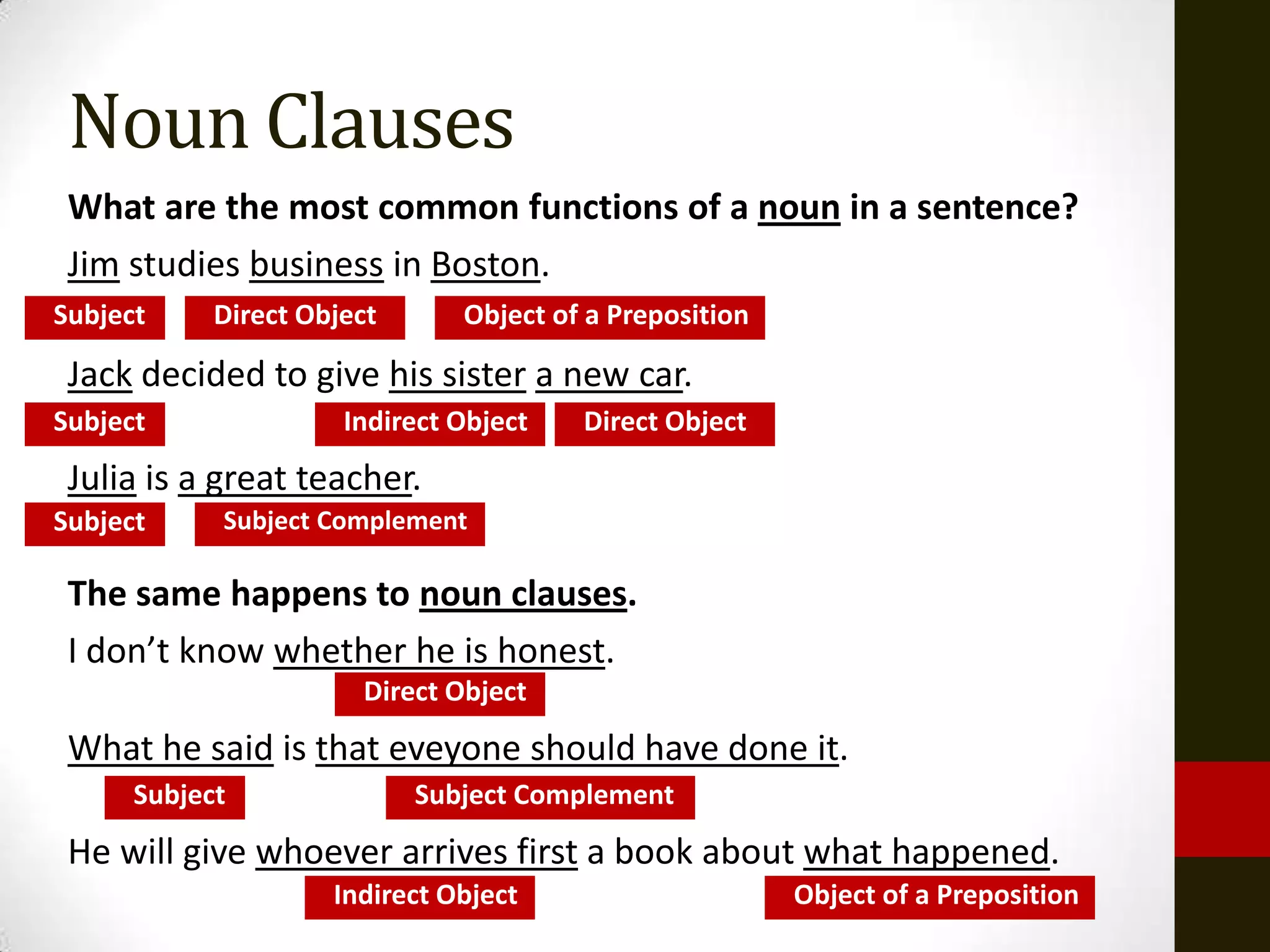
 What are the most common functions of a noun in a sentence?
 Jim studies business in Boston.
Subject     Direct Object      Object of a Preposition

 Jack decided to give his sister a new car.
Subject               Indirect Object   Direct Object
 Julia is a great teacher.
Subject     Subject Complement

 The same happens to noun clauses.
 I don’t know whether he is honest.
                       Direct Object
 What he said is that eveyone should have done it.
      Subject               Subject Complement
 He will give whoever arrives first a book about what happened.
                     Indirect Object                     Object of a Preposition
Noun Clauses
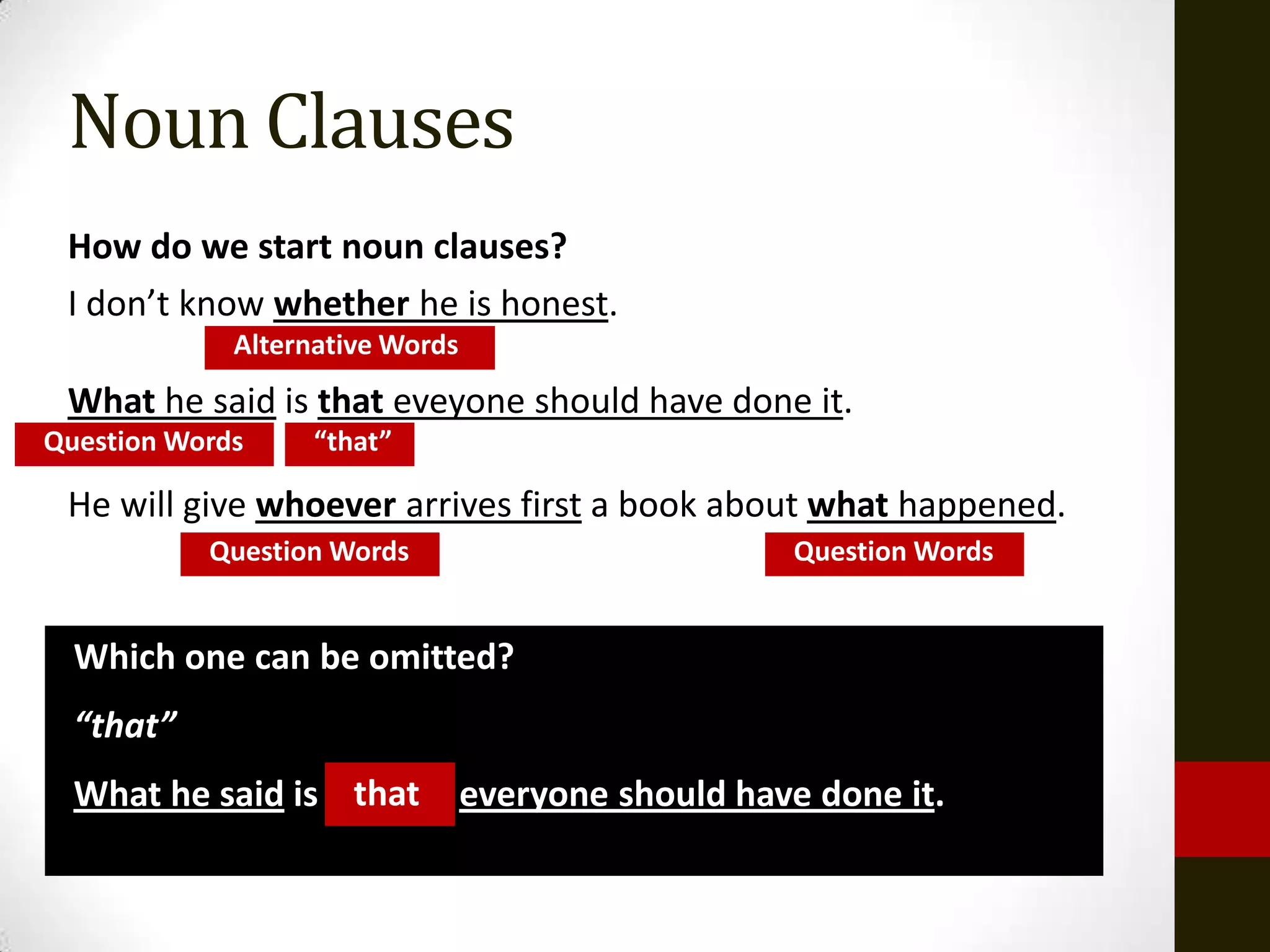
 How do we start noun clauses?
 I don’t know whether he is honest.
             Alternative Words
 What he said is that eveyone should have done it.
Question Words     “that”

 He will give whoever arrives first a book about what happened.
           Question Words                           Question Words


  Which one can be omitted?
  “that”
  What he said is that           everyone should have done it.
Noun Clauses – Indirect Speech
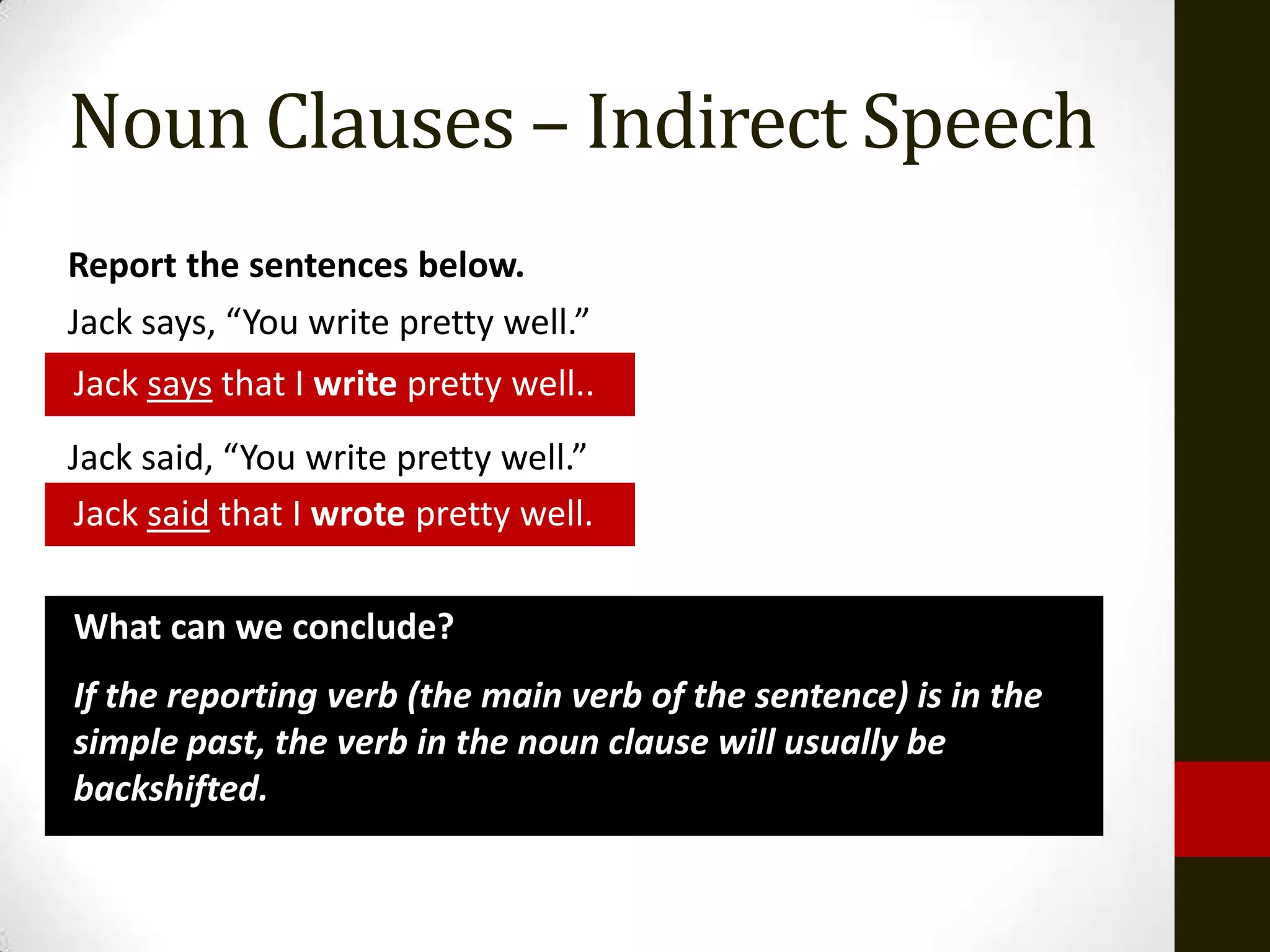
Report the sentences below.
Jack says, “You write pretty well.”
Jack says that I write pretty well..
Jack said, “You write pretty well.”
Jack said that I wrote pretty well.

What can we conclude?
If the reporting verb (the main verb of the sentence) is in the
simple past, the verb in the noun clause will usually be
backshifted.
Noun Clauses – Indirect Speech
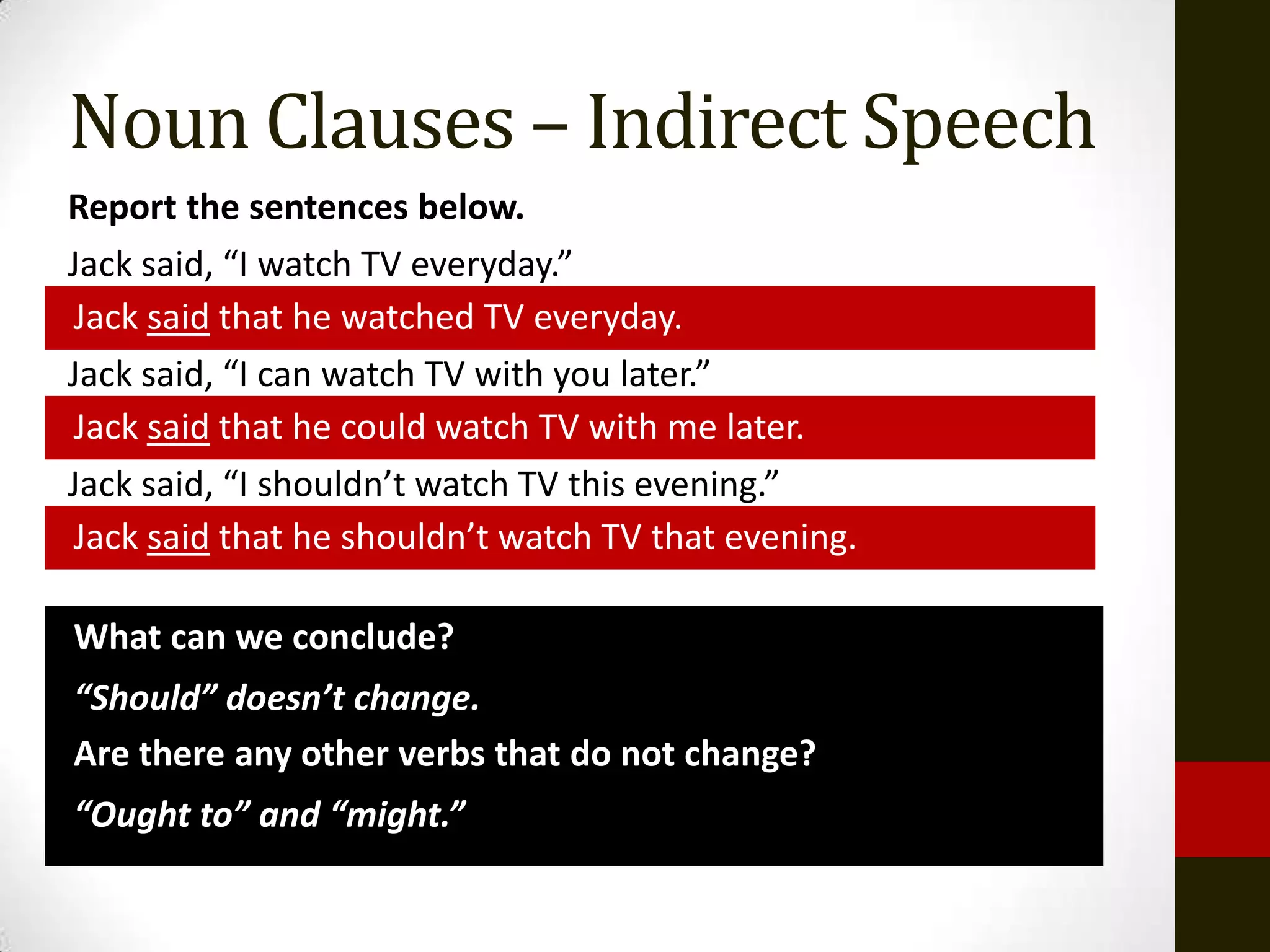
Report the sentences below.
Jack said, “I watch TV everyday.”
Jack said that he watched TV everyday.
Jack said, “I can watch TV with you later.”
Jack said that he could watch TV with me later.
Jack said, “I shouldn’t watch TV this evening.”
Jack said that he shouldn’t watch TV that evening.

What can we conclude?
“Should” doesn’t change.
Are there any other verbs that do not change?
“Ought to” and “might.”
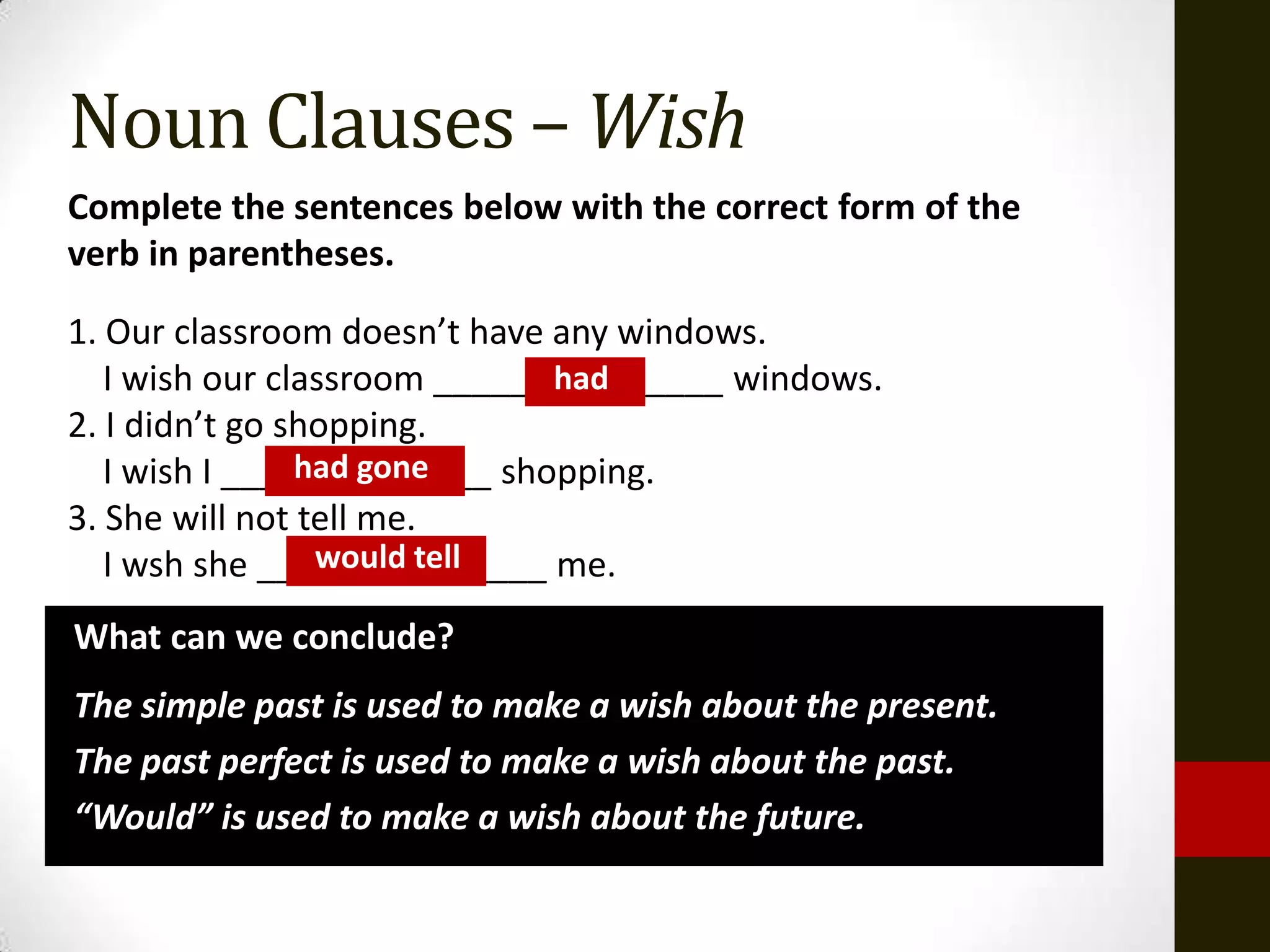
Noun Clauses – Wish
Complete the sentences below with the correct form of the
verb in parentheses.

1. Our classroom doesn’t have any windows.
   I wish our classroom _______________ windows.
                              had
2. I didn’t go shopping.
                had gone
   I wish I ______________ shopping.
3. She will not tell me.
                 would tell
   I wsh she _______________ me.
What can we conclude?
The simple past is used to make a wish about the present.
The past perfect is used to make a wish about the past.
“Would” is used to make a wish about the future.
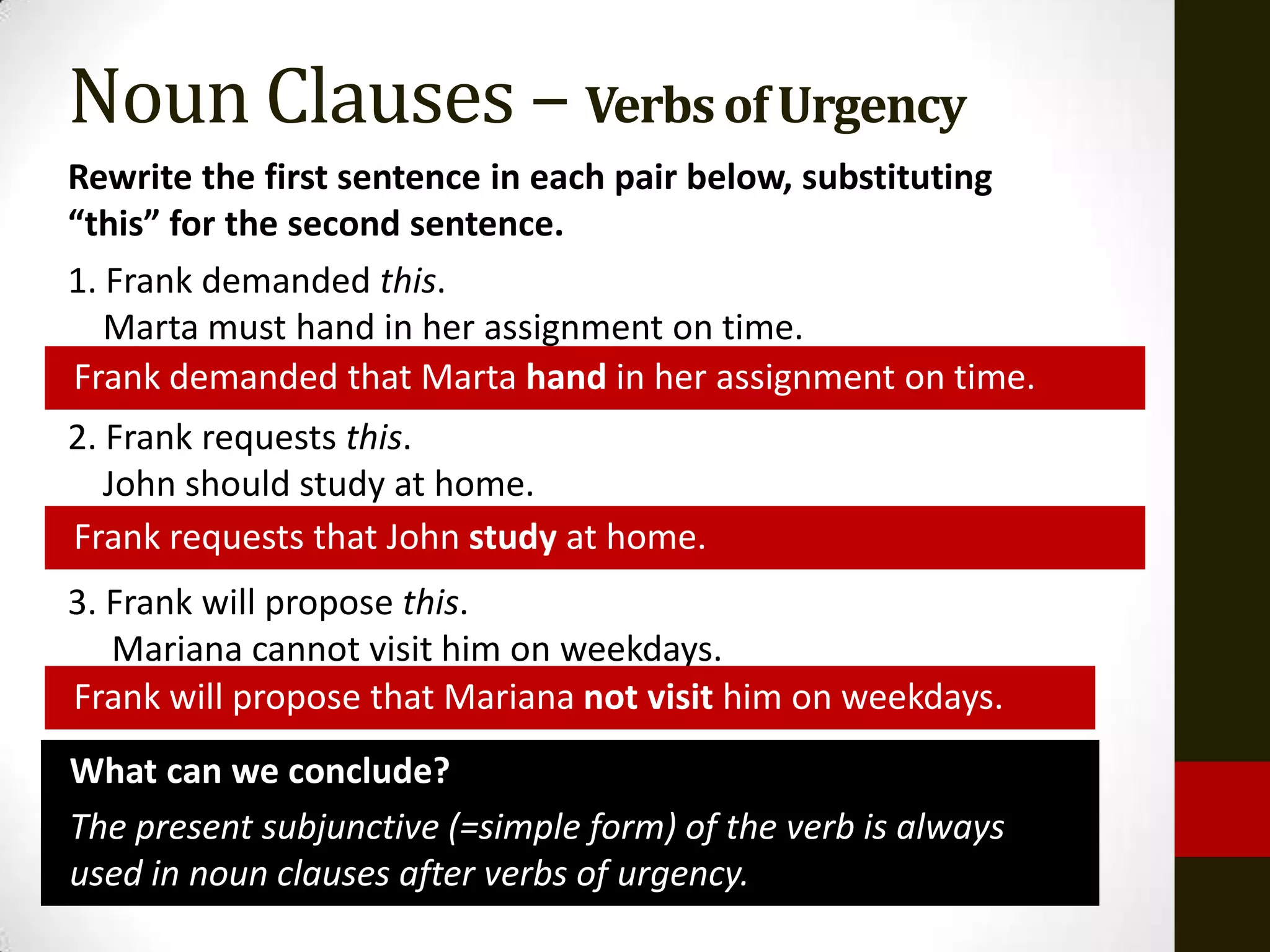
Noun Clauses – Verbs of Urgency
Rewrite the first sentence in each pair below, substituting
“this” for the second sentence.
1. Frank demanded this.
   Marta must hand in her assignment on time.
Frank demanded that Marta hand in her assignment on time.
2. Frank requests this.
   John should study at home.
Frank requests that John study at home.
3. Frank will propose this.
   Mariana cannot visit him on weekdays.
Frank will propose that Mariana not visit him on weekdays.
What can we conclude?
The present subjunctive (=simple form) of the verb is always
used in noun clauses after verbs of urgency.
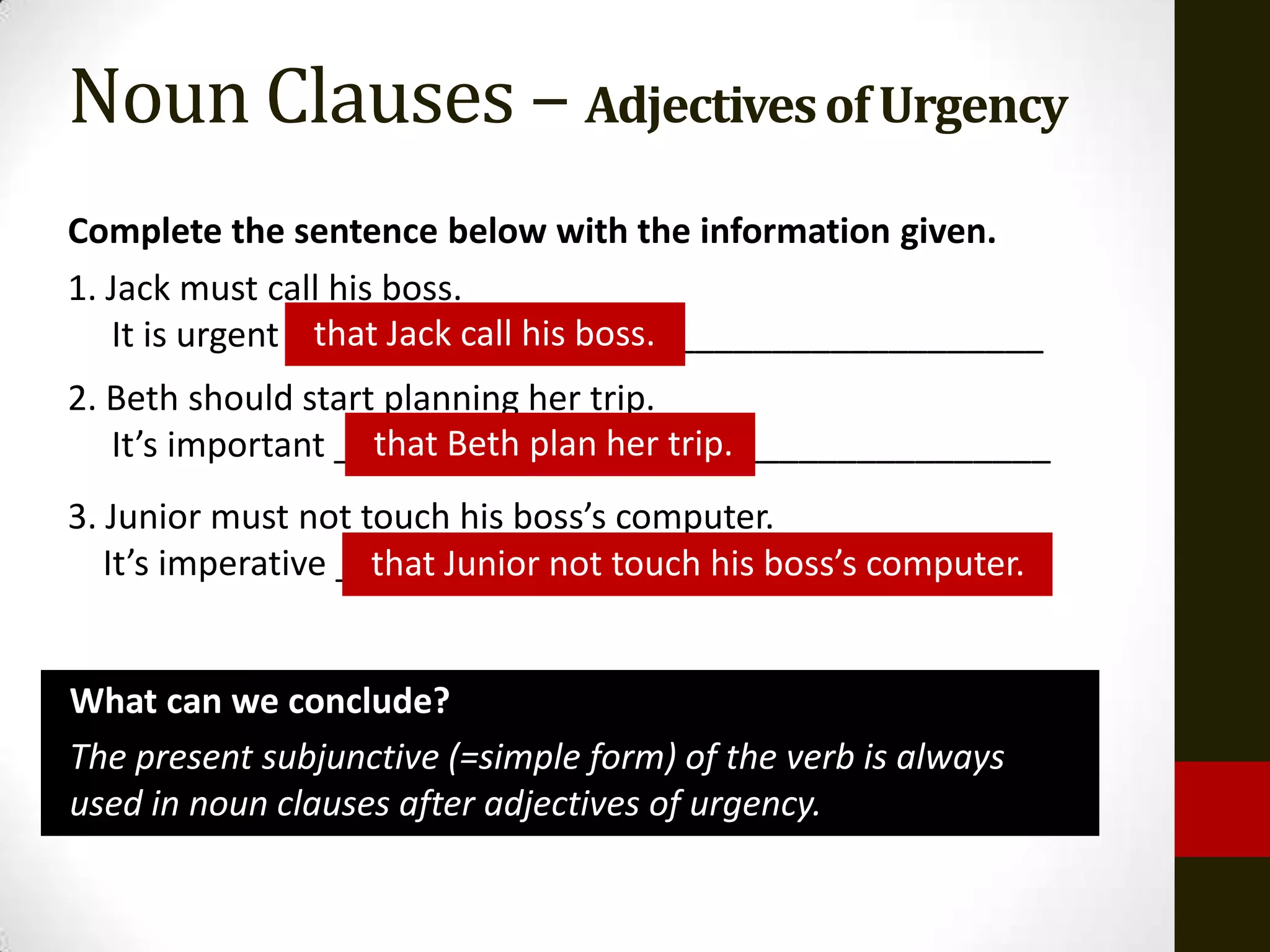
Noun Clauses – Adjectives of Urgency
Complete the sentence below with the information given.
1. Jack must call his boss.
                 that Jack call his boss.
   It is urgent _______________________________________
2. Beth should start planning her trip.
                    that Beth plan her trip.
   It’s important _____________________________________
3. Junior must not touch his boss’s computer.
   It’s imperative _____________________________________
                     that Junior not touch his boss’s computer.


What can we conclude?
The present subjunctive (=simple form) of the verb is always
used in noun clauses after adjectives of urgency.
Homework


           Study for the Test
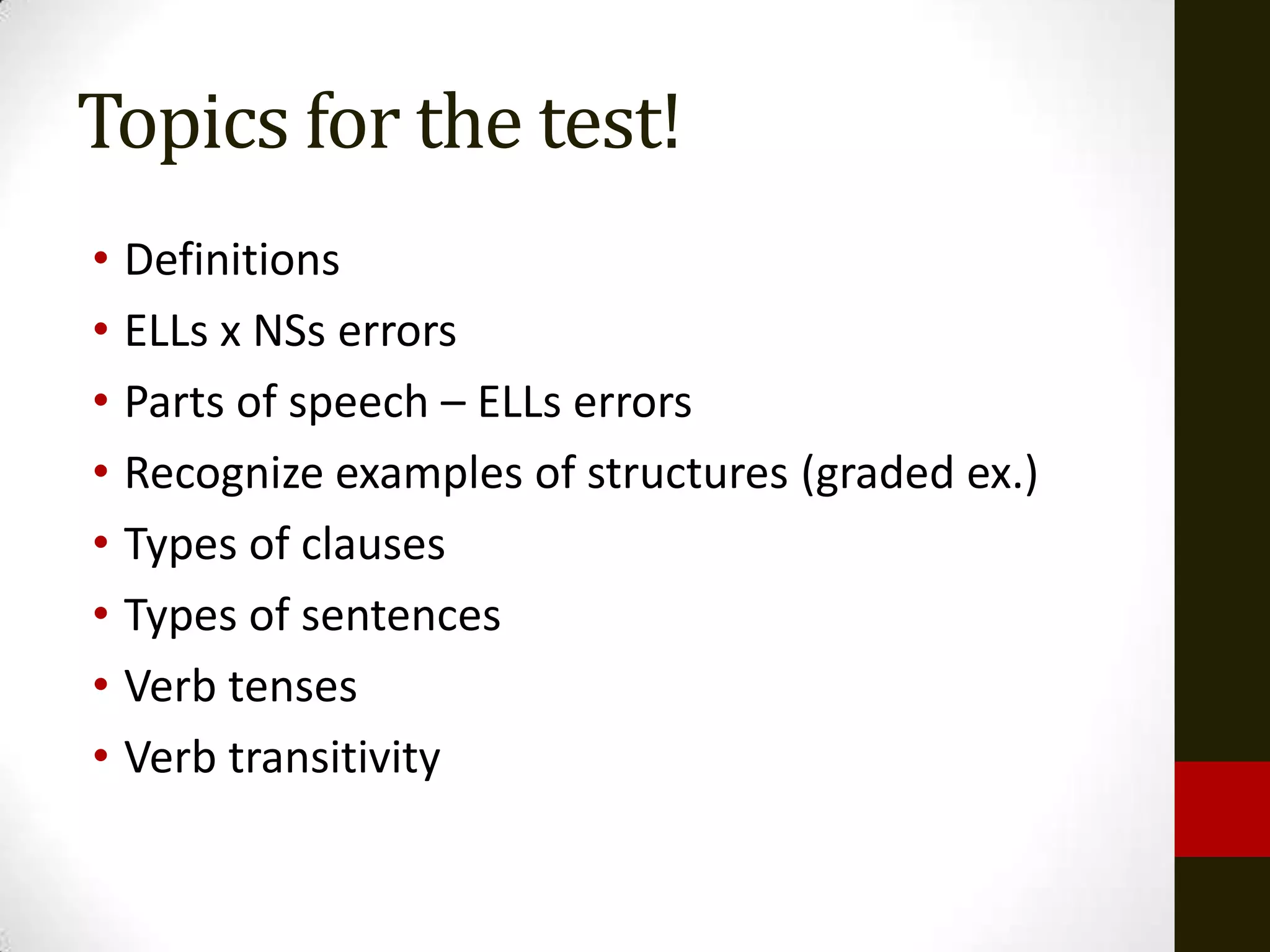
Topics for the test!
• Definitions
• ELLs x NSs errors
• Parts of speech – ELLs errors
• Recognize examples of structures (graded ex.)
• Types of clauses
• Types of sentences
• Verb tenses
• Verb transitivity
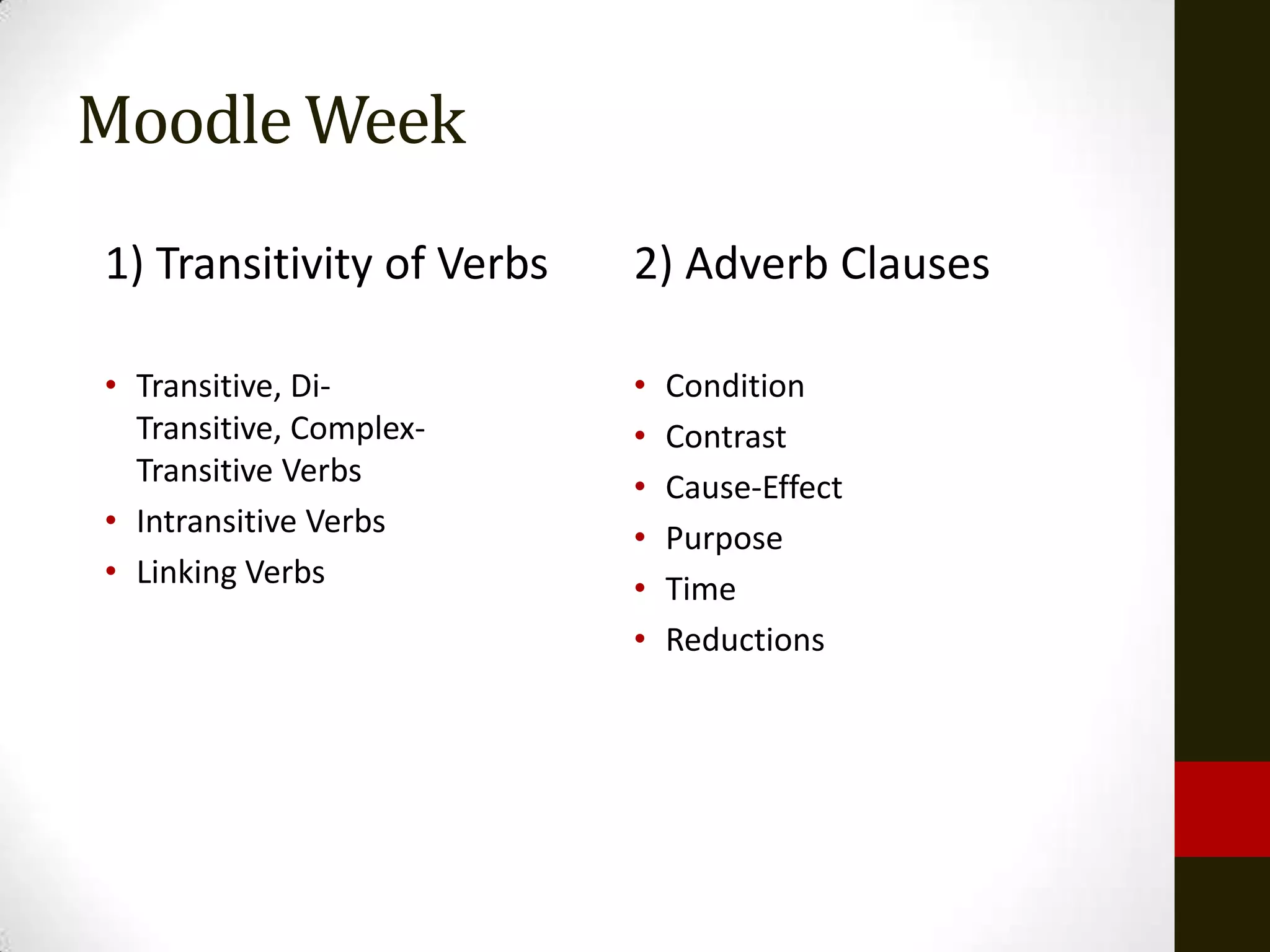
Moodle Week
1) Transitivity of Verbs   2) Adverb Clauses

• Transitive, Di-          •   Condition
  Transitive, Complex-     •   Contrast
  Transitive Verbs         •   Cause-Effect
• Intransitive Verbs       •   Purpose
• Linking Verbs            •   Time
                           •   Reductions

Tdc 1 blended - class 4

  • 1.
  • 2.
    Review Phrases, clause andsentences. • In groups of three, give a definition and an example of these three types of structure. Types of sentence  Simple  Compound  Complex  Compound - Complex • With your partners, find a way to describe and exemplify them.
  • 3.
    Let’s practice • Inthe next exercise you will classify phrases, clauses and sentences. • Have some paper and a pencil ready. Phrases, clauses and sentences
  • 4.
    Review Adjective Clauses and Reductions
  • 5.
    Noun Clauses Whatare the most common functions of a noun in a sentence? Jim studies business in Boston. Subject Direct Object Object of a Preposition Jack decided to give his sister a new car. Subject Indirect Object Direct Object Julia is a great teacher. Subject Subject Complement The same happens to noun clauses. I don’t know whether he is honest. Direct Object What he said is that eveyone should have done it. Subject Subject Complement He will give whoever arrives first a book about what happened. Indirect Object Object of a Preposition
  • 6.
    Noun Clauses Howdo we start noun clauses? I don’t know whether he is honest. Alternative Words What he said is that eveyone should have done it. Question Words “that” He will give whoever arrives first a book about what happened. Question Words Question Words Which one can be omitted? “that” What he said is that everyone should have done it.
  • 7.
    Noun Clauses –Indirect Speech Report the sentences below. Jack says, “You write pretty well.” Jack says that I write pretty well.. Jack said, “You write pretty well.” Jack said that I wrote pretty well. What can we conclude? If the reporting verb (the main verb of the sentence) is in the simple past, the verb in the noun clause will usually be backshifted.
  • 8.
    Noun Clauses –Indirect Speech Report the sentences below. Jack said, “I watch TV everyday.” Jack said that he watched TV everyday. Jack said, “I can watch TV with you later.” Jack said that he could watch TV with me later. Jack said, “I shouldn’t watch TV this evening.” Jack said that he shouldn’t watch TV that evening. What can we conclude? “Should” doesn’t change. Are there any other verbs that do not change? “Ought to” and “might.”
  • 9.
    Noun Clauses –Wish Complete the sentences below with the correct form of the verb in parentheses. 1. Our classroom doesn’t have any windows. I wish our classroom _______________ windows. had 2. I didn’t go shopping. had gone I wish I ______________ shopping. 3. She will not tell me. would tell I wsh she _______________ me. What can we conclude? The simple past is used to make a wish about the present. The past perfect is used to make a wish about the past. “Would” is used to make a wish about the future.
  • 10.
    Noun Clauses –Verbs of Urgency Rewrite the first sentence in each pair below, substituting “this” for the second sentence. 1. Frank demanded this. Marta must hand in her assignment on time. Frank demanded that Marta hand in her assignment on time. 2. Frank requests this. John should study at home. Frank requests that John study at home. 3. Frank will propose this. Mariana cannot visit him on weekdays. Frank will propose that Mariana not visit him on weekdays. What can we conclude? The present subjunctive (=simple form) of the verb is always used in noun clauses after verbs of urgency.
  • 11.
    Noun Clauses –Adjectives of Urgency Complete the sentence below with the information given. 1. Jack must call his boss. that Jack call his boss. It is urgent _______________________________________ 2. Beth should start planning her trip. that Beth plan her trip. It’s important _____________________________________ 3. Junior must not touch his boss’s computer. It’s imperative _____________________________________ that Junior not touch his boss’s computer. What can we conclude? The present subjunctive (=simple form) of the verb is always used in noun clauses after adjectives of urgency.
  • 12.
    Homework Study for the Test
  • 13.
    Topics for thetest! • Definitions • ELLs x NSs errors • Parts of speech – ELLs errors • Recognize examples of structures (graded ex.) • Types of clauses • Types of sentences • Verb tenses • Verb transitivity
  • 14.
    Moodle Week 1) Transitivityof Verbs 2) Adverb Clauses • Transitive, Di- • Condition Transitive, Complex- • Contrast Transitive Verbs • Cause-Effect • Intransitive Verbs • Purpose • Linking Verbs • Time • Reductions