“TCP/IP
PROTOCOLS”
BY,
BASIL ELDHOSE.
MCAL1722.
INTRODUCTION TO TCP/IP
PROTOCOLS
1. INTRODUCTION TO TCP/IP
PROTOCOLS
 Communication between two people or two devices needs to
follow some protocol.
 protocol is a set of rules that governs communication.
Elements of protocol.
1. Syntax : refers to the structure or format of the data.
2. Semantics : refers to the meaning of each section of
bits. How to interpret a particular pattern and what action is
to be taken.
3. Timing : when data should be sent.
The history of TCP/IP
 The Defense Advanced Research Projects Agency (DARPA), the
research branch of the U.S Department of Defense, created the
TCP/IP model in 1970 for use in ARPANET.
 TCP/IP was originally designed for the Unix operating system, and it
has been built into all of the operating systems that came after it.
 The TCP/IP model and its related protocols are now maintained by
the Internet Engineering Task Force.
TCP/IP is the set communication protocols that are used on internet
and similar computer networks.
 TCP/IP is the combination of two protocols.
1. Transmission Control Protocol (TCP).
2. Internet Protocol (IP).
 It is occasionally known as Department of Defense (DoD) model.
 It provides end-to-end communication by specifying how data should
packetized, addressed(Physical and Logical addressing), transmitted,
routed and received.
 TCP manages how a message is assembled into smaller packets before
they are transmitted over the internet and reassembled in the right order at
destination address.
 IP defines how to address and route each packets to make sure it reaches at
the right destination.
 Each gateway computer on the network check this IP address to determine
where to forward the message.
TCP/IP Protocol Layers.
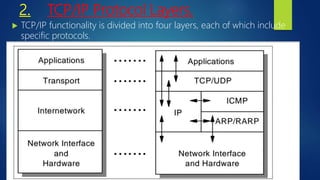
2. TCP/IP Protocol Layers.
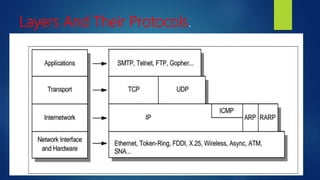
 TCP/IP functionality is divided into four layers, each of which include
specific protocols.
Layers And Their Protocols.
1.Application Layer.
This layer provides applications with standardized data exchange.
it responsible for providing services to the users.
Its protocols includes
1. Hypertext Transfer Protocols (TCP).
2. File Transfer Protocol (FTP).
3. Post Office Protocol 3 (POP3).
4. Simple Mail Transfer Protocol (SMTP).
5. Simple Network Management protocol (SNMP).
2.Transport Layer.
This layer is responsible for maintaining end-to-end
communications across the network.
Its protocols includes
1. TCP.
2. User Datagram Protocol (UPD).
3. Network Layer. (also called the data link layer or internet layer.)
* This includes (local) addressing, arbitrating access to a shared medium, and
checking for (and sometimes correcting) errors that occurred during physical
transmission.
* It deals with packets and connects independent networks to transport
packets across network boundaries.
Its protocols includes
1. IP (Internet Protocol).
2. Internet Control Message Protocol (ICMP).
4. Physical Layer.
It is responsible for transmitting individual bits.
1. Ethernet.
2. Address Resolution Protocol (ARP).
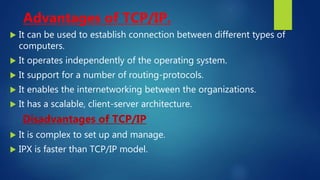
Advantages of TCP/IP.
 It can be used to establish connection between different types of
computers.
 It operates independently of the operating system.
 It support for a number of routing-protocols.
 It enables the internetworking between the organizations.
 It has a scalable, client-server architecture.
Disadvantages of TCP/IP
 It is complex to set up and manage.
 IPX is faster than TCP/IP model.
Tcp ip protocols

Tcp ip protocols

  • 1.
  • 2.
  • 3.
    1. INTRODUCTION TOTCP/IP PROTOCOLS  Communication between two people or two devices needs to follow some protocol.  protocol is a set of rules that governs communication. Elements of protocol. 1. Syntax : refers to the structure or format of the data. 2. Semantics : refers to the meaning of each section of bits. How to interpret a particular pattern and what action is to be taken. 3. Timing : when data should be sent.
  • 4.
    The history ofTCP/IP  The Defense Advanced Research Projects Agency (DARPA), the research branch of the U.S Department of Defense, created the TCP/IP model in 1970 for use in ARPANET.  TCP/IP was originally designed for the Unix operating system, and it has been built into all of the operating systems that came after it.  The TCP/IP model and its related protocols are now maintained by the Internet Engineering Task Force.
  • 5.
    TCP/IP is theset communication protocols that are used on internet and similar computer networks.  TCP/IP is the combination of two protocols. 1. Transmission Control Protocol (TCP). 2. Internet Protocol (IP).  It is occasionally known as Department of Defense (DoD) model.  It provides end-to-end communication by specifying how data should packetized, addressed(Physical and Logical addressing), transmitted, routed and received.
  • 6.
     TCP manageshow a message is assembled into smaller packets before they are transmitted over the internet and reassembled in the right order at destination address.  IP defines how to address and route each packets to make sure it reaches at the right destination.  Each gateway computer on the network check this IP address to determine where to forward the message.
  • 7.
  • 8.
    2. TCP/IP ProtocolLayers.  TCP/IP functionality is divided into four layers, each of which include specific protocols.
  • 9.
    Layers And TheirProtocols.
  • 10.
    1.Application Layer. This layerprovides applications with standardized data exchange. it responsible for providing services to the users. Its protocols includes 1. Hypertext Transfer Protocols (TCP). 2. File Transfer Protocol (FTP). 3. Post Office Protocol 3 (POP3). 4. Simple Mail Transfer Protocol (SMTP). 5. Simple Network Management protocol (SNMP).
  • 11.
    2.Transport Layer. This layeris responsible for maintaining end-to-end communications across the network. Its protocols includes 1. TCP. 2. User Datagram Protocol (UPD).
  • 12.
    3. Network Layer.(also called the data link layer or internet layer.) * This includes (local) addressing, arbitrating access to a shared medium, and checking for (and sometimes correcting) errors that occurred during physical transmission. * It deals with packets and connects independent networks to transport packets across network boundaries. Its protocols includes 1. IP (Internet Protocol). 2. Internet Control Message Protocol (ICMP). 4. Physical Layer. It is responsible for transmitting individual bits. 1. Ethernet. 2. Address Resolution Protocol (ARP).
  • 13.
    Advantages of TCP/IP. It can be used to establish connection between different types of computers.  It operates independently of the operating system.  It support for a number of routing-protocols.  It enables the internetworking between the organizations.  It has a scalable, client-server architecture. Disadvantages of TCP/IP  It is complex to set up and manage.  IPX is faster than TCP/IP model.