“ How PRAGMA Can    Help Save the Planet” Banquet Keynote Speech Pacific Rim Applications and Grid Middleware Assembly (PRAGMA) 18 Birch Aquarium, Scripps Institution of Oceanography, UCSD March 3, 2010 Dr. Larry Smarr Director, California Institute for Telecommunications and Information Technology Harry E. Gruber Professor,  Dept. of Computer Science and Engineering Jacobs School of Engineering, UCSD [email_address]
Abstract I will review the evidence that global greenhouse gas emissions are causing an impulse to the nonlinear Earth climate system on a scale not seen for millions of years.  It is essential that global reduction of such emissions be undertaken immediately.  PRAGMA is in an important position to help, because the development and use of Green IT and telecom can provide a near term slowing of the emission rates.  The Smart2020.org report shows that much of the opportunity lies in the Pacific Rim, where PRAGMA could be a leader toward a low carbon economy.
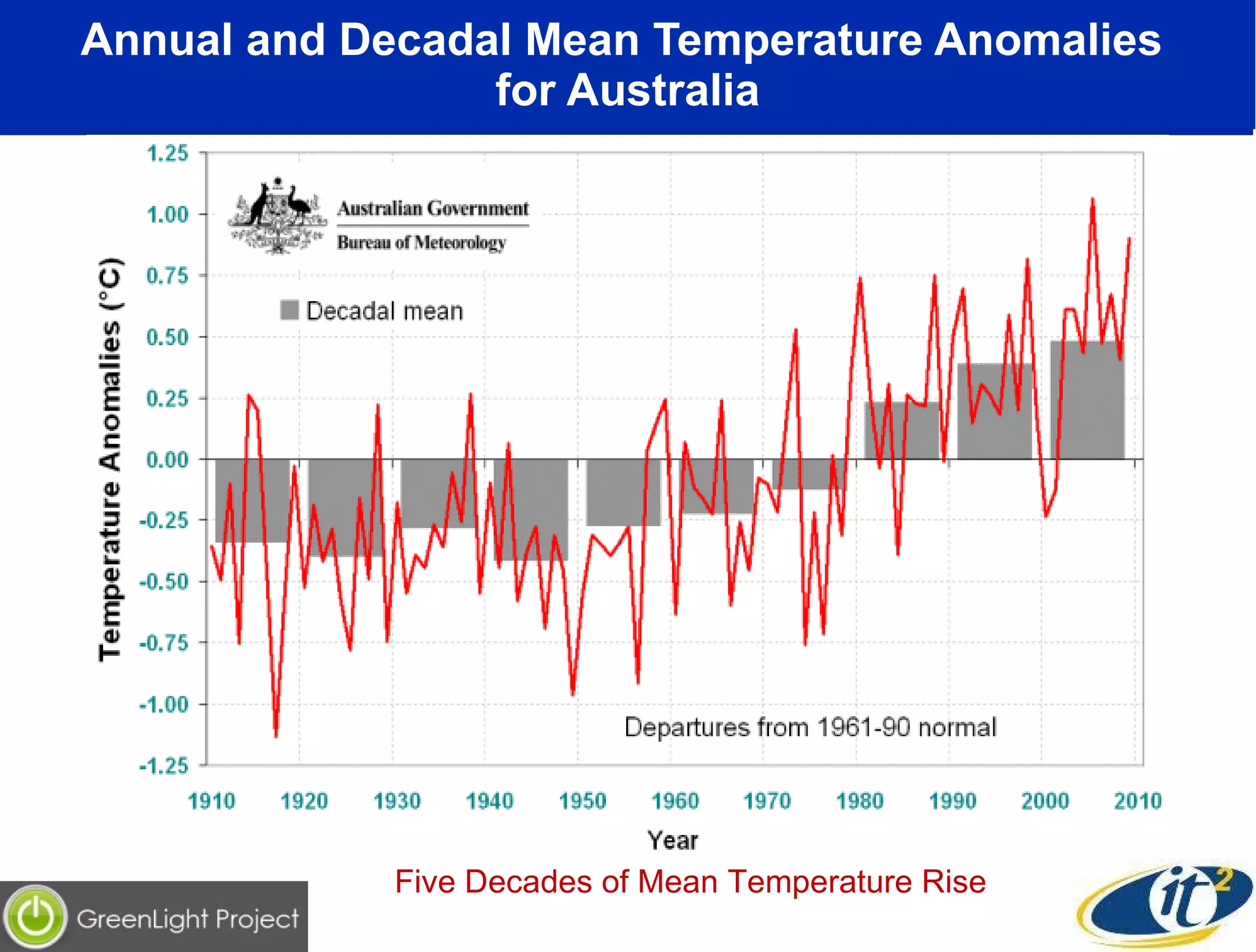
Annual and Decadal Mean Temperature Anomalies  for Australia Five Decades of Mean Temperature Rise
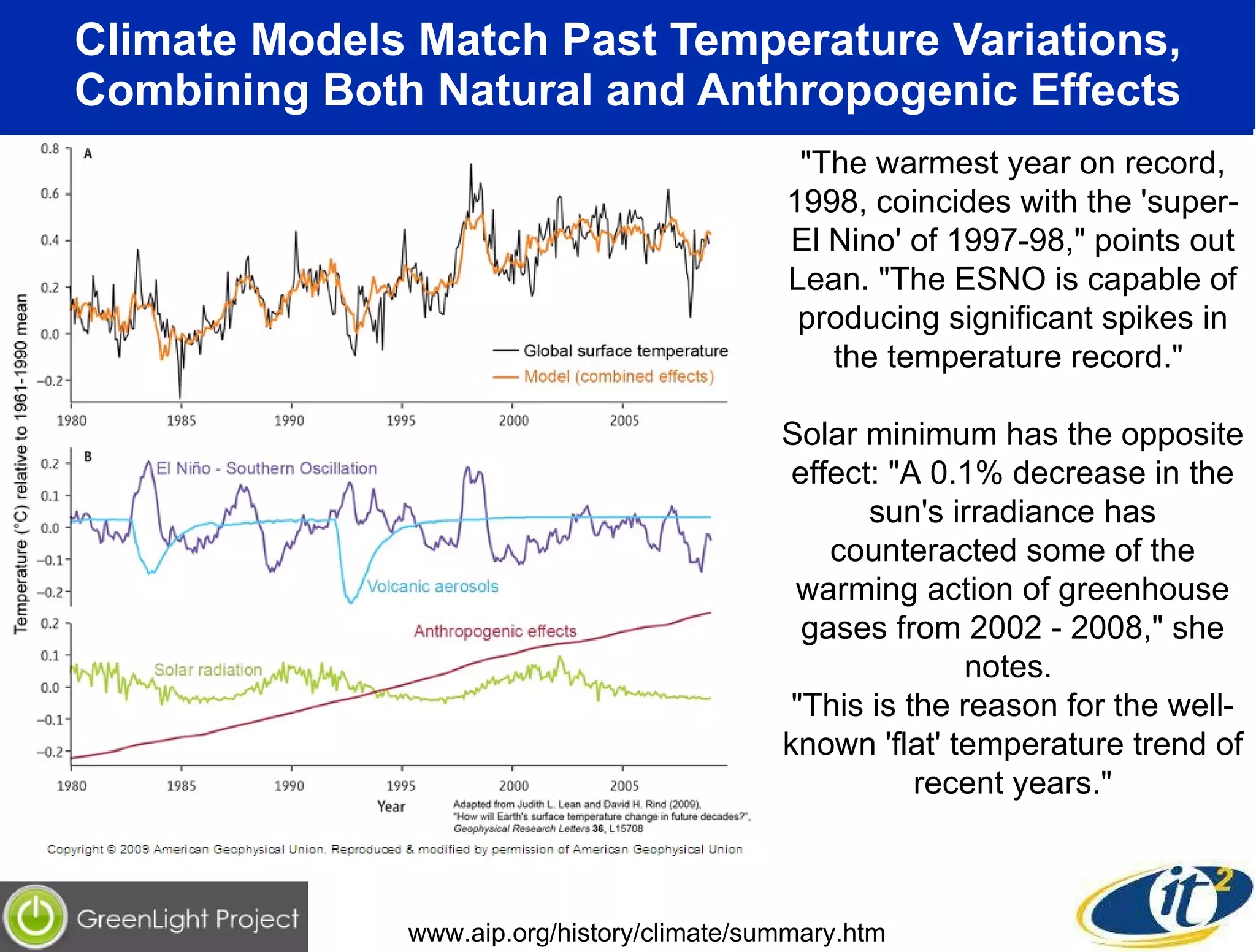
Climate Models Match Past Temperature Variations, Combining Both Natural and Anthropogenic Effects www.aip.org/history/climate/summary.htm "The warmest year on record, 1998, coincides with the 'super-El Nino' of 1997-98," points out Lean. "The ESNO is capable of producing significant spikes in the temperature record."  Solar minimum has the opposite effect: "A 0.1% decrease in the sun's irradiance has counteracted some of the warming action of greenhouse gases from 2002 - 2008," she notes.  "This is the reason for the well-known 'flat' temperature trend of recent years."
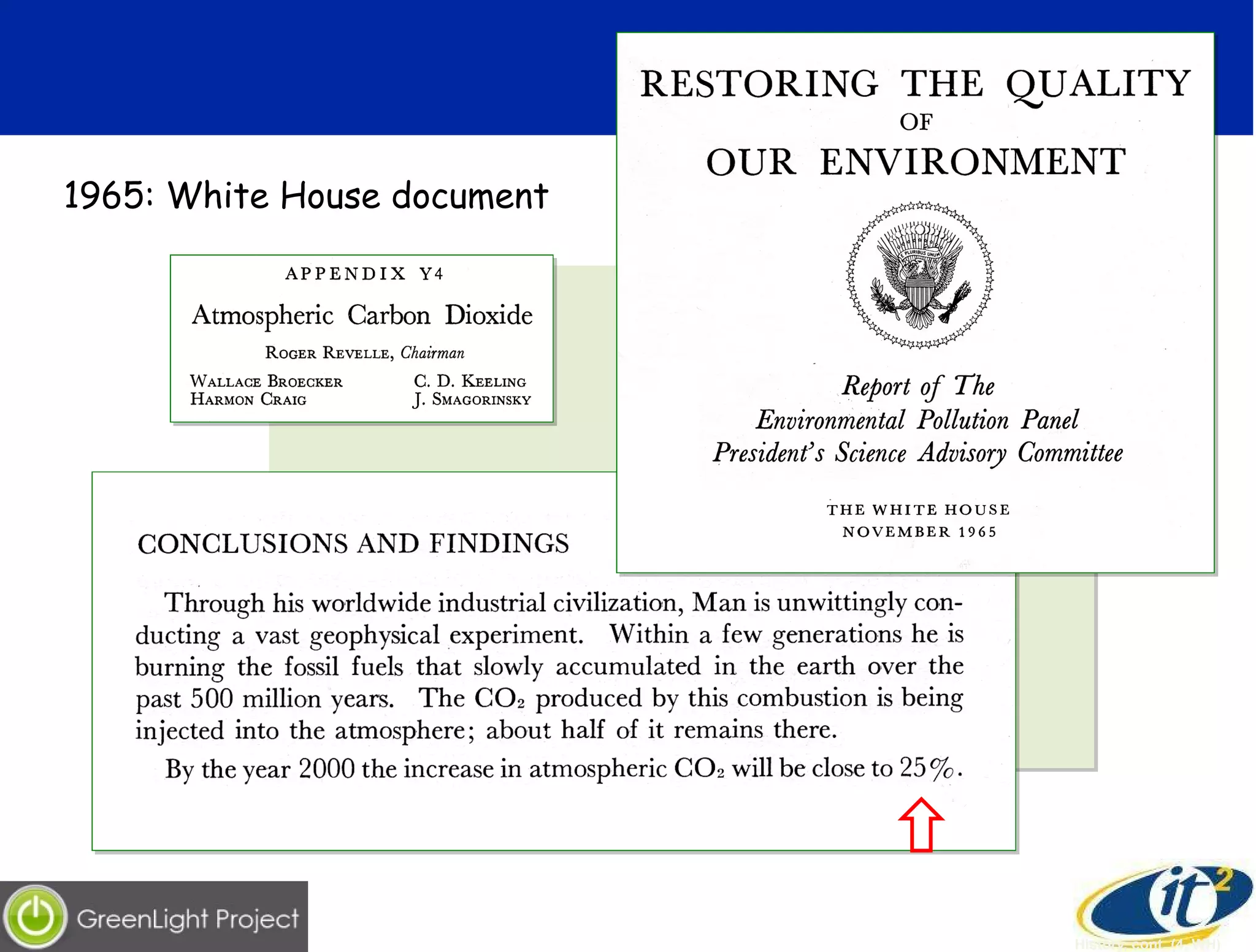
History, cont. (4, WH) 1965: White House document 
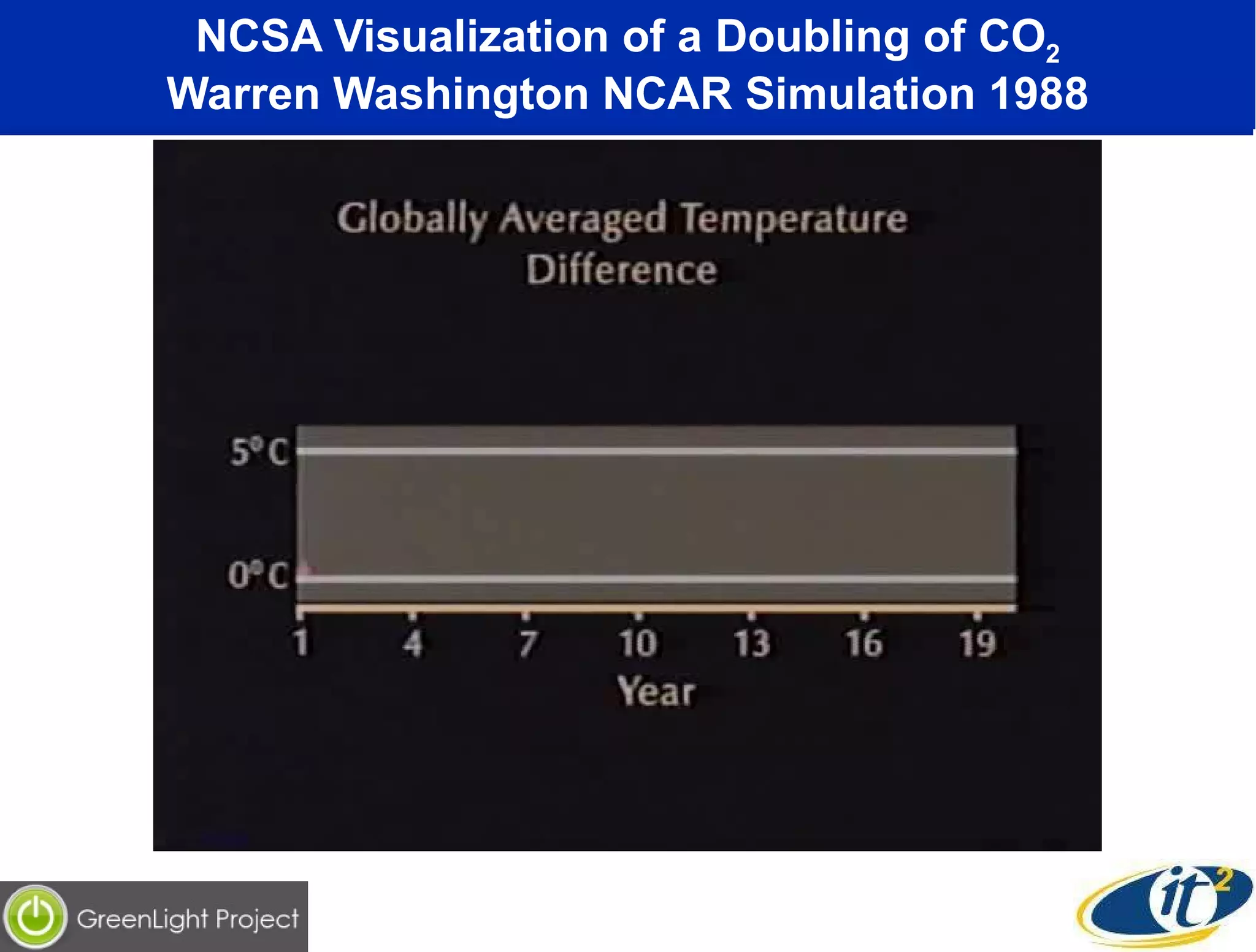
NCSA Visualization of a Doubling of CO 2 Warren Washington NCAR Simulation 1988
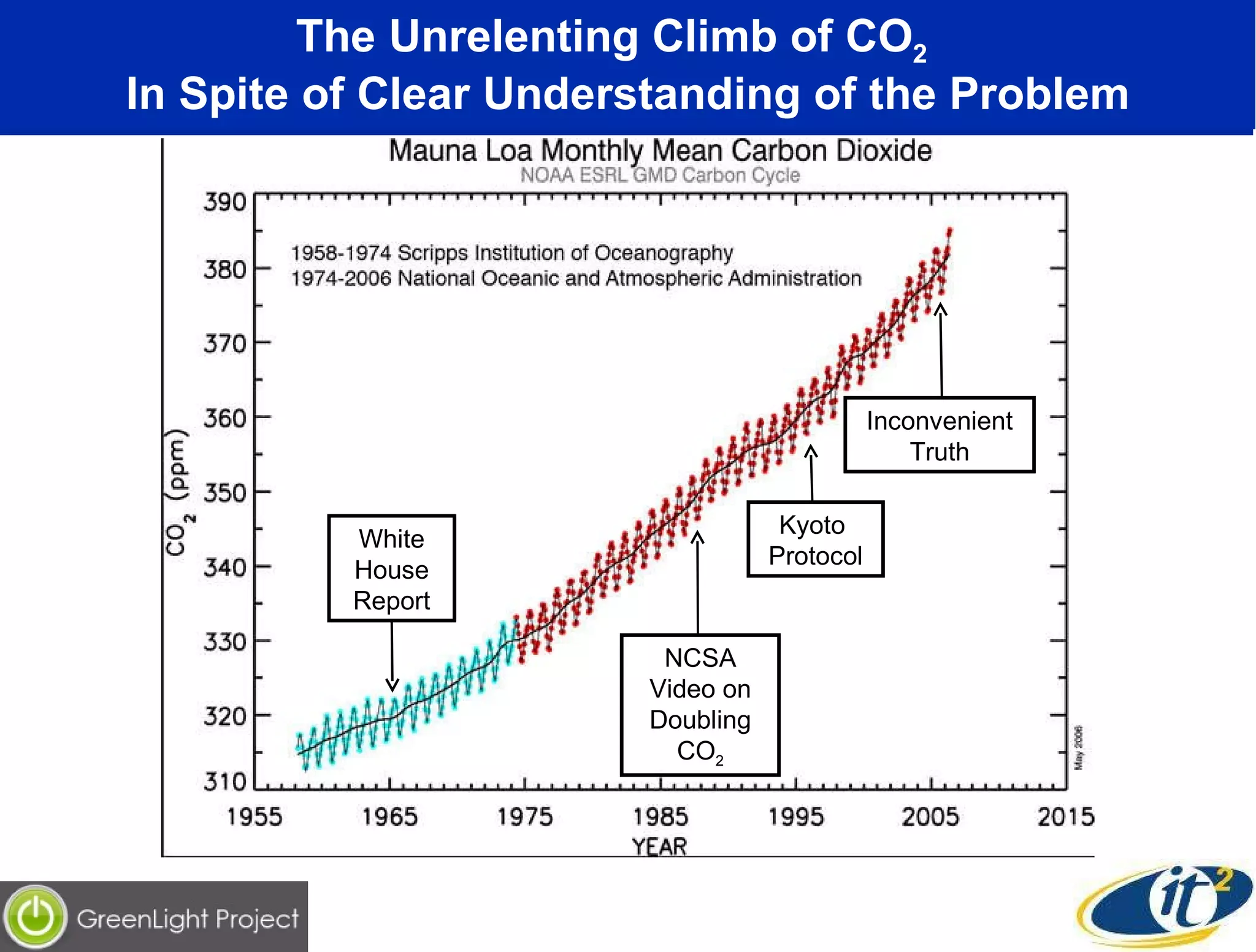
The Unrelenting Climb of CO 2  In Spite of Clear Understanding of the Problem White House Report NCSA Video on Doubling CO 2 Kyoto  Protocol Inconvenient Truth
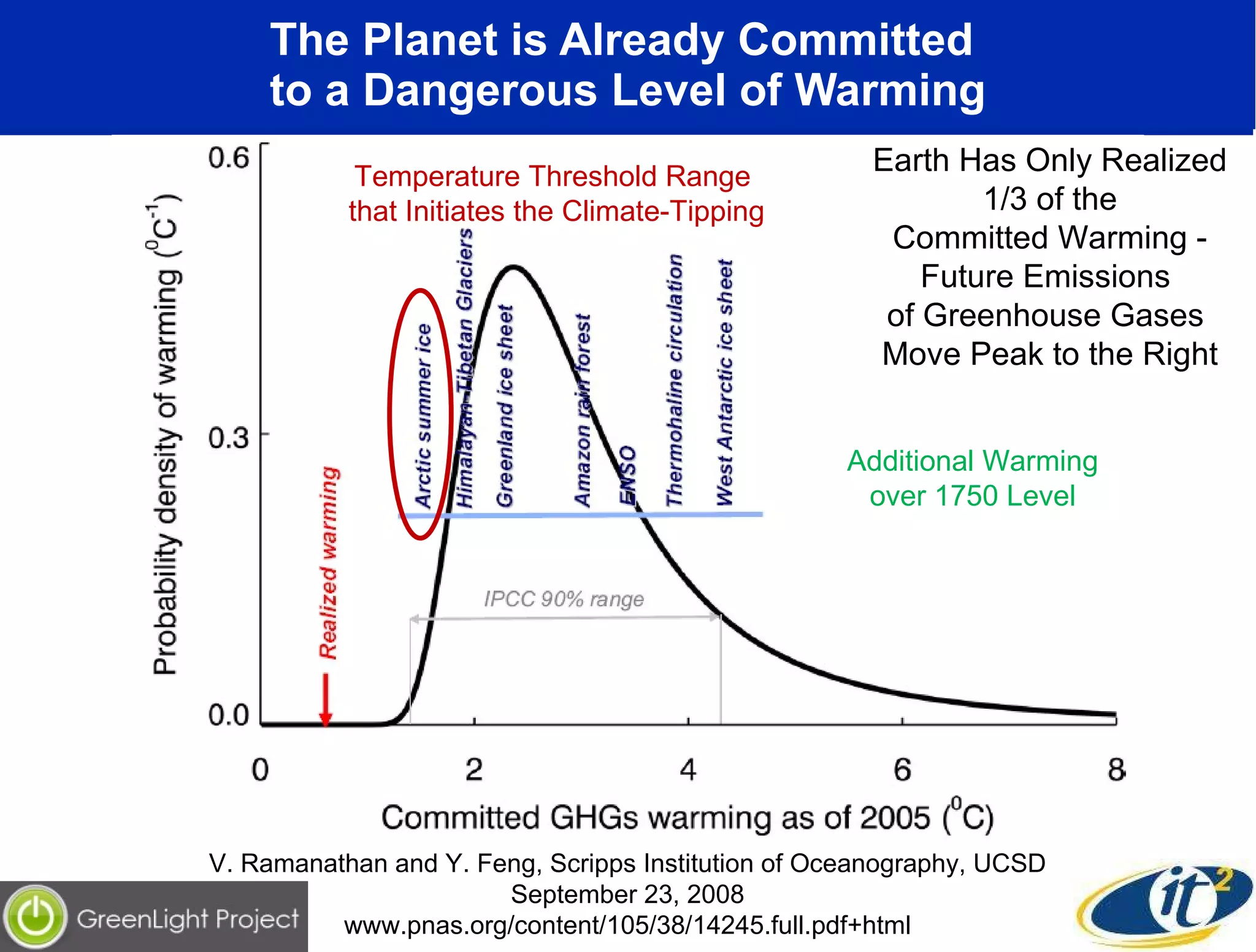
The Planet is Already Committed  to a Dangerous Level of Warming Temperature Threshold Range  that Initiates the Climate-Tipping V. Ramanathan and Y. Feng, Scripps Institution of Oceanography, UCSD September 23, 2008 www.pnas.org/content/105/38/14245.full.pdf+html Additional Warming over 1750 Level Earth Has Only Realized 1/3 of the Committed Warming - Future Emissions  of Greenhouse Gases  Move Peak to the Right
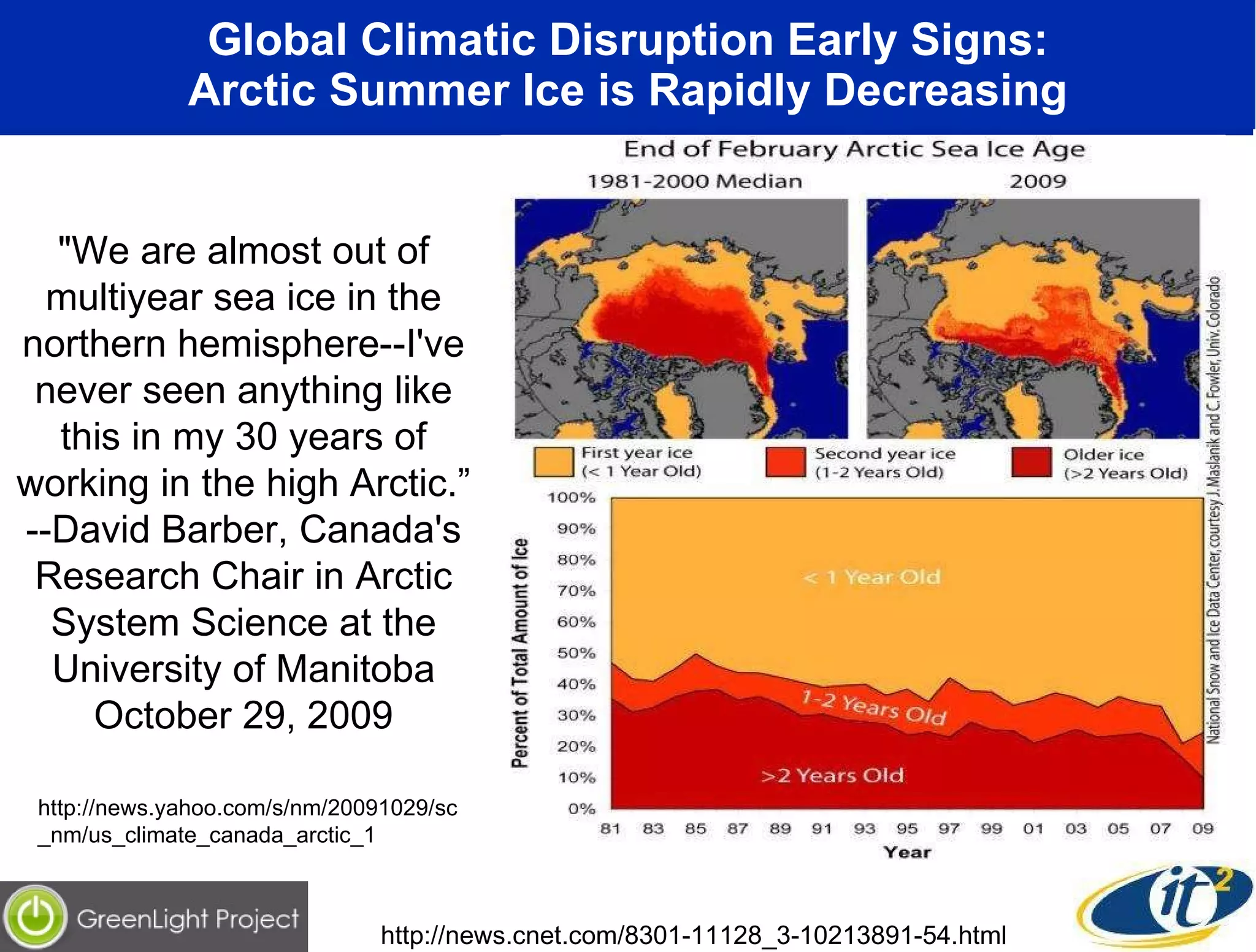
Global Climatic Disruption Early Signs: Arctic Summer Ice is Rapidly Decreasing "We are almost out of multiyear sea ice in the northern hemisphere--I've never seen anything like this in my 30 years of working in the high Arctic.” --David Barber, Canada's Research Chair in Arctic System Science at the University of Manitoba October 29, 2009 http://news.cnet.com/8301-11128_3-10213891-54.html http://news.yahoo.com/s/nm/20091029/sc_nm/us_climate_canada_arctic_1
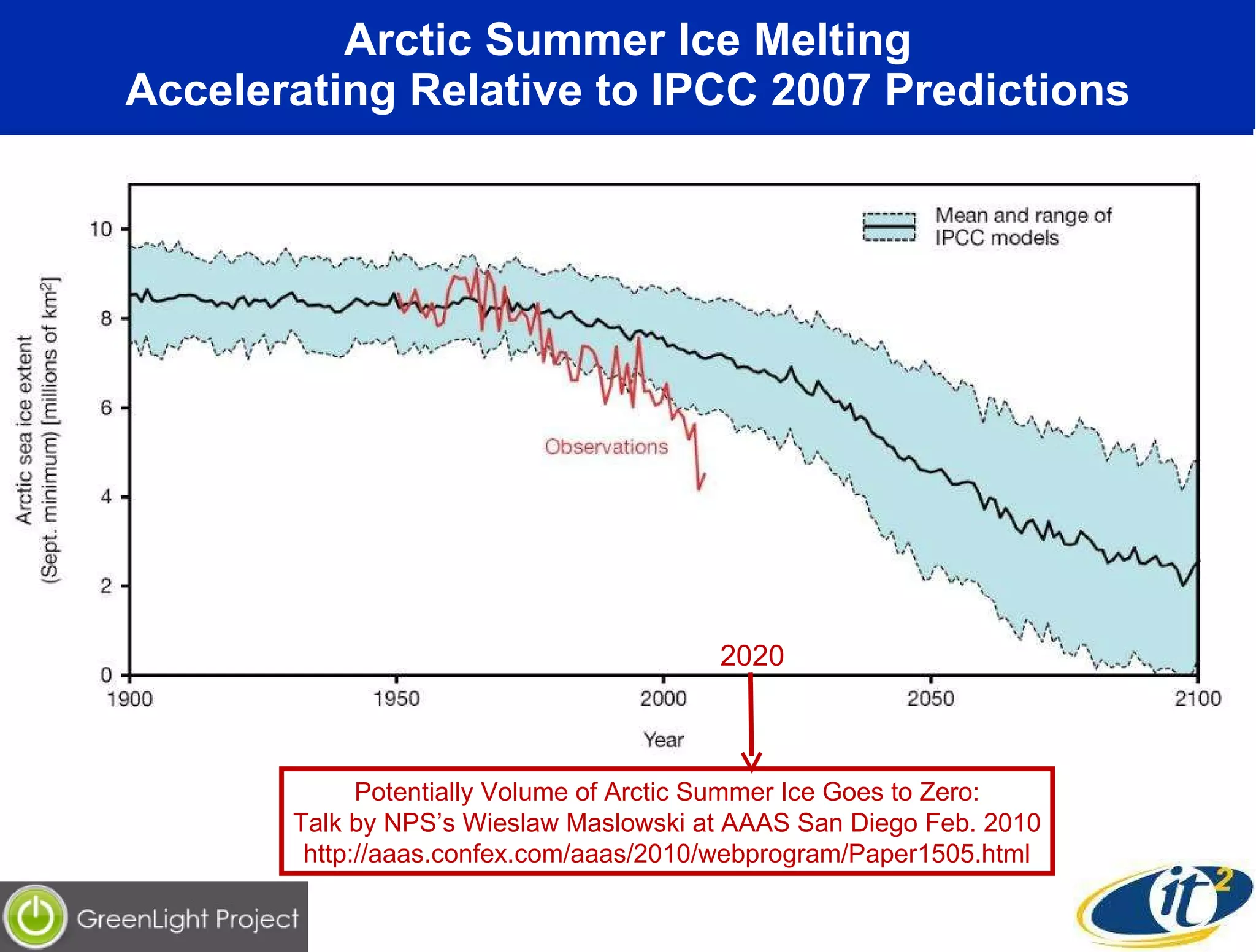
Arctic Summer Ice Melting Accelerating Relative to IPCC 2007 Predictions Potentially Volume of Arctic Summer Ice Goes to Zero: Talk by NPS’s Wieslaw Maslowski at AAAS San Diego Feb. 2010 http://aaas.confex.com/aaas/2010/webprogram/Paper1505.html 2020
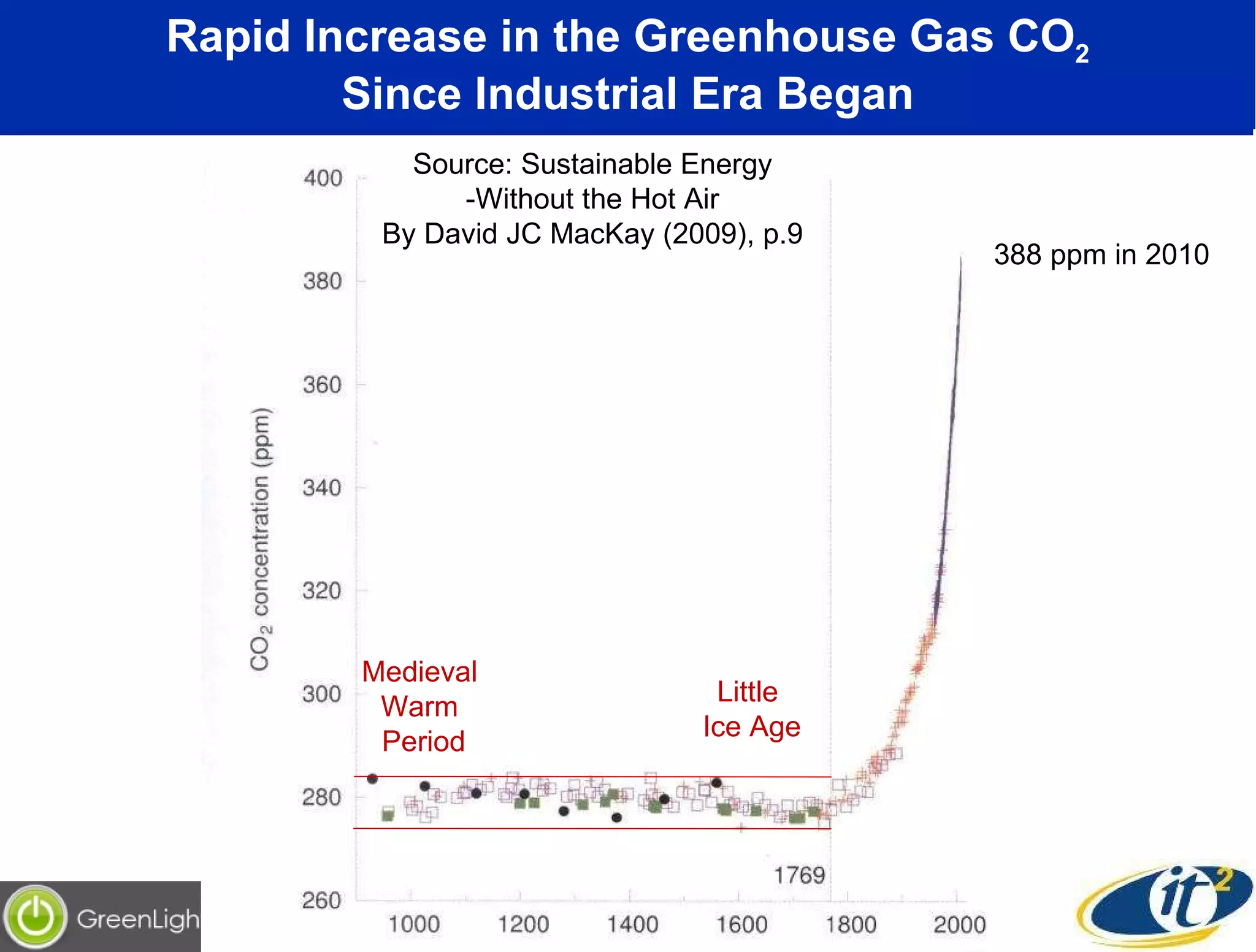
Rapid Increase in the Greenhouse Gas CO 2 Since Industrial Era Began Little  Ice Age Medieval  Warm  Period 388 ppm in 2010 Source: Sustainable Energy -Without the Hot Air By David JC MacKay (2009), p.9
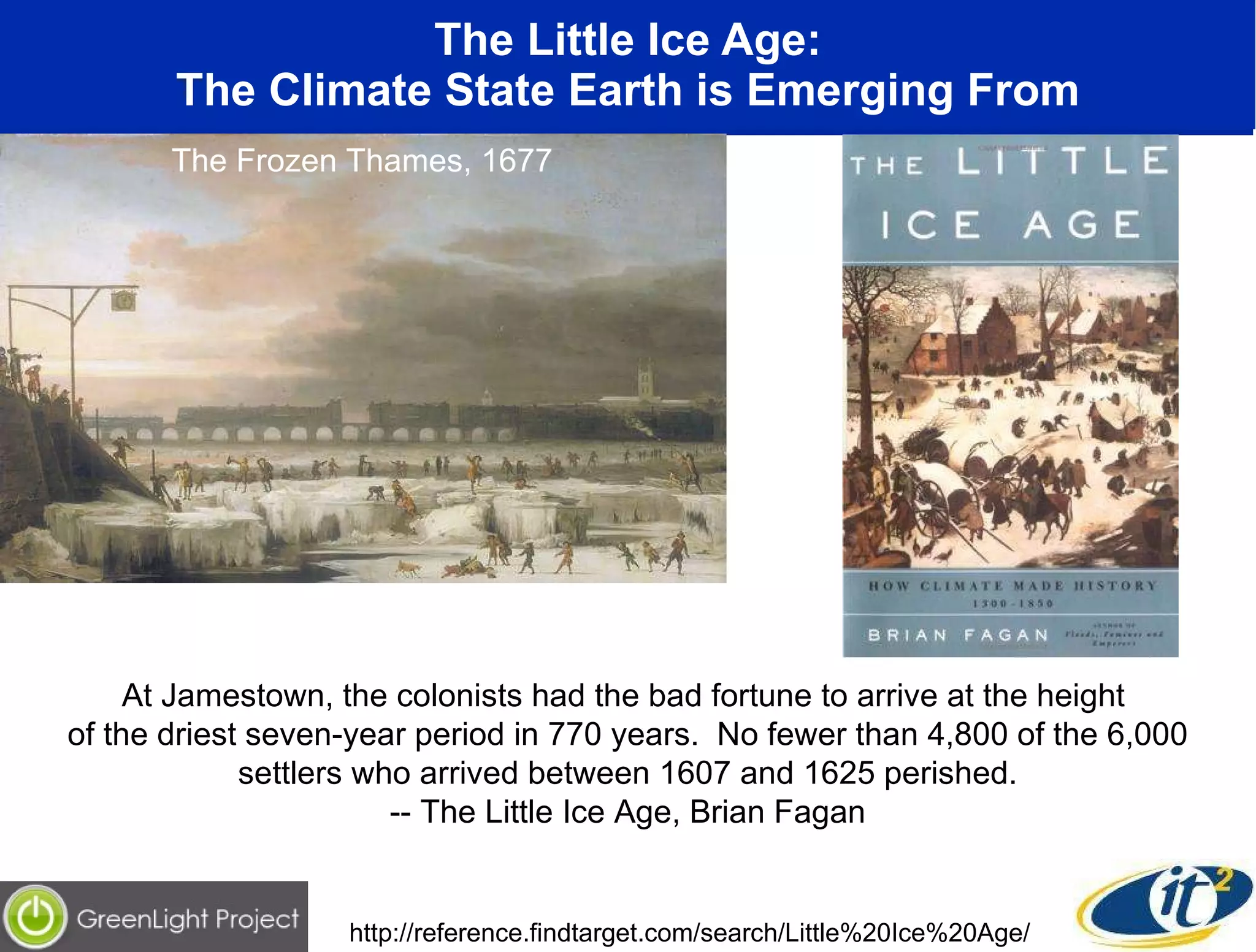
The Little Ice Age: The Climate State Earth is Emerging From The Frozen Thames, 1677 At Jamestown, the colonists had the bad fortune to arrive at the height  of the driest seven-year period in 770 years.  No fewer than 4,800 of the 6,000 settlers who arrived between 1607 and 1625 perished. -- The Little Ice Age, Brian Fagan http://reference.findtarget.com/search/Little%20Ice%20Age/
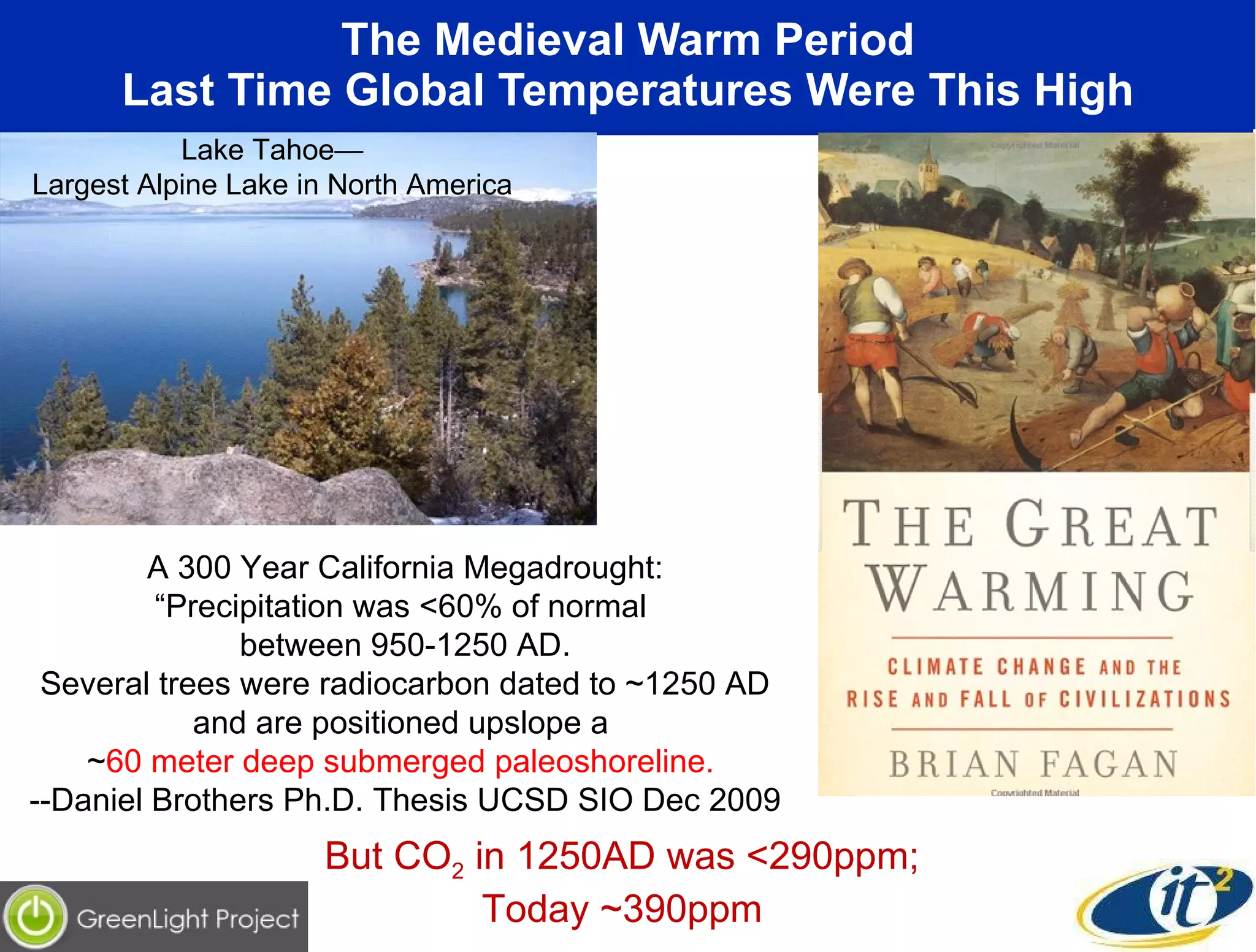
The Medieval Warm Period Last Time Global Temperatures Were This High A 300 Year California Megadrought: “ Precipitation was <60% of normal  between 950-1250 AD. Several trees were radiocarbon dated to ~1250 AD and are positioned upslope a  ~ 60 meter deep submerged paleoshoreline.   --Daniel Brothers Ph.D. Thesis UCSD SIO Dec 2009 Lake Tahoe— Largest Alpine Lake in North America But CO 2  in 1250AD was <290ppm;  Today ~390ppm
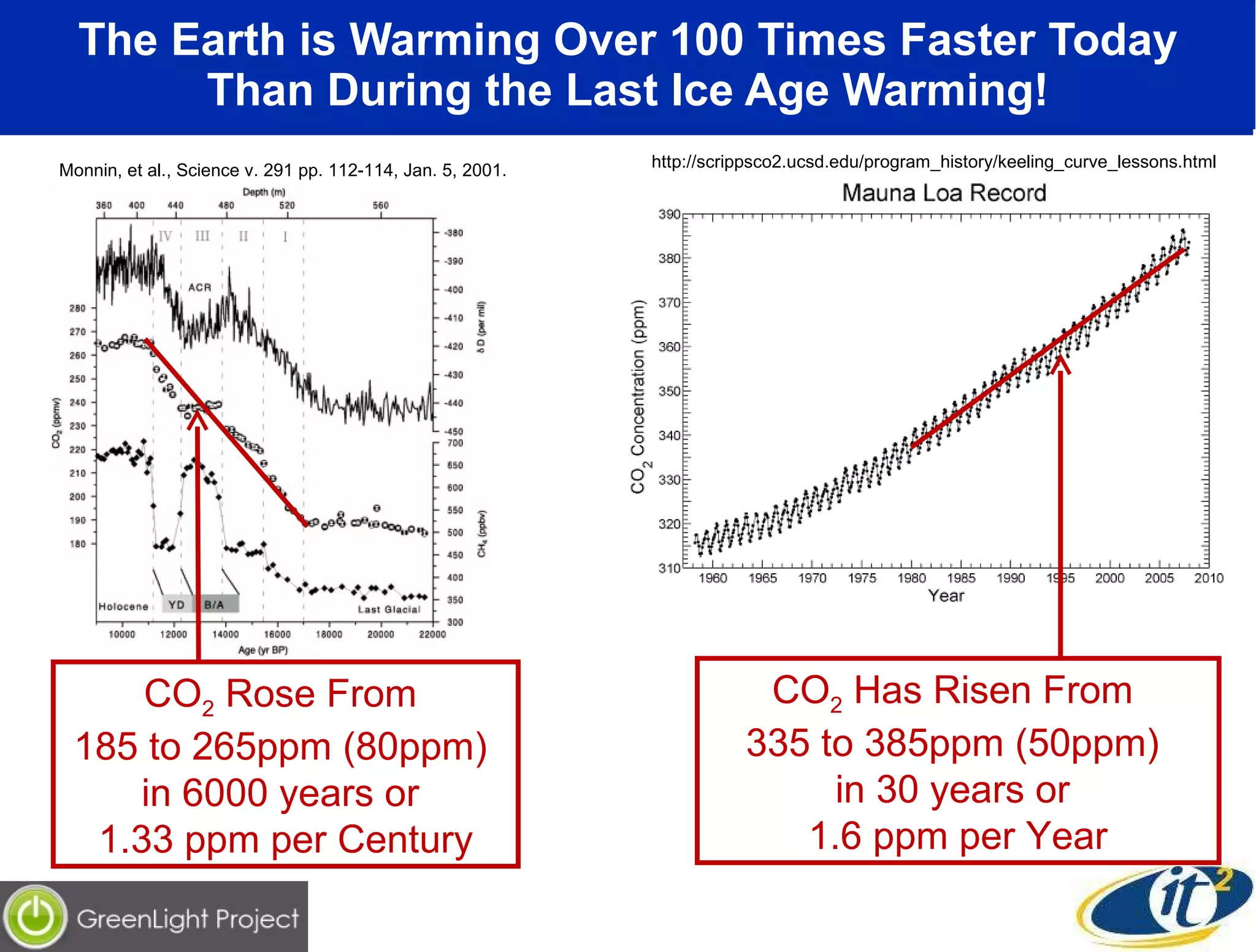
The Earth is Warming Over 100 Times Faster Today Than During the Last Ice Age Warming! http://scrippsco2.ucsd.edu/program_history/keeling_curve_lessons.html Monnin, et al., Science v. 291 pp. 112-114, Jan. 5, 2001. CO 2  Rose From  185 to 265ppm (80ppm)  in 6000 years or  1.33 ppm per Century CO 2  Has Risen From  335 to 385ppm (50ppm)  in 30 years or  1.6 ppm per Year
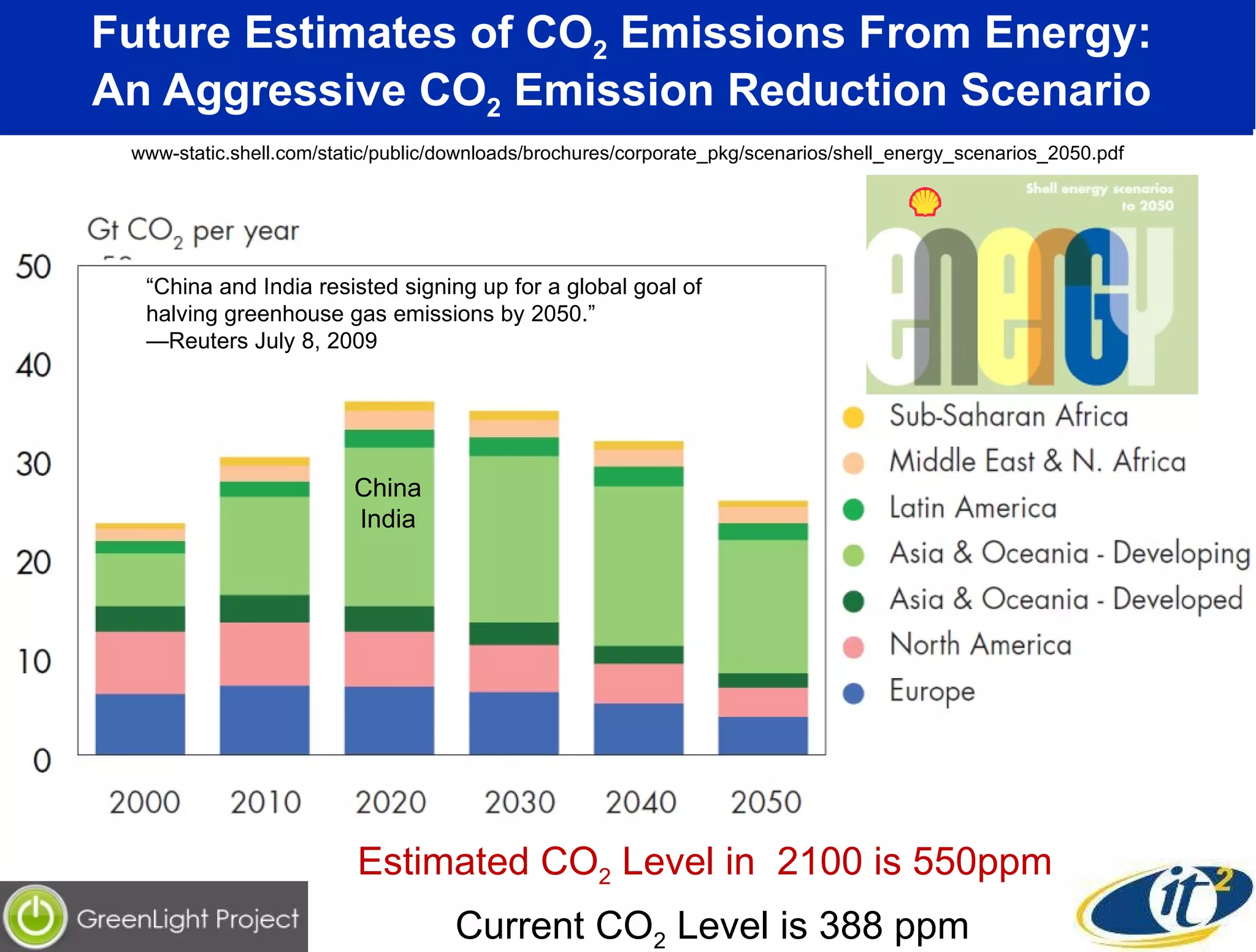
Future Estimates of CO 2  Emissions From Energy:  An Aggressive CO 2  Emission Reduction Scenario  www-static.shell.com/static/public/downloads/brochures/corporate_pkg/scenarios/shell_energy_scenarios_2050.pdf Estimated CO 2  Level in  2100 is 550ppm China India “ China and India resisted signing up for a global goal of halving greenhouse gas emissions by 2050.” — Reuters July 8, 2009 Current CO 2  Level is 388 ppm
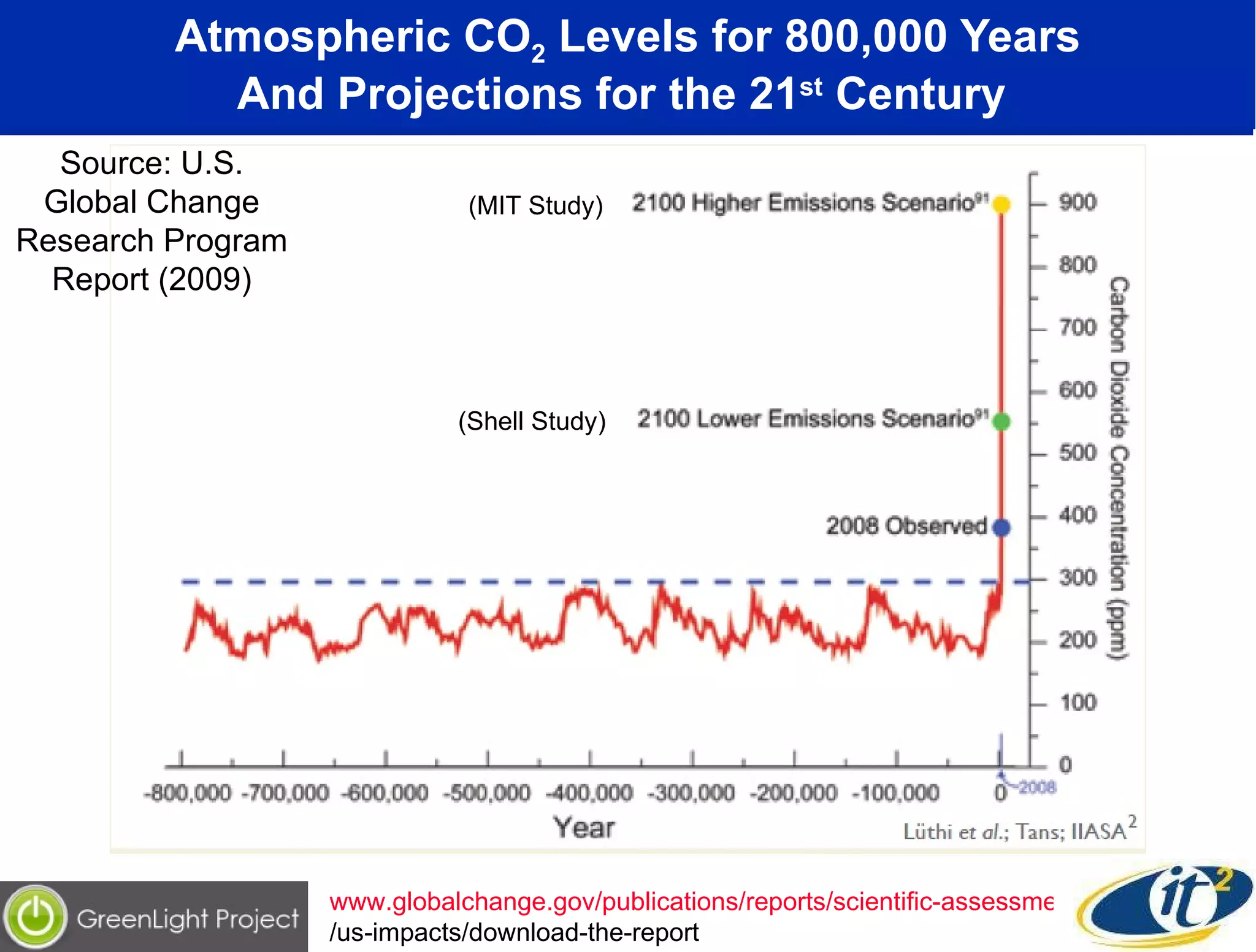
Atmospheric CO 2  Levels for 800,000 Years And Projections for the 21 st  Century  www.globalchange.gov/publications/reports/scientific-assessments /us-impacts/download-the-report Source: U.S. Global Change Research Program Report (2009) (MIT Study) (Shell Study)
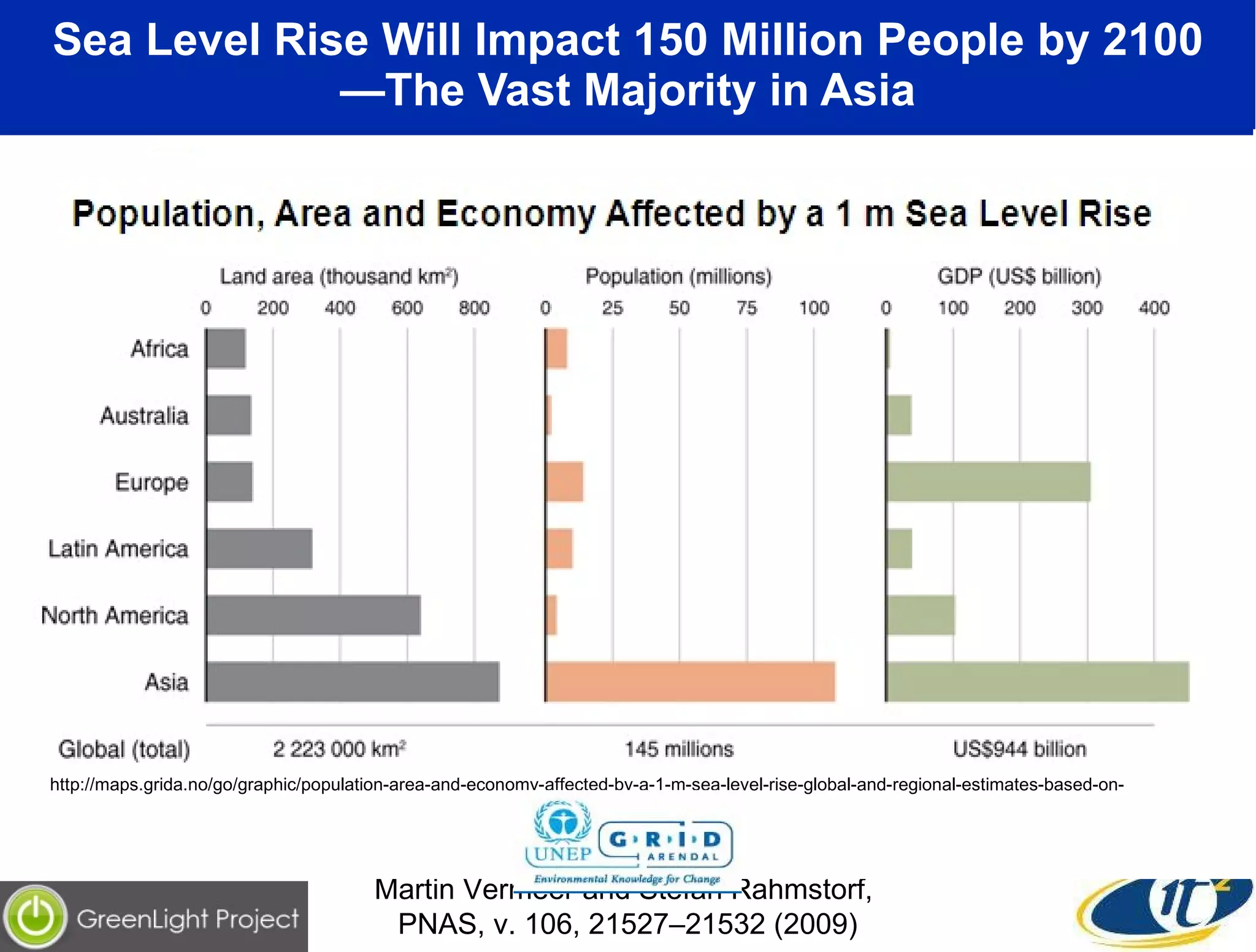
Sea Level Rise Will Impact 150 Million People by 2100 —The Vast Majority in Asia CO 2  Emissions are an Impulse to Earth Climate System—Equilibrium Response will Take Centuries IPCC 2007 Estimates 1 Meter Sea Level Rise “ Global sea level linked to global temperature,” Martin Vermeer and Stefan Rahmstorf,  PNAS, v. 106, 21527–21532 (2009) http://maps.grida.no/go/graphic/population-area-and-economy-affected-by-a-1-m-sea-level-rise-global-and-regional-estimates-based-on-
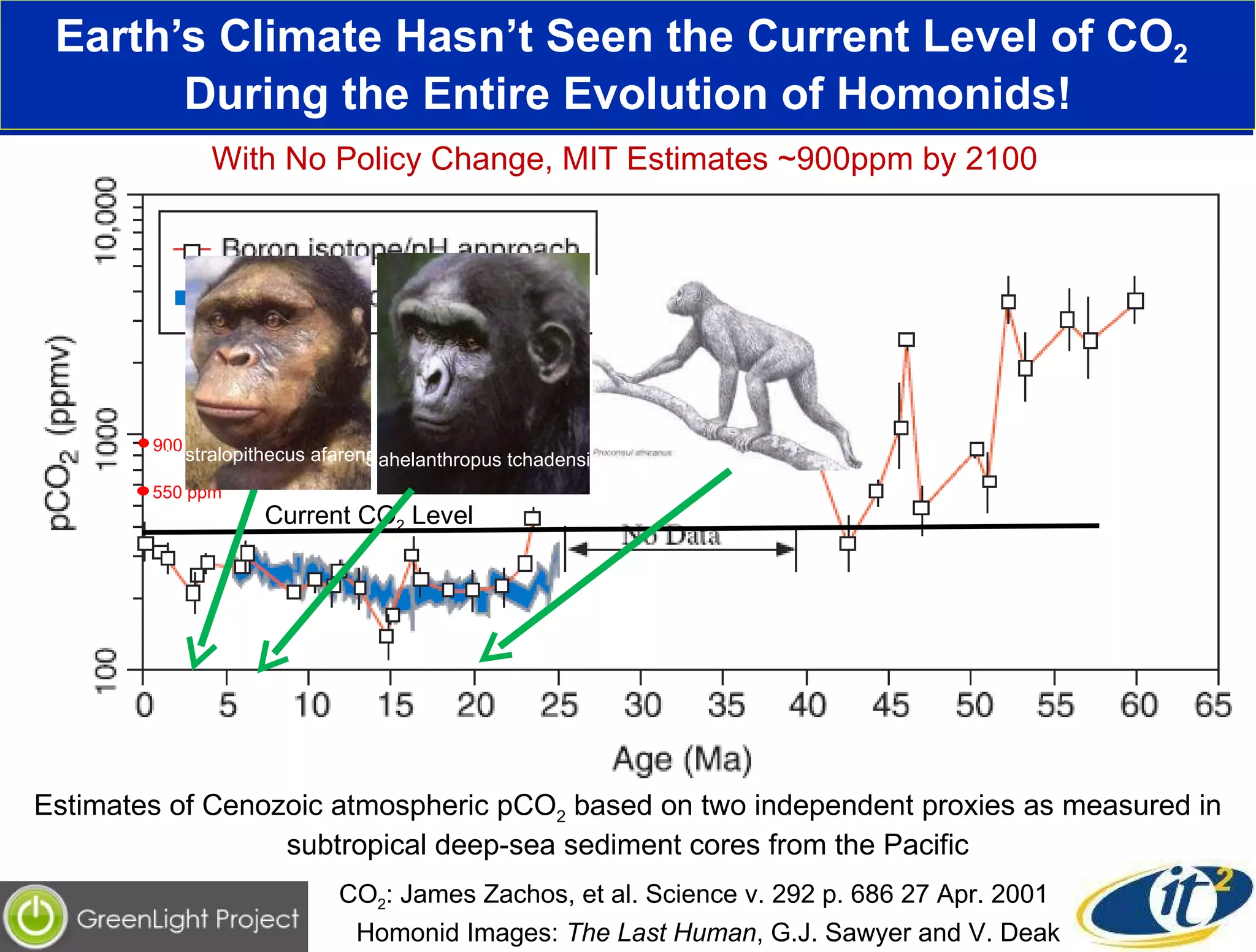
Earth’s Climate Hasn’t Seen the Current Level of CO 2   During the Entire Evolution of Homonids! Estimates of Cenozoic atmospheric pCO 2  based on two independent proxies as measured in subtropical deep-sea sediment cores from the Pacific CO 2 : James Zachos, et al. Science v. 292 p. 686 27 Apr. 2001 With No Policy Change, MIT Estimates ~900ppm by 2100 Homonid Images:  The Last Human , G.J. Sawyer and V. Deak Current CO 2  Level 550 ppm 900 ppm Australopithecus afarensis Sahelanthropus tchadensis
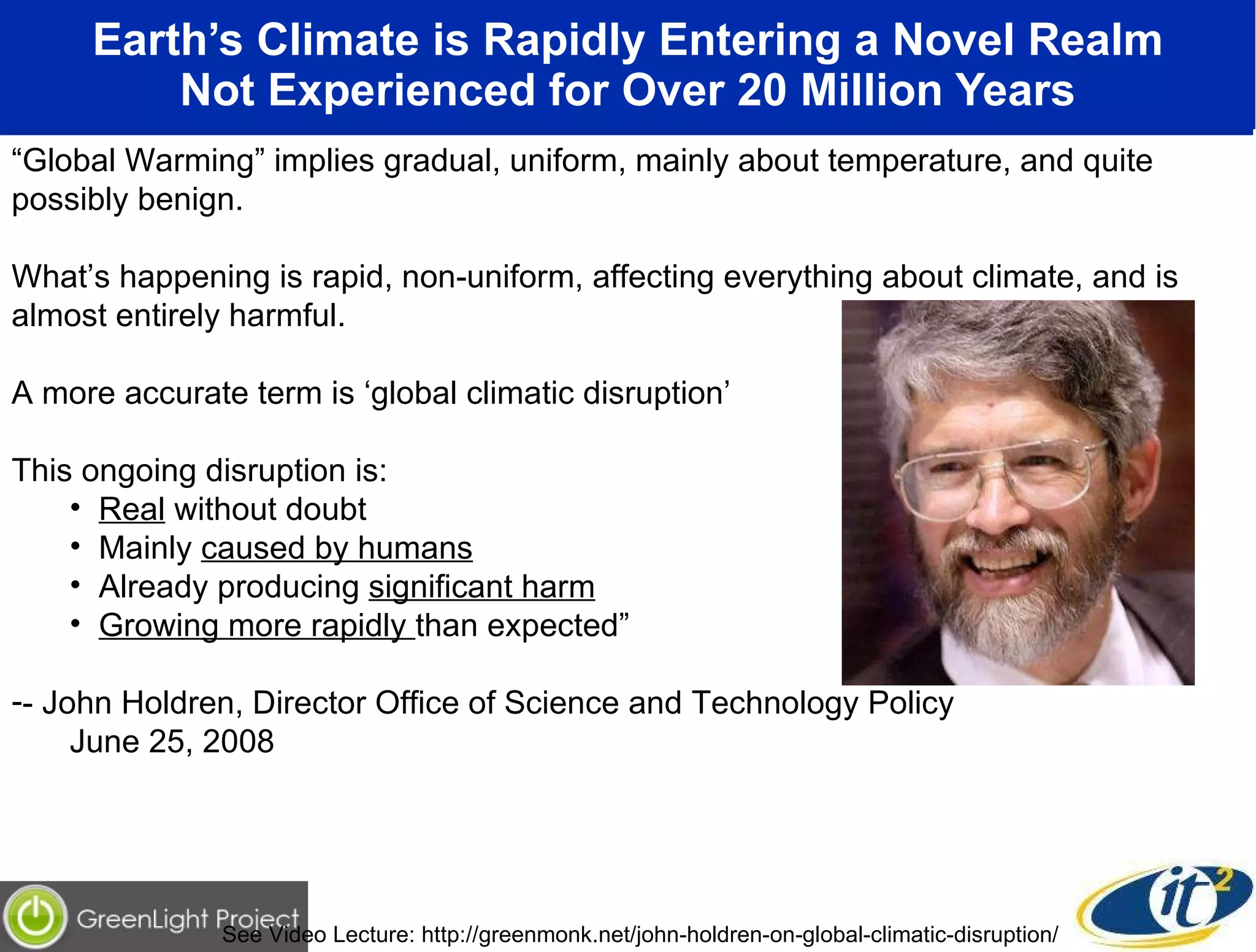
Earth’s Climate is Rapidly Entering a Novel Realm Not Experienced for Over 20 Million Years “ Global Warming” implies gradual, uniform, mainly about temperature, and quite possibly benign.  What’s happening is rapid, non-uniform, affecting everything about climate, and is almost entirely harmful. A more accurate term is ‘global climatic disruption’ This ongoing disruption is: Real  without doubt Mainly  caused by humans Already producing  significant harm Growing more rapidly  than expected” - John Holdren, Director Office of Science and Technology Policy June 25, 2008 See Video Lecture: http://greenmonk.net/john-holdren-on-global-climatic-disruption/
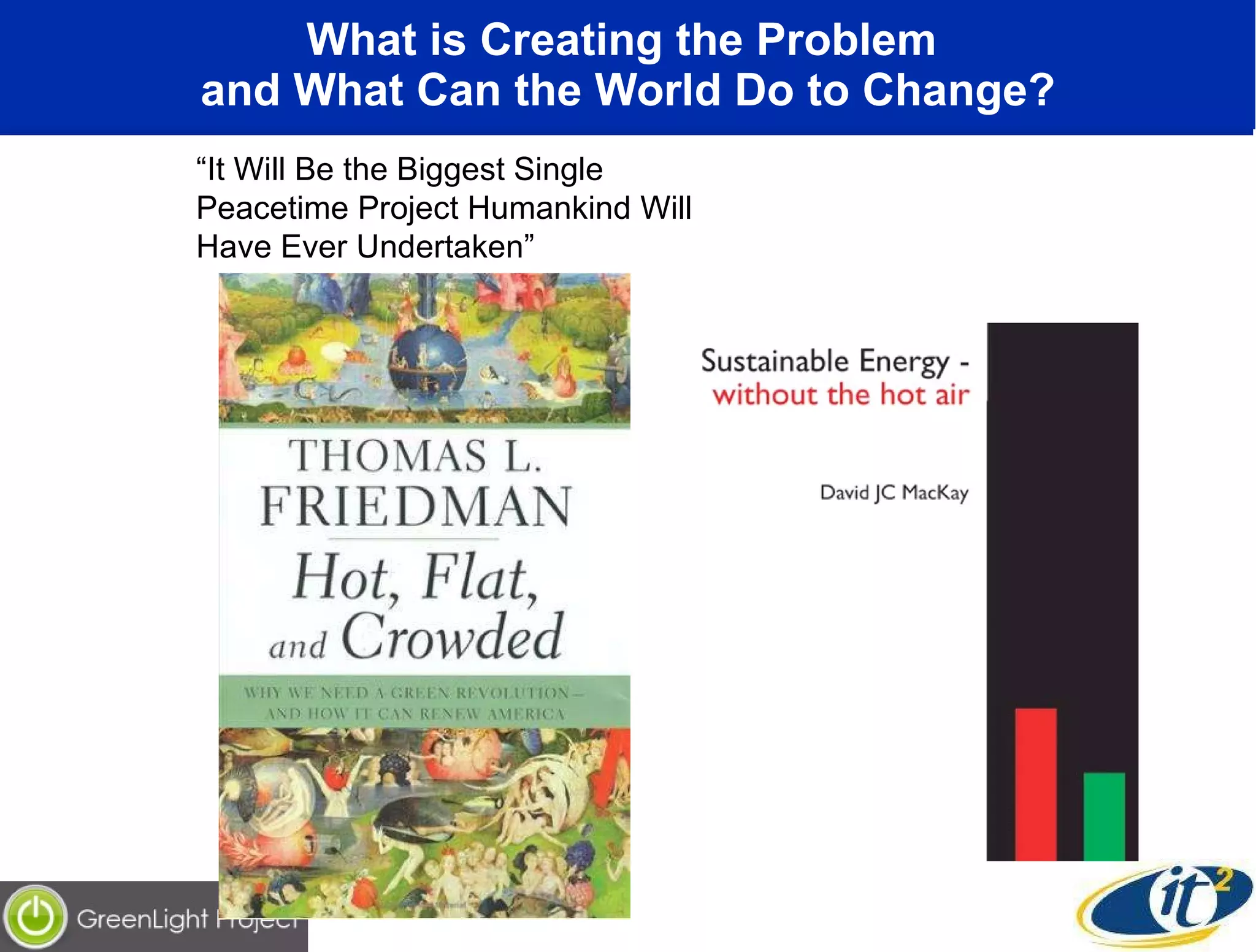
What is Creating the Problem  and What Can the World Do to Change? “ It Will Be the Biggest Single Peacetime Project Humankind Will Have Ever Undertaken”
How Can PRAGMA Research Help Slow Down  the Increasing Greenhouse Gas Emissions?
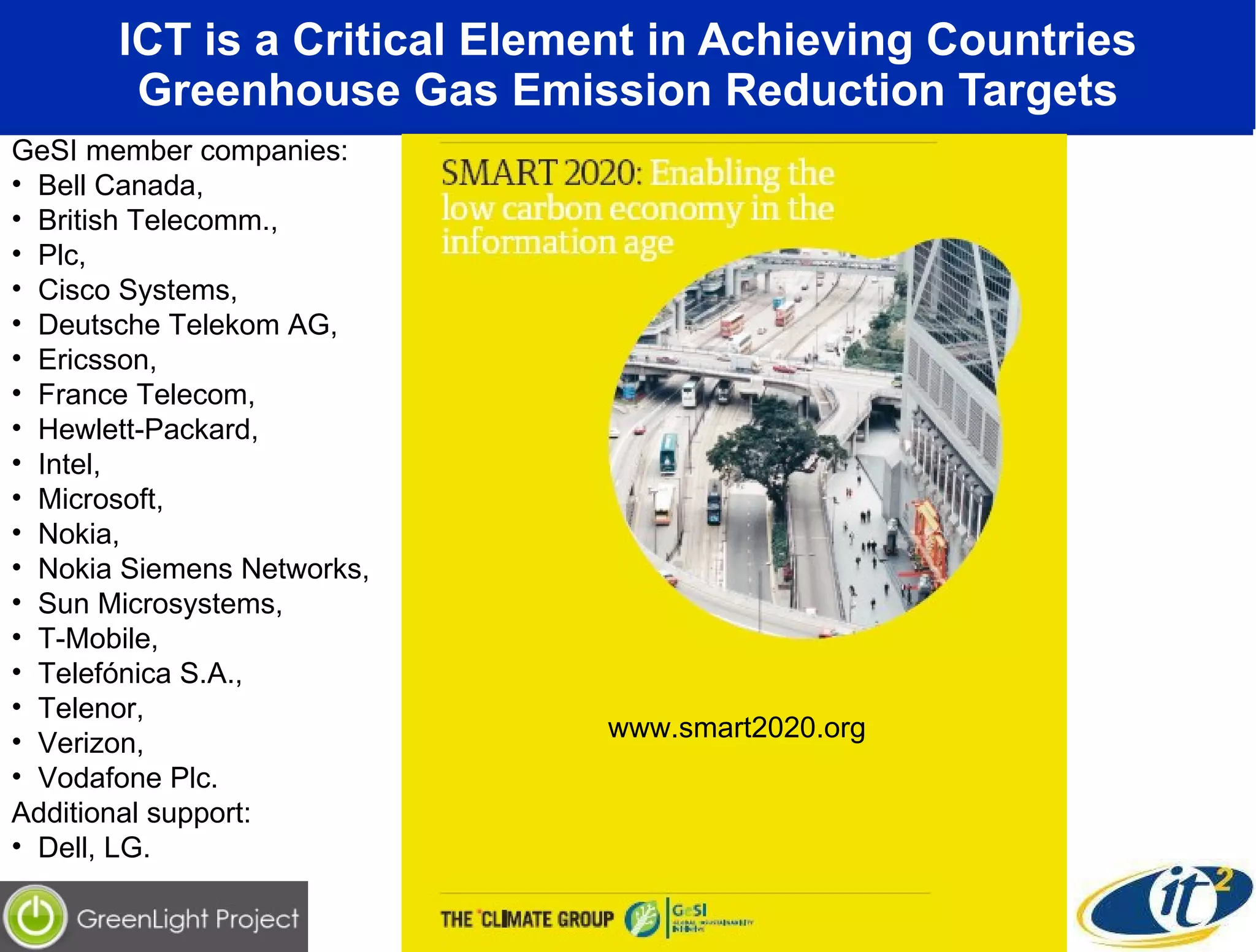
ICT is a Critical Element in Achieving Countries Greenhouse Gas Emission Reduction Targets www.smart2020.org GeSI member companies:  Bell Canada,  British Telecomm.,  Plc,  Cisco Systems,  Deutsche Telekom AG,  Ericsson,  France Telecom,  Hewlett-Packard,  Intel,  Microsoft,  Nokia,  Nokia Siemens Networks,  Sun Microsystems,  T-Mobile,  Telefónica S.A.,  Telenor,  Verizon,  Vodafone Plc.  Additional support:  Dell, LG.
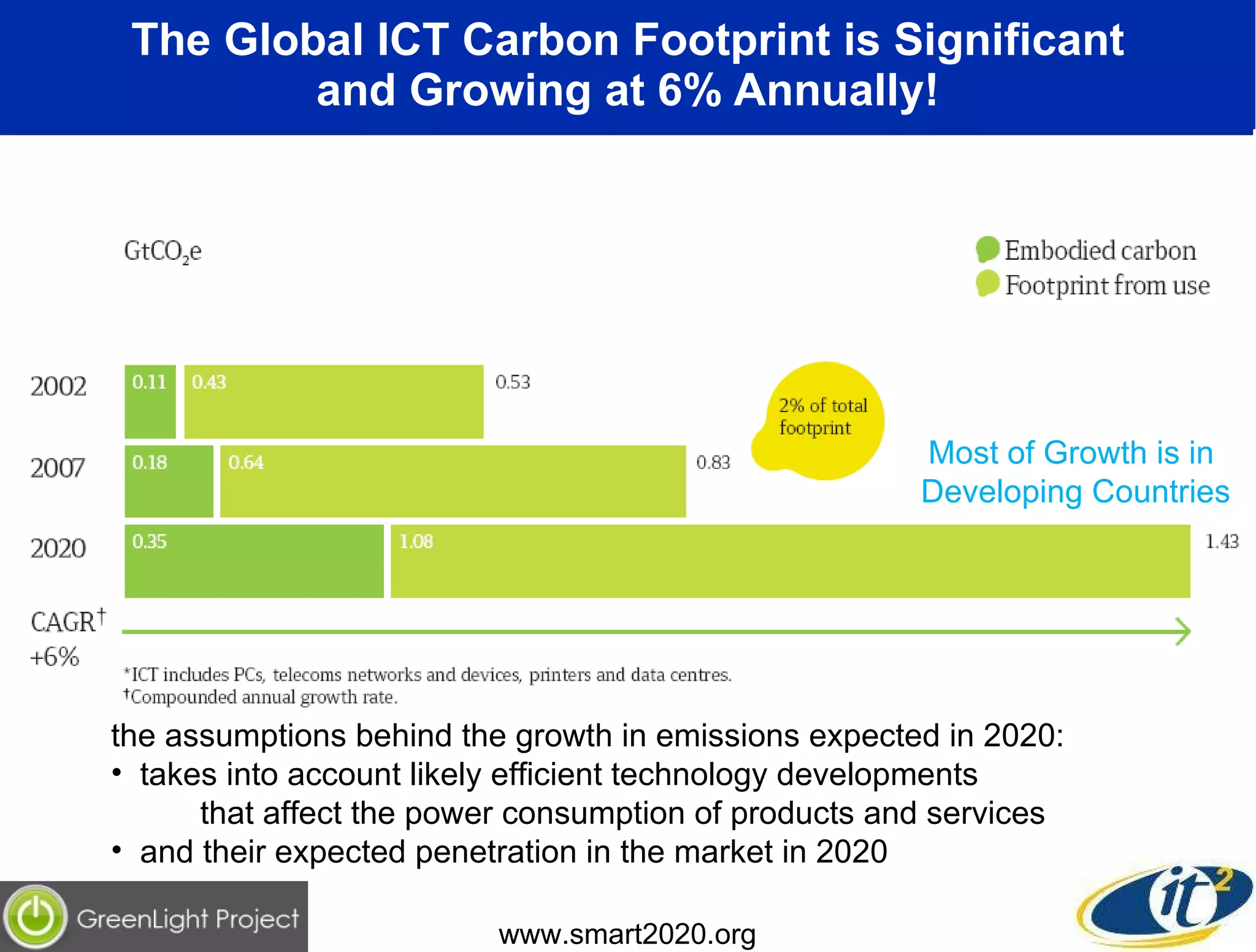
The Global ICT Carbon Footprint is Significant and Growing at 6% Annually! www.smart2020.org the assumptions behind the growth in emissions expected in 2020:  takes into account likely efficient technology developments    that affect the power consumption of products and services and their expected penetration in the market in 2020 Most of Growth is in  Developing Countries
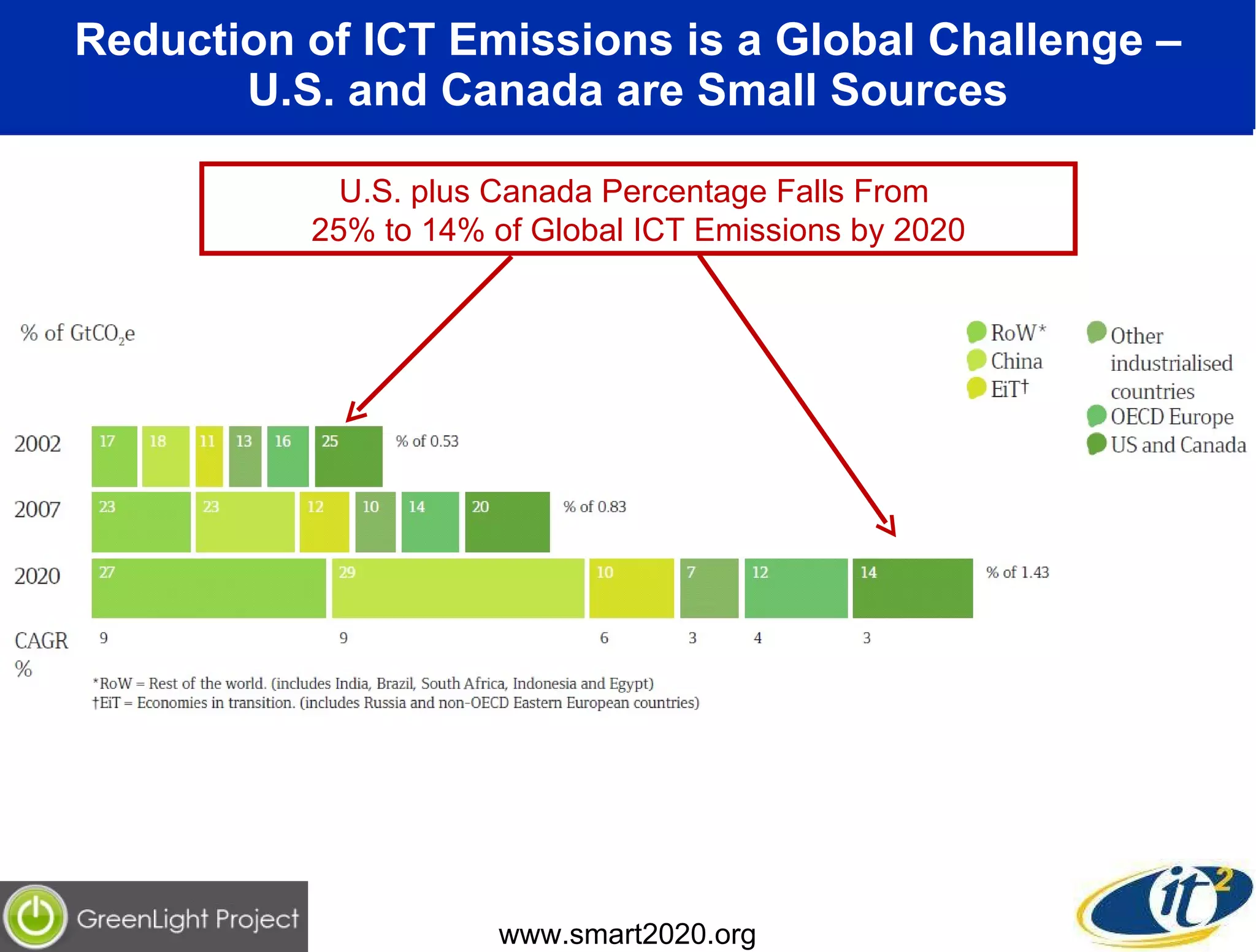
Reduction of ICT Emissions is a Global Challenge – U.S. and Canada are Small Sources U.S. plus Canada Percentage Falls From  25% to 14% of Global ICT Emissions by 2020 www.smart2020.org
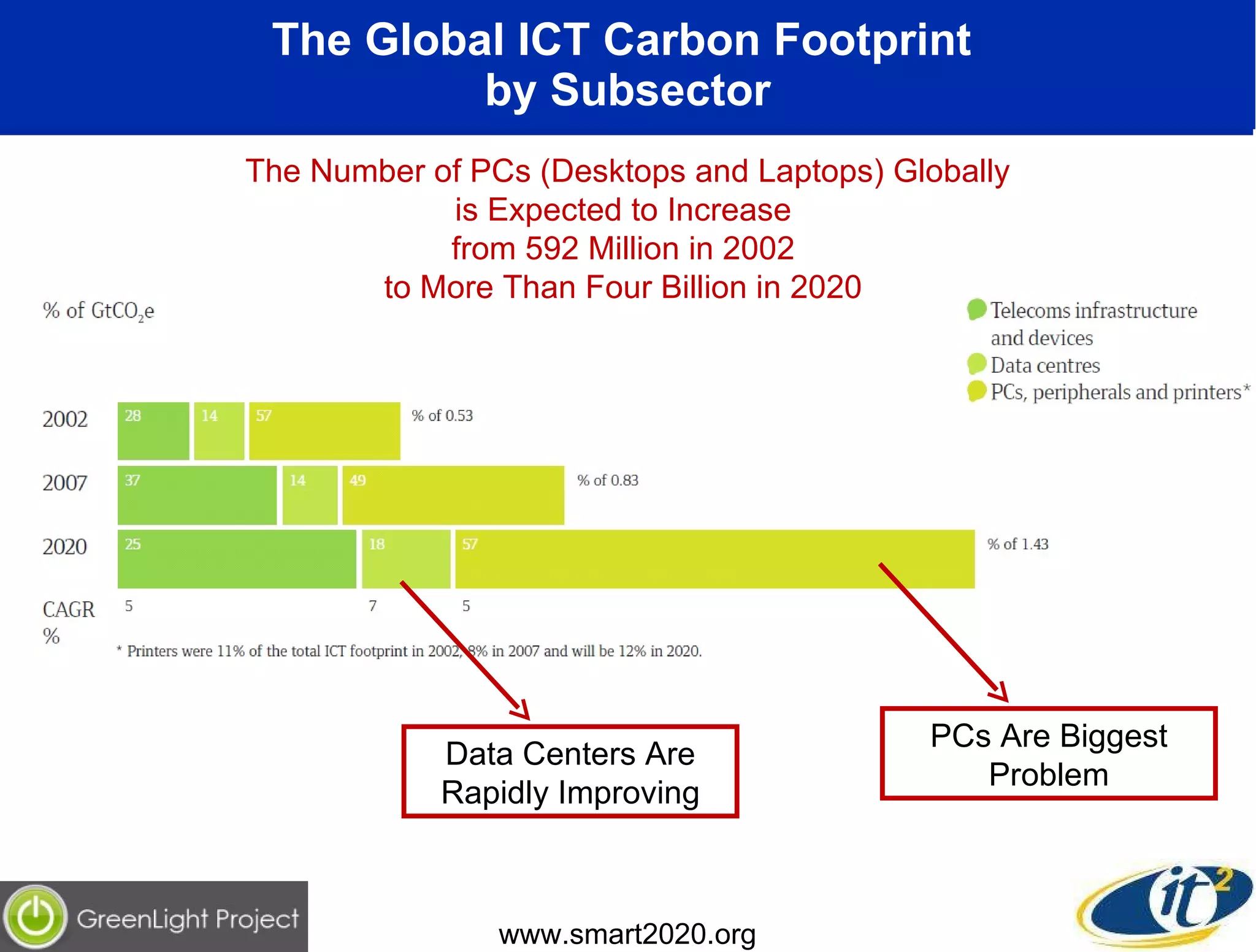
The Global ICT Carbon Footprint  by Subsector www.smart2020.org The Number of PCs (Desktops and Laptops) Globally is Expected to Increase  from 592 Million in 2002  to More Than Four Billion in 2020  PCs Are Biggest Problem Data Centers Are Rapidly Improving
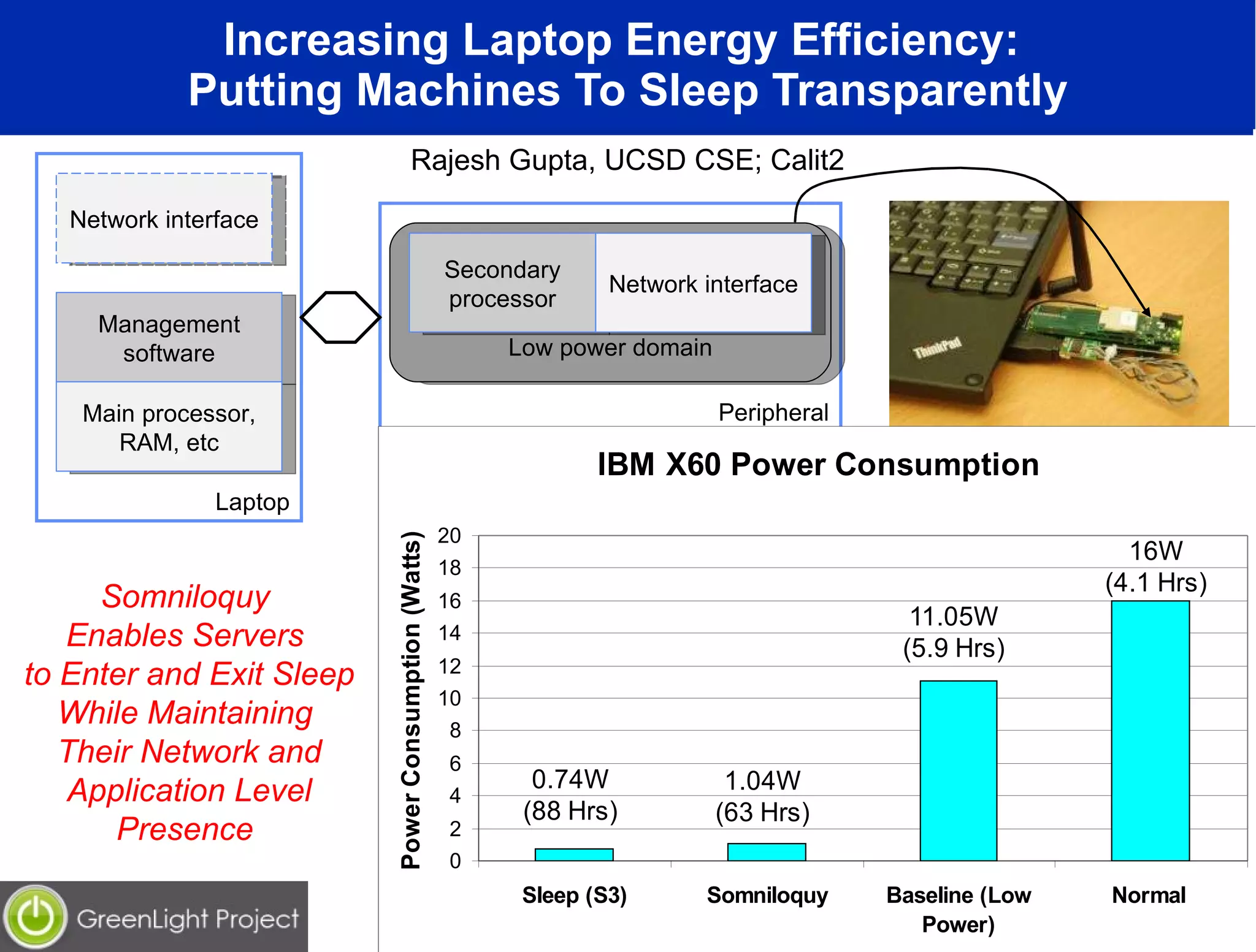
Increasing Laptop Energy Efficiency:  Putting Machines To Sleep Transparently Somniloquy  Enables Servers  to Enter and Exit Sleep While Maintaining  Their Network and Application Level Presence  Rajesh Gupta, UCSD CSE; Calit2 Peripheral Laptop Low power domain Network interface Secondary processor Network interface Management software Main processor, RAM, etc
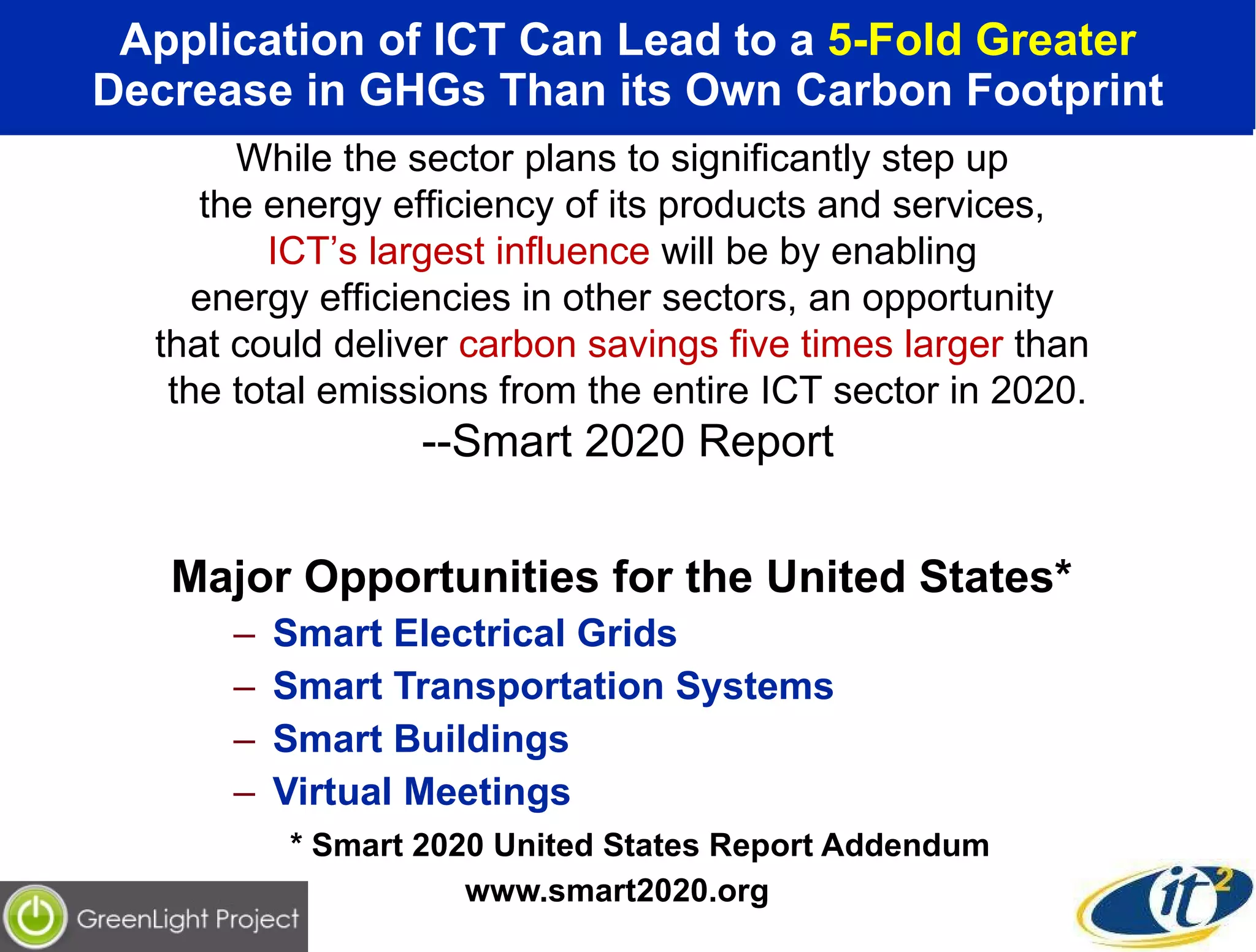
Application of ICT Can Lead to a  5-Fold Greater Decrease in GHGs Than its Own Carbon Footprint Major Opportunities for the United States* Smart Electrical Grids Smart Transportation Systems Smart Buildings Virtual Meetings * Smart 2020 United States Report Addendum www.smart2020.org While the sector plans to significantly step up  the energy efficiency of its products and services,  ICT’s largest influence  will be by enabling  energy efficiencies in other sectors, an opportunity  that could deliver  carbon savings five times larger  than  the total emissions from the entire ICT sector in 2020. --Smart 2020 Report
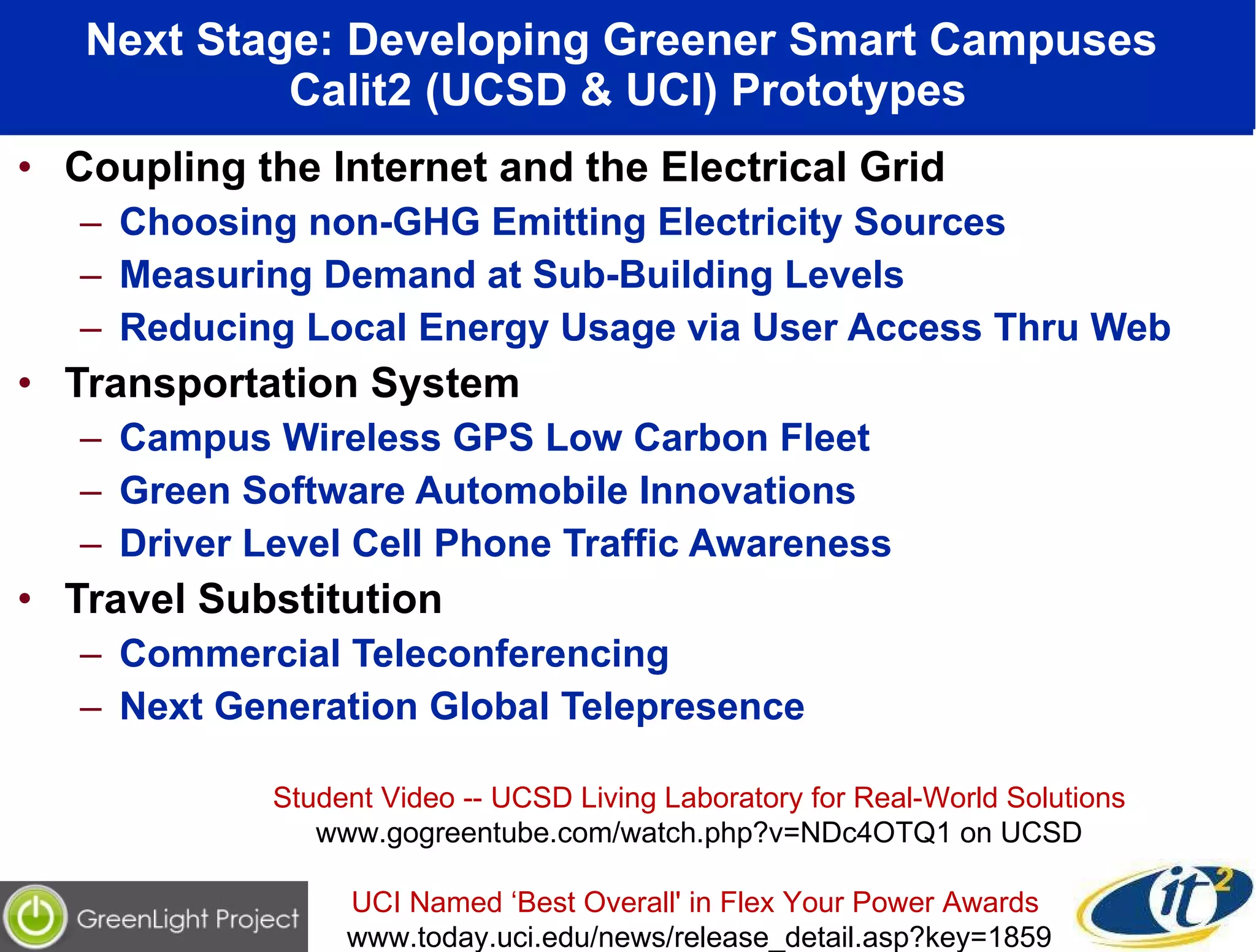
Next Stage: Developing Greener Smart Campuses  Calit2 (UCSD & UCI) Prototypes Coupling the Internet and the Electrical Grid Choosing non-GHG Emitting Electricity Sources Measuring Demand at Sub-Building Levels Reducing Local Energy Usage via User Access Thru Web Transportation System  Campus Wireless GPS Low Carbon Fleet Green Software Automobile Innovations Driver Level Cell Phone Traffic Awareness Travel Substitution Commercial Teleconferencing Next Generation Global Telepresence Student Video -- UCSD Living Laboratory for Real-World Solutions www.gogreentube.com/watch.php?v=NDc4OTQ1 on UCSD UCI Named ‘Best Overall' in Flex Your Power Awards  www.today.uci.edu/news/release_detail.asp?key=1859
Make All PRAGMA Campuses  Living Laboratories for the Greener Future www.educause.edu/EDUCAUSE+Review/EDUCAUSEReviewMagazineVolume44/CampusesasLivingLaboratoriesfo/185217
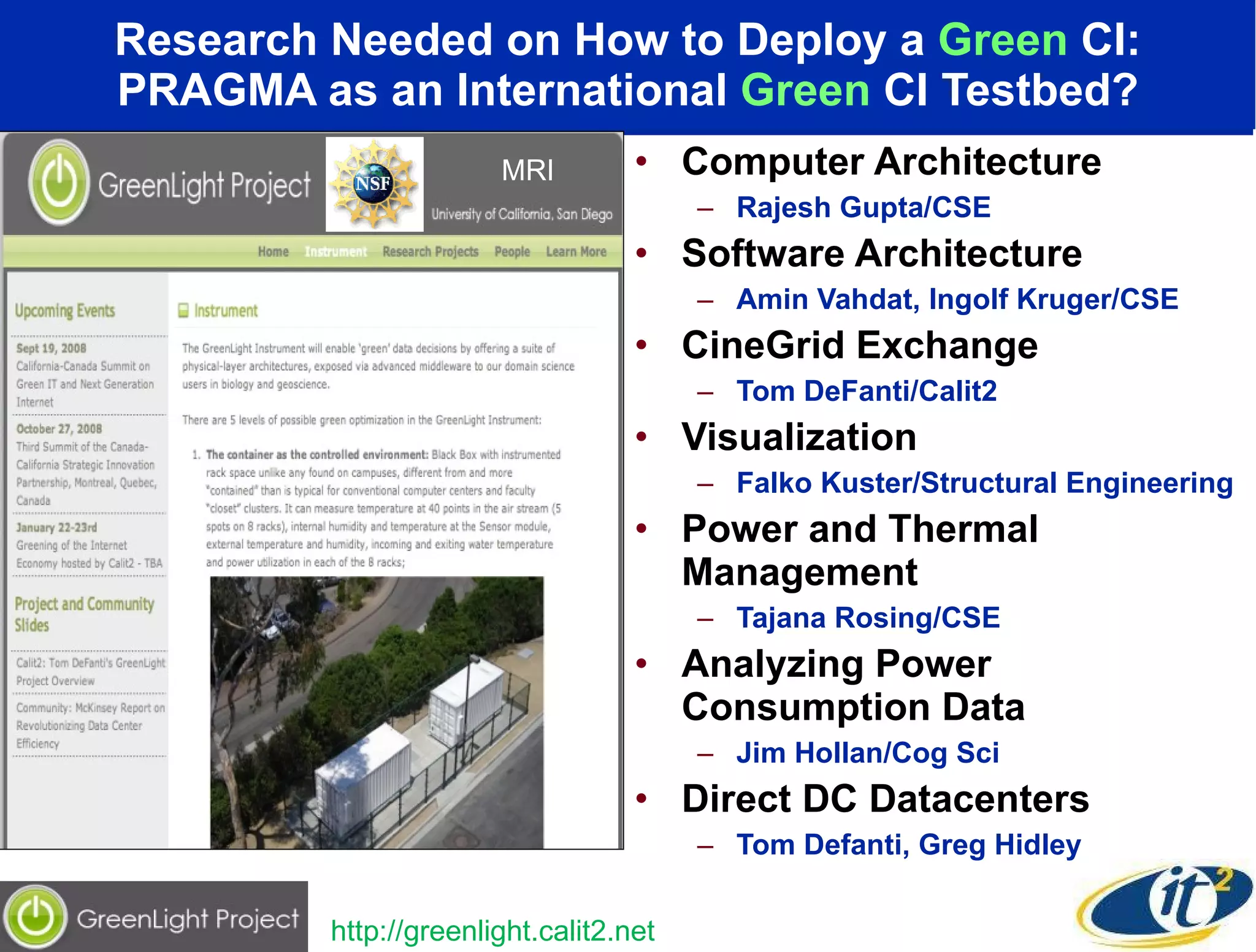
Research Needed on How to Deploy a  Green  CI: PRAGMA as an International  Green  CI Testbed? Computer Architecture  Rajesh Gupta/CSE Software Architecture  Amin Vahdat, Ingolf Kruger/CSE CineGrid Exchange  Tom DeFanti/Calit2 Visualization  Falko Kuster/Structural Engineering Power and Thermal Management  Tajana Rosing/CSE Analyzing Power Consumption Data  Jim Hollan/Cog Sci Direct DC Datacenters Tom Defanti, Greg Hidley http://greenlight.calit2.net MRI
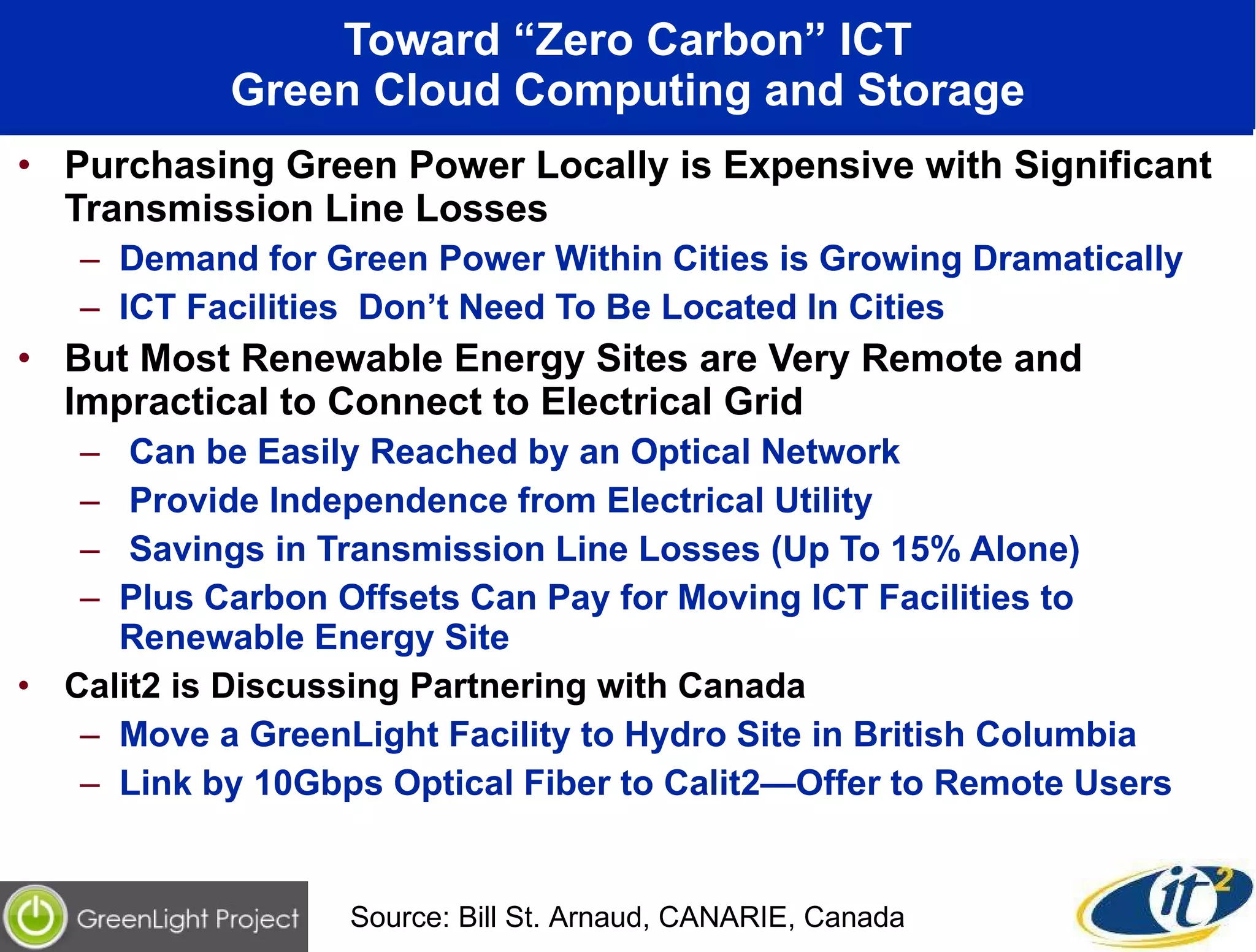
Toward “Zero Carbon” ICT Green Cloud Computing and Storage Purchasing Green Power Locally is Expensive with Significant Transmission Line Losses Demand for Green Power Within Cities is Growing Dramatically ICT Facilities  Don’t Need To Be Located In Cities But Most Renewable Energy Sites are Very Remote and Impractical to Connect to Electrical Grid Can be Easily Reached by an Optical Network Provide Independence from Electrical Utility Savings in Transmission Line Losses (Up To 15% Alone) Plus Carbon Offsets Can Pay for Moving ICT Facilities to Renewable Energy Site Calit2 is Discussing Partnering with Canada  Move a GreenLight Facility to Hydro Site in British Columbia  Link by 10Gbps Optical Fiber to Calit2—Offer to Remote Users Source: Bill St. Arnaud, CANARIE, Canada
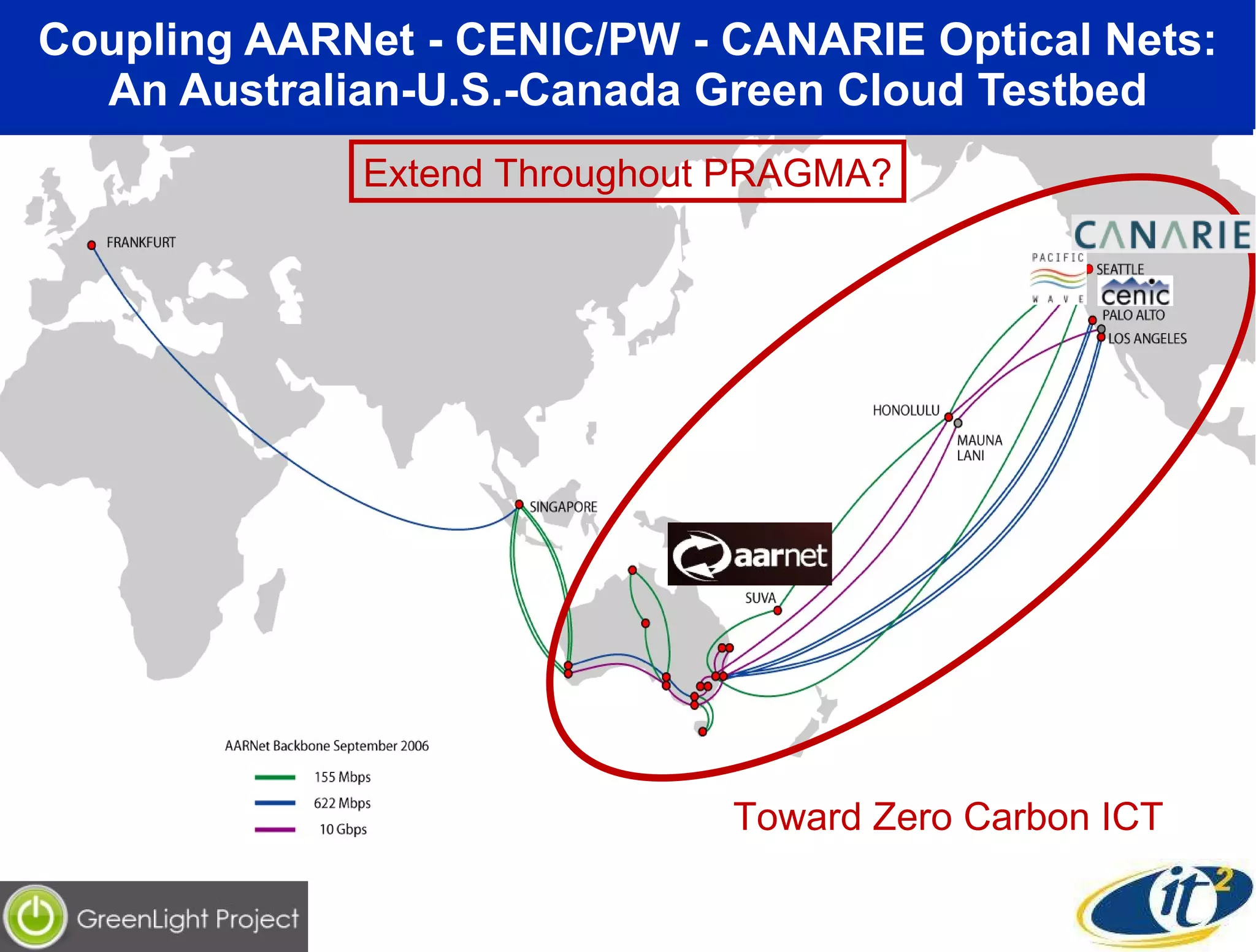
Coupling AARNet - CENIC/PW - CANARIE Optical Nets: An Australian-U.S.-Canada Green Cloud Testbed Extend Throughout PRAGMA? Toward Zero Carbon ICT
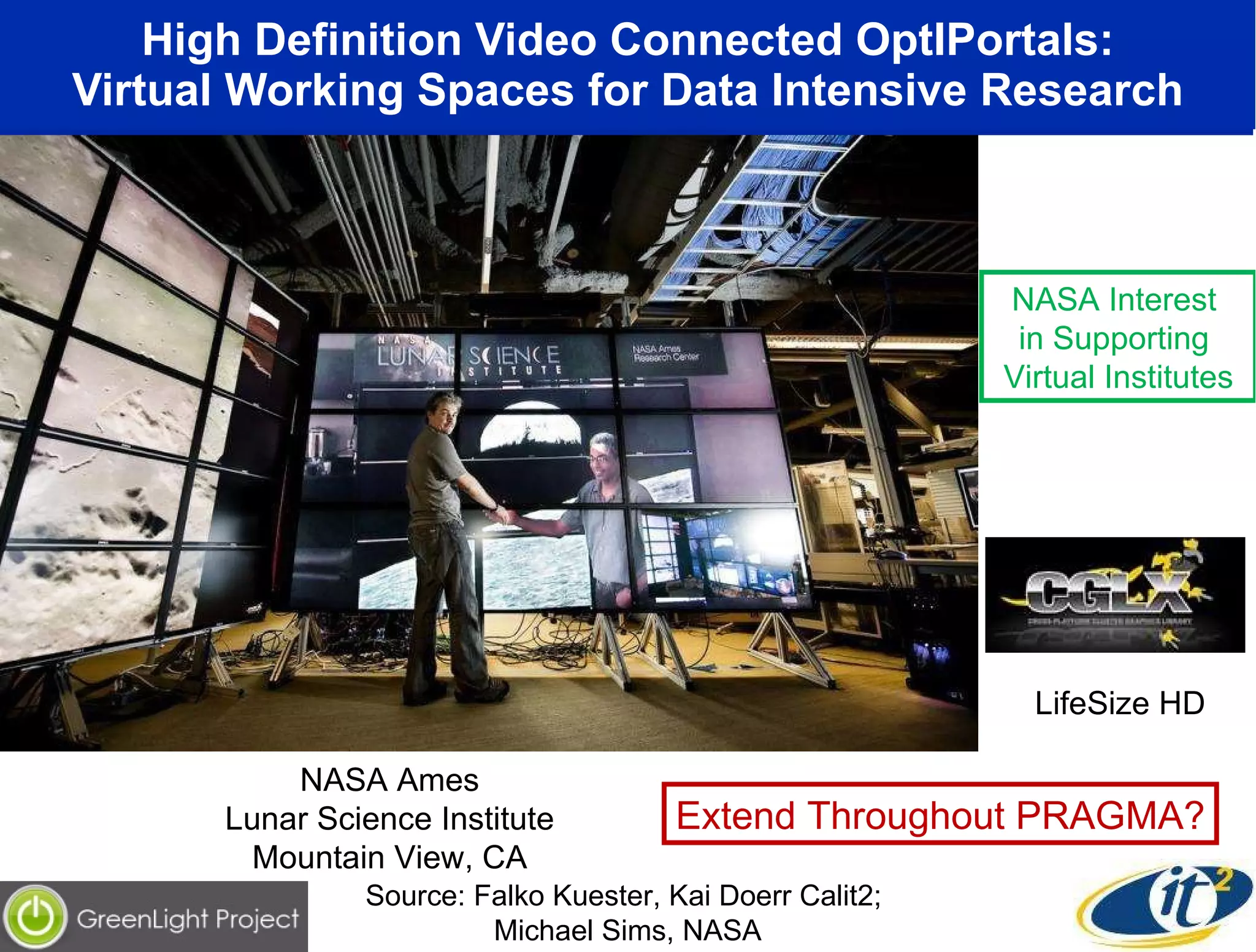
High Definition Video Connected OptIPortals: Virtual Working Spaces for Data Intensive Research Source: Falko Kuester, Kai Doerr Calit2;  Michael Sims, NASA NASA Ames Lunar Science Institute Mountain View, CA NASA Interest  in Supporting  Virtual Institutes LifeSize HD Extend Throughout PRAGMA?
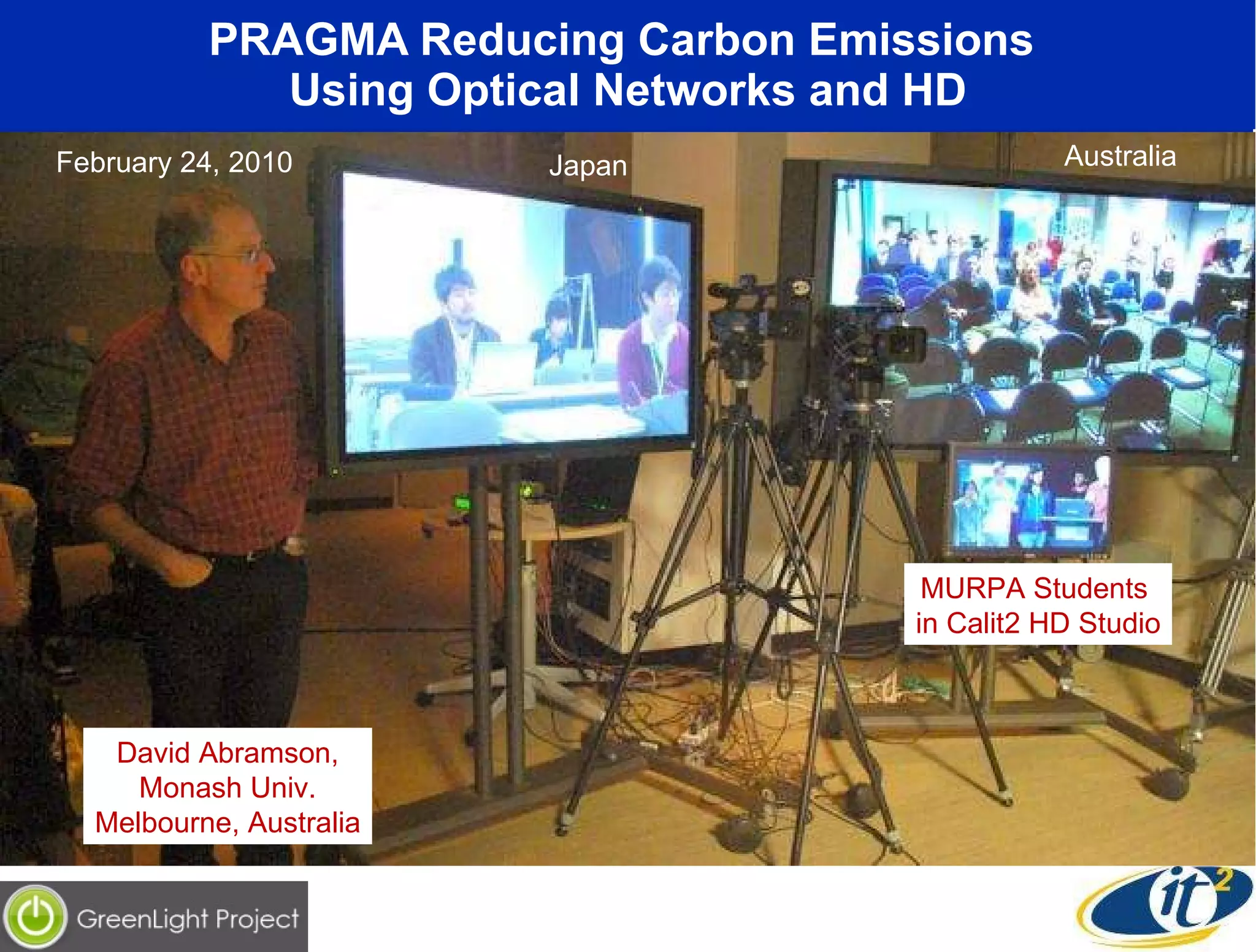
PRAGMA Reducing Carbon Emissions  Using Optical Networks and HD Japan Australia MURPA Students  in Calit2 HD Studio David Abramson, Monash Univ. Melbourne, Australia February 24, 2010
You Can Download This Presentation  at lsmarr.calit2.net

How PRAGMA Can Help Save the Planet

  • 1.
    “ How PRAGMACan Help Save the Planet” Banquet Keynote Speech Pacific Rim Applications and Grid Middleware Assembly (PRAGMA) 18 Birch Aquarium, Scripps Institution of Oceanography, UCSD March 3, 2010 Dr. Larry Smarr Director, California Institute for Telecommunications and Information Technology Harry E. Gruber Professor, Dept. of Computer Science and Engineering Jacobs School of Engineering, UCSD [email_address]
  • 2.
    Abstract I willreview the evidence that global greenhouse gas emissions are causing an impulse to the nonlinear Earth climate system on a scale not seen for millions of years. It is essential that global reduction of such emissions be undertaken immediately. PRAGMA is in an important position to help, because the development and use of Green IT and telecom can provide a near term slowing of the emission rates. The Smart2020.org report shows that much of the opportunity lies in the Pacific Rim, where PRAGMA could be a leader toward a low carbon economy.
  • 3.
    Annual and DecadalMean Temperature Anomalies for Australia Five Decades of Mean Temperature Rise
  • 4.
    Climate Models MatchPast Temperature Variations, Combining Both Natural and Anthropogenic Effects www.aip.org/history/climate/summary.htm &quot;The warmest year on record, 1998, coincides with the 'super-El Nino' of 1997-98,&quot; points out Lean. &quot;The ESNO is capable of producing significant spikes in the temperature record.&quot; Solar minimum has the opposite effect: &quot;A 0.1% decrease in the sun's irradiance has counteracted some of the warming action of greenhouse gases from 2002 - 2008,&quot; she notes. &quot;This is the reason for the well-known 'flat' temperature trend of recent years.&quot;
  • 5.
    History, cont. (4,WH) 1965: White House document 
  • 6.
    NCSA Visualization ofa Doubling of CO 2 Warren Washington NCAR Simulation 1988
  • 7.
    The Unrelenting Climbof CO 2 In Spite of Clear Understanding of the Problem White House Report NCSA Video on Doubling CO 2 Kyoto Protocol Inconvenient Truth
  • 8.
    The Planet isAlready Committed to a Dangerous Level of Warming Temperature Threshold Range that Initiates the Climate-Tipping V. Ramanathan and Y. Feng, Scripps Institution of Oceanography, UCSD September 23, 2008 www.pnas.org/content/105/38/14245.full.pdf+html Additional Warming over 1750 Level Earth Has Only Realized 1/3 of the Committed Warming - Future Emissions of Greenhouse Gases Move Peak to the Right
  • 9.
    Global Climatic DisruptionEarly Signs: Arctic Summer Ice is Rapidly Decreasing &quot;We are almost out of multiyear sea ice in the northern hemisphere--I've never seen anything like this in my 30 years of working in the high Arctic.” --David Barber, Canada's Research Chair in Arctic System Science at the University of Manitoba October 29, 2009 http://news.cnet.com/8301-11128_3-10213891-54.html http://news.yahoo.com/s/nm/20091029/sc_nm/us_climate_canada_arctic_1
  • 10.
    Arctic Summer IceMelting Accelerating Relative to IPCC 2007 Predictions Potentially Volume of Arctic Summer Ice Goes to Zero: Talk by NPS’s Wieslaw Maslowski at AAAS San Diego Feb. 2010 http://aaas.confex.com/aaas/2010/webprogram/Paper1505.html 2020
  • 11.
    Rapid Increase inthe Greenhouse Gas CO 2 Since Industrial Era Began Little Ice Age Medieval Warm Period 388 ppm in 2010 Source: Sustainable Energy -Without the Hot Air By David JC MacKay (2009), p.9
  • 12.
    The Little IceAge: The Climate State Earth is Emerging From The Frozen Thames, 1677 At Jamestown, the colonists had the bad fortune to arrive at the height of the driest seven-year period in 770 years. No fewer than 4,800 of the 6,000 settlers who arrived between 1607 and 1625 perished. -- The Little Ice Age, Brian Fagan http://reference.findtarget.com/search/Little%20Ice%20Age/
  • 13.
    The Medieval WarmPeriod Last Time Global Temperatures Were This High A 300 Year California Megadrought: “ Precipitation was <60% of normal between 950-1250 AD. Several trees were radiocarbon dated to ~1250 AD and are positioned upslope a ~ 60 meter deep submerged paleoshoreline. --Daniel Brothers Ph.D. Thesis UCSD SIO Dec 2009 Lake Tahoe— Largest Alpine Lake in North America But CO 2 in 1250AD was <290ppm; Today ~390ppm
  • 14.
    The Earth isWarming Over 100 Times Faster Today Than During the Last Ice Age Warming! http://scrippsco2.ucsd.edu/program_history/keeling_curve_lessons.html Monnin, et al., Science v. 291 pp. 112-114, Jan. 5, 2001. CO 2 Rose From 185 to 265ppm (80ppm) in 6000 years or 1.33 ppm per Century CO 2 Has Risen From 335 to 385ppm (50ppm) in 30 years or 1.6 ppm per Year
  • 15.
    Future Estimates ofCO 2 Emissions From Energy: An Aggressive CO 2 Emission Reduction Scenario www-static.shell.com/static/public/downloads/brochures/corporate_pkg/scenarios/shell_energy_scenarios_2050.pdf Estimated CO 2 Level in 2100 is 550ppm China India “ China and India resisted signing up for a global goal of halving greenhouse gas emissions by 2050.” — Reuters July 8, 2009 Current CO 2 Level is 388 ppm
  • 16.
    Atmospheric CO 2 Levels for 800,000 Years And Projections for the 21 st Century www.globalchange.gov/publications/reports/scientific-assessments /us-impacts/download-the-report Source: U.S. Global Change Research Program Report (2009) (MIT Study) (Shell Study)
  • 17.
    Sea Level RiseWill Impact 150 Million People by 2100 —The Vast Majority in Asia CO 2 Emissions are an Impulse to Earth Climate System—Equilibrium Response will Take Centuries IPCC 2007 Estimates 1 Meter Sea Level Rise “ Global sea level linked to global temperature,” Martin Vermeer and Stefan Rahmstorf, PNAS, v. 106, 21527–21532 (2009) http://maps.grida.no/go/graphic/population-area-and-economy-affected-by-a-1-m-sea-level-rise-global-and-regional-estimates-based-on-
  • 18.
    Earth’s Climate Hasn’tSeen the Current Level of CO 2 During the Entire Evolution of Homonids! Estimates of Cenozoic atmospheric pCO 2 based on two independent proxies as measured in subtropical deep-sea sediment cores from the Pacific CO 2 : James Zachos, et al. Science v. 292 p. 686 27 Apr. 2001 With No Policy Change, MIT Estimates ~900ppm by 2100 Homonid Images: The Last Human , G.J. Sawyer and V. Deak Current CO 2 Level 550 ppm 900 ppm Australopithecus afarensis Sahelanthropus tchadensis
  • 19.
    Earth’s Climate isRapidly Entering a Novel Realm Not Experienced for Over 20 Million Years “ Global Warming” implies gradual, uniform, mainly about temperature, and quite possibly benign. What’s happening is rapid, non-uniform, affecting everything about climate, and is almost entirely harmful. A more accurate term is ‘global climatic disruption’ This ongoing disruption is: Real without doubt Mainly caused by humans Already producing significant harm Growing more rapidly than expected” - John Holdren, Director Office of Science and Technology Policy June 25, 2008 See Video Lecture: http://greenmonk.net/john-holdren-on-global-climatic-disruption/
  • 20.
    What is Creatingthe Problem and What Can the World Do to Change? “ It Will Be the Biggest Single Peacetime Project Humankind Will Have Ever Undertaken”
  • 21.
    How Can PRAGMAResearch Help Slow Down the Increasing Greenhouse Gas Emissions?
  • 22.
    ICT is aCritical Element in Achieving Countries Greenhouse Gas Emission Reduction Targets www.smart2020.org GeSI member companies: Bell Canada, British Telecomm., Plc, Cisco Systems, Deutsche Telekom AG, Ericsson, France Telecom, Hewlett-Packard, Intel, Microsoft, Nokia, Nokia Siemens Networks, Sun Microsystems, T-Mobile, Telefónica S.A., Telenor, Verizon, Vodafone Plc. Additional support: Dell, LG.
  • 23.
    The Global ICTCarbon Footprint is Significant and Growing at 6% Annually! www.smart2020.org the assumptions behind the growth in emissions expected in 2020: takes into account likely efficient technology developments that affect the power consumption of products and services and their expected penetration in the market in 2020 Most of Growth is in Developing Countries
  • 24.
    Reduction of ICTEmissions is a Global Challenge – U.S. and Canada are Small Sources U.S. plus Canada Percentage Falls From 25% to 14% of Global ICT Emissions by 2020 www.smart2020.org
  • 25.
    The Global ICTCarbon Footprint by Subsector www.smart2020.org The Number of PCs (Desktops and Laptops) Globally is Expected to Increase from 592 Million in 2002 to More Than Four Billion in 2020 PCs Are Biggest Problem Data Centers Are Rapidly Improving
  • 26.
    Increasing Laptop EnergyEfficiency: Putting Machines To Sleep Transparently Somniloquy Enables Servers to Enter and Exit Sleep While Maintaining Their Network and Application Level Presence Rajesh Gupta, UCSD CSE; Calit2 Peripheral Laptop Low power domain Network interface Secondary processor Network interface Management software Main processor, RAM, etc
  • 27.
    Application of ICTCan Lead to a 5-Fold Greater Decrease in GHGs Than its Own Carbon Footprint Major Opportunities for the United States* Smart Electrical Grids Smart Transportation Systems Smart Buildings Virtual Meetings * Smart 2020 United States Report Addendum www.smart2020.org While the sector plans to significantly step up the energy efficiency of its products and services, ICT’s largest influence will be by enabling energy efficiencies in other sectors, an opportunity that could deliver carbon savings five times larger than the total emissions from the entire ICT sector in 2020. --Smart 2020 Report
  • 28.
    Next Stage: DevelopingGreener Smart Campuses Calit2 (UCSD & UCI) Prototypes Coupling the Internet and the Electrical Grid Choosing non-GHG Emitting Electricity Sources Measuring Demand at Sub-Building Levels Reducing Local Energy Usage via User Access Thru Web Transportation System Campus Wireless GPS Low Carbon Fleet Green Software Automobile Innovations Driver Level Cell Phone Traffic Awareness Travel Substitution Commercial Teleconferencing Next Generation Global Telepresence Student Video -- UCSD Living Laboratory for Real-World Solutions www.gogreentube.com/watch.php?v=NDc4OTQ1 on UCSD UCI Named ‘Best Overall' in Flex Your Power Awards www.today.uci.edu/news/release_detail.asp?key=1859
  • 29.
    Make All PRAGMACampuses Living Laboratories for the Greener Future www.educause.edu/EDUCAUSE+Review/EDUCAUSEReviewMagazineVolume44/CampusesasLivingLaboratoriesfo/185217
  • 30.
    Research Needed onHow to Deploy a Green CI: PRAGMA as an International Green CI Testbed? Computer Architecture Rajesh Gupta/CSE Software Architecture Amin Vahdat, Ingolf Kruger/CSE CineGrid Exchange Tom DeFanti/Calit2 Visualization Falko Kuster/Structural Engineering Power and Thermal Management Tajana Rosing/CSE Analyzing Power Consumption Data Jim Hollan/Cog Sci Direct DC Datacenters Tom Defanti, Greg Hidley http://greenlight.calit2.net MRI
  • 31.
    Toward “Zero Carbon”ICT Green Cloud Computing and Storage Purchasing Green Power Locally is Expensive with Significant Transmission Line Losses Demand for Green Power Within Cities is Growing Dramatically ICT Facilities Don’t Need To Be Located In Cities But Most Renewable Energy Sites are Very Remote and Impractical to Connect to Electrical Grid Can be Easily Reached by an Optical Network Provide Independence from Electrical Utility Savings in Transmission Line Losses (Up To 15% Alone) Plus Carbon Offsets Can Pay for Moving ICT Facilities to Renewable Energy Site Calit2 is Discussing Partnering with Canada Move a GreenLight Facility to Hydro Site in British Columbia Link by 10Gbps Optical Fiber to Calit2—Offer to Remote Users Source: Bill St. Arnaud, CANARIE, Canada
  • 32.
    Coupling AARNet -CENIC/PW - CANARIE Optical Nets: An Australian-U.S.-Canada Green Cloud Testbed Extend Throughout PRAGMA? Toward Zero Carbon ICT
  • 33.
    High Definition VideoConnected OptIPortals: Virtual Working Spaces for Data Intensive Research Source: Falko Kuester, Kai Doerr Calit2; Michael Sims, NASA NASA Ames Lunar Science Institute Mountain View, CA NASA Interest in Supporting Virtual Institutes LifeSize HD Extend Throughout PRAGMA?
  • 34.
    PRAGMA Reducing CarbonEmissions Using Optical Networks and HD Japan Australia MURPA Students in Calit2 HD Studio David Abramson, Monash Univ. Melbourne, Australia February 24, 2010
  • 35.
    You Can DownloadThis Presentation at lsmarr.calit2.net