
Sustainable Computing and Telecom  Can Contribute to Limiting  Global Climatic Disruption Invited Seminar AT&T Shannon Labs  Florham Park, NJ  July 28, 2010 Dr. Larry Smarr Director, California Institute for Telecommunications and Information Technology Harry E. Gruber Professor,  Dept. of Computer Science and Engineering Jacobs School of Engineering, UCSD
Abstract The Copenhagen Summit concluded that greenhouse gas emissions must be reduced in the coming decade if we are to limit global warming to 2 degrees C (The Earth has warmed ~0.8 degrees C since pre-industrial times). The International Energy Agency has shown what a radical challenge such a reduction will be for the global energy sector, but any solution requires increasing energy efficiency in electrical devices. The Information and Communication Technology (ICT) industry's Smart 2020 study reveals that the ICT industry produces ~2-3 percent of global greenhouse gas emissions. Furthermore, the ICT sector’s emissions will nearly triple, in a business-as-usual scenario, from 2002 to 2020. On the other hand, the Climate Group estimates that transformative applications of ICT to electricity grids, logistic chains, intelligent transportation and building infrastructure, and other social systems can reduce global greenhouse gas emissions by about 15 percent— five times ICT’s own footprint! I will give results on several Calit2 affiliated projects aimed at increasing ICT energy efficiency, including for individual PCs, from the NSF-funded GreenLight Project (http://greenlight.calit2.net), deployed at UCSD, which creates an instrumented data center, to cellular base stations. At a higher level, we are using the two Calit2 university campuses (UC San Diego and UC Irvine) themselves as at-scale Green IT testbeds. Campuses are functionally small towns with their own power grids, commuter transportation systems, hospitals, and populations in the tens of thousands.  Calit2 is working with campus administration, faculty and staff to instrument these campuses as Living Laboratories of the Greener Future.
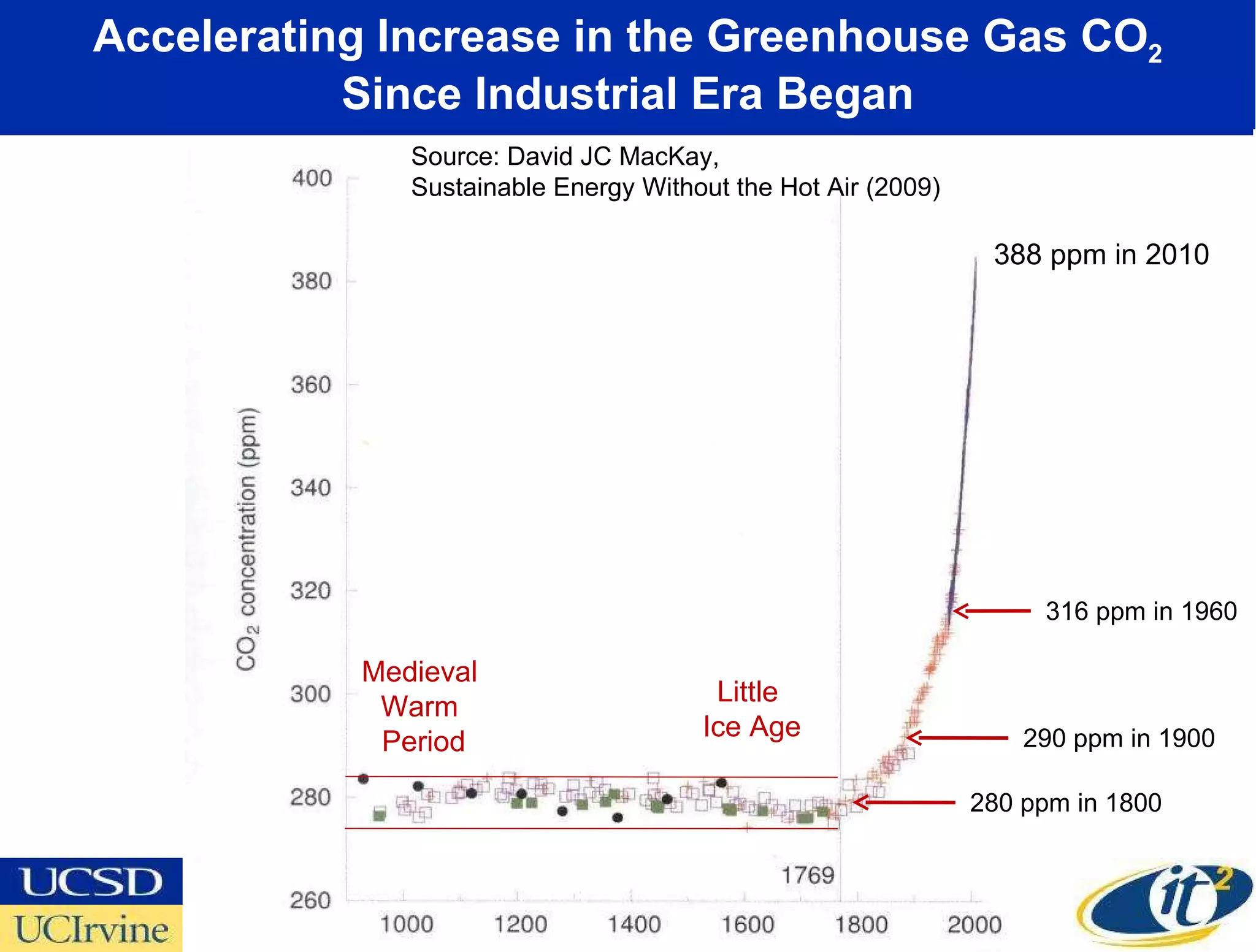
Accelerating Increase in the Greenhouse Gas CO 2 Since Industrial Era Began Little  Ice Age Medieval  Warm  Period 388 ppm in 2010 Source: David JC MacKay,  Sustainable Energy Without the Hot Air (2009)  290 ppm in 1900 316 ppm in 1960 280 ppm in 1800
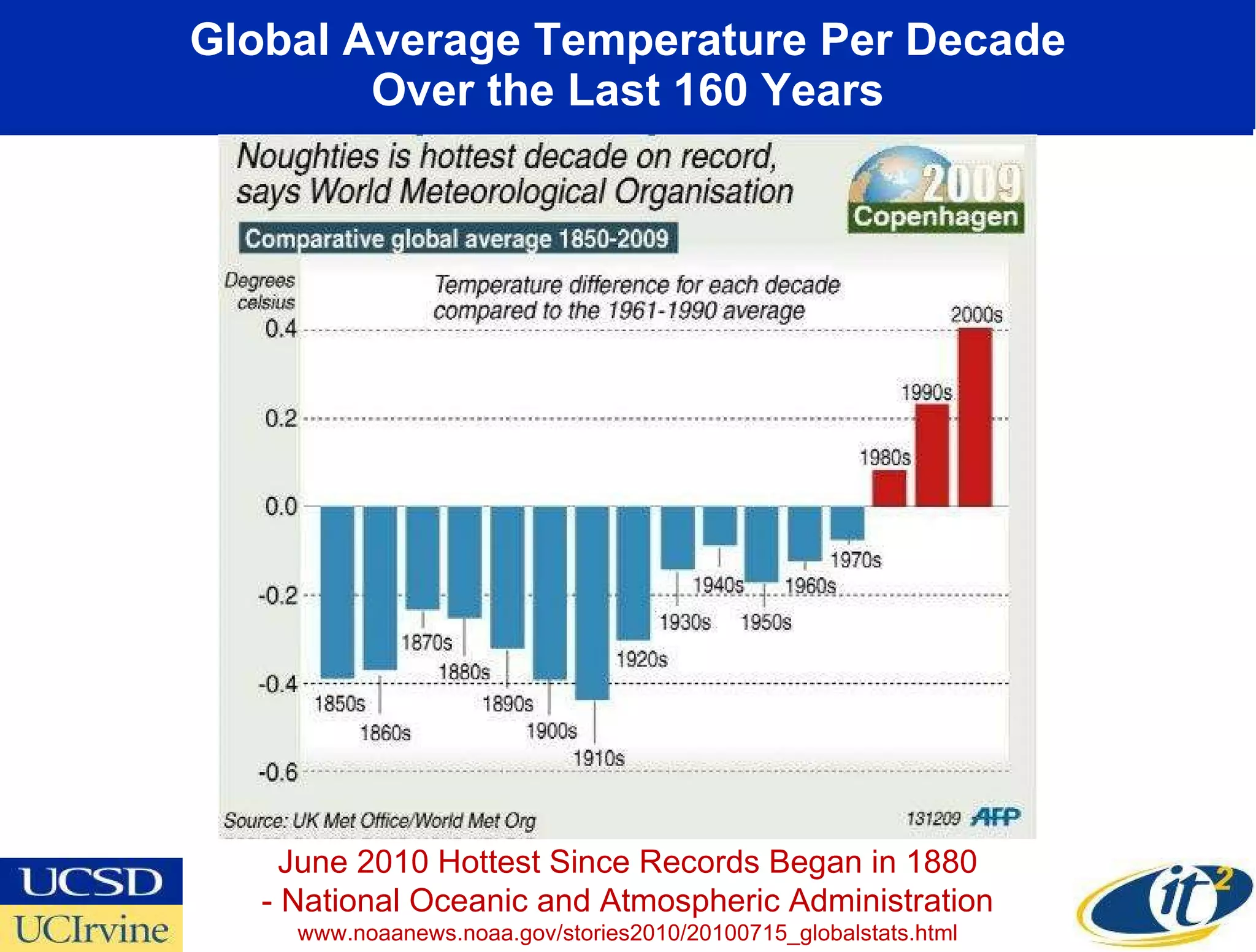
Global Average Temperature Per Decade Over the Last 160 Years June 2010 Hottest Since Records Began in 1880 - National Oceanic and Atmospheric Administration www.noaanews.noaa.gov/stories2010/20100715_globalstats.html
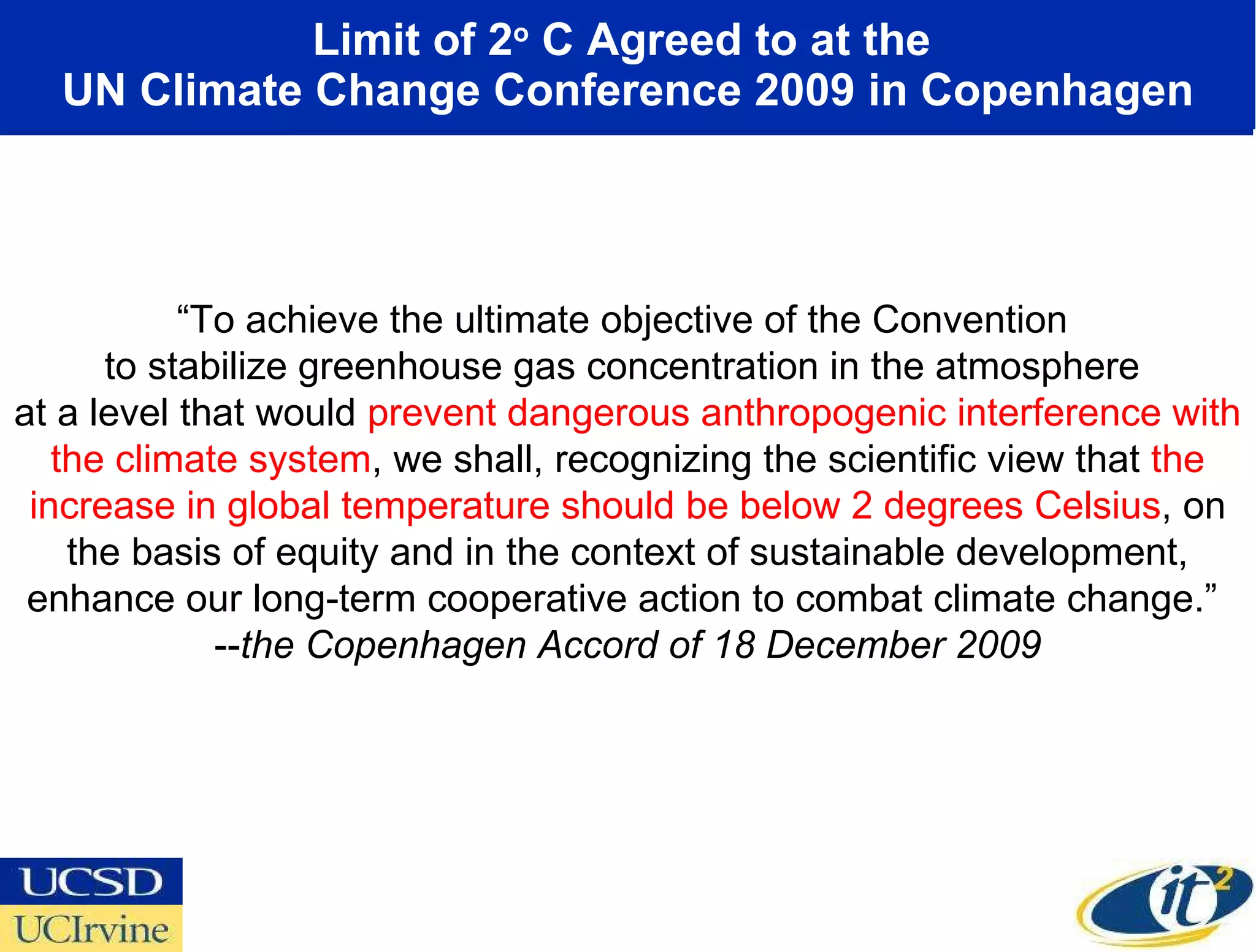
Limit of 2 o  C Agreed to at the  UN Climate Change Conference 2009 in Copenhagen “ To achieve the ultimate objective of the Convention  to stabilize greenhouse gas concentration in the atmosphere  at a level that would  prevent dangerous anthropogenic interference with the climate system , we shall, recognizing the scientific view that  the increase in global temperature should be below 2 degrees Celsius , on the basis of equity and in the context of sustainable development, enhance our long-term cooperative action to combat climate change.”  -- the Copenhagen Accord of 18 December 2009
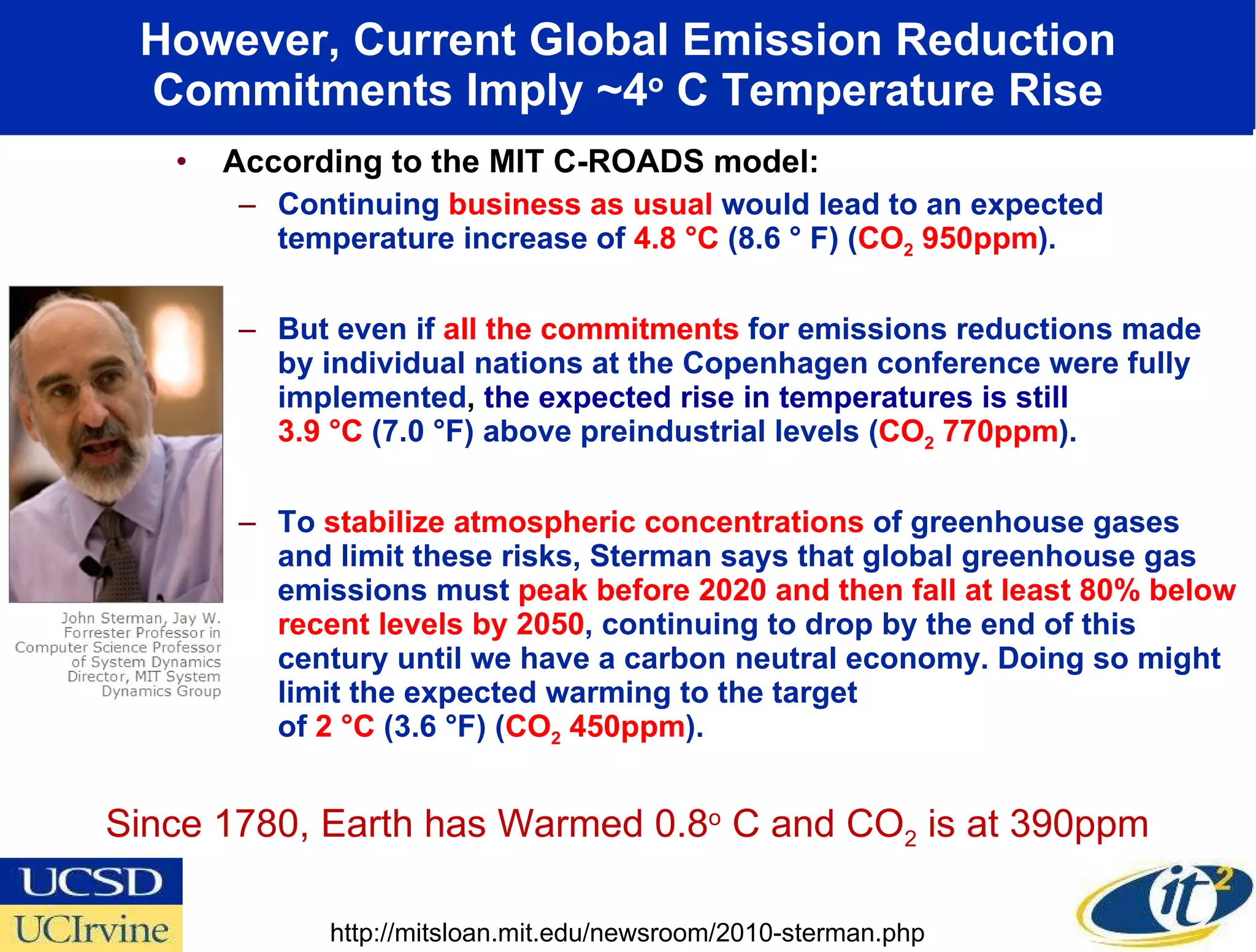
However, Current Global Emission Reduction Commitments Imply ~4 o  C Temperature Rise According to the MIT C-ROADS model:  Continuing  business as usual  would lead to an expected temperature increase of  4.8 °C  (8.6 ° F) ( CO 2  950ppm ).  But even if  all the commitments  for emissions reductions made by individual nations at the Copenhagen conference were fully implemented ,  the expected rise in temperatures is still  3.9 °C  (7.0 °F) above preindustrial levels ( CO 2  770ppm ). To  stabilize atmospheric concentrations  of greenhouse gases and limit these risks, Sterman says that global greenhouse gas emissions must  peak before 2020 and then fall at least 80% below recent levels by 2050 , continuing to drop by the end of this century until we have a carbon neutral economy. Doing so might limit the expected warming to the target  of  2 °C  (3.6 °F) ( CO 2  450ppm ).  http://mitsloan.mit.edu/newsroom/2010-sterman.php Since 1780, Earth has Warmed 0.8 o  C and CO 2  is at 390ppm
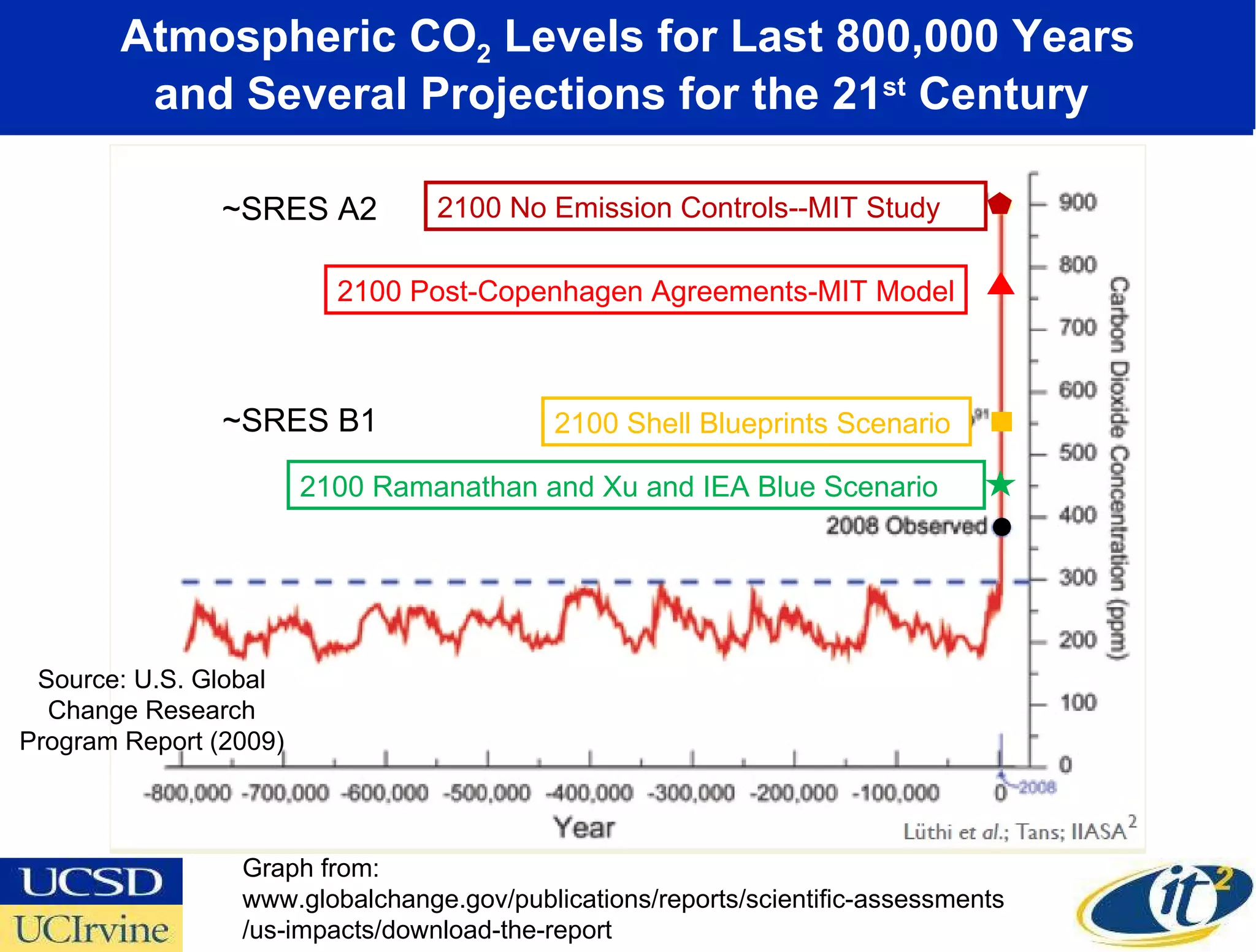
Atmospheric CO 2  Levels for Last 800,000 Years and Several Projections for the 21 st  Century  Source: U.S. Global Change Research Program Report (2009) ~SRES B1 ~SRES A2 Graph from:  www.globalchange.gov/publications/reports/scientific-assessments /us-impacts/download-the-report 2100 No Emission Controls--MIT Study 2100 Shell Blueprints Scenario  2100 Ramanathan and Xu and IEA Blue Scenario 2100 Post-Copenhagen Agreements-MIT Model
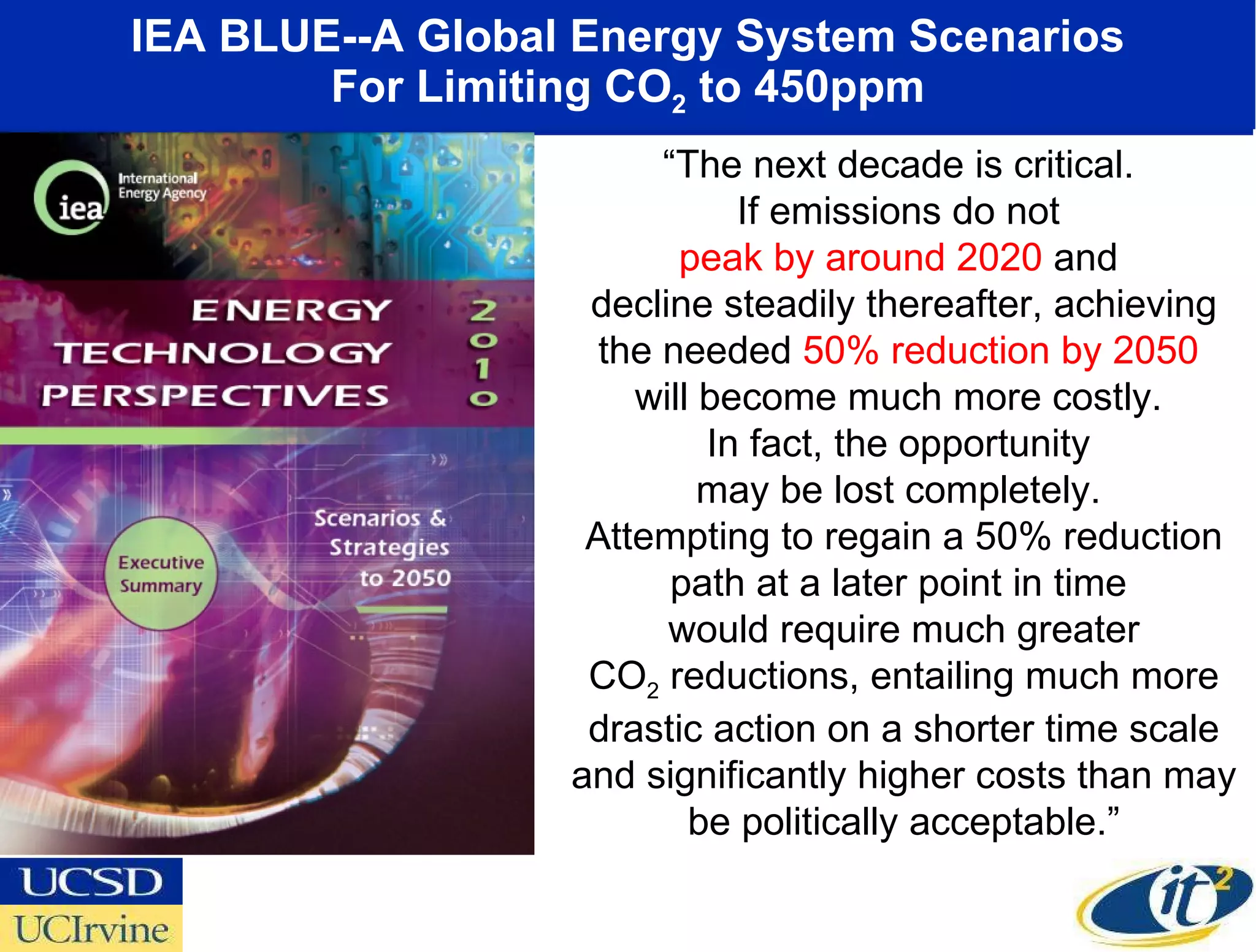
IEA BLUE--A Global Energy System Scenarios For Limiting CO 2  to 450ppm “ The next decade is critical.  If emissions do not  peak by around 2020  and  decline steadily thereafter, achieving the needed  50% reduction by 2050  will become much more costly.  In fact, the opportunity  may be lost completely.  Attempting to regain a 50% reduction path at a later point in time  would require much greater CO 2  reductions, entailing much more drastic action on a shorter time scale and significantly higher costs than may be politically acceptable.”
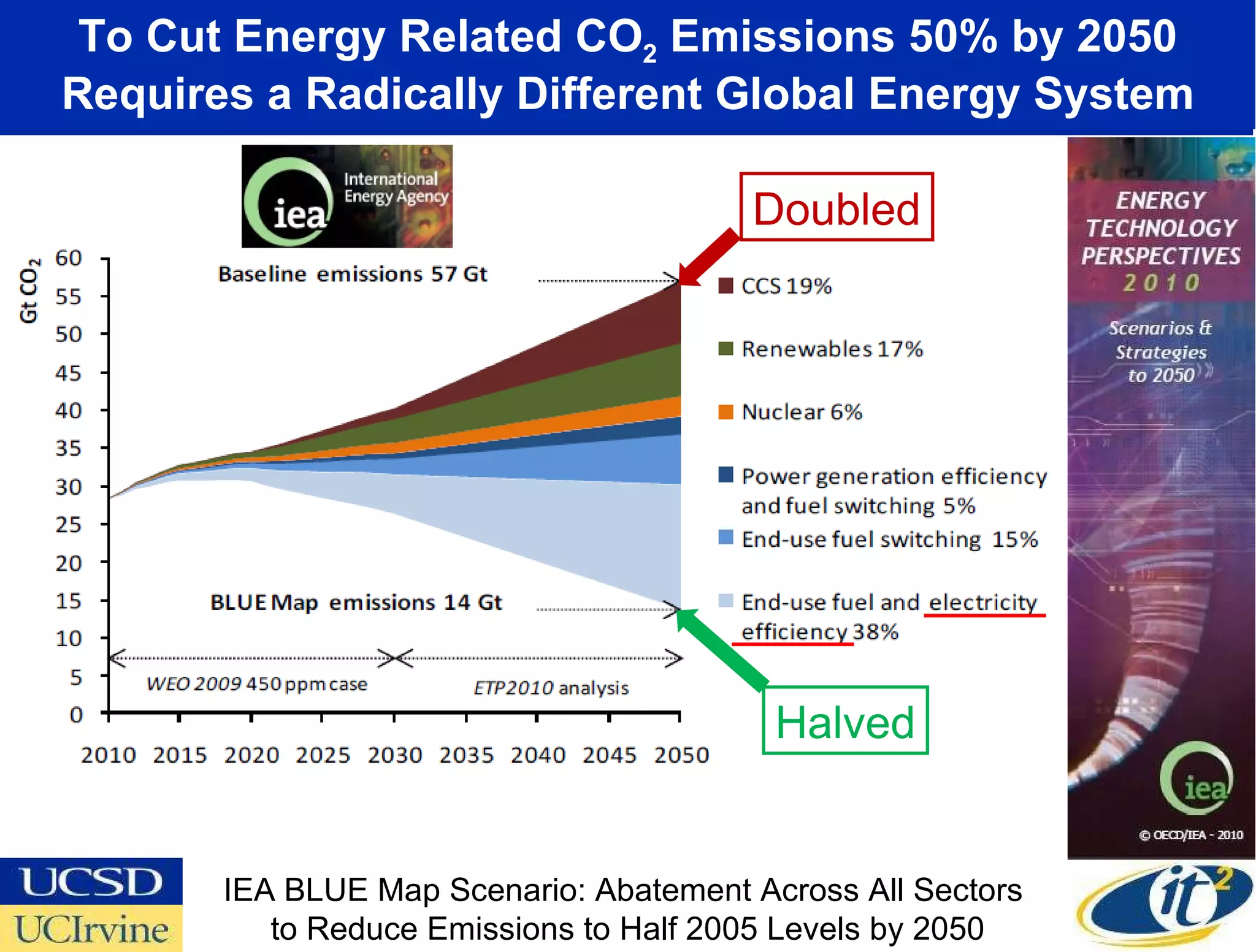
To Cut Energy Related CO 2  Emissions 50% by 2050 Requires a Radically Different Global Energy System IEA BLUE Map Scenario: Abatement Across All Sectors  to Reduce Emissions to Half 2005 Levels by 2050 Halved Doubled
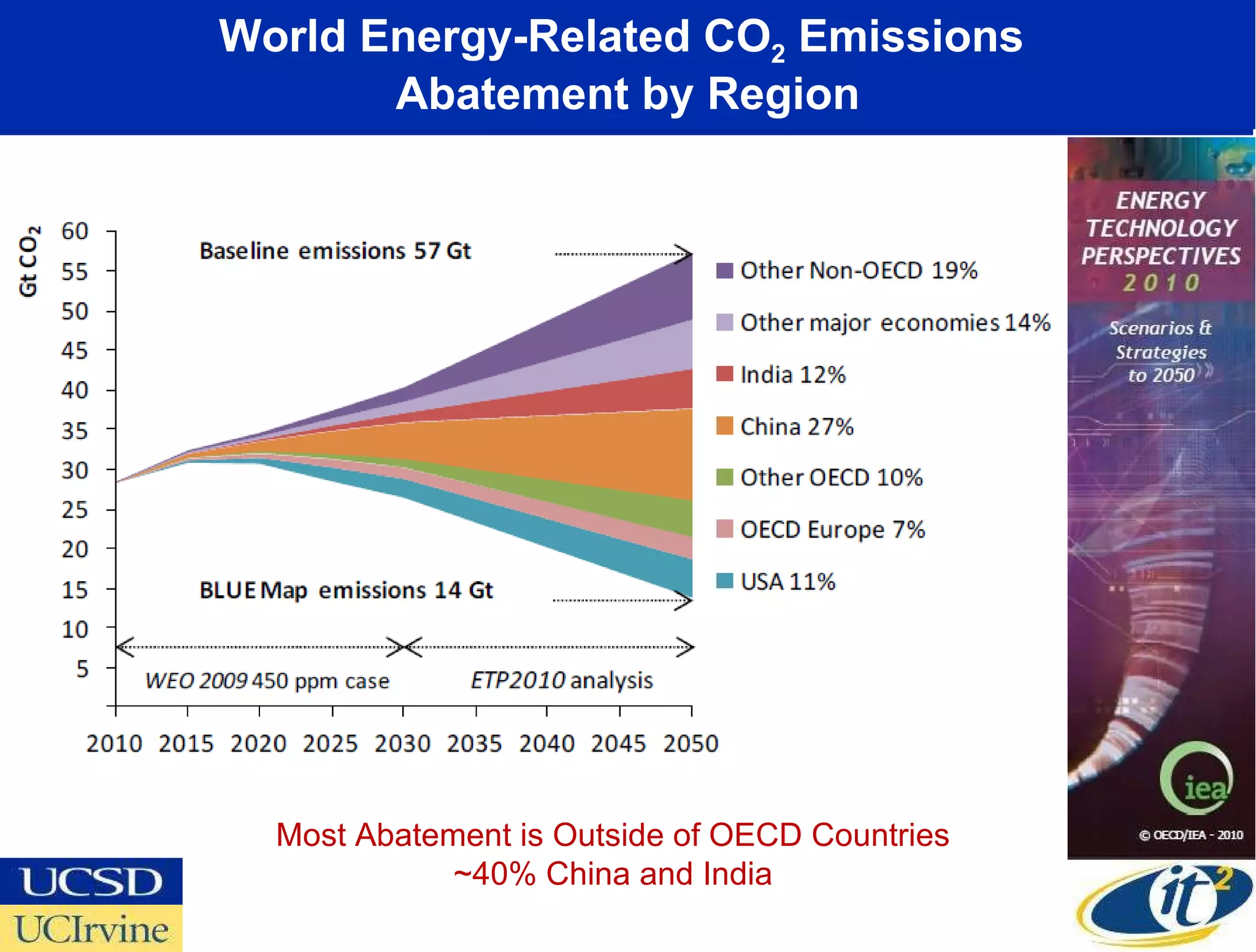
World Energy-Related CO 2  Emissions  Abatement by Region Most Abatement is Outside of OECD Countries ~40% China and India
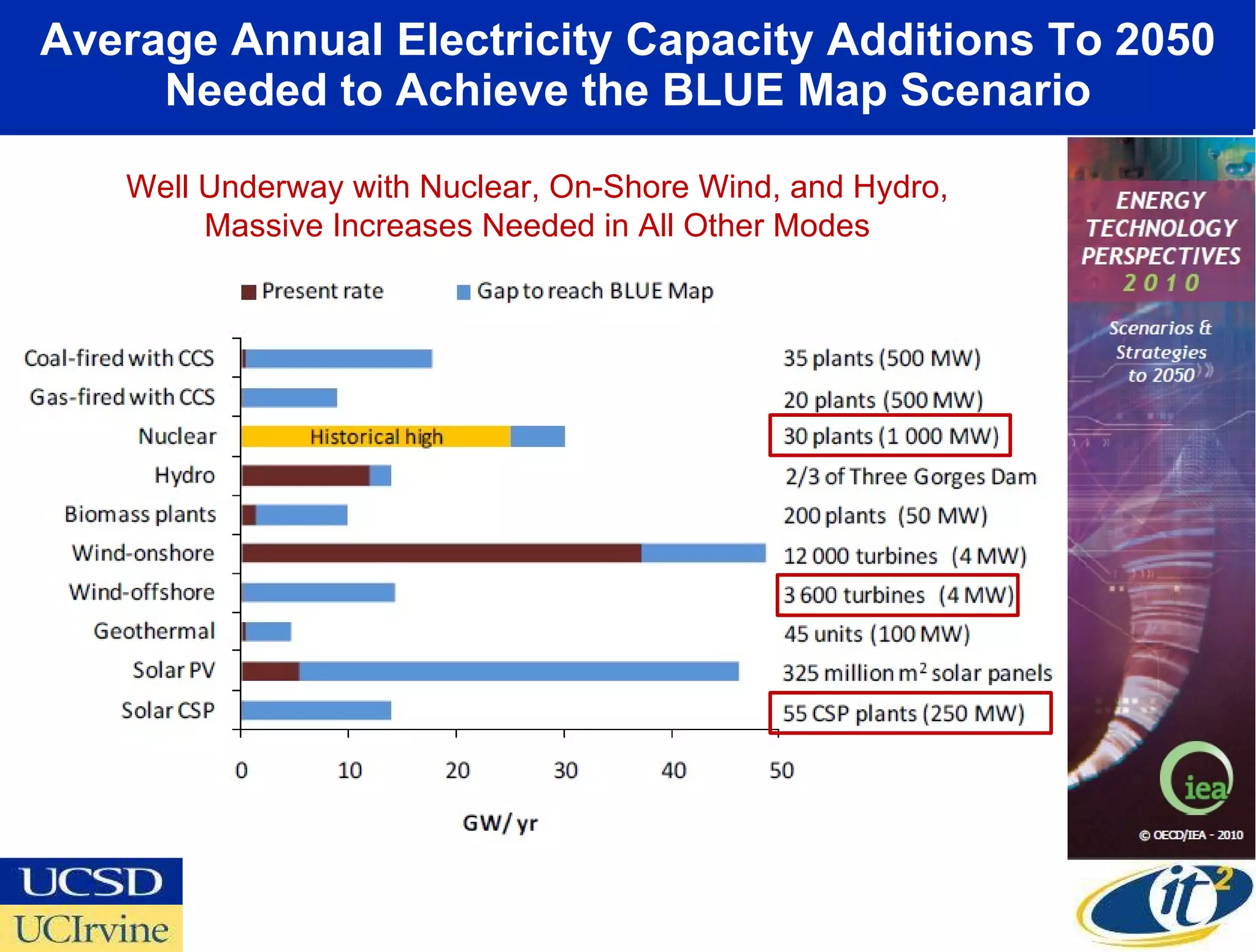
Average Annual Electricity Capacity Additions To 2050 Needed to Achieve the BLUE Map Scenario Well Underway with Nuclear, On-Shore Wind, and Hydro, Massive Increases Needed in All Other Modes
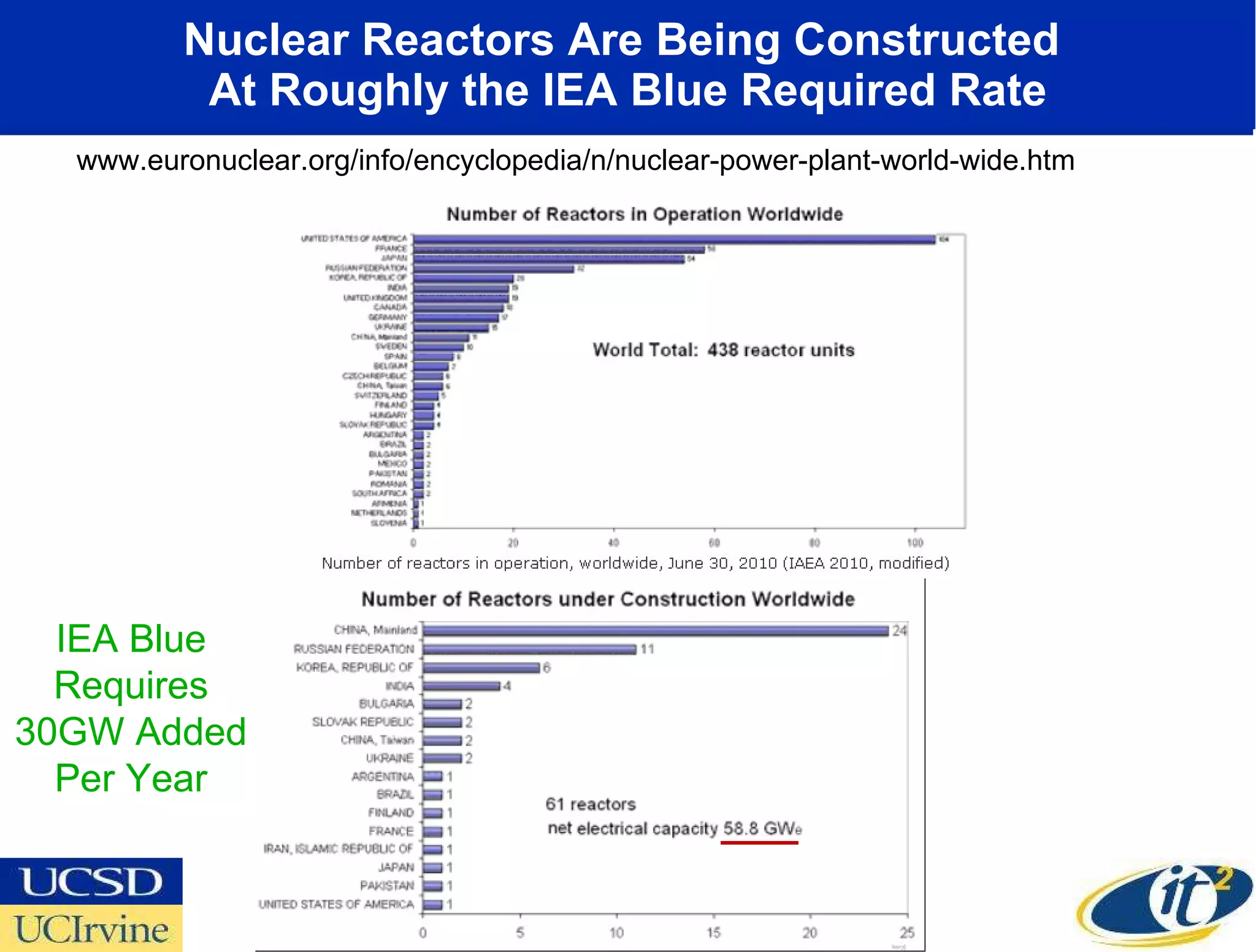
Nuclear Reactors Are Being Constructed  At Roughly the IEA Blue Required Rate www.euronuclear.org/info/encyclopedia/n/nuclear-power-plant-world-wide.htm IEA Blue Requires 30GW Added Per Year
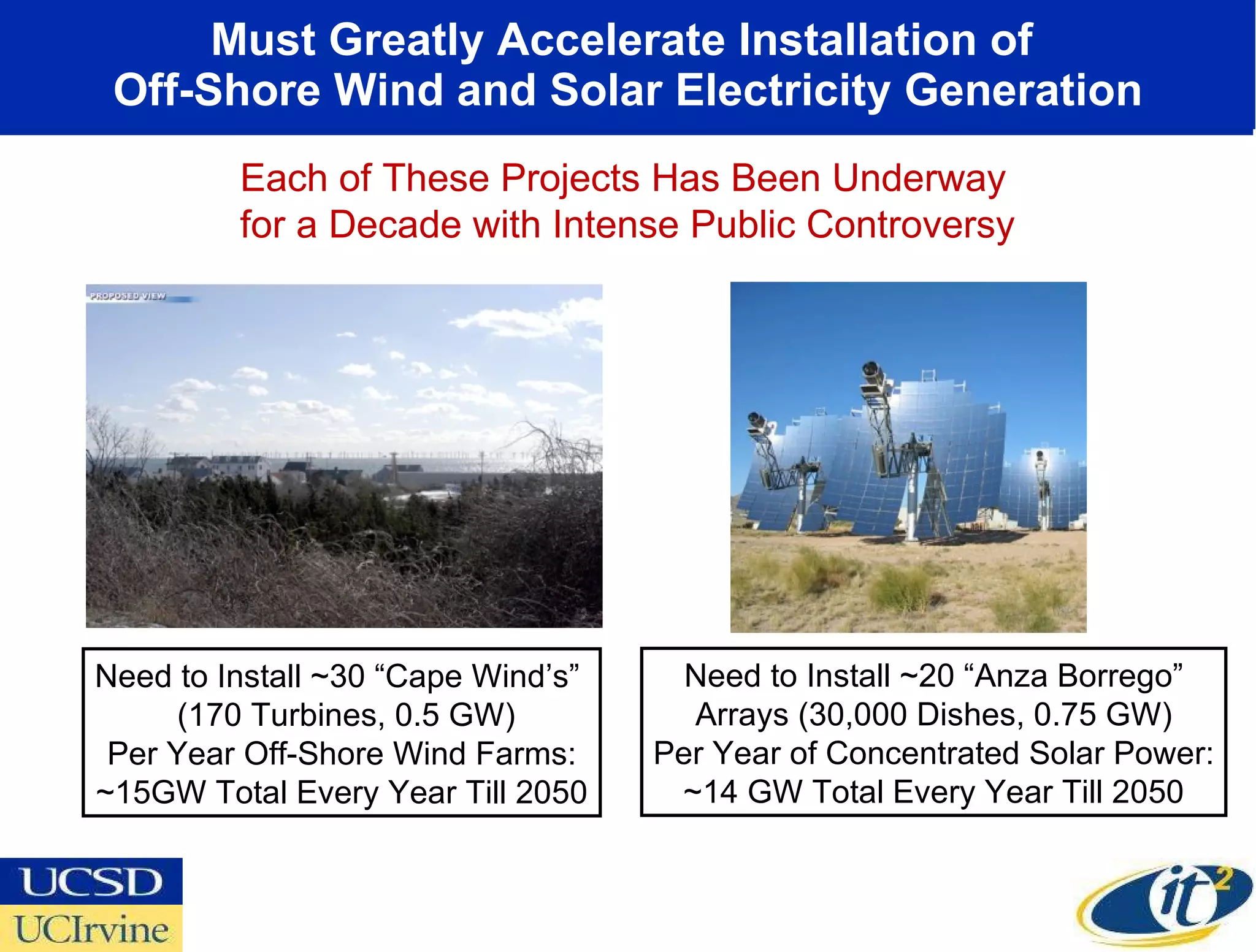
Must Greatly Accelerate Installation of  Off-Shore Wind and Solar Electricity Generation Need to Install ~30 “Cape Wind’s”   (170 Turbines, 0.5 GW) Per Year Off-Shore Wind Farms: ~15GW Total Every Year Till 2050 Need to Install ~20 “Anza Borrego” Arrays (30,000 Dishes, 0.75 GW) Per Year of Concentrated Solar Power: ~14 GW Total Every Year Till 2050 Each of These Projects Has Been Underway for a Decade with Intense Public Controversy
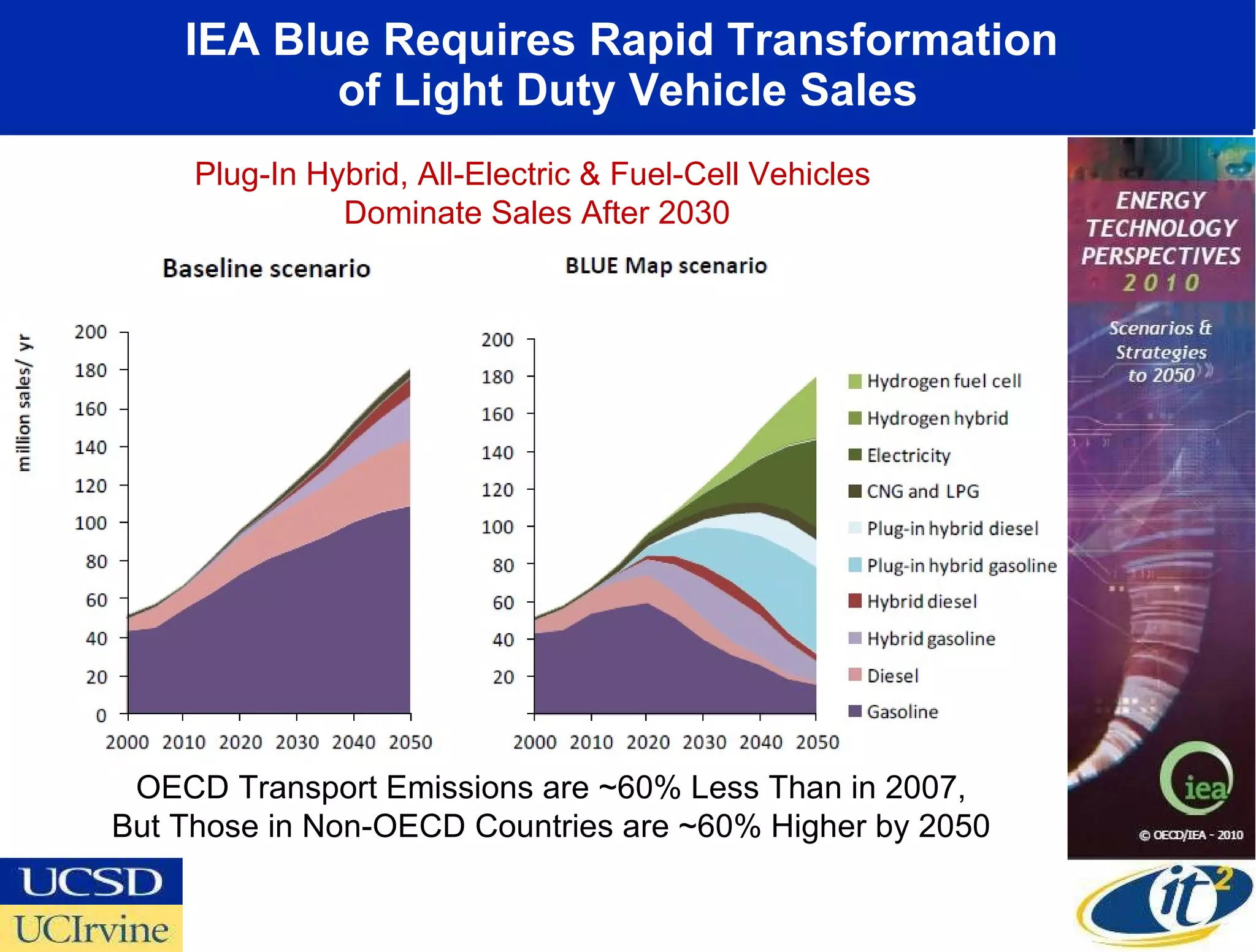
IEA Blue Requires Rapid Transformation  of Light Duty Vehicle Sales Plug-In Hybrid, All-Electric & Fuel-Cell Vehicles  Dominate Sales After 2030 OECD Transport Emissions are ~60% Less Than in 2007,  But Those in Non-OECD Countries are ~60% Higher by 2050
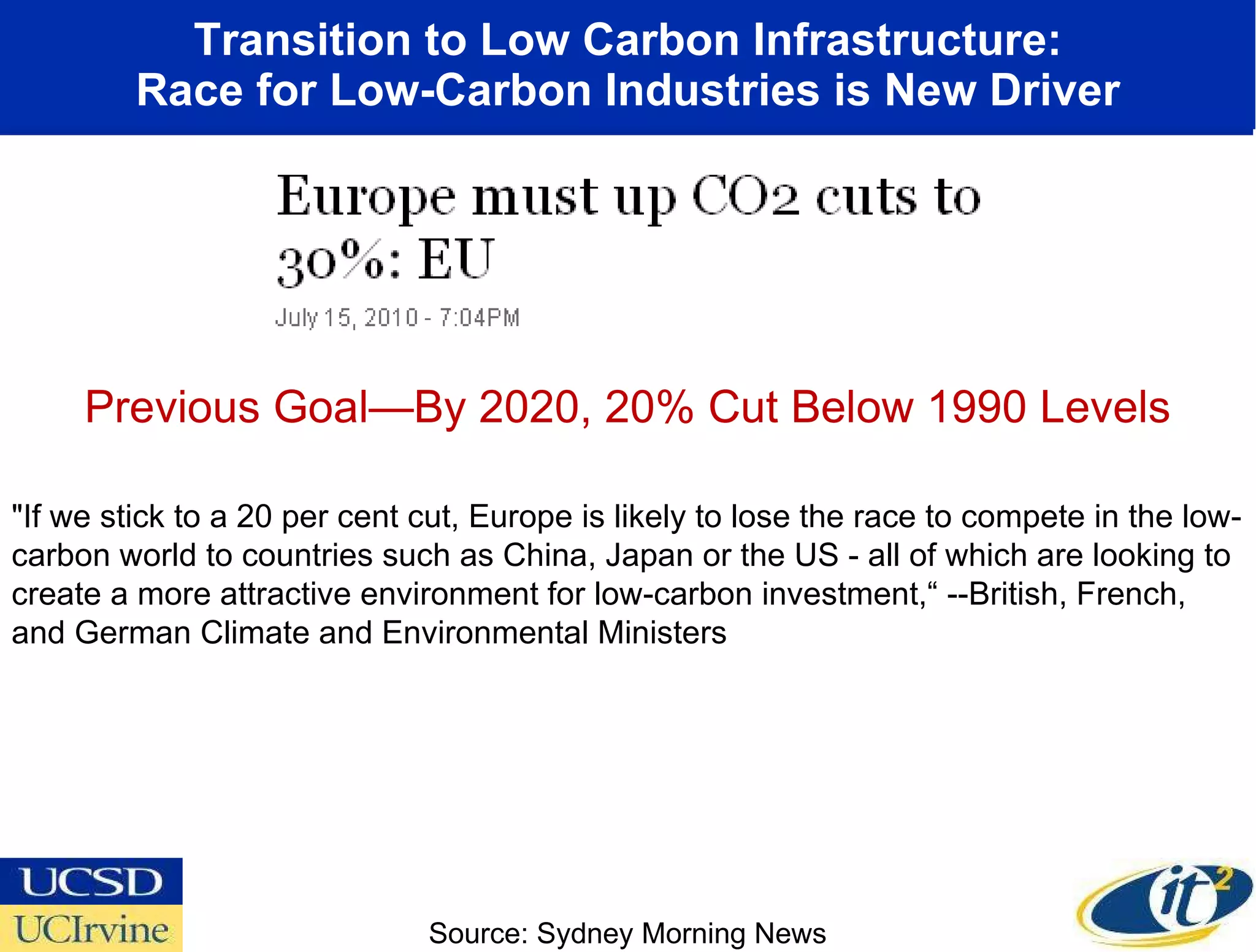
Transition to Low Carbon Infrastructure: Race for Low-Carbon Industries is New Driver "If we stick to a 20 per cent cut, Europe is likely to lose the race to compete in the low-carbon world to countries such as China, Japan or the US - all of which are looking to create a more attractive environment for low-carbon investment,“ --British, French, and German Climate and Environmental Ministers Previous Goal—By 2020, 20% Cut Below 1990 Levels Source: Sydney Morning News
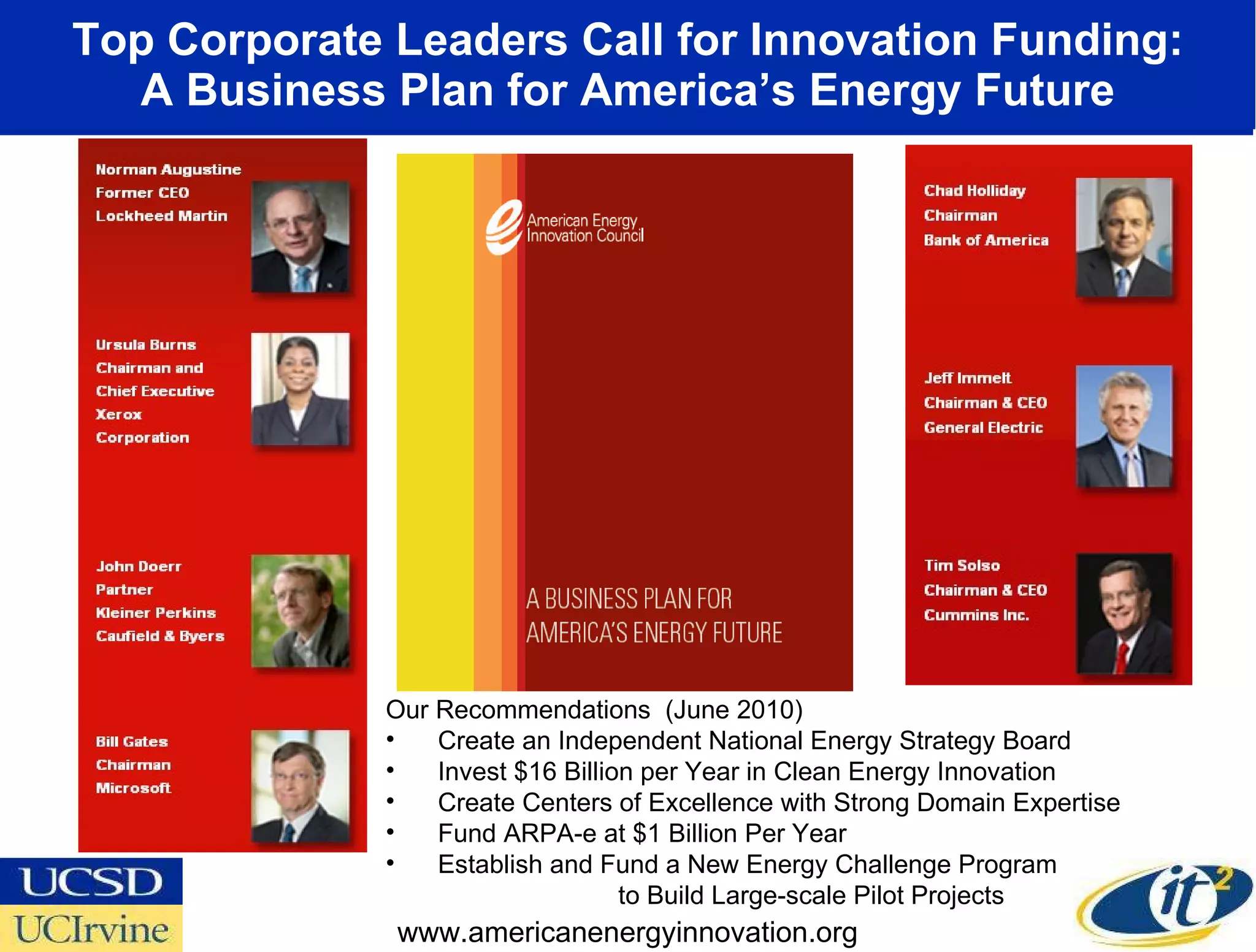
Top Corporate Leaders Call for Innovation Funding: A Business Plan for America’s Energy Future www.americanenergyinnovation.org Our Recommendations  (June 2010) Create an Independent National Energy Strategy Board Invest $16 Billion per Year in Clean Energy Innovation Create Centers of Excellence with Strong Domain Expertise Fund ARPA-e at $1 Billion Per Year Establish and Fund a New Energy Challenge Program  to Build Large-scale Pilot Projects
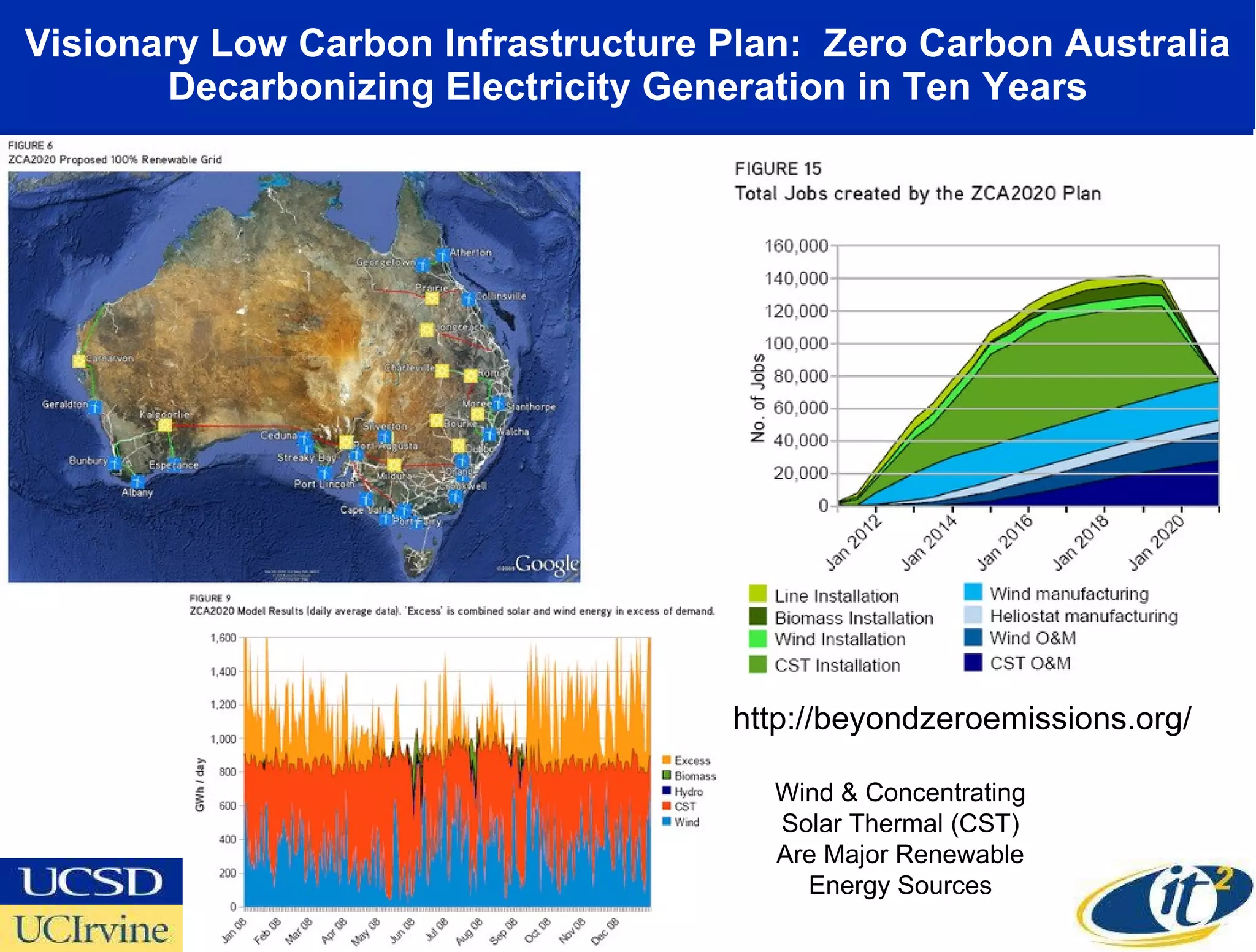
Visionary Low Carbon Infrastructure Plan:  Zero Carbon Australia Decarbonizing Electricity Generation in Ten Years http://beyondzeroemissions.org/ Wind & Concentrating Solar Thermal (CST) Are Major Renewable Energy Sources
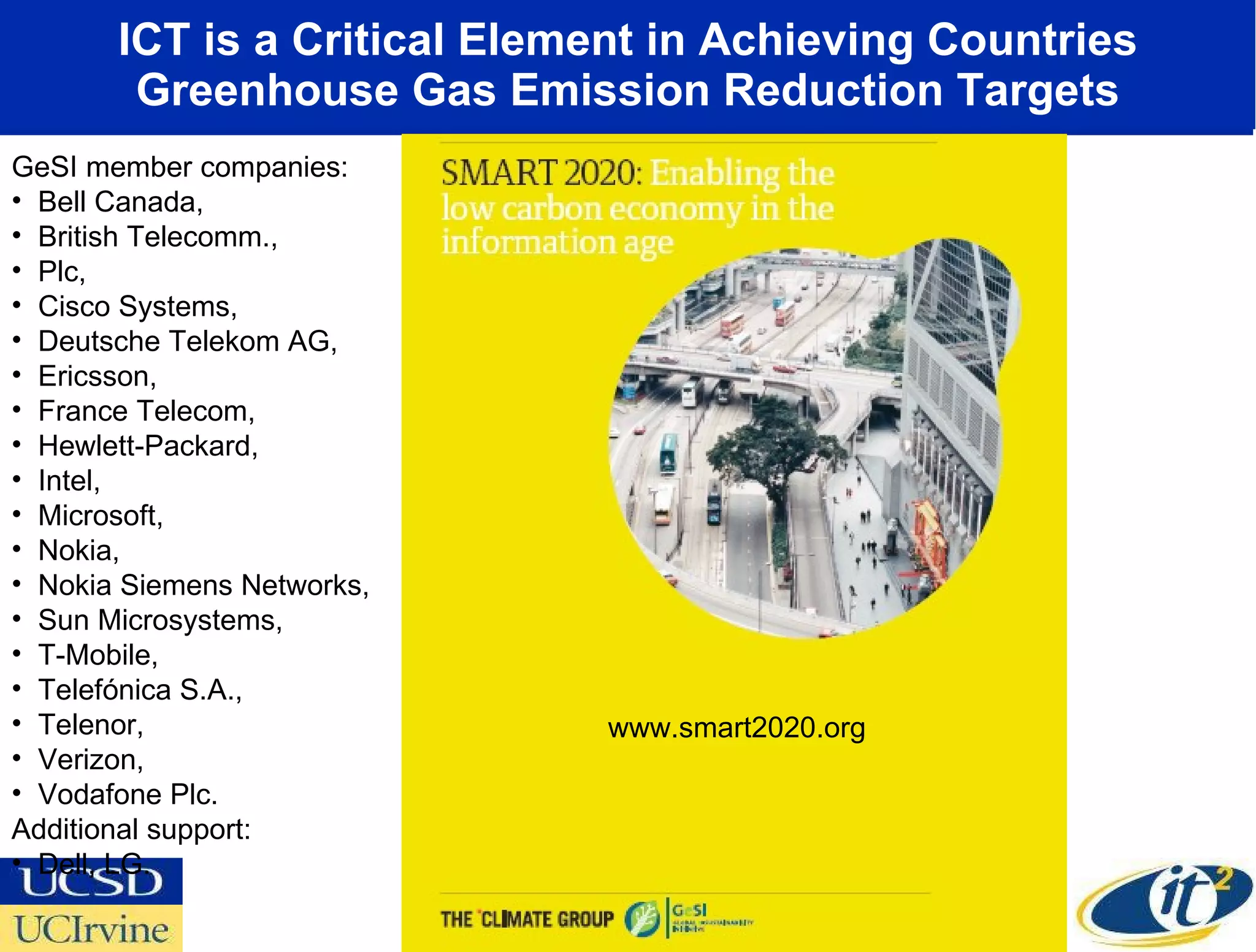
ICT is a Critical Element in Achieving Countries Greenhouse Gas Emission Reduction Targets www.smart2020.org GeSI member companies:  Bell Canada,  British Telecomm.,  Plc,  Cisco Systems,  Deutsche Telekom AG,  Ericsson,  France Telecom,  Hewlett-Packard,  Intel,  Microsoft,  Nokia,  Nokia Siemens Networks,  Sun Microsystems,  T-Mobile,  Telefónica S.A.,  Telenor,  Verizon,  Vodafone Plc.  Additional support:  Dell, LG.
The Transformation to a Smart Energy Infrastructure: Enabling the Transition to a Low Carbon Economy Applications  of ICT  could enable emissions reductions  of  15%  of business-as-usual emissions.  But it must keep its own growing footprint in check  and overcome a number of hurdles  if it expects to deliver on this potential. www.smart2020.org
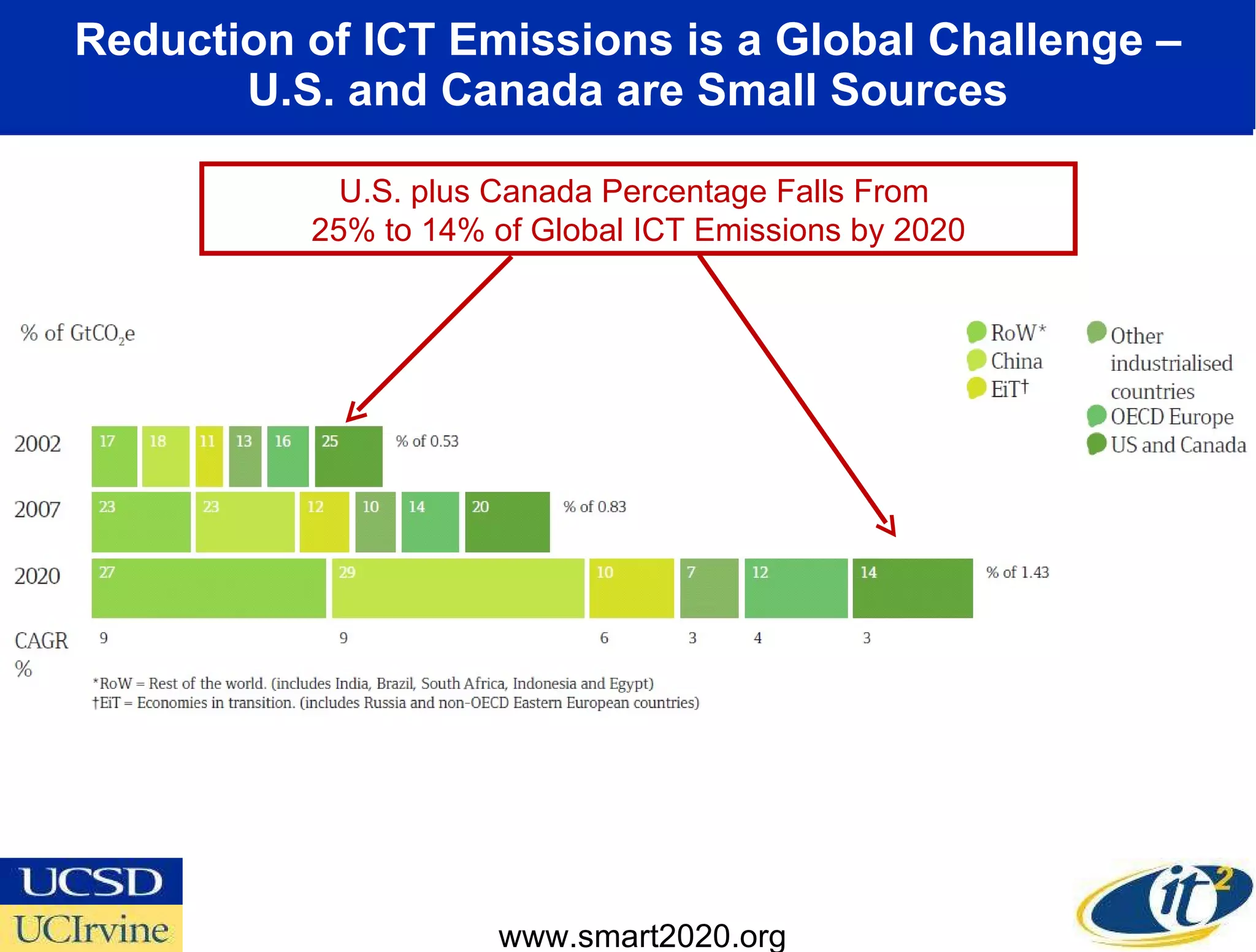
Reduction of ICT Emissions is a Global Challenge – U.S. and Canada are Small Sources U.S. plus Canada Percentage Falls From  25% to 14% of Global ICT Emissions by 2020 www.smart2020.org
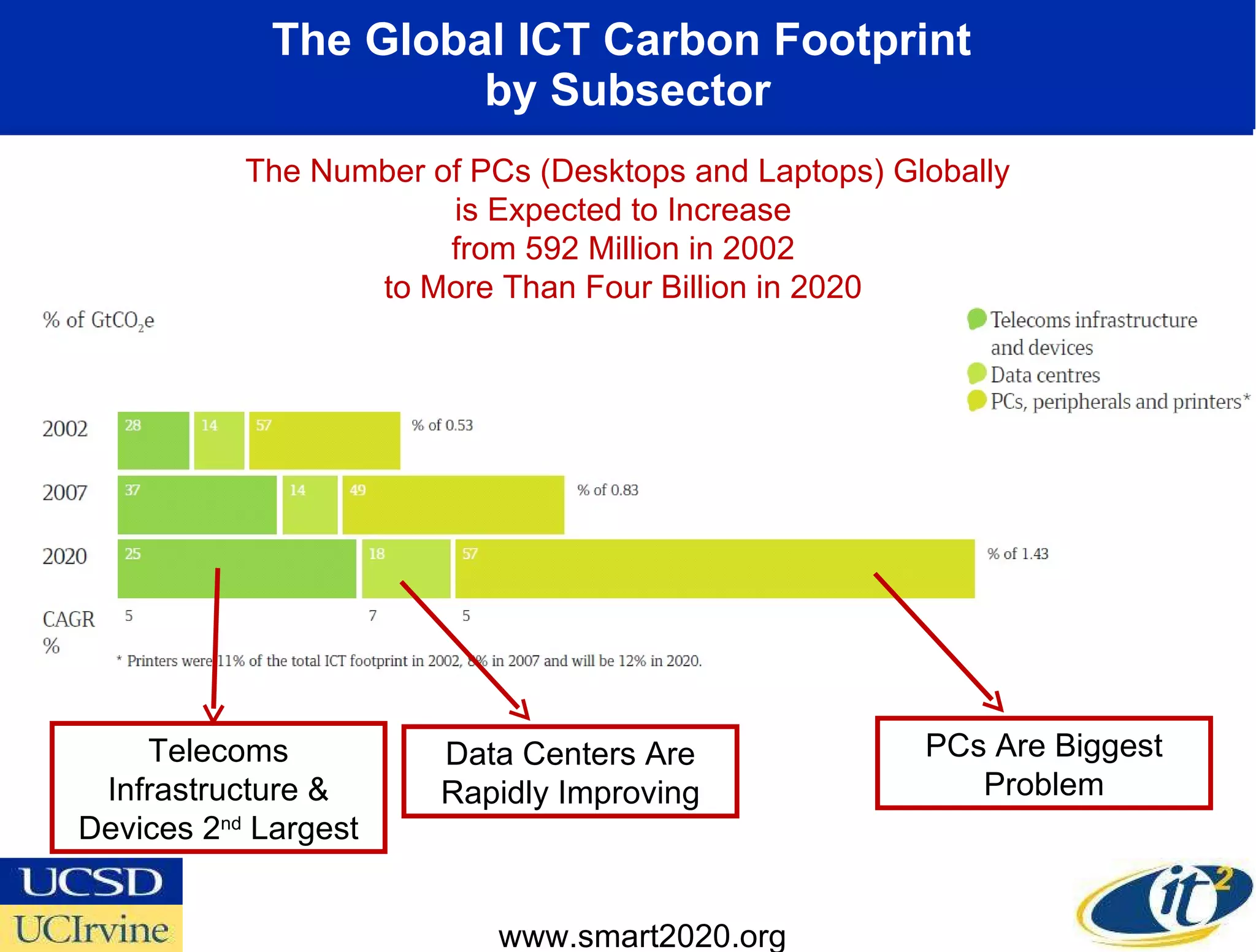
The Global ICT Carbon Footprint  by Subsector www.smart2020.org The Number of PCs (Desktops and Laptops) Globally is Expected to Increase  from 592 Million in 2002  to More Than Four Billion in 2020  PCs Are Biggest Problem Data Centers Are Rapidly Improving Telecoms Infrastructure & Devices 2 nd  Largest
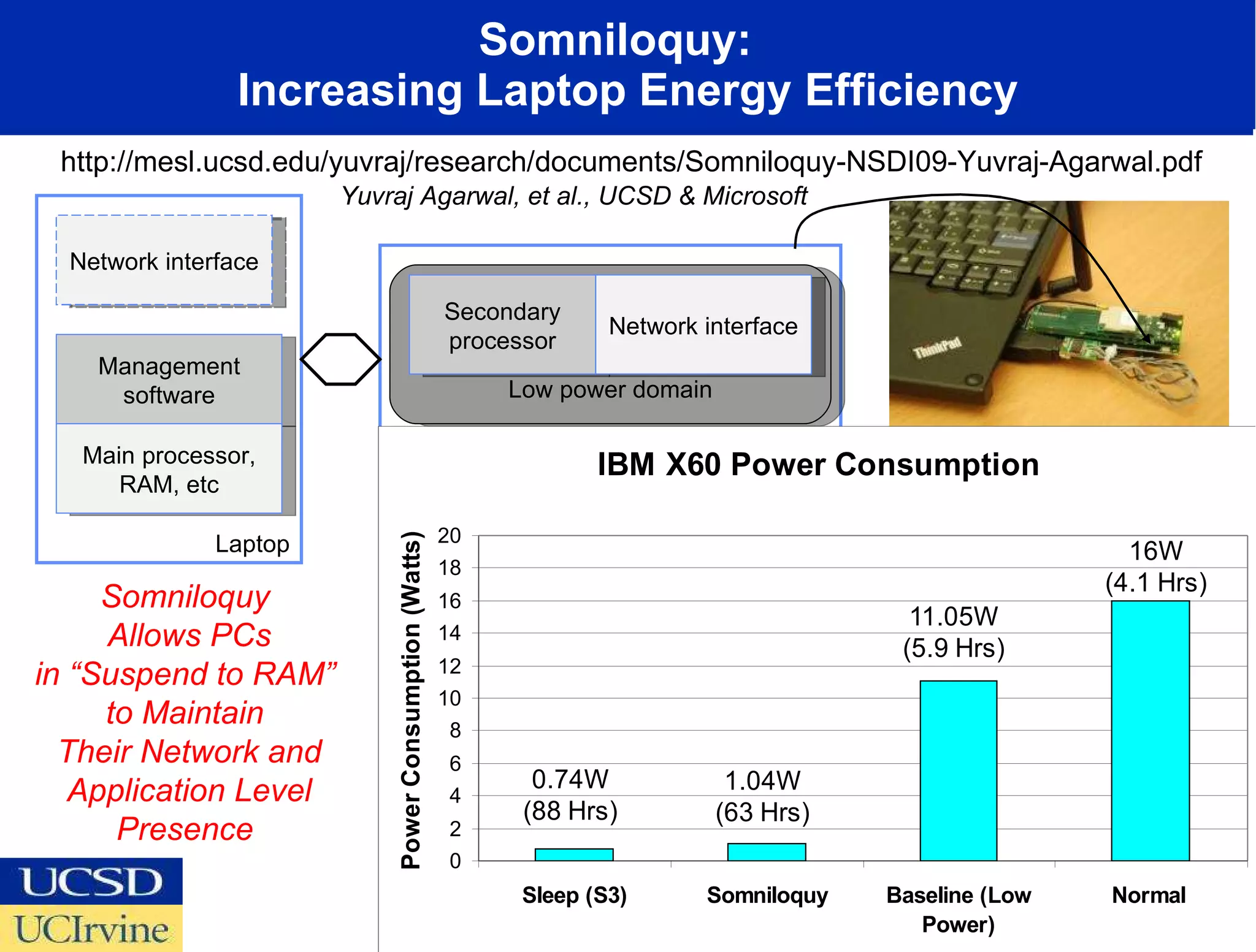
Somniloquy:  Increasing Laptop Energy Efficiency Somniloquy  Allows PCs in “Suspend to RAM”  to Maintain  Their Network and Application Level Presence  http://mesl.ucsd.edu/yuvraj/research/documents/Somniloquy-NSDI09-Yuvraj-Agarwal.pdf Yuvraj Agarwal, et al., UCSD & Microsoft Peripheral Laptop Low power domain Network interface Secondary processor Network interface Management software Main processor, RAM, etc
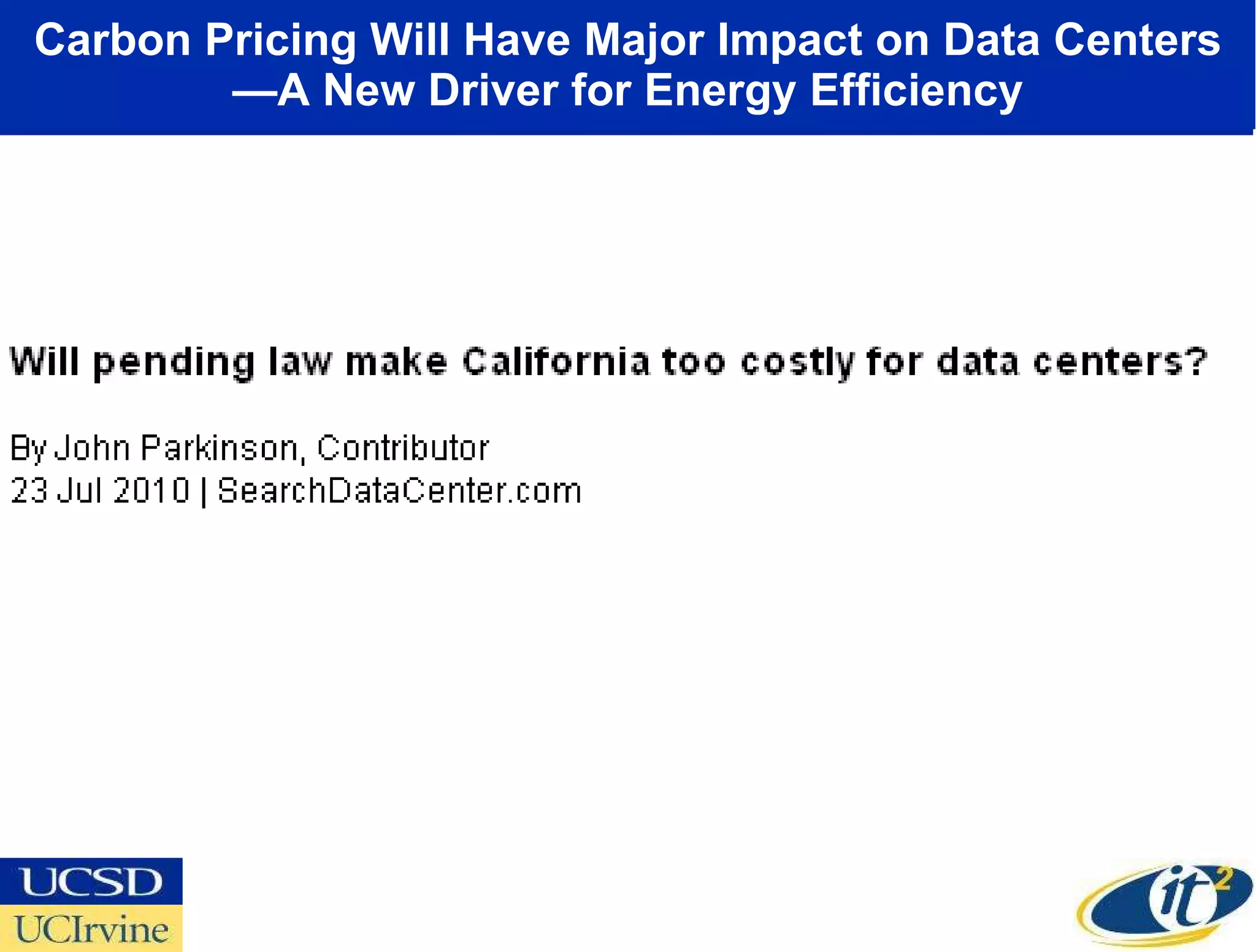
Carbon Pricing Will Have Major Impact on Data Centers—A New Driver for Energy Efficiency
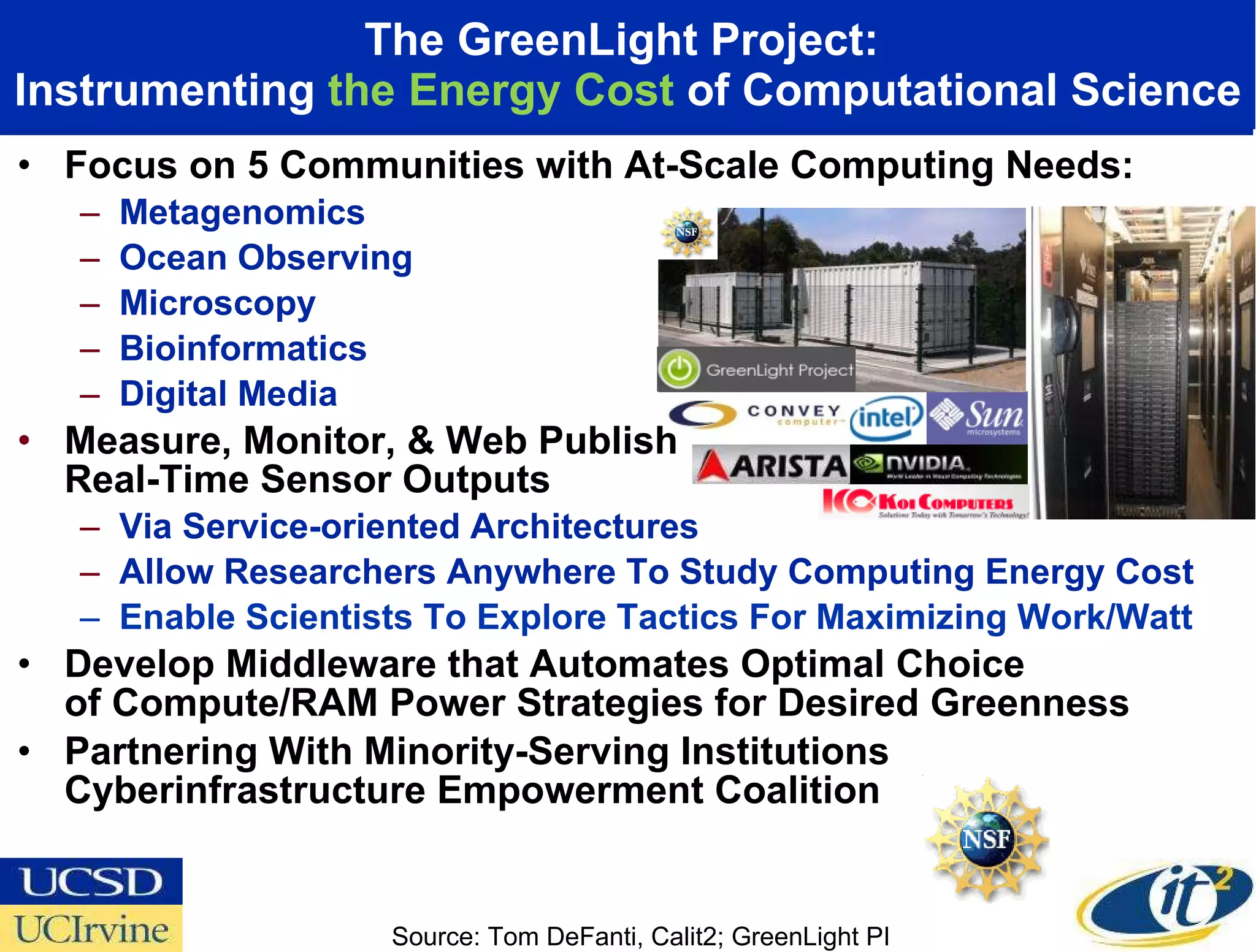
The GreenLight Project:  Instrumenting  the Energy Cost  of Computational Science Focus on 5 Communities with At-Scale Computing Needs: Metagenomics Ocean Observing Microscopy  Bioinformatics Digital Media Measure, Monitor, & Web Publish  Real-Time Sensor Outputs Via Service-oriented Architectures Allow Researchers Anywhere To Study Computing Energy Cost Enable Scientists To Explore Tactics For Maximizing Work/Watt Develop Middleware that Automates Optimal Choice  of Compute/RAM Power Strategies for Desired Greenness Partnering With Minority-Serving Institutions Cyberinfrastructure Empowerment Coalition  Source: Tom DeFanti, Calit2; GreenLight PI
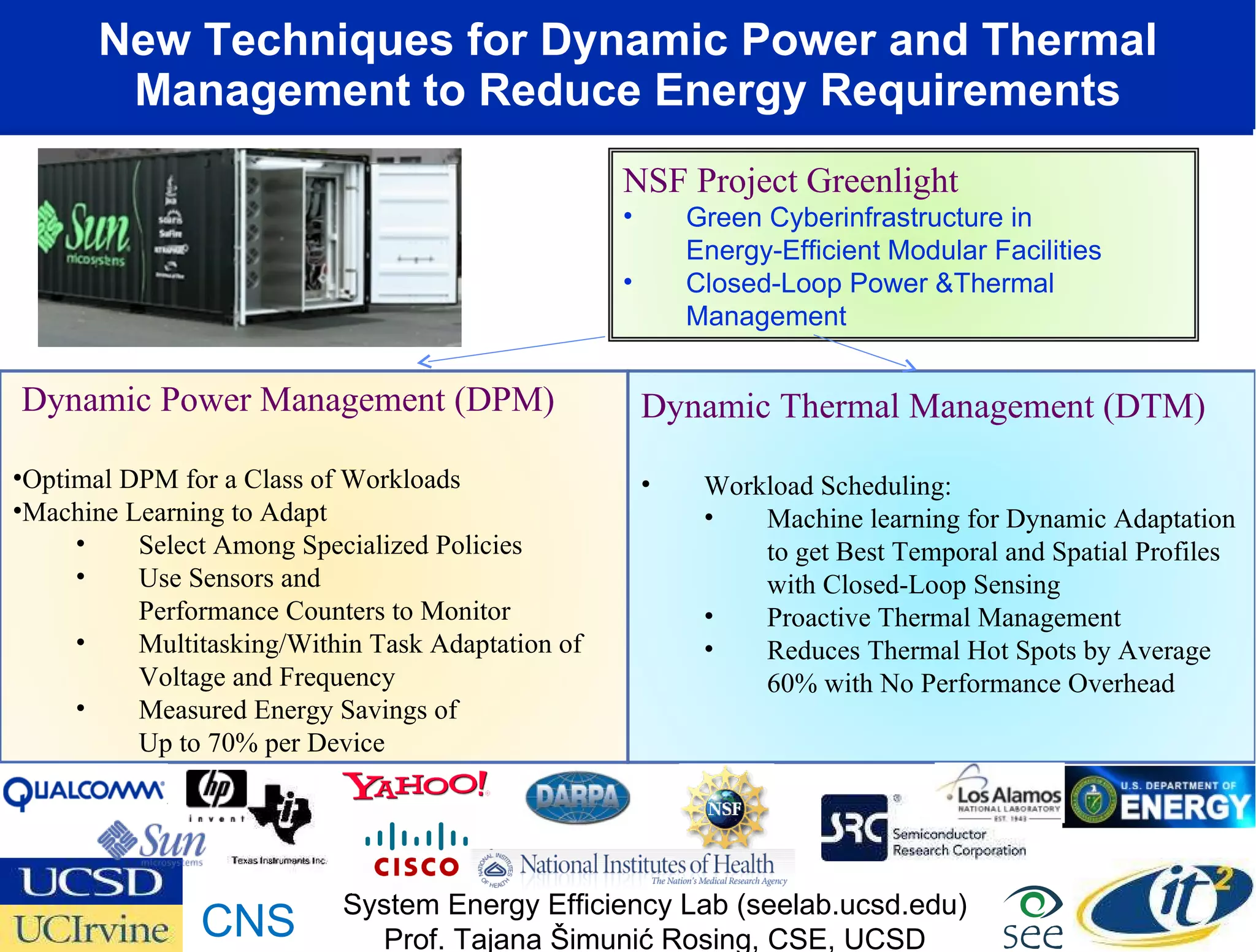
New Techniques for Dynamic Power and Thermal Management to Reduce Energy Requirements Dynamic Thermal Management (DTM) Workload Scheduling: Machine learning for Dynamic Adaptation to get Best Temporal and Spatial Profiles with Closed-Loop Sensing Proactive Thermal Management Reduces Thermal Hot Spots by Average 60% with No Performance Overhead Dynamic Power Management (DPM) Optimal DPM for a Class of Workloads Machine Learning to Adapt Select Among Specialized Policies Use Sensors and  Performance Counters to Monitor Multitasking/Within Task Adaptation of Voltage and Frequency Measured Energy Savings of  Up to 70% per Device System Energy Efficiency Lab (seelab.ucsd.edu) Prof. Tajana Šimunić Rosing, CSE, UCSD CNS NSF Project Greenlight Green Cyberinfrastructure in  Energy-Efficient Modular Facilities  Closed-Loop Power &Thermal Management
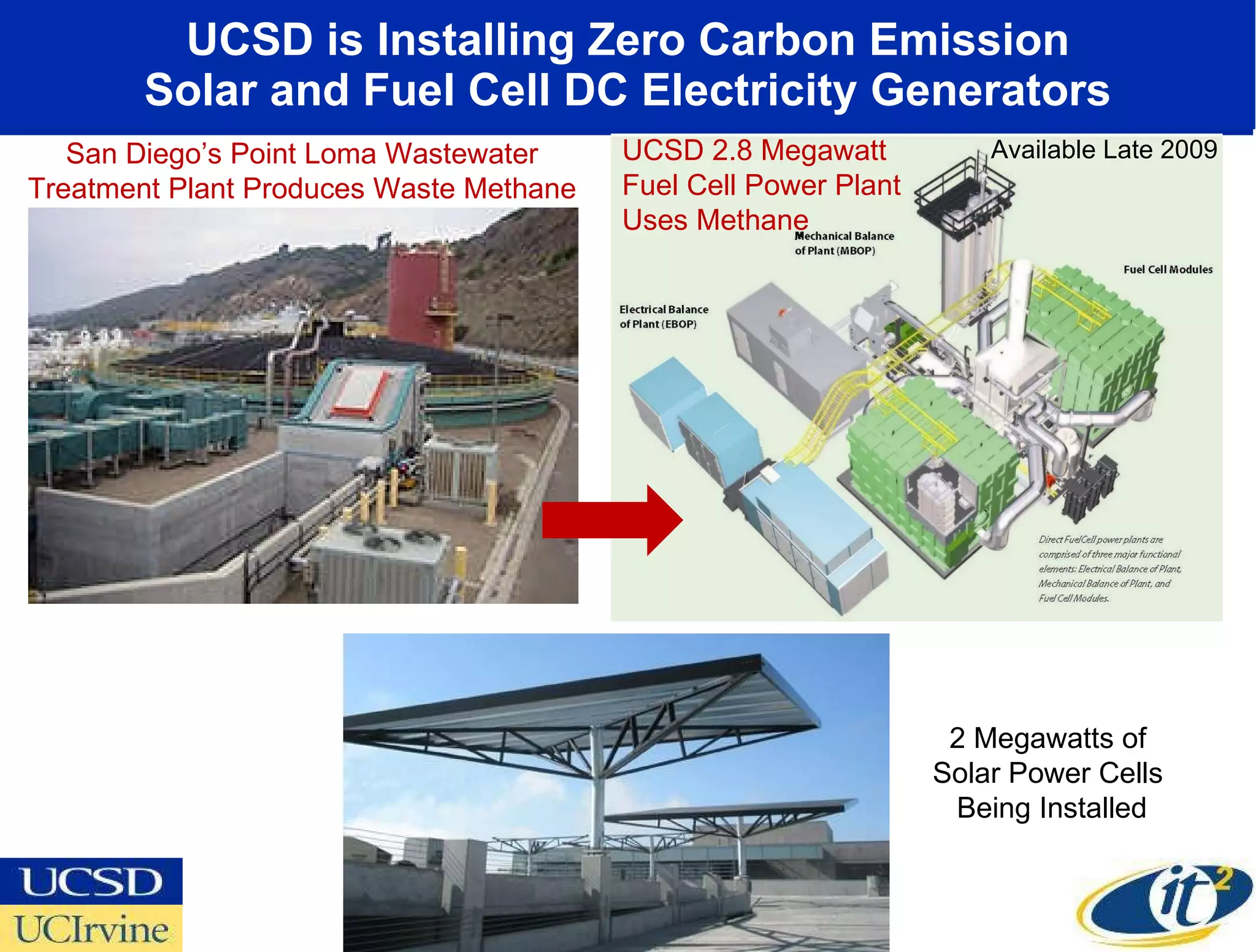
UCSD is Installing Zero Carbon Emission Solar and Fuel Cell DC Electricity Generators San Diego’s Point Loma Wastewater Treatment Plant Produces Waste Methane UCSD 2.8 Megawatt  Fuel Cell Power Plant  Uses Methane 2 Megawatts of  Solar Power Cells  Being Installed Available Late 2009
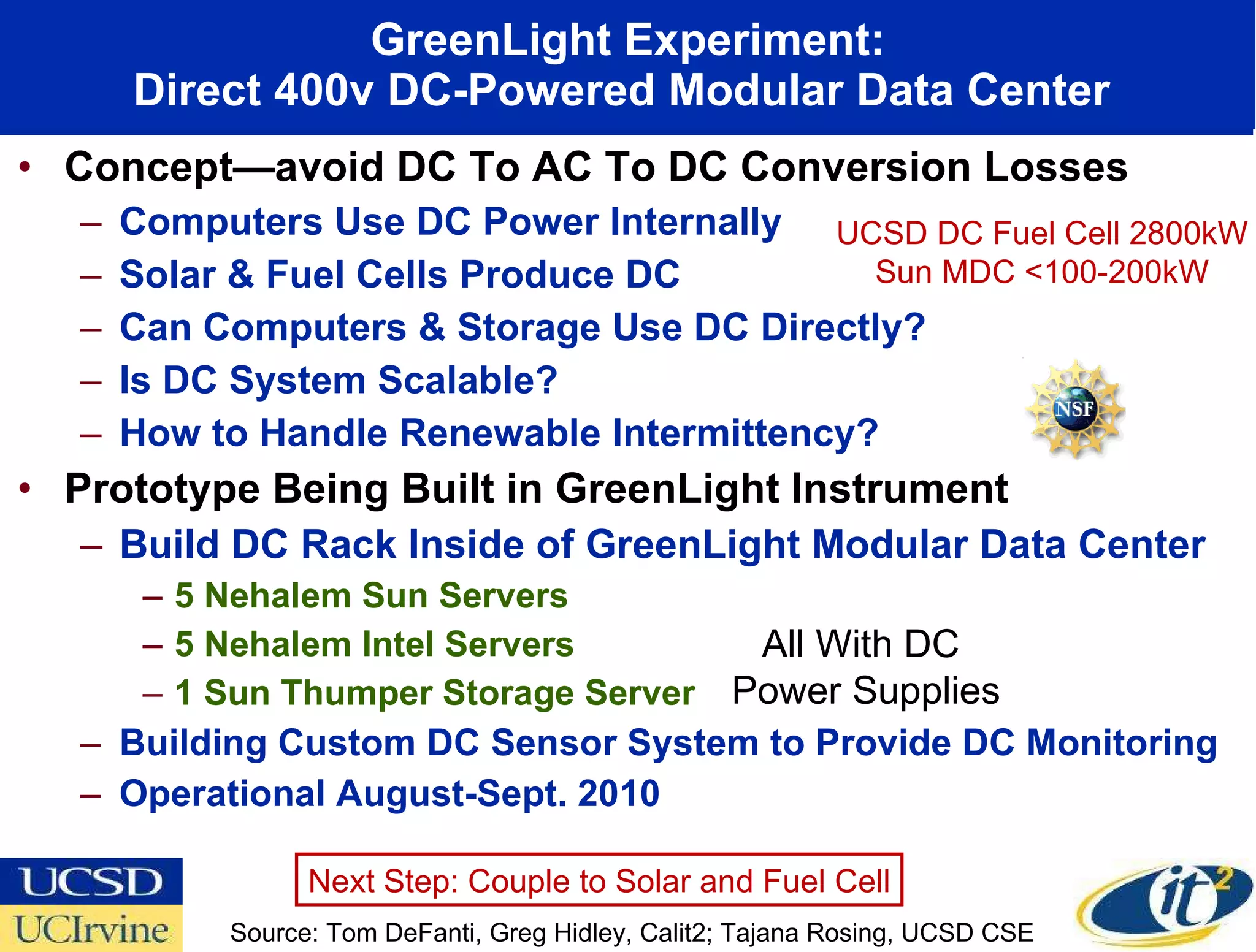
Concept—avoid DC To AC To DC Conversion Losses Computers Use DC Power Internally Solar & Fuel Cells Produce DC Can Computers & Storage Use DC Directly? Is DC System Scalable? How to Handle Renewable Intermittency? Prototype Being Built in GreenLight Instrument Build DC Rack Inside of GreenLight Modular Data Center 5 Nehalem Sun Servers 5 Nehalem Intel Servers 1 Sun Thumper Storage Server Building Custom DC Sensor System to Provide DC Monitoring Operational August-Sept. 2010 GreenLight Experiment: Direct 400v DC-Powered Modular Data Center  Source: Tom DeFanti, Greg Hidley, Calit2; Tajana Rosing, UCSD CSE  All With DC  Power Supplies UCSD DC Fuel Cell 2800kW Sun MDC <100-200kW Next Step: Couple to Solar and Fuel Cell
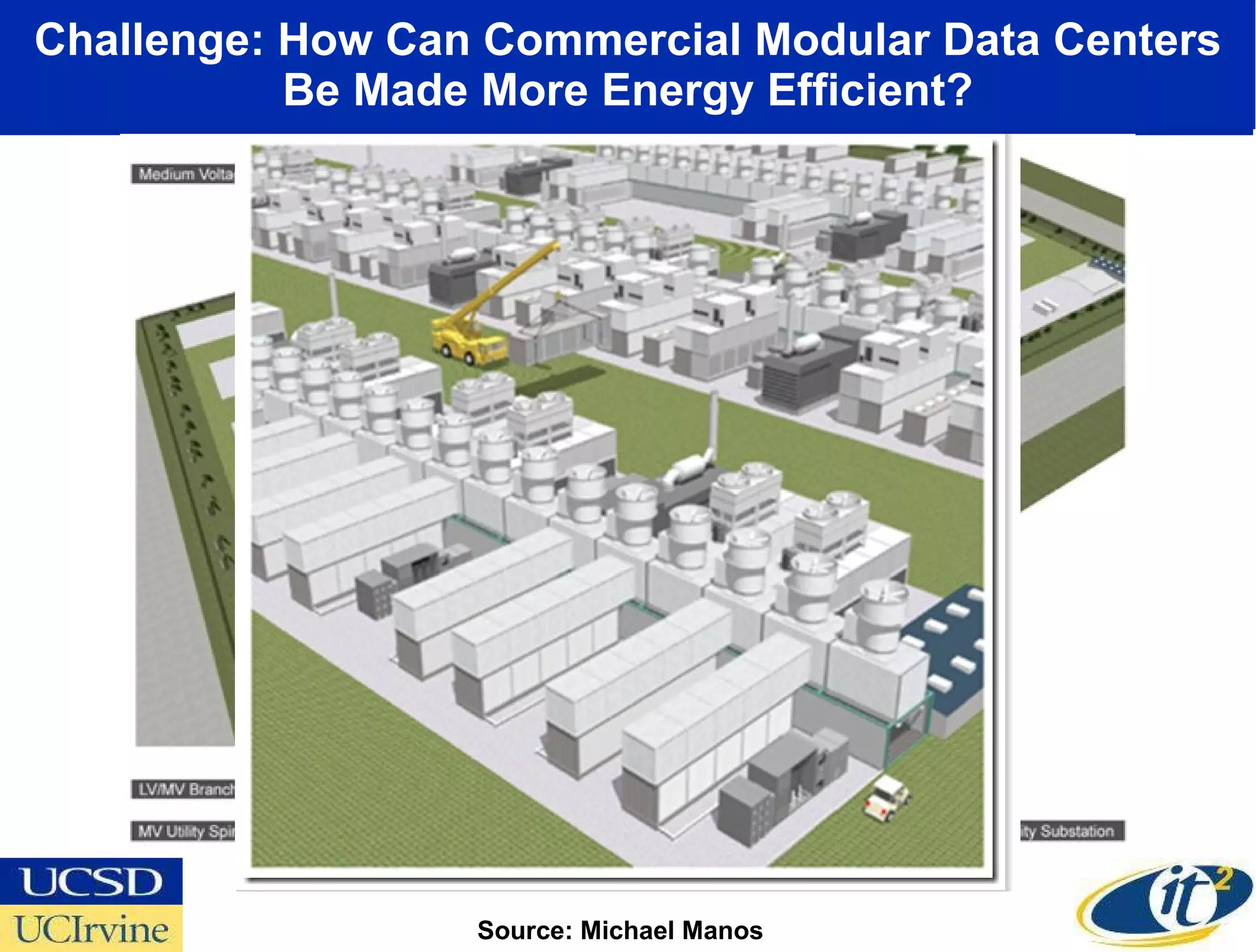
Challenge: How Can Commercial Modular Data Centers Be Made More Energy Efficient? Source: Michael Manos
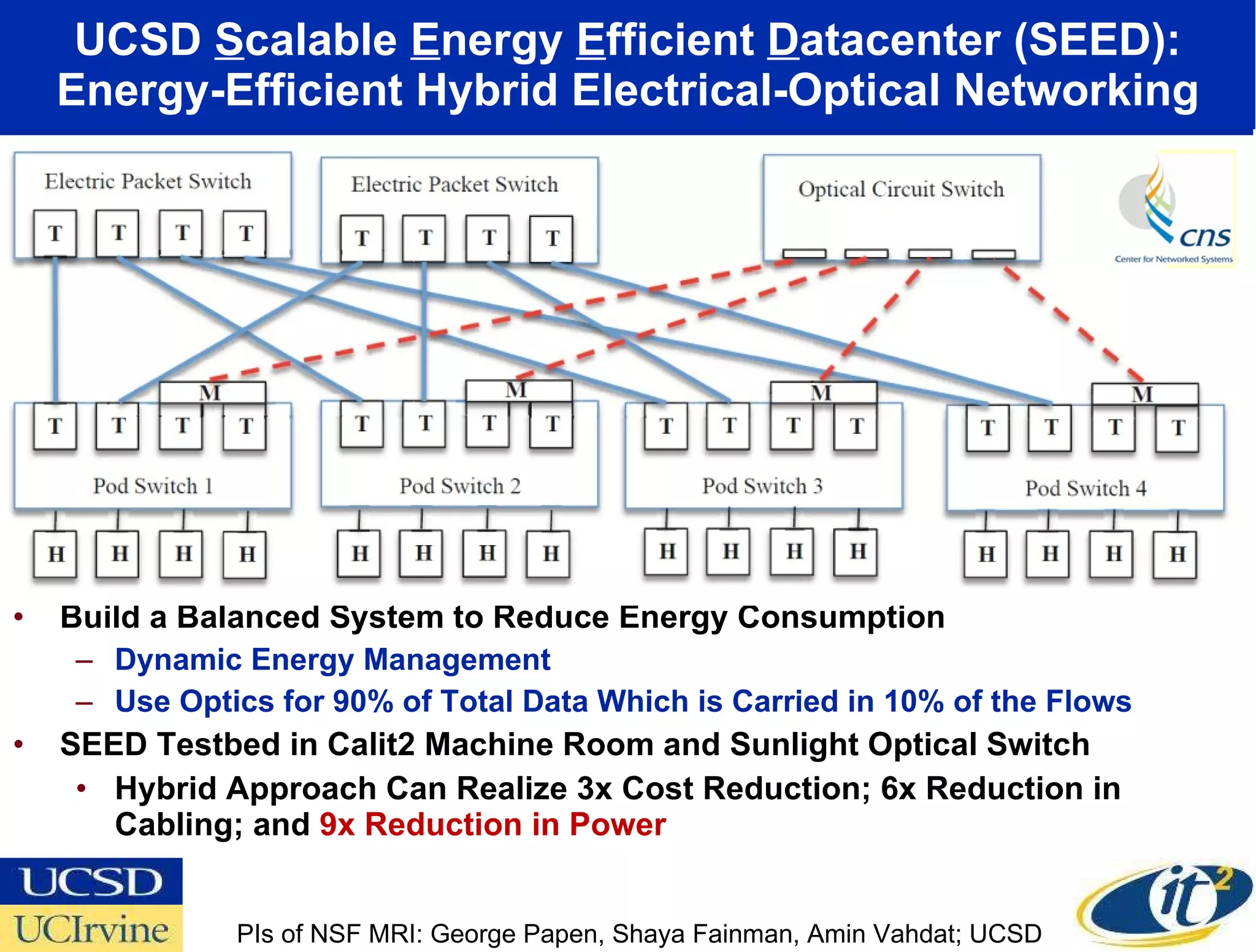
UCSD  S calable  E nergy  E fficient  D atacenter (SEED): Energy-Efficient Hybrid Electrical-Optical Networking Build a Balanced System to Reduce Energy Consumption  Dynamic Energy Management Use Optics for 90% of Total Data Which is Carried in 10% of the Flows  SEED Testbed in Calit2 Machine Room and Sunlight Optical Switch Hybrid Approach Can Realize 3x Cost Reduction; 6x Reduction in Cabling; and  9x Reduction in Power PIs of NSF MRI: George Papen, Shaya Fainman, Amin Vahdat; UCSD
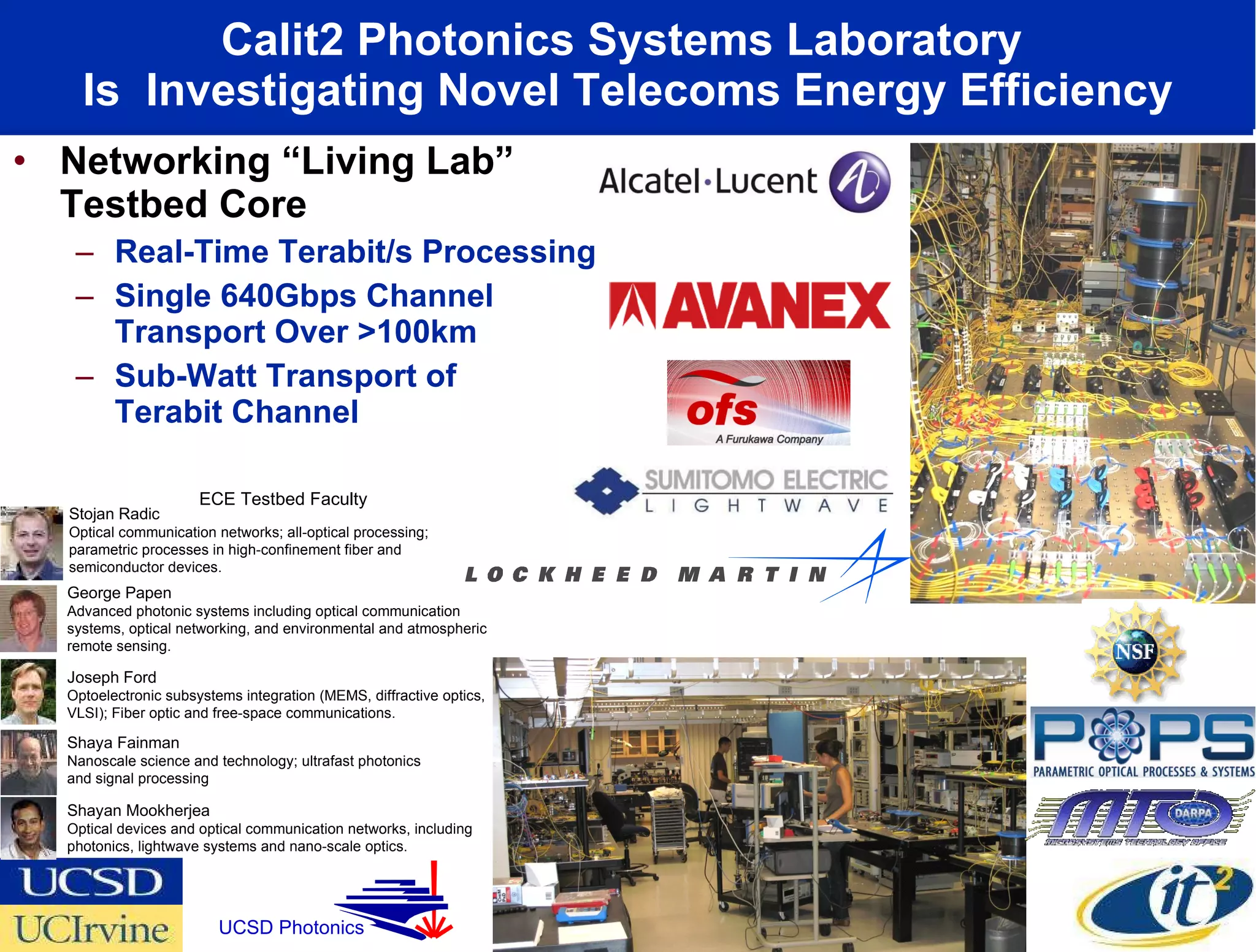
Calit2 Photonics Systems Laboratory  Is  Investigating Novel Telecoms Energy Efficiency Networking “Living Lab” Testbed Core Real-Time Terabit/s Processing  Single 640Gbps Channel Transport Over >100km Sub-Watt Transport of  Terabit Channel Shayan Mookherjea Optical devices and optical communication networks, including photonics, lightwave systems and nano-scale optics. Stojan Radic Optical communication networks; all-optical processing; parametric processes in high-confinement fiber and semiconductor devices. Shaya Fainman Nanoscale science and technology; ultrafast photonics and signal processing Joseph Ford Optoelectronic subsystems integration (MEMS, diffractive optics, VLSI); Fiber optic and free-space communications.  George Papen Advanced photonic systems including optical communication systems, optical networking, and environmental and atmospheric remote sensing.  ECE Testbed Faculty UCSD Photonics
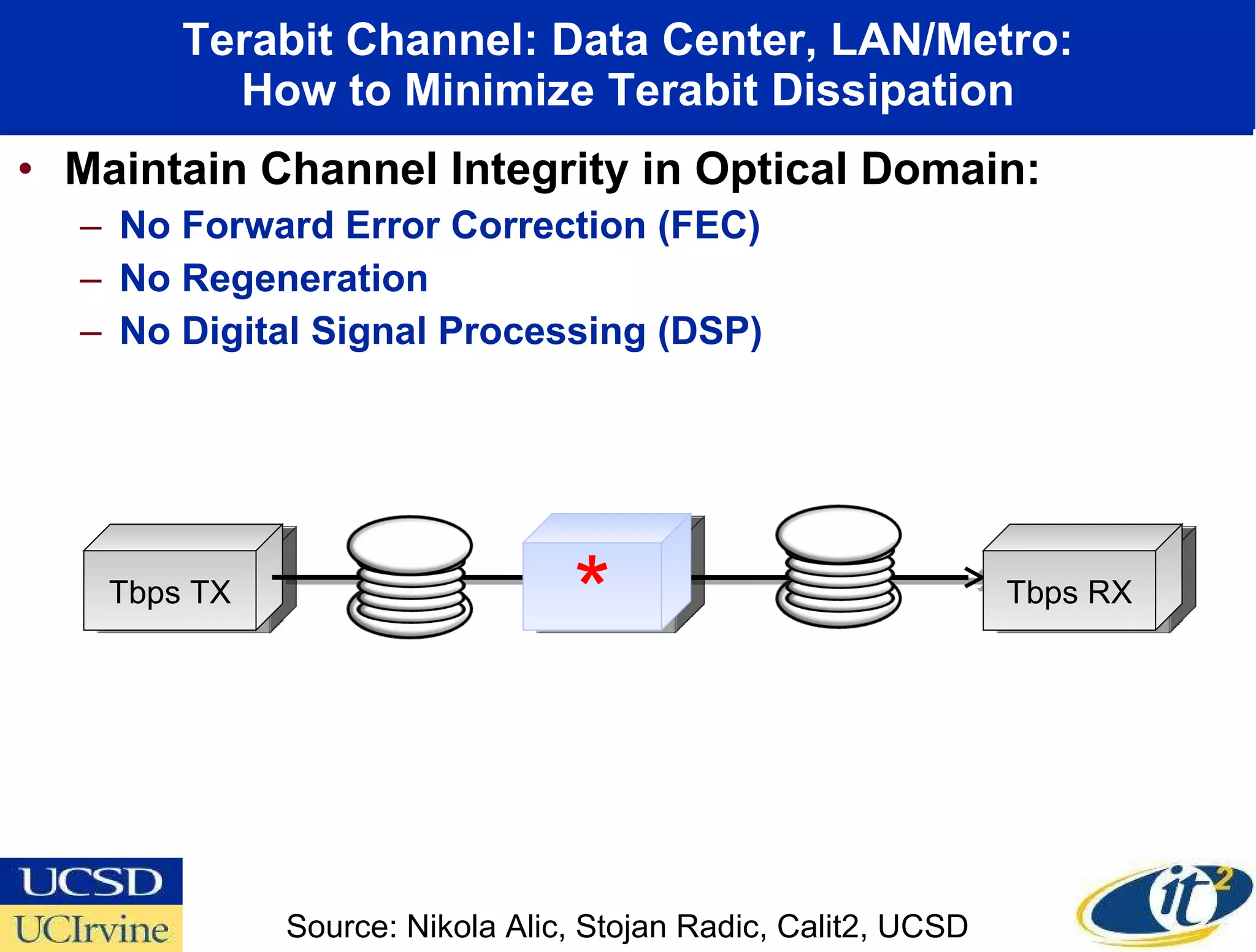
Terabit Channel: Data Center, LAN/Metro: How to Minimize Terabit Dissipation Maintain Channel Integrity in Optical Domain: No Forward Error Correction (FEC)  No Regeneration No Digital Signal Processing (DSP) Tbps TX Tbps RX Sub-Watt Transport of Terabit Channel * Source: Nikola Alic, Stojan Radic, Calit2, UCSD
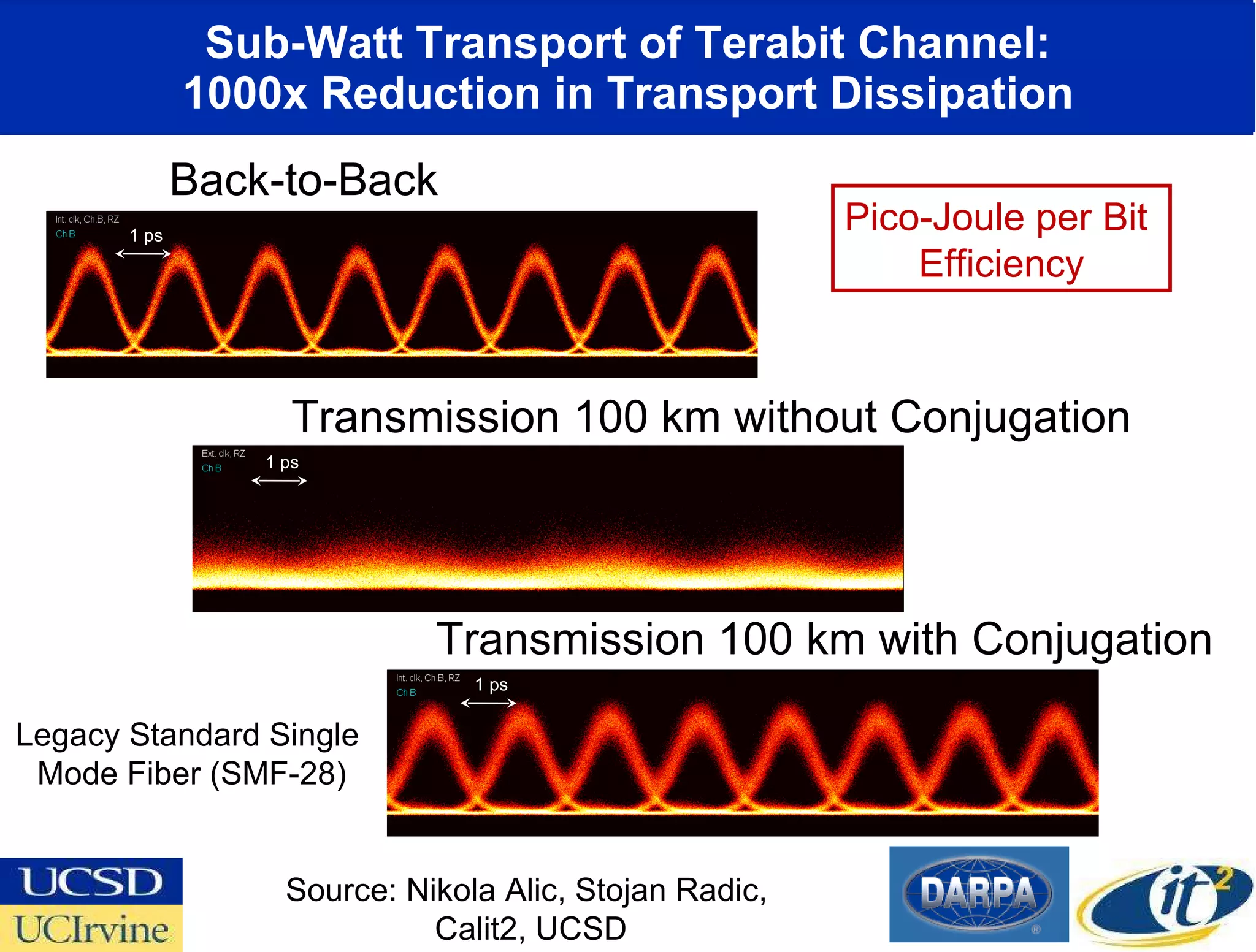
Sub-Watt Transport of Terabit Channel: 1000x Reduction in Transport Dissipation Back-to-Back Source: Nikola Alic, Stojan Radic,  Calit2, UCSD Pico-Joule per Bit  Efficiency Legacy Standard Single  Mode Fiber (SMF-28) 1 ps Transmission 100 km without Conjugation 1 ps Transmission 100 km with Conjugation 1 ps
Calit2@UCSD’s Wireless Power Amplifier Lab: Making Wireless Telecom Infrastructure More Efficient Power Transistor Tradeoffs Si-LDMOS, GaN, & GaAs Price & Performance Power Amplifier Tradeoffs WiMAX & 3.9GPP LTE Efficiency & Linearity Digital Signal Processing Tradeoffs Pre-Distortion, Memory Effects  & Power Control MIPS & Memory STMicroelectronics IEEE Topical Symposium on Power Amplifiers  for Wireless Communications was held Sept. 14-15, 2009 Oct. 2005 Calit2 Sets World Record 50% Efficiency for  High-Power Amplifiers for Cellular Base Stations
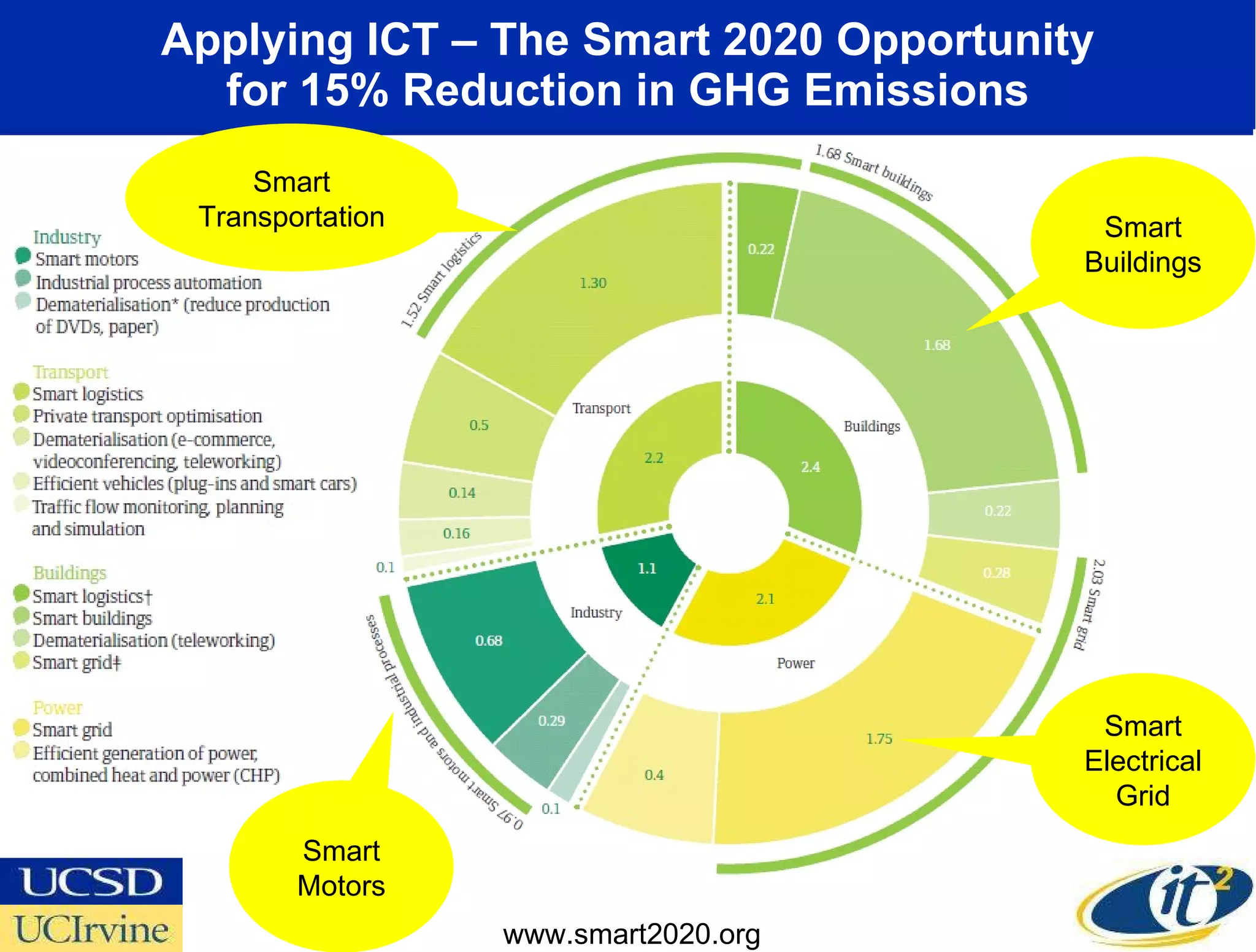
Applying ICT – The Smart 2020 Opportunity for 15% Reduction in GHG Emissions Smart Buildings Smart Electrical Grid www.smart2020.org Smart Transportation Smart Motors
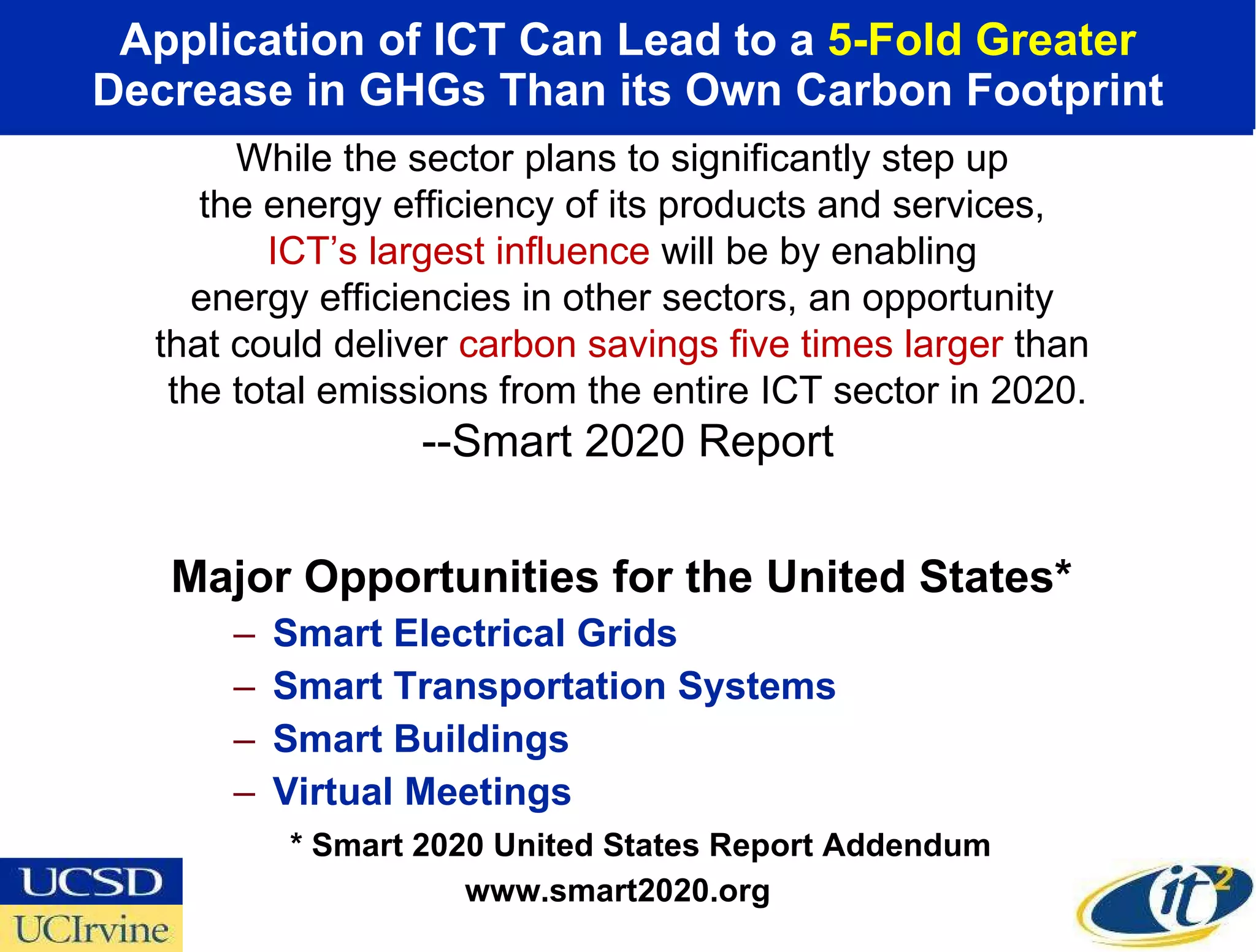
Application of ICT Can Lead to a  5-Fold Greater Decrease in GHGs Than its Own Carbon Footprint Major Opportunities for the United States* Smart Electrical Grids Smart Transportation Systems Smart Buildings Virtual Meetings * Smart 2020 United States Report Addendum www.smart2020.org While the sector plans to significantly step up  the energy efficiency of its products and services,  ICT’s largest influence  will be by enabling  energy efficiencies in other sectors, an opportunity  that could deliver  carbon savings five times larger  than  the total emissions from the entire ICT sector in 2020. --Smart 2020 Report
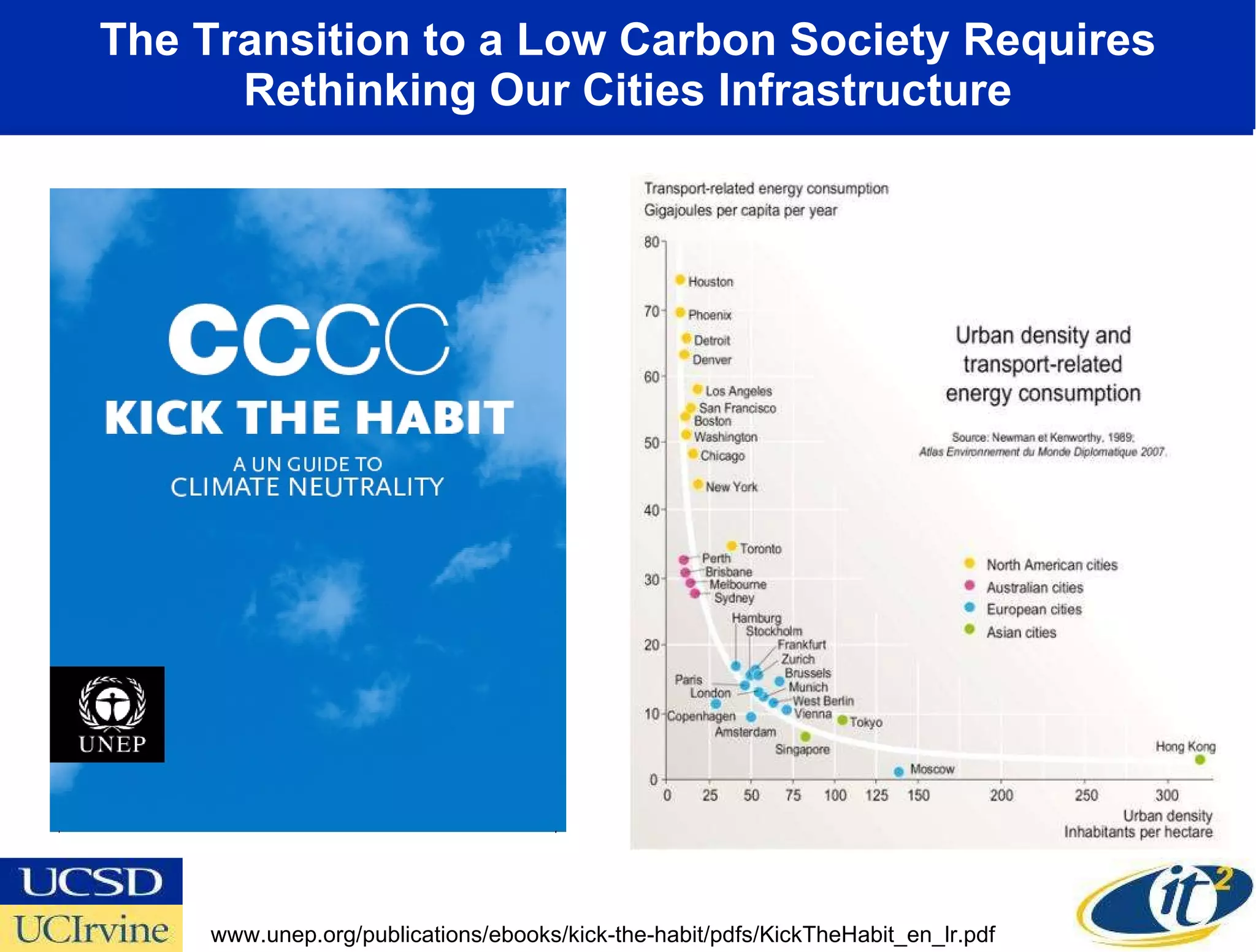
The Transition to a Low Carbon Society Requires Rethinking Our Cities Infrastructure www.unep.org/publications/ebooks/kick-the-habit/pdfs/KickTheHabit_en_lr.pdf
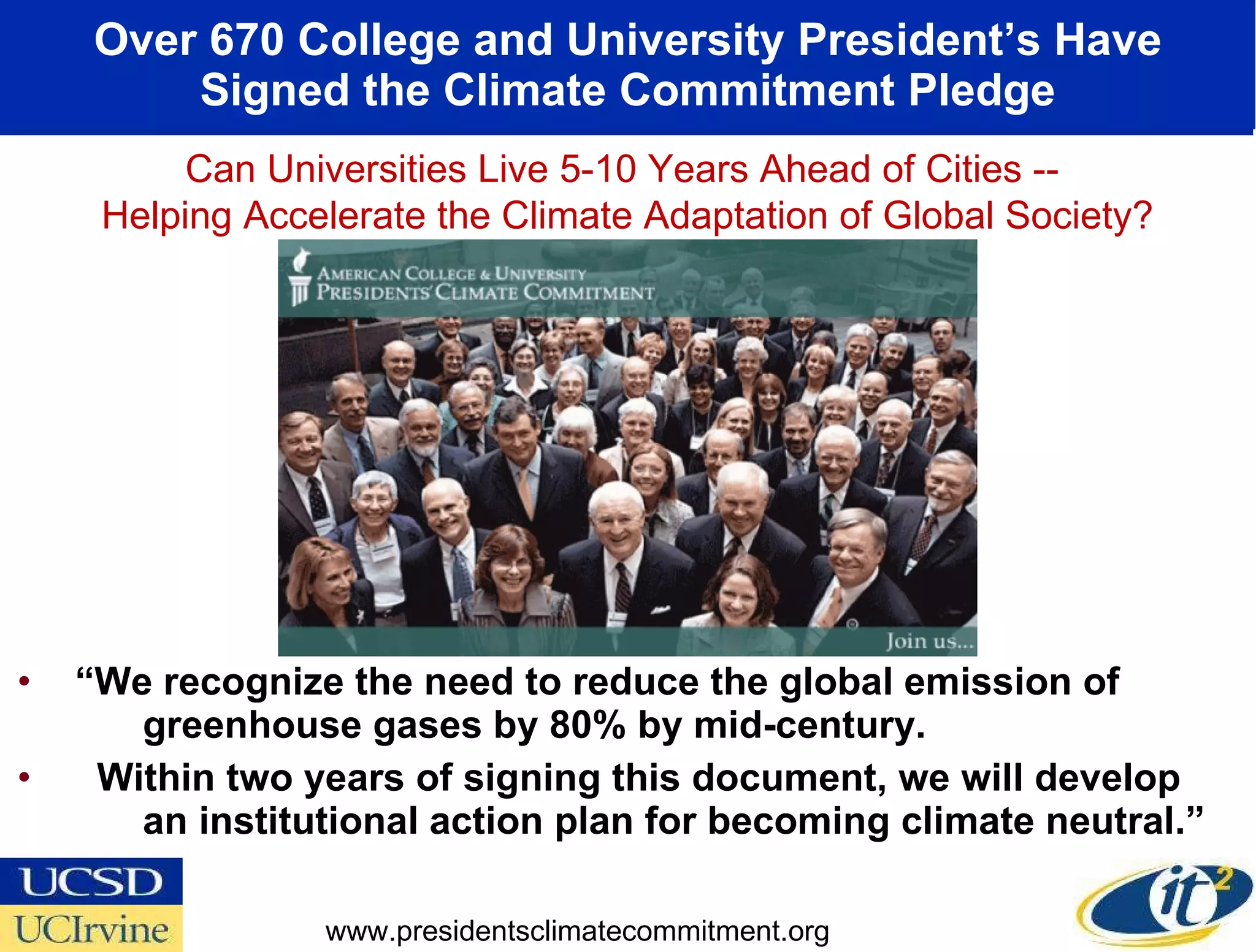
Over 670 College and University President’s Have Signed the Climate Commitment Pledge “ We recognize the need to reduce the global emission of  greenhouse gases by 80% by mid-century. Within two years of signing this document, we will develop  an institutional action plan for becoming climate neutral.” www.presidentsclimatecommitment.org Can Universities Live 5-10 Years Ahead of Cities --  Helping Accelerate the Climate Adaptation of Global Society?
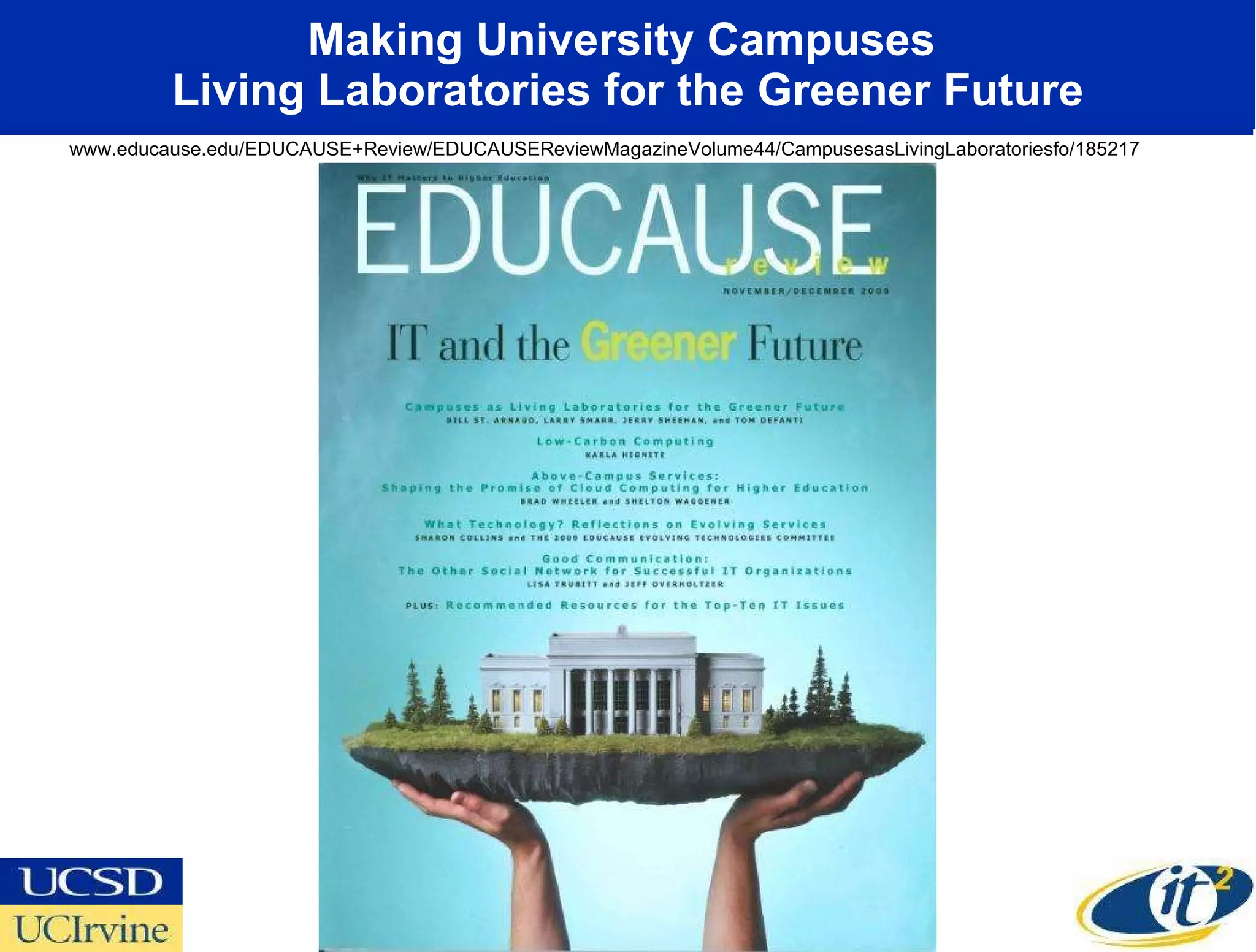
Making University Campuses  Living Laboratories for the Greener Future www.educause.edu/EDUCAUSE+Review/EDUCAUSEReviewMagazineVolume44/CampusesasLivingLaboratoriesfo/185217
UCSD  as a Model Green Campus Second-Largest User Of Electricity (~40 MW) In San Diego  45,000 Daily Occupants  After the City Itself, the Seventh-Largest City in the U.S.  Aggressive Program to De-Carbonize Generating Electricity  Natural Gas Co-Gen Facility Supplies ~90% of Campus Electricity  Saves ~$8 Million Annually in Energy Costs Installed 1.2 MW Of Solar Panels (With an Additional 2 MW Likely)  Acquiring a 2.8 MW Fuel Cell in 2011 Powered by Methane from San Diego Waste-Treatment Plant UCSD Campus Fleet 45% Renewables 300 Small Electric Cars 50 Hybrids 20 Full-Size Electrics by 2011 www.educause.edu/EDUCAUSE+Review/EDUCAUSEReviewMagazineVolume44/CampusesasLivingLaboratoriesfo/185217
UC Irvine  as a Model Green Campus California’s “Flex Your Power” Statewide Energy-Efficiency Campaign Only University Campus Cited in “Best Overall”  UCI Led in Efficiency-Saving 3.7 Million KWh of Electricity During 07–08 Reducing Peak Demand by up to 68% Saving Nearly 4 Million Gallons Of Water Annually.  UCI’s 2008 GHG Reduction Program Annually Eliminates 62,000 MtCO 2 e  Saves the Campus ~$30 Million SunEdison Financed, Built, & Operates Solar Energy System In March 2009, UCI Began Purchasing Energy Generated by System Will Produce >24 GWh over 20 Years 18 MW Combined Heating, Power, & Cooling Co-Gen Plant Employs 62,000 Ton-Hour Chilled-Water Thermal Energy Storage System  Capable of Reducing up to 6 MW of Electrical Peak Demand UCI 1st US Campus to Retrofit Shuttles for Pure Biodiesel Research Program with Toyota Plug-In Prius in Nov 2007 www.educause.edu/EDUCAUSE+Review/EDUCAUSEReviewMagazineVolume44/CampusesasLivingLaboratoriesfo/185217
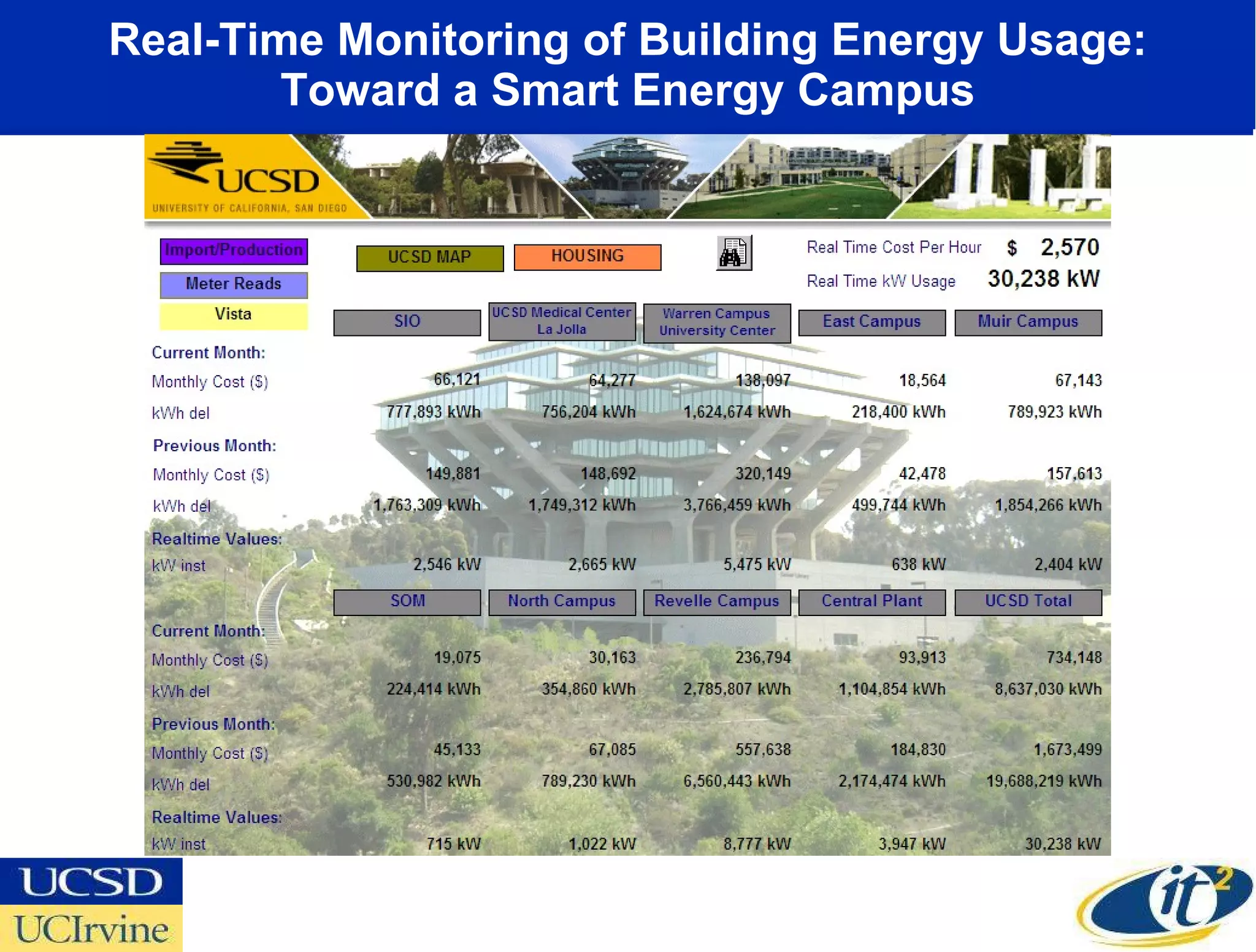
Real-Time Monitoring of Building Energy Usage: Toward a Smart Energy Campus
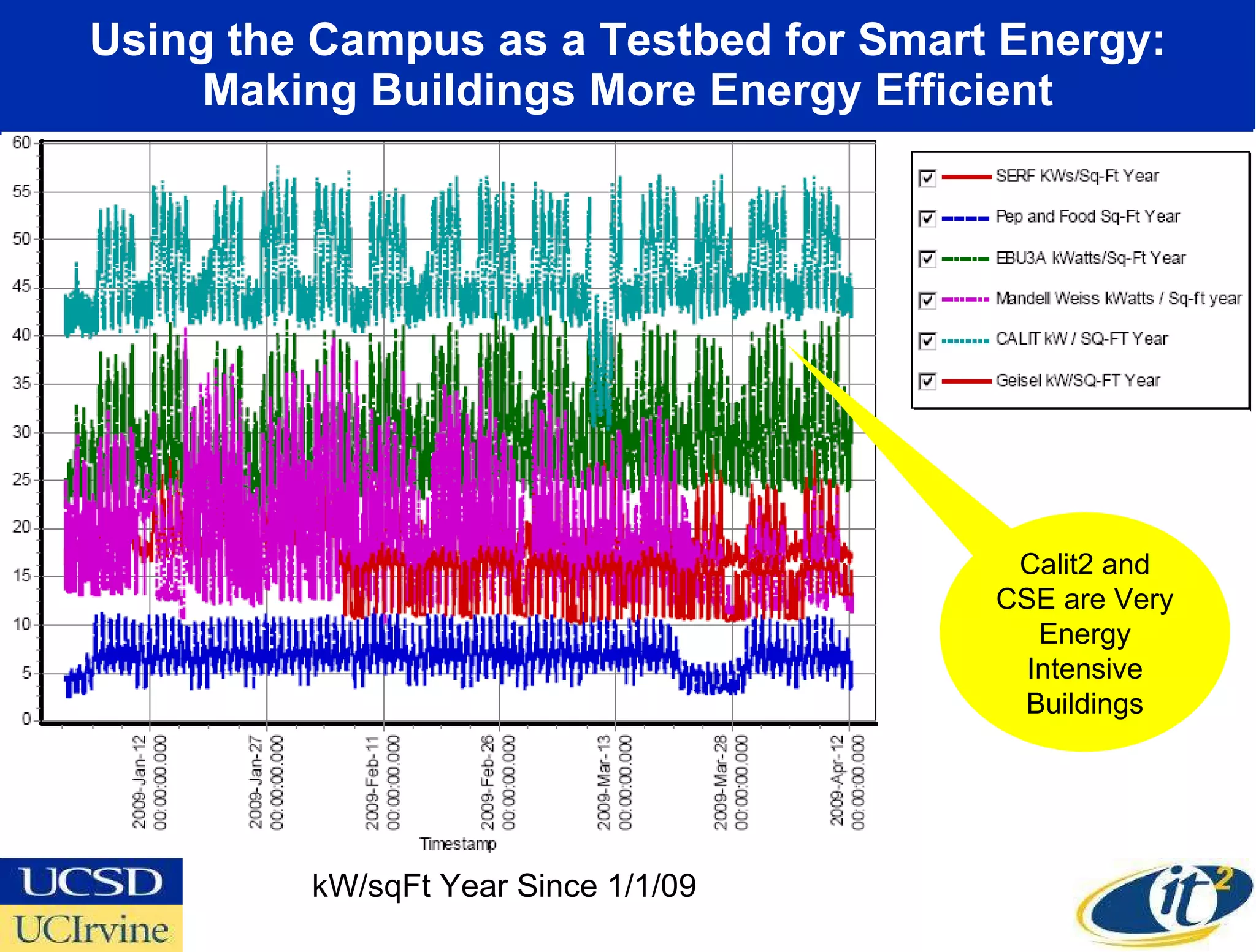
Using the Campus as a Testbed for Smart Energy: Making Buildings More Energy Efficient Calit2 and CSE are Very Energy Intensive Buildings kW/sqFt Year Since 1/1/09
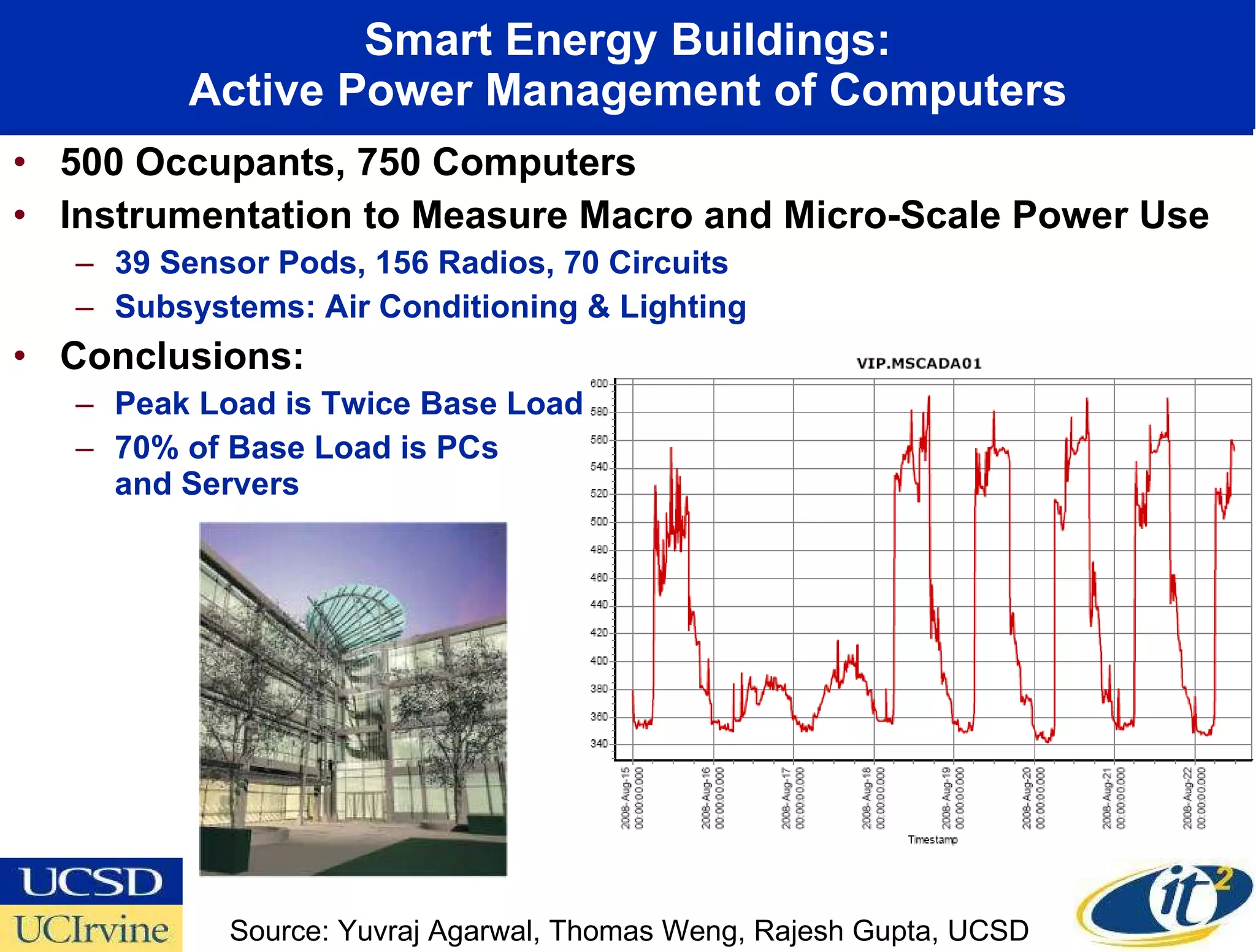
Smart Energy Buildings: Active Power Management of Computers 500 Occupants, 750 Computers Instrumentation to Measure Macro and Micro-Scale Power Use  39 Sensor Pods, 156 Radios, 70 Circuits Subsystems: Air Conditioning & Lighting Conclusions: Peak Load is Twice Base Load 70% of Base Load is PCs  and Servers Source: Yuvraj Agarwal, Thomas Weng, Rajesh Gupta, UCSD
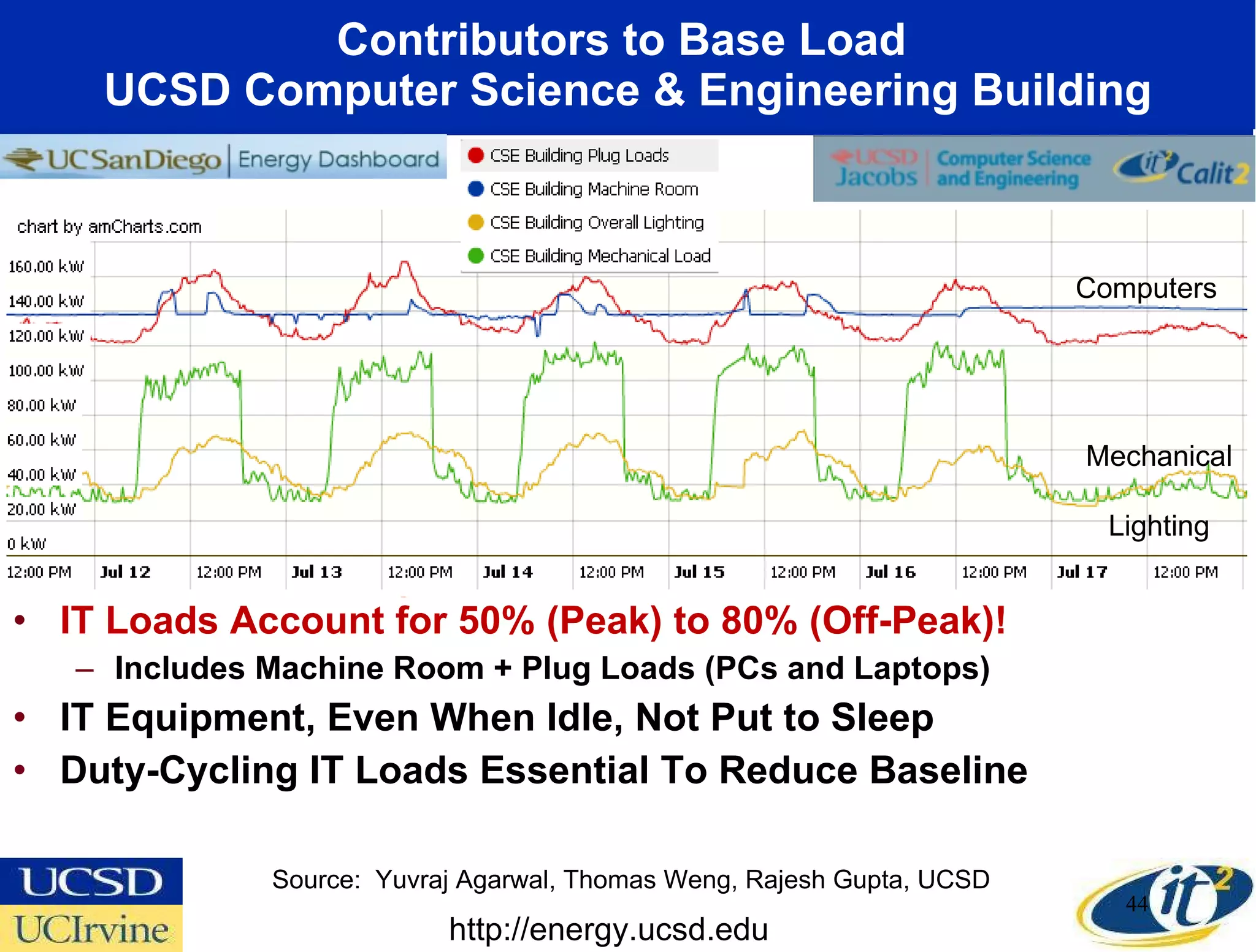
Contributors to Base Load  UCSD Computer Science & Engineering Building IT Loads Account for 50% (Peak) to 80% (Off-Peak)!  Includes Machine Room + Plug Loads (PCs and Laptops) IT Equipment, Even When Idle, Not Put to Sleep Duty-Cycling IT Loads Essential To Reduce Baseline Computers Mechanical Lighting http://energy.ucsd.edu Source:  Yuvraj Agarwal, Thomas Weng, Rajesh Gupta, UCSD
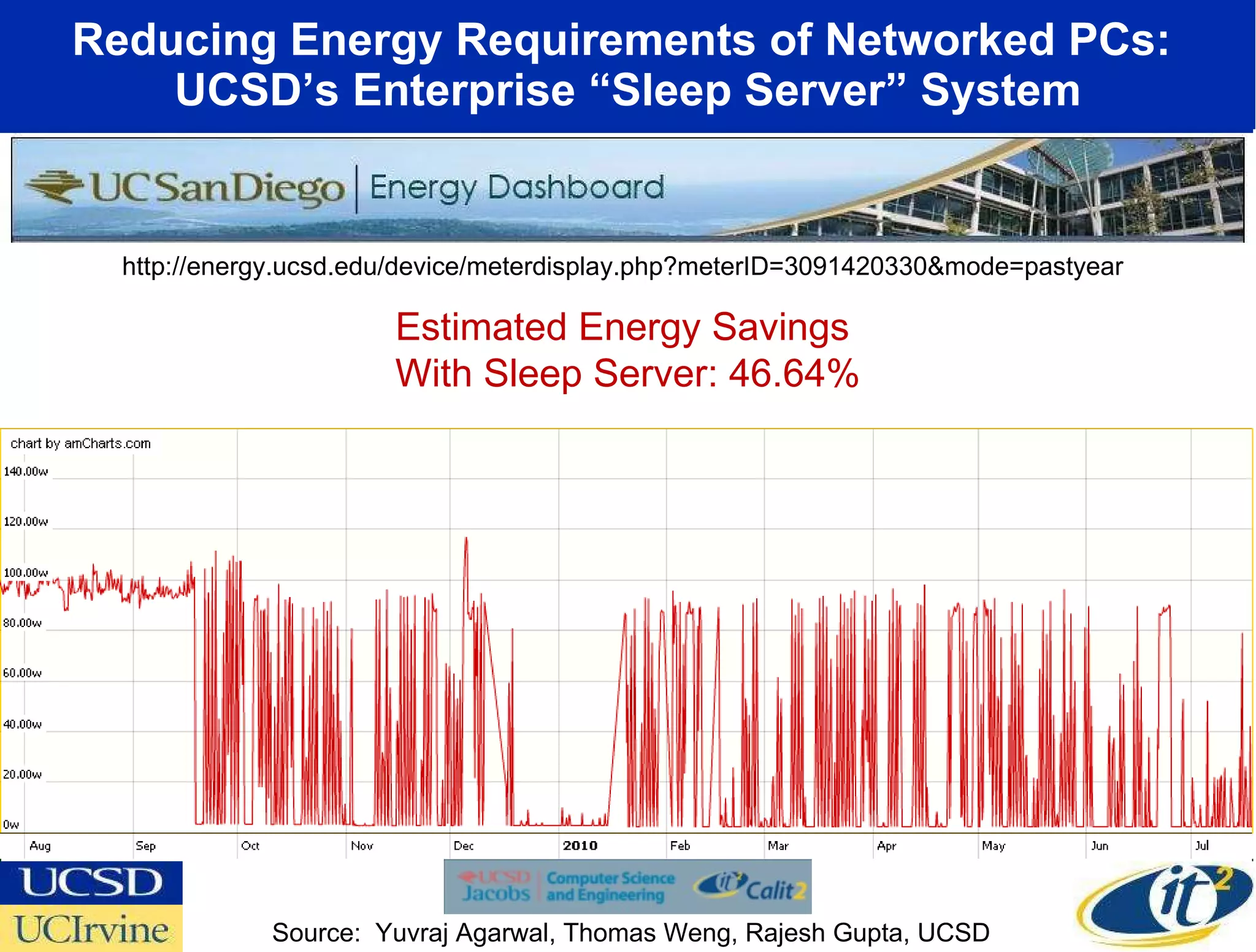
Reducing Energy Requirements of Networked PCs:  UCSD’s Enterprise “Sleep Server” System http://energy.ucsd.edu/device/meterdisplay.php?meterID=3091420330&mode=pastyear Source:  Yuvraj Agarwal, Thomas Weng, Rajesh Gupta, UCSD Estimated Energy Savings  With Sleep Server: 46.64%
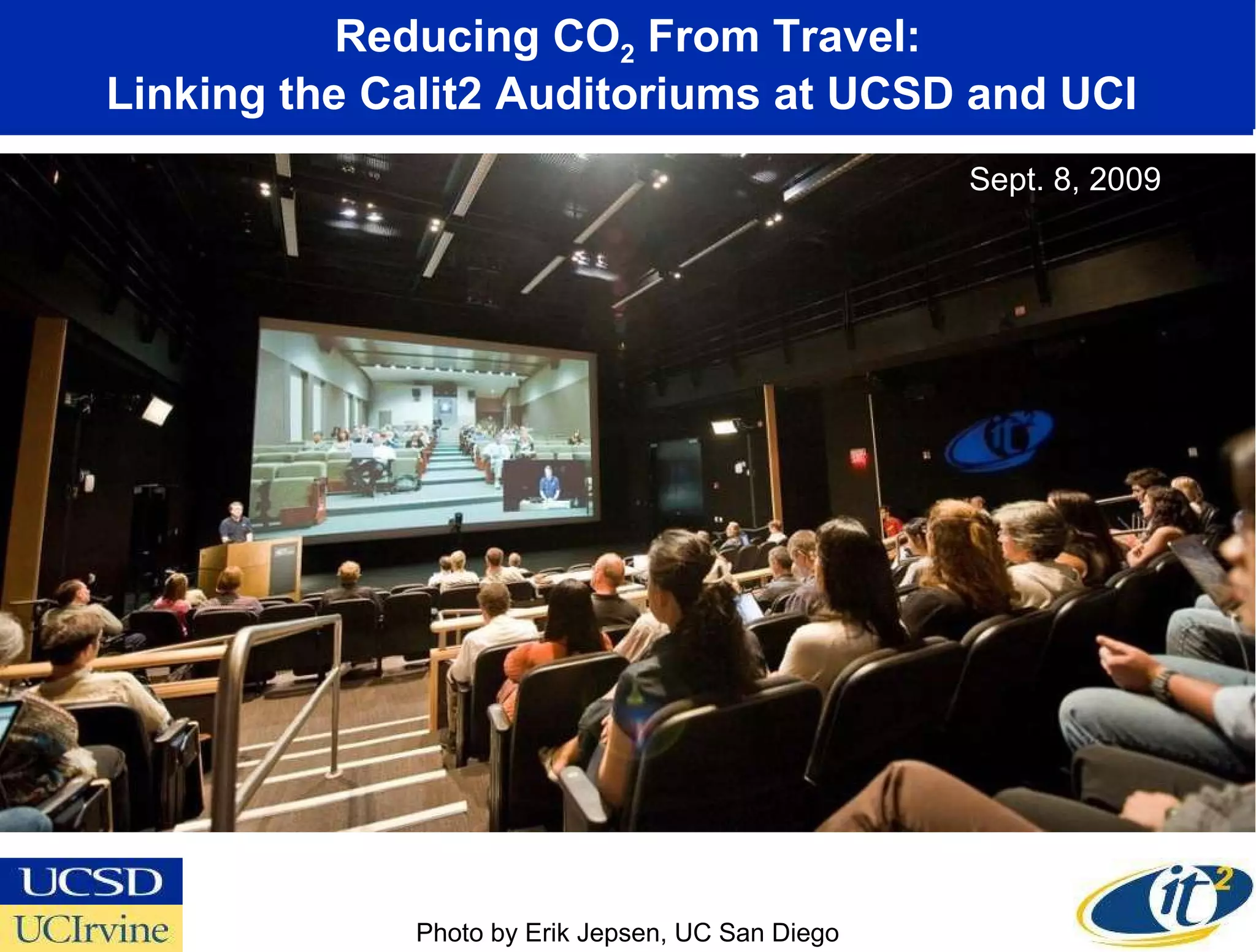
Reducing CO 2  From Travel: Linking the Calit2 Auditoriums at UCSD and UCI  September 8, 2009 Photo by Erik Jepsen, UC San Diego Sept. 8, 2009
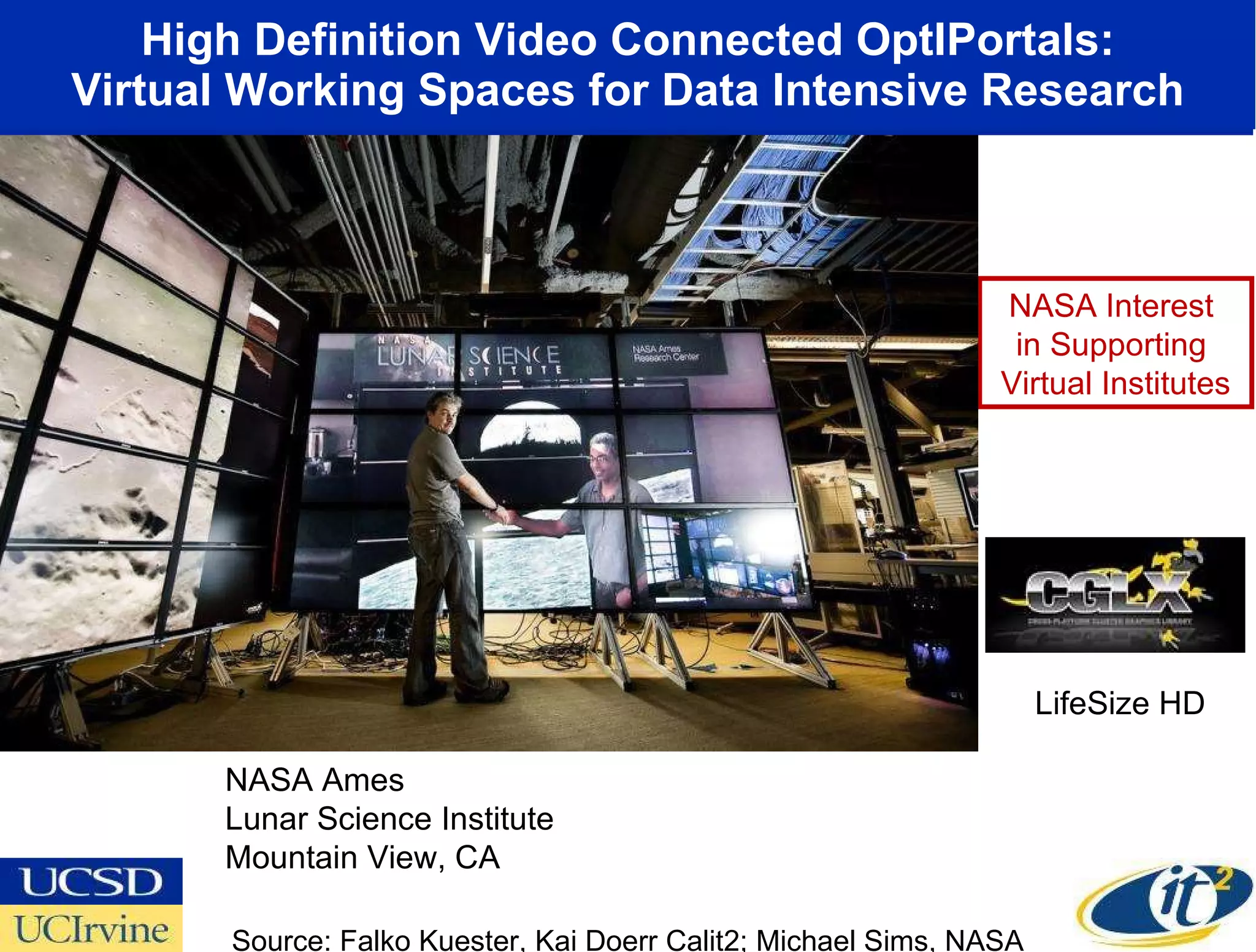
High Definition Video Connected OptIPortals: Virtual Working Spaces for Data Intensive Research Source: Falko Kuester, Kai Doerr Calit2; Michael Sims, NASA NASA Ames Lunar Science Institute Mountain View, CA NASA Interest  in Supporting  Virtual Institutes LifeSize HD
Symposia on Green ICT: Greening ICT and Applying ICT to Green Infrastructures [email_address] Webcasts Available at: www.calit2.net/newsroom/article.php?id=1456 www.calit2.net/newsroom/article.php?id=1498
You Can Download This Presentation  at lsmarr.calit2.net

Sustainable Computing and Telecom Can Contribute to Limiting Global Climatic Disruption

  • 1.
    Sustainable Computing andTelecom Can Contribute to Limiting Global Climatic Disruption Invited Seminar AT&T Shannon Labs Florham Park, NJ July 28, 2010 Dr. Larry Smarr Director, California Institute for Telecommunications and Information Technology Harry E. Gruber Professor, Dept. of Computer Science and Engineering Jacobs School of Engineering, UCSD
  • 2.
    Abstract The CopenhagenSummit concluded that greenhouse gas emissions must be reduced in the coming decade if we are to limit global warming to 2 degrees C (The Earth has warmed ~0.8 degrees C since pre-industrial times). The International Energy Agency has shown what a radical challenge such a reduction will be for the global energy sector, but any solution requires increasing energy efficiency in electrical devices. The Information and Communication Technology (ICT) industry's Smart 2020 study reveals that the ICT industry produces ~2-3 percent of global greenhouse gas emissions. Furthermore, the ICT sector’s emissions will nearly triple, in a business-as-usual scenario, from 2002 to 2020. On the other hand, the Climate Group estimates that transformative applications of ICT to electricity grids, logistic chains, intelligent transportation and building infrastructure, and other social systems can reduce global greenhouse gas emissions by about 15 percent— five times ICT’s own footprint! I will give results on several Calit2 affiliated projects aimed at increasing ICT energy efficiency, including for individual PCs, from the NSF-funded GreenLight Project (http://greenlight.calit2.net), deployed at UCSD, which creates an instrumented data center, to cellular base stations. At a higher level, we are using the two Calit2 university campuses (UC San Diego and UC Irvine) themselves as at-scale Green IT testbeds. Campuses are functionally small towns with their own power grids, commuter transportation systems, hospitals, and populations in the tens of thousands. Calit2 is working with campus administration, faculty and staff to instrument these campuses as Living Laboratories of the Greener Future.
  • 3.
    Accelerating Increase inthe Greenhouse Gas CO 2 Since Industrial Era Began Little Ice Age Medieval Warm Period 388 ppm in 2010 Source: David JC MacKay, Sustainable Energy Without the Hot Air (2009) 290 ppm in 1900 316 ppm in 1960 280 ppm in 1800
  • 4.
    Global Average TemperaturePer Decade Over the Last 160 Years June 2010 Hottest Since Records Began in 1880 - National Oceanic and Atmospheric Administration www.noaanews.noaa.gov/stories2010/20100715_globalstats.html
  • 5.
    Limit of 2o C Agreed to at the UN Climate Change Conference 2009 in Copenhagen “ To achieve the ultimate objective of the Convention to stabilize greenhouse gas concentration in the atmosphere at a level that would prevent dangerous anthropogenic interference with the climate system , we shall, recognizing the scientific view that the increase in global temperature should be below 2 degrees Celsius , on the basis of equity and in the context of sustainable development, enhance our long-term cooperative action to combat climate change.” -- the Copenhagen Accord of 18 December 2009
  • 6.
    However, Current GlobalEmission Reduction Commitments Imply ~4 o C Temperature Rise According to the MIT C-ROADS model: Continuing business as usual would lead to an expected temperature increase of 4.8 °C (8.6 ° F) ( CO 2 950ppm ). But even if all the commitments for emissions reductions made by individual nations at the Copenhagen conference were fully implemented , the expected rise in temperatures is still 3.9 °C (7.0 °F) above preindustrial levels ( CO 2 770ppm ). To stabilize atmospheric concentrations of greenhouse gases and limit these risks, Sterman says that global greenhouse gas emissions must peak before 2020 and then fall at least 80% below recent levels by 2050 , continuing to drop by the end of this century until we have a carbon neutral economy. Doing so might limit the expected warming to the target of 2 °C (3.6 °F) ( CO 2 450ppm ). http://mitsloan.mit.edu/newsroom/2010-sterman.php Since 1780, Earth has Warmed 0.8 o C and CO 2 is at 390ppm
  • 7.
    Atmospheric CO 2 Levels for Last 800,000 Years and Several Projections for the 21 st Century Source: U.S. Global Change Research Program Report (2009) ~SRES B1 ~SRES A2 Graph from: www.globalchange.gov/publications/reports/scientific-assessments /us-impacts/download-the-report 2100 No Emission Controls--MIT Study 2100 Shell Blueprints Scenario 2100 Ramanathan and Xu and IEA Blue Scenario 2100 Post-Copenhagen Agreements-MIT Model
  • 8.
    IEA BLUE--A GlobalEnergy System Scenarios For Limiting CO 2 to 450ppm “ The next decade is critical. If emissions do not peak by around 2020 and decline steadily thereafter, achieving the needed 50% reduction by 2050 will become much more costly. In fact, the opportunity may be lost completely. Attempting to regain a 50% reduction path at a later point in time would require much greater CO 2 reductions, entailing much more drastic action on a shorter time scale and significantly higher costs than may be politically acceptable.”
  • 9.
    To Cut EnergyRelated CO 2 Emissions 50% by 2050 Requires a Radically Different Global Energy System IEA BLUE Map Scenario: Abatement Across All Sectors to Reduce Emissions to Half 2005 Levels by 2050 Halved Doubled
  • 10.
    World Energy-Related CO2 Emissions Abatement by Region Most Abatement is Outside of OECD Countries ~40% China and India
  • 11.
    Average Annual ElectricityCapacity Additions To 2050 Needed to Achieve the BLUE Map Scenario Well Underway with Nuclear, On-Shore Wind, and Hydro, Massive Increases Needed in All Other Modes
  • 12.
    Nuclear Reactors AreBeing Constructed At Roughly the IEA Blue Required Rate www.euronuclear.org/info/encyclopedia/n/nuclear-power-plant-world-wide.htm IEA Blue Requires 30GW Added Per Year
  • 13.
    Must Greatly AccelerateInstallation of Off-Shore Wind and Solar Electricity Generation Need to Install ~30 “Cape Wind’s” (170 Turbines, 0.5 GW) Per Year Off-Shore Wind Farms: ~15GW Total Every Year Till 2050 Need to Install ~20 “Anza Borrego” Arrays (30,000 Dishes, 0.75 GW) Per Year of Concentrated Solar Power: ~14 GW Total Every Year Till 2050 Each of These Projects Has Been Underway for a Decade with Intense Public Controversy
  • 14.
    IEA Blue RequiresRapid Transformation of Light Duty Vehicle Sales Plug-In Hybrid, All-Electric & Fuel-Cell Vehicles Dominate Sales After 2030 OECD Transport Emissions are ~60% Less Than in 2007, But Those in Non-OECD Countries are ~60% Higher by 2050
  • 15.
    Transition to LowCarbon Infrastructure: Race for Low-Carbon Industries is New Driver &quot;If we stick to a 20 per cent cut, Europe is likely to lose the race to compete in the low-carbon world to countries such as China, Japan or the US - all of which are looking to create a more attractive environment for low-carbon investment,“ --British, French, and German Climate and Environmental Ministers Previous Goal—By 2020, 20% Cut Below 1990 Levels Source: Sydney Morning News
  • 16.
    Top Corporate LeadersCall for Innovation Funding: A Business Plan for America’s Energy Future www.americanenergyinnovation.org Our Recommendations (June 2010) Create an Independent National Energy Strategy Board Invest $16 Billion per Year in Clean Energy Innovation Create Centers of Excellence with Strong Domain Expertise Fund ARPA-e at $1 Billion Per Year Establish and Fund a New Energy Challenge Program to Build Large-scale Pilot Projects
  • 17.
    Visionary Low CarbonInfrastructure Plan: Zero Carbon Australia Decarbonizing Electricity Generation in Ten Years http://beyondzeroemissions.org/ Wind & Concentrating Solar Thermal (CST) Are Major Renewable Energy Sources
  • 18.
    ICT is aCritical Element in Achieving Countries Greenhouse Gas Emission Reduction Targets www.smart2020.org GeSI member companies: Bell Canada, British Telecomm., Plc, Cisco Systems, Deutsche Telekom AG, Ericsson, France Telecom, Hewlett-Packard, Intel, Microsoft, Nokia, Nokia Siemens Networks, Sun Microsystems, T-Mobile, Telefónica S.A., Telenor, Verizon, Vodafone Plc. Additional support: Dell, LG.
  • 19.
    The Transformation toa Smart Energy Infrastructure: Enabling the Transition to a Low Carbon Economy Applications of ICT could enable emissions reductions of 15% of business-as-usual emissions. But it must keep its own growing footprint in check and overcome a number of hurdles if it expects to deliver on this potential. www.smart2020.org
  • 20.
    Reduction of ICTEmissions is a Global Challenge – U.S. and Canada are Small Sources U.S. plus Canada Percentage Falls From 25% to 14% of Global ICT Emissions by 2020 www.smart2020.org
  • 21.
    The Global ICTCarbon Footprint by Subsector www.smart2020.org The Number of PCs (Desktops and Laptops) Globally is Expected to Increase from 592 Million in 2002 to More Than Four Billion in 2020 PCs Are Biggest Problem Data Centers Are Rapidly Improving Telecoms Infrastructure & Devices 2 nd Largest
  • 22.
    Somniloquy: IncreasingLaptop Energy Efficiency Somniloquy Allows PCs in “Suspend to RAM” to Maintain Their Network and Application Level Presence http://mesl.ucsd.edu/yuvraj/research/documents/Somniloquy-NSDI09-Yuvraj-Agarwal.pdf Yuvraj Agarwal, et al., UCSD & Microsoft Peripheral Laptop Low power domain Network interface Secondary processor Network interface Management software Main processor, RAM, etc
  • 23.
    Carbon Pricing WillHave Major Impact on Data Centers—A New Driver for Energy Efficiency
  • 24.
    The GreenLight Project: Instrumenting the Energy Cost of Computational Science Focus on 5 Communities with At-Scale Computing Needs: Metagenomics Ocean Observing Microscopy Bioinformatics Digital Media Measure, Monitor, & Web Publish Real-Time Sensor Outputs Via Service-oriented Architectures Allow Researchers Anywhere To Study Computing Energy Cost Enable Scientists To Explore Tactics For Maximizing Work/Watt Develop Middleware that Automates Optimal Choice of Compute/RAM Power Strategies for Desired Greenness Partnering With Minority-Serving Institutions Cyberinfrastructure Empowerment Coalition Source: Tom DeFanti, Calit2; GreenLight PI
  • 25.
    New Techniques forDynamic Power and Thermal Management to Reduce Energy Requirements Dynamic Thermal Management (DTM) Workload Scheduling: Machine learning for Dynamic Adaptation to get Best Temporal and Spatial Profiles with Closed-Loop Sensing Proactive Thermal Management Reduces Thermal Hot Spots by Average 60% with No Performance Overhead Dynamic Power Management (DPM) Optimal DPM for a Class of Workloads Machine Learning to Adapt Select Among Specialized Policies Use Sensors and Performance Counters to Monitor Multitasking/Within Task Adaptation of Voltage and Frequency Measured Energy Savings of Up to 70% per Device System Energy Efficiency Lab (seelab.ucsd.edu) Prof. Tajana Šimunić Rosing, CSE, UCSD CNS NSF Project Greenlight Green Cyberinfrastructure in Energy-Efficient Modular Facilities Closed-Loop Power &Thermal Management
  • 26.
    UCSD is InstallingZero Carbon Emission Solar and Fuel Cell DC Electricity Generators San Diego’s Point Loma Wastewater Treatment Plant Produces Waste Methane UCSD 2.8 Megawatt Fuel Cell Power Plant Uses Methane 2 Megawatts of Solar Power Cells Being Installed Available Late 2009
  • 27.
    Concept—avoid DC ToAC To DC Conversion Losses Computers Use DC Power Internally Solar & Fuel Cells Produce DC Can Computers & Storage Use DC Directly? Is DC System Scalable? How to Handle Renewable Intermittency? Prototype Being Built in GreenLight Instrument Build DC Rack Inside of GreenLight Modular Data Center 5 Nehalem Sun Servers 5 Nehalem Intel Servers 1 Sun Thumper Storage Server Building Custom DC Sensor System to Provide DC Monitoring Operational August-Sept. 2010 GreenLight Experiment: Direct 400v DC-Powered Modular Data Center Source: Tom DeFanti, Greg Hidley, Calit2; Tajana Rosing, UCSD CSE All With DC Power Supplies UCSD DC Fuel Cell 2800kW Sun MDC <100-200kW Next Step: Couple to Solar and Fuel Cell
  • 28.
    Challenge: How CanCommercial Modular Data Centers Be Made More Energy Efficient? Source: Michael Manos
  • 29.
    UCSD Scalable E nergy E fficient D atacenter (SEED): Energy-Efficient Hybrid Electrical-Optical Networking Build a Balanced System to Reduce Energy Consumption Dynamic Energy Management Use Optics for 90% of Total Data Which is Carried in 10% of the Flows SEED Testbed in Calit2 Machine Room and Sunlight Optical Switch Hybrid Approach Can Realize 3x Cost Reduction; 6x Reduction in Cabling; and 9x Reduction in Power PIs of NSF MRI: George Papen, Shaya Fainman, Amin Vahdat; UCSD
  • 30.
    Calit2 Photonics SystemsLaboratory Is Investigating Novel Telecoms Energy Efficiency Networking “Living Lab” Testbed Core Real-Time Terabit/s Processing Single 640Gbps Channel Transport Over >100km Sub-Watt Transport of Terabit Channel Shayan Mookherjea Optical devices and optical communication networks, including photonics, lightwave systems and nano-scale optics. Stojan Radic Optical communication networks; all-optical processing; parametric processes in high-confinement fiber and semiconductor devices. Shaya Fainman Nanoscale science and technology; ultrafast photonics and signal processing Joseph Ford Optoelectronic subsystems integration (MEMS, diffractive optics, VLSI); Fiber optic and free-space communications. George Papen Advanced photonic systems including optical communication systems, optical networking, and environmental and atmospheric remote sensing. ECE Testbed Faculty UCSD Photonics
  • 31.
    Terabit Channel: DataCenter, LAN/Metro: How to Minimize Terabit Dissipation Maintain Channel Integrity in Optical Domain: No Forward Error Correction (FEC) No Regeneration No Digital Signal Processing (DSP) Tbps TX Tbps RX Sub-Watt Transport of Terabit Channel * Source: Nikola Alic, Stojan Radic, Calit2, UCSD
  • 32.
    Sub-Watt Transport ofTerabit Channel: 1000x Reduction in Transport Dissipation Back-to-Back Source: Nikola Alic, Stojan Radic, Calit2, UCSD Pico-Joule per Bit Efficiency Legacy Standard Single Mode Fiber (SMF-28) 1 ps Transmission 100 km without Conjugation 1 ps Transmission 100 km with Conjugation 1 ps
  • 33.
    Calit2@UCSD’s Wireless PowerAmplifier Lab: Making Wireless Telecom Infrastructure More Efficient Power Transistor Tradeoffs Si-LDMOS, GaN, & GaAs Price & Performance Power Amplifier Tradeoffs WiMAX & 3.9GPP LTE Efficiency & Linearity Digital Signal Processing Tradeoffs Pre-Distortion, Memory Effects & Power Control MIPS & Memory STMicroelectronics IEEE Topical Symposium on Power Amplifiers for Wireless Communications was held Sept. 14-15, 2009 Oct. 2005 Calit2 Sets World Record 50% Efficiency for High-Power Amplifiers for Cellular Base Stations
  • 34.
    Applying ICT –The Smart 2020 Opportunity for 15% Reduction in GHG Emissions Smart Buildings Smart Electrical Grid www.smart2020.org Smart Transportation Smart Motors
  • 35.
    Application of ICTCan Lead to a 5-Fold Greater Decrease in GHGs Than its Own Carbon Footprint Major Opportunities for the United States* Smart Electrical Grids Smart Transportation Systems Smart Buildings Virtual Meetings * Smart 2020 United States Report Addendum www.smart2020.org While the sector plans to significantly step up the energy efficiency of its products and services, ICT’s largest influence will be by enabling energy efficiencies in other sectors, an opportunity that could deliver carbon savings five times larger than the total emissions from the entire ICT sector in 2020. --Smart 2020 Report
  • 36.
    The Transition toa Low Carbon Society Requires Rethinking Our Cities Infrastructure www.unep.org/publications/ebooks/kick-the-habit/pdfs/KickTheHabit_en_lr.pdf
  • 37.
    Over 670 Collegeand University President’s Have Signed the Climate Commitment Pledge “ We recognize the need to reduce the global emission of greenhouse gases by 80% by mid-century. Within two years of signing this document, we will develop an institutional action plan for becoming climate neutral.” www.presidentsclimatecommitment.org Can Universities Live 5-10 Years Ahead of Cities -- Helping Accelerate the Climate Adaptation of Global Society?
  • 38.
    Making University Campuses Living Laboratories for the Greener Future www.educause.edu/EDUCAUSE+Review/EDUCAUSEReviewMagazineVolume44/CampusesasLivingLaboratoriesfo/185217
  • 39.
    UCSD asa Model Green Campus Second-Largest User Of Electricity (~40 MW) In San Diego 45,000 Daily Occupants After the City Itself, the Seventh-Largest City in the U.S. Aggressive Program to De-Carbonize Generating Electricity Natural Gas Co-Gen Facility Supplies ~90% of Campus Electricity Saves ~$8 Million Annually in Energy Costs Installed 1.2 MW Of Solar Panels (With an Additional 2 MW Likely) Acquiring a 2.8 MW Fuel Cell in 2011 Powered by Methane from San Diego Waste-Treatment Plant UCSD Campus Fleet 45% Renewables 300 Small Electric Cars 50 Hybrids 20 Full-Size Electrics by 2011 www.educause.edu/EDUCAUSE+Review/EDUCAUSEReviewMagazineVolume44/CampusesasLivingLaboratoriesfo/185217
  • 40.
    UC Irvine as a Model Green Campus California’s “Flex Your Power” Statewide Energy-Efficiency Campaign Only University Campus Cited in “Best Overall” UCI Led in Efficiency-Saving 3.7 Million KWh of Electricity During 07–08 Reducing Peak Demand by up to 68% Saving Nearly 4 Million Gallons Of Water Annually. UCI’s 2008 GHG Reduction Program Annually Eliminates 62,000 MtCO 2 e Saves the Campus ~$30 Million SunEdison Financed, Built, & Operates Solar Energy System In March 2009, UCI Began Purchasing Energy Generated by System Will Produce >24 GWh over 20 Years 18 MW Combined Heating, Power, & Cooling Co-Gen Plant Employs 62,000 Ton-Hour Chilled-Water Thermal Energy Storage System Capable of Reducing up to 6 MW of Electrical Peak Demand UCI 1st US Campus to Retrofit Shuttles for Pure Biodiesel Research Program with Toyota Plug-In Prius in Nov 2007 www.educause.edu/EDUCAUSE+Review/EDUCAUSEReviewMagazineVolume44/CampusesasLivingLaboratoriesfo/185217
  • 41.
    Real-Time Monitoring ofBuilding Energy Usage: Toward a Smart Energy Campus
  • 42.
    Using the Campusas a Testbed for Smart Energy: Making Buildings More Energy Efficient Calit2 and CSE are Very Energy Intensive Buildings kW/sqFt Year Since 1/1/09
  • 43.
    Smart Energy Buildings:Active Power Management of Computers 500 Occupants, 750 Computers Instrumentation to Measure Macro and Micro-Scale Power Use 39 Sensor Pods, 156 Radios, 70 Circuits Subsystems: Air Conditioning & Lighting Conclusions: Peak Load is Twice Base Load 70% of Base Load is PCs and Servers Source: Yuvraj Agarwal, Thomas Weng, Rajesh Gupta, UCSD
  • 44.
    Contributors to BaseLoad UCSD Computer Science & Engineering Building IT Loads Account for 50% (Peak) to 80% (Off-Peak)! Includes Machine Room + Plug Loads (PCs and Laptops) IT Equipment, Even When Idle, Not Put to Sleep Duty-Cycling IT Loads Essential To Reduce Baseline Computers Mechanical Lighting http://energy.ucsd.edu Source: Yuvraj Agarwal, Thomas Weng, Rajesh Gupta, UCSD
  • 45.
    Reducing Energy Requirementsof Networked PCs: UCSD’s Enterprise “Sleep Server” System http://energy.ucsd.edu/device/meterdisplay.php?meterID=3091420330&mode=pastyear Source: Yuvraj Agarwal, Thomas Weng, Rajesh Gupta, UCSD Estimated Energy Savings With Sleep Server: 46.64%
  • 46.
    Reducing CO 2 From Travel: Linking the Calit2 Auditoriums at UCSD and UCI September 8, 2009 Photo by Erik Jepsen, UC San Diego Sept. 8, 2009
  • 47.
    High Definition VideoConnected OptIPortals: Virtual Working Spaces for Data Intensive Research Source: Falko Kuester, Kai Doerr Calit2; Michael Sims, NASA NASA Ames Lunar Science Institute Mountain View, CA NASA Interest in Supporting Virtual Institutes LifeSize HD
  • 48.
    Symposia on GreenICT: Greening ICT and Applying ICT to Green Infrastructures [email_address] Webcasts Available at: www.calit2.net/newsroom/article.php?id=1456 www.calit2.net/newsroom/article.php?id=1498
  • 49.
    You Can DownloadThis Presentation at lsmarr.calit2.net