
How Your Network Can Help Reduce Your Carbon Footprint and Create a Greener CampusJerry Sheehan, California Institute for Telecommunications & Information Technology (jerry@ucsd.edu)Rod Wilson, Nortel Networks (rgwilson@nortel.com)Internet 2, Fall Member MeetingOctober 6, 2009 8:45-10:00
Climate Change and ICTClimate Change 101The Role of ICT in Anthropomorphic Climate ChangeClimate Regulation and ICT The Case of British Columbia:  A Carbon Neutral RealityThe Case of California:  A Carbon Constrained FutureThe Case of Aviation:  A Potential ICT Future?Calit2:  A Testbed for ICT Enabled Carbon ReductionNSF Major Research Instrumentation Project GreenLightFlexible Work and TelepresenceSmarter BuildingsSmarter TransportationInternational PartnershipsPresentation Overview
Presentation OverviewEnablers and InnovationGovernment assistsCANARIECanada California Strategic Innovation Initiative (CCSIP)Green ICT & next generation Data CentersPowerBandwidthControlFinding maximum Bandwidth agility and flexibilityRe thinking the Virtual Machine Turntable
Climate Change & ICT
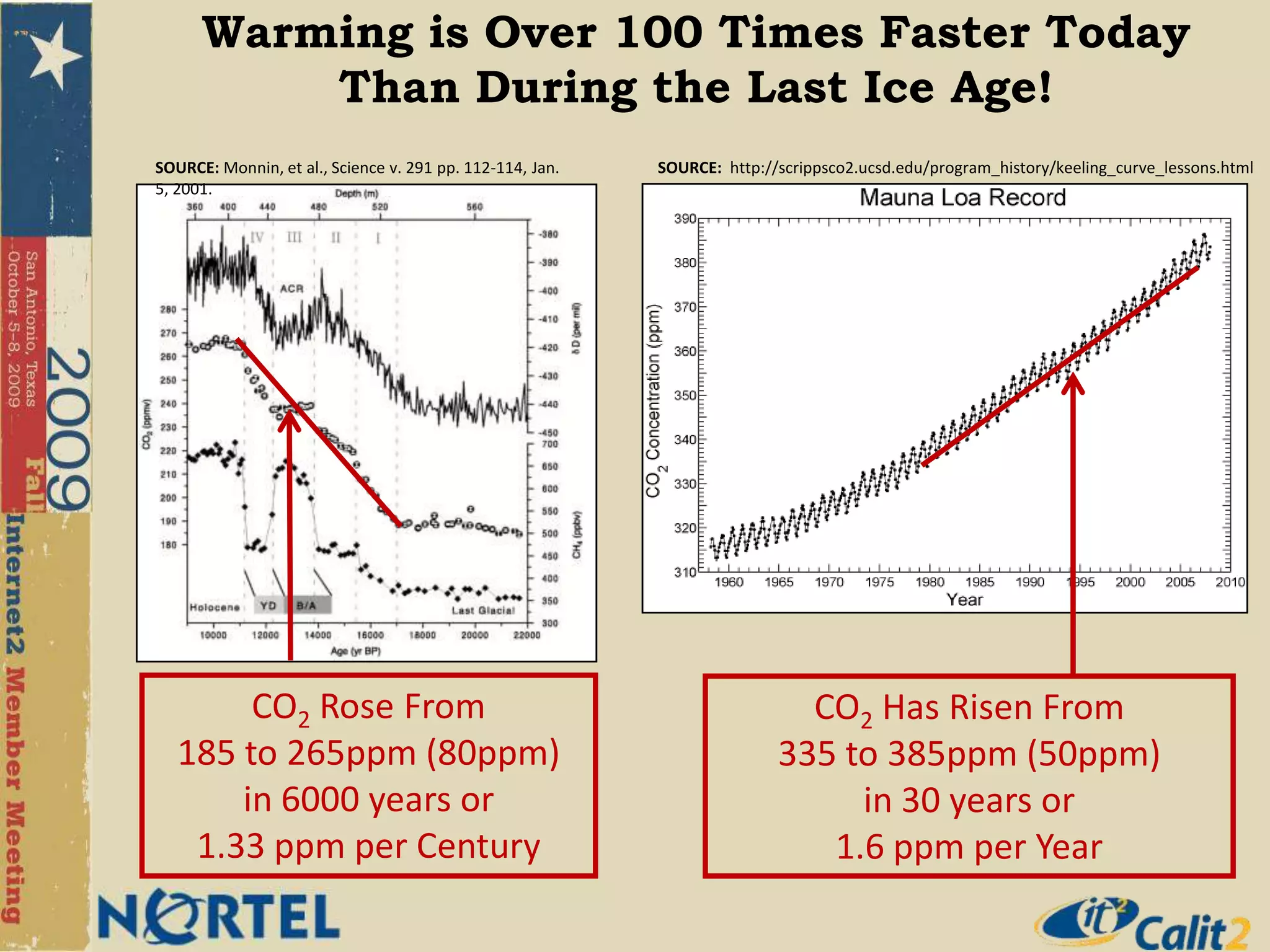
Warming is Over 100 Times Faster TodayThan During the Last Ice Age!SOURCE:  http://scrippsco2.ucsd.edu/program_history/keeling_curve_lessons.htmlSOURCE: Monnin, et al., Science v. 291 pp. 112-114, Jan. 5, 2001.CO2 Has Risen From 335 to 385ppm (50ppm) in 30 years or 1.6 ppm per YearCO2 Rose From 185 to 265ppm (80ppm) in 6000 years or 1.33 ppm per Century
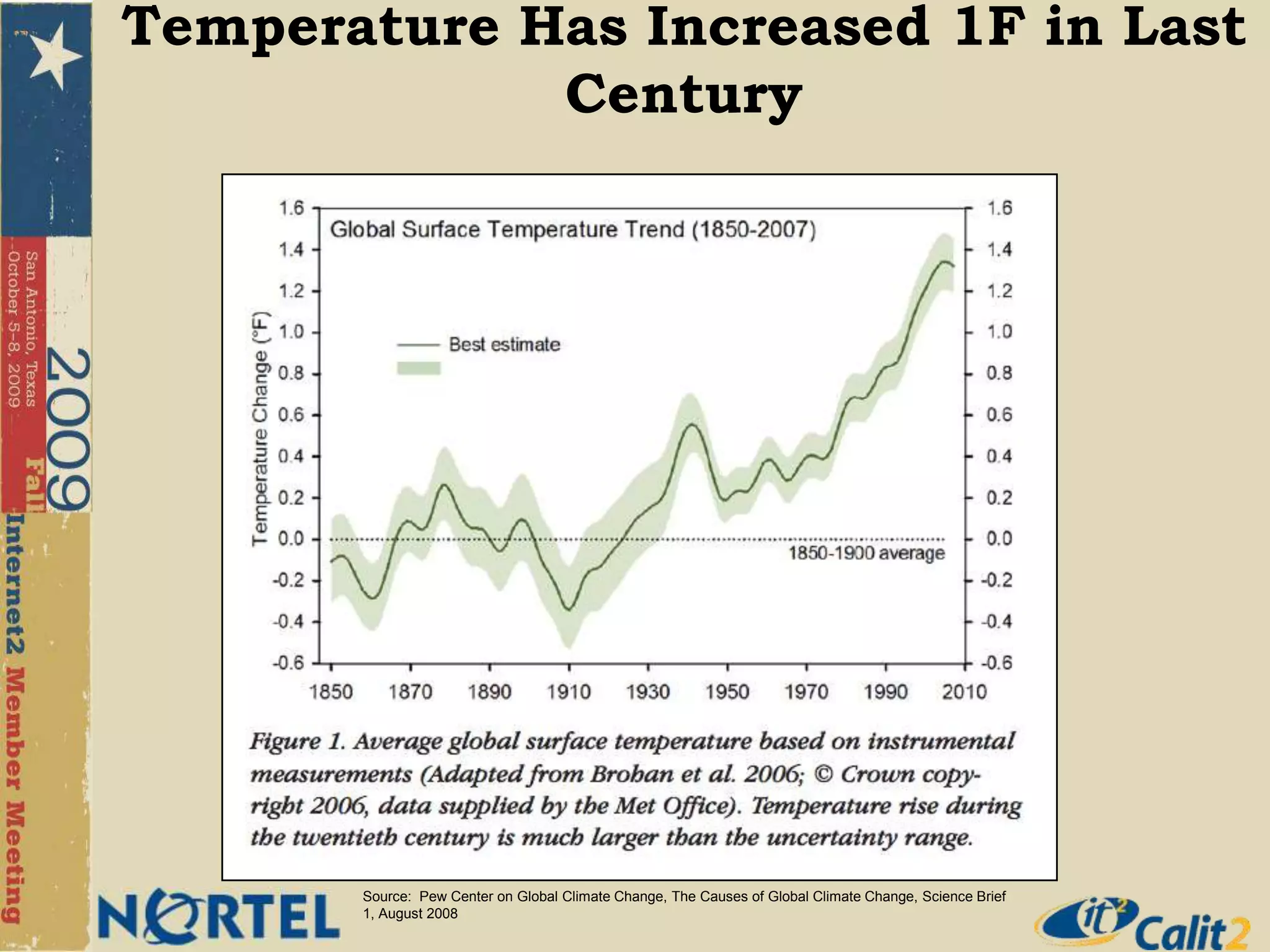
Temperature Has Increased 1F in Last CenturySource:  Pew Center on Global Climate Change, The Causes of Global Climate Change, Science Brief 1, August 2008
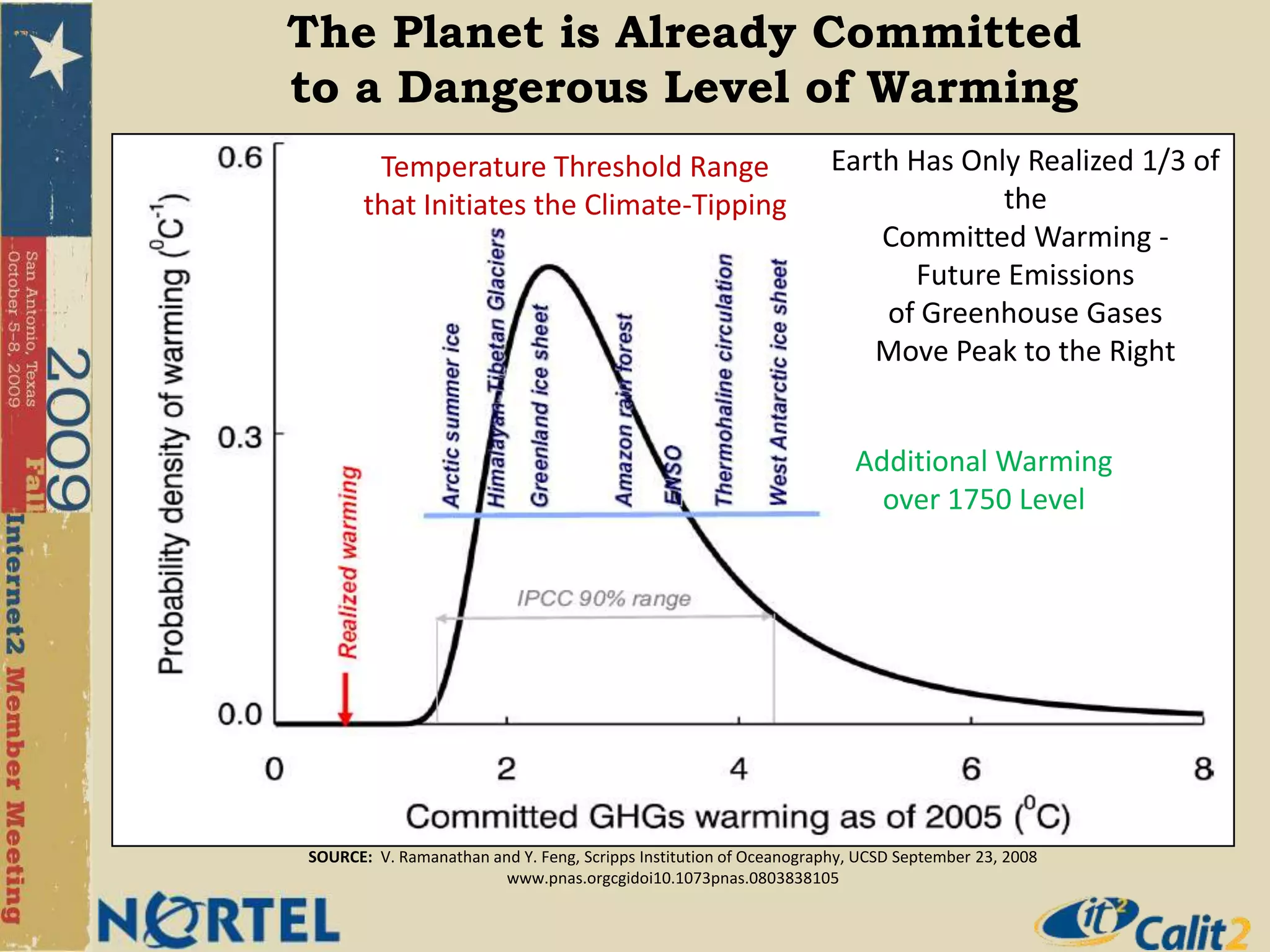
The Planet is Already Committed to a Dangerous Level of WarmingTemperature Threshold Range that Initiates the Climate-TippingEarth Has Only Realized 1/3 of theCommitted Warming -Future Emissions of Greenhouse Gases Move Peak to the RightAdditional Warming over 1750 LevelSOURCE:  V. Ramanathan and Y. Feng, Scripps Institution of Oceanography, UCSD September 23, 2008www.pnas.orgcgidoi10.1073pnas.0803838105
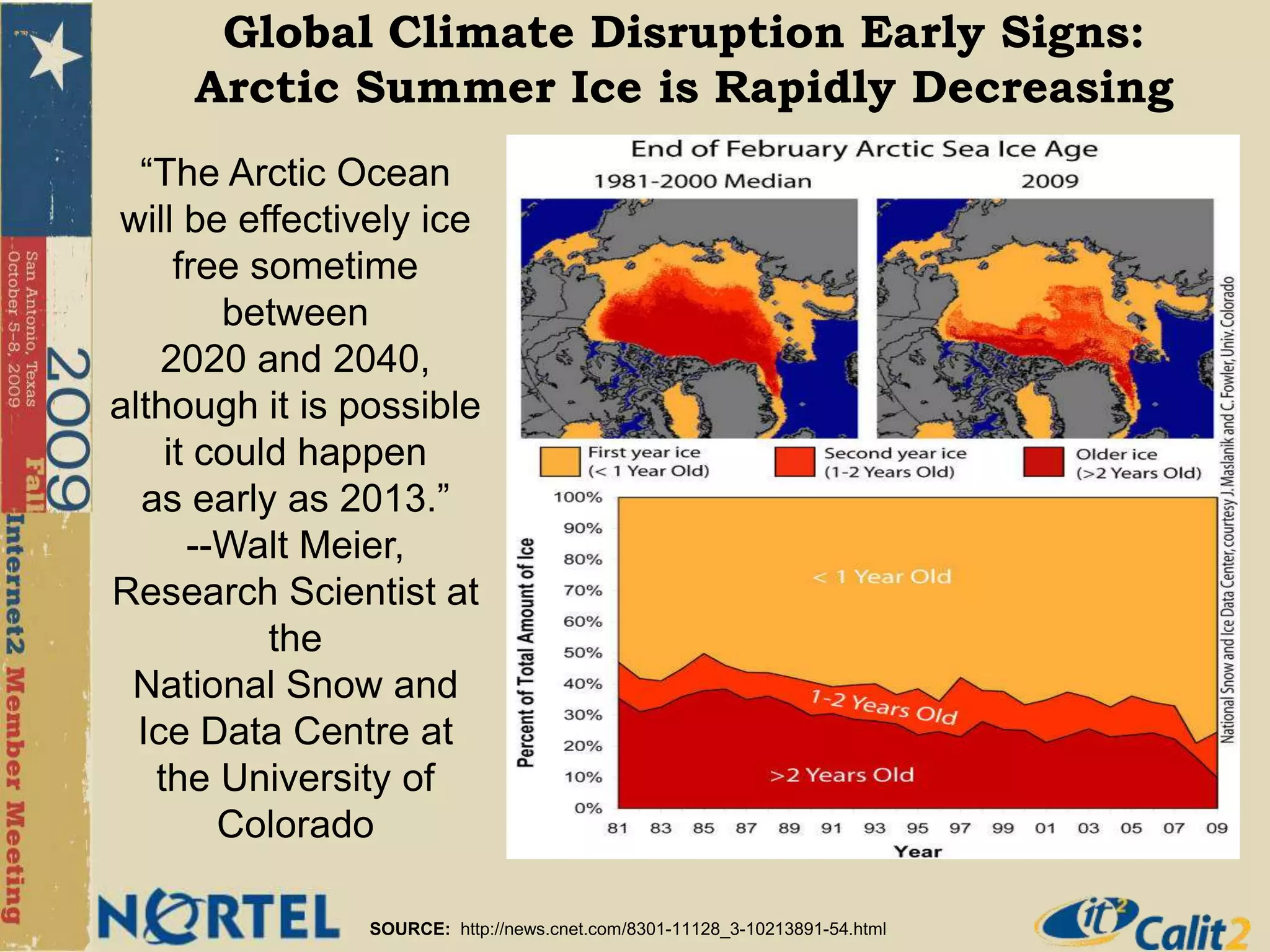
Global Climate Disruption Early Signs:Arctic Summer Ice is Rapidly Decreasing“The Arctic Ocean will be effectively ice free sometime between 2020 and 2040, although it is possible it could happen as early as 2013.”--Walt Meier, Research Scientist at the National Snow and Ice Data Centre at the University of Colorado SOURCE:  http://news.cnet.com/8301-11128_3-10213891-54.html
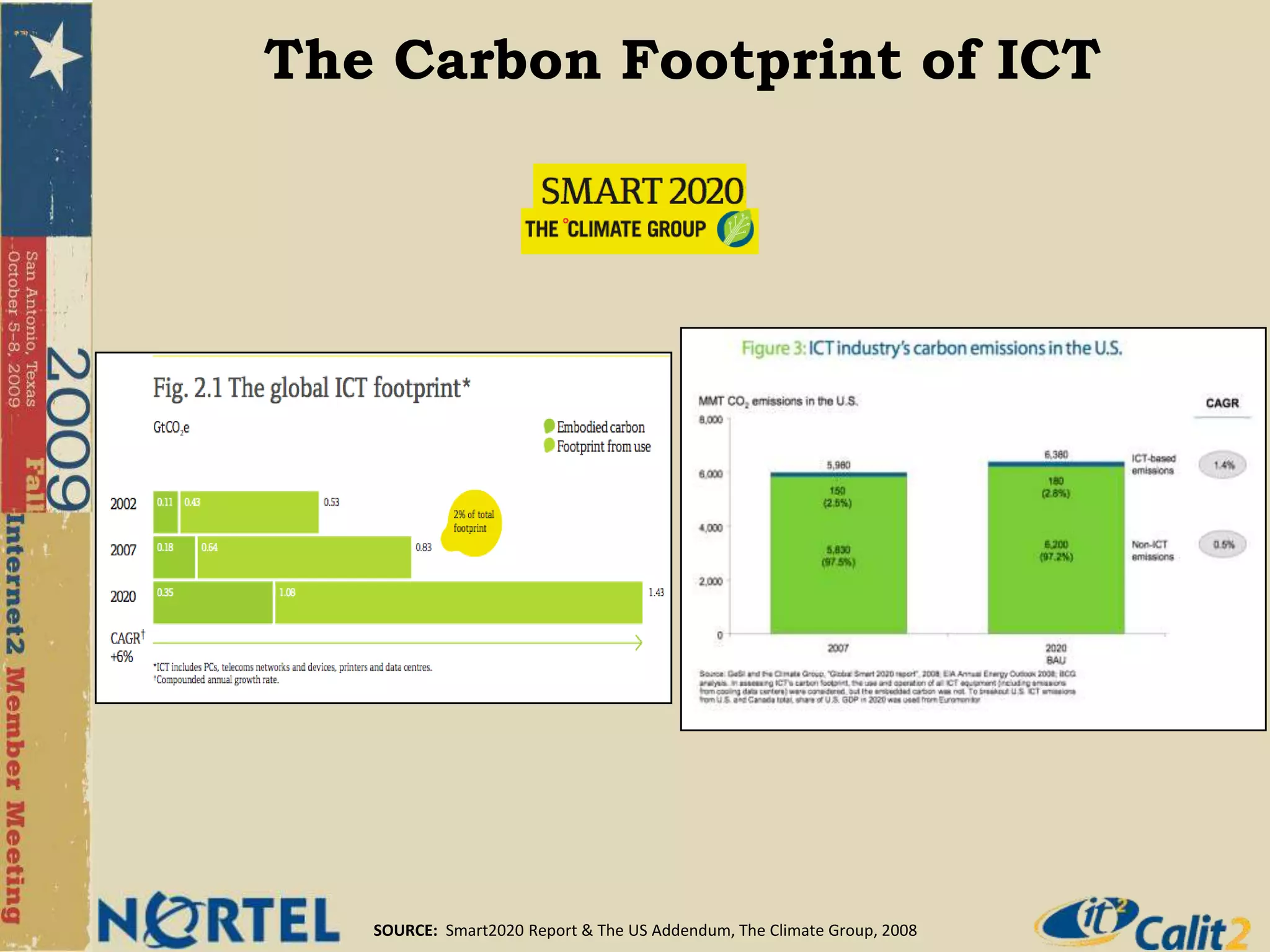
The Carbon Footprint of ICT SOURCE:  Smart2020 Report & The US Addendum, The Climate Group, 2008
Climate Regulation & ICT
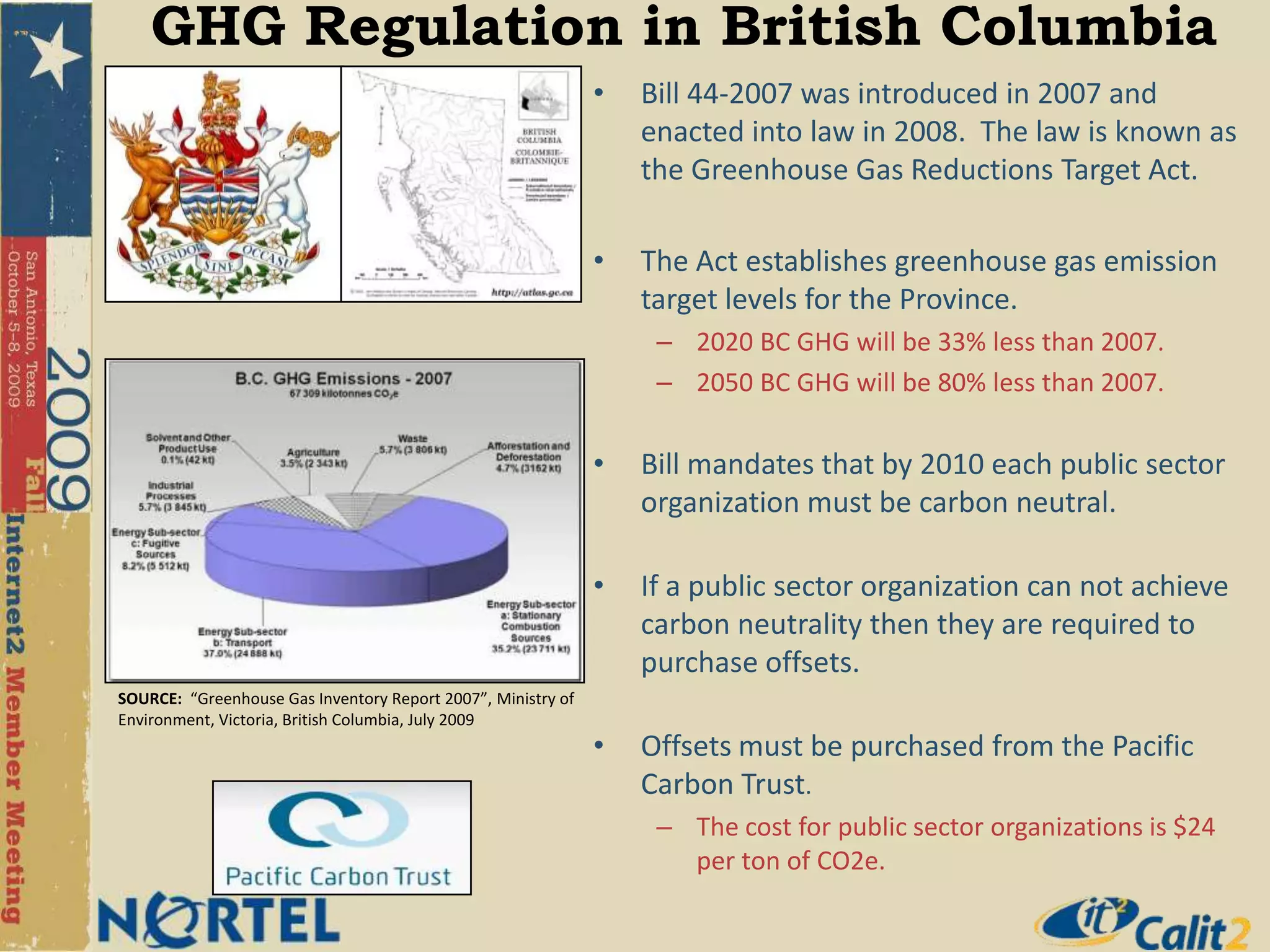
GHG Regulation in British ColumbiaBill 44-2007 was introduced in 2007 and enacted into law in 2008.  The law is known as the Greenhouse Gas Reductions Target Act.The Act establishes greenhouse gas emission target levels for the Province.2020 BC GHG will be 33% less than 2007.2050 BC GHG will be 80% less than 2007.Bill mandates that by 2010 each public sector organization must be carbon neutral.If a public sector organization can not achieve carbon neutrality then they are required to purchase offsets.Offsets must be purchased from the Pacific Carbon Trust.  The cost for public sector organizations is $24 per ton of CO2e.SOURCE:  “Greenhouse Gas Inventory Report 2007”, Ministry of Environment, Victoria, British Columbia, July 2009
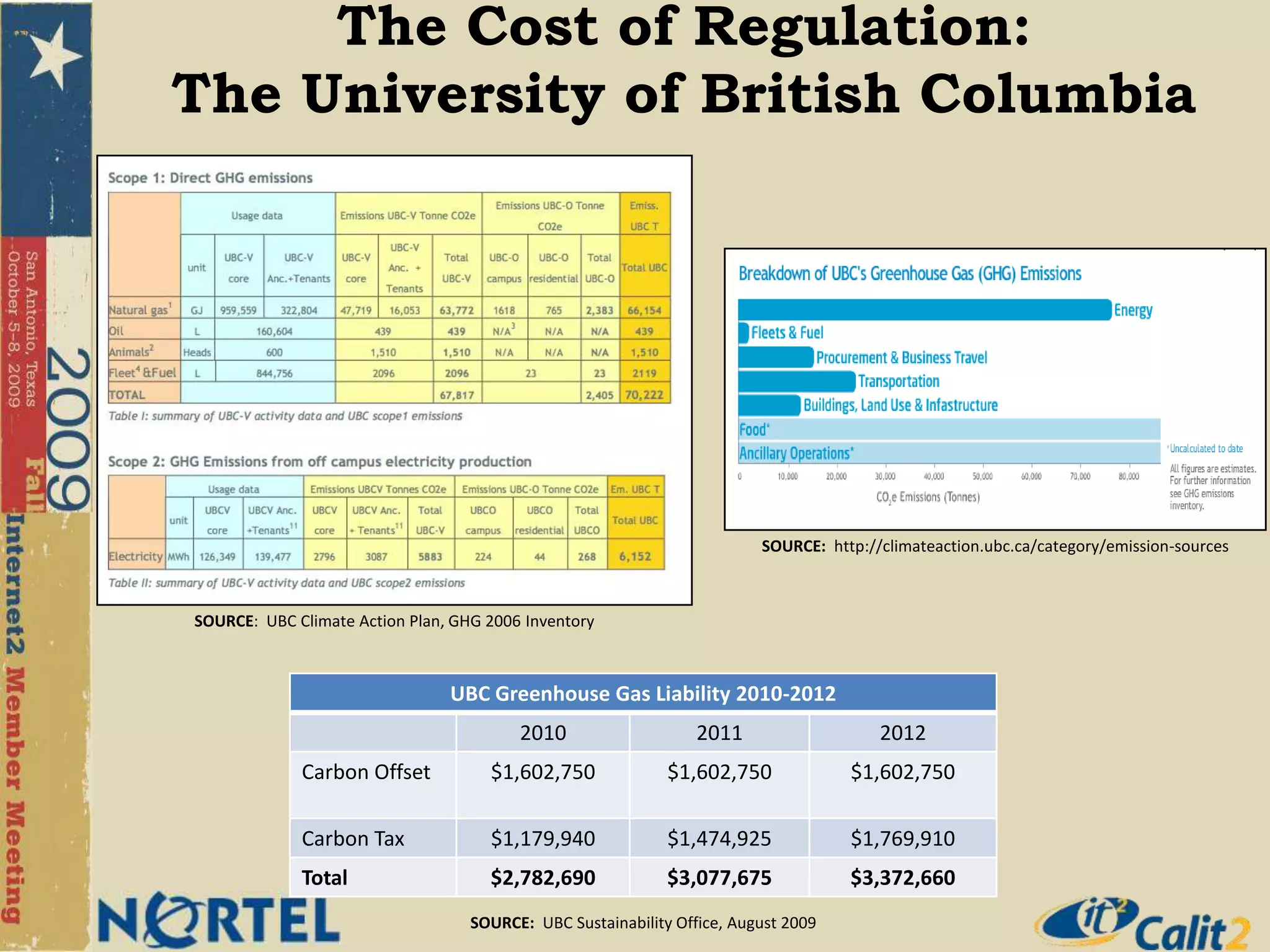
SOURCE:  http://climateaction.ubc.ca/category/emission-sourcesSOURCE:  UBC Climate Action Plan, GHG 2006 InventorySOURCE:  UBC Sustainability Office, August 2009The Cost of Regulation:                     The University of British Columbia
The California Global Warming Solutions Act of 2006 (AB32)Executive Order S-3-05 signed from Governor Schwarzenegger sets GHG targets.
2010 GHG emissions set to 2000 levels.
2020 GHG emissions set to 1990 levels.
2050 GHG emissions set to 80% of 1990 levels.
AB 32 Overview (Signed Into Law 2006)
Identify statewide GHG emissions for 1990 to serve as emissions limit to be achieved by 2020.
427 million metric tons of CO2e goal, roughly 30% reduction.
Mandatory reporting and verification of GHG emissions by major emitters on or before Jan 1, 2008.
If you emit over 25,000 metric tons of CO2e reporting is required.
Identify and adopt regulations for discrete early actions enforceable by or before January 2010.
Ensure early voluntary reductions receive appropriate credit in AB32 implementation.
Convene Environmental Justice Advisory Committee to advise in development of scoping plan and implementation of AB32.
Appoint an Economic and Technology Advancement Advisory CommitteeSOURCE:  2009 Climate Adaptation Strategy Draft, p15, 2009
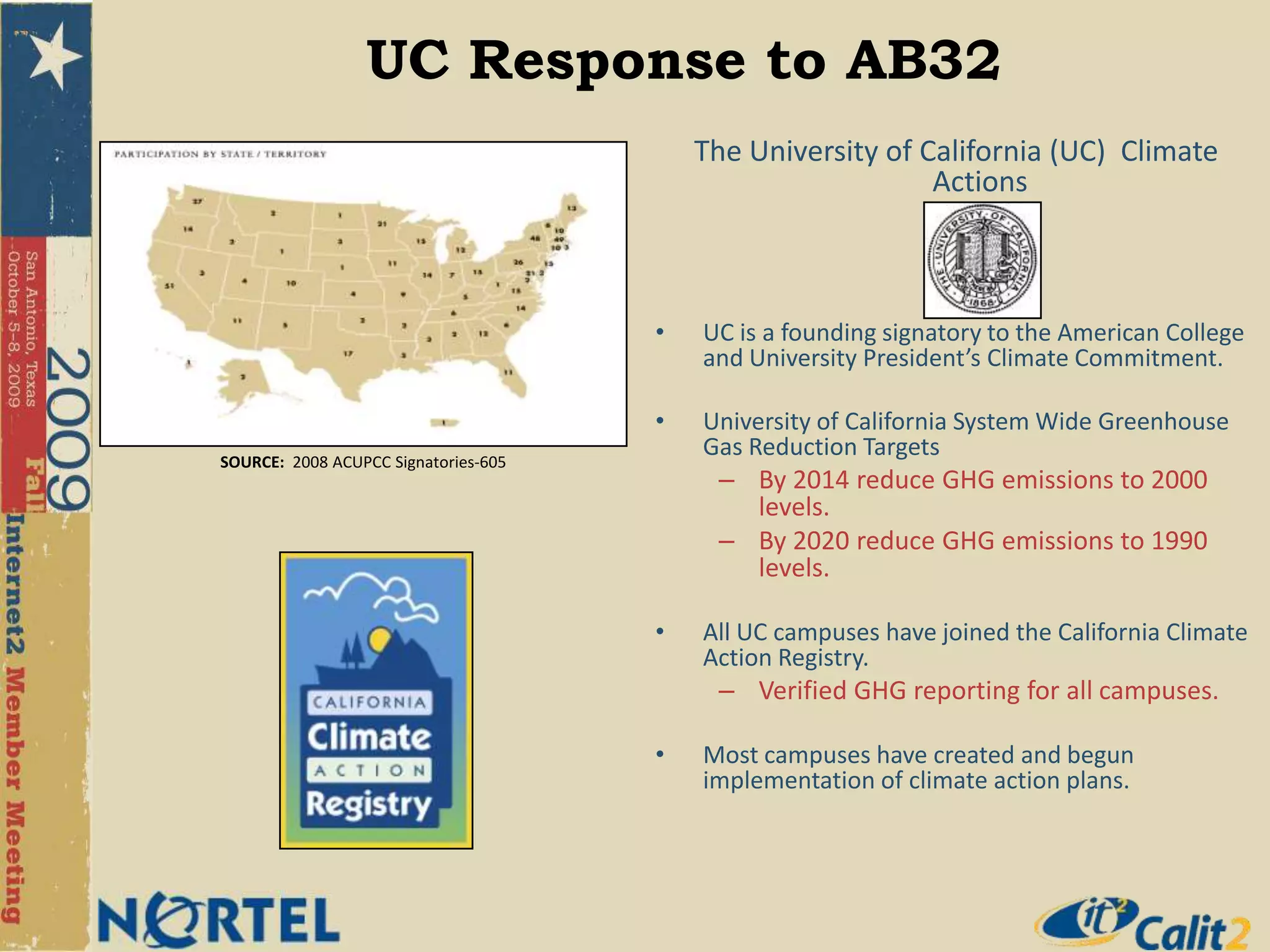
UC Response to AB32The University of California (UC)  Climate ActionsUC is a founding signatory to the American College and University President’s Climate Commitment.
University of California System Wide Greenhouse Gas Reduction Targets
By 2014 reduce GHG emissions to 2000 levels.
By 2020 reduce GHG emissions to 1990 levels.
All UC campuses have joined the California Climate Action Registry.
Verified GHG reporting for all campuses.
Most campuses have created and begun implementation of climate action plans.SOURCE:  2008 ACUPCC Signatories-605
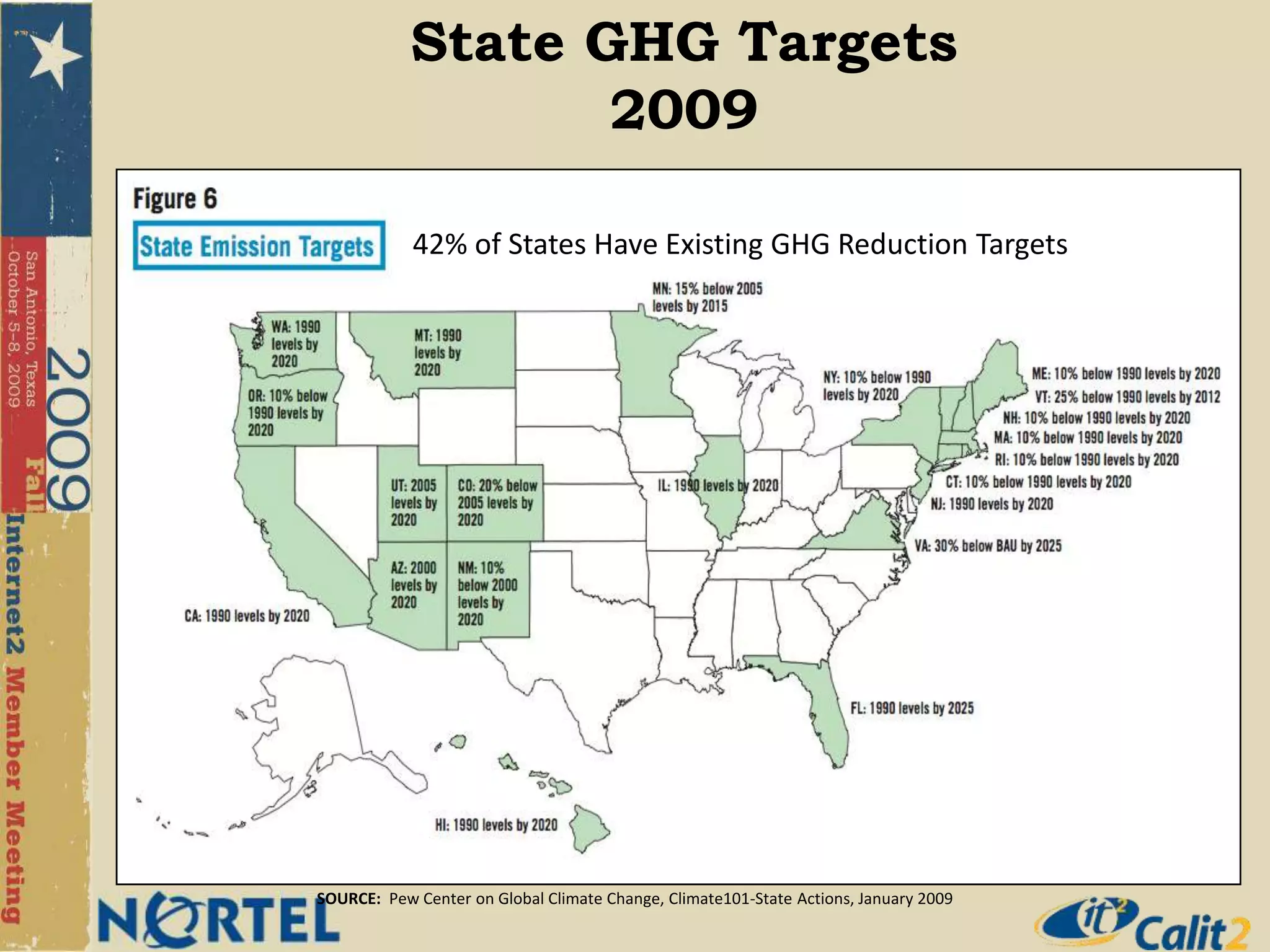
42% of States Have Existing GHG Reduction TargetsSOURCE:  Pew Center on Global Climate Change, Climate101-State Actions, January 2009State GHG Targets2009
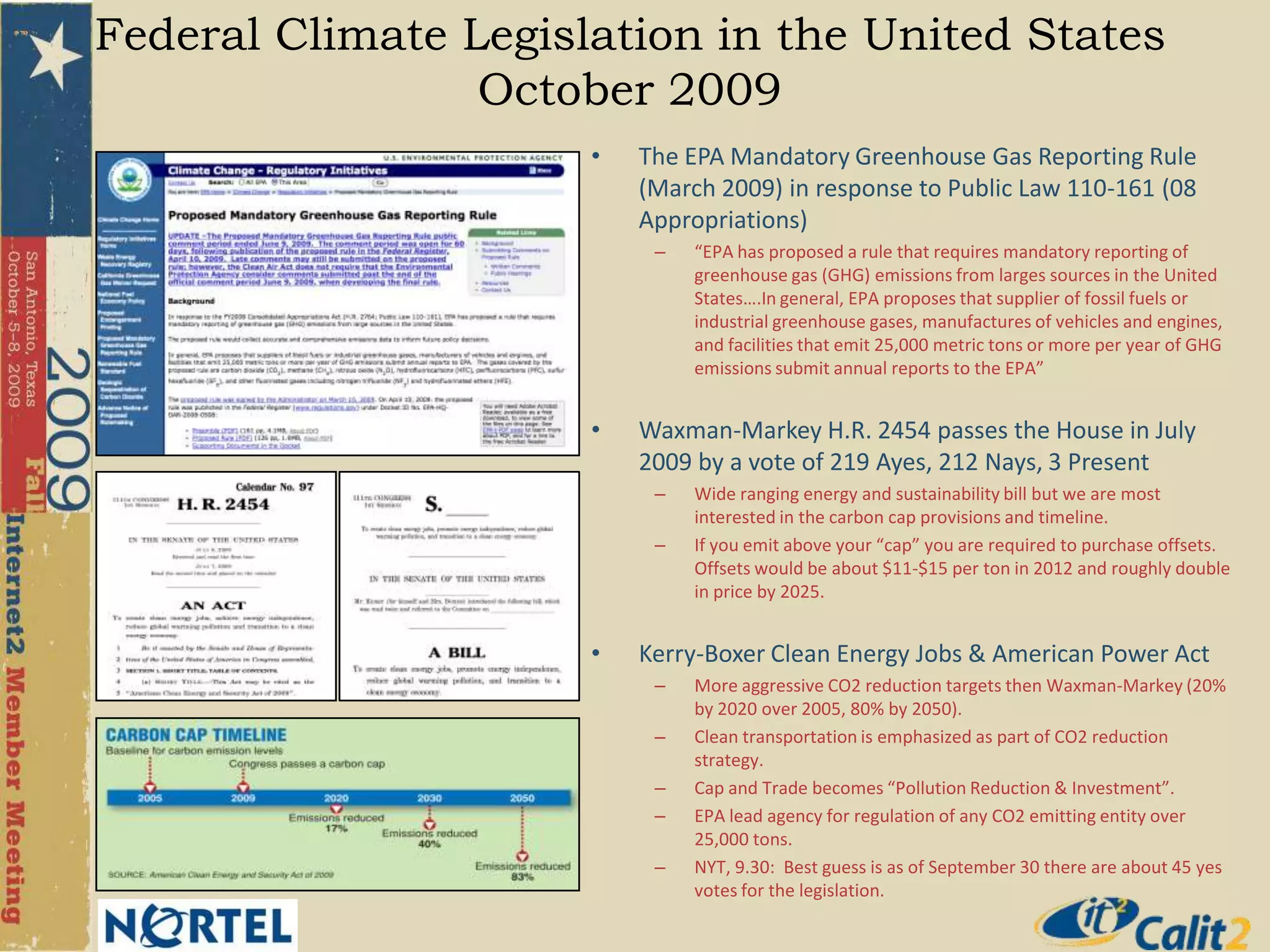
Federal Climate Legislation in the United StatesOctober 2009The EPA Mandatory Greenhouse Gas Reporting Rule (March 2009) in response to Public Law 110-161 (08 Appropriations)“EPA has proposed a rule that requires mandatory reporting of greenhouse gas (GHG) emissions from larges sources in the United States….In general, EPA proposes that supplier of fossil fuels or industrial greenhouse gases, manufactures of vehicles and engines, and facilities that emit 25,000 metric tons or more per year of GHG emissions submit annual reports to the EPA”Waxman-Markey H.R. 2454 passes the House in July 2009 by a vote of 219 Ayes, 212 Nays, 3 PresentWide ranging energy and sustainability bill but we are most interested in the carbon cap provisions and timeline.If you emit above your “cap” you are required to purchase offsets.  Offsets would be about $11-$15 per ton in 2012 and roughly double in price by 2025.Kerry-Boxer Clean Energy Jobs & American Power ActMore aggressive CO2 reduction targets then Waxman-Markey (20% by 2020 over 2005, 80% by 2050).Clean transportation is emphasized as part of CO2 reduction strategy.Cap and Trade becomes “Pollution Reduction & Investment”.EPA lead agency for regulation of any CO2 emitting entity over 25,000 tons.NYT, 9.30:  Best guess is as of September 30 there are about 45 yes votes for the legislation.
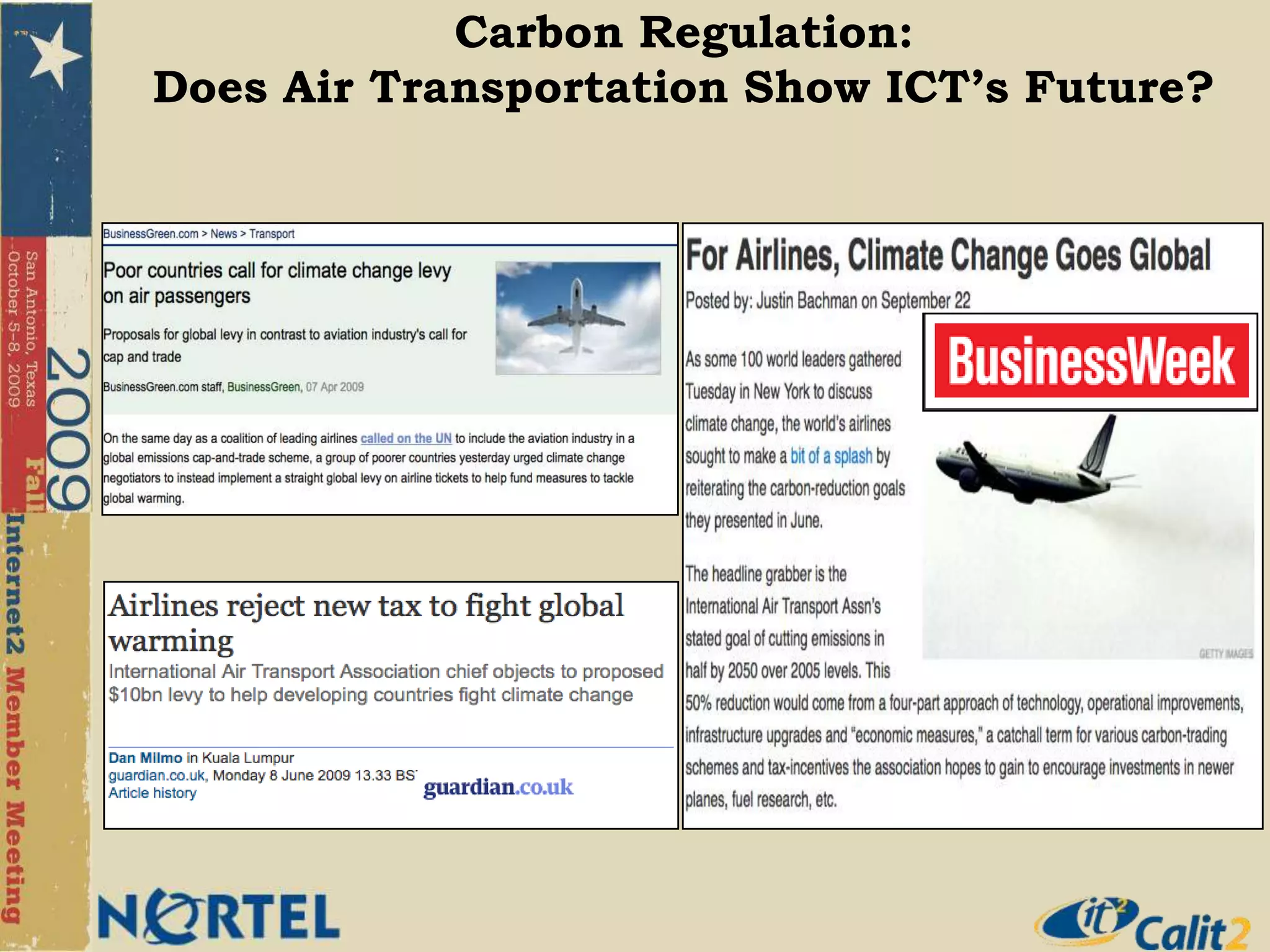
Carbon Regulation:Does Air Transportation Show ICT’s Future?
Calit2:  A Living Laboratory for ICT Enabled Carbon Reduction
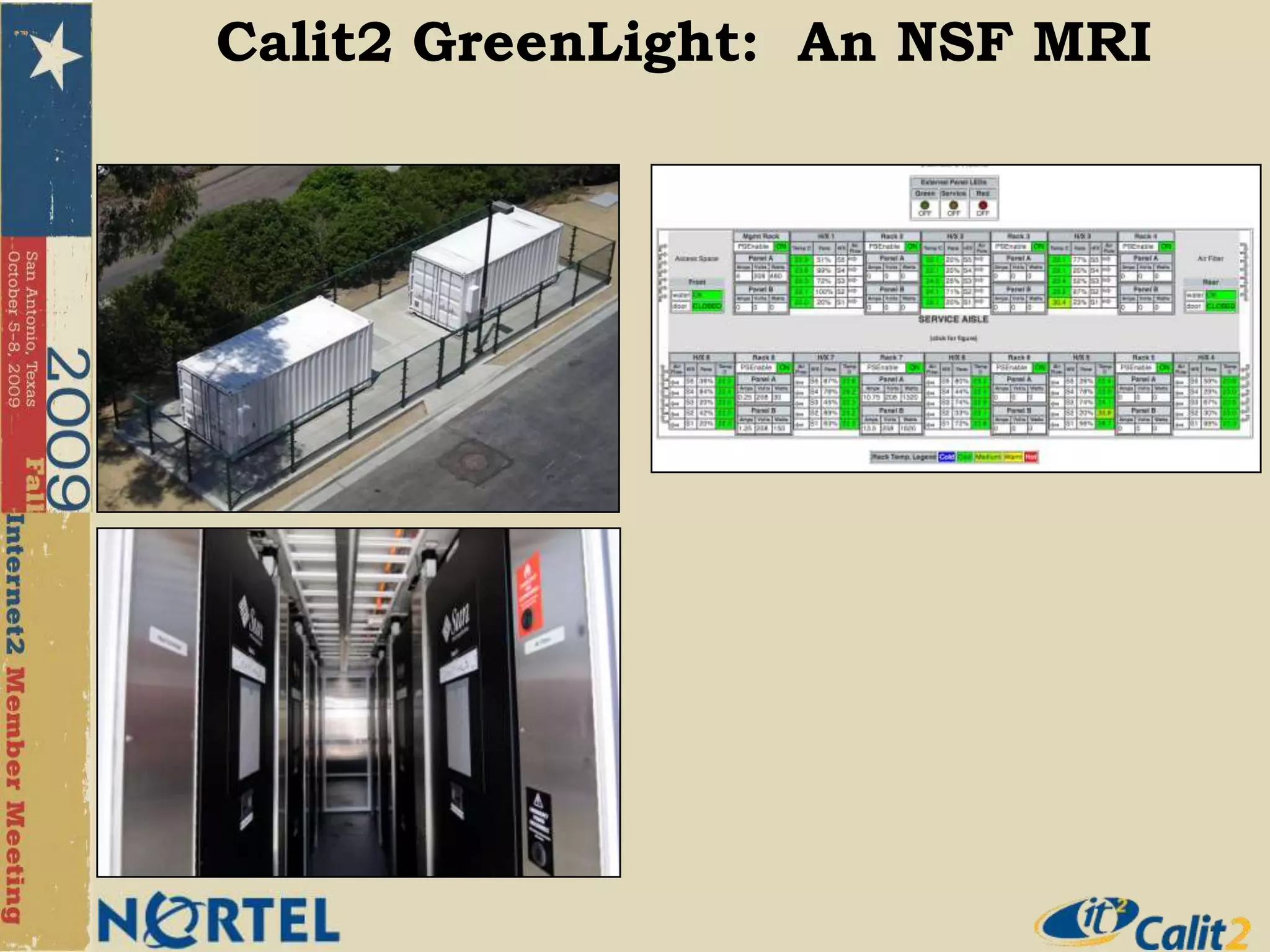
Calit2 GreenLight:  An NSF MRI
Research
Specialized Co-Processing in Generalized Execution Environment (Rajesh Gupta)
Conserving Resources Through Virtualization (AminVahdat)
Power and Thermal Management (TajanaRosing)
Virtual and Augmented Reality (FalkoKuester, Jurgen Schulze, Tom DeFanti, BhaskarRao)
Service Oriented Architecture (Ingolf Krueger, PavelPevzner, Matt Arrott)
Capturing, Storing, Analyzing, and Sharing Energy Consumption Data (Jim Hollan)
CineGrid Exchange, Storage for 4K Video (Tom DeFanti, Larry Smarr, Jeanne Ferrante)	GreenLight Research Team and FociApplications

Internet2: How Your Network Can Help Reduce Your Carbon Footprint and Create a Greener Campus

  • 1.
    How Your NetworkCan Help Reduce Your Carbon Footprint and Create a Greener CampusJerry Sheehan, California Institute for Telecommunications & Information Technology (jerry@ucsd.edu)Rod Wilson, Nortel Networks (rgwilson@nortel.com)Internet 2, Fall Member MeetingOctober 6, 2009 8:45-10:00
  • 2.
    Climate Change andICTClimate Change 101The Role of ICT in Anthropomorphic Climate ChangeClimate Regulation and ICT The Case of British Columbia: A Carbon Neutral RealityThe Case of California: A Carbon Constrained FutureThe Case of Aviation: A Potential ICT Future?Calit2: A Testbed for ICT Enabled Carbon ReductionNSF Major Research Instrumentation Project GreenLightFlexible Work and TelepresenceSmarter BuildingsSmarter TransportationInternational PartnershipsPresentation Overview
  • 3.
    Presentation OverviewEnablers andInnovationGovernment assistsCANARIECanada California Strategic Innovation Initiative (CCSIP)Green ICT & next generation Data CentersPowerBandwidthControlFinding maximum Bandwidth agility and flexibilityRe thinking the Virtual Machine Turntable
  • 4.
  • 5.
    Warming is Over100 Times Faster TodayThan During the Last Ice Age!SOURCE: http://scrippsco2.ucsd.edu/program_history/keeling_curve_lessons.htmlSOURCE: Monnin, et al., Science v. 291 pp. 112-114, Jan. 5, 2001.CO2 Has Risen From 335 to 385ppm (50ppm) in 30 years or 1.6 ppm per YearCO2 Rose From 185 to 265ppm (80ppm) in 6000 years or 1.33 ppm per Century
  • 6.
    Temperature Has Increased1F in Last CenturySource: Pew Center on Global Climate Change, The Causes of Global Climate Change, Science Brief 1, August 2008
  • 7.
    The Planet isAlready Committed to a Dangerous Level of WarmingTemperature Threshold Range that Initiates the Climate-TippingEarth Has Only Realized 1/3 of theCommitted Warming -Future Emissions of Greenhouse Gases Move Peak to the RightAdditional Warming over 1750 LevelSOURCE: V. Ramanathan and Y. Feng, Scripps Institution of Oceanography, UCSD September 23, 2008www.pnas.orgcgidoi10.1073pnas.0803838105
  • 8.
    Global Climate DisruptionEarly Signs:Arctic Summer Ice is Rapidly Decreasing“The Arctic Ocean will be effectively ice free sometime between 2020 and 2040, although it is possible it could happen as early as 2013.”--Walt Meier, Research Scientist at the National Snow and Ice Data Centre at the University of Colorado SOURCE: http://news.cnet.com/8301-11128_3-10213891-54.html
  • 9.
    The Carbon Footprintof ICT SOURCE: Smart2020 Report & The US Addendum, The Climate Group, 2008
  • 10.
  • 11.
    GHG Regulation inBritish ColumbiaBill 44-2007 was introduced in 2007 and enacted into law in 2008. The law is known as the Greenhouse Gas Reductions Target Act.The Act establishes greenhouse gas emission target levels for the Province.2020 BC GHG will be 33% less than 2007.2050 BC GHG will be 80% less than 2007.Bill mandates that by 2010 each public sector organization must be carbon neutral.If a public sector organization can not achieve carbon neutrality then they are required to purchase offsets.Offsets must be purchased from the Pacific Carbon Trust. The cost for public sector organizations is $24 per ton of CO2e.SOURCE: “Greenhouse Gas Inventory Report 2007”, Ministry of Environment, Victoria, British Columbia, July 2009
  • 12.
    SOURCE: http://climateaction.ubc.ca/category/emission-sourcesSOURCE: UBC Climate Action Plan, GHG 2006 InventorySOURCE: UBC Sustainability Office, August 2009The Cost of Regulation: The University of British Columbia
  • 13.
    The California GlobalWarming Solutions Act of 2006 (AB32)Executive Order S-3-05 signed from Governor Schwarzenegger sets GHG targets.
  • 14.
    2010 GHG emissionsset to 2000 levels.
  • 15.
    2020 GHG emissionsset to 1990 levels.
  • 16.
    2050 GHG emissionsset to 80% of 1990 levels.
  • 17.
    AB 32 Overview(Signed Into Law 2006)
  • 18.
    Identify statewide GHGemissions for 1990 to serve as emissions limit to be achieved by 2020.
  • 19.
    427 million metrictons of CO2e goal, roughly 30% reduction.
  • 20.
    Mandatory reporting andverification of GHG emissions by major emitters on or before Jan 1, 2008.
  • 21.
    If you emitover 25,000 metric tons of CO2e reporting is required.
  • 22.
    Identify and adoptregulations for discrete early actions enforceable by or before January 2010.
  • 23.
    Ensure early voluntaryreductions receive appropriate credit in AB32 implementation.
  • 24.
    Convene Environmental JusticeAdvisory Committee to advise in development of scoping plan and implementation of AB32.
  • 25.
    Appoint an Economicand Technology Advancement Advisory CommitteeSOURCE: 2009 Climate Adaptation Strategy Draft, p15, 2009
  • 26.
    UC Response toAB32The University of California (UC) Climate ActionsUC is a founding signatory to the American College and University President’s Climate Commitment.
  • 27.
    University of CaliforniaSystem Wide Greenhouse Gas Reduction Targets
  • 28.
    By 2014 reduceGHG emissions to 2000 levels.
  • 29.
    By 2020 reduceGHG emissions to 1990 levels.
  • 30.
    All UC campuseshave joined the California Climate Action Registry.
  • 31.
    Verified GHG reportingfor all campuses.
  • 32.
    Most campuses havecreated and begun implementation of climate action plans.SOURCE: 2008 ACUPCC Signatories-605
  • 33.
    42% of StatesHave Existing GHG Reduction TargetsSOURCE: Pew Center on Global Climate Change, Climate101-State Actions, January 2009State GHG Targets2009
  • 34.
    Federal Climate Legislationin the United StatesOctober 2009The EPA Mandatory Greenhouse Gas Reporting Rule (March 2009) in response to Public Law 110-161 (08 Appropriations)“EPA has proposed a rule that requires mandatory reporting of greenhouse gas (GHG) emissions from larges sources in the United States….In general, EPA proposes that supplier of fossil fuels or industrial greenhouse gases, manufactures of vehicles and engines, and facilities that emit 25,000 metric tons or more per year of GHG emissions submit annual reports to the EPA”Waxman-Markey H.R. 2454 passes the House in July 2009 by a vote of 219 Ayes, 212 Nays, 3 PresentWide ranging energy and sustainability bill but we are most interested in the carbon cap provisions and timeline.If you emit above your “cap” you are required to purchase offsets. Offsets would be about $11-$15 per ton in 2012 and roughly double in price by 2025.Kerry-Boxer Clean Energy Jobs & American Power ActMore aggressive CO2 reduction targets then Waxman-Markey (20% by 2020 over 2005, 80% by 2050).Clean transportation is emphasized as part of CO2 reduction strategy.Cap and Trade becomes “Pollution Reduction & Investment”.EPA lead agency for regulation of any CO2 emitting entity over 25,000 tons.NYT, 9.30: Best guess is as of September 30 there are about 45 yes votes for the legislation.
  • 35.
    Carbon Regulation:Does AirTransportation Show ICT’s Future?
  • 36.
    Calit2: ALiving Laboratory for ICT Enabled Carbon Reduction
  • 37.
  • 38.
  • 39.
    Specialized Co-Processing inGeneralized Execution Environment (Rajesh Gupta)
  • 40.
    Conserving Resources ThroughVirtualization (AminVahdat)
  • 41.
    Power and ThermalManagement (TajanaRosing)
  • 42.
    Virtual and AugmentedReality (FalkoKuester, Jurgen Schulze, Tom DeFanti, BhaskarRao)
  • 43.
    Service Oriented Architecture(Ingolf Krueger, PavelPevzner, Matt Arrott)
  • 44.
    Capturing, Storing, Analyzing,and Sharing Energy Consumption Data (Jim Hollan)
  • 45.
    CineGrid Exchange, Storagefor 4K Video (Tom DeFanti, Larry Smarr, Jeanne Ferrante) GreenLight Research Team and FociApplications
  • 46.
  • 47.
    Pathway Assembly andBioinformatics (Trey Idekar)
  • 48.
    Computational Service forMetagenomics (Paul Gilna, Kayo Arrao, Phil Papadopoulous)
  • 49.
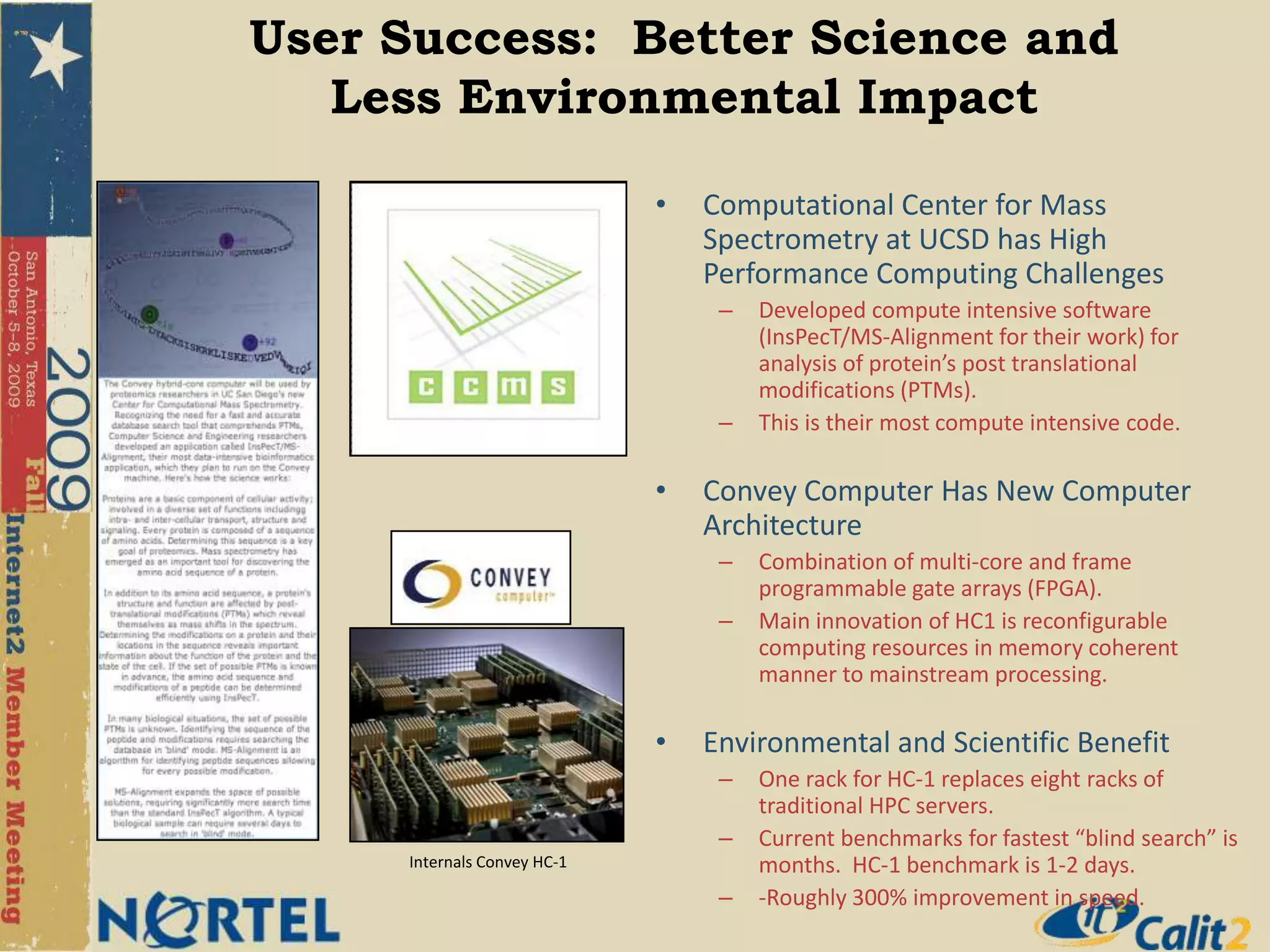
    CineGrid Exchange, Storagefor 4K Video (Tom DeFanti, Larry Smarr, Jeanne Ferrante) Internals Convey HC-1User Success: Better Science and Less Environmental ImpactComputational Center for Mass Spectrometry at UCSD has High Performance Computing Challenges
  • 50.
    Developed compute intensivesoftware (InsPecT/MS-Alignment for their work) for analysis of protein’s post translational modifications (PTMs).
  • 51.
    This is theirmost compute intensive code.
  • 52.
    Convey Computer HasNew Computer Architecture
  • 53.
    Combination of multi-coreand frame programmable gate arrays (FPGA).
  • 54.
    Main innovation ofHC1 is reconfigurable computing resources in memory coherent manner to mainstream processing.
  • 55.
  • 56.
    One rack forHC-1 replaces eight racks of traditional HPC servers.
  • 57.
    Current benchmarks forfastest “blind search” is months. HC-1 benchmark is 1-2 days.
  • 58.
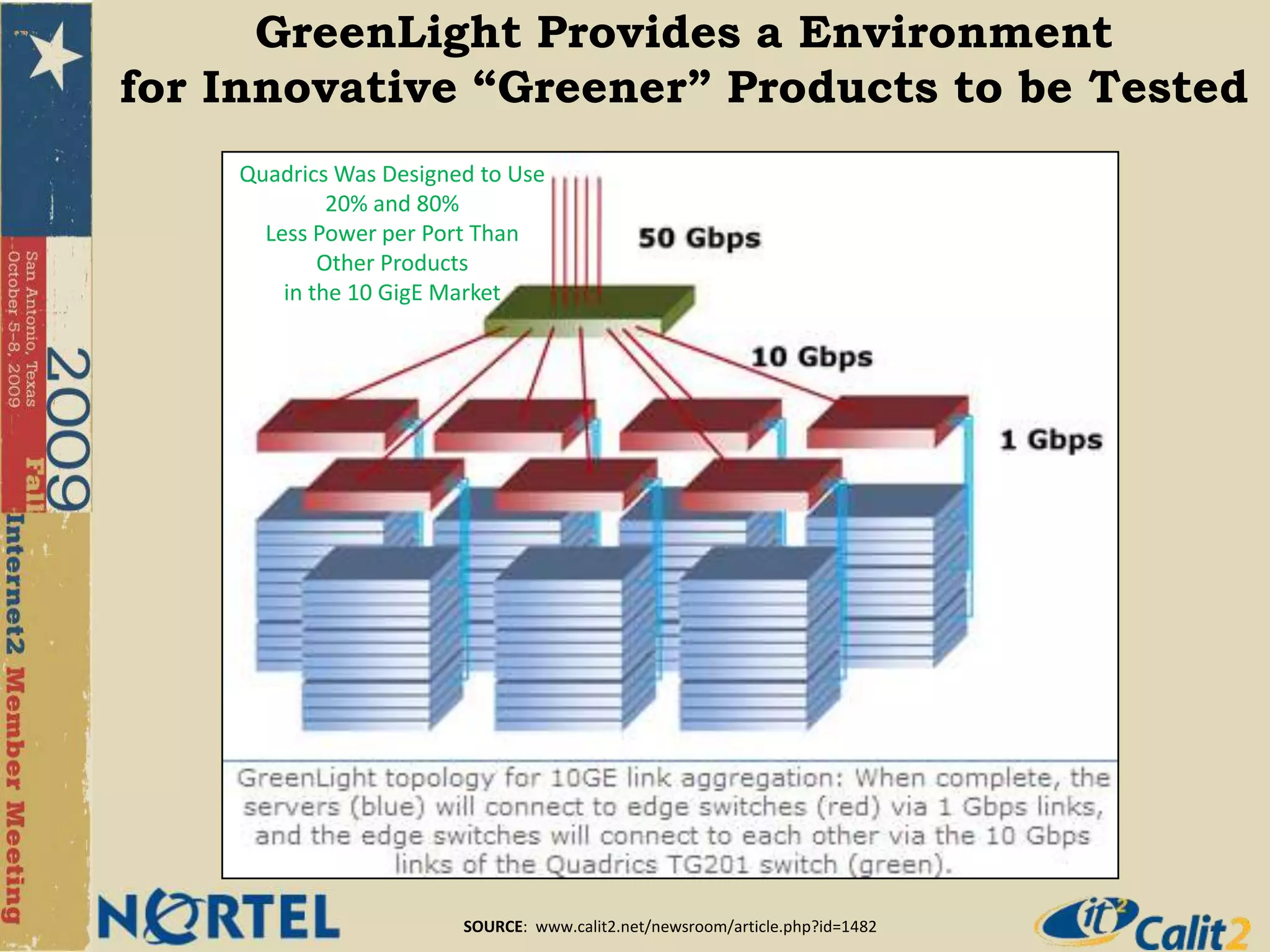
    -Roughly 300% improvementin speed.GreenLight Provides a Environment for Innovative “Greener” Products to be TestedQuadrics Was Designed to Use 20% and 80% Less Power per Port Than Other Products in the 10 GigE Market SOURCE: www.calit2.net/newsroom/article.php?id=1482
  • 59.
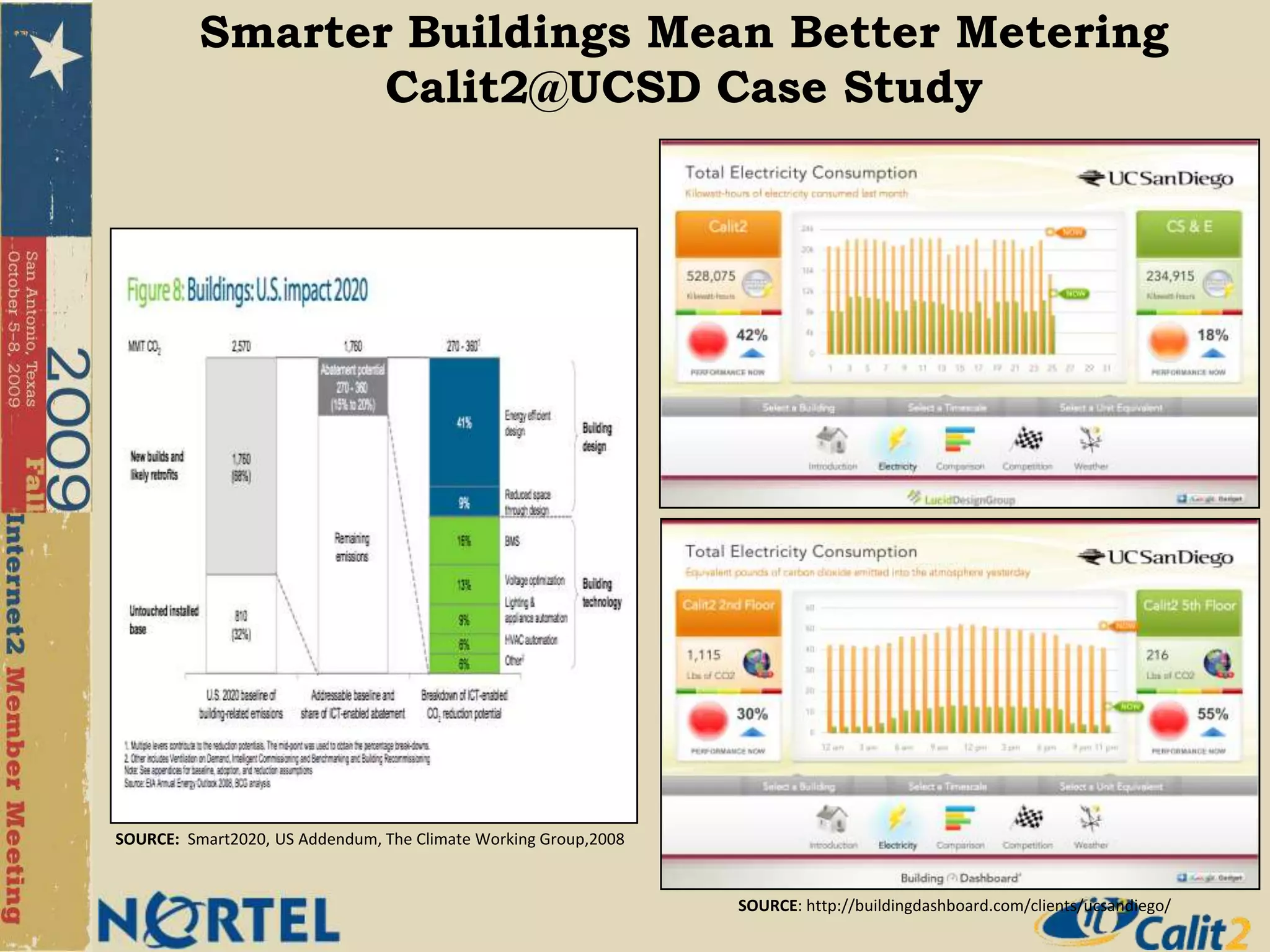
    Smarter Buildings MeanBetter MeteringCalit2@UCSD Case StudySOURCE: Smart2020, US Addendum, The Climate Working Group,2008 SOURCE: http://buildingdashboard.com/clients/ucsandiego/
  • 60.
    Smarter BuildingsWhat CanWe Learn About Mixed Use Buildings500 Occupants, 750 ComputersDetailed Instrumentation to Measure Macro and Micro-Scale Power Use 39 Sensor Pods, 156 Radios, 70 CircuitsSubsystems: Air Conditioning & LightingConclusions:Peak Load is Twice Base Load70% of Base Load is PCs and Servers90% of That Could Be Avoided!SOURCE: Rajesh Gupta, CSE, Calit2
  • 61.
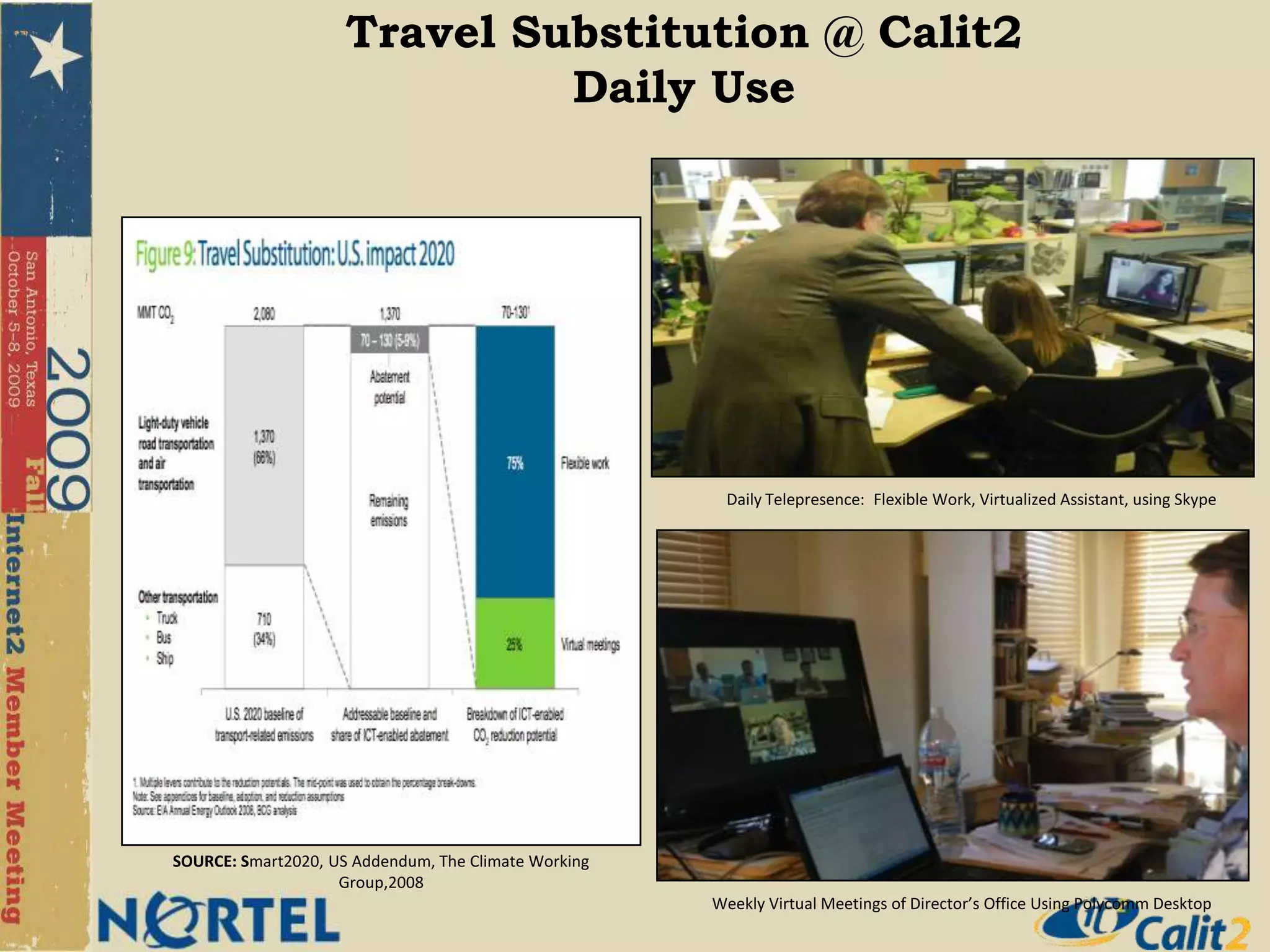
    Travel Substitution @Calit2Daily UseDaily Telepresence: Flexible Work, Virtualized Assistant, using SkypeSOURCE: Smart2020, US Addendum, The Climate Working Group,2008 Weekly Virtual Meetings of Director’s Office Using Polycomm Desktop
  • 62.
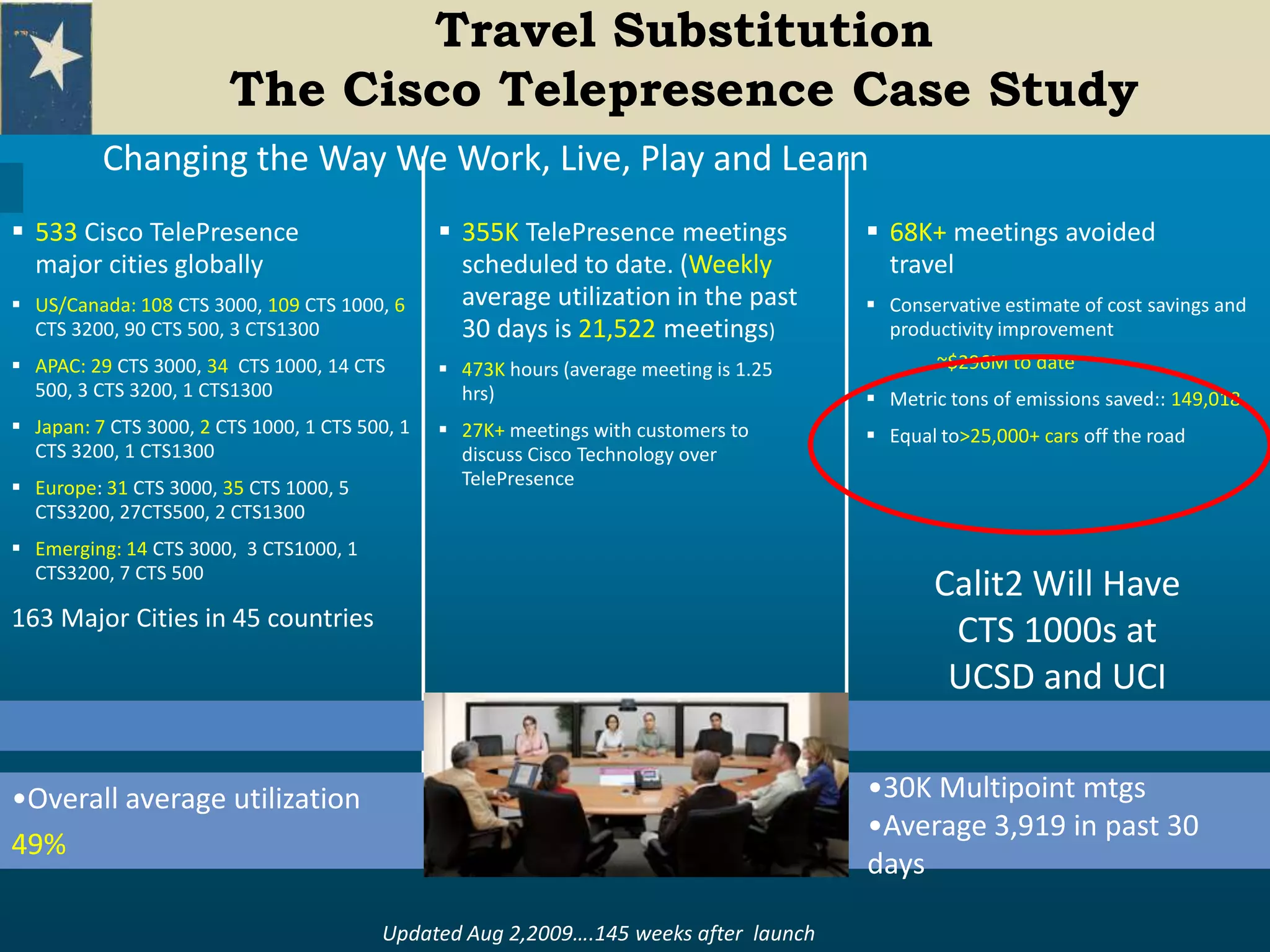
    Travel SubstitutionThe CiscoTelepresence Case StudyChanging the Way We Work, Live, Play and Learn533 Cisco TelePresence major cities globally
  • 63.
    US/Canada: 108 CTS3000, 109 CTS 1000, 6 CTS 3200, 90 CTS 500, 3 CTS1300
  • 64.
    APAC: 29 CTS3000, 34 CTS 1000, 14 CTS 500, 3 CTS 3200, 1 CTS1300
  • 65.
    Japan: 7 CTS3000, 2 CTS 1000, 1 CTS 500, 1 CTS 3200, 1 CTS1300
  • 66.
    Europe: 31 CTS3000, 35 CTS 1000, 5 CTS3200, 27CTS500, 2 CTS1300
  • 67.
    Emerging: 14 CTS3000, 3 CTS1000, 1 CTS3200, 7 CTS 500163 Major Cities in 45 countries355K TelePresence meetings scheduled to date. (Weekly average utilization in the past30 days is 21,522 meetings)
  • 68.
    473K hours (averagemeeting is 1.25 hrs)
  • 69.
    27K+ meetings withcustomers to discuss Cisco Technology over TelePresence
  • 70.
  • 71.
    Conservative estimate ofcost savings and productivity improvement~$296M to dateMetric tons of emissions saved:: 149,018
  • 72.
    Equal to >25,000+cars off the roadCalit2 Will Have CTS 1000s at UCSD and UCI30K Multipoint mtgs
  • 73.
    Average 3,919 inpast 30daysOverall average utilization49%Updated Aug 2,2009….145 weeks after launch
  • 74.
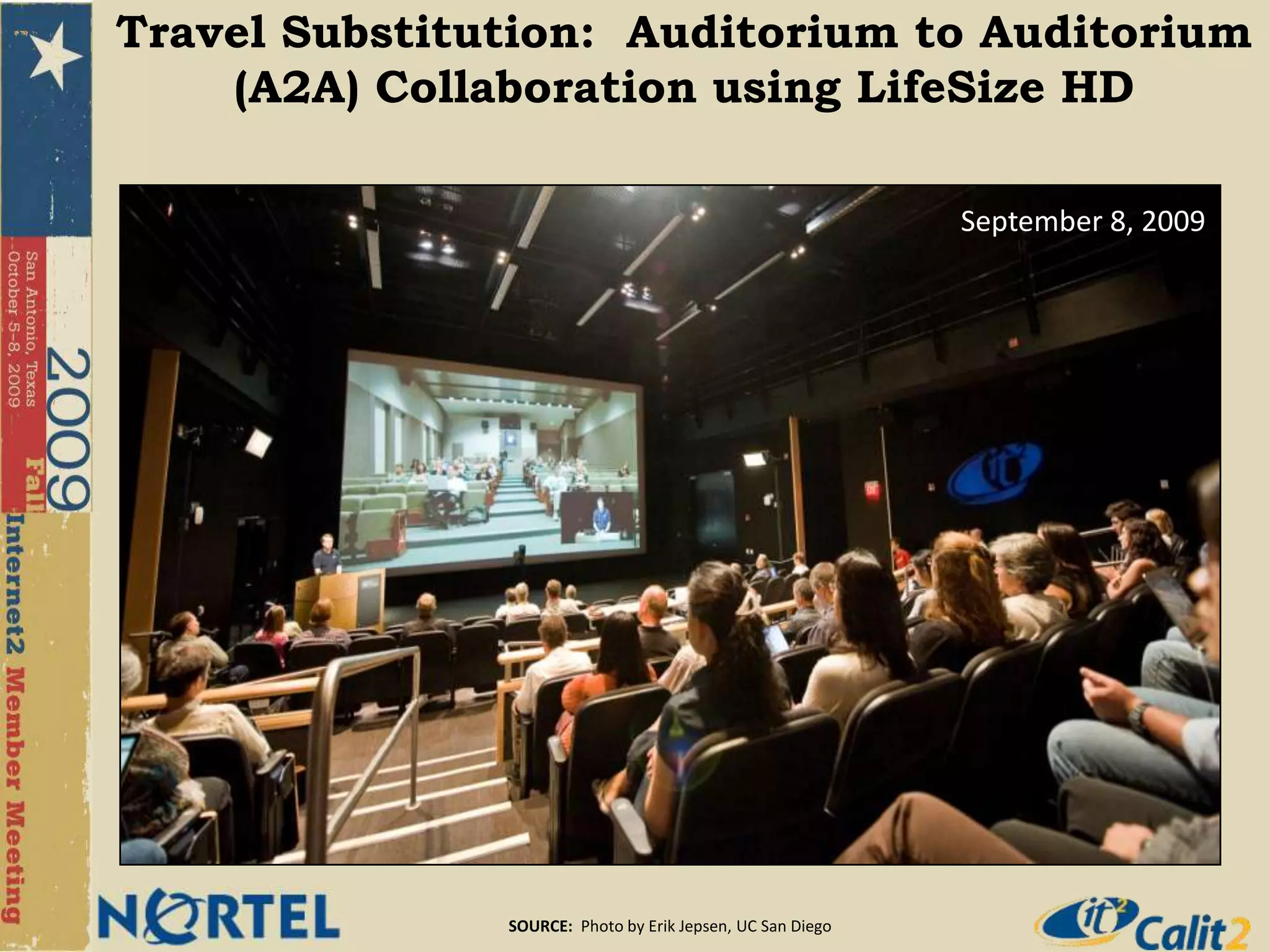
    Travel Substitution: Auditorium to Auditorium (A2A) Collaboration using LifeSize HDSeptember 8, 2009SOURCE: Photo by Erik Jepsen, UC San Diego
  • 75.
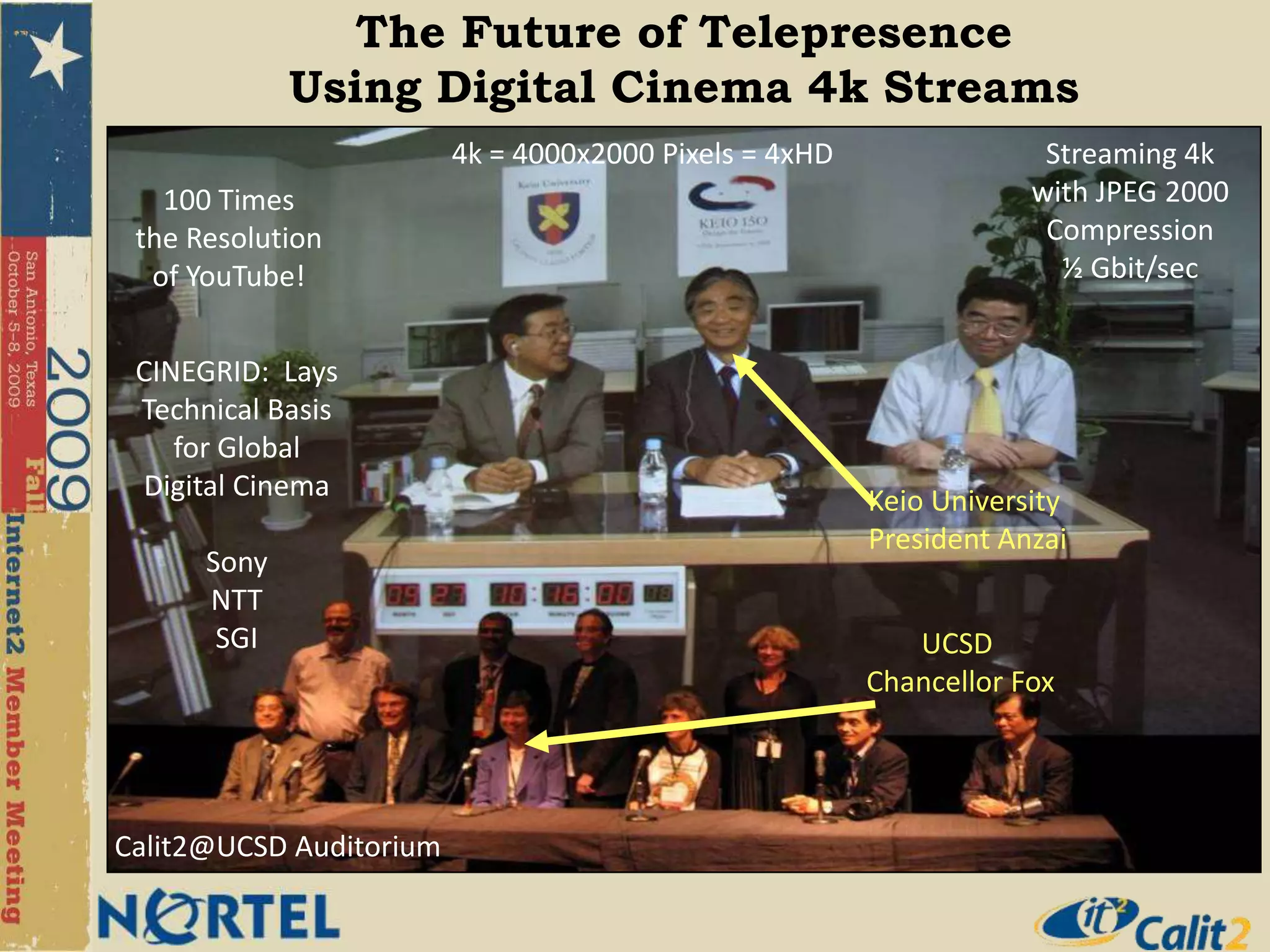
    The Future ofTelepresenceUsing Digital Cinema 4k StreamsKeio University President AnzaiUCSD Chancellor FoxStreaming 4k with JPEG 2000 Compression ½ Gbit/sec4k = 4000x2000 Pixels = 4xHD 100 Times the Resolution of YouTube!CINEGRID: Lays Technical Basis for Global Digital CinemaSony NTT SGICalit2@UCSD Auditorium
  • 76.
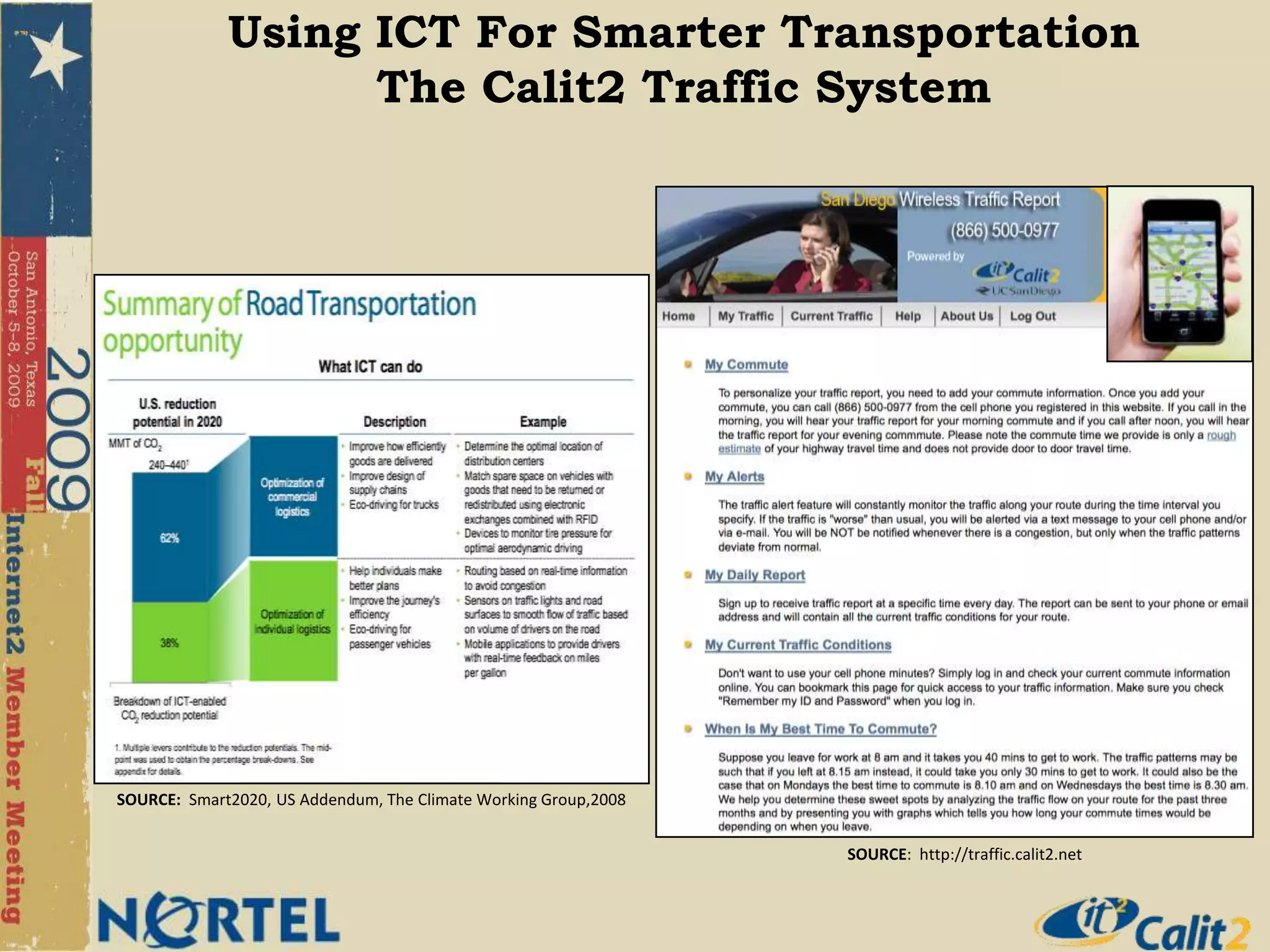
    Using ICT ForSmarter TransportationThe Calit2 Traffic SystemSOURCE: Smart2020, US Addendum, The Climate Working Group,2008 SOURCE: http://traffic.calit2.net
  • 77.
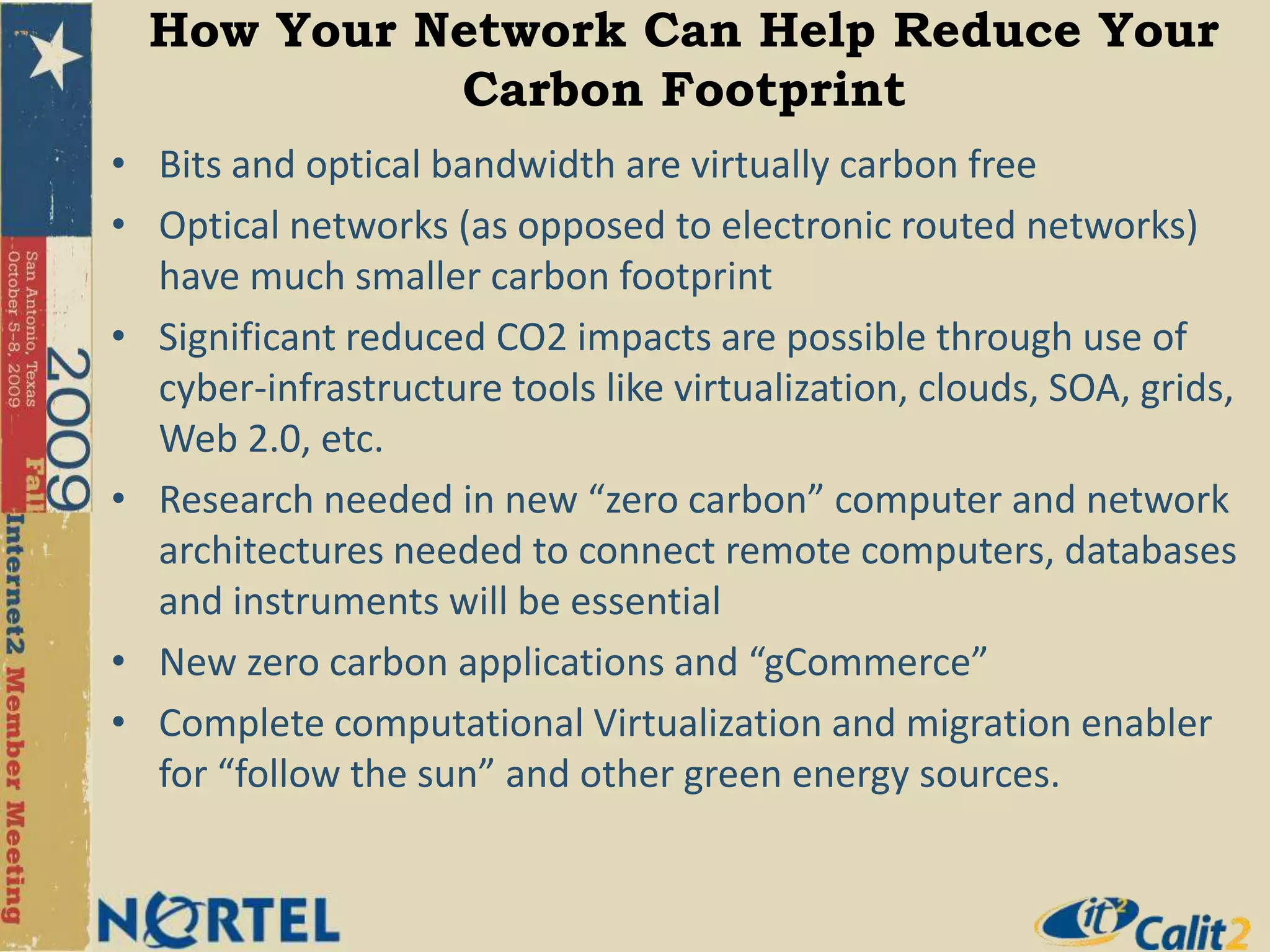
    How Your NetworkCan Help Reduce Your Carbon Footprint Bits and optical bandwidth are virtually carbon freeOptical networks (as opposed to electronic routed networks) have much smaller carbon footprintSignificant reduced CO2 impacts are possible through use of cyber-infrastructure tools like virtualization, clouds, SOA, grids, Web 2.0, etc. Research needed in new “zero carbon” computer and network architectures needed to connect remote computers, databases and instruments will be essential New zero carbon applications and “gCommerce” Complete computational Virtualization and migration enabler for “follow the sun” and other green energy sources.
  • 78.
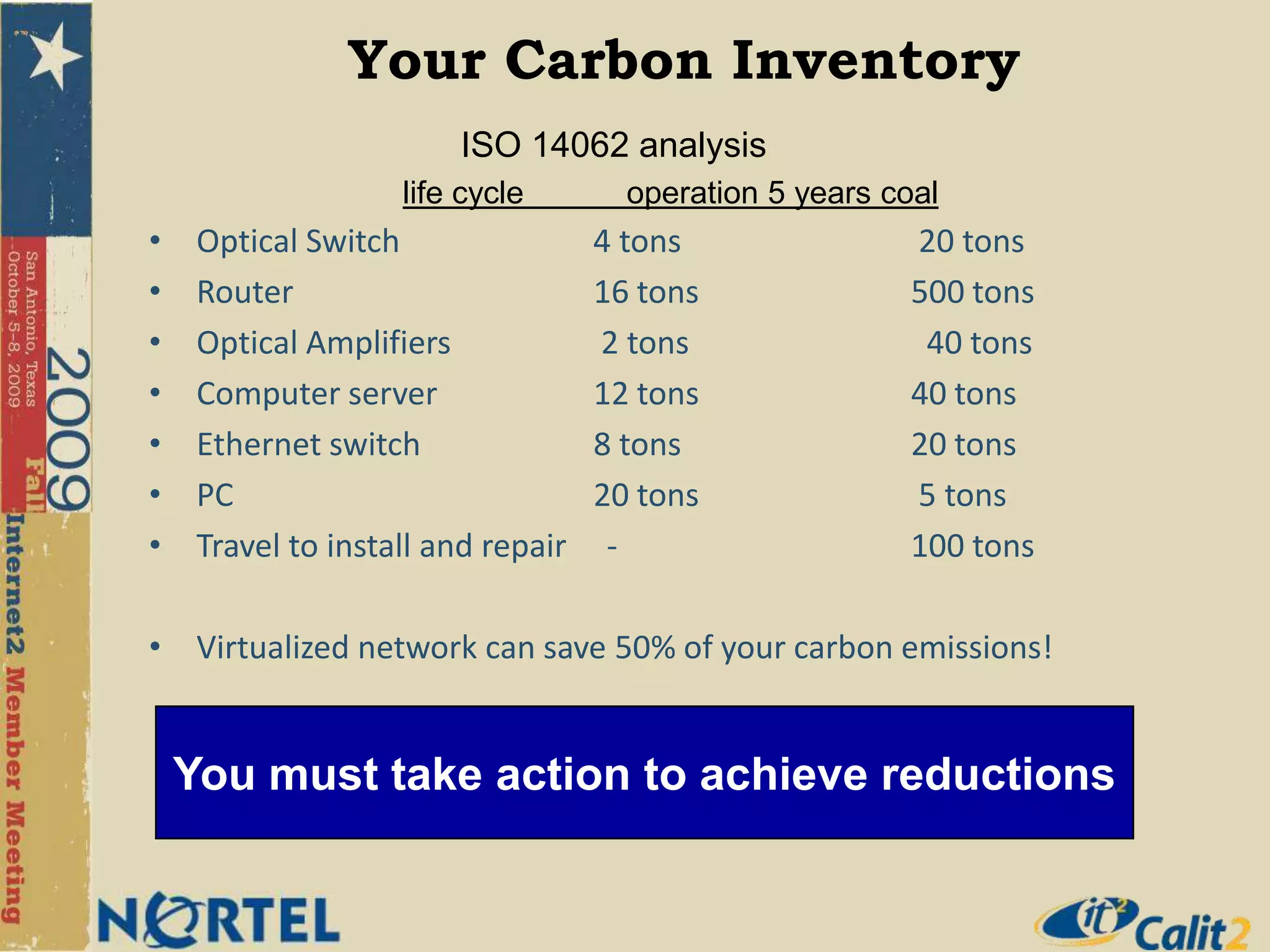
    Your Carbon Inventory ISO 14062 analysis life cycle operation 5 years coalOptical Switch 4 tons 20 tonsRouter 16 tons 500 tonsOptical Amplifiers 2 tons 40 tons Computer server 12 tons 40 tonsEthernet switch 8 tons 20 tonsPC 20 tons 5 tonsTravel to install and repair - 100 tonsVirtualized network can save 50% of your carbon emissions!You must take action to achieve reductions
  • 79.
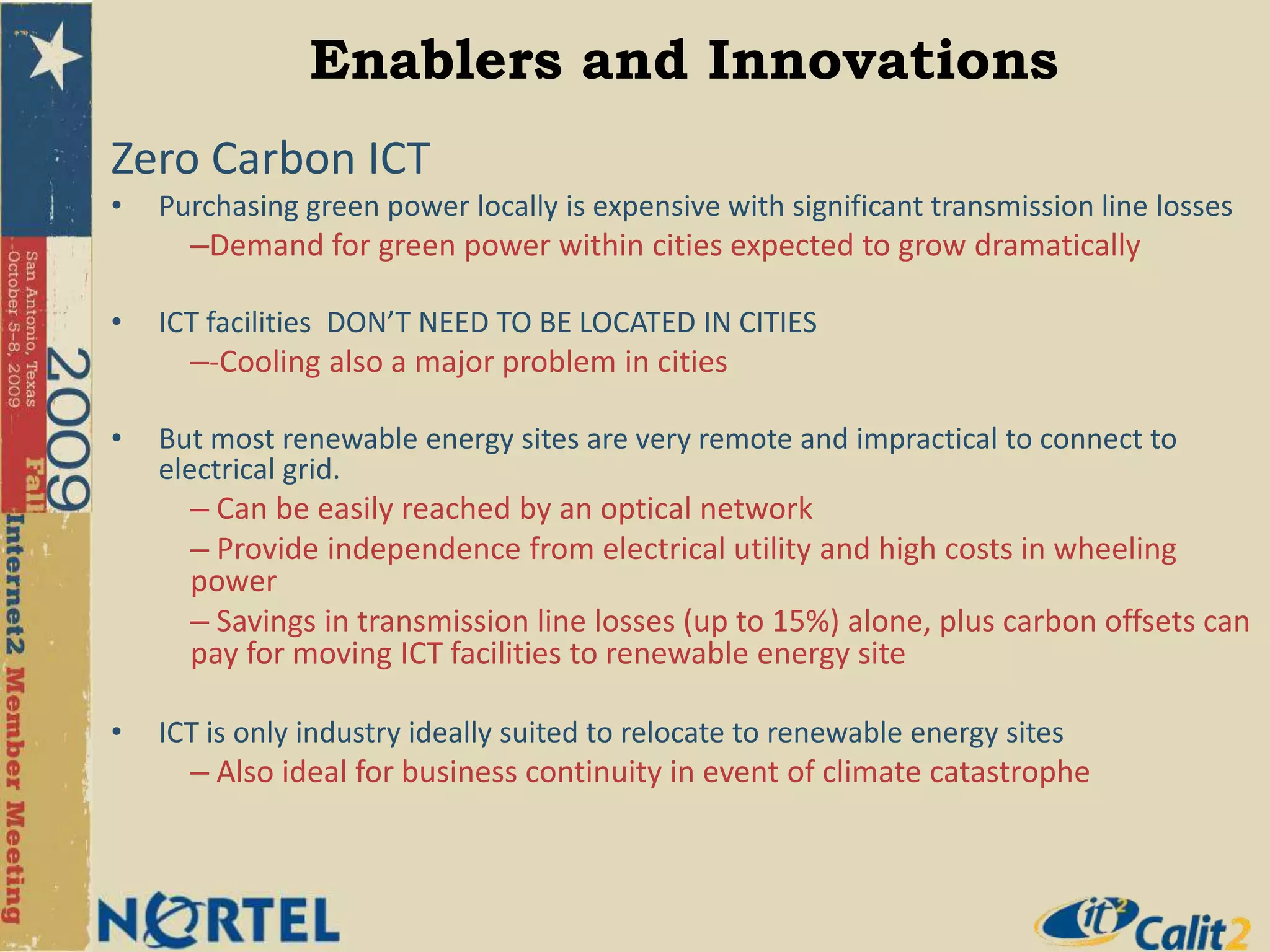
    Enablers and InnovationsZeroCarbon ICTPurchasing green power locally is expensive with significant transmission line lossesDemand for green power within cities expected to grow dramaticallyICT facilities DON’T NEED TO BE LOCATED IN CITIES-Cooling also a major problem in citiesBut most renewable energy sites are very remote and impractical to connect to electrical grid. Can be easily reached by an optical network Provide independence from electrical utility and high costs in wheeling power Savings in transmission line losses (up to 15%) alone, plus carbon offsets can pay for moving ICT facilities to renewable energy siteICT is only industry ideally suited to relocate to renewable energy sites Also ideal for business continuity in event of climate catastrophe
  • 80.
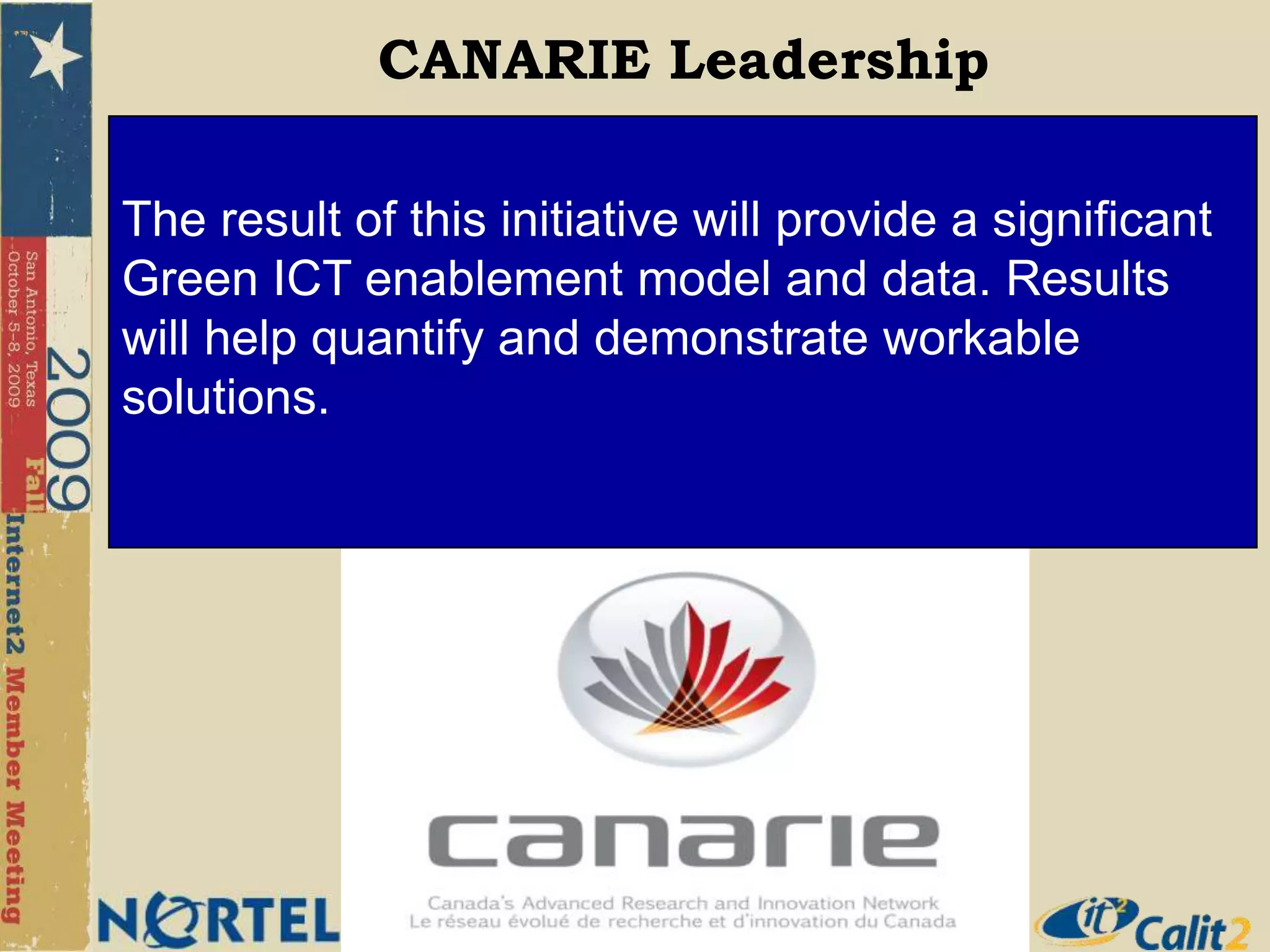
    CANARIE LeadershipThe resultof this initiative will provide a significant Green ICT enablement model and data. Results will help quantify and demonstrate workable solutions.Canada’s advanced research network and research organizationJune 1st Call for million $ Green ICT grant proposalsDemonstrate technical feasibility and usability of relocating computers and other cyber infrastructure to zero-carbon data centres that are connected by optical networks, and powered solely by renewable energy sources such as the sun or the wind, and Create business case for providing carbon offsets (and/or equivalent services) to university researchers and IT personnel who reduce their carbon footprint by relocating computers and instrumentation to zero-carbon data centres23 proposals submittedFinal decisions not yet publicly announced
  • 81.
    Canada California StrategicInnovation Partnership5 areas of research: Carbon capture; Green It; Infectious Disease; Next Gen Media; sustainable bio-fuelsMOU : California, Canada campuses combat greenhouse gas emissions with green ITUniversity of British Columbia is first University signatory to the MOU
  • 82.
    Green IT MoUInitialSignatories: UCSD, UBC, PROMPTTo share best practices in reducing GHG emissions and baseline emission data for cyber-infrastructure and networks as per ISO 14064, To explore carbon reduction strategies by new network and distributed computing architectures such as PROMPT G-NGI, OptiPuter and CineGrid. To work with R&E network to explore relocation of resources to renewable energy sites, virtualization, etc. To explore the potential for a “virtual” carbon trading systemsTo explore the creation of a multi-sector pilot of a generalized ICT carbon trading system including stakeholders from government, industry, and universities.To collaborate with each other and with government agencies and departments and other organizations
  • 83.
    Current Data CenterChallengesCooling and electrical costs can represent up to 44% of a data centers total cost of ownershipThe Uptime Institute estimates , the three-year cost of powering and cooling servers is currently one-and-a-half times the cost of purchasing server hardwareWith the growing demand for cheaper and ever-more-powerful high-performance computer clusters, the problem is not just paying for the computers, but determining whether institutions have the budget to pay for power and coolingCurrent Campus power is at a premium if available at all to light new initiativesSome institutions can’t deploy more servers because extra space and electricity isn’t available at any price. Many utilities, especially those in crowded urban areas, are telling customers that power feeds are at capacity and they simply have no more power to sell. BC Hydro currently has to import power to meet its demandssource: Dan GillardBCnet 04/09
  • 84.
    British Columbia BCnetLeadershipThe ConceptUse cyber infrastructure to combat global warming by reducing computing infrastructure’s carbon footprintFind efficient ways to share computing facilities that are close to sources of green power by utilizing BCNET’s advanced network infrastructure within the ProvinceMake it possible for BC’s Universities to reduce their carbon footprint by relocating their existing ICT infrastructure to “greener facilities” Build a zero carbon data centre and use the BCNET/CANARIE ROADM network to connect users to it
  • 85.
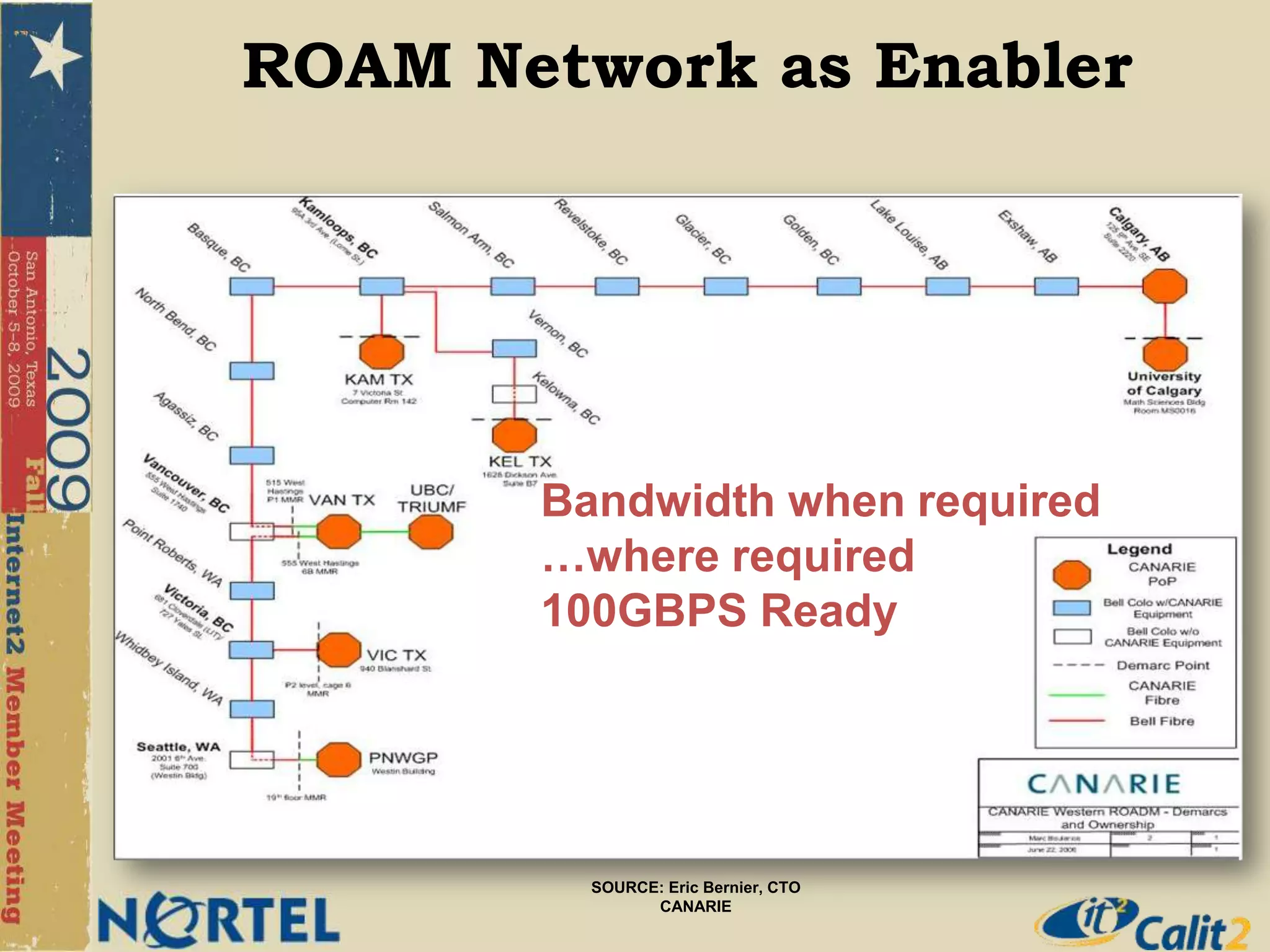
    ROAM Network asEnablerBandwidth when required…where required100GBPS ReadySOURCE: Eric Bernier, CTOCANARIE
  • 86.
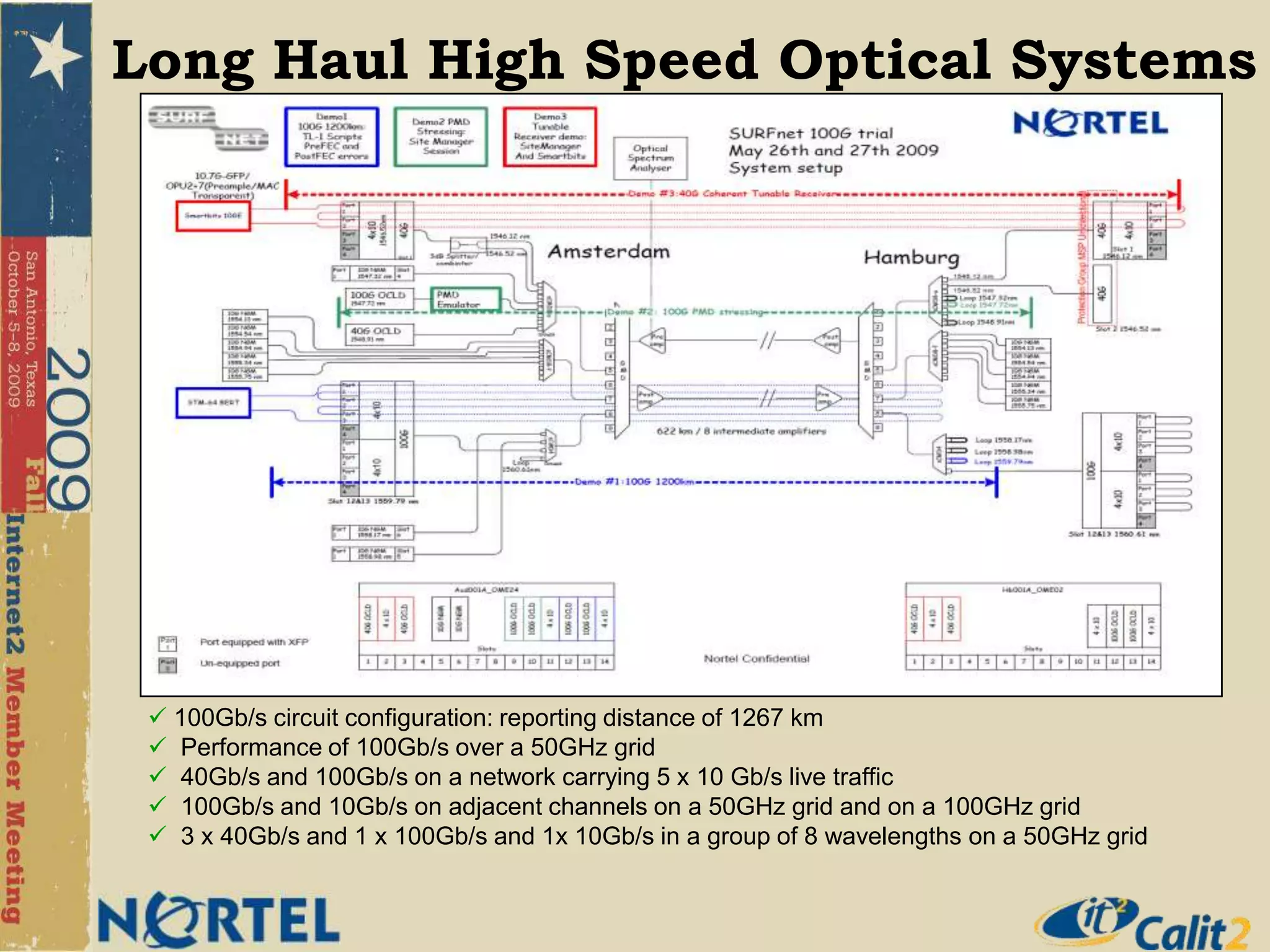
    Long Haul HighSpeed Optical Systems 100Gb/s circuit configuration: reporting distance of 1267 km
  • 87.
    Performanceof 100Gb/s over a 50GHz grid
  • 88.
    40Gb/sand 100Gb/s on a network carrying 5 x 10 Gb/s live traffic
  • 89.
    100Gb/sand 10Gb/s on adjacent channels on a 50GHz grid and on a 100GHz grid
  • 90.
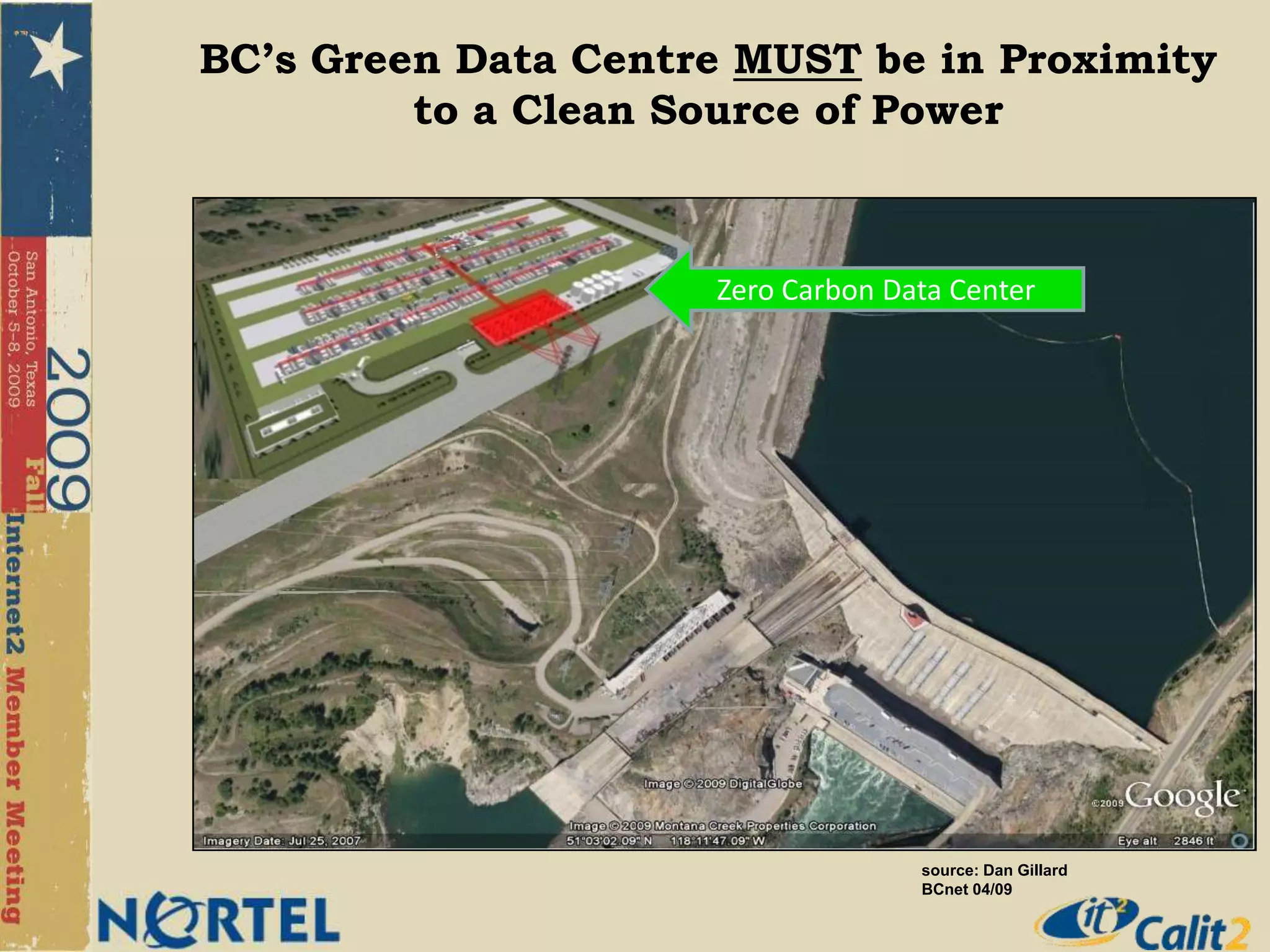
    3x 40Gb/s and 1 x 100Gb/s and 1x 10Gb/s in a group of 8 wavelengths on a 50GHz gridBC’s Green Data Centre MUST be in Proximity to a Clean Source of PowerZero Carbon Data Centersource: Dan GillardBCnet 04/09
  • 91.
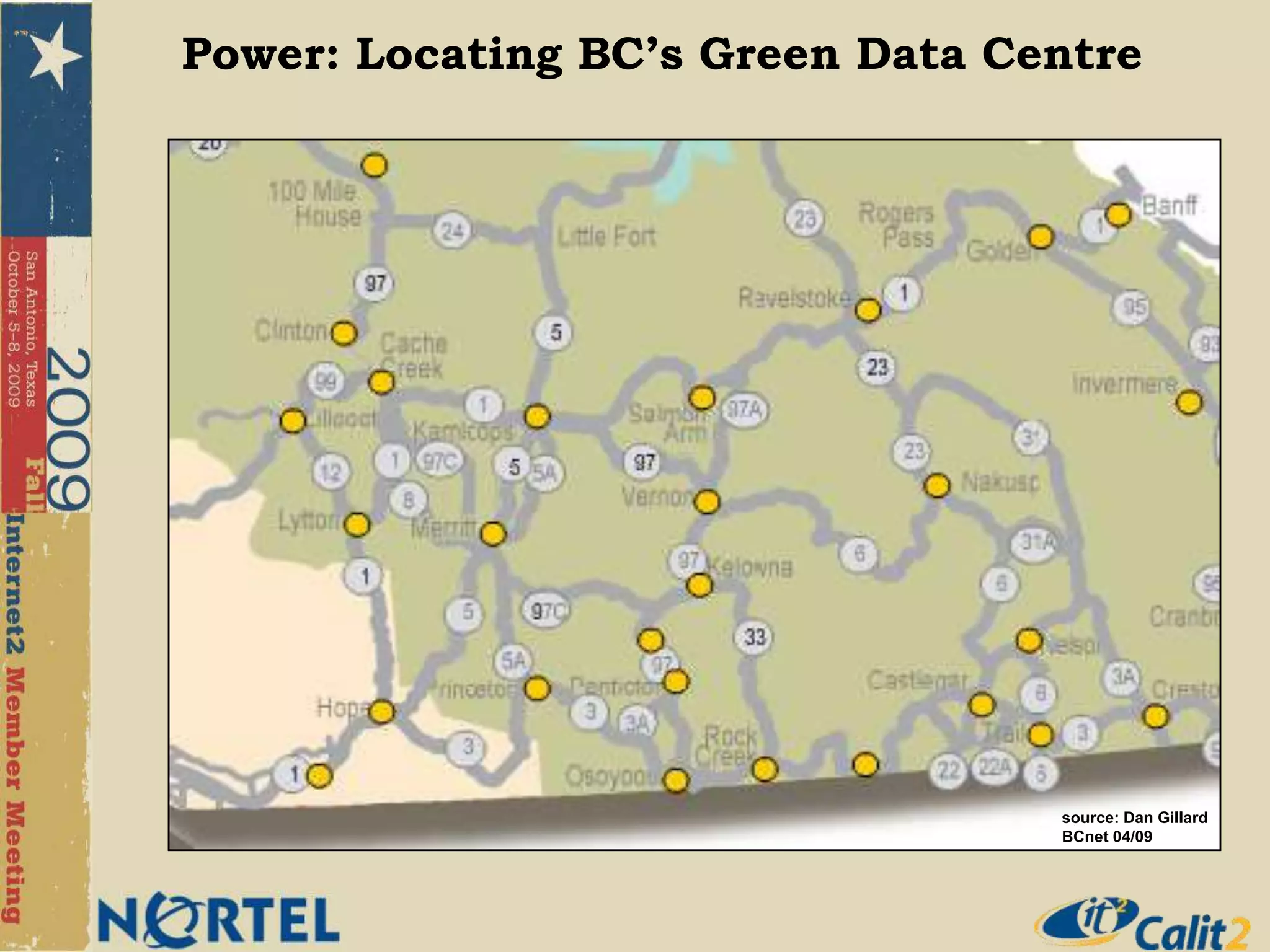
    Power: Locating BC’sGreen Data CentreWhere: MUST be in the BC InteriorGreenest?Greener?Green?source: Dan GillardBCnet 04/09
  • 92.
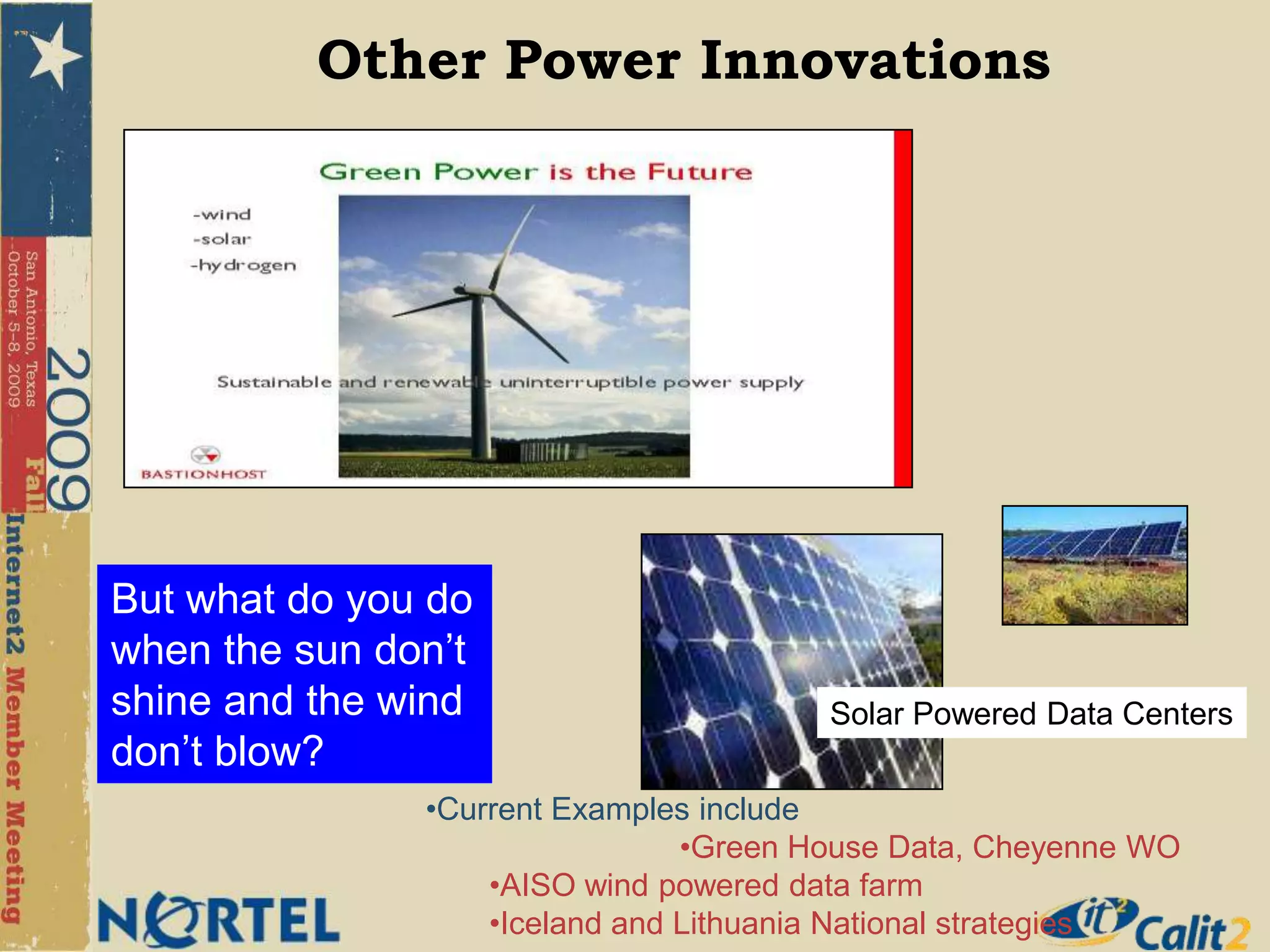
    Other Power InnovationsButwhat do you do when the sun don’t shine and the wind don’t blow?Solar Powered Data CentersCurrent Examples include
  • 93.
  • 94.
  • 95.
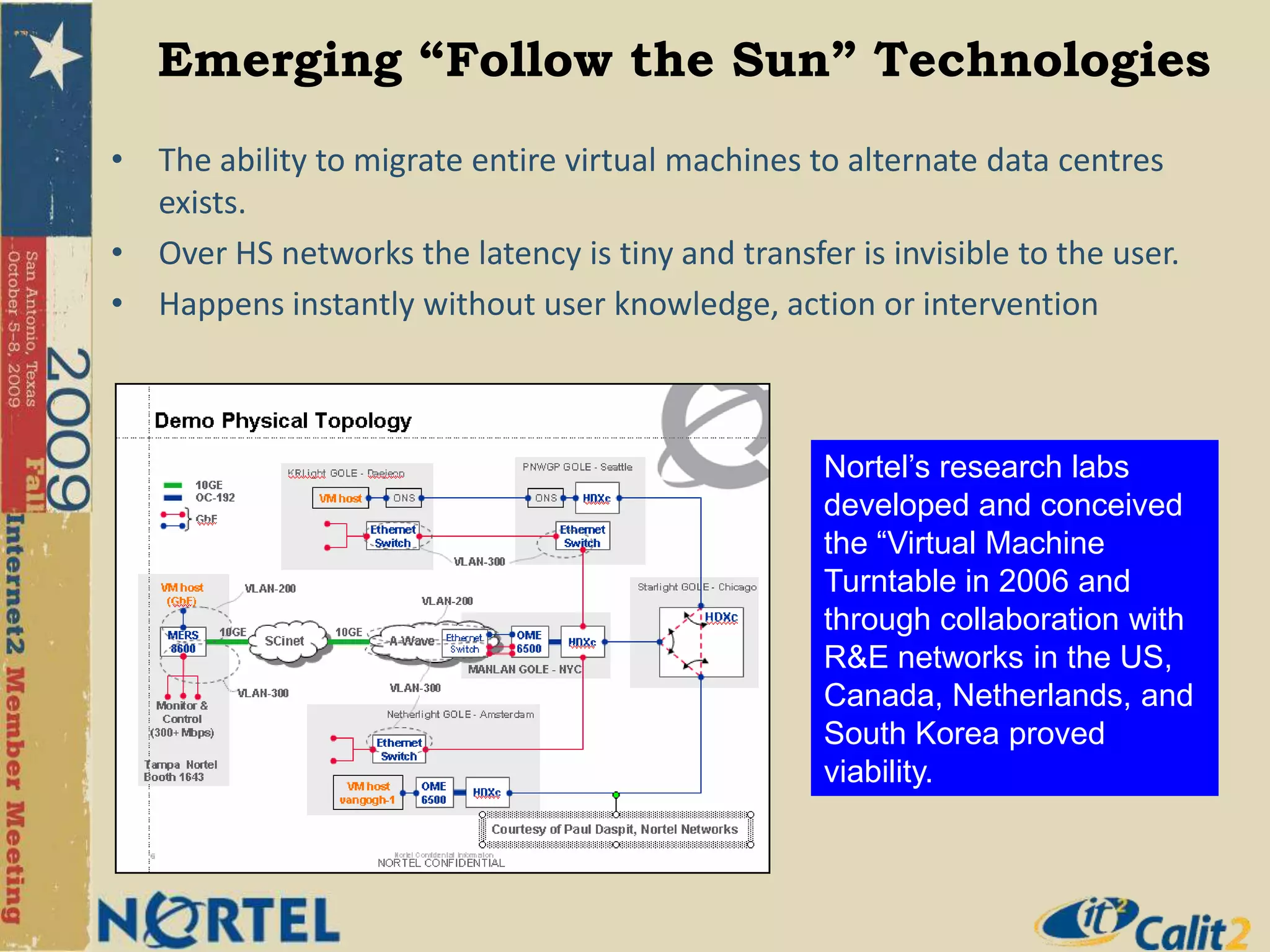
    Iceland and LithuaniaNational strategiesEmerging “Follow the Sun” TechnologiesThe ability to migrate entire virtual machines to alternate data centres exists.Over HS networks the latency is tiny and transfer is invisible to the user. Happens instantly without user knowledge, action or interventionNortel’s research labs developed and conceived the “Virtual Machine Turntable in 2006 and through collaboration with R&E networks in the US, Canada, Netherlands, and South Korea proved viability.
  • 96.
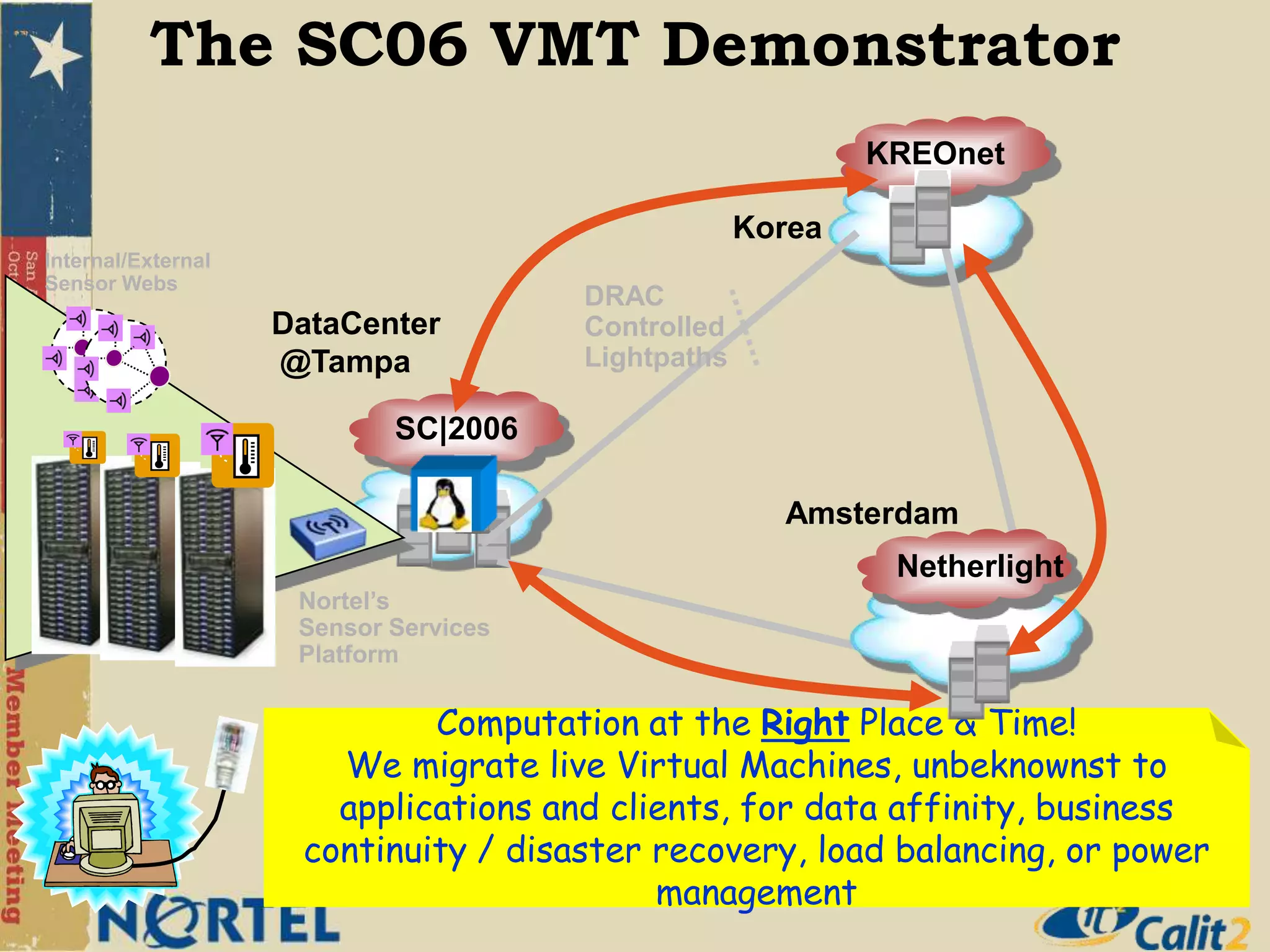
    The SC06 VMTDemonstratorSC|2006KREOnetKoreaInternal/ExternalSensor WebsDRACControlledLightpathsDataCenter @TampaAmsterdam NetherlightNortel’sSensor ServicesPlatformComputation at the Right Place & Time!We migrate live Virtual Machines, unbeknownst to applications and clients, for data affinity, business continuity / disaster recovery, load balancing, or power management
  • 97.
    Concluding ThoughtsGreen ICTneeds to Move Beyond “Data Centers” to Showing the Full Range of Challenges and Opportunities.We need to remember that “It’s about the carbon, dummy.”Academic CIOs need to begin to think strategically about how to use ICT to enable carbon minimized computing and education. What does it do to our networking needs?Who skills do we need to have that we don’t currently have?